SPECIAL ISSUE: The Dynamics and Value of Ecosystem Services: Integrating
Economic and Ecological Perspectives
Complex systems and valuation
Karin E. Limburg
a,*, Robert V. O’Neill
b, Robert Costanza
c,1,
Stephen Farber
daDepartment of En6ironmental/Forest Biology,College of En6ironmental Sciences and Forestry,State Uni6ersity of New York, Syracuse,NY13210,USA
bEn6ironmental Sciences Di6ision,Oak Ridge National Laboratory,Oak Ridge,TN37831,USA
cInstitute of Ecological Economics,Center for En6ironmental Science,Uni6ersity of Maryland,Solomons,MD20688,USA dDepartment of Economics,Uni6ersity of Pittsburgh,Pittsburgh,PA15260,USA
Abstract
Ecological and economic systems are undeniably complex. Whereas a goal of delineating ‘ecosystem services’ is to make readily apparent some of the important ways in which ecosystems underpin human welfare, insights are also gained by appreciating the nonlinear dynamic properties of ecosystems. In this paper, we review some of the relevant characteristics of complex systems. Ecosystems and economic systems share many properties, but valuation has typically been driven by short-term human preferences. Here we argue that as the force of humanity increases on the planet, ecosystem service valuation will need to switch from choosing among resources to valuing the avoidance of catastrophic ecosystem change. © 2002 Elsevier Science B.V. All rights reserved.
Keywords:Complex system dynamics; Ecosystem services; Human welfare; Valuation
This article is also available online at:
www.elsevier.com/locate/ecolecon
1. Ecological and economic complex, adaptive systems
Ecological and economic systems share many characteristics. Both are complex networks of component parts linked by dynamic processes. Both contain interacting biotic and abiotic
com-ponents, and are open to exchanges across their boundaries. Just what constitutes an ecosystem is somewhat arbitrary, and depends on how the system boundaries are drawn by the observer. Similarly, economic systems have boundaries that expand and contract (e.g. due to increased com-munication, transportation access, and price differentials).2
* Corresponding author. Tel.: +1-315-470-6741; fax: +1-315-470-6934
E-mail address:[email protected](K.E. Limburg). 1
As of 09/01/2002, this author can be reached at the Gund Institute for Ecological Economics, University of Vermont, School of Natural Resources, George D. Aiken Center, Burlington VT 05405 – 0088, USA.
2Of course, economic systems are subsystems of human social systems, which in turn bring structure through norms, institutions, and beliefs. We focus here on economic systems because these are currently the major arenas where environ-mental valuation is debated and quantified.
In spite of these and many other parallels, one important distinction between these systems is that human perception shapes our species’ behav-iors, and this perception is expressed in economic and other social systems as value. Human soci-eties are complex, adaptive systems, but they are embedded within even more complex, adaptive ecosystems. The suite of terrestrial, aquatic, aerial, and subterranean interacting ecosystems throughout the world provide the basic support required for human life. We place value on ecosystem functions because they are essential for our continued existence. We also place value on ecosystems for our cultural and emotional needs. From an ecological perspective, the concept of value has a different connotation because ecosys-tems do not have sysecosys-tems of value. Ecosystem ser6iceis a term coined to make apparent that the structure and function of ecosystems provide value (some of it measurable with money, some of it not) to humans (Daily, 1997).
By recognizing ecosystem services and the value provided to humans as one of perhaps 30 million species on the planet, ecological economists must develop indicators of value which can be used in decision-making. But in order to do so, they must also understand and appreciate the inherent com-plexities of ecological and economic systems, par-ticularly as the dynamics of the latter increasingly affect those of the former. In this paper, we review some characteristics of complex nonlinear systems and the implications for valuation.
2. What are characteristics of complex systems?
2.1. Structural features and boundaries
Systems are usually characterized as having components (state variables or stocks), interac-tions between them (flows of matter, energy, or information), and in open systems such as ecolog-ical and economic ones, fluxes in and out of the system boundaries (imports and exports).
A critical first step in analyzing any system is to identify the components and flows, but as impor-tantly, to delineate the boundaries, because it is here that the explicit analysis ends. Fluxes in and
out of the system are regarded as sources and sinks (sometimes, called forcing functions or driv-ing forces), beyond control of the system once they are outside its bounds. There are situations where it is pertinent to study ‘the system’ as a particular site, as in an environmental impact assessment, and others where ‘the system’ must be defined at a larger and more aggregate scale, as in determining the cumulative impacts of many dis-turbances of particular sites, or impacts at the global scale when determining international pol-icy. Some boundaries are relatively easy to draw, such as the boundaries of a lake, or the divides of a watershed. Others, like those of ephemeral wet-lands, can shift considerably over space and time. Setting the system boundaries is also a function of the problem at hand: sometimes the wetland can be ‘the system’, but if the dynamics of water and minerals entering the wetland from its sur-rounding watershed are critical to understand as well, then the appropriate system boundaries are those delineating the watershed. Where we draw the boundary also depends on the analytical ques-tion at hand. Valuaques-tion of a unique or spectacular site, such as the Grand Canyon, is international in scope whereas the value of a forest for sediment control may have local and regional value.
2.2. Dynamics
pattern of behavior in the presence of stress (Holling, 1986). The concept of system resilience has two main components: (1) the length of time it takes a system to recover from stress (Pimm, 1984); and (2) the magnitude of stress from which the system can recover, or the system’s specific thresholds for absorbing various stresses (Holling, 1986).
Many, if not most, complex systems are metastable and can undergo rapid transitions to a new equilibrium state. We often speak of eco-nomic or political systems that are poised on the brink of collapse; what we mean is that they are in a locally stable equilibrium, but are likely to move quickly into a different stable state. Charac-teristic of such changes, too, is their relative speed, and the fact that the change may not be reversible. For example, overgrazing or climate change can push vegetated systems into a new stability domain (desertification), which is rein-forced by feedback loops that maintain high tem-peratures and low water and nutrients (O’Neill and Kahn, 2000). An important function of un-derstanding complex systems should be to inform decision-makers about when, or under what cir-cumstances, an undesirable substantive state change is likely to occur, one that will diminish or enhance the value of ecosystem services.
3. Concepts of scale
3.1. Ecosystems and scale
When we speak of the scale of an ecological property, we usually mean the temporal or spatial scale at which that property has greatest coher-ence; how far in space or time must one go before that property is no longer important (Powell, 1989; Levin and Buttel, 1987). Ecosystem services are provided by processes functioning at various scales. In ecosystems science, scales of phenom-ena, the degree of their coupling, measurement across scales, and how phenomena vary across scales are important issues and are now consid-ered basic to any ecosystem analysis (Denman and Platt, 1976; Okubo, 1980; Odum, 1983; O’Neill et al., 1986; Powell, 1989; Levin, 1992;
Powell and Steele, 1995; Waring and Running, 1998; Schneider, 2001). Indeed, the ecosystem should itself be defined in terms of the scale of the question or problems posed.
Part of understanding ecosystems is learning how tightly or loosely coupled are processes at different scales (O’Neill et al., 1986), which helps to elucidate hierarchies of interacting systems. In general, large-scale, long-period phenomena (cli-mate patterns, hurricanes, fires) set physical con-straints on smaller scale, shorter period ones; there will be tighter coupling among processes and components with similar rates and overlap-ping spatial scales (O’Neill, 1989; Levin, 1992). Influence can ‘run up’ scales as well: small-scale, ‘neighborhood’ interactions may trigger larger-scale phenomena (Levin, 1992, 1999). Microbes, which operate on the scale of micrometers and minutes, decompose and remineralize organic matter in virtually every environment. Collectively cyanobacteria changed the atmosphere, ‘polluting’ it with oxygen (Staley and Orians, 1992), and other microbes respire enough CO2to keep many
lakes and rivers supersaturated (Del Giorgio et al., 1997).
Many phenomena at different scales can be related by means of scaling rules or power laws (Schneider, 2001). An example is how volume relates to length as a cubic function (three-dimen-sional); here the exponent is an integer. However, many physical, biological, and ecological proper-ties do not scale as integers, but rather as frac-tions. The ‘fractal dimension’ (Mandelbrot, 1977) of a property is this fractional exponent. Fractals have been used as scalars to describe such com-plex structures as cloud shape, river drainages, coastline lengths, areas of lungs, and landscape patches.
croorganisms in soil, water, and sediments. How-ever, it seems reasonable that the value of micro-scopically generated services cannot be valued at that scale, but rather at some larger scale, e.g. the level of a patch of soil needed for plant fertility. Coupled with plants and animals that use the nutrients, the service of nutrient cycling is carried out over a range of space and time scales.
The point here is that complex systems typically contain processes that function at different, but often overlapping, time and space scales. Since the delivery of ecosystem services depends on such processes, awareness of the scales of operation helps us to understand and safeguard (a form of insurance valuation) them. However, we have yet to discover and quantify scaling rules that de-scribe production and delivery of ecosystem services.
3.2. Economic systems and scale
It should come as no surprise that the same issues of scale that arise in ecosystem understand-ing and analysis also arise in understandunderstand-ing of economic systems, as humans are just species components of larger ecosystems. Economic sys-tems are composed of elements interacting through exchange, production, and consumption processes by which materials and energy are transformed and moved through the people and institutions to create income, wealth, and well-be-ing. The same types of properties investigated in ‘natural’ systems, such as stability, resilience, in-tegrity and efficiency are also properties of economies.
Economic phenomena, such as income creation, trade, changes in market conditions, welfare max-imization, etc. all can be considered at different spatial and temporal scales. The appropriate ana-lytic scale depends on the research question. If we are investigating local markets to determine the economic consequences of environmental ameni-ties, we have to first determine the set of con-nected markets that can potentially be impacted. This is not a simple problem, as labor markets and housing markets may jointly reflect environ-mental characteristics, such as higher wages and lower housing prices for low amenities (Roback,
1982). The extent to which these local markets may reflect these amenities will, in turn, depend upon how connected local markets are to regional and national markets in labor and housing. If they are unconnected, as they may be in countries where education, capital, and labor mobility are low, local markets may not reflect local environ-mental amenities.
Ecological properties, such as resilience or in-stability, can be considered at different scales in economic systems. These properties may emerge at macro scales even when micro scales do not exhibit them. For example, the market for had-dock may be non-resilient, and under certain con-ditions harvesting may deplete the species. But the more macro market for fish may be trivially im-pacted, and remain quite stable and vibrant. The converse can also be true, as herd behavior in stock markets can create in instability in the aggregate that then trickles down to individual stocks.
some time horizon, these may be exploited in fisheries. However, the economic value of the service depends upon whether that stability is important to economies. Stabilizing haddock pop-ulations may be of trivial economic value, if there are easily substitutable species and fishermen can easily move between markets. Determining the value of these stabilization services then requires looking further than the immediate market, and using an analytic scale that encompasses all perti-nent markets (Daly, 1991).
4. Valuation of ecological goods and services
Here we explore the notion of value in ecosys-tems, the ‘separability’ of economic and ecological systems in valuation analysis, and propose some guidelines for further research on determining which set of valuation schemes are appropriate to different situations.
4.1. Ecosystems and6alue
Are there bases for measuring the value (to humans) of natural system component structures and functions? If we consider valuation in its general form, as a measure of contribution of something to a condition or objective, the answer would be yes. However, from a purely ecological perspective, valuation begins with identifying the key structures, functions, and interactions of sys-tems, and probing these (via models or experi-ments) to understand which are important in maintaining their condition, dynamics, and pro-duction of ecosystem services.
For many ecologists (and even some economists, see Heal, 2000), valuation of ecosys-tem services seems unnecessary and even inappro-priate. Homo sapiens is one species among millions and our value systems and preferences, while certainly having the potential radically to change ecosystem structures and functions, will not alter the fact that ecosystems will continue to operate in some fashion regardless of human ac-tivities. The concept that one species is ‘in charge’ and is ‘managing the ecosystem’ makes little sense. The ecological system is invaluable because
its continued stable operation is essential for hu-man survival.
The critical interactions between humans and environment are not determined by societal value systems but rather by inexorable principles that determine interactions within ecological systems. In the opinion of most ecologists, factors govern-ing ecosystem dynamics are the critical determi-nants of the human – environment interaction. It is the ecosystem’s rules that count, not humanity’s self-centered concept of its place in the universe. So, to many ecologists, it is not the biosphere that is in jeopardy — it has survived dinosaurs and asteroids — it is Homo sapiens that is in jeopardy because that species is undermining the ability of the biosphere to maintain essential flows of ecosystem goods and services.
4.2. Separability of ecosystems and economic
systems
The economic system is ordinarily conceptual-ized as a complex dynamic system that interacts with a separate environmental system through inputs and outputs. The environment is large, changes very slowly, and can be considered as a background or context within which economic dynamics occur. Under this assumption, the eco-nomic subsystem can be represented separately by a linear model, in the neighborhood of its equi-librium, that is amenable to established analyses even though there are slow, nonlinear changes in the environment. An assumption of linearity in the economic model necessitates the assumption that the environmental system is stable and rela-tively constant.
Under what set of conditions is the concept of a ‘separable’ economic system legitimate? This theoretical question has arisen a number of times in the context of simplifying models. Interestingly, it has been addressed independently in geology (Schumm and Lichty, 1965), macroeconomics (Ijiri, 1971; Chipman, 1975), and ecology (Zeigler, 1976; O’Neill and Rust, 1979). A significant body of mathematical theory has developed around the question (Luckyanov, 1995).
system in the vicinity of equilibrium. A subsystem can be separated out and considered to be dynam-ically independent only if it operates on a differ-ent scale (Schaffer, 1981). The separable system must operate orders of magnitude faster than the rest of the system. In simplest terms, the rate coefficients associated with the variables in the economic sub-model must be much larger than the rate coefficients in the environmental sub-model.
Under some circumstances, we would expect this criterion to be satisfied. It simply states that one species (Homo sapiens) responds more rapidly than the entire ecosystem of which it is a part. That difference in scale is required for ecosystem stability and is expected in any hierarchically structured system (O’Neill et al., 1986). Intu-itively, this means that economics appears as a flicker or background noise on the slow, stable dynamics of the total (global) system.
The distinction becomes important as the scale of human activity increases. In the absence of humans, the turnover of a forest takes a century, implying a rate coefficient of 1/100=0.01. If eco-nomic activity begins to extract 10% of the forest each year, the depletion rate coefficient becomes 0.11, a change of an order of magnitude. Increas-ing harvests can easily violate the assumptions required for dealing with the economic activity as a separable system. The most important conse-quence is that the dynamics of the economic system are no longer determined by economics alone, but by the dynamics of the total environ-mental (economic and ecological) system.
As the magnitude of economic activity in-creases, there is increasing probability that the stability assumption will also be violated. At low levels of activity relative to a large, intact ecosys-tem, it is reasonable to assume that the ecosystem will respond stably to a disturbance. As the mag-nitude, frequency, and spatial proximity of the impacts increase, there is increased risk that the assimilative capacity of the ecosystem will be ex-ceeded. For example, Phillips (1995) points out the importance of the ratio between the time required to recover from a disturbance and the time interval between successive disturbances. He suggests that a ratio of 1:10 is required for
sus-tainability. As the frequency of disturbance ex-ceeds this ratio, there is significant risk of a nonlinear, unstable response. The important point that we want to make here is the assumptions of separateness and linearity in the economic model may be violated. The dynamics of the system will no longer be related to isolated economic model predictions.
As the assimilative capacity is exceeded, the ecological system can enter a condition of ‘metastability’ (Tikanov, 1950). A kind of threshold, or region of rapid transition, is reached and even a minor disturbance can move the sys-tem to a new state. Examples include gradual increases in nutrients transforming an olig-otrophic into a eutrophic lake, overgrazing trans-forming a grassland into a desert scrub ecosystem, and overfishing causing the sudden collapse of a fishery. The ecosystem still responds in a stable fashion to further disturbances, but it now moves toward a new equilibrium state. Goods and ser-vices assumed in the economic model are no longer available and the assumptions of the eco-nomic model are no longer valid.
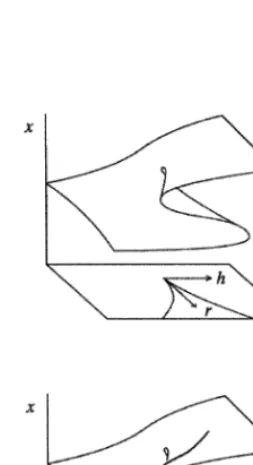
Technically, the system has moved into a region of parameter space where a ‘fold catastrophe’ exists. There are two stable equilibria and the system can jump from one stable state to the other (see Fig. 1). Empirically, one observes a stable system moving rapidly to a new stable state, without the intervention of a major external disturbance.
The risk is more than a theoretical possibility since environmental systems commonly show such dynamics (O’Neill et al., 1982, 1989). For exam-ple, Jones (1975) argues that pest outbreaks fol-low precisely these dynamics. At the global scale, Crowley and North (1988) show a fold catastro-phe in very simple models of ice cap dynamics and argue that this accounts for rapid climate changes in glacial – interglacial transitions; indeed empirical evidence for this was found in ice cores, and the transitions are on the order of 10 years (Taylor, 1999).
by a catastrophe in the form of a large meteorite. The other eight are attributed to gradual changes leading up to a catastrophic reorganization. In one instance, the evolution of bony jaws increased the efficiency of predators. When land bridges permitted faunal exchanges between continents, the new predators caused less efficient fauna to go extinct. The internal dynamics of competition and predator – prey interaction moved the ecological system to a new stable state.
A worrisome feature is that the mathematical theory demonstrates that catastrophe change can-not be anticipated without complete knowledge of every component and a perfect model of the interactions. Such a state of knowledge is un-achievable in complex ecological systems. It may be possible to develop early warning indicators (e.g. Kahn et al., 1999; O’Neill, 1999, 2000) but these efforts remain speculative.
4.3. Marginal and non-marginal regimes
All valuation schemes make assumptions about the state of the system and its behavior when perturbed (see Farber and Howarth, this issue). Valuation is essentially the determination of the ‘difference’ something makes. Economic valuation establishes the difference something makes to well-being; e.g. the availability of a new recreation site, and permits ranking of alternatives. This valuation has to be made in the context of the goods and services already available to the indi-vidual, e.g. incomes and prices of other goods and services, the availability of other recreational sites, etc. It also must establish whether the differences analyzed will be ‘partial’, i.e. not observing the full range of responses of the individual or system, or ‘general’, allowing for a larger set of responses. In some dynamic regions, i.e. far from any bifurcation, ecosystem response to an infinitesimal or ‘marginal’ deviation from equilibrium will re-sult in a stable response. However, ecosystems are complex, nonlinear systems that are only metastable: that is, we cannot predict precisely where the bifurcation (rapid shift from one stable state to another) will occur, nor can we predict the magnitude and direction of the change. Tradi-tional valuation under these circumstances is risky at best.
We propose to distinguish between a contin-uum of ecological/economic conditions or ‘regimes’ that fall along the lines of the separabil-ity discussion in Section 4.2. On one end of the continuum, the ‘marginal regime’ is defined as a set of ecological conditions far from any bifurca-tion and there is a high degree of certainty and predictability in understanding relations among system components. In this regime, economic con-ditions mirror the ecological ones. Furthermore, it is a regime in which substitutabilities and trade-offs dominate marginal choices of individuals; i.e. the margins of choice are not at the frontier of basic species and cultural survival. Under these circumstances, predictabilities, stabilities, continu-ities, and substitutabilities permit the marginal analyses of values of ecosystem services based upon human preferences. This is not a state space in which human life support ecosystem services Fig. 1. Diagram of a cusp catastrophe fold. The 3-D
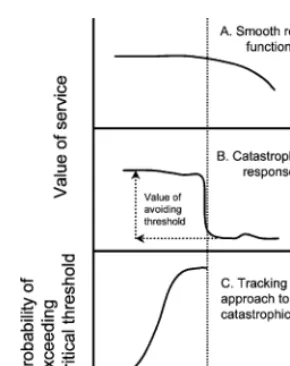
Fig. 2. Value responses to stress under ‘marginal’ (well-be-haved dynamics) and ‘non-marginal’ (nonlinear, threshold dy-namics) system behaviors.
be continuous and negative. The second panel (B) shows how we conceive of the change in values when the system is in the vicinity of a bifurcation. Here, even an infinitesimal stress precipitates a large and dramatic change in value, and recovery of that value cannot simply be produced by re-moving the stress. The difference in value states (pre-threshold and post-threshold) represents the loss of ecosystem goods and services value. Note that conventional economic signals (determined by assumptions used in Fig. 2A) can fail to show the actual system response and corresponding loss in value seen in Fig. 2B, and might even show an increase in value past the threshold, due to poor signals (as in overfishing or climate change) or other factors which obscure the situation (e.g. fossil fuel subsidies to agriculture can obscure the fact that land has lost its soil or its soil-building capacity).
In reality, estimating these trajectories will be imprecise, so that the lines drawn in Fig. 2A and B should really have error bounds around them. A major concern, then, is to determine how close the system is to some critical threshold. In the third panel (C), we propose that a probability distribution function of ‘distance from the threshold’ could be constructed, based upon knowledge of the behavior of the ecological/ eco-nomic system. This would be tantamount to a warning indicator: the more the stress, the higher the probability that we move the system toward catastrophic change in value. This function will likely look different for different circumstances, and a major research challenge is to determine the shapes of this function for those situations. We suspect that the probability function will often look as it appears in Fig. 2C, that is, there will be a region wherein a small change in the ecosystem results in a large increase in the probability of dramatic system change in response to infinitesi-mal stress.
As one moves away from the marginal regime, gradually we find conditions in the system becom-ing less predictable, and our assumptions about linearity, substitutability, stable equilibrium, etc. gradually erode. An example of a system that can move from the marginal to the non-marginal regime is a marine fishery. As long as the target are at risk, or human survival needs are
unsatisfied.
At the other end, the ‘non-marginal regime’ is defined as a set of conditions wherein the assump-tions necessary for marginal economic valuation no longer hold. The non-marginal regime has at least some strongly nonlinear dynamics. Under the right circumstances the system can undergo bifurcations, where the state of the system sud-denly may proceed down either of two paths, or can move abruptly into a new stability domain. Marginal changes in a stressor may no longer yield simple or predictable effects. For example, another 1 million tons of carbon dioxide may cause dramatic atmospheric changes with catastrophic implications for human welfare (Fig. 2B). What might have been substitutabilities when the scale of human/environment interactions was smaller are no longer trade-offs. Margins of choice may be between life and death, which is no margin from a valuation perspective.
species is able to sustain itself under harvesting and other pressures, the fishery can persist. If fishing effort becomes too intense, the species may be harvested to the point of extinction, a threshold event for the fish species. With a reason-ably ‘full’, functioning marine ecosystem, fisher-men may be able to redirect effort onto another species and still participate in the market for protein. This is still a marginal regime for the fishermen, but not for the extinct fish species. Further from the margin, when the level of fish harvesting worldwide becomes so intense that all the species that we would like to catch go extinct, we may still substitute other sources of protein (beans, chickens, cows, etc.), although we will not have a market wherein fisheries activities are vi-able. However, the marine ecosystems’ loss of fish is likely to have complex feedbacks (trophic cas-cades); but we are likely not to understand these repercussions, partly because of measurement problems and partly because of the complexity of their collective roles in marine ecosystems. Our uncertainty as to the true ramifications of global overfishing rises. At the same time, we have lost irreversibly the extinct fish. This is not a purely hypothetical construct: we know that we have been selectively overharvesting the top predator species in marine food webs (Pauly et al., 1998), and ecological theory tells us that this potentially can have large-scale, destabilizing effects.
5. Conclusions
Standard economic theory has only the human-based concepts of willingness-to-pay (for goods and services) or willingness-to-accept (for disease, environmental degradation, etc.). As we have tried to emphasize here, these human values, and the marginal analytic methods to elucidate those values, are limited to situations when ecosystems are relatively intact and functioning in normal bounds far from any bifurcation. As these situa-tions become increasingly rare, so too must the assumption of marginality.
As the ecosystem is forced away from the neighborhood of a singular stable equilibrium, the relevant value concepts shift from utility to
risk-avoidance. If the fundamental value is life sup-port, then the relevant cost of a human action is directly related to the risk that the action will destabilize or irrevocably alter the life support system. We can think of ecological values under risk-avoidance as translating into insurance pre-miums that would willingly be paid to protect against the risk of destabilization.
When the natural world can be divided into forms of capital that provide critical services, for which there are no substitutes (or when evalua-tions are made at scales where there are no substi-tutes) and forms of capital whose services may have substitutes, we need two separate valuation systems. In the substitutable regime, economic valuations may be adequate to guide human man-agement decisions; whereas in the non-substi-tutable regime, ecosystem-based valuations or indicators will be necessary. In general, the tri-partite valuation of efficiency, sustainability, and equity implications of natural capital, for which there may or may not be substitutes, suggests at best a multi-criteria valuation framework (Costanza and Folke, 1997).
Often, the narrowly economic welfare values of natural systems will be too limiting, in terms of their assumptions and scope, to reflect the rich-ness of natural values in all their multi-dimen-sional value contexts. Economic welfare valuations become even more limited in their ap-plicability when considering the likelihood that preferences toward ecosystems’ services may be vague or poorly formed, likely to change over time, and are likely to change substantially with new information. In this context of unreliability, ecologically based values may have more useful-ness as indicators of conditions and scarcities of some potentially valuable natural services than economic values.
current equilibrium state of the ecosystem and its distance from unknown and possibly separable, unknowable bifurcations, the scale of the ex-ploitation or disturbance of the natural ecosys-tem, and the characteristic scale of the ecosystem service being valued. Some contexts will be ana-lytically separable, but we will need to monitor the relative rates of human impacts on natural systems vis a vis the ecosystems’ own renewal rates and residence times. Finally, we must con-tinue to develop and improve indicators that serve to warn us about, and away from, thresholds of dramatic declines in ecosystem services.
Acknowledgements
This work was conducted as part of the Work-ing Group on the Value of the World’s Ecosystem Services and Natural Capital; Toward a Dynamic, Integrated Approach supported by the National Center for Ecological Analysis and Synthesis, a Center funded by NSF (Grant cDEB-0072909), the University of California, and the Santa Bar-bara campus. Additional support was also pro-vided for the Postdoctoral Associate, Matthew A. Wilson, in the Group. We are grateful for com-ments from C.A.S. Hall, J. Kahn, G.M. Lange, K. Schulz, and an anonymous reviewer.
References
Bjo¨rklund, J., Limburg, K.E., Rydberg, T., 1975. Impact of production intensity on the ability of the agricultural land-scape to generate ecosystem services an example from Sweden. Ecological Economics 29 (2), 269 – 291.
Chipman, J.S., 1975. Optimal aggregation in large scale econo-metrics models. Sankhya Series C 37, 121 – 159.
Costanza, R., Folke, C., 1997. Valuing ecosystem services with efficiency, fairness, and sustainability as goals. In: Daily, G. (Ed.), Nature’s Services: Societal Dependence on Natu-ral Ecosystems. Island Press, Washington, DC.
Crowley, T.J., North, G.R., 1988. Abrupt climate change and extinction events in Earth history. Science 240, 996 – 1002. Daily, G. (Ed.), 1997. Natures Services: Societal Dependence
on Natural Ecosystems. Island Press, Washington, DC. Daly, H.E., 1991. Towards an environmental
macroeconom-ics. Land Economics 67, 255 – 259.
Del Giorgio, P.A., Cole, J.J., Cimbleris, A., 1997. Respiration rates in bacteria exceed phytoplankton production in un-productive aquatic systems. Nature 385, 148 – 151.
Denman, K.L., Platt, T., 1976. The variance spectrum of phytoplankton in a turbulent ocean. Journal of Marine Research 34, 593 – 601.
Donovan, S.K. (Ed.), 1989. Mass Extinctions Processes and Evidence. Columbia University Press, New York. Heal, G., 2000. Valuing ecosystem services. Ecosystems 3,
24 – 30.
Holling, C.S., 1986. The resilience of terrestrial ecosystems: local surprise and global change. In: Clark, W.C., Munn, R.E. (Eds.), Sustainable Development of the Biosphere. Cambridge University Press, Cambridge.
Ijiri, Y., 1971. Fundamental queries in aggregation theory. Journal of American Statistical Association 66, 766 – 782. Jones, D.D., 1975. The application of catastrophe theory to
ecological systems. RR-75-15. International UInstitute for Applied Systems Analysis, Laxenburg, Austria.
Kahn, J.R., O’Neill, R.V., 1999. Ecological interaction as a source of economic irreversibility. Southern Economic Journal 66, 391 – 402.
Levin, S.A., 1992. The problem of pattern and scale in ecol-ogy. Ecology 73, 1943 – 1967.
Levin, S.A., 1999. Fragile Dominion: Complexity and the Commons. Perseus Books, Reading, Massachusetts. Levin, S.A., Buttel, L., 1987. Measures of patchiness in
ecolog-ical systems. Ecosystems Research Center Report No. ERC-130, Cornell University, Ithaca, NY.
Luckyanov, N.K., 1995. Model aggregation Mathematical per-spectives. In: Patten, B.C., Jorgensen, S.E. (Eds.), Complex Ecology. Prentice Hall, Englewood Cliffs, NJ, pp. 242 – 261.
Mallin, M.A., 2000. Impacts of industrial animal production on rivers and estuaries. American Scientist 88, 26 – 37. Mandelbrot, B.B., 1977. Fractals: Form, Chance, and
Dimen-sion. Freeman Publishers, San Francisco.
Odum, H.T., 1983. Systems Ecology: an Introduction. Wiley, New York.
Okubo, A., 1980. Diffusion and Ecological Models. Springer, New York.
O’Neill, R.V., 1989. Perspectives in hierarchy and scale. In: Roughgarden, J., May, R.M., Levin, S.A. (Eds.), Perspec-tives in Ecological Theory. Princeton University Press, Princeton, NJ, pp. 140 – 156.
O’Neill, R.V., 1999. Recovery in complex ecosystems. Journal of Aquatic Ecosystem Stress and Recovery 6, 181 – 187. O’Neill, R.V., 2000. Ecosystems on the landscape the role of
space in ecosystem theory. In: Jorgenson, S.E., Muller, F. (Eds.), Handbook of Ecosystem Theories and Manage-ment. Lewis Publisher, New York, pp. 447 – 463. O’Neill, R.V., Rust, B., 1979. Aggregation error in ecological
models. Ecological Modelling 7, 91 – 105.
O’Neill, R.V., Kahn, J.R., 2000. Homo economicus as a keystone species. BioScience 50, 333 – 337.
O’Neill, R.V., DeAngelis, D.L., Waide, J.B., Allen, T.F.H., 1986. A Hierarchical Concept of Ecosystems. Princeton University Press, Princeton, NJ.
O’Neill, R.V., Johnson, A.R., King, A.W., 1989. A Hierarchical framework for the analysis of scale. Landscape Ecology 3, 193 – 205.
Pauly, D., Christensen, V., Dalsgaard, J., Froese, R., Torres, F., 1998. Fishing down marine food webs. Science 279, 860 – 863.
Phillips, J.D., 1995. Time lags and emergent stability in morpho-genic/pedogenic system models. Ecological Modelling 78, 267 – 276.
Pimm, S.L., 1984. The complexity and stability of ecosystems. Nature 307, 321 – 326.
Powell, T.M., 1989. Physical and biological scales of variability in lakes, estuaries, and the coastal ocean. In: Roughgarden, J., May, R.M., Levin, S.A. (Eds.), Perspectives in Ecological Theory. Princeton University Press, Princeton, NJ, pp. 157 – 176.
Roback, J., 1982. Wages, rents, and the quality of life. Journal of Political Economy 90, 1257 – 1278.
Schaffer, W.M., 1981. Ecological abstraction: the consequences
of reduced dimensionality in ecological models. Ecological Monographs 5, 383 – 401.
Schneider, D.C., 2001. The rise of the concept of scale in ecology. BioScience 51, 545 – 553.
Schumm, S.A., Lichty, R.W., 1965. Time, space, and causality in geomorphology. American Journal of Science 263, 110 – 119. Staley, J.T., Orians, G.H., 1992. Evolution and the biosphere. In: Butcher, S.S., Charlson, R.J., Orians, G.H., Wolfe, G.V. (Eds.), Global Biogeochemical Cycles. Academic Press, London, pp. 21 – 54.
Strogatz, S.H., 1994. Nonlinear Dynamics and Chaos. Addison-Wesley, Reading, Massachusetts.
Taylor, K., 1999. Rapid climate change. American Scientist 4, 320 – 327.
Tikanov, A.N., 1950. On systems of differential equations containing parameters. Mat. Sb. 27, 283 – 302.
Waring, R.H., Running, S.W., 1998. Forest Ecosystems: Anal-ysis at Multiple Scales, second ed. Academic Press, New York.