Fine Root Development of Alfalfa as Affected by Wheel Traffic
E. A. Rechel,* B. D. Meek, W. R. DeTar, L. M. Carter
ABSTRACT
Root development in alfalfa (Medicago satire L.) is dependent of many factors including the soil environment which is influenced by crop management procedures. Soil compaction, which is unavoidable under current management procedures, can have a detrimental effect on root development. The purpose of this field experiment was to compare the effects of controlled and conventional traffic manage-ment on alfalfa fine root growth in a Wasco sandy loam (coarse-loamy, mixed, nonacid thermic Typic Torriorthent). No wheel traffic and traffic only before planting were compared to two conventional systems that varied in the amount of traffic applied during crop production. Twenty months after planting, there was a significant decrease in fine root density (FRD) from single passes of traffic after each harvest down to a 0.45-m depth while several passes after each harvest significantly decreased FRD down to 1.8-m depth. Regard-less of treatment, root density was greatest in the upper 0.1 m of soil decreasing to 1.8 m in the first summer. By the second summer FRD showed bimodal distribution with significantly fewer roots at 0.3 to 0.6 m compared to layers above and below this depth. Sea-sonally there was a significantly higher root density during the
win-E. A. Rechel, W. R. DeTar, and L. M. Carter, USDA-ARS Cotton Res. Stn., 17053 Shafter Ave., Shafter, CA 93263; and B. D. Meek, USDA-ARS Soil and Water Manage. Res. Cent. Route 1, 3793 N 3600E, Kimberly, ID 83341. Received 15 Aug. 1988.
*Correspond-ing author.
ter than the summer in the upper 0.3 m of soil. The results of this study shows that alfalfa fine roots more thoroughly exploit the soil volume in the absence of wheel traffic and that compaction from traffic diminished root growth to different depths depending on its intensity.
OIL physical characteristics are partially deter-k..3 mined by the soil management system used for crop production. These soil management systems can change the soil environment and impact resultant crop productivity. Soil type and water content interact with wheel traffic to alter soil structure, strength, bulk density, pore size distribution, water relations, and nutrient availability (Voorhees et al., 1986; Lindstrom and Onstad, 1984; Powers and Skidmore, 1984; Carter and Tavernetti, 1968; Olness, 1984). Providing per-manent traffic zones in the field is an agricultural pro-duction scheme that confines the negative effect of traffic to a small zone and provides larger zones in the field for optimum plant growth (Taylor, 1983; Voor-hees et al., 1985). When wheel traffic is confined to established zones, soil physical properties under the crop are quite different than when traffic is random (Meek et al., 1988, 1989; Williford, 1980). Most of
2.4
2.2
NN PR RE GR-0 GR-H E
2.0
a
1.6
1.4
0 0.6 0.9 1.2
Depth (m)
1.5 0.3
today's cropping systems place little or no emphasis on long-term placement of wheel traffic.
Laboratory studies have shown that increasing soil strength, reflecting the impact of tractor traffic, de-creases root elongation (Russell and Goss, 1974; Whi-teley et al., 1981). Field studies have confirmed these results by demonstrating root growth to be greatest in non-trafficked soil when growing the annual crops wheat, corn, and barley (Bennie and Botha, 1986; Wil-latt, 1986). We have shown a lower soil bulk density (Meek et al., 1988), higher water infiltration rates (Meek et al., 1989) and greater growth rates and plant biomass production in the absence of harvest traffic (Rechel et al., 1987) for the perennial crop alfalfa.
However, data on the long-term rooting character-istics of alfalfa as affected by traffic are unavailable. These data are needed for developing optimum eco-nomic alfalfa cropping systems. The specific objec-tives of this study were to: (i) define how fine-root growth patterns of alfalfa were affected by wheel traffic, and (ii) examine the development of fine roots throughout the duration of the alfalfa crop.
METHODS AND MATERIALS Crop Culture
The research was conducted at the USDA Cotton Re-search Station, Shafter, CA at 35°32' N, 119° 17' W, and 112 m above sea level. The soil is a Wasco sandy loam. Rainfall is 160 mm yr- 1 , with little rainfall from May to September. The nondormant alfalfa, `WL514,' was sown on 20 Oct. 1982 at a rate of 33.6 kg ha-'. Triple superphosphate was broadcast at 162 kg P ha-' in February 1983. Plant tissue analysis during the study indicated that P was adequate for alfalfa growth. Plots were initially sprinkler irrigated to in-sure adequate germination. Thereafter the alfalfa was flood irrigated, using basins, when one-fourth of the field had de-pleted 50% or more of the available soil water in the top meter measured weekly using a neutron probe. The exper-imental design was a split-plot analysis of variance with the main plots (traffic patterns) in a randomized complete block design with six replications, repeated for depth and time (SAS Institute, Inc., 1986).
Traffic Treatments
A detailed description of crop establishment and man-agement procedures for each traffic system was reported pre-viously (Rechel et al., 1987). Plots were 8 m wide and 30 m long. Treatments with none or reduced wheel traffic were designated None (NN) and Preplant (PR). The treatments representing conventional traffic schemes were designated Repeat (RE) and Growers (GR). The NN treatment was established by directly sowing alfalfa onto a thoroughly chis-eled soil with no wheel traffic during subsequent manage-ment practices. The total surface of each PR plot was traf-ficked after chiseling and before sowing when the soil was dry with an International TD9' crawler followed by a John Deere 4020 tractor. No other wheel traffic was applied. The RE treatment was initially compacted the same as the PR treatment and 100% of each plot was trafficked 3 to 5 d after each harvest with a John Deere 4020. The GR treatment simulated conventional preplanting and harvest traffic pat-terns in a grower's alfalfa field. This created several distinct lanes of differing widths and compaction the length of each plot. Two of these lanes were selected for study and were defined as (i) GR-0, a 0.8-m-wide lane that never received
' Trade names and company names are included for the benefit of the reader and do not imply any endorsement or preferential treatment by the authors or USDA of the product listed.
wheel traffic, and (ii) GR-H a 0.6-m-wide lane having re-ceived several passes of the John Deere 4020 in the same track.
All field preparation, crop production, and research sam-pling was done with the wide-tractive-research vehicle which eliminated all traffic from the cropped area (Carter et al.,
1987). No foot traffic was allowed in any plot.
Root Measurements
The sampling area within each plot was confined to the center 2 m extending the length of the plot excluding a 1 m boundary at each end. Within each sampling area, six 45-mm diam. core samples were obtained to a depth of 0.9 m of which 4 were extended to a depth of 1.8 m. The soil cores were separated into subsamples by depth as follows: surface to 0.1, 0.1 to 0.2, 0.2 to 0.3, 0.3 to 0.45, 0.45 to 0.6, 0.6 to 0.9, 0.9 to 1.2, 1.2 to 1.5, and 1.5 to 1.8 m. Samples from a common depth and plot were combined. The roots were washed from the soil using an elutriator (Bohm, 1979). Root length was determined with a Comair Root Scanner (Com-monwealth Aircraft Corp. Limited, Melbourne, Victoria, Aust.). Fine roots were -2 mm in diameter (Bohm, 1979) and roots >2 mm in diameter were excluded.
The first two samplings to determine fine root density (FRD) were 17 Aug. 1983 and 1 Mar. 1984. All subsequent samplings were at approximately 13-wk intervals; 26 June, 10 Oct. 1984; 22 Jan., 8 May, 6 Aug., and 4 Nov. 1985; 4 Feb., 2 May, and 8 Aug. 1986. The first harvest traffic was applied May 1983. Four harvest traffic applications preceded the first root sampling.
During the summer of 1984 the effect of compaction on the distribution of large lateral and taproots was determined and compared to the FRD profile. A 2-m-deep trench was dug in each of three replicates of each treatment. A needle-board 1.2 long by 0.9 m wide was driven into the trench wall. The needleboard and inclusive alfalfa plants were re-moved from the trench and the soil washed from the board exposing the lateral taproots (Bohm, 1979). The gross ori-entation of large lateral and taproots were estimated visu-ally.
RESULTS AND DISCUSSION Traffic Response
Analysis of variance shows alfalfa fine roots re-sponding significantly to traffic treatment, time, and depth
(P <
0.05). More importantly there are signif-icant interactions occurring between treatment X depth and depth X time(P <
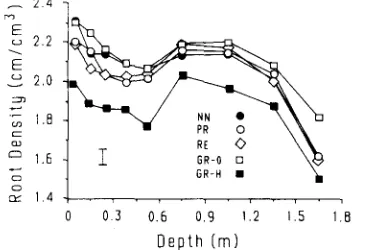
0.05). Even though there was a significant treatment X depth interaction, all treatments have a similar root density profile as a function of depth, when averaged over time (Fig. 1).ihi
ux
t,
molosati rt
rez-irro",
620At all depths FRD in the GR-H lane was significantly lower than the other treatments. Among the other four treatments significant differences in FRD only oc-curred down to the 0.45-m depth. The significant in-teraction can be explained, in part, by the minor sta-tistical fluctuation in the FRD of NN and RE from the overall root density pattern at the 0.1 to 0.2- and 0.3 to 0.45-m layers. The absence of traffic resulted in the NN and GR-O lane having statistically similar FRD with a significantly higher density than PR and RE, which were also statistically similar. Even mini-mal traffic reduced root density as shown by the sig-nificantly lower FRD in the PR treatment which was only trafficked before planting. Between 0.45 to 1.5-m FRD was statistically similar for all four treatments.
The traffic patterns in this experiment were the same used in the study on determining dry matter production characteristics (Rechel et al., 1987). The results from both studies show traffic to cause a sig-nificant reduction in above and below ground plant
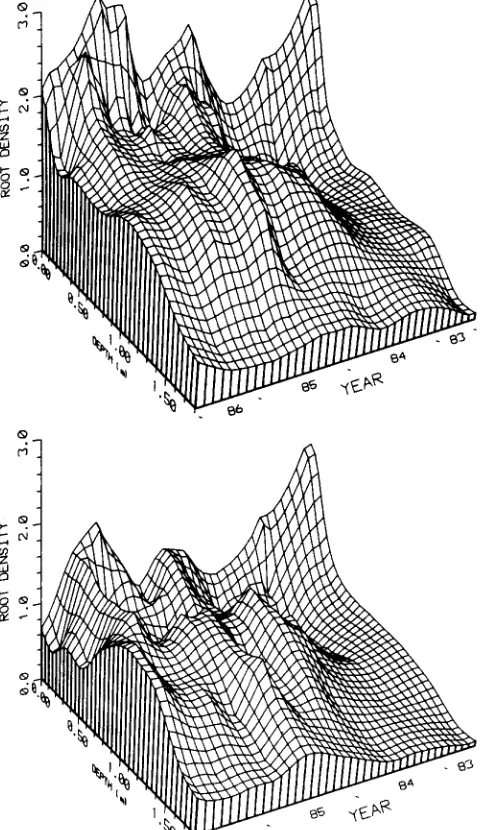
Fig. 2. Three dimensional display of FRD of alfalfa over depth and time for the NN treatment (A) and GR-H . lane (B).
growth. As the plants were subjected to a greater de-gree of traffic there was a greater reduction in forage. This relationship is also true for FRD with extreme traffic resulting in reduced root growth at soil depths below the compaction zone.
Alfalfa fine-root growth snowed a dynamic response over time and soil depth as shown by NN and GR-H (Fig. 2A,B). Three peaks in root density are seen in the surface —0.3-m-soil depth. The first was August 1983, the first summer growing season, while the sec-ond and third occurred during the 1984 to 1985 and 1985 to 1986 winters. These peak values are statisti-cally similar as well as the summer densities, but the two seasons are significantly different (P < 0.05). This explains the nonsignificant interaction between treat-ment and time, i.e., each treattreat-ment oscillated the same way with time. Fine-root density below the 0.6-m depth was relatively minimal until the fall of 1984. It then increased through the winter of 1985 after which the density was significantly higher (P < 0.05) than the previous samplings. Below 1.5 m there were few fine roots.
Plotting the difference between NN and GR-H ex-emplifies the effect wheel traffic has on FRD (Fig. 3). The absence of any difference in FRD during 1983 and the winter of 1984 represents no effect on root density from harvest traffic even though it had been implemented four to five times. Twenty months elapsed from the time of planting until there was a significant decrease in fine-root growth due to harvest traffic. Prominent peaks in the surface-0.45-m depths during the winters of 1984 to 1985 and 1985 to 1986 represent the maximum difference between these treatments. The third peak, August 1986, is due to the dramatic decline in root density in the GR-H lane after four seasons of extreme traffic as seen in Fig. 2B.
The difference plot between NN and RE (graphic representation not shown), shows statistical similarity in root density from the 0.6 to 1.8-m depth throughout the experiment. The significantly greater FRD in NN (Fig. 1) was seen between the surface — 0.45-m layers. This difference was not observed until October 1984.
0. 1.0 2.0 3.0 0.0
bcdaebc cd
at
ebc
ebc
B
2.0 3.0 at b
eb eb
85
eb
eb
1 . 0 From this time onward peaks in this plot occurred at
the same time as in the above comparison.
The overall seasonal fluctuations in alfalfa FRD are consistent with those reported by Jones (1943) for a dormant variety. He documented an increase in fine root growth in early spring, followed by a decline dur-ing July and August, and an increase again in late fall. He also noted that the seasonal pattern of fine root growth during the 1st yr of production was not the same as the following years. Seasonal fluctuations in fine root growth will contribute to the complexity of understanding carbohydrate allocation patterns throughout the year. For semidormant varieties an in-creasing root system, during the winter, will require photosynthates and nutrients for growth and main-tenance. The pattern of carbohydrate allocation based on forage production (Heichel et al., 1988) will have to be expanded to the entire year to include its im-portance in winter fine root growth in semidormant varieties.
The determination of root length at a specific depth due to soil compaction is important in understanding plant reaction to soil disease and fertilizer placement, but total root length in the soil environment can be used in understanding and interpreting crop response to different cropping systems. In all treatments total fine-root length (TFRL) responded to time in a similar manner with significant differences occurring among treatments (Table 1). During August to November 1985 TFRL increased to a maximum after which it declined. Starting with the June 1984 sampling, TFRL in NN and GR-O were statistically similar with one exception. The GR-H lane had a significantly less TFRL than the other four treatments until May 1986 when all treatments were statistically similar.
When large-lateral and taproot systems were com-pared with a needleboard in the summer of 1984 no qualitative differences in growth were observed among treatments. Generally the taproot was contorted one to several times from the vertical in the 0.35 to 0.50-m layer, regardless of treat0.50-ment. This represents the historical depth of tillage. The significant increase in
Table 1. Total fine root length of alfalfa from reduced and conven-tional traffic systems in a soil volume 1 m by 1 m by 1.8 m deep.
Management system
Zone production Growers system
Date NN PR RE GR-H GR-0
m X 104
17 Aug. 1983 1.57at 1.52a 1.17b 1.35ab 1 Mar. 1984 1.30ab 1.36a 1.076 0.78c
29 June 1984 1.72ab 1.52b 1.58b 1.12c 2.20a 3 Oct. 1984 1.79b 1.68b 2.04ab 1.20c 2.50a 26 Jan. 1985 2.4 I a 2.47a 2.42a 1.81b 2.69a 6 May 1985 2.50ab 2.3 lb 2.29b 1.66c 2.89a 7 Aug. 1985 2.64ab 2.46b 2.64ab 1.82c 3.01a 5 Nov. 1985 2.52ab 2.83a 2.33b 1.60c 2.85a 5 Feb. 1986 2.58a 2.30a 2.51a 1.58b 2.66a 2 May 1986 2.48a 2.52a 2.48a 2.01a 2.72a 8 Aug. 1986 2.21a 2.32a 2.17a 1.71a 2.41a Average 2.15b 2.12b 2.06b 1.51c 2.43a
t Values within a date followed by the same letter are not significantly different at the 0.10 level on log transformed data based on Duncan's Multiple Range Test.
t Data were not collected.
soil bulk density from traffic (Meek et al., 1988) had no effect on the distribution of large lateral or taproots in adjacent GR-H and GR-O lanes. Adequate time had elapsed in this experiment for these roots to grow throughout the soil profile and become established be-fore any adverse soil characteristics from wheel traffic were measured (Carlson, 1925; Grimes et al., 1978).
To understand fine root development as a conse-quence of traffic and related soil compaction, the time of sampling became critical. Crop rooting systems be-came well established in the 8 months prior to the treatment condition being imposed and were not af-fected by traffic until the 2nd yr of production. The establishment of significant differences between treat-ments required sampling throughout seasons and over years. The most pronounced difference in root growth due to wheel traffic was during the winter, a time when photosynthetic rates are reduced and the plant is con-sidered semidormant. Our present conclusions of how FRD response to wheel traffic would not have been as conclusive if samples were only taken during the first season of production and the following summers; the potential damage to root growth from traffic would not have been quantified.
Yearly Development
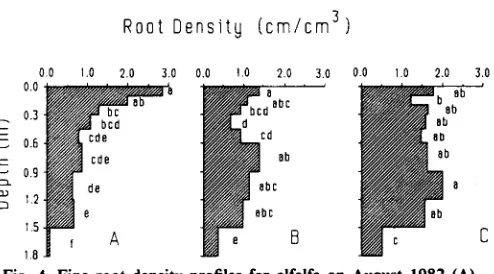
The shape of the FRD profile 45 wk after sowing, for all treatments, was in the classical form of an ex-ponential function (Fig. 4A). In the summer of 1983, 18% of the fine roots occurred in the surface to 0.1-m layer, 60% in the surface to 0.6 m, and 40% between 0.6 to 1.8 m. Past studies have shown a similar profile based on dry weights of large lateral and taproots (Lamba et al., 1949; Bennett and Doss, 1960). How-ever, our results show that this root profile pattern was only evident the first season of production. Such a distribution pattern will be misleading when knowl-edge between water and nutrient uptake and root dis-tribution is required in the 2nd and 3rd yr of an alfalfa stand.
Two changes occurred in the root density profile from August 1983 to June 1984. First a bimodal dis-tribution in fine roots had developed (Fig. 4B). Av-erage fine root density in the 0.3 to 0.6-m layer was significantly less than in the surface to 0.1 and 0.6- to
Root Density (cm/cm3 )
Fig. 4. Fine root density profiles for alfalfa on August 1982 (A), June 1984 (B), August 1985 (C) for None (NN) treatment which oscillated in the same manner as the other management systems. Values within a profile with the same letter are not significantly different at the 0.10 level of probability as determined by Duncan's Multiple Range Test on log transformed data.
E
Cl CL)
CD
0.0
0.0
0.3
0.6
0.9
1.2
1.5
1.8
/
1.0
be bcd cde
cde
de
e
A 2.0 3.0
0.0 10.0 20.0 30.0 622
Water Depletion (mm)
0 0
0 3
0.6 E
0.9
1.2
1.5
1.8
Fig. 5. Water depletion vs. depth averaged over the NN, PR, and RE treatments for the period June 25 to July 9, 1984. Values with the same letter are not significantly different at the 0.05 level as determined by Duncan's Multiple Range Test.
0.9-m layers. This prominent distribution is statisti-cally significant when FRD is averaged over time (Fig. 1). Because the bimodal distribution is similar among treatments it must be due to factors other than soil compaction. Such a phenomenon has been reported before by Kohl and Kolar (1976). Their soil had a cemented calcic horizon which was thought to be re-sponsible for the observed decrease in roots between 0.4 to 1.0 m. The lower FRD at this depth also co-incides with the historical depth of tillage which occurs at 0.3 to 0.6 m, but whether this distribution is a result of soil pedogensis or inherent plant qualities is un-known.
The bimodal distribution of fine roots was consist-ent with water uptake in NN, PR, and RE. Soil water depletion profiles for these three treatments were sta-tistically similar for June 1984 so all data were com-bined (Fig. 5). Significantly less water was removed from the 0.3- to 0.6-m layer than either above or below it. This bimodal profile in water uptake is similar to FRD and shows activity to 1.8 m.
The second change starting with June 1984, was the increase in FRD in the 0.6- to 1.8-m layers represented 64 to 68% of the total fine roots (Fig. 4C). This large concentration of fine roots below the tillage layer con-tinued throughout the remainder of the experiment. Fifty to 60% of the total roots would have been ex-cluded by limiting the sampling depth to the top 0.6 m.
CONCLUSION
Wheel traffic did not alter alfalfa FRD until early in the second season of production and then significantly reduced FRD in the upper 0.45-m soil layers and with extreme traffic down to 1.8 m. Traffic negatively af-fected FRD through seasons and years with a signif-icantly higher FRD and a greater absolute difference between the reduced traffic management system than the conventional system during the winters compared
to summers in the surface -0.3 m. The seasonal os-cillation and bimodal distribution of fine-root growth was not observed until 20 months after planting. Soil compaction from tractor traffic decreased the plant's ability to exploit the soil environment for nutrients and water by reducing fine-root production.
REFERENCES
Bennett, 0.L., and B.D. Doss. 1960. Effect of soil moisture level on root distribution of cool-season forage species. Agron. J. 52:204-207.
Bennie, A.T.P., and F.J.P. Botha. 1986. Effect of deep tillage and controlled traffic on root growth, water-use efficiency and yield of irrigated maize and wheat. Soil Tillage Res. 7:85-95.
Bohm, W. 1979. Methods of studying root systems. Ecological stud-ies 33. Springer-Verlag, New York.
Carlson, F.A. 1925. The effect of soil structure on the character of alfalfa root-systems. J. Am. Soc. Agron. 17:336-345.
Carter, L.M., E.A. Rechel, and B.D. Meek. 1987. Zone production system concept. p. 25-24. In M.D. Orzolek (ed.) Controlled traffic cropping systems for management of soil compaction. Int. Soc. Hort. Sci., Tech. Comm. 210. Drukkjerij Avanti, Zaltbommel, Netherlands.
Carter, L.M., and J.R. Tavemetti. 1968. Influence of precision tillage and soil compaction on cotton yields. Tran. ASAE 11:65-73. Grimes, D.W., W.R. Sheesley, and P.L. Wiley. 1978. Alfalfa root
development and shoot regrowth in compact soil by wheel traffic patterns. Agron. J. 70:955-958.
Heichel, G.H., R.H. Delaney, and H.T. Cralle. 1988. Carbon assim-ilation, partitioning, and utilization. In A.A. Hanson et al. Alfalfa and alfalfa improvement. Agronomy 29:195-228.
Jones, F.R. 1943. Growth and decay of the transient (noncambial) roots of alfalfa. J. Am. Soc. Agron. 35:625-634.
Kohl, R.A., and J.J. Kolar. 1976. Soil water uptake by alfalfa. Agron. J. 68:536-538.
Lamba, P.S., H.L. Ahlgren, and R.J. Muckenhim. 1949. Root growth of alfalfa, medium red clover, bromegrass, and timothy under various soil conditions. Agron. J. 41:451-458.
Lindstrom, M.J., and C.A. Onstad. 1984. Influence of tillage systems on soil physical parameters and infiltration after planting. J. Soil Water Conserv. 39:149-152.
Meek, B.D., E.A. Rechel, L.M. Carter, W.R. DeTar. 1988. Soil com-paction and its effect on alfalfa in zone-production systems. Soil Sci. Soc. Am. J. 52:233-236.
Meek, B.D., E.A. Rechel, L.M. Carter, and W.R. DeTar. 1989. Changes in infiltration under alfalfa as influenced by time and wheel traffic. Soil Sci. Soc. Am. J. 53:238-241.
Olness, A. 1984. Tillage effects on nitrogen uptake by maize from fine textured soils in the northwestern corn belt, USA. Plant Soil 76:67-73.
Powers, D.H., and E.L. Skidmore. 1984. Soil structure as influenced by simulated tillage. Soil Sci. Soc. Am. J. 48:879-884.
Rechel, E.A., L.M. Carter, and W.R. DeTar. 1987. Alfalfa growth response to a zone-production system. I. Forage production char-acteristics. Crop Sci. 27:1029-1034.
Russell, R.S., and M.J. Goss. 1974. Physical aspects of soil fertility-the response of roots to mechanical impedance. Neth. J. Agnc. Sci. 22:305-318.
SAS Institute, Inc. 1986. Two repeated measures
factors-multivar-iate and univarfactors-multivar-iate analysis. p. 190-196. In System for linear
models. SAS Institute, Inc., Cary, NC.
Taylor, J.H. 1983. Benefits of permanent traffic lanes in a controlled traffic crop production system. Soil Tillage Res. 3:385-395. Voorhees, W.B., S.D. Evans, and D.D. Wames. 1985. Effect of
pre-plant wheel traffic on soil compaction, water use, and growth of spring wheat. Soil Sci. Soc. Am. J. 49:215-220.
Voorhees, W.B., W.W. Nelson, and G.W. Randall. 1986. Extent and persistence of subsoil compaction caused by heavy axle loads. Soil Sci. Soc. Am. J. 50:428-433.
Whiteley, G.M., W.H. Utomo, and A.R. Dexter. 1981. A Compar-ison of penetrometer pressures and the pressures exerted by roots. Plant Soil 61:351-364.
Willett, S.T. 1986. Root growth of winter barley in a soil compacted by the passage of tractors. Soil Tillage Res. 7:41-50.