110
Volume-4, Issue-4, August-2014,
ISSN No.: 2250-0758
International Journal of Engineering and Management Research
Available at:
www.ijemr.net
Page Number: 110-116
Optimized Location Aided Routing Protocol using Greedy Forwarding
Approach in MANET
Jasvant Kumar1, Rafeeq Ahmed2, Mohammed Shuaib3
1,2,3Department of Computer Science & Engineering, Integral University, Lucknow, Uttar Pradesh, INDIA
ABSTRACT
This paper presents optimized model of location aided routing for mobile ad hoc networks. Optimization is basically done in forwarding strategy and in the procedure to discover and reach to the destination node from source node. Optimized location aided routing protocol (OLAR) limits the search space as well as in reduction in the number of routing messages. This protocol also reduce the participation of intermediate mobile nodes, intermediate mobile nodes are that nodes which are outside of the radio communication ranges of the source and the destination node.
Keywords: MANETs, LAR, AODV, DSR, Flooding, Greedy Approach.
I.
INTRODUCTION
In the literature of computer networking numerous types of networks are found, in recent years more attention is drawn by mobile ad hoc networks. Mobile ad hoc networks are infrastructure less networks in which nodes are free to move in unpredicted manner, due to unpredictability in movement of the nodes it becomes difficult to predict the behavior (direction, cooperation etc) of the nodes in MANET. Therefore the task of finding and maintaining routes in MANET is very difficult. Many routing protocols have been proposed for the purpose of achieving efficient route in mobile ad hoc networks [6, 9, 11, 12, 14, 16, 17, 18, 21, 23, 24, 28]. All these protocols differ in the approach needed for searching a new route and /or a modifying a known route when hosts move.
In this paper we suggest an approach to decrease overhead of route discovery by utilizing position information and radio communication ranges of mobile nodes. Such position information can be obtained using the global positioning system (GPS) [5, 6]. We demonstrate how radio communication range of mobile hosts can be used to find a route to the destination node from the source node. OLAR makes use of radio communication range of mobile hosts for establishing connection between source and the destination hosts.
II.
METHODOLOGY
Mobile ad hoc network is made of autonomous mobile nodes, each of the mobile node is equipped with a battery, transmitter and receiver, memory unit, processing unit and other supporting components ( A/D and D/A) converter. Transmitter and receiver collectively called as transceiver, embedded processor for local processing, and small memory unit for storage of data, all the unit run on the power supplied by an attached battery.
Transceiver attached to the node play a prominent role in optimized location aided routing protocol (OLAR). Communication capability of the mobile node with other nodes in the mobile ad hoc networks depends upon capacity of the transceiver to accept or send data with acceptable signal level from or to other nodes. The radius of the transceiver attached to the node defined as the distance from/to node can accept/send data is called radio communication range of the node.
When two communication nodes are not in the range of each other in wireless mobile ad hoc network, they need to rely on other neighboring node to forward the data to the final destination. In such a case packet forwarding or packet routing becomes imperative. The chosen value of radio transmission range considerably affects the network topology and node energy consumption.
Related work: Location Aided Routing with Flooding
Location Aided Routing protocol utilize location information (obtained by GPS), description of the LAR protocol is given below.
LAR Technique
111
Proactive routing is not a desirable approach when wehave less data to send due to its routing overhead. Reactive routing is suitable in case of when nodes have fewer amounts of data to send. But we can make these routing algorithms more efficient by exploiting the feature of locations of the node. By using location information, the Location-Aided Routing (LAR) protocols limit the search for a new route to a smaller “request zone” of the ad hoc network. This results in a significant decline in the number of routing messages.
Location Aided Routing Protocols
In this paper we explore the possibility of using location information to improve performance of routing protocol for MANET. As an illustration, we show how a route discovery protocol based on flooding can be improved. When a node S needs to find to route to node D, Node S broadcasts route request message to all it neighbors -hereafter node S will be referred to as the sender and node D as the destination. A node say X, on receiving a route request message, compares the most wanted destination with its own identifier, if there is a math, it means the request is for a route to itself (i.e., node X). Otherwise, node X Broadcasts the request to its neighbors- to avoid redundant transmissions of route requests a node X only broadcasts a particular route request once(repeated reception of a route request is detected using sequence number). It is easy to detect the repeated request because each message originated from source node is numbered for identification purpose.
Figure 1 illustrates this algorithm. In this figure node S needs to determine a route to a node D. Therefore, node S broadcasts routes request to its neighbors. When node B and C receive the route request, they forward it to all there neighbors. When node X receives the route request from B, it ahead the request to its neighbors. However, when node X receives the same route request from C, node X simply discards the route request.
Figure1. Flooding
When the route request is in progress the route request is propagated to various nodes, the path traversed by the request is included in the forwarding route request packet. Using the introduced flooding approach, provided that the desired destination is reachable from the sender, the destination should eventually receive a route request message. On receiving the route request, the intended node responds by sending a route reply message to the sender – the route reply message follows a path that is obtained by reversing the path followed by the route request received by D (the route request message includes the path traversed by the request).
There may be some situation that the destination will not receive a route request message (for instance, when the destination is unreachable from the sender or route requests are lost due to transmission errors). In such cases, the sender needs to be able to re-initiate the process of route discovery. Consequently, when a sender initiates route discovery, it sets a timeout. If during the Route discovery is initiated either when the sender S detects that a previously determined route to node D is broken, or if S does not know a route to the destination. In our implementation, we assume that node S can know that the route is broken only if it at-tempts to use the route. When node S sends a data packet towards a particular route, a node on that path returns a route error message, if the next hop on the route is broken. When node A receives the routing error message, it initiates the process of route discovery for destination D, when using the above approach, observe that the route request would reach to every node which are reachable from node S (potentially, all nodes in the MANETs). Using location information, we attempted to reduce the number of nodes to whom route request is propagated.
Dynamic source routing (DSR) [15, 16] and ad hoc on-demand distance vector routing (AODV) [23] protocols are both based on variations of flooding approach. DSR and AODV also use some optimizations - several of these optimizations as well as other optimizations suggested in this paper can be used in conjunction with the proposed algorithms.
Location Information
The proposed approach is termed Location-Aided Routing (LAR), as it makes use of location information to reduce routing operating cost. Location information used in the LAR protocol may be provided by the Global Positioning System (GPS). With the availability of GPS, it is possible for a mobile host to know its physical location. In reality, position information provided by GPS includes some amount of error, which is the discrepancy between GPS-calculated coordinates and the real coordinates.
Expected Zone
112
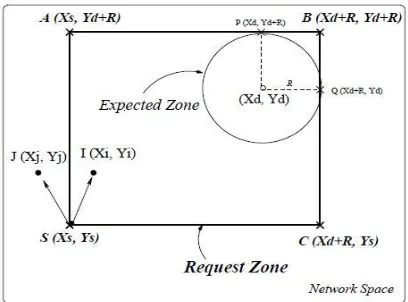
Figure 2- Request Zone and Expected Zone divisionFor instance, if node S knows that node D travels with average speed v , then S may assume that the expected zone is the circular region of radius v(t1-t0), centered at location L (see Figure 4.1). If actual speed happens to be larger than the average, then the destination may really be outside the expected zone at time t1. Thus, expected zone is only an approximation made by node S to determine a region that potentially contains D at time t1.
Request Zone
Again, consider node S that needs to determine a route to node D. The wished-for LAR algorithms use flooding with one modification. Node S defines (implicitly or explicitly) a request zone for the route request. A node ahead a route request only if it belongs to the request zone. To increase the possibility that the route request will reach node D, the request zone should contain the expected zone. In above Fig 4.1, we assume that node S knows that node D was at location (xd, yd) at time t0. At time t1 node S initiates a new route discovery r destination D. We assume that node S also knows the average speed v with which D can move. by means of this, node S defines the expected zone at time t1 to be the circle of radius R=v (t1 – t0) centered at location (xd, yd). The source node S can thus determine the four corners of the expected zone. S includes their coordinates with the route request message transmitted when initiating route discovery process. When a node receives a route request, it rejects the request if the node is not within the rectangle specified by the four corners included in the route request. For instance in figure1, if node I receives the route request from an additional node, node I ahead the request to its neighbors, because I determines that it is within the rectangular request zone. On the other hand, when node J receives the route request, node J rejects the request, as node J is not within the request zone. When node D receives the route request message, then node replies by sending a route reply message (as in the flooding approach). However, in case of LAR, node D includes its current location and current time in the route reply message. When node S receives this route reply message (ending its route discovery), it account the location of node D.
Proposed Work: Location Aided Routing With Greedy Approach
In this proposed work Location Aided Routing protocol uses greedy approach to establish route between source and destination.
Greedy Approach for Path Selection
In the figure-4.4 given below, dictates the greedy logic for best route selection among the three routes identified as above.
Figure 3- Greedy Approach (calculating distance b/w neighbor nodes of source S to the destination node D)
In fig.4.4 we are calculating the distance b/w the node 3 and destination D and the distance is stored in d1. Similarly we calculate and stored the distance b/w node 4 and node D and node 5 and node D in d2 and d3 respectively. Here we found that the node 4 is nearest node among the node 3, 4 and 5. So we send the packets to node 4.
113
Figure 4- Greedy Approach (calculating distance b/wneighbor nodes of node 4 to the destination node D)
Figure 5- Greedy Approach (calculating distance b/w neighbor nodes of node 9 to the destination node D)
Figure 6- Greedy Approach (calculating distance b/w neighbor nodes of node 14 to the destination node D)
Figure 7- Route Discovered Using Greedy Approach
Algorithm:
Assumptions
1. Distribution of nodes is random thus many nodes are in the radio communication range of other nodes.
2. Radio communication range of the node is given. 3. Initially location of destination is known (by GPS). 4. Destination is very slightly or no movement.
Notations
SC : Node S calculates
AB: X||Y, A Sends message x||y to B. Rcircle: Circle of radius r.
Algorithm steps
114
2. Perform route discovery phase and is optimize using LAR. (Less Control Packet Overhead).
3. Perform Greedy approach to choose a best path among all.
Note- The location of every node gets assigned using GPS and sharing of their location. Information among their neighbors using hello packets (a periodic packet used for neighborhood detection).
4 Mathematical Description Algorithms
1. SC:DISTs=SQRT[(xd-xs)2 +(yd-ys)2 ]
2. S to every node in r circle:(xs, ys)||(xd, yd)||DISTs 3. Every node in Rcircle, Receive the message send by S. 4. Now every recipient I in Rcircle calculates the DISTi as 5. IC :DISTi=SQRT[(xd-xi)2 + (yd-yi)2]
6. Now every node in Rcircle perform as denoted as IS : DISTi||(xi, yi).
7. Node S receives messages from every node I in rcircle and maintains a queue for all the DISTi.
8. Now source node S processes the queue to find the smallest DISTi and sends the packet to the node from which destination is more nearer. i.e if DISTi<DISTj then packet is forwarded to node i.
9. Above procedure is continued till we reach to the destination node.
III.
SIMULATION MODEL
Simulation of proposed work carried by using NS2 ( Network Simulator version 2). One of the concerns when using mobility models is to use models that reflect realistic mobility scenarios so that the evaluation results will have a close correlation to the performance when actually deployed. Number of nodes taken for simulation purpose is 5, 10, 15, 20, 25, 30, 35 for different simulation runs, we assume that each node move with constant speed without pause at any time.
IV.
SIMULATION RESULT AND
ANALYSIS
Initially we suppose that a node knows its current location accurately without any error at the end of this description we briefly introduce the impact of location error on performance of proposed algorithm.
In the above the term „data packet‟ (or DP) is used to refer to the data packets received by the destination-the number of data packets received by the destination node different from the number of data packets send by the sender, because some data packets lost when route is broken, in the above, the term „routing packets‟ (or RP) is used to denote routing related packets (route request, route reply, route error) received by various nodes-the number of such packets received is different from the packets sent, because a single broadcast of a route request packet by some node is received by the node with in the transmission range of that node, also some of these packets lost due to broken routes.
The number of routing packets (RP) per data packet (DP) is depicted in figure8. as a function of average speed. This is calculated as the ratio of the number of routing packets, and the number of data packets received by the destination. Figure10. depicts the same data but plotted as a percentage improvement greedy approach to LAR.
Figure9.Depicts that number of RP per DP decrease when there is variation in transmission range of the nodes.
Figure8. Number of RPs per DP versus Average speed (units/second)
115
Figure10. Percentage Improvement versus average speedV.
CONCLUSION AND FUTURE
WORK
From figures8, and figure9, it is extracted that when apply Greedy Approach relative to LAR, the number of RPs per DP vary with the speed variation of the nodes and shows that significant reduction in RPs per DP with varying speed of mobile node, thus saving the transmission energy of the nodes in the Mobile Ad-hoc Networks, this makes the Mobile Ad- hoc networks live long.
Figure10. shows that with the larger transmission range, the frequency of route discovery should be smaller, as wireless links will break less frequently; this factor contributes to a decrease in RPs per DP.
Finally, in the proposed work conclusion is that routing overhead decreased, makes Mobile Ad-hoc Networks energy efficient.
For the future work, in the proposed algorithm, it is possible to apply other forwarding strategies, fuzzy approach, and greedy fuzzy approach depending upon suitability with in the mobile ad-hoc networks, to improve the performance of proposed algorithm.
REFERENCES
[1] “GPS and precision timing applications.” Web site at http://wwwtmo.external.hp.com/tmo/pia/infinium/PIATop/ Notes/English/5965-2791E.html.
[2] “Iowa State University GPS page.” Web site at http://www.cnde.iastate.edu/gps.html.
[3] “NAVSTAR GPS operations.” Web site at http://tycho.usno.navy.mil/gpsinfo.html.
[4] I. F. Akyildiz, S. M. Joseph, and Y.-B. Lin, “Movementbased location update and selective paging for PCS networks,” IEEE/ACM Transactions on Networking, vol. 4, no. 4, pp. 94–104, 1996.
[5] C. Alaettinoglu, K. Dussa-Zieger, I. Matta, and A. U.Shankar, “MaRS user‟s manual - version 1.0,” Tech. Rep. TR 91-80, The University of Maryland, June 1991.
[6] M. S. Corson and A. Ephremides, “A distributed routing algorithm for mobile wireless networks,” ACM J. Wireless Networks, vol. 1, no. 1, pp. 61–81, 1995.
[7] S. Corson, S. Batsell, and J. Macker, “Architectural considerations for mobile mesh networking (Internet draft RFC, version 2),” May 1996.
[8] S. Corson and J. Macker, “Mobile ad hoc networking (manet):Routing protocol performance issues and evaluation considerations (Internet-Draft),” Mar. 1998. [9] B. Das, E. Sivakumar, and V. Bhargavan, “Routing in ad-hoc networks using a spine,” in IEEE International Conference on Computer Communications and Networks ’97, 1997.
[10] G. Dommety and R. Jain, “Potential networking applications of global positioning systems (GPS),” Tech. Rep. TR-24, CS Dept., The Ohio State University, April 1996.
[11] R. Dube, C. D. Rais, K. Wang, and S. K. Tripathi, “Signal stability based adaptive routing (SSA) for ad hoc mobile networks,” IEEE Personal Communication, Feb. 1997.
[12] Z. J. Haas and M. R. Pearlman, “The zone routing protocol (ZRP) for ad hoc networks (Internet-Draft),” Aug. 1998.
[13] T. Imielinski and J. C. Navas, “GPS-based addressing and routing,” Tech. Rep. LCSR-TR-262, CS Dept., Rutgers University, March (updated August) 1996. [14] M. Jiang, J. Li, and Y.-C. Tay, “Cluster based routing protocol (CBRP) functional specification (Internet-Draft),” Aug. 1998.
[15] D. Johnson and D. A. Maltz, “Dynamic source routing in ad hoc wireless networks,” in Mobile Computing (T. Imielinski and H. Korth, eds.), Kluwere Academic Publishers, 1996.
[16] D. Johnson, D. A. Maltz, and J. Broch, “The dynamic source routing protocol for mobile ad hoc networks (Internet-Draft),” Mar. 1998.
[17] Y.-B. Ko and N. H. Vaidya, “Location-aided routing in mobile ad hoc networks,” Tech. Rep. 98-012, CS Dept., Texas A&M University, June 1998.
[18] P. Krishna, M. Chatterjee, N. H. Vaidya, and D. K. Pradhan, “A cluster-based approach for routing in adhoc networks,” in USENIX Symposium on Location
Independent and Mobile Computing, Apr. 1995.
[19] Metricom Web Page, “http://www.metricom.com.” [20] J. C. Navas and T. Imielinski, “Geocast - geographic addressing and routing,” in Proc. of the 3rd Annual
ACM/IEEE International Conference on Mobile
Computing and Networking(MOBICOM ’97), 1997.
[21] V. D. Park and M. S. Corson, “Temporally-ordered routing algorithm (TORA) version 1 functional specification (Internet-Draft),” Aug. 1998.
[22] B. Parkinson and S. Gilbert, “NAVSTAR: global positioning system - ten years later,” in Proceeding of IEEE, pp. 1177–1186, 1983.
116
[24] C. E. Perkins and P. Bhagwat, “Highly dynamicdestination sequenced distance-vector routing (DSDV) for mobile computers,” in ACM SIGCOMM Symposium on
Communication,Architectures and Protocols, 1994.
[25] S. Ramanathan and M. Steenstrup, “A survey of routing techniques for mobile communication networks,”
Mobile Networks and Applications, pp. 89–104, 1996.
[26] R. D. Samir, C. Robert, Y. Jiangtao, and S. Rimli, “Comparative performance evaluation of routing protocols for mobile, ad hoc networks,” in Proc. of IEEE the Seventh International Conference on Computer Communications and Networks (IC3N ’98) – to appear, Oct. 1998.
[27] M. Spreitzer and M. Theimer, “Providing location information in a ubiquitous computing environment,” in
Proc. Symposium on Operating System Principles, Dec. 1993.
[28] C.-K. Toh, “A novel distributed routing protocol to support ad-hoc mobile computing,” Wireless Personal
Communication, Jan. 1997.
[29] M. Weiser, “The computer for the 21st century,”
Scientific American, pp. 94–104, Sept. 1991.