348 |
P a g e
BEHAVIOUR OF SUGACANE BAGASSE ASH WHEN
EXPOSED TO NACL SOLUTION
B.G. Ravi Teja
1, T. Santhosh Kumar
2, K.V.G.D. Balaji
3 1M -Tech (SE&NDM),
2Assistant Professor,
3Professor,
Civil Engineering Department, GITAM University (India)
ABSTRACT
Construction officials in coastal areas have long been facing the challenge of building and maintaining durable
concrete structures in a saltwater environment. Gradual penetration of sea salts and the subsequent formation
of expansive and leachable compounds lead to disintegration of structural concrete. The average NaCl
concentration of sea water is about 3.5% although it varies from sea to sea depending upon geological location.
In this study bagasse ash is used because it is one of the main by product can be used as mineral admixture due
to its high content in silica (SiO2).In this study, Bagasse ash has been chemically and physically characterized,
and partially replaced in the ratio of 0%, 5%,10%,15% and 20% by weight of cement in concrete. Fresh
concrete tests like compaction factor test and slump cone test were undertaken was well as hardened concrete
test compressive strength at the age of 7,28 and 60 days was obtained. The result shows that the strength of
concrete .Concrete specimens were cured in normal water and NaCl solution and comparison is made between
them.
Keywords
:
Bagasse Ash, Concrete, Compressive Strength, Sodium Chloride (Nacl).
I INTRODUCTION
Agricultural and industrial by-products are commonly used in concrete production as cement replacement
materials CRMs or as admixtures to enhance both fresh and hardened properties of concrete as well as to save
the environment from the negative effects caused by their disposal. Approximately 1500 Million tons of
sugarcane is annually produced over all the world which leave about 40-45 % bagasse after juice crushing for
sugar industry giving an average annual production of 675 Million tons of bagasse as a waste material.
Initiatives are emerging worldwide to strike a balance between the developments in infrastructure and
prevention of the environment from contamination by reusing the industrial wastes. The feasibility of using
sugarcane Bagasse Ash (SCBA), a finely ground waste product from the sugarcane industry, as partial
replacement for cement in conventional concrete is examined. The utilization of industrial and agricultural waste
produced by industrial processes has been the focus of waste reduction research for economical, environmental,
and technical reasons. Sugarcane bagasse ash (SCBA) is one of the main by product can be used as mineral
directly from the industries to study pozzolanic activity and their suitability as binders, partially replacing
cement (Mrs.U.R.Kawade et al ., ).
II MATERIALS AND METHODS
In the present experimental investigation sugar cane bagasse ash has been used as partial replacement of cement
in concrete mixes. On replacing cement with different weight percentage of SCBA, the compressive strength
properties are studied at different ages of concrete cured in different environments like fresh water and NaCl
solution. M35 grade concrete has been designed in this investigation and specimens of SCBA concrete with
partial replacement of cement with SCBA by 5%,10%, 15% and 20% for M35 grade concrete. In this present
study cubes casted are exposed to normal water and 5% diluted NaCl solution. The cubes are tested at 7 days, 28
days and 60 days. The details of experimental investigations are as follows.
2.1 Cement
Ordinary Portland cement of 53 Grade from a single batch was used for the entire work and care has been taken
to store it in airtight containers to prevent it from being affected by the atmospheric and monsoon moisture and
humidity.
2.2 Sugarcane Bagasse Ash
(Srinivasanan and Sathiya,2010) observed that Sugarcane bagasse consists of approximately 50% of cellulose,
25% of hemicelluloses of lignin. Each ton of sugarcane generates approximately 26% of bagasse (at a moisture
content of 50%) and 0.62% of residual ash. The residue after combustion presents a chemical composition
dominates by silicon dioxide (SiO2). In spite of being a material of hard degradation and that presents few
nutrients, the ash is used on the farms as a fertilizer in the sugarcane harvests. In this project sugarcane bagasse
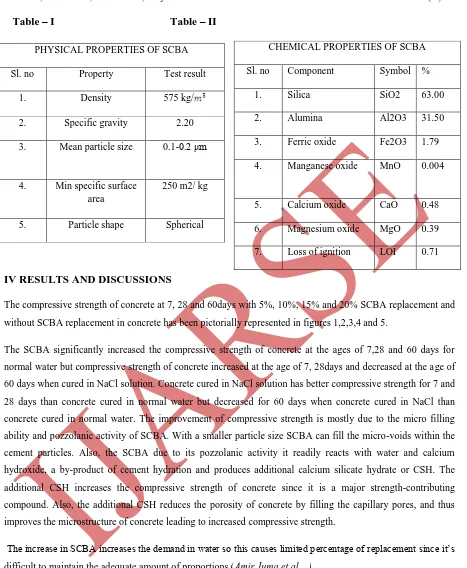
ash was collected from the industry and its physical and chemical properties are given in Table 1 and Table 2
respectively.
2.3 Fine Aggregate
The river sand passing through 4.75 mm sieve and retained on 600 μm sieve, conforming to Zone II as per IS
383-1970 was used as fine aggregate in the present study. The sand is free from clay, silt and organic impurities.
The aggregate was tested for its physical requirements such as Gradation, Fineness modulus, and Specific
Gravity and Bulk modulus in accordance with IS: 2386-1963.
2.4 Coarse Aggregate
Throughout the investigations, a crushed coarse aggregate of 20 mm procured from the local crushing plant was
used. The aggregate was tested for its physical requirements such as Gradation, Fineness modulus, Specific
Gravity and Bulk density etc. in accordance with IS: 2386-1963 and IS: 383- 1970.
350 |
P a g e
Fresh portable water with pH value less than 7 free from organic matter and oil which is available in the collegecampus is used in mixing the concrete. Water in required quantity was measured by graduated jar and added to
the concrete. The rest of the materials for preparation of the concrete mix were taken by weigh batching.
2.6 Curing in NaCl solution
Concrete cubes are cured in 5% diluted Nacl solution with ph value of 8 was maintained constant throughout the
curing period of time.
III FIGURES AND TABLES
Graph – I: Compressive Strength of Concrete Cubes Cured In Normal Water and NACL for 7days
Graph – III: Compressive Strength of Concrete Cubes Cured In Normal Water and NACL for 60days
Graph – IV: Compressive Strength of Concrete Cubes Cured In Normal Water for 7, 28 and 60 days
352 |
P a g e
Table – I Table – II
PHYSICAL PROPERTIES OF SCBA
Sl. no Property Test result
1. Density 575 kg/
2. Specific gravity 2.20
3. Mean particle size 0.1-0.2 μm
4. Min specific surface area
250 m2/ kg
5. Particle shape Spherical
IV RESULTS AND DISCUSSIONS
The compressive strength of concrete at 7, 28 and 60days with 5%, 10%, 15% and 20% SCBA replacement and
without SCBA replacement in concrete has been pictorially represented in figures 1,2,3,4 and 5.
The SCBA significantly increased the compressive strength of concrete at the ages of 7,28 and 60 days for
normal water but compressive strength of concrete increased at the age of 7, 28days and decreased at the age of
60 days when cured in NaCl solution. Concrete cured in NaCl solution has better compressive strength for 7 and
28 days than concrete cured in normal water but decreased for 60 days when concrete cured in NaCl than
concrete cured in normal water. The improvement of compressive strength is mostly due to the micro filling
ability and pozzolanic activity of SCBA. With a smaller particle size SCBA can fill the micro-voids within the
cement particles. Also, the SCBA due to its pozzolanic activity it readily reacts with water and calcium
hydroxide, a by-product of cement hydration and produces additional calcium silicate hydrate or CSH. The
additional CSH increases the compressive strength of concrete since it is a major strength-contributing
compound. Also, the additional CSH reduces the porosity of concrete by filling the capillary pores, and thus
improves the microstructure of concrete leading to increased compressive strength.
The increase in SCBA increases the demand in water so this causes limited percentage of replacement since it’s
difficult to maintain the adequate amount of proportions (Amir Juma et al ., )
NaCl solution appears to cause early compressive strength increase in concrete that cannot be maintained long
term.
CHEMICAL PROPERTIES OF SCBA
Sl. no Component Symbol %
1. Silica SiO2 63.00
2. Alumina Al2O3 31.50
3. Ferric oxide Fe2O3 1.79
4. Manganese oxide MnO 0.004
5. Calcium oxide CaO 0.48
6. Magnesium oxide MgO 0.39
Chlorides are known to exist in pore solution, either chemically bound to hydration products or physically held
to surface of hydration products Chlorides interact with calcium silicate hydrate (CSH) at three different levels
as either chemisorbed layer on CSH, in the CSH inter layer spaces or be intimately bound in the CSH lattice.
Chloride ions do alter the pore size distribution of hardened cement paste and chloride solutions produce
chloroaluminate and appear to cause deterioration by decalcifications that are more noticeable at later days.
Chlorides are also known to promote the leaching of Ca (OH) 2 and promote the formation of porous CSH
involving complex reactions. The decalcification effects of NaCl, the formation of porous CSH and the leaching
of calcium hydroxide all take their toll on concrete (Abalaka et al ., ) .
V CONCLUSIONS
1. SCBA concrete performed better when compared to ordinary concrete upto 10% replacement of sugar cane
bagasse ash when cured in normal water.
2. The compressive strength of concrete with 5%, 10%, 15% and 20% with weight replacement of cement with
SCBA cured in normal water for 7, 28 and 60 days has shown an increase in strength.
3. The compressive strength of concrete with 5%, 10%, 15% and 20% with weight replacement of cement with
SCBA cured in NaCl solution has shown increase in strength for 7 and 28 days but there is a decrease at an age
of 60 days.
4. Both SCBA and normal concrete cured in NaCl solution has shown an perceptible increase in compressive
strength for 7 and 28 days than concrete cured in normal water but for a longer period of curing in NaCl solution
i.e for 60 days there is a decrease in strength. there is a decrease in strengths at the age of 60 days when concrete
cured in NaCl solution.
5. Utilization of the waste material Sugar Cane Bagasse ash can be advantageously used as a replacement of
cement in the preparation of concrete even when it is exposed to chloride attack.
REFERENCES
[1].Mrs.U.R.Kawade, Mr.V.R.Rathi, Miss Vaishali and D. Girge, Effect of use of Bagasse Ash on Strength of
Concrete, International Journal of Innovative Research in Science, Engineering and Technology Vol. 2, Issue
7, July 2013.
[2].R.Srinivasan and K.Sathiya, Experimental Study on Bagasse Ash in Concrete, International Journal for
Service Learning in Engineering Vol. 5, No. 2, pp. 60-66, Fall 2010 ISSN 1555-9033.
354 |
P a g e
[4].Abalaka, A. E. and Babalaga, A. D, Effects of Sodium Chloride Solutions on Compressive StrengthDevelopment of Concrete Containing Rice Husk Ash.
[5].Lavanya M.R, Sugumaran.B and Pradeep.T, An Experimental study on the compressive strength of concrete
by partial replacement of cement with sugarcane bagasse ash, International Journal of Engineering
Inventions ISSN: 2278-7461, ISBN: 2319-6491 Volume 1, Issue 11 (December2012) PP: 01-04.
[6].T. shafana and R.venkatasubramani, A study on the Mechanical Properties of Concrete with partial
replacement of Fine aggregate with Sugarcane bagasse ash, International Journal of Advanced Structures