39
Formulation of solid dosage forms using natural ingredients and
novel method development for estimation of drug content
Syed Mohammed Kazim * and Mohammed Ibrahim *,**
* Nizam Institute of Pharmacy and Research Center, Deshmukhi, Pochampally, Near Ramoji Film City, Nalgonda-508284, AP, India **Asian Institute of Advance Scientific and Pharmaceutical Research, Hyderabad-500058, A.P, India.
Received for publication September 7, 2012; accepted November 10, 2012
Abstract
The study is based upon the formulation of solid dosage forms, using natural ingredients and a novel method development for the estimation of individual ingredients in various combination units. Tablets of analgesic drug mafenemic acid in combination with dicyclomine, a smooth muscle relaxant was prepared. A hepatoprotective agent DL-methionine was also incorporated in the formulation. Enhancement of bioavailability of analgesic tablets by introducing the seeds of
Lallemantia royleana Benth (commonly known as Balanga) was achieved,
accompanied with the estimation of the amount of methionine, incorporated in the formulation. The mathematical tool of orthogonal polynomials was implemented for the above estimation of percentage purity of a particular ingredient in the above complex formulation.The novel formulation is evaluated in terms of its bioavailability by comparing the parameters like disintegration time and dissolution time, with that of the standard formulations. The above assessment was carried out to establish the role of the natural disintegrant used. There are many methods to enhance bioavailability; one of the methods is the reduction of disintegration time. Balanga seeds are used for the above purpose as the seeds are known to contain plenty of mucilage within its chemical constituents. The mucilage absorbs water by imbibition and helps in tablet disintegration.
Key words: Balanga seeds, Bioavailability, Disintegration time, Orthogonal
polynomials, Hepatoprotective
Author for correspondence: Professor Syed Mohammed Kazim
Nizam institute of Pharmacy and Research Centre, Deshmukhi, Pochampalli, Near Ramoji Film City, Nalgonda-508284, A.P., India E-mail: [email protected]
Tel.: +91-9866527616
PHYTOMEDICINE
An International Journal Annals of Phytomedicine 1(2): 39-44, 2012
Introduction
Disintegration: It can be defined as the process by which
the tablet breaks down or loses cohesion. It is the time required for the tablet to break down into aggregates. Several mechanisms of tablet disintegration have been proposed. Eventhough these concepts are listed separately. Interrelationships probably occur in almost all tablet formulations (Anonymous, 2008).
(i) Effect of water absorption
The water absorbed by the tablet initiate disintegration, but this depends on the solubility of the drug and other ingredients present.
(ii) Swelling
The grains of the disintegrant, particularly of starches, swell in the presence of water and exert pressure on the granules to force them apart. Shangraw et al. (1980) reported that tablets of water insoluble drugs disintegrated faster with starches than those of water soluble drugs due to the diminished water absorption capacity of the starches in the latter case.
and the mobility ratio (M) have the greatest importance. It is also defined as the phenomenon by which the living or dead plant cells absorb water by surface attraction.
Porosity of tablets: It has been shown that penetration of
water into a tablet is proportional to its mean pore diameter or porosity. The porosity and permeability of tablets decrease as the tabletting pressure is increased, and as the porosity decreases, the disintegration time increases. Though, no quantitative relationships have been reported between disintegration and penetration times, generally short disintegration times are associated with rapid fluid penetration and drug absorption. Thus, the above parameter is related directly to the absolute bioavailability of drugs(Shargel, 1999
and Graham Lappin, 2006).
Lallemantia royleana Benth (Commonly known as Balanga)
Chemical constituents: 10.8% of fixed oil is present.
Verbenone (16.4%) and trans-carveol (9.8%) were the major components of the oil (Braj Kishore Malavya and Shikibhushan Dutt.,1941). The exact chemical constituents responsible for the specific therapeutic activity are not known. When moistened with water, the seeds become voluminous and form translucent mucilage.
Mafenemic Acid
Systematic (IUPAC) name 2-(2,3-dimethylphenyl) amino benzoic acid
Mefenamic acid binds the prostaglandin synthetase receptors
COX-1 and COX-2, inhibiting the action of prostaglandin synthetase. As these receptors have a role as a major mediator of inflammation and/or a role for prostanoid signalling in activity-dependent plasticity, the symptoms of pain are temporarily reduced ( Cryer and Feldman,1998).
Dicyclomine hydrochloride is an antispasmodic and
anticholinergic (antimuscarinic) agent available in various dosage forms.
Chemically, BENTYL (dicyclomine hydrochloride) is [bicyclohexyl]-1-carboxylic acid, 2-(diethylamino) ethyl ester, hydrochloride with the following chemical structure:
Dicyclomine hydrochloride
Dicyclomine hydrochloride occurs as a fine, white, crystalline, practically odorless powder with a bitter taste. It is soluble in water, freely soluble in alcohol and chloroform, and very slightly soluble in ether(Chananont and Hamor,1981).
Methionine
Chemical structure for DL-METHIONINE
Methionine may be one of the earliest organic substances, formed in evolution. In man, it is essential as a donor of the critical methyl (CH
3) group (Banesh,1978) and as a sulphur
donor. The CH
3 group comes from its activated form, SAM
(S-adenosyl N-methionine), and goes into the formation of important compounds like choline (in bile acids, phospholipids), creatine (in muscles), epinephrine (a neuro-transmitter), and carnitine (essential for oxidation of fat). Methionine is also a component of enkephalin and various endorphins (the painrelieving brain peptides), coenzyme A, heparin, biotin, and the tripeptide glutathione, an all-important antioxidant and detoxifying agent. Vitamin B6, B12 and folate, and probably magnesium are involved in methionine metabolism; and selenium, an essential trace element, needs methionine for absorption, transportation and bioavailability (Chaitow,1985).. With low methionine levels, folate is trapped
in the liver causing temporary folic acid deficiency (Anonymous,2008). Methionine is metabolised to homocysteine, excess of which is believed to cause atherosclerosis by its oxidant effect (Murphy et al.,1985). This hazard is less with adequate Vitamin B6 which helps reconversion of homocysteine to the antioxidant (cystathione). Methionine hastens histamine breakdown and reputedly lowers serum calcium in animals.
(Meredith et al.,1978) through its conversion into cysteine and glutathione. The average methionine dose is 1-2 g/day in 2 doses.
Methodology
Extraction of balanga mucilage
Crushed seeds were extracted by hot benzene in a large extraction flask, and after removal of the solvent by distillation; the crude fixed oil was left behind as a bottle green and somewhat opalescent liquid. It was treated with animal charcoal and Fuller’s earth and was ultimately obtained as transparent light green oil(Mohammad Amini and Razavi, 2012).
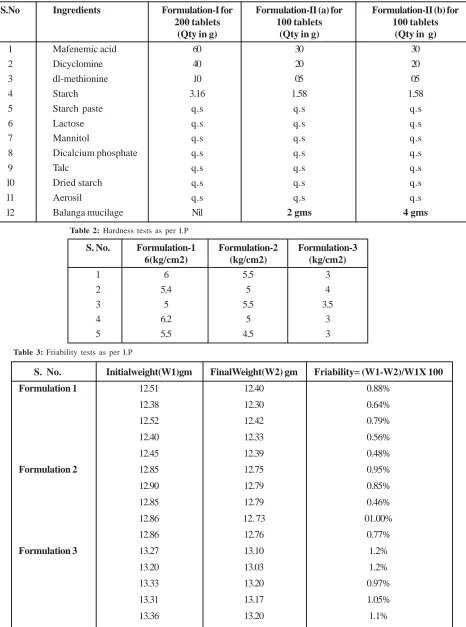
Three different formulations were prepared which are as follows: Formulation-I was prepared according to the standard procedure without the incorporation of balanga mucilage. Formulation-II was prepared by adding 2 g of balanga mucilage. Formulation-III was prepared by adding 4 g of balanga mucilage. These three formulations were compared by conducting the evaluation tests for tablet dosage forms such as weight variation, hardness, friability, disintegration and dissolution tests.
Formulation
The conventional tablets were prepared with wet granulation technique. The active ingredients were mixed with the diluents for about 4-5 min.Granulating agent was prepared with soluble starch in the form of a paste. Granulation was done by mixing the mass powders to form a dough. Disintegrating agent as per the formula was dried starch and balanga mucilage. The mucilage was mixed along with the wet dough. The dough was made to pass through a sieve of number10. The above obtained granules were dried in the hot air oven for about 30 minutes at a temperature of 45 degrees. The above dried granules after removing the fines were lubricated with talc and aerosol. The above granules were punched into tablets using 10mm punch of concave surface (Table 1).
Evaluation tests as per I.P. Hardness test
Monsanto hardness tester is used. The hardness of uncoated tablets should be between 3-7 kg/cm2 (Table 2).
Friability test
Roche friabilator is used. 20 tablets are selected at random and weighed. They are placed in a friabilator and operated for 100 revolutions at 25 rpm. The tablets are dropped at a distance of 6 inches with each revolution. The tablets are then dusted and reweighed. The acceptable limit is 0.5 to 1% (Table 3).
Disintegration test
The standard pharmacoepial disintegration apparatus is used. It consists of 6 glass tubes that are 3 inches long, open at the
top and bottom is held against a 10 no. screen. Tablet is placed in each tube and the basket rack is positioned in a 1 liter beaker of water at 37 0C such that the tablet remains 2-5
cm below the surface of liquid on their upward movement and descend not closer than 2-5 cm from the bottom of the beaker. A standard motor device is used to move the basket assembly ontaining the basket up and down through distance of 5-6 cm at a frequency of 28-32 cycles/min. limit specified is 5-30 min. (Table 4).
Estimation of methionine in the pharmaceutical dosage forms by applying orthogonal polynomials
Methods
A novel method for the estimation of DL-Methionine in various pharmaceutical dosage forms like tablets and syrups was developed. The absorbance of the solution was measured at 570 nm. Beer-Lambert’s law was observed to obey in the range of 10-100 µg. In the estimation of methionine in pharmaceutical dosage forms, the quadratic polynomial coefficient was computed by measuring the fluorescence of the drug in 0.01N hydrochloric acid and six points equally spaced at 5nm levels on the emission spectrum from 550 to 575 nm were plotted. The quadratic polynomial coefficient was found to be linear (directly proportional) to the concentration in the range 0.5 to 2.0µg.
Method - A
For quantitative analysis, mafenemic acid, dicyclomine, methionine suspension (20 mg) was transferred to 100 ml. calibrated flask and made up to the mark with water. In the case of tablets accurately weighed powder equivalent to 20 mg of methionine was transferred to 100 ml of calibrated flask and made up to the mark with water. Weigh accurately 20 mg of the reference standards and transferred into a 250 ml calibrated flask and make up to the mark with water. Filter the test reference standard solution, and pipette 5 ml of the test and reference standard into 25 ml calibrated flasks. The flasks are kept for 20 minutes in the boiling water along with the blank. The violet blue coloured chromogen having a maximum absorbance was recorded at 570 nm. The flasks were allowed to cool to room temperature before being made up to mark with water and the absorbance of the test and reference standard solutions were read against blank at 570 nm. (Table 5).
Method - B
P2f=(5) F550 -(1) F555 - (4) F560 – (4) F565 (-1) F570 + (5) F575 …Eq 1
Where F is the value of fluorescence and the subscript denotes the wavelength at which it is measured and the figures in the brackets taken from standard texts on numerical analysis. The quadratic polynomial coefficient (P2f) was more for the segment 550 to 575 nm and, hence, was chosen for the method(George,1968 and Rao,1966). The amount of drug content in the dosage form was calculated from equation 2.
Vt / Vs x Ws/ Wt x A.W/D x 100 = % of the label claim. …Eq. 2
Where Ws and Wt are the weights of the standard drug and the sample preparation.A.W is the average weight of the tablet and D the labeled drug content, all the weight being expressed in the mg. Vt and Vs are the values of quadratic polynomial coefficient, calculated for the test and standard, respectively, using Eq….active ingredients like asprin, Ibuprofen and excipients like mannitol, parabens, sugar. Essence and coloring agents did not interfere with proposed method as indicated by the quantitative recovery. The proposed method can be used for quantitative analysis of methionine in market formulations.
Results and Discussion
Chemical tests of Lallemantia royleana Benth
Balanga powder was subjected to ruthenium red test, gave reddish pink colour, indicating the presence of mucilage in the seeds. The above powder was also subjected to molisch test formation of reddish pink ring indicates the presence of carbohydrates.
Evaluation of physical properties of tablets
The hardness of tablets of all the three groups of formulations 1, 2, and 3. was measured and was found to be within the range of 5.0-6.2, 4.5-5.5,3.0-4.0, respectively. The addition of balanga mucilage appears to have reduced the bulk density of the powder blend and subsequently granules. However, the reduction in hardness for formulation 3 was found to be within the acceptable limits.
The three formulation categories were subjected to comparative studies, taking their friability into account. The friabilities of three formulations were found to be in the range of 0.48-0.88%,0.46-1.0%, and 0.97-1.2%, respectively. The increase in friability is attributed the proportionate increase in the content of balanga from formulations 1-3. However, the friability of formulation 3 is still within the acceptable limits. The three formulations were again subjected to disintegration test. The disintegrating times of the three formulations were found to be within the ranges of 5 min 50
sec,7.0 min, 3 min 50 sec,4min 50 sec.and 1 min 10 sec ,2 min 18 sec, respectively. The subsequent reduction in the disintegrating time is attributed again to the increase in the content of balanga. The disintegrant, particularly of mucilage’s, swell in the presence of water and exert pressure on the granules to force them apart quickly.
Both isomers of methionine D and L forms, gave Rf values 0.32 and 0.40, respectively. The test sample showed the presence of both the isomers. The violet blue chromogen gave linear responses on the concentration range 10-100 mcg. The recovery experiments gave 98 to 99% recovery with 99 to 100% reproducibility by method A as shown in Table 5.
Also the formulation was put on trial for the estimation of percentage purity of methionine by applying orthogonal polynomials to all the three formulations. The formulation 1 was considered as the standard and the other two formulations were compared with that of the standard one. The quantitative analysis for methionine in the test formulations 2 and 3 showed that the foreign absorbance’s were ignored by the application of the polynomial coefficients. The analysis was done by the application of quadratic polynomials with taking 6 points into consideration.
Conclusion
It is ascertained that natural disintegrants are far more superior to the synthetic ones. The disintegrant (balanga mucilage) is found to be absorbing water instantly, followed by its imbibition. This results in the easy break down of the tablets in turn resulting in the deaggregation of all the granules. Furthmore, mucilage of balanga seeds also helps in the dissolution of the drug. The high water absorption tendency of balanga mucilage which encircles each drug particle retains water within the vicinity and promotes the drug solvation. Balanga mucilage is found to be superior to other suitable disintegrants like aerosil (silica) in terms of action, availability
etc. Aerosil has been found to be less preferable as a
Table 1: Fromulation of tablets with natural ingredients
S.No Ingredients Formulation-I for Formulation-II (a) for Formulation-II (b) for
200 tablets 100 tablets 100 tablets
(Qty in g) (Qty in g) (Qty in g)
1 Mafenemic acid 60 30 30
2 Dicyclomine 40 20 20
3 dl-methionine 10 05 05
4 Starch 3.16 1.58 1.58
5 Starch paste q.s q.s q.s
6 Lactose q.s q.s q.s
7 Mannitol q.s q.s q.s
8 Dicalcium phosphate q.s q.s q.s
9 Talc q.s q.s q.s
10 Dried starch q.s q.s q.s
11 Aerosil q.s q.s q.s
12 Balanga mucilage Nil 2 gms 4 gms
Table 2: Hardness tests as per I.P
S. No. Formulation-1 Formulation-2 Formulation-3
6(kg/cm2) (kg/cm2) (kg/cm2)
1 6 5.5 3
2 5.4 5 4
3 5 5.5 3.5
4 6.2 5 3
5 5.5 4.5 3
Table 3: Friability tests as per I.P
S. No. Initialweight(W1)gm FinalWeight(W2) gm Friability= (W1-W2)/W1X 100
Formulation 1 12.51 12.40 0.88%
12.38 12.30 0.64%
12.52 12.42 0.79%
12.40 12.33 0.56%
12.45 12.39 0.48%
Formulation 2 12.85 12.75 0.95%
12.90 12.79 0.85%
12.85 12.79 0.46%
12.86 12. 73 01.00%
12.86 12.76 0.77%
Formulation 3 13.27 13.10 1.2%
13.20 13.03 1.2%
13.33 13.20 0.97%
13.31 13.17 1.05%
Table 4: Disintegration tests as per I.P
S. No. Formulation-I Formulation-II Formulation-II (time in min) (a) (time in min) (b) (time in min) 1. 7 min 4 min 10 sec 2 min 5 sec
2. 6 min 4 min 30 sec 1 min 50 sec
3. 6 min 20 sec 4 min 50 sec 1 min 40 sec
4. 7 min 10 sec 4 min 10 sec 2 min 3 sec
5. 5 min 50 sec 3 min 50 sec 1 min 10 sec
6. 6 min 2 sec 3 min 55 sec 2 min 18 sec
Table 5: Assay of methionine by the proposed method% amount found
S.No. Method-I Recovery studies Reproducibility
Standard 98.9 98.8 99.1
Formulation-1 99.2 99.1 98.9
Acknolwedgements
I sincerely thank to my guide, Dr. Mohammed Ibrahim, Principal, Nizam Institute of Pharmacy and Research Centre, for rendering his suggestions and helping me at each and every step of completion of this research work successfully.
References
Mohammad Amini, A. and Razavi, S. (2012). Dilute solution properties of Balangu (Lallemantia royleana) seed gum: Effect of temperature, salt, and sugar. International Journal of Biological Macromolecules, Elsevier, 51:3.
Benesh, F.C. and Carl, G.F. (1978). Methyl Biogenesis, Bio Psychiat,
13(4):465-480.
Braj Kishore Malavya and Shikibhushan Dutt ( 1941). Chemical examination of the fixed oil derived from the seeds of Lallemantia
royleana Benth. Ph.D. Thesis, Department of Chemistry, University
of Allahabad, Allahabad, U.P. India.
Chaitow L. (1985). Amino acids in therapy. Northamptonshire, UK: Thorsons Publishers Ltd.
Cryer, B. and Feldman, M. (1998). Cyclooxygenase-1 and cyclooxygenase-2 selectivity of widely used nonsteroidal anti-inflammatory drugs. Am. J. Med. May, 104(5):413-421.
George, W.S and William, G.C. (1968). Statistical Methods, Oxford and IBH. (6th edition, Indian). IBH Publishing Co. Calcutta.
Meredith, T.J. (1978). Paracetamol poisoning in children. BMJ: 2:478-4 79
Murphy, D.R.; Wexman, M.P. and Grieco, A.J.(1985). Methionine intolerance, a possible risk factor for coronary heart disease. JACC,
6(4):725-730.
Oluwatoyin A. Odeku, (2008), Theories of disintegration. .pharmainfo.net/tablet-evaluation- tests/disintegration/theories-disintegration.
Chananont, P. and Hamor, T. A. (1981). Stereochemistry of anticholinergic agents. XV. Structure of 2-(diethylamino)ethyl 1-cyclohexylcyclohexanecarboxylate hydrochloride (dicyclomine hydrochloride) Acta Cryst, 37:1371-1375.
Shangraw, R.F.; Mitrevej, A. and Shah, M. (1980). A new era of tablet disintegrants. Pharm Technol., 4:49-57.