R E S E A R C H A R T I C L E
Open Access
Exploratory randomized controlled trial
evaluating the impact of a waiting list control
design
John A Cunningham
1,2*, Kypros Kypri
3and Jim McCambridge
4Abstract
Background:Employing waiting list control designs in psychological and behavioral intervention research may artificially inflate intervention effect estimates. This exploratory randomized controlled trial tested this proposition in a study employing a brief intervention for problem drinkers, one domain of research in which waiting list control designs are used.
Methods:All participants (N = 185) were provided with brief personalized feedback intervention materials after being randomly allocated either to be told that they were in the intervention condition and that this was the intervention or to be told that they were in the waiting list control condition and that they would receive access to the intervention in four weeks with this information provided in the meantime.
Results:A total of 157 participants (85%) were followed-up after 4 weeks. Between-group differences were found in one of four outcomes (proportion within safe drinking guidelines). An interaction was identified between experimental manipulation and stage of change at study entry such that participant change was arrested among those more ready to change and told they were on the waiting list.
Conclusions:Trials with waiting list control conditions may overestimate treatment effects, though the extent of any such bias appears likely to vary between study populations. Arguably they should only be used where this threat to valid inference has been carefully assessed.
Keywords:Randomized controlled trials, Research methods, Waiting list control design, Alternate explanation, Alcohol, Brief intervention
Background
There has been growing concern over the use of waiting list control designs in psychological and behavioral inter-vention research [1-8]. While there are ethical advantages to a waiting list design because it allows for the provision of care (if delayed) to research participants who are seek-ing help, whilst permittseek-ing a non-intervention evaluation, it has been noted that such designs may overestimate intervention effects [1-7]. This is because participants assigned to a waiting list control condition appear to im-prove less (or not at all) than would be expected for
people who are concerned about their behavior and who are taking steps to change. In a discussion of this possibil-ity, Miller and Rollnick point out that examination of pat-terns of change in participants assigned to waiting list control conditions may indicate that they perceive they are expected to‘wait’to change until receiving the inter-vention and compliantly do so [9]. This contrasts with studies not employing waiting list designs in which control group participants tend to improve [10-12].
There has been some research on this topic, usually framed in the context of expectancies or demand char-acteristics, though there has been little dedicated study of the latter outside laboratory settings [13]. Previous studies have included a range of waiting list designs, some in which the participant is told that they will have to wait to receive treatment and others where a period
* Correspondence:[email protected]
1Centre for Mental Health Research, the Australian National University, Canberra, Australia
2Centre for Addiction and Mental Health, Toronto, Canada Full list of author information is available at the end of the article
of monitoring is described as a necessary baseline [14,15]. For the rare interventions where it is impos-sible for the participant to know whether they are re-ceiving an intervention (e.g., distance healing), research has also been conducted where the presence or absence of the intervention is crossed with the participant being told that they are, or are not, receiving the intervention in order to estimate the impact of expectancies [16]. Other factorial designs have also been used to evaluate unin-tended impacts of the research process [17].
Brief interventions for problem (i.e. hazardous or harmful) drinking is one area of research utilizing wait-ing list control designs [18,19]. Given evidence that problem drinking is often resolved without treatment [10,20], the use of a waiting list control design may be unethical if it has the effects ascribed to it. While other aspects of the research process have been evaluated in this field [21], there has been no experimental study of the effects of waiting list control conditions on partici-pant drinking, i.e., of reactivity within this research de-sign. In this exploratory randomized controlled trial we sought to develop a method for testing two hypotheses: Hypothesis 1: When given the same intervention mater-ial, people told that they are in the waiting list control condition will report heavier drinking at follow-up than people told that they are in the intervention condition (a main effect); Hypothesis 2: Participants who are more ready to change their drinking will report heavier drink-ing at follow-up compared to participants who are less ready to change (an interaction effect).
Methods
This study employed a ‘no difference’ trial paradigm in which all participants are given access to the same inter-vention while other aspects of the research process are experimentally manipulated [22]. Potential participants were recruited through Toronto newspaper advertise-ments inviting people ‘concerned about their drinking’ to help with the evaluation of self-directed interventions. The newspaper advertisement also mentioned that com-pensation would be provided and that the study was not a treatment program. Respondents telephoned study staff and were mailed out a consent form and baseline assessment questionnaire. Participants who returned the consent form and baseline questionnaire were randomized to be told that they were either in the: a) intervention con-dition and sent feedback generated from a known effective intervention, Check Your Drinking (CYD) website [23-26]; or b) waiting list condition and would be sent details of the intervention in 4 weeks and provided with information about their drinking in the meantime (which was identical to the feedback generated using the CYD website). See below for the exact content of this experimental manipula-tion. Follow-up was conducted four weeks after baseline
and participants received $20 for returning the follow-up questionnaire. Both baseline and follow-up assessments were conducted by postal questionnaire. After the follow-up questionnaire was returned, all participants were pro-vided access to the Alcohol Help Centre (AHC) online program and participants in the‘waiting list control condi-tion’were told that this was the intervention [27]. Thus, the only difference between the two groups was that those in one condition were told that they were receiving an intervention and those in the other were told that they had to wait four weeks before getting access to the interven-tion. The follow-up length of four weeks was partly chosen to replicate a published trial of a similar web-based inter-vention for problem drinkers which used a waiting list con-trol design [18].
Text used as experimental manipulation
Text used in intervention condition: “You are in the
intervention condition of this study. We have developed a personalized feedback intervention for people con-cerned about their drinking. We generated a Final Re-port for you from this intervention and it is included with this letter.”
Text used in waiting list condition:“You are in the
waiting list condition of this study. You will need to wait for 4 weeks until we can send you the intervention ma-terials. In the meantime, we have generated some per-sonalized information about your drinking and it is included with this letter.”
Ethics
After providing a description of the study to the sub-jects, written informed consent was obtained. This con-sent procedure and the conduct of the study were approved by the standing ethics review committee of the Centre for Addiction and Mental Health.
Baseline and outcome variables and analysis plan
variables were assessed at baseline and at follow-up. In addition, at baseline, participants provided information on their demographic characteristics, and completed the other items of the full AUDIT and the Readiness to Change (RTC) questionnaire [32,33].
Continuous outcome variables were examined for out-liers and Winsorized to normalize the distribution by re-placing values more than three standard deviations from the mean with the next highest value. Analyses for the continuous variables were conducted using stepwise linear regression in which the baseline value of each outcome variable was entered in Step 1. In Step 2, participant ex-perimental condition was entered. In addition, the Action subscale of the RTC was entered as a main effect continu-ous variable. Finally, in Step 3, an interaction term was added. The categorical variable, proportion of participants drinking within safe drinking guidelines, was compared between experimental conditions using Fisher’s exact test. Note that an earlier version of this analysis was conducted using logistic regression in order to allow the inclusion of the Action subscale as one of the predictors (including a main effect and an interaction term with experimental condition). However, as there was no significant (p> .05) main effect or interaction effect of the Action subscale, and because the inclusion of the Action subscale did not substantively influence the main effect of experimental condition observed, the simpler Fischer’s exact test is pre-sented in this paper. Data missing at follow-up were not replaced to mimic the treatment of missing data employed in studies evaluating brief interventions of this type with waiting list control designs [18] and because attrition was not judged likely to be problematica.
Study participants
A total of 191 participants responded to the newspaper advertisements and returned a signed consent form and baseline questionnaire. Of these, 185 were hazardous or harmful drinkers (as defined by an AUDIT score of 8 or more) and were included in this study. Bivariate compar-isons were made on demographic and baseline drinking characteristics between experimental condition and there were no significant differences (p> .05). The mean age of the 185 participants was 47.3 (SD 11.4), 70.3% were male, 55.1% had some post-secondary education, 31.4% were married or living in common law relationships, 52.4% were full or part-time employed, and 48.1% reported a family income of less than $30,000 per year. Baseline levels of problem drinking were quite severe for a community-recruited sample with a mean AUDIT score of 24.1 (SD 7.0; a score of 20 or more on the AUDIT is in-dicative of possible alcohol dependence). Participants re-ported typically consuming an average of 35.3 (SD 21.4) drinks per week, and the mean highest number of drinks consumed on one occasion in the last year was 14.7 (SD
7.5). Participants’ baseline AUDIT-C mean score was 9.0 (SD 2.0).
Results
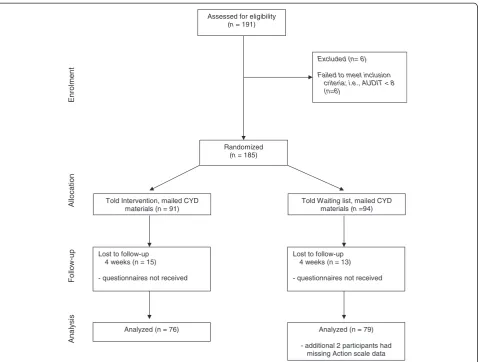
Follow-up rates were satisfactory with 157 (85%) return-ing their four-week survey. An additional two partici-pants did not complete the items for the Action subscale at baseline, leaving 155 participants available for analysis. Figure 1 provides displays an overview of the recruit-ment and follow-up rates of the trial.
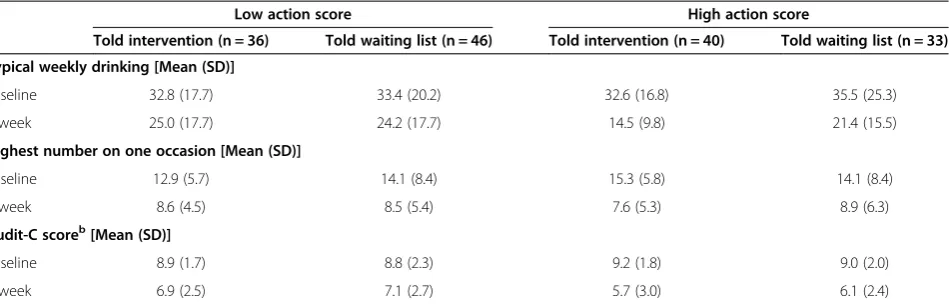
There were no significant differences in follow-up rates between experimental condition (Told intervention condition = 83.5%; Told waiting list = 86.2%; p= .68). Table 1 displays the data for the three regression lyses. In order to facilitate interpretation of these ana-lyses, Table 2 displays the means (SD) of the three continuous variables at baseline and follow-up, separated by experimental condition and a median split on partici-pants’ baseline Action subscale scores. For the outcome variable, typical drinks per week, there was a significant interaction between experimental condition and the Ac-tion subscale (p= .05). Inspection of the estimated mar-ginal means on Table 2 revealed that for participants who rated themselves as low on the Action subscale, condition allocation (waiting list or intervention) had lit-tle or no impact on their drinking. However, participants who scored themselves above the median on the Action subscale and who were in the waiting list condition re-ported drinking about 6 drinks per week more than their counterparts in the intervention condition. A similar pattern of results was observed for the largest number of drinks consumed on one occasion (p< .01). There were no significant experimental condition or interaction ef-fects (p> .05) for AUDIT-C scores.
Proportion drinking within safe drinking guidelines Despite scoring 8 or more on the AUDIT, 4.3% of partic-ipants [(8/185; or 4.5% (7/157) of particpartic-ipants followed-up], were drinking within safe drinking guidelines at the time of the baseline assessment. At follow-up, 20.4% (32/157) were drinking within safe drinking guidelines. There was a main effect of study condition, both on the proportion of participants drinking within safe drinking guidelines at follow-up (Fisher’s Exact test, p= .03; Told intervention condition = 27.6%; Told waiting list = 13.6%) and on the increase in proportion of those who did not drink within safe drinking guidelines at baseline but did so at follow-up (Fisher’s Exact test, p= .009; Told interven-tion condiinterven-tion = 25.0%; Told waiting list = 8.6%).
Discussion
research. The intention behind this study design was to achieve a contrast between the effect of intervention liberately confounded with expectancy (as is usually de-livered and evaluated), versus the effect of intervention without expectancy, thereby estimating the expectancy
effect as the difference between the two. Specifically, the design allows for a test of the impact of being told that the participant is in the waiting list control condition be-cause all participants are provided with the same interven-tion materials (the personalized feedback report generated
Assessed for eligibility (n= 191)
Excluded (n= 6)
Failed to meet inclusion criteria; i.e., AUDIT < 8 (n=6)
Randomized (n = 185)
Told Intervention, mailed CYD materials (n = 91)
Lost to follow-up 4 weeks (n = 15)
- questionnaires not received
Analyzed (n = 76)
Enrolment
Analy
s
is
Follow
-up
Allocat
ion
Analyzed (n = 79)
- additional 2 participants had missing Action scale data Told Waiting list, mailed CYD
materials (n=94)
Lost to follow-up 4 weeks (n = 13)
- questionnaires not received
Figure 1CONSORT flowchart.
Table 1 Relationship of four-week follow-up drinking with intervention condition and level of action for change intent after controlling for baseline drinking
Drinks per week Highest number AUDIT-Ca
Predictor ΔR2 β(95% C.I) ΔR2 β(95% C.I) ΔR2 β(95% C.I)
STEP 1 .32*** .45*** .19***
Baseline drinking 0.46 (0.35 - 0.56)*** 0.50 (0.41 - 0.59)*** 0.59 (0.39 - 0.79)***
STEP 2 .05** .01 .06**
Conditionb 1.51 (−2.71–5.73) 0.45 (−0.84–1.74) 0.27 (−0.50–1.03)
Action subscale −0.87 (−1.41 - -0.32)** −0.12 (−0.29–0.44) −1.65 (−0.26 - -0.06)***
STEP 3 .02* .03** .01
Condition*Action 1.08 (0.00 - 2.16)* 0.48 (0.16 - 0.81)** 0.14 (−0.06–0.34)
Note:*p≤.05. **p≤.01. ***p≤.001.
a
AUDIT-C is a composite measure that consists of respondents scores on frequency of drinking, drinks per drinking day, and frequency of five or more drinks on one occasion.
b
from the CYD online program). This design is equiva-lent to the subtractive expectancy placebo proposed by Suedfeld [34] where all participants are given the interven-tion but a randomized half is led to expect that it is inert with respect to the problem being treated. The advantage of the personalized feedback material for this particular study was that it was brief and could credibly be described as merely information to those in the waiting list control condition, while at the same time being a plausible inter-vention for those in the other study condition. As such, the feedback has intrinsic placebo properties and this intervention is not different in this respect from other interventions.
Mixed findings were obtained in relation to Hypoth-esis 1, only in the sense that while a lower proportion of participants in the control condition reported drinking within recommended guidelines at follow-up than their intervention group counterparts (an originally unplanned analysis), there were no between-group differences in the number of drinks per week, highest number of drinks on one occasion, and the heaviness of drinking measured with the AUDIT-C (the three planned outcome measures). The observed differences were in the anticipated direction and are generally coherent with an expectation that they would be statistically significant in a larger sample. Our test of Hypothesis 2 strengthens this possibility as it dem-onstrated heavier drinking among waiting-list control par-ticipants who were more ready to change compared to their counterparts receiving the“intervention.”This find-ing is consistent with the overarchfind-ing hypothesised mech-anism of effect, that waiting list allocation interrupts efforts at change, and also points to the importance of consideration of readiness for, or activities towards, change in this regard.
While it would be unjustified to conclude that a wait-ing list effect exists on the basis of statistically significant
main effects from one of the four outcomes, the inter-action effects observed here are provocative. For two of the continuous outcome variables, largest number of drinks on one occasion, and number of drinks in a typ-ical week, there were interactions between experimental condition and readiness to change (started to do some-thing about their drinking on entering the trial). It should be noted that these analyses were conducted in two different ways–the first using the categorical stages of change designation calculated using the full RTC scale [32] and the second employing just the action subscale. This repetition of analyses is justified given the explora-tory nature of this trial, though the lack of an a priori constructed data analysis plan is acknowledged. Also, the finding that only the action subscale was predictive of outcome aligns with findings from previous research on Stages of Change albeit using a different measure of the construct [35].
Despite the strengths in the employed research design, one limitation may also be implicit in it. An additive model is assumed in that both groups are intended to actually read the feedback report [36]. Any differences between groups in doing so, will serve to inflate appar-ent waiting list effects appar-entirely due to expectancies. Spe-cifically, if being told that being in the intervention condition makes one more likely to read, or to think about, the intervention material, then the nature of the effect involves an interaction and is thus more complex [36]. This means that the effects observed here are con-tingent upon this specific feature of this study. The ex-ploratory nature of this study also imposes various limits to inference. A power calculation was not undertaken a priori, making both the attainment of statistical signifi-cance here less important, and relatedly, clear and unam-biguous interpretation of study findings more challenging. Effect estimates for future larger replication studies are
Table 2 Mean (SD) drinking variables at baseline and four-week follow-up by study condition (told in intervention versus told on waiting list) and median split on Action stage variable (N = 155)a
Low action score High action score
Told intervention (n = 36) Told waiting list (n = 46) Told intervention (n = 40) Told waiting list (n = 33)
Typical weekly drinking [Mean (SD)]
Baseline 32.8 (17.7) 33.4 (20.2) 32.6 (16.8) 35.5 (25.3)
4-week 25.0 (17.7) 24.2 (17.7) 14.5 (9.8) 21.4 (15.5)
Highest number on one occasion [Mean (SD)]
Baseline 12.9 (5.7) 14.1 (8.4) 15.3 (5.8) 14.1 (8.4)
4-week 8.6 (4.5) 8.5 (5.4) 7.6 (5.3) 8.9 (6.3)
Audit-C scoreb[Mean (SD)]
Baseline 8.9 (1.7) 8.8 (2.3) 9.2 (1.8) 9.0 (2.0)
4-week 6.9 (2.5) 7.1 (2.7) 5.7 (3.0) 6.1 (2.4)
a
Analyses employed Action scale as a continuous measure (see Table1). Median split values on this table are provided for descriptive purposes.
b
now available in this study [37]. Another limitation was that there was no way to distinguish between those who were responding to the newspaper advertisements because they were looking for help regarding their drinking and those more motivated by the $20 for participating in the trial. To the extent that the financial incentive motivated participation it is likely that the observed differences under-represent the size of the true effects, particularly in light of the observed readiness to change findings. Alter-natively, if the newspaper recruitment resulted in a sample that was highly motivated to change (e.g., in comparison to a proactively recruited sample) then the results of this trial could overestimate the impact of a waiting list design in such a population. The latter possibility is highly un-likely in treatment studies for help seekers, but should be borne in mind for brief intervention trials based on oppor-tunistic recruitment in healthcare settings.
Future directions for this research include examining whether a waiting list control manipulation has more impact in particular research settings and with specific populations. For example, in situations where the ma-nipulation is delivered face-to-face, more reactivity rela-tive to the waiting list control condition may result. There is obvious value in examining the mechanisms be-hind the hypothesised negative impact of the waiting list control condition. This is particularly true for study pop-ulations of confirmed help-seekers. Qualitative interviews could also be used to investigate negative reactions of par-ticipants assigned to waiting list or other types of control conditions, particularly among those with clear prefer-ences. Separating true expectancy effects associated with compliance with demand characteristics implicit in wait-ing list study conditions from participants becomwait-ing irri-tated or disconsolate over not getting the help they hoped to receive and reduce their own efforts to drink less (termed resentful demoralization [38]) will be a further challenge to address when this field of investigation is more developed.
Conclusions
The results of this exploratory study give further weight to the generally increasing levels of scrutiny recently given to control conditions, and for the interpretation of findings from trials employing wait-list control designs in particular. Further, these results point to the need for caution regarding the ethics of assigning participants ac-tively ready to change to a waiting list control condition.
Endnote a
At the suggestion of one of the reviewers, the primary analyses were re-conducted using an intention-to-treat approach (missing data at follow-up replaced with the respective baseline values). However, as the pattern of
results was unchanged from that reported here, this al-ternative analysis was not reported in this paper.
Competing interests
The authors have no competing interests to declare.
Authors’contributions
JAC, KK, and JM conceived of the study. JAC conducted the study and the analyses. JAC wrote the first draft of the paper. KK and JM revised
subsequent drafts of the paper. All authors have read and approved the final version of the manuscript.
Acknowledgements
During the conduct of this research, John Cunningham was supported as the Canada Research Chair on Brief Interventions for Addictive Behaviours. Kypros Kypri is supported by a National Health & Medical Research Council Senior Research Fellowship (APP1041867) and a Senior Brawn Fellowship from the University of Newcastle Jim McCambridge is supported by a Wellcome Trust Research Career Development fellowship in Basic Biomedical Science (WT086516MA).
Author details
1Centre for Mental Health Research, the Australian National University, Canberra, Australia.2Centre for Addiction and Mental Health, Toronto, Canada.3Centre for Clinical Epidemiology and Biostatistics, School of Medicine and Public Health, University of Newcastle, Callaghan, NSW, Australia.4Faculty of Public Health and Policy, London School of Hygiene and Tropical Medicine, London, UK.
Received: 21 August 2013 Accepted: 29 November 2013 Published: 6 December 2013
References
1. Hart T, Fann JR, Novack TA:The dilemma of the control condition in experience-based cognitive and behavioural treatment research. Neuropsychol Rehabil2008,18(1):1–21.
2. Barkauskas VH, Lusk SL, Eakin BL:Selecting control interventions for clinical outcome studies.West J Nurs Res2005,27(3):346–363.
3. Whitehead WE:Control groups appropriate for behavioral interventions. Gastroenterology2004,126(1 Suppl 1):S159–S163.
4. Gaudiano BA, Herbert JD:Methodological issues in clinical trials of antidepressant medications: perspectives from psychotherapy outcome research.Psychother Psychosom2005,74(1):17–25.
5. Basham RB:Scientific and practical advantages of comparative design in psychotherapy outcome research.J Consult Clin Psych1986,54(1):88–94. 6. Hart T, Bagiella E:Design and implementation of clinical trials in
rehabilitation research.Arch Phys Med Rehabil2012,93(8 Suppl):S117–S126. 7. Mohr DC, Spring B, Freedland KE, Beckner V, Arean P, Hollon SD, Ockene J,
Kaplan R:The selection and design of control conditions for randomized controlled trials of psychological interventions.Psychother Psychosom 2009,78(5):275–284.
8. Freedland KE, Mohr DC, Davidson KW, Schwartz JE:Usual and unusual care: existing practice control groups in randomized controlled trials of behavioral interventions.Psychosom Med2011,73(4):323–335. 9. Miller WR, Rollnick S:Motivational Interviewing: Preparing People to Change
Addictive Behavior.2nd edition. New York, NY: Guilford Press; 2002. 10. Moyer A, Finney JW:Outcomes for untreated individuals involved in
randomized trials of alcohol treatment.J Subst Abuse Treat2002, 23:247–252.
11. de Bruin M, Viechtbauer W, Schaalma HP, Kok G, Abraham C, Hospers HJ: Standard care impact on effects of highly active antiretroviral therapy adherence interventions: A meta-analysis of randomized controlled trials. Arch Intern Med2010,170(3):240–250.
12. Jenkins RJ, McAlaney J, McCambridge J:Change over time in alcohol consumption in control groups in brief intervention studies: systematic review and meta-regression study.Drug Alcohol Depen2009,100(1–2):107–114. 13. McCambridge J, de Bruin M, Witton J:The effects of demand
14. Borkovec TD, Grayson JB, Cooper KM:Treatment of general tension: subjective and physiological effects of progressive relaxation.J Consult Clin Psych1978,46(3):518–528.
15. Harris KB, Miller WR:Behavioral self-control training for problem drinkers: components of efficacy.Psych Addict Behav1990,4:82–90.
16. Walach H, Bosch H, Lewith G, Naumann J, Schwarzer B, Falk S, Kohls N, Haraldsson E, Wiesendanger H, Nordmann A,et al:Effectiveness of distant healing for patients with chronic fatigue syndrome: a randomised controlled partially blinded trial (EUHEALS).Psychother Psychosom2008, 77(3):158–166.
17. McCambridge J, Butor-Bhavsar K, Witton J, Elbourne D:Can research assessments themselves cause bias in behaviour change trials? A systematic review of evidence from solomon 4-group studies.PLoS One2011,6(10):e25223.
18. Hester RK, Squires DD, Delaney HD:The Drinker’s Check-up: 12-month outcomes of a controlled clinical trial of a stand-alone software program for problem drinkers.J Subst Abuse Treat2005,28(2):159–169. 19. Postel MG, de Haan HA, ter Huurne ED, Becker ES, de Jong CA:
Effectiveness of a web-based intervention for problem drinkers and reasons for dropout: randomized controlled trial.J Med Internet Res 2010,12(4):e68.
20. Cunningham JA:Resolving alcohol-related problems with and without treatment: the effects of different problem criteria.J Stud Alcohol1999, 60(4):463–466.
21. McCambridge J, Kypri K:Can simply answering research questions change behaviour? Systematic review and meta analyses of brief alcohol intervention trials.PLoS One2011,6(10):e23748.
22. Kypri K, McCambridge J, Wilson A, Attia J, Sheeran P, Bowe S, Vater T: Effects of Study Design and Allocation on participant behaviour - ESDA: study protocol for a randomized controlled trial.Trials2011,12(1):42. 23. Cunningham JA, Wild TC, Cordingley J, van Mierlo T, Humphreys K:A
randomized controlled trial of an internet-based intervention for alcohol abusers.Addiction2009,104(12):2023–2032.
24. Doumas DM, Hannah E:Preventing high-risk drinking in youth in the workplace: a web-based normative feedback program.J Subst Abuse Treat2008,34(3):263–271.
25. Doumas DM, Haustveit T:Reducing heavy drinking in intercollegiate athletes: evaluation of a web-based personalized feedback program. Sport Psychol2008,22:213–229.
26. Doumas DM, McKinley LL, Book P:Evaluation of two Web-based alcohol interventions for mandated college students.J Subst Abuse Treat2009, 36(1):65–74.
27. Cunningham JA:Comparison of two internet-based interventions for problem drinkers: randomized controlled trial.J Med Internet Res2012, 14(4):e107.
28. Dawson DA, Grant BF, Stinson FS, Zhou Y:Effectiveness of the derived Alcohol Use Disorders Identification Test (AUDIT-C) in screening for alcohol use disorders and risk drinking in the US general population. Alcohol Clin Exp Res2005,29(5):844–854.
29. Babor TF, De La Fuente MF, Saunders JB, Grant M:AUDIT - The Alcohol use Disorders Identification Test: Guidelines for use in Primary Health Care.Geneva, Switzerland: World Health Organization; 1989.
30. Saunders JB, Aasland OG, Babor TF, De La Fuente JR, Grant M: Development of the Alcohol Use Disorders Identification Test (AUDIT): WHO collaborative project on early detection of persons with harmful alcohol consumption—II.Addiction1993,88:791–804.
31. Butt P, Beirness D, Cesa F, Gliksman L, Paradis C, Stockwell T:Alcohol and Health in Canada: A Summary of Evidence and Guidelines for Low-Risk Drinking.Ottawa: Canadian Centre on Substance Abuse; 2011.
32. Rollnick S, Heather N, Gold R, Hall W:Development of a short‘readiness to change’questionnaire for use in brief, opportunistic interventions among excessive drinkers.Br J Addict1992,87:743–754.
33. Heather N, Hönekopp J:A revised edition of the Readiness to Change Questionnaire.Newcastle: Northumbria University; 2008.
34. Suedfeld P:The subtractive expectancy placebo procedure: a measure of non-specific factors in behavioural interventions.Behav Res Ther1984, 22(2):159–164.
35. Bertholet N, Cheng DM, Palfai TP, Samet JH, Saitz R:Does readiness to change predict subsequent alcohol consumption in medical inpatients with unhealthy alcohol use?Addict behav2009,34(8):636–640.
36. McCambridge J, Kypri K, Elbourne D:In randomisation we trust? Possible problems in experimenting with people in behavioural intervention trials.J Clin Epidemiol. in press.
37. Campbell M, Fitzpatrick R, Haines A, Kinmonth AL, Sandercock P, Spiegelhalter D, Tyrer P:Framework for design and evaluation of complex interventions to improve health.BMJ2000,321(7262):694–696.
38. Cook TD, Campbell DT:Quasi-Experimentation: Design and Analysis Issues for field Settings.Chicago: Rand McNally; 1979.
doi:10.1186/1471-2288-13-150
Cite this article as:Cunninghamet al.:Exploratory randomized controlled trial evaluating the impact of a waiting list control design. BMC Medical Research Methodology201313:150.
Submit your next manuscript to BioMed Central and take full advantage of:
• Convenient online submission
• Thorough peer review
• No space constraints or color figure charges
• Immediate publication on acceptance
• Inclusion in PubMed, CAS, Scopus and Google Scholar
• Research which is freely available for redistribution