SAARC JOURNAL
OF
EDUCATIONAL
RESEARCH
Volume, 11. 2014
ISSN 1391-1880
NATIONAL INSTITUTE OF EDUCATION
Exploring Creativity: Creativity, Cognitive Styles and Learning Styles
among Engineering and Computing Students
Chathurika Sewwandi Kannangara
T2-54, First Floor, School of Education and Psychology, University of Bolton,
Deane Road, Bolton, BL3 5AB, United Kingdom.
Shailaja Shastri
Dean/ Professor, School of Social Sciences and Psychology, Jain University, J. C. Road, Bangalore, India.
Abstract
The purpose of the study was to understand and describe the level of non-verbal creativity and its relation to cognitive and learning styles of engineering and computing students. This might possibly provide engineering educators with knowledge of the above three factors and their adaptation to teaching and learning. The study was an exploratory-comparative study with one independent variable (engineering versus computing students) and three dependent variables [the Non-Verbal Test of Creative Thinking (Mehdi, 1973), The Group Embedded Figures Test, (Witkin et al, 1971); the Visual, Auditory, Read and Write Kinesthetic VARK Questionnaire , (Fleming, 1992) ]. The study aimed to compare the level of non-verbal creativity and influence of other attributes on the creativity of students of engineering and computing science. Additional aims were to see if there were significant differences in cognitive and learning styles of students from engineering and computing science. Data were collected by administering the three tests to engineering and computing students in three colleges in Bangalore (N=105). Data analysis was conducted using t-test, ANOVA, MANOVA and Pearson correlation coefficients. Findings indicated that engineering and computer students have above average levels of non-verbal creativity. Engineering students are more field-independent compared to computing students. Computing students are field-dependent in their cognitive style. Engineering and computer students focus more on the kinesthetic learning style. The implications of these findings for the education of engineering and computing students are discussed.
Introduction
Creativity is a complex construct and is most commonly expressed through a broad range of intelligences including linguistic, musical, mathematical, spatial, kinaesthetic, interpersonal perhaps even intrapersonal (Gardner, 1985). In simplest terms Robinson (2001) describes creativity as ‘imaginative process with outcomes that are original and of value’. It is also interesting to understand that reasoning, imagination and intuition have a reciprocal relationship to contribute to each other while one fails to act the other will be in action (Crane, 1983). While all our technological advances can be linked to above definitions and explanations of creativity, then the logic can be safely extended and the importance of creative thinking in engineering education can be firmly established.
Similarly, according to the demand of engineering courses, growing number of students and interestingly the focused issue of the gap between employability challenges and competencies among the engineering students in India can be addressed to some level by this current research focus. It’s not only in India, also in UK as well as in the world, creative problem solving skills are identified as essential abilities for fresh undergraduate engineers and also for professional engineers (Adams et al, 2010). Several surveys revealed that there is a remarkable gap in employability skills of passing out engineers and the mode of teaching-learning approach in Indian engineering colleges (Wipro Limited: Mission 10X Division, 2009). In the year 1990, with the embarked policy of rapid expansion in higher education in par with market demands in Singapore (Brown, 1996) that they have focused to equip their Politechnique graduates with a blend of creative abilities, logical reasoning and analytical abilities (Seng, n.d.). While the blends of the abilities were promoting and innovative conceptualization is prioritised, educators were the majorly challenged group since they were to train the graduates adaptable to such a changing environment (Seng, n.d.). Similarly, even in India, it is a call for equipped student’s skills pertaining creativity and fulfilling the demands of the enterprise.
With several considerations, it raises the question, what is creativity? What is the level of creativity of engineering students in Bangalore, India? Can creativity possibly be a part of the curriculum of engineering students to enhance their employability skills? Or What leads to creativity among engineering students? This research focused to explore how creativity and innovation can be linked to the engineering students learning and processing styles such as cognitive styles: field independent-field dependent and different learning styles. Can there be a model which integrates these aspects to the engineering curriculum?
Purpose
The purpose of this study was to describe the level of non-verbal creativity and it’s relation to cognitive and learning styles of engineering students, which might possibly provide engineering educators to acquire knowledge on inter relational effect on above three factors and its possible adaptation to teaching-learning-approach. The research sought to determine : (1) whether there were significant differences in non-verbal creativity of the students from different engineering disciplines (2) whether there were significant differences in cognitive styles of students from different engineering disciplines (3) whether there were significant differences cognitive style and non-verbal creativity (4) whether there were significant differences in learning styles of the students from different engineering disciplines (5) whether there were significant relationship between non-verbal creativity, cognitive style and learning style of engineering students.
Methodology Design and Instrumentation
An exploratory-comparative study with one dependent variable and three independent variables was established to compare the level of non-verbal creativity and influence of other three attributes on creativity of students in different engineering disciplines. The dependent variable of non-verbal creativity score provided by the Non-verbal test of Creative thinking by Mehdi (1985), the test is a pictorial test which includes three different activities as picture construction, picture completion and triangles and eclipses. Subjects who produced original, unusual, meaningful and unique responses have considered as creative (Mehdi, 1985) .
VARK questionnaire (version 7.1) originally developed by Fleming (1987) which was added with four categories in 1992 by Fleming and Mills as Visual, Auditory, Read & write and Kinesthetic was used to measure the students preferred learning style.
Data Collection
The three instruments of Non-verbal creativity, Cognitive style and Learning style were administered to 105 engineering college students which consists mechanical engineering, electronic engineering, Information science and Computer science attending three different engineering colleges in Bangalore, India. At each of the instrument administration sessions, exact procedures were followed. Subjects were read, verbatim, the instructions provided by each of the instrument administration manuals. Practical problems given in the manuals for practice have facilitated and ensured comprehension of the directions. The subjects first completed the Non-verbal creative thinking test since it is simple in instructions and no complexity is involved as well as it was to be given in the fresh mind set to obtain the better outcome of creativity from participants. Then Group embedded figure test was given and at last learning styles questionnaire was given to answer.
Data Analysis
The four engineering specialization groups’ scores on the Non-verbal creativity test were used as the dependent variable in analysis of variance (ANOVA). An ANOVA was utilized since the creativity is a single set of scores and specialization which is the independent variable is a categorical variable which consists four categories. The means of the scores are then analysed for significant differences. Similarly, Cognitive style score and specialization was compared through analysis of variance test for the mean differences to see whether there is any significant difference in cognitive style among the students of four engineering disciplines.
To conclude the analysis, the relationship between three main variables; creativity, cognitive style, and learning style were tested on Pearson correlation coefficient and analysed for inter-relatedness among three variables with reference to engineering specialization.
Findings
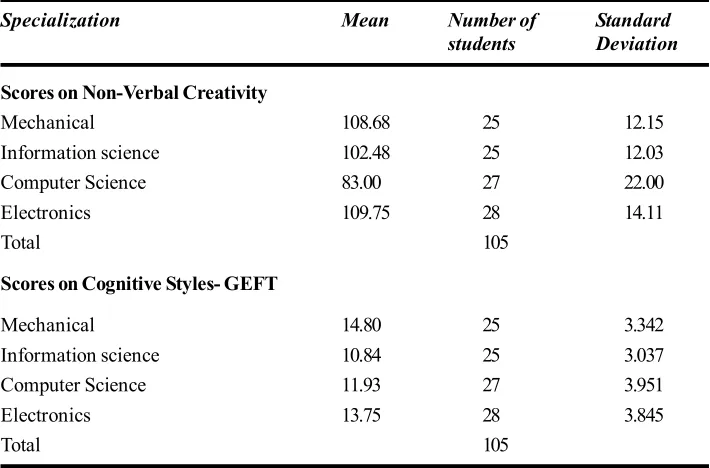
The first research question was “Whether there were significant differences in non-verbal creativity of the students from different engineering disciplines?” to answer this research question, data gathered by using Non-Verbal Creativity assessment ( Mehdi, 1973) were primarily analyzed using descriptive statistics such as mean and standard deviation. The table No 1 below shows the results.
Table 1: Mean and standard deviation on Non-Verbal Creativity and group Embedded Figure Test - GEFT scores of different Engineering discipline students
Specialization Mean Number of Standard
students Deviation
Scores on Non-Verbal Creativity
Mechanical 108.68 25 12.15 Information science 102.48 25 12.03 Computer Science 83.00 27 22.00 Electronics 109.75 28 14.11
Total 105
Scores on Cognitive Styles- GEFT
Mechanical 14.80 25 3.342 Information science 10.84 25 3.037 Computer Science 11.93 27 3.951 Electronics 13.75 28 3.845
Total 105
Table 2 : Analysis of variance of Non-verbal creative thinking ability, Cognitive Styles-Group Embedded Figure Test scores and Specialization
Source df SS MS F Effect Size
Non Verbal Creativity
Engineering Disciplines 3 12419.67 4139.90 16.73 .000* Error 101 24986.93 247.39
Total 104 37406.63
Cognitive Style- GEFT
Engineering Disciplines 3 241.79 80.59 6.29 0.001* Error 101 1294.46 12.82
Total 104 1536.25
*P < 0.05.
The Non-verbal creative thinking scores were initially analysed against their specializations using analysis of variance, results presented in table 2. Similarly, Cognitive style scores also analysed with analysis of variance for identifying the differences among engineering disciplines. According to the presented findings in table 2, which shows that two analyses of variances executed for the scores of Non-verbal creativity and Cognitive style on their mean differences in comparison between engineering specializations? Findings indicated that students from four engineering disciplines are significantly different in their Non-verbal creativity and Cognitive styles (Field independency and field dependency).
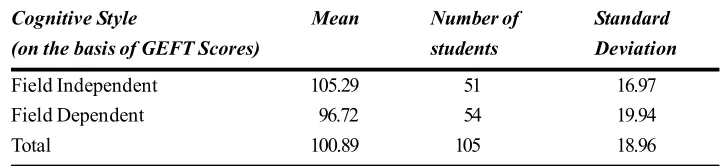
Research question “whether there were significant differences cognitive style and non-verbal creativity “ was answered by the assessment of cognitive styles test results. The results are summarized in Table 3 which provides the mean and standard deviations on non-verbal creativity scores of Field independent and Field dependent students.
Table 3: Mean and standard deviation on Non-verbal creativity scores of Field Independent / Field Dependent students.
Cognitive Style Mean Number of Standard
(on the basis of GEFT Scores) students Deviation
Further analysis of T-test results (Table 4) on Non-verbal creativity based on two cognitive styles, indicated that field independent individuals are significantly higher in creativity score when compared to field dependent individuals at p d” 0.05 confidence level. The creative thinking and cognitive styles had maximum possible scores of 18 and 130 respectively. For learning styles; visual style, aural style, read & write style and kinaesthetic style had obtained four different scores for each individual.
Table 4: T-test analysis for Non-Verbal Creativity among Field Independent and Field dependent engineering students.
Source Mean Standard df t Significance
Difference Error (2 tailed)
Difference
Non Verbal Creativity
Equal Variances Assumed 8.57 3.62 103 2.365 .020* Equal Variances not Assumed 8.57 3.60 101.92 2.376 .019*
*P < 0.05.
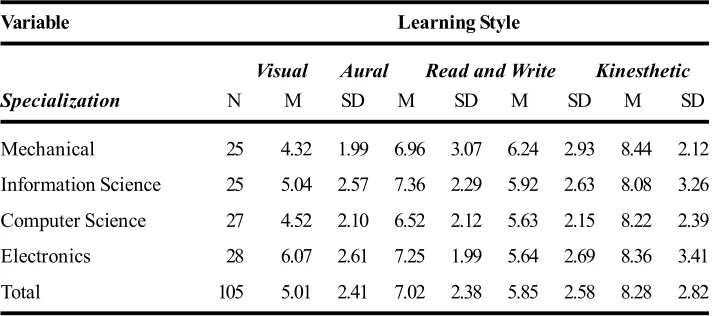
Table 5, reveals the mean and standard deviation values for different learning styles across four engineering disciplines.
Table 5: Learning Style scores means and standard deviation by hypothesis
Variable Learning Style
Visual Aural Read and Write Kinesthetic
Specialization N M SD M SD M SD M SD
Table 6a: Multivariate Analysis of Variance for Learning Style Scores according to different Engineering disciplines
Effect Multivariate test of significance
F Significance Hyp. Error
df df
Specialization Learning Style
Visual 3.044 .032* 3 101 Aural .657 .581 3 101 Read and Write .314 .815 3 101 Kinesthetic .972 .972 3 101
*P < 0.05.
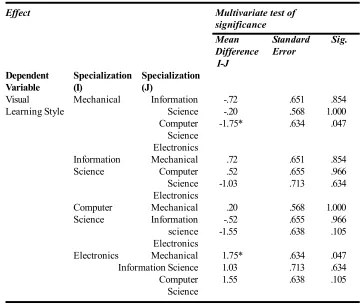
Table 6b: Multivariate Analysis of Variance for Visual Learning Style Scores across four Engineering disciplines
(Visual learning style is predominantly significant according to F ratio:Table 6a)
Effect Multivariate test of
significance
Mean Standard Sig.
Difference Error
I-J Dependent Specialization Specialization
Variable (I) (J)
Visual Mechanical Information -.72 .651 .854 Learning Style Science -.20 .568 1.000 Computer -1.75* .634 .047
Science Electronics
Information Mechanical .72 .651 .854 Science Computer .52 .655 .966 Science -1.03 .713 .634 Electronics
Computer Mechanical .20 .568 1.000 Science Information -.52 .655 .966 science -1.55 .638 .105 Electronics
Electronics Mechanical 1.75* .634 .047 Information Science 1.03 .713 .634 Computer 1.55 .638 .105
Science
According to mean values, all four engineering discipline students pre-dominantly preferred kinaesthetic style, which leads to an interesting finding of the research. Further test of Multivariate analysis of variance results presented in Table 6a and Table 6b, to identify the significant differences of learning styles across four engineering discipline students. Findings indicated a significant difference on visual learning style. Electronic engineering students have predominantly preferred visual learning style and have shown a significant relation at p d” 0.05 with their specialization of study. However, among other study specializations and learning styles there were no significant interactions indicated by the MANOVA test.
Finally, Pearson correlation coefficients were computed among the three variables of non-verbal creativity, cognitive style and learning style. The results of these correlational analysis indicated that visual learning style, creativity and cognitive style are positively correlated; also cognitive style and kinaesthetic learning style have shown a positive correlation with one another as well. The bivariate correlation between non-verbal creativity and cognitive style was r (102)=0.247, p< 0.05, and the bivariate correlation between non-verbal creativity and visual learning style was r (102)= 0.208, p < 0.05. Moreover, the bivariate correlation between cognitive style and kinaesthetic learning style was r (102) = 0. 243, p < 0.05. The results suggest that non-verbal creative thinking, cognitive style and visual learning style are positively correlated when compared and controlled for four engineering d of the disciplines of the sample.
According to mean values, all four engineering discipline students pre-dominantly preferred kinaesthetic style, which leads to an interesting finding of the research. Further test of Multivariate analysis of variance results presented in Table 6a and Table 6b, to identify the significant differences of learning styles across four engineering discipline students. Findings indicated a significant difference on visual learning style. Electronic engineering students have predominantly preferred visual learning style and have shown a significant relation at p d” 0.05 with their specialization of study. However, among other study specializations and learning styles there were no significant interactions indicated by the MANOVA test.
that non-verbal creative thinking, cognitive style and visual learning style are positively correlated when compared and controlled for students from four engineering disciplines of the sample.
Discussion
The results of this study confirms the possibility of enhancing and utilising creativity, cognitive styles and learning styles within the undergraduate learning environment supporting the goal of some of the surveys and research conducted in India (WIPRO Wipro Limited: Mission 10X Division, 2009; Padmini, H.A., Bharadwaj, A.K., Nair, T.R.G.,2009).
The comparisons between four engineering disciplines have indicated that their non-verbal creative thinking ability and field independency are higher and better in overall (Graph 1), and all four groups are indicated to have preferred kinaesthetic learning style mainly according to mean comparisons.
Graph 1: Normal Probability Curve on Non-Verbal Creativity among Engineering Students
A study conducted on a cognitive apprenticeship approach to engineering education: the role of learning styles (Poitras & Poitras, 2011), found that the cognitive apprenticeship approach can fulfil and consists a range of learning styles preferred, which would benefit in creating an optimal learning platform suits each student. Therefore, as a countering method to adopting preferred learning style in teaching-learning approach it can also be possible to adopt such techniques. But according to the current study, it suggest that an accountable number of students in the study preferred the kinaesthetic learning style dominantly among engineering disciplines.
However, findings indicated that groups are more of field independent and simultaneously field independent students also have obtained significantly higher non-verbal creative thinking scores. Furthermore, electronics engineering group have indicated that they prefer visual learning style when compared to other three groups, even though kinaesthetic is common to all the four disciplines.
Finally, it was also shown that there is an inter-relational effect between cognitive styles, creativity and learning styles; especially when focused to electronic engineering, visual learning style and cognitive style. Moreover, Computer science and information science students have indicated to be field dependent when compared to other two engineering specialization groups.
Acknowledgements
References
Adams, J., Kaczmarczyk, S., Picton, P., & Demian, P. (2010). Problem solving and creativity in engineering: conclusions of a three year project involving reusable learning objects and robots. Engineering Education, 5(2), 4-14.
Bellinger, R. (1998). Professional development sessions dominate; new poll on engineers’ image released—PACE conference hits ‘a year of transition. Electronic Engineering Times.
Brown, S. (1996). A view of Temasek Polytechnic. A special supplement. Innovations in Education and Training International, 33 (4).
Crane, L. (1983). Unlocking the brain’s two powerful learning systems. Human Intelligence News Letter, 4, (4), 7.
Fleming, N.D. and Mills, C. (1992), Not Another Inventory, Rather a Catalyst for Reflection, To Improve the Academy, Vol. 11, 1992., page 137.
Gardner, H. (1985). The mind’s new science: A history of the cognitive revolution. New York: Basic Books.
Mehdi, B. (1973). “Manual of Verbal and Non-verbal Tool of Creativity”. Psychological Corporation of India, Kachari Ghat, New Delhi.
Padmini, H. A., Bharadwaj, A., & Nair, T. (2009). Approaches to Curriculum and Teaching Materials to Bring out Better Skilled Software Engineers – An Indian Perspective.
EDULEARN09 Conference, (pp. 990-994). Barcelona, Spain.
Poitras, G., & Poitras, E. (2011). A cognitive apprenticeship approach to engineering education: the role of learning styles. Engineering Education, 6(1), 62-69. Robinson, K. (2001). Out of our minds: Learning to be creative. Oxford: Capstone
Publishing Limited.
Seng, T. (n.d.). Thinking Skills, Creativity and Problem Based Learning. Singapore: Temasek Polytechnic.
Stouffer, W. B. (2004). Making The Strange Familiar: Creativity and the Future of Engineering Education. American Society for Engineering Education Annual Conference & Exposition (pp. 1-10). American Society for Engineering Education.
Wipro Limited: Mission 10X Division. (2009). One Mission Journey Book 2. Mission 10X, 5-10.
Witkin, H., Oltman, P., & Raskin, E. &. (1971). A Manual for The Group Embedded Figure Test. Palo Alto, CA: Consulting Psychologists Press, Palo Alto, CA.