P R O T O C O L
Open Access
Pharmacologic interventions for painful diabetic
neuropathy: an umbrella systematic review and
comparative effectiveness network meta-analysis
(Protocol)
Marcio L Griebeler
1*, Apostolos Tsapas
2, Juan P Brito
3, Zhen Wang
4, Olivia J Phung
5, Victor M Montori
5and M Hassan Murad
5Abstract
Background:Neuropathic pain can reduce the quality of life and independence of 30% to 50% of patients with
diabetes. The comparative effectiveness of analgesics for patients with diabetic neuropathy remains unclear. The aim of the current work, therefore, was to summarize the evidence about the analgesic effectiveness of the most common oral and topical agents used for the treatment of peripheral diabetic neuropathy.
Methods:We will use an umbrella approach (systematic review of systematic reviews) to identify eligible randomized controlled trials (RCTs) for the most common oral or topical analgesics for painful diabetic neuropathy. Two reviewers will independently determine RCT eligibility. Disagreement will be solved by consensus and arbitrated by a third reviewer. We will extract descriptive, methodological and efficacy data in duplicate. Results will be pooled and analyzed using classic random-effects meta-analyses and network meta-analyses to compute the absolute and relative efficacy of therapeutic options. We will use theI2statistic and Cochran’s Q test to assess heterogeneity. Risk of bias and publication bias, if appropriate, will be evaluated, as well as overall strength of the evidence.
Discussion:This network meta-analysis aims to synthesize available direct and indirect evidence of effectiveness of analgesics in the treatment of painful diabetic neuropathy. The network approach will offer the opportunity to generate a ranking based on efficacy and along with known side effects, costs, and administration burdens will enable patients and clinicians to make choices that best reflect their preferences for treatment of painful diabetic neuropathy.
Keywords:Comparative effectiveness research, Diabetic neuropathy, Network meta-analysis, Systematic review
Background
Diabetic neuropathy is the most common complication of diabetes. It usually has a distal symmetric pattern that slowly progresses proximally with major implications to quality of life. It affects the function, mood and sleep patterns of the majority of affected patients. Symptoms include neuropathic pain, burning, tingling, decreased sensation, and loss of temperature perception [1-4]. Neuropathic pain is present in 30% to 50% of patients with diabetes [5,6].
Glycemic control has been shown to be effective in slow-ing the progression of diabetic neuropathy [7]. Patients with painful neuropathy often need other agents to palliate their symptoms. Agents used include tricyclic antidepres-sants, anticonvulantidepres-sants, serotonin-norepinephrine reuptake inhibitors, opiates, opiate-like substances and topical medi-cations. However, these medications usually at best provide only partial pain relief [2,5,6].
There is no clear evidence-based guidance about treat-ment selection of analgesic agents for painful diabetic neuropathy. Stepwise approach and algorithms may be used, but comparative effectiveness of treatments to control pain in patients with diabetic neuropathy is * Correspondence:[email protected]
1
Division of Diabetes, Endocrinology, Metabolism and Nutrition, Department of Medicine, Mayo Clinic, Rochester, MN 55905, USA
Full list of author information is available at the end of the article
unclear and there is no evidence of relative superiority across the different drug classes or the individual agents.
We therefore decided to conduct a systematic review to appraise and summarize the totality of evidence regarding the efficacy of the most common non-parenteral (oral and topical) analgesic therapeutic options for the treatment of diabetic neuropathy.
Methods Objectives
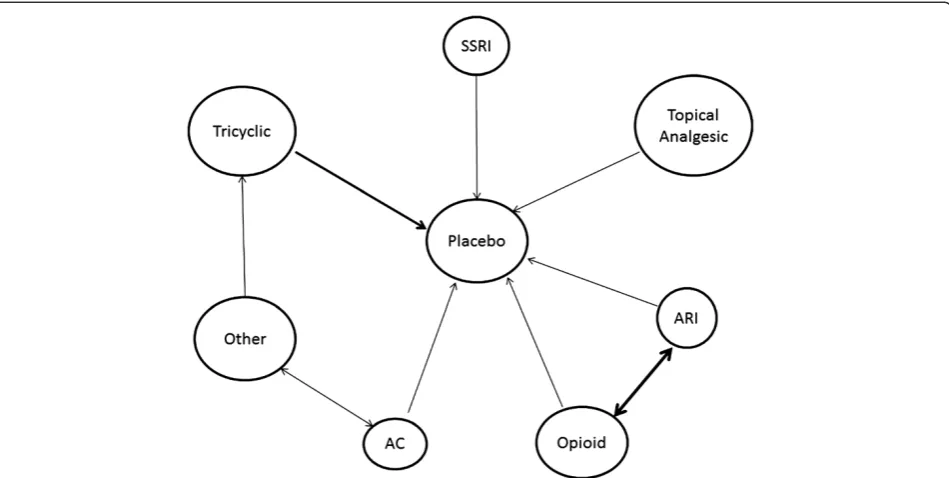
Considering the large number of pharmacologic therap-ies and the availability of multiple systematic reviews that identified the efficacy trials of these drugs, we decided to follow an‘umbrella’[8,9] approach to identify eligible randomized controlled trials (RCTs). In brief, we will identify systematic reviews that compare available therapeutic options for painful diabetic neuropathy to placebo or any other active comparators. Eligible system-atic reviews will be retrieved and used to identify relevant RCTs. We will subsequently build a dataset comprising eligible RCTs to obtain, critically appraise for quality, and extract data from each RCT to be used for the meta-analyses of relevant outcomes. Extracted data will be combined using a network design to draw infer-ences about the absolute and relative efficacy (from dir-ect and indirdir-ect comparisons) of individual therapeutic options (Figure 1).
Umbrella systematic review
Interventions
Two study investigators with expertise in diabetes (VMM and AT) provided input about the most common drugs used for diabetic neuropathy in USA and Europe. A list describing the most commonly used therapies deemed eli-gible for this review, with their minimum effective dose and therapeutic range based on American Diabetes Asso-ciation (ADA) recommendations or expert opinion is pre-sented in Table 1. For a trial to be included, the intervention dose evaluated must be at least the minimum effective dose cited in Table 1. This was set to reduce the risk of bias when an agent is compared to an ineffective dose of a competitor. If more than one dose is evaluated within the same RCT, we will include the results of patients treated with the highest dose in the efficacy com-parisons, again ensuring that this dose is within the usual or recommended use of the agent.
Study design
During the umbrella stage of this systematic review, we will perform a literature search for all systematic reviews (any review with a clear and relevant clinical question, an explicit strategy and list of results) summarizing evidence from randomized trials testing treatments for painful diabetic neuropathy or neuralgia (Additional file 1).
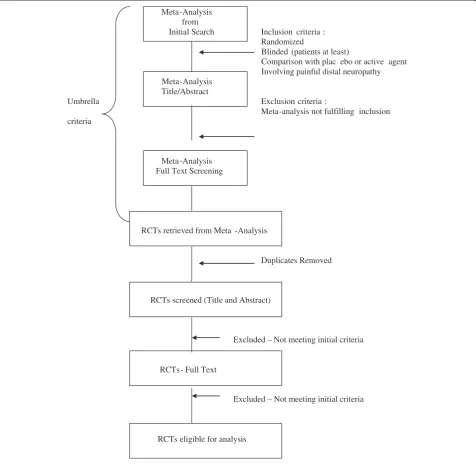
From these reviews, we will identify eligible trials. These should enroll patients with painful distal symmet-rical polyneuropathy and randomly allocate these patients to treatment and control while keeping patients unaware of the therapy to which they have been allo-cated. There will be no restriction based on language of publication, number of patients or type of diabetes. Figure 2 illustrates the process of study selection.
Information sources and search methods
We will conduct a comprehensive literature search for systematic reviews published in the last 5 years (2007 to 2011) for diabetic neuropathy or neuralgia in major elec-tronic databases (MEDLINE™ via Ovid, EMBASE via Ovid, and the Cochrane Database of Systematic Reviews). Two study investigators with experience in systematic reviews (VMM and MHM) and an expert reference librar-ian developed the search strategy (Additional file 1) using a combination of controlled vocabulary (MeSH terms) and key words for the concepts of treatment of neuralgia or diabetic neuropathy.
Two reviewers working independently will identify by title and abstract screening systematic reviews for the treatment of diabetic neuropathy. We will retrieve system-atic reviews and meta-analyses deemed to be relevant and review them in full text to extract all eligible RCTs. These will be retrieved in full text for further assessment.
Two reviewers will independently determine RCT eli-gibility. Disagreement will be solved by consensus, or if consensus is not achieved a third reviewer will serve as an arbitrator. We will assess chance-adjusted agreement (κ statistic) for each step. We will extract descriptive, methodological and analgesic efficacy data in duplicate.
Outcomes
The main outcome of this study is improvement of pain. We are going to assess this outcome both as a dichotom-ous (for example, percentage of patients experiencing an improvement of pain of at least≥30%) and a continuous variable (for example, standardized mean difference on a pain scale). If both dichotomous and continuous outcome data are available from the same trial, data for each vari-able will be analyzed separately. If pain is reported both in upper and lower extremities, we will analyze data only for the lower extremities. We understand that several out-comes describing pain may be reported and we have therefore decided to build a hierarchy of the pain out-comes we will consider. We will prefer, in decreasing order of relevance, intensity, overall pain, quality, dur-ation, and timing. If pain is reported at multiple time points, we will assess efficacy of treatment at subacute (≤3 months) and chronic timeframes (anything >3 months). If multiple assessments are reported, we will use the longest time point within the aforementioned categories.
Griebeleret al. Systematic Reviews2012,1:61 Page 2 of 7
We expect a significant variety of scales measuring our outcomes of interest. We will standardize all scales, hence creating a unitless metric of pain, by expressing differences in number of standard deviations (standar-dized difference), which will allow comparison among the different scales (Figure 3).
For parallel-arm placebo-controlled trials and com-parative effectiveness head-to-head trials, differences will be calculated between arms. Crossover trials are going to be analyzed according to recommendations from the Cochrane Handbook for Systematic Reviews of Interven-tions [8].
The network approach will generate a ranking list based on efficacy. According to the results we will rank all the included medications from most to least effective based on their effect on pain scores.
Data collection and extraction
Data from RCTs will be extracted in duplicate, by independent reviewers, using a standardized, piloted, web-based data extraction form. We will re-extract data from each randomized clinical trial on patient demo-graphics, baseline characteristics (duration of diabetes, hemoglobin A1c (HbA1c)), study design, sample size, intervention type (class, type and dosages), scale type, reporting of functional status outcomes or impaired sleep pattern.
Risk of bias assessment
We will use the Cochrane Collaboration’s risk of bias tool to evaluate the methodological quality of RCTs. Two reviewers will independently assess risk of bias using the following domains: random sequence generation (ad-equate if based on computer generated random numbers, tables of random numbers or similar), allocation conceal-ment (adequate if based on central randomization, sealed envelopes or similar), blinding of patients care givers or outcome assessors, incomplete outcome data (due to high rate of discontinuation, loss to follow-up, type of analysis, or imputation of missing data), selective reporting and other bias (source of funding, whether by not-for-profit or for-profit sources.) Disagreements between reviewers will be resolved by discussion or will be arbitrated by a third reviewer (MHM). We will summarize the risk of bias at all six domains to produce an overall risk of bias for every trial. This will be deemed high if there is presence of high bias in any key domain (allocation concealment or blind-ing of patients), low if risk of bias is low for all key domains, and unclear in all other cases. We chose a priori to consider allocation concealment and blinding as key quality domains, due to their relative importance for as-sessment of subjective outcomes such as pain, and have formulated an a priori rule to summarize risk of bias for every class of outcomes across domains, based on scoring of risk of bias in every domain of the Cochrane Risk of Bias tool [8].
Grading of quality of evidence
We will use the GRADE (‘Grading of Recommendation, Assessment, Development and Evaluation’) framework to evaluate the quality of evidence. Evidence derived from the RCTs will be initially considered high (at low risk of bias) and subsequently downgraded based on methodological limitations, imprecision, inconsistency, indirectness and publication bias [10]. A final generated grade will reflect the confidence we have in the reported estimate of effect.
Statistical analysis
We will pool odds ratios (ORs) for pain improvement reported as a dichotomous outcome and standardized
mean differences (SMDs) using Hedges’ adjusted g for pain scores based on different scales from included stud-ies, accompanying 95% confidence intervals (CI). Then, we will conduct pairwise meta-analyses and estimate the combined efficacy of treatment using a random effects model using the method of DerSimonian and Laird, with the estimate of heterogeneity being taken from the Mantel-Haenszel model [11]. Network meta-analyses will be adopted to combine direct and indirect evidence using Lumley’s generalized linear mixed models based on Frequentists’ method. The Bayesian Markov Chain Monte Carlo method will also be used as an alternative statistical method to validate the results.
Generalized linear mixed models
We will construct linear mixed models to combine dir-ect and indirdir-ect evidence. First introduced by Lumley [12], linear mixed models can be used to estimate the effects of an indirect comparison with two or more link-ing treatments (paths). For example, to pool the indirect evidence between treatment A and treatment B, we can combine estimates from treatment A to treatment C, treatment B to treatment C, treatment A to treatment D, and treatment B to treatment D. Another advantage of linear mixed models is it can evaluate the agreement of indirect comparisons through different linking treat-ments, also called‘incoherence’, and incorporate the in-coherence in the calculation of confidence interval of the pooled estimate. If there is direct evidence, linear mixed models also allow us to pool direct and indirect evidence and get more efficient estimate. R statistical software V. 2.15.1 will be used to fit generalized linear mixed models.
Dealing with missing data
It is likely that some eligible RCTs will not report all relevant data such as the standard deviation or other im-portant variability measures [13]. In order to include these studies in the analysis we will try first to calculate them through algebraic manipulation of the available in-formation such as confidence intervals, p or t values. If that was not possible, we will attempt to contact study authors for these data. If that approach also failed we will borrow these measures from other similar studies as Furukawaet al. suggested. When assumptions are made in estimating these measures, such assumptions will be tested in sensitivity analysis [14].
Subgroup analysis
To investigate potential heterogeneity across studies, we will conduct subgroup analysis based on class of medi-cine, quality of evidence (low and unclear risk of bias vs high risk of bias), oral versus topical agents, HbA1clevel, duration of diabetes, and patients’age. Random effects Table 1 Most commonly used therapies for treatment of
diabetic neuropathy
Class Medication Minimum effective dose (total daily dose)
Tricyclics Amitriptyline 50 mg
Desipramine 100 mg
Imipramine 100 mg
Nortriptyline 50 mg
Selective serotonin reuptake inhibitors
Duloxetine 60 mg
Paroxetine 40 mg
Venlafaxinea 75 mg
Anticonvulsants Carbamazepine 600 mg
Gabapentin 900 mg
Lamotriginea 100 mg
Oxcarbazepinea 600 mg
Pregabalin 150 mg
Sodium valproatea 400 mg
Topiramatea 100 mg
Topical analgesics Capsaicin 0.0075%
Doxepina
Lidocaine 5% patcha
Mexiletinea
Pentoxifylinea
Analgesic opiates Morphinea 15 mg
Oxycodone 20 mg
Tapentadola 100 mg
Tramadol 100 mg
Aldose reductase inhibitorsa
Epalrestat 150 mg
Ranirestat 20 mg
Fidarestat 1 mg
Ponalrestat 600 mg
Sorbinil 250 mg
Various Lacosamidea 100 mg
a
No dose recommended by the American Diabetes Association.
Griebeleret al. Systematic Reviews2012,1:61 Page 4 of 7
meta-regression models will be used to quantify the dif-ference between subgroups and test for statistical signifi-cant interactions among subgroups.
Sensitivity analysis
We will conduct sensitivity analysis to assess the effects of individual studies on the combined estimates and de-termine whether certain studies dominate the pooled event (particularly if these studies were at high risk of bias). Any imputations made for measures of dispersion (that is, standard deviation) of the difference in pain out-come will be tested in sensitivity analysis. If correlation coefficients are needed to estimate standard deviations, Figure 3Formula for standard error calculation.
different coefficients will be tested. If certain studies have borderline eligibility status for any reason, analysis will be conducted with and without such studies. Finally, a major sensitivity analysis would be to determine whether Bayesian analysis results are different from the Frequentist method ones. Robustness of analysis (consistency throughout sen-sitivity analyses and assumptions) would increase our con-fidence in the comparative effectiveness analysis.
We also plan to use the Bayesian Markov Chain Monte Carlo method to combine direct and indirect evidence and fit the model in WinBUGS V. 1.4.3 [15,16]. This method allows for the pooling of indirect and direct com-parisons of effect between the different classes of therapy for diabetic neuropathy, while preserving within-trial randomization, and allowing comparisons of agents not addressed within any of the individual trials [15,16]. A random-effects model will be fitted due to potential for heterogeneity among included trials. The posterior distri-bution of all parameters will be estimated using non-informative priors, in order for results to be represented solely by the included data. Results will be based from 100,000 iterations, after a 50,000-iteration burn-in. Incon-sistency will be evaluated by comparing the estimates from direct comparisons and those from the indirect com-parisons for the magnitude and direction of effect. Appro-priateness of model fit will be evaluated using the residual deviance, where good model fit is represented by the re-sidual deviance value approximating the number of un-constrained data points [17]. The Bayesian Markov Chain Monte Carlo method will provide us an alternative statis-tical method to validate our results.
We will use theI2statistic and Cochran’s Q test to as-sess heterogeneity across studies. We will explore het-erogeneity for potential intraclass differences.
Finally, publication bias and small study effect will be assessed, whenever possible, using the Egger regression asymmetry test and the Begg adjusted rank correlation test [18,19]. All statistical analyses, except generalized lin-ear mixed models, and the Bayesian Markov Chain Monte Carlo method, will be conducted using STATA V. 12.0.
Reporting
The study will be reported in accordance with the recom-mendations set forth by the Preferred Reporting Items for Systematic Reviews and Meta-Analyses (PRISMA) work groups [20]. We will present network graphs depicting the effect size for direct, indirect and combined analyses highlighting the quality and risk of bias in each network loop.
Discussion
This network meta-analysis aims to synthesize available direct and indirect evidence of effectiveness of analgesics in the treatment of painful diabetic neuropathy. We
expect to use evidence of inconsistency between direct and indirect comparisons to identify publication bias affecting the literature on head-to-head comparisons. The network approach will offer the opportunity to gen-erate a ranking based on efficacy. This, along with known side effects, costs, and administration burdens will enable patients and clinicians to make choices that best reflect this evidence, their context, and the informed preferences of patients with painful diabetic neuropathy.
Additional file
Additional file 1:EMBASE/MEDLINE.
Competing interests
The authors declare they have no conflicts of interest.
Authors’contributions
MLG, AT and JPB developed the search criteria, selection criteria, specified outcome measures determined the data to be abstracted and drafted the manuscript. ZW and OJP determined the analyses and interpretation of data to be conducted. VMM and MHM drafted the manuscript and did critical revisions. All authors read, provided feedback and approved the final manuscript.
Acknowledgements
This protocol was funded by the CTSA and the Mayo Foundation for Medical Education and Research.
Author details
1Division of Diabetes, Endocrinology, Metabolism and Nutrition, Department
of Medicine, Mayo Clinic, Rochester, MN 55905, USA.2Second Medical
Department, Aristotle University Thessaloniki, Thessaloniki, Greece.
3Knowledge and Evaluation Research Unit, Mayo Clinic, Rochester, MN 55905,
USA.4Western University of Health Sciences, College of Pharmacy and
Western Diabetes Institute, Rochester, MN, USA.5Division of Preventive
Medicine, Department of Medicine, Mayo Clinic, Rochester, MN 55905, USA.
Received: 14 May 2012 Accepted: 12 November 2012 Published: 2 December 2012
References
1. Benbow SJ, Wallymahmed ME, MacFarlane IA:Diabetic peripheral neuropathy and quality of life.QJM1998,91:733–737.
2. Wong MC, Chung JW, Wong TK:Effects of treatments for symptoms of painful diabetic neuropathy: systematic review.BMJ2007,335:87. 3. Boulton AJ:Pharmacologic management of painful diabetic neuropathy.
Curr Diab Rep2008,8:429–430.
4. Bril V, England J, Franklin GM, Backonja M, Cohen J, Del Toro D, Feldman E, Iverson DJ, Perkins B, Russell JW, Zochodne D, American Academy of Neurology, American Association of Neuromuscular and Electrodiagnostic Medicine, American Academy of Physical Medicine and Rehabilitation:
Evidence-based guideline: treatment of painful diabetic neuropathy: report of the American Academy of Neurology, the American Association of Neuromuscular and Electrodiagnostic Medicine, and the American Academy of Physical Medicine and Rehabilitation.Neurology
2011,76:1758–1765.
5. Boulton AJ:Pharmacologic management of painful diabetic neuropathy. Curr Diab Rep2008,8:429–430.
6. Lindsay TJ, Rodgers BC, Savath V, Hettinger K:Treating diabetic peripheral neuropathic pain.Am Fam Physician2010,82:151–158.
7. Boulton AJ, Vinik AI, Arezzo JC, Bril V, Feldman EL, Freeman R, Malik RA, Maser RE, Sosenko JM, Ziegler D:Diabetic neuropathies: a statement by the American Diabetes Association.Diabetes Care2005,28:956–962.
Griebeleret al. Systematic Reviews2012,1:61 Page 6 of 7
8. Higgins JPGS:Cochrane Handbook for Systematic Reviews of Interventions, Version 5.1.0.http://www.cochrane-handbook.org. 9. Domecq JP, Prutsky G, Wang Z, Elraiyah T, Brito JP, Mauck K, Lababidi MH,
Leppin A, Fidahusse S, Prokop LJ, Montori VM, Murad MH:Drugs commonly associated with weight change: umbrella systematic review and meta-analysis (Protocol).Syst Rev2012,1:44.
10. Balshem H, Helfand M, Schünemann HJ, Oxman AD, Kunz R, Brozek J, Vist GE, Falck-Ytter Y, Meerpohl J, Norris S, Guyatt GH:GRADE guidelines: 3. Rating the quality of evidence.J Clin Epidemiol2011,64:401–406. 11. DerSimonian R, Laird N:Meta-analysis in clinical trials.Control Clin Trials
1986,7:177–188.
12. Lumley T:Network meta-analysis for indirect treatment comparisons.Stat Med2002,21:2313–2324.
13. Lambert PC, Sutton AJ, Burton PR, Abrams KR, Jones DR:How vague is vague? A simulation study of the impact of the use of vague prior distributions in MCMC using WinBUGS.Stat Med2005,24:2401–2428. 14. Furukawa TA, Barbui C, Cipriani A, Brambilla P, Watanabe N:Imputing
missing standard deviations in meta-analyses can provide accurate results.J Clin Epidemiol2006,59:7–10.
15. Lu G, Ades AE:Combination of direct and indirect evidence in mixed treatment comparisons.Stat Med2004,23:3105–3124.
16. Salanti G, Higgins JP, Ades AE, Ioannidis JP:Evaluation of networks of randomized trials.Stat Methods Med Res2008,17:279–301.
17. Caldwell DM, Welton NJ, Ades AE:Mixed treatment comparison analysis provides internally coherent treatment effect estimates based on overviews of reviews and can reveal inconsistency.J Clin Epidemiol2010,
63:875–882.
18. Begg CB, Mazumdar M:Operating characteristics of a rank correlation test for publication bias.Biometrics1994,50:1088–1101.
19. Egger M, Davey Smith G, Schneider M, Minder C:Bias in meta-analysis detected by a simple, graphical test.BMJ1997,315:629–634.
20. Liberati A, Altman DG, Tetzlaff J, Mulrow C, Gotzsche PC, Ioannidis JP, Clarke M, Devereaux PJ, Kleijnen J, Moher D:The PRISMA statement for reporting systematic reviews and meta-analyses of studies that evaluate health care interventions: explanation and elaboration.J Clin Epidemiol2009,
62:e1–34.
doi:10.1186/2046-4053-1-61
Cite this article as:Griebeleret al.:Pharmacologic interventions for
painful diabetic neuropathy: an umbrella systematic review and
comparative effectiveness network meta-analysis (Protocol).Systematic
Reviews20121:61.
Submit your next manuscript to BioMed Central and take full advantage of:
• Convenient online submission
• Thorough peer review
• No space constraints or color figure charges
• Immediate publication on acceptance
• Inclusion in PubMed, CAS, Scopus and Google Scholar
• Research which is freely available for redistribution