The Thirty-Third AAAI Conference on Artificial Intelligence (AAAI-19)
Evolutionarily Learning Multi-Aspect Interactions and Influences
from Network Structure and Node Content
Songlei Jian,
1,2Liang Hu,
2,3Longbing Cao,
2Kai Lu,
1Hang Gao
41College of Computer, National University of Defense Technology, China
2Advanced Analytics Institute, University of Technology Sydney, Australia 3University of Shanghai for Science and Technology,4Alibaba Group, China
[email protected], [email protected], [email protected], [email protected], [email protected]
Abstract
The formation of a complex network is highly driven by multi-aspect node influences and interactions, reflected on network structures and the content embodied in network nodes. Limited work has jointly modeled all these aspects, which typically focuses on topological structures but over-looks the heterogeneous interactions behind node linkage and contributions of node content to the interactive hetero-geneities. Here, we propose a multi-aspect interaction and influence-unified evolutionary coupled system (MAI-ECS) for network representation by involving node content and linkage-based network structure. MAI-ECS jointly and itera-tively learns two systems: a multi-aspect interaction learning system to capture heterogeneous hidden interactions between nodes and an influence propagation system to capture multi-aspect node influences and their propagation between nodes. MAI-ECS couples, unifies and optimizes the two systems to-ward an effective representation of explicit node content and network structure, and implicit node interactions and influ-ences. MAI-ECS shows superior performance in node clas-sification and link prediction in comparison with the state-of-the-art methods on two real-world datasets. Further, we demonstrate the semantic interpretability of the results gen-erated by MAI-ECS.
Introduction
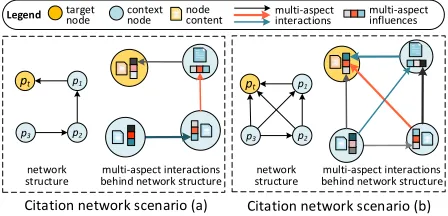
Complex networks are ubiquitous; precisely representing a complex network is critical for understanding and develop-ing networkdevelop-ing applications yet challengdevelop-ing due to intricate network structures, node information and influence, and in-teractions between nodes (Cui et al. 2018; Cai, Zheng, and Chang 2018). As the citation network in Figure 1 illustrates, each paperpowns its content information, including title, abstract and other information, and plays various influences on other papers w.r.t. such aspects as research topic unique-ness, method novelty, and experimental advantage. Accord-ingly, different citation network structures are formed under different scenarios, as shown in Figure 1(a) and Figure 1(b). While the network structures reflect different node connec-tions (citaconnec-tions) between three context papersp1,p2andp3
and the target paperptin scenarios (a) and (b), it is impor-tant to understand the underlying node interactions and the
Copyright c2019, Association for the Advancement of Artificial Intelligence (www.aaai.org). All rights reserved.
pt
p3
p1
p2
target
node node content multi-aspectinteractions multi-aspect influences
Citation network scenario (a)
Legend
pt
p3
p1
p2
Citation network scenario (b)
network
structure structurenetwork
context node
multi-aspect interactions
behind network structure behind network structuremulti-aspect interactions
Figure 1: Two scenarios in citation networks: different net-work structures driving by different node influences and in-teractions between nodes.
roles of node information in influencing node interactions, which are hidden behind each network structure. For exam-ple, the influences of each paper and the multi-aspect inter-actions between context papers and between the target pa-per and context papa-pers in scenario (a) may be quite different from that in scenario (b), even though both scenarios share the same node content of each paper. It is important for us to understand the aspect node influences and the multi-aspect interactions between nodes that drive the formation of connections.
aspects.
Most of existing plain network representation methods (Li et al. 2014; Tang et al. 2015; Grover and Leskovec 2016) aim to preserve the network structure. Some recent methods tend to integrate topological and content information by extend-ing existextend-ing plain network representation methods. For ex-ample, TriDNR (Pan et al. 2016) conducts random walk on node text to build an independent term in its objective func-tion. However, it models the network structure and node con-tent separately through a weighted combination, which fails to jointly consider the information from network structure and node content. Although CANE (Tu et al. 2017) builds context-aware network embedding, it only models the differ-ent semantic aspects of node contdiffer-ent without considering the multi-aspect node influence or the multi-aspect interactions between nodes. The work in (Gao and Huang 2018) uses two Autoencoders on network structure and node content sepa-rately and combines them through alignment on their consis-tent information. However, the above methods overlook the multi-aspect interactions between node pairs or only model the different attentions within node content.
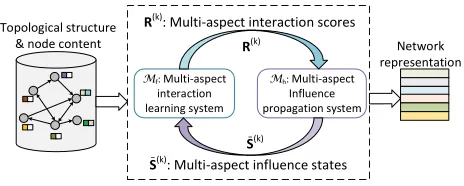
To model the explicit and implicit information and multi-aspect heterogeneous interactions discussed above in a com-plex network, we here propose a multi-aspect interaction and influence-unified evolutionary coupled system (MAI-ECS), as shown in Figure 2. MAI-ECS involves both node con-tent and network structure information, and couples a multi-aspect interaction learning system (MAI-LS) to model the hidden and various interactions between nodes with a multi-aspect influence propagation system (MAI-PS) to generate the implicit and multi-aspect node influences. The MAI-LS decomposes a node linkage (an edge in a network) into sev-eral hidden interactive relations to explain why the linkage forms, and then MAI-PS discloses a node’s various influ-ences on others in terms of node attributes (e.g., content) and its multiple roles in forming a topological structure. The two coupled systems (Geiser 2014) in MAI-ECS are alter-nately optimized to form an evolutionary learning system, until producing the desired network representation.
We apply MAI-ECS to node classification and link predic-tion on two real-world data sets, showing significant perfor-mance improvement over the start-of-the-art baselines. We further demonstrate the semantic meaning of learned multi-aspect influence and multi-multi-aspect interactions, indicating the interpretability of MAI-ECS.
Related Work
Plain Network Representation A typical solution to rep-resent nodes or edges is to factorize graph Laplacian eigen-maps or the node proximity matrix directly (Yin, Gao, and Lin 2016; He and Niyogi 2004). With deep learning, re-cently a lot of methods try to incorporate deep learning mod-els to learn node representation. Among them, the most rep-resentative way is to combine the random walk and word embedding, such as Skip-gram and CBOW (Mikolov et al. 2013). DeepWalk (Perozzi, Al-Rfou, and Skiena 2014) and Node2vec (Grover and Leskovec 2016) build context through the random walk and feed the contexts into a Skip-gram model. LINE (Tang et al. 2015) and SDNE (Wang,
Cui, and Zhu 2016) tend to learn representations from local network structure while other methods aim to capture the global structure and community patterns, such as GraRep (Cao, Lu, and Xu 2015) and M-NMF (Wang et al. 2017). Other method (Hu et al. 2019) considers the context influ-ence in multiple networks and applies into recommender systems. Only considering the structure information cannot capture the implicit and heterogeneous aspects of node in-fluence and interactions. Further, the random walk and deep learning model are treated as two independent parts in these methods. This means the two parts cannot optimize each other, which is not suitable for jointly learning node content and network structure.
Attributed Network Representation Due to the hetero-geneity and couplings (Cao 2014) between node content in-formation and network topological inin-formation, only a lim-ited number of methods are able to import content informa-tion into network representainforma-tion. Text-associated DeepWalk (TADW) (Yang et al. 2015) firstly attempts to incorporate node text information into node representation through ma-trix factorization. TriDNR (Pan et al. 2016)] further exploits node labels to make node representations better for node classification. The method in (Zhang et al. 2018b) also mod-els the node text through attribute-aware Skip-gram model. Then the node text and network structure information are combined w.r.t. a weight parameter, which is largely affected by the performance and generalizability of the method. UPP-SNE (Zhang et al. 2017) incorporates user profile with net-work structure by mapping them into the same space. In this work, the user profile attributes and the network structure are assumed highly interrelated so the nodes in a context are represented by their attribute vectors. All these meth-ods also conduct random walk to collect contexts and use a deep model to learn representation. The node content in-formation is forced to fit the topological structure without considering the multi-aspect node influence or interactions brought by node attributes. CANE (Tu et al. 2017) considers the node context’s influence on the node content information and use mutual attention mechanism to build context-aware embedding. However, only modeling the aspects in content cannot capture the implicit aspects of node influence or in-teractions. The method in (Gao and Huang 2018) tries to modify autoencoder to align the structure information and node attributes, which only keeps the consistent information and leads to information loss.
Problem Formalization
A network with node content is denoted asG = (V,E,C), whereV ={vi}Ni=1 denotes the node set,ei,j ∈ E denotes an edge,(vi, vj, wij), with weightwij between source node
vi and target node vj, and ci ∈ C isvi’s content informa-tion which may be a text, an image or an attribute vector. The MAI-ECSMΘaims to learn a network representation
Mf: Multi-aspect
interaction learning system
Mh: Multi-aspect
Influence propagation system
R(k): Multi-aspect interaction scores
S(k): Multi-aspect influence states
Network representation Topological structure
& node content R(k)
S_(k) _
Figure 2: The MAI-ECS for jointly learning multi-aspect in-fluences and interactions in a complex network.
model parameters.
MΘ consists of two coupled systems: Mh is a multi-aspect influence propagation system based on the transition configurationRfed byMf;Mf is a multi-aspect interac-tion learning system to refine the configurainterac-tionRaccording to the stable influential statesS¯fed byMh. We aim to ob-tain the desired network representationN via an evolution-ary learning process overMhandMf.
Multi-aspect Evolutionary Coupled Systems
Here, we present the details of the coupled evolution process to learn the underlying multi-aspect interactions. As illus-trated in Figure 2, the learning process of the coupled sys-tems can be formalized as the following evolutionary equa-tions, wherekdenotes the evolutionary iteration:(
Mf : R(k+1)=fΘ(¯S(k),R(k)|G)
Mh: S¯(k+1)=h(R(k+1),S¯(k)|G)
(1)
(2)
The above two coupled equations outline the evolutionary dynamics betweenMfandMh. MAI-LSMfaims to learn multi-aspect interaction scoresR(k)for all edges, which is
largely dependent on the multi-aspect influence statesS¯(k)
for all nodes. In turn, MAI-PSMhupdates the stable multi-aspect influence statesS¯(k+1)according to the refined tran-sition configuration based on R(k). Therefore, this is an asymptotic evolution process over the coupled systemsMf andMh to learn the optimized network representationN. In the following subsections, we introduce Mf andMh, and the evolutionary learning algorithm based on these two coupled systems.
Multi-aspect Interaction Learning System
According to Eq. 1, MAI-LS takes the latest stable multi-aspect influence statesS¯(k)as the input to learn the
multi-aspect interaction scores, which consists of two submodels: node representation model and interaction scoring model.
Node Representation Model Without loss of generality, we present the node content w.r.t. textual data. Other con-tent can be represented by their representations, e.g., VGG features (Simonyan and Zisserman 2014) for images. First, we map each word j in a node text contentci into a pre-trained word embeddingwj ∈RK×1(Pennington, Socher,
and Manning 2014). Then, the text embeddingtiis encoded by the attention mechanism (Hu et al. 2018):
ti =
X
wj∈ci
αjwj (3)
where the attention weightαjis learned through a two-layer attention network:
αj = softmax(tanh(Wtwj+bt)) (4)
softmax(xk) =exk/Pje
xj andWt∈
R1×Kandbt∈R
is the bias term.
Then, we associate an embedding vectorei ∈ RK×1 for
each nodevito learn the topological structure information. Since the content embeddingtiand structure embeddingei are characterized by different properties, we combine them as the node representationyito capture more comprehensive information in the network:
yi=L2norm(ei⊕ti) (5)
where L2norm denotesL2 normalization and ⊕denotes
a merging operation, e.g., concatenation. In this paper, we adopt the addition operation which results in the best perfor-mance in our experiments.
Interaction Scoring Model As discussed in the introduc-tion, each observed edge ei,j can be regarded as the for-mation of the underlying interactions between a node pair
(vi, vj) w.r.t. different aspects. The multi-aspect interac-tion scores are relevant to the properties of interactive node pair(vi, vj), which are encoded by the node representations
(yi,yj), and their influential states(¯si,¯sj), which are gen-erated by MAI-PS to depict the interaction aspects and their strengths.
First, we measure the compatibility of interactions ac-cording to the node properties encoded byyiandyj:
yi,j=yiyj (6)
wheredenotes the element-wise product.
Then, we encode the attraction of nodevjon nodevi for directed interaction and mutual attraction betweenvjandvi for undirected interaction according to the nodes’ influential states¯siand¯sj:
xi,j=
Ws¯s
j if(vi, vj)is directed
Ws¯siWs¯sj otherwise (7)
whereWs∈
RL×L. In the case of directed interactions, the
formation of an interaction is mainly relevant to the influ-ence of the target node, e.g., a citation is formed due to the influence of its target paper. In the case of an undirected or bi-directional interaction, its formation is driven by the in-fluence of both nodes, e.g., the collaboration between two influential authors.
As a result, the overall interaction score SO
i,j between
(vi, vj)is measured by summing overyi,jandxi,j:
SO i,j=
X yi,j+
X
xi,j=y>i yj+ ¯s>i W s>Ws¯s
Moreover, we need to determine the interaction aspect be-tween node pair(vi, vj). First, we score the interaction for each aspect as follows:
Sl,i,jA =W y>
l yi,j+Wxl>xi,j+bl (9) whereWyl ∈ RK×1 andWxl ∈ RL×1 are the parameters for measuring the score of aspect l. In the same way, we obtain the scores for all aspects.
These aspects of scores imply the probability of the in-teraction aspects, which can be viewed as a mixture model of the interactions over multiple aspects. As a result, the as-signment of the interaction aspects,ai,j ∈ {1,· · · , L}, can be drawn from the following categorical distribution:
ai,j∼π({Sl,i,jA }l=1,···,L) (10) where the probability mass function is defined as:
πl= softmax(tanh(Sl,i,jA )), l= 1,· · · , L (11)
However, the assignmentai,j is a discrete random variable which cannot work with other continuous variables due to the absence of the gradient for backpropagation (Jang, Gu, and Poole 2016) in a neural network. As a workaround, we adopt the Gumbel-SoftMax (Jang, Gu, and Poole 2016) to conduct a soft sampling for discrete values:
al,i,j=
exp ((logπl+gl)/τ)
PL
k=1exp ((logπk+gk)/τ)
(12)
whereg = −log(−log(u))andu ∼ unif orm(0,1). In this paper, we set the temperature parameterτ= 0.1, which tends to output a one-hot-like assignment, that is, only one aspect has the mass close to 1 and the masses of other as-pects are close to 0. Accordingly, we get a relaxed discrete version of multi-aspect interaction score vectorri→j ∈ R, where only one aspect score tends to be preserved:
ril→j = max(al,i,jSl,i,jA ,0), l= 1,· · · , L (13)
Multi-aspect Influence Propagation System
So far we have learned multi-aspect interaction scoresR(k)
(cf. Eq. 13) from MAI-LSMf. Correspondingly, the multi-aspect influence of each node is changed with the updated multi-aspect interactions in the network. According to Eq. 2, MAI-PSMhtakesR(k)to configure the influence propa-gation dynamical system. This dynamical system is defined in terms of the following state space equations:
S(:,lk)(n+ 1) =TlS
(k)
:,l (n) (14)
S(:,lk)(0) = ¯S(:,lk−1). (15)
S(:,lk)(n)denotes the influential states w.r.t. aspect l for all nodes, wherendenotes the propagation time step in the dy-namical system. SinceMhis a multi-aspect influence prop-agation system, we haveLtransition matrices{Tl}Ll=1.
Given an aspect l, transition matrix Tl ∈ [0,1]N×N is configured as follows:
Tl=
(1−d)
N 11
>+d(P
l+Dl) (16)
where1∈RN×1is all-one vector anddis the damping ratio
to prevent sticking in local network neighborhoods. We set
d= 0.95in the experiments. The matrixDlis set to handle the dangling nodes that do not have any outlink in aspectl:
Dl[:,i]=
1
N1, ifviis dangling node
0, otherwise.
(17)
Plis configured according to multi-aspect interaction scores
R(k). The transition probabilitypi→j fromv
i tovj is pro-portional to the correspondingrli→j.
pi→j=
rli→j
PN
i=1r
i→j l
, if(vi, vj)∈ Eandai,j=l
0, otherwise.
(18) whereai,j =lmeans that we only consider the interaction on the sampled interaction aspect (cf. Eq. 10) sinceril→j is a softly sampled score (cf. Eq. 13). As a result, we havePl:
Pl=
p1→1 p2→1 . . . pN→1
p1→2 . .. ...
..
. pi→j
p1→N . . . pN→N
. (19)
Under the above settings forTl, this influence propaga-tion dynamical system sets up a Markov chain for each as-pectl. According to Markov’s theorem:a Markov chain is ergodic if there is a positive probability to pass from any
state to any other state in one step.Obviously,Tl satisfies
the condition of ergodicity, which guarantees the stable state
¯
S:,lfor each influential aspect within finite time steps. Eq. 14 implies the power method (Saad 2011) to findS¯. SincePlis very sparse, the total number of nonzero entries over all{Pl}is|E|, i.e., the number of edges, the influence state matrixS(n)for all aspects can be computed inO(|E|)
CPU time or inO(1)GPU time for each power iteration.
Evolutionary Learning Process
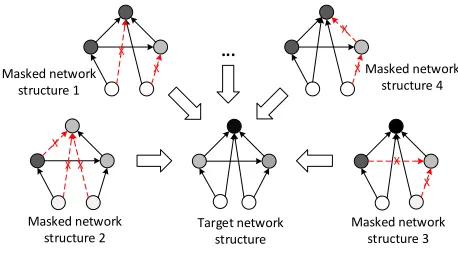
The coupled systems MAI-LSMf and MAI-PSMhset up the evolutionary dynamics over the network. Notice that an observed structure of a network is evolved from some previ-ous structure with fewer edges. That is, given a masked net-work structure with masked edgesE−⊂ E, the evolutionary dynamics tend to drive it to recover the target network struc-ture, as demonstrated in Figure 3. Inspired by this idea, we set up an evolutionary objective for MAI-LSMf and MAI-PSMhbased on sampled masked network structures.
Given a masked network structure, the evolutionary direc-tion is driven by the interacdirec-tion between nodes. Therefore, given a source nodeviand any two other nodesvj, vk, we have the following orders of the interaction strengths:
Oi,j Oi,k, ifwi,j> wi,k
Oi,j Oi,k, if(vi, vj)∈ Eand(vi, vk)∈ E/
Oi,j Oi,k, if(vi, vj)∈ E−and(vi, vk)∈ E/ (20) (21)
Target network structure
X
X
X X
X X
X
Masked network structure 1
Masked network structure 2
Masked network structure 3 Masked network
structure 4
X X
...
Figure 3: The evolutionary learning process.
Eq. 20 specifies the interaction order according to the weight of edges; Eq. 21 specifies the interaction order according to the presence of edges; and Eq. 22 specifies the interaction order according to the possibility to form new edges.
According to the above order relationships, we can set up the following objective overhvi, vj, vki:
(
Si,jO > Si,kO, ifOi,j Oi,k
Si,jA|al,i,j > Si,kA|al,i,j, ifOi,j Oi,k
(23)
(24)
whereSO
i,j is overall interaction score given by Eq. 8 and
SA
i,j|al,i,j = Pal,i,jSl,i,jA , S A
i,k|al,i,j = Pal,i,jSAl,i,k are the aspect-specific interaction scores conditional on the sam-pled interaction aspect (cf. Eq. 12). Accordingly, we set up the following triplet max-margin losses:
(
LO= max{0, εO−(Si,jO −S O i,k)}
LA= max{0, εA−(SAi,j|al,i,j−SAi,k|al,i,j)} (25)
(26)
whereεO and εA are the max-margin parameters, we set both of them to 1 in the experiments. Specifically, LO mainly aims to optimize the overall topological interaction resulting in the edge formation whileLAmainly aims to op-timize the semantic interaction in a specific aspect resulting in the edge formation.
We use mini-batch learning to learn the parametersΘof
Mf. Then the mean loss of a mini-batchB for computing gradients is given as:
L= 1
|B| X
hvi,vj,vki∈B
(LO+LA) (27)
We adopt Adam (Ruder 2016) for optimizing the gradients
∇ΘLto find the optimal model parametersΘ.
The whole learning process is depicted in Algorithm 1. For the overall iteration, we randomly sample a masked net-work structure to learn the coupled systemsMf andMh in turn. This process begins withMf with randomly ini-tialized S¯(0). In M
h, since the dynamical system is er-godic, we employ the power method on GPU to find the stable influential states. The MAI-ECS code is available at: https://github.com/jiansonglei/MAI-ECS.
Algorithm 1 The evolutionary learning process of MAI-ECS
Require: G: network, M1: maximum iterations of
evolu-tionary learning process, M2: maximum iterations in
Mf,M3: maximum iterations inMh
Ensure: N ={Y,S¯,R;Θ}- the network representation 1: InitializeS¯(0)with a random value
2: fork= 0,· · · , M1do
3: Sample a masked networkGkfromG 4: R(k+1)=f
Θ(¯S(k),R(k)|Gk) 5: S¯(k+1)=h(R(k+1),S¯(k)|G
k) 6: end for
7: ConstructYaccording to Eq. 5 and extractΘfromMf 8: returnY,S¯,R,Θ
9: functionfΘ(S¯,R|G)
10: whileiter≤M2do
11: Optimize∇ΘL(cf. Eq.27) with Adam
12: end while
13: Generateri→jaccording to Eq. 13 14: returnR,Θ
15: end function 16: functionh(R,S¯|G)
17: Construct{Tl}Ll=1according to Eq. 16
18: whilen≤M3do .Power iteration
19: S:,l(n+ 1) =TlS:,l(n)forl∈[1,· · ·L] 20: end while
21: returnS¯
22: end function
Experiments
In this section, we evaluate our proposed model on two real-world datasets and two applications, and compare it with the state-of-the-art network representation methods.
Experimental Setup
The citation network Aminer1 collects data from DBLP,
ACM, MAG (Microsoft Academic Graph), and other sources. The nodes denote the papers and the edges denote the citation relationship which are directed. The whole net-work contains millions of papers from various domains. We choose papers from four domains, i.e., artificial intelligence, database & data mining, theoretical computer science, and computer graphics & multimedia. The domains are used for labels in node classification. For each paper, we use its title as the node content information. The final citation network contains 29,896 nodes and 66,166 edges.
The second dataset is a coauthoring network in Aminer2,
where the nodes denote authors, the edges denote the thorship and the edge weight denotes the number of coau-thored papers. For each author, we use her/his research inter-ests as the node content information. This network contains 1,712,433 authors and 4,258,615 edges.
In our experiments, we evaluate the network representa-tion on standard learning tasks: node classificarepresenta-tion on
cita-1
https://aminer.org/citation (V7 version is used)
2
Table 1: Node classification performance on citation network
p% Metric Node2vec Doc2vec NV+DV TriDNR CANE MAI-LS MAI-ECS
80 Accuracy 0.804±0.002 0.658±0.002 0.838±0.005 0.817±0.009 0.820±0.006 0.857±0.004 0.887±0.003 F1-score 0.707±0.006 0.551±0.002 0.768±0.009 0.728±0.012 0.708±0.009 0.802±0.006 0.832±0.005
20 Accuracy 0.787±0.002 0.655±0.001 0.833±0.002 0.812±0.001 0.817±0.003 0.845±0.002 0.873±0.001 F1-score 0.680±0.004 0.549±0.007 0.764±0.002 0.724±0.002 0.703±0.003 0.783±0.005 0.815±0.003
tion network (because only the citation network has class labels) and link prediction on both citation and coauthoring network. Additionally, we demonstrate the semantic inter-pretability of MAI-ECS in terms of multi-aspect influences and multi-aspect interactions.
The following algorithms are compared in our paper:
• Node2vec (Grover and Leskovec 2016): which learns node representation through random walk and the Skip-gram model with network structure only. The sampling strategy in DeepWalk (Li et al. 2014) can be seen as a special case of Node2vec.
• Doc2vec(Le and Mikolov 2014): which embeds text, i.e., node content, into a distributed vector by neural network models without network structure.
• NV+DV: which concatenates node representation from Node2vec and Doc2Vec to utilize both network structure and node content.
• TriDNR (Pan et al. 2016): which utilizes network, text information and labels to learn network representation.
• CANE(Tu et al. 2017): which is the state-of-the-art al-gorithm that utilizes both network and text information to learn network representation.
• MAI-LS: which only includes the multi-aspect interac-tion learning system without considering multi-aspect in-fluence propagation.
• MAI-ECS: which is the full model proposed in this paper. The node embedding length in representation methods is set to 100. The interaction and influence aspects are set to 10. In Node2vec, the random walk control parameters p = 1 and q = 1 which lead to the best performance. In TriDNR, we use different combination weight parameter which adjust-ing the ratio between text information and network infor-mation in different tasks because the performance is highly sensitive to this parameter (i.e., the importance ratio of text is set to 0.8 in classification and 0.2 in link prediction). Other hyper-parameters used in the above algorithms follow the recommendation or default parameters in their original source codes.
Node Classification
We assess the effectiveness of network representations on node classification in the citation network in which the do-mains are regarded as class labels. The classification results in terms of accuracy and F1-score are demonstrated in Table 1. The percentagesp%of training samples are set top= 20
andp= 80.
Importance of considering node content.Table 1 shows that MAI-LS and MAI-ECS achieve better performance than all other methods. Node2vec which only utilizes topologi-cal information outperforms Doc2vec which only uses node content. Meanwhile combining topological and node con-tent contributes to the node classification.
Importance of the way to learn node content.Although TriDNR and CANE both incorporate network and node con-tent, their performance is worse than the concatenation of Node2vec and Doc2vec (i.e., NV+DV) on the citation work. This is because TriDNR and CANE model the net-work structure and node content separately by two inde-pendent objectives. This shallow combination cannot learn a comprehensive representation that embeds the informa-tion of both network structure and node content. By con-trast, MAI-LS and MAI-ECS jointly learn network structure and node content through an evolutionary learning process which largely benefits the further learning tasks.
Contribution of influence propagation system. Ac-cording to the classification results, MAI-ECS outper-forms MAI-LS because MAI-ECS explores the network with multi-aspect influence propagation system and cap-tures more comprehensive network structure. Also, the sta-ble multi-aspect influence states are fed into the multi-aspect interaction learning system in MAI-ECS to optimize the rep-resentation learning process in turn.
Link Prediction
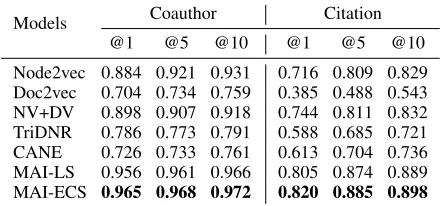
Link prediction has been widely explored in network analy-sis, we use network representation learned on a training net-work which randomly samples 90% edges from the origi-nal network and test the link prediction performance on the remaining network in terms of ranking results. In particu-lar, we use the inner-product of node representation from Node2vec, Doc2vec, NV+DV, TriDNR and CANE as the node proximity because no special design is available in these models for evaluating node proximity or edge connect-ing strength. In MAI-LS and MAI-ECS, the overall multi-aspect interaction scores between nodes (cf. Eq. 8) are used to quantify the connection strength. Normalized discounted cumulative gain on top-kranked nodes (nDCG@k) is used to evaluate the ranking performance for link prediction.
lim-Table 2: Link prediction performance w.r.t. nDCG on Coau-thoring and Citation networks
Models Coauthor Citation
@1 @5 @10 @1 @5 @10
Node2vec 0.884 0.921 0.931 0.716 0.809 0.829 Doc2vec 0.704 0.734 0.759 0.385 0.488 0.543 NV+DV 0.898 0.907 0.918 0.744 0.811 0.832 TriDNR 0.786 0.773 0.791 0.588 0.685 0.721 CANE 0.726 0.733 0.761 0.613 0.704 0.736 MAI-LS 0.956 0.961 0.966 0.805 0.874 0.889 MAI-ECS 0.965 0.968 0.972 0.820 0.885 0.898
ited, which shows the deficiency of the way that TriDNR and CANE incorporate network structure and node content, i.e., a simple linear combination of text information and net-work information. Another reason leading to the poor per-formance of CANE is that CANE emphasizes the text infor-mation and uses the convolutional neural network to capture the multiple influences within text which is not suitable for the short text, e.g., title.
MAI-LS and MAI-ECS incorporate node content and net-work structure in terms of multi-aspect interaction and influ-ence evolution, which is more effective to deeply fuse the in-formation from both sources. Moreover, LS and MAI-ECS learn to rank the edge formation through an evolution-ary learning process on different masked networks, which is consistent with the goal of link prediction. In addition, MAI-ECS employs MAI-PS to disclose the multi-aspect in-fluences through the influence propagation dynamics to re-fine MAI-LS learning, which makes MAI-ECS achieve the best performance.
Semantic Interpretability Demonstration
The most distinctive characteristic of MAI-ECS is to model the multi-aspect influences and multi-aspect interactions, which empowers MAI-ECS with the semantic interpretabil-ity. We respectively list top-3 ranked authors with their re-search interests in two aspects according to the multi-aspect influence states (cf. Eq. 2) output from MAI-PS. As shown in Figure 4, the research interests of the top-3 authors in as-pect 1 are all about “high performance” and “systems”, and that in aspect 2 are about “network” and “communication”. These aspects reflect different research areas in the coau-thoring network. Only with the text similarity between node content, we can neither differentiate the research areas be-cause there are some commonly used words, such as “al-gorithm” and “model”, nor assign authors to their specific area for ranking. MAI-ECS jointly model node content, net-work structure, and influence propagation, which enables it to provide multi-aspect semantics and influence ranking.
To demonstrate the multi-aspect interactions between nodes, we randomly sample a paper with the title“A Taxon-omy and Evaluation of Dense Two-Frame Stereo
Correspon-dence Algorithms” and all its references from the citation
network. Due to the space limitation, we only list the top-5 papers on each aspect according to the interaction scores (cf.
Aspect 1 Aspect 2 Aspect 3
Mario Gerla – 10798 Willy Yonkers - 518
Group 3:
Mario Gerla - 10798
[wireless network; network coding; vehicular network; mobile network; network performance; mobile wireless network; network topology; sensor network; mesh network; network layer]
Willy Yonkers - 518
[remote communication; familiar telecommunication product; human need; human product interaction; new face; new form; communicationRecent advance; network infrastructure; physical closeness; visionary design]
M. Ott - 1620653
Aspect Top-rank Authors Research Interests
1
Robert van de Geijn
high performance; high-performance implementation; parallel linear algebra package; parallel implementation; dense linear algebra algorithm; excellent performance
Jack J. Dongarra
high performance; performance analysis; performance result; high performance computing platform; performance issue; peak performance; performance penalty
Oscar H. Ibarra
P system; equivalence problem; reversal-bounded counter; neural P system; decision problem; computing power; emptiness problem; reachability problem; SN P system
2
Mario Gerla
wireless network; network coding; vehicular network; mobile network; network performance; mobile wireless network; network topology; sensor network; mesh network;
Willy Yonkers
remote communication; familiar telecommunication product; human need; human product interaction; network infrastructure; physical closeness; visionary design
M. Ott
future network availability; mobile device; active network monitoring; multiple access network; network availability prediction; network resource; network selection
Figure 4: The top-3 authors on aspect 1 and aspect 2 in terms of the node influence.
Sample paper A taxonomy and evaluation of dense two-frame stereo correspondence algorithms.
Citation Aspect 3 A maximum likelihood stereo algorithm.
Genetic-based stereo algorithm and disparity map evaluation. Real-time correlation-based stereo vision with reduced border errors. Calculating dense disparity maps from color stereo images.
Map-based stochastic diffusion for stereo matching and line fields estimation.
Citation Aspect 8 Human motion tracking with a kinematic parameterization of extremal contours.
Learning generative models for multi-activity body pose estimation. A study on smoothing for particle-filtered 3d human body tracking. Optimization and filtering for human motion capture. Coupled visual and kinematic manifold models for tracking.
Figure 5: The top-5 papers on aspect 3 and aspect 8 in terms of the interaction scores.
Eq. 13) in two focused aspects 3 and 8, and this paper has few references in other aspects. As shown in Figure 5, the word clouds demonstrate the frequency of words appearing in the titles of all references. We find aspect 3 mainly focuses on “stereo” while aspect 8 mainly focuses on “tracking” and “motion”. Obviously, current state-of-the-art methods can only predict whether existing citation between papers, but they cannot semantically tell why this citation is formed and which aspect leads to this citation.
Conclusion and Future Work
In this paper, we propose a critical and challenging prob-lem in attributed network representation: learning the het-erogeneities of multi-aspect interactions between nodes and node influences in a complex network. Accordingly, we pro-pose the MAI-ECS to model multi-aspect node influence and multi-aspect interactions between nodes. MAI-ECS en-ables an evolutionary learning process on integrating node texts and network structure to jointly and iteratively learn the multi-aspect influences and interactions.
Acknowledgement
This work is partially supported by the The Na-tional Key Research and Development Program of China (2016YFB0200401), by the program for New Century Ex-cellent Talents in University, by National High-level Person-nel for Defense Technology Program (2017-JCJQ-ZQ-013), by the HUNAN Province Science Foundation 2017RS3045.
References
Cai, H.; Zheng, V. W.; and Chang, K. 2018. A comprehen-sive survey of graph embedding: problems, techniques and applications. IEEE Transactions on Knowledge and Data
Engineering.
Cao, S.; Lu, W.; and Xu, Q. 2015. Grarep: Learning graph representations with global structural information. InCIKM, 891–900. ACM.
Cao, L. 2014. Non-iidness learning in behavioral and social data.The Computer Journal57(9):1358–1370.
Cao, L. 2015. Coupling learning of complex interactions.
Information Processing & Management51(2):167–186.
Cui, P.; Wang, X.; Pei, J.; and Zhu, W. 2018. A survey on network embedding. IEEE Transactions on Knowledge and
Data Engineering.
Gao, H., and Huang, H. 2018. Deep attributed network embedding. InIJCAI, 3364–3370.
Geiser, J. 2014. Coupled Systems: Theory, Models, and
Applications in Engineering. Chapman and Hall/CRC.
Grover, A., and Leskovec, J. 2016. node2vec: Scalable fea-ture learning for networks. InSIGKDD, 855–864. ACM. He, X., and Niyogi, P. 2004. Locality preserving projections.
InAdvances in neural information processing systems, 153–
160.
Hu, L.; Jian, S.; Cao, L.; and Chen, Q. 2018. Interpretable recommendation via attraction modeling: Learning multi-level attractiveness over multimodal movie contents. In IJ-CAI, 3400–3406.
Hu, L.; Jian, S.; Cao, L.; Gu, Z.; Chen, Q.; and Amirbekyan, A. 2019. Hers: Modeling influential contexts with hetero-geneous relations for sparse and cold-start recommendation. InAAAI.
Jang, E.; Gu, S.; and Poole, B. 2016. Categorical reparameterization with gumbel-softmax. arXiv preprint
arXiv:1611.01144.
Le, Q., and Mikolov, T. 2014. Distributed representations of sentences and documents. InInternational Conference on
Machine Learning, 1188–1196.
Li, X.; Du, N.; Li, H.; Li, K.; Gao, J.; and Zhang, A. 2014. A deep learning approach to link prediction in dynamic net-works. InSIAM, 289–297.
Mikolov, T.; Chen, K.; Corrado, G.; and Dean, J. 2013. Ef-ficient estimation of word representations in vector space.
arXiv preprint arXiv:1301.3781.
Pan, S.; Wu, J.; Zhu, X.; Zhang, C.; and Wang, Y. 2016. Tri-party deep network representation.Network11(9):12.
Pennington, J.; Socher, R.; and Manning, C. 2014. Glove: Global vectors for word representation. InEMNLP, 1532– 1543.
Perozzi, B.; Al-Rfou, R.; and Skiena, S. 2014. Deepwalk: Online learning of social representations. InSIGKDD, 701– 710. ACM.
Ruder, S. 2016. An overview of gradient descent optimiza-tion algorithms.arXiv preprint arXiv:1609.04747.
Saad, Y. 2011. Numerical methods for large eigenvalue
problems: revised edition, volume 66. SIAM.
Simonyan, K., and Zisserman, A. 2014. Very deep convo-lutional networks for large-scale image recognition. arXiv
preprint arXiv:1409.1556.
Tang, J.; Qu, M.; Wang, M.; Zhang, M.; Yan, J.; and Mei, Q. 2015. Line: Large-scale information network embed-ding. InWWW, 1067–1077. International World Wide Web Conferences Steering Committee.
Tu, C.; Liu, H.; Liu, Z.; and Sun, M. 2017. Cane: Context-aware network embedding for relation modeling. In Pro-ceedings of the 55th Annual Meeting of the Association for
Computational Linguistics (Volume 1: Long Papers),
vol-ume 1, 1722–1731.
Wang, X.; Cui, P.; Wang, J.; Pei, J.; Zhu, W.; and Yang, S. 2017. Community preserving network embedding. InAAAI, 203–209.
Wang, D.; Cui, P.; and Zhu, W. 2016. Structural deep net-work embedding. InSIGKDD, 1225–1234. ACM.
Yang, C.; Liu, Z.; Zhao, D.; Sun, M.; and Chang, E. Y. 2015. Network representation learning with rich text information.
InIJCAI, 2111–2117.
Yin, M.; Gao, J.; and Lin, Z. 2016. Laplacian regular-ized low-rank representation and its applications. IEEE transactions on pattern analysis and machine intelligence
38(3):504–517.
Zhang, D.; Yin, J.; Zhu, X.; and Zhang, C. 2017. User pro-file preserving social network embedding. InProceedings of
IJCAI, 3378–3384.
Zhang, Q.; Cao, L.; Zhu, C.; Li, Z.; and Sun, J. 2018a. Cou-pledcf: Learning explicit and implicit user-item couplings in recommendation for deep collaborative filtering. InIJCAI, 3662–3668.