345
Information Technology and Control 2017/3/46
An Efficient
Certificate-Based Authenticated
Key Agreement Protocol
Without Bilinear Pairing
ITC 3/46
Journal of Information Technology and Control
Vol. 46 / No. 3 / 2017 pp. 345-359
DOI 10.5755/j01.itc.46.3.14968 © Kaunas University of Technology
An Efficient Certificate-Based Authenticated Key Agreement Protocol Without Bilinear Pairing
Received 2016/05/13 Accepted after revision 2017/07/03
http://dx.doi.org/10.5755/j01.itc.46.3.14968
Corresponding author: [email protected]
Yang Lu, Quanling Zhang, Jiguo Li
College of Computer and Information, Hohai University, No. 8, Focheng Xi Road, Jiangning District, Nanjing, China e-mails: [email protected], [email protected], [email protected]
Jian Shen
School of Computer and Software, Nanjing University of Information Science and Technology, No. 219, Ningliu Road, Nanjing, China, e-mail: [email protected]
1. Introduction
To provide secure communications over insecure public networks, privacy and confidentiality should be guaranteed. An authenticated key agreement (AKA) protocol enables the communication parties to authenticate each other and securely set up a shared session key for their communications over an unreli-able communication channel. Therefore, it can assure the privacy and data confidentiality of the later com-munications.
The famous Diffie-Hellman key-exchange proto-col [8] is the first practical key agreement protoproto-col. However, Diffie-Hellman protocol suffers from the man-in-the-middle (MITM) attack due to the reason that it does not provide authentication to the proto-col participants. The protoproto-cols that can provide the authentication mechanism have attracted great at-tention from the research commnity (e.g. [14-17]). Over the years, many AKA protocols have been pro-posed. However, most of the previous AKA protocols were constructed over either conventional public-key cryptography (PKC) [4, 11, 13, 20, 25] or identity-ba-sed cryptography (IBC) [5-7, 36, 41, 44]. It is well-known that conventional PKC suffers from the heavy certificate management problem while IBC has the key escrow and key distribution problems.
To solve the key escrow problem, Al-Riyami and Pat-erson [1] presented the concept of certificateless AKA (CL-AKA) protocol by extending AKA protocol into certificateless PKC. In a CL-AKA protocol, a partially trusted key generation center (KGC) is employed to assist every user to produce a private key from a secret value selected by the user. In this way, KGC does not know any user’s private key. As a result, CL-AKA pro-tocols avoid the key escrow problem while reserving the certificateless property. Since the introduction of CL-AKA protocol, many CL-AKA protocols have been proposed [12, 19, 26, 40, 42, 47, 48]. However, KGC has to distribute a partial private key to every user over secure channels. This feature limits the application of CL-AKA protocols in the untrusted network environ-ments, because setting up a secure channel in those environments is usually expensive.
In Eurocrypt 2003, Gentry [10] put forward a new public-key cryptographic paradigm called certifi-cate-based cryptography (CBC). This new cryptog-raphy lies between conventional PKC and IBC. When
using CBC, every user should produce a pair of private key and public key independently and then apply for a certificate from a trusted certification authority (CA). The certificate is sent to its owner and serves as a partial decryption key or a partial signing key. This functionality of the certificate supplies an implicit certificate property so that a user can execute some cryptographic operations (e.g., decryption and sign-ing) correctly only when both his certificate and pri-vate key are known, while this user’s communication parties need not obtain the current status of his cer-tificate. Therefore, CBC solves the certificate revo-cation problem in conventional PKC. Furthermore, CBC eliminates both the key escrow problem (as CA has no knowledge of users’ private keys) and the key distribution problem (as CA can send the certificates to their owners publicly). Since its invention, CBC has obsorbed great interest from the cryptography community and numerous CBC schemes have been published, including certificate-based encryption (e.g. [9, 28, 31, 32, 39, 46]), certificate-based signature (e.g. [2, 18, 21, 22, 27, 30]) and certificate-based sign-cryption (e.g. [23, 29, 34]).
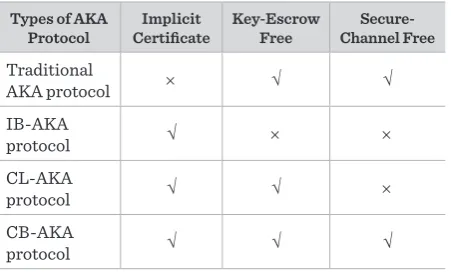
To overcome the problems imposed on the previous AKA protocols, Wang and Cao [45] proposed the notion of certificate-based AKA (CB-AKA) protocol following the idea of CBC. Compared with previous types of AKA protocol, CB-AKA protocol enjoys many attractive merits. Table 1 summarizes the properties of the different types of AKA protocol, including conventional AKA protocol over conventional PKC,
Table 1
Properties of AKA protocols over different public-key cryptography.
Types of AKA
Protocol CertificateImplicit Key-Escrow Free Channel Free
Secure-Traditional
AKA protocol × √ √
IB-AKA
protocol √ × ×
CL-AKA
protocol √ √ ×
CB-AKA
347
Information Technology and Control 2017/3/46
identity-based AKA (IB-AKA) protocol over IBC, CL-AKA protocol and CB-CL-AKA protocol.
To our knowledge, there exist four CB-AKA protocols [24, 33, 35, 45] in the literature so far. In [45], Wang and Cao proposed the first CB-AKA protocol that is based on Gentry’s certificate-based encryption scheme [10] and Smart’s AKA protocol [41]. Unfortunately, Lim
et al. [24] point out that Wang-Cao’s CB-AKA proto-col is insecure against ephemeral secret leakage. To fix the weakness in Wang-Cao’s protocol, Lim et al.
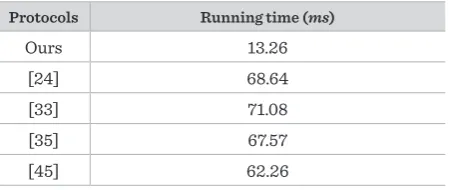
[24] proposed an improved CB-AKA protocol. They claim that the improved protocol is secure against all non-trivial secret leakages. However, no formal secu-rity proof is given in [24]. In [35], Luo et al. provide a security model for constructing provably secure CB-AKA protocols. They also present a CB-CB-AKA protocol that can be proven secure in the random oracle model [3]. Recently, Lu et al. [33] pointed out that the CB-AKA protocols in [24, 35, 45] can not resist the public key replacement (PKR) attack. To fight against PKR attack, Lu et al. [33] designed a new CB-AKA protocol with provable security in the random oracle model. The motivation of this paper is to design a CB-AKA protocol without costly bilinear pairing. In practice, the cryptographic operations are often performed on some devices which have very constrained resources, such as smart phone or PDA. Due to the limited com-putation or the constrained battery power, only the li-ghtweight or power-saving cryptographic schemes can be emplyed on these devices. All the previous CB-AKA protocols [24, 33, 35, 45] are constructed with bilinear pairings. Compared with other common cryptographic operations such as scalar multiplications in the ellip-tic curve group, the bilinear pairing may be the most expensive one. Our experiment results show that the average computation cost of a bilinear pairing is about nine times as much as that of a scalar multiplication in elliptic curve group under the 1024-bit RSA security level. Since the computationally-heavy pairing opera-tions will greatly aggravate the computation load of a device, they are extremely disliked by the computati-on-limited or power-constrained devices. Therefore, as far as the efficiency, the cryptographic schemes wi-thout bilinear pairing would be more attractive. Inspired by Schnorr’s signature scheme [37], we de-velop a practical CB-AKA protocol without bilin-ear pairing. Under the classic complexity
assump-tion computaassump-tional Diffie-Hellman assumpassump-tion, the proposed protocol is proven secure in the random oracle model. Without costly bilinear pairing oper-ations, the proposed CB-AKA protocol significantly decreases the computation cost. Compared with the previous pairing-based CB-AKA protocols [24, 33, 35, 45], it enjoys obvious advantage in the computational efficiency and is more suitable for the power-con-strained and computation-limited devices.
2. Preliminaries
2.1 Computational assumption
The security of our CB-AKA protocol is based on the computational Diffie-Hellman (CDH) assumption. Definition 1. Let G be a cyclic group of prime order q. The CDH problem over G is, given a tuple (P, xP, yP) ∈
G3 for unknown values x, y ∈ *
q
Z , to compute xyP. The CDH assumption holds if for any polynomial-time algorithm A, the advantage Adv(A) = Pr{A(G, q, P, xP,
yP) = xyP} is negligible.
2.2 Bilinear pairing
Assume that G and GT are two cyclic groups of prime order q. A bilinear pairing e: G× G →GT is a map that satisfies the following properties:
1 Bilinearity: e(xU, yV) = e(U, V)xy for all U, V ∈G and
x, y ∈ *
q Z .
2 Non-degeneracy: There exists U, V ∈G such that
e(U, V) ≠ 1.
3 Computability: There exists an efficient algorithm to compute e U V( , ) for all U V G, ∈ .
Note that the construction of our CB-AKA protocol does not depend on the bilinear pairing. We only use this notion in the security proofs.
3. Formal model of CB-AKA protocol
3.1 Definition of CB-AKA protocol
performed by a CA to produce a master secret key and a set of system public parameters; (2) User key gene-ration algorithm UserKeyGen, which is performed by each user to produce a private key and a partial public key; (3) Certificate generation algorithm CertGen, which is performed by a CA to produce a full public key and a certificate for each user; (4) Key agreement algorithm KeyAgreement, which is performed by two communication users (an initiatorand a responder) to generate a session key.
Figure 1 gives a more concrete functional description of a CB-AKA protocol.
3.2 Security model of CB-AKA protocol
As introduced in [33, 35], a CB-AKA protocol should satisfy some commonly desired security properties, including known-key security, unknown key-share resilience, basic impersonation attacks resilience, forward secrecy, key compromise impersonation re-silience and key control security.
To capture these security properties, Luo et al. pre-sented a formal security model for CB-AKA protocols in [35]. However, Lu et al. [33] show that Luo et al.’s CB-AKA protocol is insecure against the PKR attacks, although it was proven secure in their proposed secu-rity model. To fix this problem, Lu et al. [33] improved Luo et al.’s security model to capture the adversaries’ PKR actions.
There are two types of adversaries against the
secu-Figure1
Functional description of a CB-AKA protocol
rity of CB-AKA protocols. They are the Type 1 adver-sary and the Type 2 adveradver-sary. The Type 1 adveradver-sary who acts as a malicious uncertified user is able to replace any user’s public key, but does not know the target user’s certificate. The Type 2 adversary who acts as an honest-but-curious CA possesses the CA’s master secret key, but does not know the target user’s private key and is disallowed to replace public keys. The security model of a CB-AKA protocol can be defined via an adversarial game which is played be-tween a challenger with a Type 1 adversary or a Type 2 adversary (denoted by ). In the description of the adversarial game, the symbol n,
A B
∏ denotes an oralce that represents the n-th session between two participants A and B, where A is the initiatorand B
is the responder. LetSID= (IDA,IDB,MA Bn, ,MB An, ) be
the session identity of the session n, A B
∏ , where n, B A M and MA Bn, are the incoming protocol message and the
outgoing protocol message, respectively, in the n-th
session of the protocol. Two sessions are said to have matching conversation with each other if they have the same session identity.
The security model is formally described as follows: Setup. The challenger simulates the algorithm Setup to produce msk and params. Then the adversary is given params if it is a Type 1 adversary or both msk
and params if it is a Type 2 adversary.
349
Information Technology and Control 2017/3/46
1 CreateUser(IDi): On receiving an identity IDi, the challenger outputs a public key PKi. If there is no public key associated with IDi, the challenger pro-duces a key pair (SKi, PKi) and a certificate Certi for
IDi, and then outputs PKi. In this case, the identi-ty IDi is said to be created. For simplicity, it is as-sumed that an identity can be responded by other oracles only when it has been created.
2 ReplacePublicKey(IDi, PKi′): On receiving an iden-tity IDi and a false public key PKi′, the challenger sets PKi′ as the user i’s current public key. Such an oracle is merely queried by the Type 1 adversary. It models the Type 1 adversary’s ability to replace public keys and thus captures the PKR attacks.
3 Corrupt(IDi): On receiving an identity IDi, the chal-lenger outputs a private key SKi. For the Type 1 ad-versary, if it has made an oracle query ReplacePub-licKey(IDi, PKi′), then it is disallowed to request the user i’s private key.
4 Certificate(IDi): On receiving an identity IDi, the challenger outputs a certificate Certi. Such an or-acle is merely queried by the Type 1 adversary. If it has made an oracle query ReplacePublicKey(IDi,
i
PK′), then it is disallowed to request the user i’s certificate.
5 Send(∏i jn, , M): On receiving an oracle n, i j
∏ and a
mes-sage M, the challenger initiates a protocol session between the users i and j if M = λ or responds with an outgoing message according to the specification of the protocol otherwise. If the first message re-ceived by an oracle is λ, then n,
i j
∏ is called an
initia-tor; otherwise it is a responder oracle.
6 Reveal( n, i j
∏ ): On receiving an oracle n, i j ∏ , the challenger responds with the shared session key associated with n,
i j ∏ .
Test. Once Phase 1 is over, the adversary makes one Test query on an oracle ∏TI J, which is fresh (see
the following Definition 2). To respond, the challeng-er picks a random bit b∈{0,1}. It outputs the shared session key SKTI J, associated with ∏TI J, if b=0 or a
ran-dom key chosen from the session key space otherwise. Phase 2. continues to make a sequence of adaptive queries.
Guess. outputs its guess b′∈{0,1}. It wins the game if and only if b b= ′ and the following constraints are satisfied: (1) is unable to query the oracle Reveal on the oracle ∏TI J, and its matching conversation ∏TJ I,; (2)
is unable to make a oracle query Certificate(IDJ) if it is a Type 1 adversary or a oracle query Corrupt(IDJ) if it is a Type 2 adversary.
The advantage of the adversary in winning the game is defined to be Adv =Pr{b b= ′} 1/ 2- .
Definition 2. An oracle ∏nA B, is fresh if (1) It has
estab-lished a shared session key; (2) The adversary has not queried the oracle Reveal on it and its matching conversation; (3) The adversary has not queried the oracle Certificate on the identity IDB if it is a Type 1 adversary or the oracle Corrupt on the identity IDB if it is a Type 2 adversary.
Definition 3. We say that a CB-AKA protocol is se-cure if the following two conditions are both satisfied: (1) Two oracles ∏ni j, and ∏mj i, always establish the same
session key in the presence of a benign adversary, and the session key is distributed uniformly at random in the session key space; (2) Adv() is negligible for any adversary .
4. The proposed CB-AKA protocol
The proposed CB-AKA protocol is described as follows:Setup(k): On input a security parameter k, this algo-rithm generates a cyclic group G of prime order q with generator P. It then chooses a random integer *
q s Z∈
as the CA’s master secret key msk and calculates the master public key Ppub = sP. Furthermore, it choos-es two cryptographic hash functions H1: {0,1}*×G ×
G → *
q
Z and H2: {0,1}*× {0,1}*×G8→ {0,1}k. Finally, it
outputs msk = s and params = {k, q, G, P, Ppub, H1, H2}.
UserKeyGen(params): On input params, this algo-rithm chooses a random integer *
U q
x ∈Z as a private key SKU for a user U with identity IDU and then com-putes a partial public key PPKU =x PU .
CertGen(params, msk, IDU,PPKU): On input
params, msk s= and a user U’s identity IDU and partial public key PPKU, this algorithm sets (1)
U U
PK =PPK . It then chooses a random integer *
U q
y ∈Z and com-putes (2)=
U U
PK y P. Finally, it sets the user U’s public key ( (1), (2))
U U U
PK = PK PK and certificate CertU = yU +
sH1(IDU, PKU).
KeyAgreement(params, IDA, PKA, SKA, CertA, IDB,
PKB, SKB, CertB): Assume that two participants A and
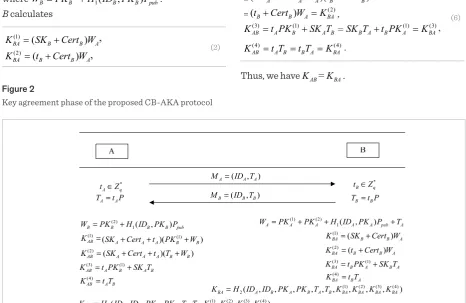
participant A is the initiatorwith identity IDA, public key PKA, private key SKA and certificate CertA, while the participant B is the responder with identity IDB, public key PKB, private key SKB and certificate CertB. As described in Figure 2, they can do as follows:
1 The participant A chooses a random integer tA∈Zq*, computes TA =t PA and then sends a message
( , )
A A A M = ID T to B.
2 After receiving MA, the participant B chooses a
random integer *
B q
t ∈Z , computes TB =t PB and sends a message MB = (IDB, TB) to A.
3 A and B, respectively, calculate four shared secrets as follows:
A calculates
(1) ( )( (1) )
AB A A A B B
K = SK +Cert +t PK +W
,
(2) ( )( )
AB A A A B B
K = SK +Cert +t T W+
,
(3)=
AB
K (1)
A
A B B
t PK +SK T
,
(4)
AB A B K =t T
,
(1)
where (2)
1( , )
B B B B pub
W =PK +H ID PK P .
B calculates
(1) ( )
BA B B A
K = SK +Cert W
,
(2) ( )
BA B B A
K = t +Cert W
,
(2)(3) (1)
BA B A B A K =t PK +SK T
,
(4)
BA B A
K =t T
,
(3)where (1) (2)
1( , )
A A A A A pub A
W =PK +PK +H ID PK P +T .
4 A and B, respectively, compute the shared session key as follows:
2( , , , , , ,
AB A B A B A B
K =H ID ID PK PK T T (1), (2), (3), (4))
AB AB AB AB
K K K K
2( , , , , , ,
BA A B A B A B
K =H ID ID PK PK T T (1), (2), (3), (4))
BA BA BA BA
K K K K
(4) For the correctness of the proposed protocol, we can deduce that
(1)
AB
K =( )( (1) )
A A A B B
SK +Cert +t PK +W =(SKA+CertA+t SKA)( B+Cert PB)
=
( ) (1)B B A BA
SK +Cert W =K
,
(5)
(2)
AB
K =(SKA+CertA+t T WA)( B+ B)
=(SKA+CertA+t tA)(B+Cert PB)
=( ) (2)
B B A BA
t +Cert W =K ,
(3) (1)
AB A B A B
K =t PK +SK T = (1) (3)
B A B A BA SK T +t PK =K ,
(4) (4)
AB A B B A BA K =t T =t T =K .
(6)
Thus, we haveKAB= KBA. Figure 2
Key agreement phase of the proposed CB-AKA protocol
* B q
t Z
B B
T t P
( , )
B B B
M ID T
(1) AB
K
(2) ( )( )
AB A A A B B
K SK Cert t T W
(1) (2)
1( , )
A A A A A pub A
W PK PK H ID PK P T
(1) ( )
BA B B A
K SK Cert W
(2) ( )
BA B B A
K t Cert W
(3) (1)
AB A B A B
K t PK SK T KBA(3)t PKB A(1)SK TB A *
A q
t Z
A A
T t P
( , )
A A A
M ID T
(4) AB A B
K t T K(4)BAt TB A
(1) (2) (3) (4)
2( , , , , , , , , , )
AB A B A B A B AB AB AB AB
K H ID ID PK PK T T K K K K
(1) (2) (3) (4)
2( , , , , , , , , , )
BA A B A B A B BA BA BA BA
K H ID ID PK PK T T K K K K
(1)
(SKACertAt PKA)( B WB)
(2)
1( , )
B B B B pub
351
Information Technology and Control 2017/3/46
5. Security analysis
The security of the proposed CB-AKA protocol can be formally proved by combining the following three theorems.
Theorem 1. In the presence of a benign adversary, any two oracles n,
i j
∏ and m,
j i
∏ always establish the same shared session key that is distributed uniformly at ran-dom.
Proof.According to the correctness verification of the proposed protocol in Section 4, we can see that if two oracles n,
i j
∏ and m,
j i
∏ are matching, then they must es-tablish the same shared session key. In addtion, since the values tA, tB are randomly picked and TA, TB can be viewed as the random input of the hash function H2,
the shared session key can be viewed as the output of
H2. Thus, the session key is uniformly distributed due
to the properties of hash functions.
Theorem 2. Suppose that H1 and H2 are two random
oracles. If there is a Type 1 adversary 1 against the
security of our CB-AKA protocol with advantage e when running in time τ, making at most qcu queries to
the oracle CreateUser, qrp queries to the oracle
Replace-PublicKey, qco queries to the oracle Corrupt, qce queries
to the oracle Certificate, qse queries to the oracle Send,
qre queries to the oracle Reveal and qi queries to the random oracles Hi(1≤ i ≤ 2), then there exists an
algo-rithm to solve the CDH problem in G with advantage
2 2
s cu n q q
ε
ε ′ ≥ and running time τ ′≤ τ+ (q1 + qrp + qco +
qce)O(1) + q2(4τm+ 9τp + O(1)) + qcu(3τm+ O(1)) + qse(τm+
O(1)) + qre(10τm+ 2τp + O(1)), where ns denotes the
max-imal number of the protocol sessions that each partici-pant participates in,τp andτm, respectively, denote the
time for computing a pairing and a scalar multiplica-tion in G.
Proof.Suppose that the algorithm takes as input a random CDH instance (q, G, P, uP, vP), where u, v∈ *
q Z are unknown to the algorithm . To compute uvP, interacts with the adversary 1 as below:
At the beginning of the game, the algorithm chooses at random Ppub∈G as the system master public key and sends params = {k, q, G , P, Ppub, H1, H2} to 1.
Furthermore, it picks three different indices I, J∈ {1, 2,…, qcu} and T∈ {1, 2,…, ns} at random.
In Phase 1 and Phase 2, the algorithm answers the adversary 1’s queries as below:
H1(IDi, PKi): The algorithm keeps a list L1 of tuples
<IDi, PKi, hi>. Upon receiving a H1 query on (IDi, PKi), it returns hi if a tuple <IDi, PKi, hi> is already in the list
L1. Otherwise, it randomly chooses h Zi∈ q*, adds a new tuple <IDi, PKi, hi> to the list L1 and returns hi.
H2(IDiA, IDiB, PKiA, PKiB, TiA, TiB, Ki(1), Ki(2), Ki(3), Ki(4)): The algorithm keeps alist L2 of tuples <IDiA,IDiB,
A i PK , B
i PK , A
i T , B
i T , (1)
i K , (2)
i K , (3)
i K , (4)
i
K , hi>. Upon receiving a H2 query on(IDiA,IDiB,PKiA, PKiB,TiA,TiB,
(1)
i K , (2)
i K , (3)
i K , (4)
i
K ), it returns hi if a tuple <IDiA,IDiB, A
i PK , B
i PK , A
i T , B
i T , (1)
i K , (2)
i K , (3)
i K , (4)
i
K , hi> is already in the list L2. Otherwise, does as below:
1 If there exists a tuple <∏ni j,, IDi, IDj, PKi, PKj,ti jn, ,Ti j,n, ,
n j i T , n,
i j
K > in the list Ls(maintained by the oracle
Send) such thatKi jn, ≠⊥,ID IDi= Jand
_ Case 1: ∏i jn, is an initiator, searches for the list
L2 to see if there exists a tuple <IDiA,IDiB,PKiA, B
i PK , A
i T , B
i T , (1)
i K , (2)
i K , (3)
i K , (4)
i
K ,hi> such that i
ID = A i
ID ,IDj= B i ID , A
i
PK =PKi, B i
PK =PKj, ,n i j T = A
i T
andTj in, =TiB. If it does, computes Ki(2)=Ki(2)-(SK Cert Ti+ i)( j in, +PKi(2)+h Pi pub)-t Ti j in, (2) (2) (2)
, ,
= ( )( n + ) n
i i i i j i i i pub i j i
K K - SK Cert T+ +PK h P -t T and checks whether the following equations hold given a proper bilinear map e for the group G:
(2) (2) ,
( + , n) ( , )
i i pub i j i e PK h P T =e K P ,
(1) (1) (2) ,
( + n )(
i i i i j j j
K = SK Cert t+ PK +PK +H ID PK P1( j, j) pub),
(3) (1) ,
n n
i i j j i j,i K =t PK +SK T ,
(4) , ,
n n i i j j i K =t T .
(7)
If (1)
i K , (2)
i K , (3)
i
K and (4)
i
K pass the above validati-ons, then sets hi =Ki jn, , adds a new tuple <IDiA,
B i ID , A
i PK , B
i PK , A
i T , B
i T , (1)
i K , (2)
i K , (3)
i K , (4)
i
K ,hi> to the list L2 and returns hi.
_ Case 2: ∏ni j, is a responder, searches for the list L2 to see if there exists a tuple <IDiA,IDiB,
A i
PK , B i PK , A
i T , B
i T , (1)
i K , (2)
i K , (3)
i K , (4)
i
K ,hi> such that IDj= A
i
ID ,IDi=IDiB,PKiA=PKj,PKiB=PKi,
,n
i j T = B
i
T andTj in, =TiA. If it does, computes
(2)
i
K = (2) (1) (2)
,
( + n)
i i j j j pub j i K -Cert PK +PK h P +T
-,n n,
j i j i j i
SK T -t T and checks whether the following equations hold given a proper bilinear map e for the group G:
(2) (2) ,
( + , n) ( , )
i i pub i j i e PK h P T =e K P
,
(1) (1) (2) ,
( + n ) (
i i i i j j j
K = SK Cert t+ ⋅ PK +PK
+H ID PK P1( j, j) pub)
,
(3) n i i j,i
K =SK T (1) ,
n i j j t PK
+
,
(4) , ,
n n i i j j i K =t T
.
If (1)i K , (2)
i K , (3)
i
K and (4)
i
K pass the above validations, then sets hi= n,
i j
K , puts a new tuple < A i ID , B
i ID , A
i PK , B
i PK , A
i T , B
i T , (1)
i K , (2)
i K , (3)
i K , (4)
i
K ,hi> in the list L2
and returnshi.
2 Else, if there exists a tuple <∏ni j, , IDi, IDj, PKi, PKj,
,
n i j t , ,n
i j T , n,
j i T , n,
i j
K > on Ls such that Ki jn, ≠⊥, IDi ≠IDJ and the following equations hold given a proper bi-linear map e for the group G:
(1) (1) (2)
1 ,
( , ) ( ( , ) n,
i i i i i pub i j
e K P =e PK +PK +H ID PK P +T (1) (2)
1( , ) )
j j j j pub
PK +PK +H ID PK P ,
(2) (1) (2)
1 ,
( , ) ( ( , ) n,
i i i i i pub i j
e K P =e PK +PK +H ID PK P +T
Tj in, +PK(2)j +H ID PK P1( j, j) pub),
(3) (1) (1)
, ,
( , ) ( ,n ) ( , )n
i i j j i j i
e K P =e T PK e PK T ,
(4)
, ,
( , ) ( , )n n
i i j j i
e K P =e T T , (9)
then setsh Ki = i jn, , puts a new tuple <IDiA, IDiB, A
i PK , B
i PK , A
i T , B
i T , (1)
i K , (2)
i K , (3)
i K , (4)
i
K ,hi> in the list L2 and returnshi.
3 Otherwise, the algorithm picks a random value
{0,1}k i
h ∈ , puts a new tuple < A i ID , B
i ID , A
i PK , B
i PK , A
i T , B
i T , (1)
i K , (2)
i K , (3)
i K , (4)
i
K ,hi> in the list L2 and
returnshi.
CreateUser(IDi): The algorithm keeps a list Lc of tuples<ID SK PK Certi, i, i, i >. Upon receiving a
CreateUser query on(IDi), it returnsPKiif a tuple
, , ,
i i i i ID SK PK Cert
< >is already in the list Lc. Otherwise, it performs as below:
1 If IDi is the J-th identity submitted to this oracle (i.e.,IDi=IDJ), it randomly chooses x Zi∈ *q, com-putes PKi =(x P uP h Pi , - i pub)and sets Certi =⊥
and SKi =xirespectively. It then adds new tuples
, , ,
i i P i ID x K
< ⊥> and <ID PK hi, i, i >to the lists Lc and L1, respectively, and returnsPKi.
2 Otherwise, it randomly chooses s x h Zi, ,i i∈ q*, com-putes PKi =(x P P h Pi ,si - i pub) and sets Certi =⊥ and SKi =xirespectively. It then adds new tuples
, , i, i i P i
D K
I x s
< > and <IDi, PKi, hi> to the lists Lc and L1, respectively, and returns PKi.
Certificate(IDi): Upon receiving a Certificate query
on (IDi), the algorithm aborts the game if IDi =IDJ. Otherwise, it searches for the list Lc to get a tuple
, , ,
i i i i ID SK PK Cert
< >and returns Certi.
Corrupt(IDi): Upon receiving a Corrupt query on (IDi), the algorithm searches for the list Lc to get a tuple
, , ,
i i i i ID SK PK Cert
< >and returnsSKi.
ReplacePublicKey(IDi,PKi′): Upon receiving a query on (IDi,PKi′), the algorithm searches for the list
Lc to get a tuple <ID SK PK Certi, i, i, i > and replaces it with <IDi, ,⊥ PKi′,⊥>.
Send( n, i j
∏ , M): The algorithm keeps a listLsof tu-ples <∏ni j, , IDi, IDj, PKi, PKj,ti jn, ,Ti j,n ,Tj in, ,Ki jn, >. Upon
receiving a Send query on ( n, i j
∏ , M) ( sets Tj in, =M if
M ≠λ), returnsTi j,n if a tuple <∏ni j, , IDi, IDj, PKi, PKj,
,
n i j
t ,Ti j,n ,Tj in, ,Ki jn, > is already in the list Ls. Otherwise, does as follows:
1 If ∏ = ∏ni j, TI J, , it sets n, n, i j i j K =t =⊥, ,n
i j
T =vP, n, j i T =M, then puts a new tuple < n,
i j
∏ , IDi, IDj, PKi, PKj,ti jn, , ,
n i j T , n,
j i T , n,
i j
K > in the list Ls and returns Ti j,n .
2 Otherwise, it randomly chooses Ki jn, ∈{0,1}k, *
,
n i j q
t ∈Z and sets ,n n, i j i j
T =t P, then puts a new tuple <
,
n i j
∏ , IDi, IDj, PKi, PKj,ti jn, ,Ti j,n ,Tj in, ,Ki jn, > in the list Ls and returns ,n
i j T .
Reveal(∏ni j, ): Upon receiving a Reveal query on (∏i jn, ),
the algorithm aborts the game if ∏ = ∏ni j, TI J, or∏ni j,
is a matching conversation of ∏TI J, . Otherwise, it
searches for a tuple < n, i j
∏ , IDi, IDj, PKi, PKj,ti jn, , Ti j,n , ,
n j i T , n,
i j
K > in the list Ls and does the following:
1 If <∏ni j, , IDi, IDj, PKi, PKj,ti jn, ,Ti j,n ,Tj in, ,Ki jn, > is on the
list Ls andKi jn, ≠⊥, returnsKi jn, .
2 Else if <∏ni j,, IDi, IDj, PKi, PKj, ti jn, , Ti j,n, Tj in,, Ki jn,> is
on the list Ls andKi jn, =⊥, searches for a tuple
, , ,
i i i i ID SK PK Cert
< > in the list Lc and performs as follows:
_ Case 1: IDi =IDJ, n, i j
∏ is an initiator and there
exists a tuple < A i ID , B
i ID , A
i PK , B
i PK , A
i T , B
i T ,
(1)
i K , (2)
i K , (3)
i K , (4)
i
K , hi > in the list L2 such that
A i i
ID ID= , B j i ID =ID , A
i i
PK =PK , B i
PK =PKj,
,n A
i j i
T =T and n, B j i i
T =T . If it does, computes Ki(2) =
(2) (2)
, , ,
( )( n + ) n n
i i i j i i i pub i j j i K - SK Cert T+ +PK h P -t T and checks whether the following equations hold:
(2) (2) ,
( + , n) ( , )
i i pub i j i e PK h P T =e K P
,
(1) (1) (2) ,
( + n )(
i i i i j j j
K = SK Cert t+ PK +PK +
H ID PK P1( j, j) pub)
,
353
Information Technology and Control 2017/3/46
(3)
i
K = (1)
,
n n
i j j i j,i t PK +SK T
,
(4) , ,
n n i i j j i K =t T
.
If (1)
i K , (2)
i K , (3)
i
K and (4)
i
K pass the above validati-ons, then sets Ki jn, =hiand returnshi.
_ Case 2: IDi =IDJ, n, i j
∏ is a responder and there exists a tuple < A
i ID , B
i ID , A
i PK , B
i PK , A
i T , B
i T , (1)
i K , (2)
i K , (3)
i K , (4)
i
K , hi> in the list L2 such
that IDj = A i
ID , IDi = B
i ID , A
i
PK = PKj, PKiB = PKi,
,n
i j T = B
i
T and Tj in, = TiA. If so, computes Ki(2)=
(2) (1) (2)
, ,
( + n) n
i i j j j pub j i j i j K -Cert PK +PK h P +T -SK T -t Ti j j in, n,
and checks whether the following equations hold:
(2) (2) ,
( + , n) ( , )
i i pub i j i e PK h P T =e K P
(1) (1) (2) ,
( + n )(
i i i i j j j
K = SK Cert t+ PK +PK +
H ID PK P1( j, j) pub)
,
(3) (1) ,
n i i j j
K =t PK + n i j,i SK T
,
(4) , ,
n n i i j j i K =t T
.
(11)
If (1)
i K , (2)
i K , (3)
i
K and (4)
i
K pass the above validati-ons, then setsKi jn, =hiand returnshi.
_ Case 3: IDi ≠IDJ, n, i j
∏ is an initiator and there
exists a tuple < A i ID , B
i ID , A
i PK , B
i PK , A
i T , B
i T , (1)
i K , (2)
i K ,
(3)
i K , (4)
i
K , hi> in the list L2 such that IDi = IDiA, IDj = B
i ID , A
i
PK = PKi, PKiB = PKj, Ti j,n = TiA and Tj in, = TiB. If it does, checks whether the following equations hold:
(1) (1) (2) ,
( n )(
i i i i j j j
K = SK Cert t+ + PK +PK +
H ID PK P1( j, j) pub)
,
(2) (2) ,
( n )( n
i i i i j j,i j K = SK Cert t+ + T +PK +
H ID PK P1( j, j) pub)
,
(3)
i
K = (1)
,
n n
i j j i j,i t PK +SK T
,
(4) ,
n n i i j j,i K =t T
.
(12)
If (1)
i K , (2)
i K , (3)
i
K and (4)
i
K pass the above validati-ons, then sets Ki jn, =hi and returns hi.
_ Case 4: IDi ≠IDJ, ∏i jn, is a responder and there
exists a tuple < A i ID , B
i ID , A
i PK , B
i PK , A
i T , B
i T , (1)
i K , (2)
i K ,
(3)
i K , (4)
i
K , hi > in the list L2 such that IDj = IDiA, IDi = B
i ID , A
i
PK = PKj, PKiB = PKi, Ti jn, = TiB and Tj in, = TiA. If it does, checks whether the following equations hold:
(1) ( )( (1) (2)
i i i j j
K = SK Cert PK+ +PK +
H ID PK1( j, j)Ppub+ )Tj in,
,
(2) (1) (2),
( n )(
i i j i j j
K = t +Cert PK +PK +
H ID PK1( j, j)Ppub+ )Tj in,
,
(3) (1) ,
= n n
i i j j i j,i K t PK +SK T
,
(4) ,
n n i i j j,i K =t T
.
(13)
If (1)
i K , (2)
i K , (3)
i
K and (4)
i
K pass the above validati-ons, then sets Ki jn, =hi and returns hi.
3 Otherwise, randomly chooses n, {0,1}k i j
K ∈ and returns Ki jn, .
At the test phase, if 1 does not ask a Test query on the oracle T,
I J
∏ , then aborts the game. Otherwise, returns a random value x∈{0,1}k.
Once 1 finishes its queries, it returns its guess.
Clearly, if 1 can win the game with non-negligible advantage ε, there must exist a tuple < T,
I J
∏ , IDI, IDJ, I
PK , PKJ=⊥, , TI JT, , TJ IT,=⊥, > in the list Ls. According to the above simulation, if T,
I J
∏ is an initiator, then there exists a tupe < A
i ID , B
i ID , A
i PK , B
i PK , A
i T , B
i T , (1)
i K , (2)
i K ,
(3)
i K , (4)
i
K , hi > in the list L2 such that TiA = TI JT, = vP and ,
B T i J I
T =T =M (Note that if M is an incoming message, then M = TJ IT, ). computes
Z =
(2) (2),
( )( T
i I I J I J
K - SK +Cert T +PK +
1( J, J) pub) TI,J J IT,
H ID PK P -t T
=
(SKI+Cert tI+ I,JT )(TJ IT, +U) (- SKI +(4) ,
)( T )
I J I I Cert T +U -K
=
T =I,J
t uP uvP
,
(14)
where (4) ,
T T I I,J J I
K =t T which can be found in the list L2.
Else if ∏TI J, is a responder, then there exists a tuple
< A i ID , B
i ID , A
i PK , B
i PK , A
i T , B
i T , (1)
i K , (2)
i K , (3)
i K , (4)
i
K , hi> in the list L2 such that TiB =TI JT, =vP and TiA = TJ IT, =M
(Note that if M is an incoming message, then T, J I M T= ). computes
Z =
(2) ( (1) (2)i I J J
K -Cert PK +PK +
H ID PK P1( J, J) pub+TJ IT, )-SK V t TJ - TI,J J IT,
Information Technology and Control 2017/3/46 354
=
(1),
(T )( + T )
I,J I J J I
t +Cert PK +U T
Cert PKI( J(1)+ +U TJ IT, )-SK V KJ - I(4)
=
T =I,J
t uP uvP
,
where (4),
T T I I,J J I
K =t T which can be found in the list L2. For both cases, we have that Z uvP= . Therefore, the algorithm can return Z as the solution to the given CDH problem.
To derive the algorithm ’s advantage in solving the CDH problem, we define the following events: (1) E1:
1 does not choose∏TI J, as the test oracle; (2) E2: 1
makes an oracle query Certificate(IDJ); (3) E3: 1
makes an oracle query Reveal (∏TI J, ).
According to the above simulation, the algorithm aborts the game only when one of the above events happens. It is clear that Pr[¬E1] ≥1/(n qs cu2 ) as I, J∈ {1, 2,…, qcu} and T∈ {1, 2,…, ns}. In addition, because ¬E1
implies both ¬E2 and ¬E3, we get that Pr[¬E1∧¬E2∧
¬E3] ≥ 1/(n qs cu2).
Since the algorithm selects the correct tuple from the list L2 with probability 1/q2, it can correctly solve
the given CDH problem with advantage 2
2
s cu n q q
ε
ε ′ ≥ .
The time complexity of the algorithm is mainly dominated by the running time τ of the adversary 1
and the scalar multiplications and pairings performed in the queries. From the simulation above, we obtain that the time complexity of the algorithm is bound-ed by τ ′≤ τ+ (q1 + qrp + qco + qce)O(1) + q2(4τm+ 9τp + O(1)) + qcu(3τm+ O(1)) + qse(τm+ O(1)) + qre(10τm+ 2τp + O(1)). Theorem 3. Suppose that H1 and H2 are two random
oracles. If there is a Type 2 adversary 2 against the
security of our CB-AKA protocol with advantage e when running in time τ, making at most qcu queries to
the oracle CreateUser, qco queries to the oracle Corrupt,
qse queries to the oracle Send, qre queries to the oracle
Reveal and qi queries to the random oracles Hi(1≤ i ≤ 2), then there exists an algorithm to solve the CDH
problem in G with advantage 2
2
s cu n q q
ε
ε ′ ≥ and running
time τ ′≤ τ+ (q1 +qco)O(1) + q2(4τm+ 9τp + O(1)) + qcu(3τm + O(1)) + qse(τm+ O(1)) + qre(7τm+ O(1)), where ns
de-notes the maximal number of the protocol sessions that each participant participates in,τp andτm, respectively,
denote the time for computing a pairing and a scalar multiplication in G.
Proof. Suppose that the algorithm takes as input a random CDH instance (q, G, P, aP, bP), where a, b∈
*
q
Z are unknown to the algorithm . To computeabP, interacts with the adversary 2 as below:
At the beginning of the game, the algorithm chooses a random value *
q
s Z∈ as the master key msk and computes Ppub=sP. It then outputs the public parameters params = {k, q, G, P, Ppub, H1, H2} and the
master secret key msk = s to 2. Furthermore, it selects three different indices I, J∈ {1, 2,…, qcu} and T ∈ {1, 2,…, ns} at random.
In Phase 1 and Phase 2, the algorithm answers the adversary 2’s queries as below:
H1(IDi,PKi): The algorithm keeps a list L1 of
tu-ples <IDi,PKi,hi>. Upon receiving a H1 query on
(IDi,PKi), the algorithm returnshiif there exists a tuple <IDi,PKi,hi> in the list L1. Otherwise, it selects
a random value *
i q
h Z∈ , adds a new tuple < IDi, PKi, i
h > to the list L1 and returns hi.
H2(IDiA, IDiB, PKiA, PKiB, TiA, TiB, Ki(1), Ki(2), Ki(3),Ki(4), i
h): The algorithm keeps a list L2 of tuples <IDiA, B
i ID , A
i PK , B
i PK , A
i T , B
i T , (1)
i K , (2)
i K , (3)
i K , (4)
i K , hi>. Upon receiving a H2 query on (IDiA,IDiB,PKiA, PKiB,
A i T , B
i T , (1)
i K , (2)
i K , (3)
i K , (4)
i
K ), the algorithm re-turnshiif there exists a tuple <IDiA, IDiB, PKiA, PKiB,
A i T , B
i T , (1)
i K , (2)
i K , (3)
i K , (4)
i
K , hi> in the list L2.
Oth-erwise, the algorithm searches for a tuple <∏ni j, , IDi,
IDj, PKi, PKj,ti jn, , Ti j,n , Tj in, , Ki jn, > in the list Ls and per-forms as follows:
1 If such a tuple exists and satisfies the equations:
(1) (1) (2) 1
( i , ) ( i i ( i, i) pub
e K P =e PK +PK +H ID PK P
(1) (2)
,n, 1( , ) )
i j j j j j pub
T PK PK H ID PK P
+ + +
,
(2) (1) (2) 1
( i , ) ( i i ( i, i) pub
e K P =e PK +PK +H ID PK P
(2)
,n, n, 1( , ) )
i j j i j j j pub T T PK H ID PK P
+ + +
,
(3)
,
( , ) ( ,n
i i j
e K P =e T (1) (1) ,
) ( , )n
j i j i PK e PK T
,
(4)
, ,
( , ) ( , )n n
i i j j i e K P =e T T
,
then the algorithm obtains Ki jn, and sets h Ki = i jn, .
It adds a new tuple < A i ID , B
i ID , A
i PK , B
i PK , A
i T , B
i T ,
(1)
i K , (2)
i K , (3)
i K , (4)
i
K , hi> to the list L2 and returns hi.
2 Otherwise, randomly selects hi ∈{0,1}k, adds a new tuple < A
i ID , B
i ID , A
i PK , B
i PK , A
i T , B
i T , (1)
i K ,
(2)
i K , (3)
i K , (4)
i
355
Information Technology and Control 2017/3/46
CreateUser(IDi): The algorithm keeps a list Lc of tuples <ID SK PK Certi, i, i, i >. Upon receiving a Cre-ateUser query on (IDi), the algorithm returns PKi if a tuple<ID SK PK Certi, i, i, i >is already in the list
Lc. Otherwise, it does as below:
1 If IDi =IDJ, it randomly selects , *
q i i h
Cert ∈Z , sets
( , )
i i i
PK = aP Cert P h sP- , adds a new tuple <IDi, ,
,PKi Certi
⊥ > to the list Lc and returnsPKi.
2 Otherwise, it randomly selects SK Certi, i,hi∈Zq*, setsPKi =(SK P Cert P h sPi , i - i ), adds a new tuple
, , ,
i i i i ID SK PK Cert
< > to the list Lc and returns i
PK .
Corrupt(IDi): Upon receiving a Corrupt query on (IDi), the algorithm aborts if IDi =IDJ. Otherwise, it retrives a tuple <ID SK PK Certi, i, i, i > in the list Lc and returns SKi.
Send( n, i j
∏ , M): The algorithm keeps a listLsof tu-ples <∏i jn, , IDi, IDj, PKi, PKj,ti jn, , Ti j,n , Tj in, , Ki jn, >. Upon
receiving a Send query on ( n, i j
∏ , M) ( sets Tj in, =M
if M ≠λ), returns Ti j,n to 2 if a tuple <∏ni j, , IDi, IDj,
PKi, PKj,ti jn, , Ti jn, , Tj in, , Ki jn, > is already in the list Ls. Otherwise, it does as follows:
1 If ∏ = ∏i jn, TI J, , it sets n, n, i j i j K =t =⊥, ,n
i j
T =bP and
,
n j i
T = M. Then it adds a new tuple <∏ni j, , IDi, IDj,
PKi, PKj,ti jn, , Ti jn, , Tj in, ,Ki jn, > to the list Ls and returns
,
n i j T .
2 Otherwise, it randomly choosesKi jn, ∈{0,1}k,
* ,
n i j q t ∈Z
and sets Ti j,n =t Pi jn, . Then it puts a new
tu-ple < n, i j
∏ , IDi, IDj, PKi, PKj,ti jn, , Ti j,n , Tj in, , Ki jn, > in the
list Ls and returns Ti j,n .
Reveal(∏i jn, ): Upon receiving a Reveal query on (∏ni j, ),
the algorithm aborts the game if n, T, i j I J
∏ = ∏ or n,
i j ∏
is a matching conversation of T, I J
∏ . Otherwise, searches for a tuple < n,
i j
∏ , IDi, IDj, PKi, PKj,ti jn, , Ti j,n ,Tj in, , ,
n i j
K > in the list Ls.
1 If such a tuple exists and Ki jn, ≠⊥, it returns n, i j K .
2 Else if such a tuple exists and Ki jn, =⊥, it searches
for a tuple <ID SK PK Certi, i, i, i >in the list Lc and does as below:
_ Case 1: ∏i jn, is an initiator and a tuple < A i ID , B
i ID , A
i PK , B
i PK , A
i T , B
i T , (1)
i K , (2)
i K , (3)
i K , (4)
i
K , hi > can be found in the list L2 such that IDi = IDiA,IDj = IDiB,
A i
PK = PKi, PKiB = PKj, Ti jn, = TiAand Tj in, =TiB. If it does, checks whether the following equations hold:
(1) (1) (2) ,
( n )(
i i i i j j j
K = SK Cert t+ + PK +PK +
H ID PK P1( j, j) pub)
,
(2) (2) ,
=( n )( n
i i i i j j,i j K SK Cert t+ + T +PK +
H ID PK P1( j, j) pub)
,
(3) (1) ,
= n n
i i j j i j,i K t PK +SK T
,
(4) ,
n n i i j j,i K =t T
.
(17)
If (1)
i K , (2)
i K , (3)
i
K and (4)
i
K pass the above validations, then sets Ki jn, =hi and returns hi.
_ Case 2: ∏ni j, is a responder and there exists a tuple
< A i ID , B
i ID , A
i PK , B
i PK , A
i T , B
i T , (1)
i K , (2)
i K , (3)
i K , (4)
i K , hi> in the list L2 such that IDj = IDiA, IDi= IDiB, PKiA =
j PK , B
i
PK = PKi, Ti j,n = TiB and Tj in, = TiA. If it does, checks whether the following equations hold:
(1) ( )( (1) (2)
i i i j j
K = SK Cert PK+ +PK +
H ID PK1( j, j)Ppub+ )Tj in,
,
(2) (1) (2) ,
( n )(
i i j i j j
K = t +Cert PK +PK +
H ID PK1( j, j)Ppub+ )Tj in,
,
(3) (1) ,
= n +
i i j j
K t PK n
i j,i SK T
,
(4) ,
n n i i j j,i K =t T
.
(18)
If (1)
i K , (2)
i K , (3)
i
K and (4)
i
K pass the above validati-ons, then sets n,
i j i
K =hand returnshi.
3 Otherwise, it randomly selectsKi jn, ∈{0,1}k and
re-turns n, i j K .
At the test phase, if the adversary 2 does not ask a
Test query on the oracle T, I J
∏ , then the algorithm aborts the game. Otherwise, the algorithm outputs a random value x∈{0,1}k.
Once the adversary 2 finishes its queries, it returns
its guess. Clearly, if the adversary 2 can win the game
with non-negligible advantage ε, then there must be a tuple < T,
I J
∏ ,IDI,IDJ,PKI,PKJ=⊥, ,bP, T, J I
T =⊥, > in the list Ls. According to the above simulation, if ∏TI J,
is an initiator oracle, then there exists a tuple < A i ID , B
i ID , A
i PK , B
i PK , A
i T , B
i T , (1)
i K , (2)
i K , (3)
i K , (4)
i
K , hi> in the list L2 such that PKiB=PKJ, wherePKJ(1)=aPand
,
A T i I J
T =T =bP; else if ∏TI J, is a responder oracle, then
there exists a tuple < A i ID , B
i ID , A
i PK , B
i PK , A
i T , B
i T , (1)