A
NNAP
ARADOWSKA, B
ARTOSZM
ARCZEWSKI, E
WAP
AWŁOWSKA−C
IERNIAKSelf−Perception of Halitosis Among Students
of Wrocław Medical University
Odczucie halitozy wśród studentów Akademii Medycznej we Wrocławiu
Student’s Scientific Association of Dental Prosthetics, Silesian Piasts University of Medicine, Wrocław, Poland
Adv Clin Exp Med 2007, 16, 4, 543–548 ISSN 1230−025X
ORIGINAL PAPERS
© Copyright by Silesian Piasts University of Medicine in Wrocław
Abstract
Background. Halitosis (bad breath) may result from bacteria colonizing the oral cavity, systemic diseases, caries, calculus, infections of the oral cavity or throat, tonsillitis, as well as insufficient oral hygiene.
Objectives.The aim of this study was to determine the frequency of self−assessed halitosis among students of Wroclaw Medical University and its correlation with oral hygiene habits and accompanying systemic diseases.
Material and Methods.The questionnaire−based survey included 400 students (287 women and 113 men) of Wrocław Medical University. Statistic analysis was done using the χ2test.
Results.Among those questioned, 24% suffered from halitosis, 77% of whom experienced it every morning or more frequently. Sixty percent of the students suffering from halitosis also suffered from xerostomia, while among the rest of the students this was a problem in less than 27%. Fourteen percent leaned of their own bad breath from a person of the opposite sex, while a dentist informed 3.5% of those questioned. It is significant that 96% (of den− tistry students: 100%) smelled bad breath in others. It was not significant whether a person brushed their teeth once, twice, or three or more times a day (p= 0.08). Supplementary oral hygiene products such as mouthwash and den− tal floss were used more often by the dentistry students (83%) than by those of the other faculties (60%). Chewing gum and breath fresheners were used more often (90%) than such additional agents as mouthwash and floss (70%). Using additional agents (mouthwash and dental floss) decreased the frequency of subjective halitosis (p = 0.00016).
Conclusions. Using additional agents for oral hygiene rather than more frequent brushing decreases the self− assessed halitosis level. People prefer using chewing gum or breath fresheners (90%) to dental floss or mouthwash (70%). A large portion of those questioned suffered from both halitosis and xerostomia. Almost all of those ques− tioned (96%) smelled bad breath from other people (Adv Clin Exp Med 2007, 16, 4, 543–548).
Key words:halitosis, oral hygiene, students.
Streszczenie
Wprowadzenie.Halitosis, czyli nieprzyjemny zapach z jamy ustnej, może wynikać z działania niektórych bakterii kolonizujących jamę ustną lub może być objawem chorób ogólnoustrojowych. Początkiem może być proces próch− nicowy, obecność kamienia nazębnego, zakażenie jamy ustnej, gardła i migdałków, lecz przede wszystkim niewystarczająca higiena jamy ustnej.
Cel pracy. Ocena częstości występowania halitozy wśród studentów Akademii Medycznej we Wrocławiu oraz związku jej występowania z poziomem higieny jamy ustnej i współwystępującymi chorobami ogólnoustrojowymi.
Materiał i metody. Badaniem ankietowym objęto 400 studentów Akademii Medycznej we Wrocławiu. Wśród zbadanych było 287 kobiet i 113 mężczyzn. Analizę statystyczną wykonano za pomocą testu χ2.
Halitosis is a common problem, occurring in about one fourth of the population. Bad breath may be a result of a specific spectrum of bacteria, lack of or poor hygiene, or by some somatic dis− eases. The pathogens are usually Gram−negative anaerobic microflora that live in places inaccessi− ble to oxygen [1]. The most common bacteria responsible for bad breath are Porphyromonas gingivalis, Prevotella intermedia, Fusobacterium nucleatum, Treponema denticola, and Tannerella forsythensis[2, 3].
Some authors claim that halitosis is synony− mous to fetor ex ore[2,4]. Others distinguish the two, stating that fetor ex oreis caused by local fac− tors, such as periodontal diseases, caries, lack of or poor oral hygiene, laryngological diseases, or the use of drugs, while halitosis is a condition of exhaling fetid substances coming from deeper parts of the human body as a result of an internal disease, e.g. bronchitis, gastric or kidney diseases. It can also be part of a neoplasmic process [5, 6].
Halitosis may be divided into three groups: 1) real halitosis, which is bad, unacceptable, intense breath, 2) pseudohalitosis, which is bad breath not smelled by others but by the person claiming to suffer from bad breath, and 3) hali− phobia, in which after curing halitosis, the patient still thinks he suffers from it. Real halitosis may also be divided into two groups: physiological hal− itosis, caused by debris and putrefaction, and pathological halitosis, which originates in the oral cavity or from deeper regions of the body as a result of some somatic disease [7].
Although halitosis is said to occur in approxi− mately one fourth of the population, its true preva− lence is not really known and may be from 15 to 50% of people [1, 4, 8]. As it is such a common problem, halitosis has a great influence on the psy− chological aspects of life, especially for those who suffer from it. Bad breath is the third most frequent reason for visiting the dentist, after caries and peri− odontal disease [2]. Those who suffer from bad breath also seek help from general practitioners and gastroenterologists. People often try to cover their bad breath by brushing their teeth more fre− quently or using some additional agents such as
mouthwash (especially those with 0.2% aqueous chlorhexidine gluconate) or dental floss. Only by reducing oral flora are we able to decrease the level of bad breath [6, 8].
The aim of this study was to determine the fre− quency of halitosis among students of Wrocław Medical University and its correlation with some oral hygiene habits, i.e. the frequency of brushing teeth, the use of additional oral hygiene products, bad habits such as drinking sweet fizzy drinks, cig− arette smoking, and accompanying systemic dis− eases. It concerned how often people smelled bad breath from other people’s mouths and if they were aware of their own halitosis.
Material and Methods
The anonymous questionnaire−based survey included 400 students, 100 from each faculty, i.e. medicine, dentistry, pharmacy, and public health. There were 287 women and 113 men. All of the responders were between 19 and 28 years of age. The questionnaire contained 16 questions about halitosis, oral hygiene habits (the frequency of brushing teeth and using additional agents), somat− ic diseases, and bad habits, such as drinking sweet− ened drinks and smoking cigarettes (Table 1). The questionnaire was developed by reviewing the lit− erature on the subject. The study was conducted in the winter (January to February) of 2006. The results were collated for each faculty separately and added together so that differences among the students of each faculty could be easily noted. Statistical analysis was done using the χ2test.
Results
Twenty−four percent of the responders report− ed they suffered from halitosis (Fig. 1). Statistically, men suffered from it more often than women (29 vs. 19%, respectively). Of the group with halitosis, 77% experienced their own bad breath every morning or more frequently. People usually learned about their own bad breath from że stosowanie dodatkowych środków higieny jamy ustnej w przeciwieństwie do częstszego oczyszczania zębów szczoteczką zmniejsza częstość występowania halitozy (p = 0,00016).
Wnioski. Stosowanie dodatkowych środków higieny jamy ustnej, w przeciwieństwie do częstszego oczyszczania zębów szczoteczką, zmniejsza częstość występowania halitozy. Większy jest odsetek osób używających gum do żucia i odświeżaczy do ust (90%) niż osób używających nici dentystycznych i płynów do płukania jamy ustnej (70%). Duży jest odsetek osób, u których występowanie halitozy wiąże się również z występowaniem suchości w jamie ustnej. Prawie wszyscy ankietowani (96%) spotykają się z nieprzyjemnym zapachem z ust u innych osób (Adv Clin Exp Med 2007, 16, 4, 543–548).
a member of the opposite sex (14%), while a den− tist informed them of an unpleasant scent in only 3.5% of those questioned. It is significant that 96% of the students (of dentistry students: 100%) smelled bad breath from others. Sixty percent of the students suffering from halitosis also suffered from xerostomia, while among the rest of students this was a problem in less than 27% (Fig. 2).
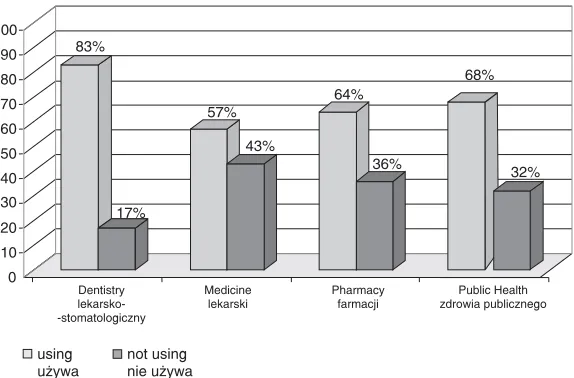
Some oral hygiene habits influenced the level of halitosis. It was not statistically significant whether a person brushed their teeth once, twice, or three or more times a day (p = 0.08). It was found, though, that using additional agents decreased the frequency of subjective halitosis sig− nificantly (p = 0.00016). Supplementary oral hygiene products such as mouthwash and dental floss were used much more often by the students of dentistry (83%) than by those of the other fac−
ulties (average: 60%, with the lowest level at the faculty of medicine) (Fig. 3). Chewing gum and breath fresheners were used by almost all of those questioned (90%). The students preferred freshen− ers to other additional agents such as mouthwash and dental floss (70%).
There was no influence of drinking sweetened fizzy canned drinks on halitosis. About 50% of those questioned drank such drinks at least once a week (49% in the group with halitosis and 54.5% in the group without). Only 2 people of the 35 smokers questioned (5.7%) claimed they did not smell their own bad breath at all.
Only 6 of the 400 students stated that they suf− fered from somatic diseases, these being chronic maxillary sinusitis, asthma, reflux disease, dia− betes, hypertension, and Gilbert’s syndrome. 1. Sex male female Age ………..
2. Faculty: Medical
Dental
Pharmacy
Public Health
3. Do you smell bad breath from yourself? Yes No If yes, how often? ………
If yes, at what time of the day? ………..
4. Did anyone tell you that they smelled bad breath from you? Yes No If yes, who: someone of the opposite sex
a dentist
5. Do you smell bad breath from others? yes no 6. How often do you brush your teeth? ………..
7. How often do you visit your dentist? ………
8. Do you use dental floss or intradental brushes? Yes No
9. Do you use mouthwash? Yes No
10. Do you use dental fresheners in spray form? Yes No 11. Do you use chewing gum or mint candies? Yes No 12. Do you use other oral hygiene products? Yes No 13. Do you suffer from or cure any somatic disease?
a) a periodontal disease Yes – what kind? ………. No
b) disease of the digestive system Yes – what kind? ………. No c) disease of the respiratory system Yes – what kind? ………. No d) disease of the vascular system Yes – what kind? ………. No
e) other disease? Yes – what kind? ………. No
14. Do you suffer from xerostomia (oral dryness)? Yes No
If yes – how often? ………. 15. How often do you drink sweetened fizzy drinks?
never 1–3 cans per week 3–5 cans per week more
16. Do you smoke cigarettes? Yes No
Among them, only the person with Gilbert’s syn− drome claimed she did not suffer from halitosis.
Discussion
This study on students of Wrocław Medical University found a level of people suffering from halitosis (24%) close to the reported average of approximately one fourth of the population. Among these students, men suffered from halitosis more frequently than women. Almas et al. investi− gated the self−perception of halitosis among 481 students of a dental faculty and obtained similar results. In the present study the level of bad breath in men was 29% and in women 19%, while in Almas’ study these percentages were 44 for male and 32 for female dental students. Both the age range (19–24 in Almas’ study, 19–28 in the pre− sent one) and the education level (medical stu− dents) in the two investigated groups were similar. The differences between the students from Poland and those from Saudi Arabia may be a result of cultural and regional differences or may be influ− enced by the differences in climate and ambient temperature, considering that the present study was conducted during the winter [9].
The students of the present study complained on their own bad breath especially in the morning, which supports the thesis that halitosis appears mostly just after sleep, when the flow of saliva is reduced [8, 10].
Views on the self−perception of bad breath are diverse. Some researchers claim we are good judges of the degree of our own bad breath [8], while others say we are unable to smell it [10]. The students of the present study learned about their own bad breath from people of the opposite sex (14%), while a dentist informed them of it in only 3.5% of those questioned (in other studies this per− centage was even lower, e.g. less than 1.5% of those questioned being informed by a dentist [9]),
while it should be a dentist who informs us of such problems [10]. It is significant that 96% of the stu− dents had noted bad breath in other people at least once (among dentistry students: 100%), which shows how good we are in judging other peo− ple’s bad breath and that it may have an effect on our relations with other people and social life [2].
Some oral hygiene habits influenced the level of halitosis. Dental plaque and bacteria colonizing the oral cavity are named as reasons for bad breath [11, 12], and they are the reasons in 85% of those suffering from halitosis [10]. Other causes of bad breath are dry mouth, systemic disorders, upper and lower respiratory tract infection, medications, and gastric content [10, 11]. Proper oral hygiene may decrease or cure halitosis [1, 8, 12]. Cleaning the tongue with special brushes also decreases the level of the coating and of bacteria on its dorsum, thus reducing bad breath [13–15]. The present study found that it was not statistically significant whether a person brushed their teeth once, twice, or three or more times a day (p= 0.08). It was shown, though, that using additional agents decreases the frequency of halitosis significantly (p= 0.00016). Brushing teeth eliminates bacteria only from some easily accessible parts of the oral cavity, while it is important to clean all surfaces that may provide a good environment for the multiplication of bacte− ria [13–15]. Some people (in one study, 26% of females and 12% of males [9]) use additional agents as a way of self−treatment of bad breath. The
96 (24%)
304 (76%)
halitosis halitoza
no halitosis brak halitozy
Fig. 1. Presence of halitosis
Ryc. 1.Obecność halitozy
55 41
84 220
0 50 100 150 200 250
halitosis halitoza
no halitosis brak halitozy
xerostomia
suchość w jamie ustnej
no xerostomia
brak suchości w jamie ustnej
Fig. 2. Halitosis and xerostomia
present study found that such agents as mouthwash and dental floss were used much more often by dentistry students (83%) than by the students of the other faculties (average: 60%, with the lowest level in the medical faculty). Additional products were used by the students more frequently than the aver− age for the general population [9]. Chewing gum and breath fresheners were used almost by all of the students questioned (90%). These reduce microorganisms in the mouth and help to eliminate or reduce bad breath quickly [8]. The best and most−known substances for curing or reducing hal− itosis seem to be seed oils and chlorhexidine, which are usually ingredients of mouthwashes, tooth pastes, and the like [15]. These medications are effective only when the odor originates in the oral cavity and is not connected to any somatic dis− ease [16]. Dental and otolaryngological diseases are thought to be responsible for 87% of the cases of halitosis. The rest are caused by somatic dis− eases, including gastroenterological, pulmonologi− cal, and nephrological diseases. In 5% of cases the factor causing bad breath is unknown [17]. This may also support the thesis that halitosis can often be reduced or even cured by using additional oral hygiene agents, as the present study showed.
There was no influence of drinking sweet fizzy canned drinks on the occurrence of halitosis noted in this study, although there are some reports on it in the literature [3]. About 50% of the ques− tioned students drank such drinks at least once a week (49% in the group with halitosis and 54.5% in the group without).
To measure the actual level of halitosis, a hal− itometer is used. This measures the level of volatile sulfur compounds in expired air and helps to verify the symptoms of oral malodor [17]. Even though such a professional tester is available, self− perception of bad breath remains the main diag− nostic indicator of halitosis [8]. This may be a result of the low number of halitometers in den− tal clinics and practices.
There are some reports on the influence of tongue piercing on the occurrence of halitosis. Bad breath is found to occur together with tooth frac− tures, glossitis, and abscesses, some of the compli− cations of tongue piercing [18]. As piercing becomes more and more popular, it may become a serious problem in the future. Only two of the stu− dents in the present study wore metallic decorations in their mouths; one of them wrote in the question− naire that she experienced her own unrelenting bad breath just after she had had her tongue pierced. 83%
17%
57%
43%
64%
36%
68%
0 10 20 30 40 50 60 70 80 90 100
Dentistry lekarsko− −stomatologiczny
Medicine lekarski
Pharmacy farmacji
Public zdrowia publicznego
Health
using używa
not using nie używa
32%
Fig. 3. The use of additional agents in the different academic faculties
Ryc. 3.Użycie dodatkowych środków higieny przez studentów z różnych wydziałów
Acknowledgements. We would like to thank Prof. Halina Panek and Dr. Barbara Bruziewicz−Mikłaszewska for help in the research.
References
[1] Chitaivii N, Mdzeluri T, Dzagnidze G, Chonishivii Kh, Kurashivii N:Unpleasant smell from mouth – halito− sis. Georgian Med News 2006, 141, 26–29.
[2] John M, Vandana KL:Detection and measurement of oral malodor in periodontitis patients. Indian J Dent Res 2006, 17, 2–6.
[4] van Nieuw Amerongen A, Veerman EC, Abraham−Inpijn L, van Steenbergen TJ, van Winkelhoff AJ:
Halitosis (fetor ex ore). A review. Ned Rijdschr Tandheelkd 1994, 101, 10–14.
[5] Herold G:Gastroenterologia – przykry zapach z ust. Medycyna wewnętrzna, repetytorium dla studentów medy− cyny i lekarzy. Wydawnictwo Lekarskie PZWL, Warszawa 2003, 448.
[6] Beers MH, Berkow R, Bogin RM, Fletcher AJ, Bondy PK, Dilts PV Jr, Drossman DA, Faling LJ, Frenkel EP, Gabbard GO, Hoeckelman RA, Mandell GL, Plum F, Rossi GV, Tancer PH:Badanie jamy ustnej. W: The Merck Manual. Podręcznik diagnostyki i terapii. Wydawnictwo Urban & Partner, Wrocław 2001, 881.
[7] Kępa−Prokopienko J, Iwanicka−Grzegorek E, Michalik E:Halitosis – etiology, classification and epidemiolo− gy on the basis of current literature. Nowa Stom 2005, 31, 41–44.
[8] Scully C, Porter S, Greenman J:What to do about halitosis. BMJ 1994, 308, 217–218.
[9] Almas K, Al−Hawish A, Al−Khamis W:Oral hygiene practices, smoking habits, and self−perceived oral malodor among dental students. J Contemp Dent Pract 2003, 4, 77–90.
[10] Rosenberg M:Clinical assessment of bad breath: Current Concepts. JADA 1996, 127, 472–482.
[11] Feller L, Blignaut E:Halitosis: a review. SADJ 2005, 60, 17–19.
[12] Bruziewicz−Mikłaszewska B, Urbanowicz I, Owczarek H:Microbiological aspects of halitosis. Dent Med Probl 2003, 40, 117–120.
[13] Kaczmarek U, Przywitowska I, Ziętek M, Sułtan E, Malicka B, Pregiel B:Clinical efficiency of new manual toothbrush on removal of dental plaque and tongue coating. Dent Med Probl 2006, 43, 548–555.
[14] Christensen GJ:Why clean your tongue? JADA 1998, 129, 1605–1607.
[15] Kowalczyk A, Tuberoso C, Bruziewicz−Mikłaszewska B, Cisowski W:Possible applications of some commer− cial seed oils in the treatment of stomatitis protetica and halitosis. Herba Polonica 2005, 51, 44–49.
[16] Quirynen M:Management of oral malodour. J Clin Periodontol 2003, 30, 17–18.
[17] Kozłowski Z, Bruziewicz−Mikłaszewska B, Konopka T, Drulis−Kawa Z, Lewczyk E:Using a halitometer to verify the symptoms of halitosis. Adv Clin Exp Med 2007, 16, 411–416.
[18] Shinohara HK, Horikawa FK, Ruiz MM, Shinohara MT: Tongue piercing: case report of a local complication. J Contemp Dent Pract 2007, 8, 83–89.
Address for correspondence:
Anna Paradowska
Student’s Scientific Association of Dental Prosthetics Department of Dental Prosthetics
Silesian Piasts University of Medicine Krakowska 26
50−425 Wrocław Poland
E−mail: [email protected]
Conflict of interests: None delared