R
OBERTŚ
LUSARZ1, W
OJCIECHB
EUTH1, B
ARBARAK
SIĄŻKIEWICZ2Functional Capacity Scale as a Suggested Nursing Tool
for Assessing Patient Condition with Aneurysmal
Subarachnoid Hemorrhage – Part II
Skala wydolności funkcjonalnej jako propozycja narzędzia
w pielęgniarskiej ocenie stanu chorego
z krwotokiem podpajęczynówkowym
wywołanym tętniakiem śródczaszkowym – część II
1 Zakład Pielęgniarstwa Neurologicznego i Neurochirurgicznego CM UMK, Bydgoszcz, Poland 2 Katedra i Klinika Neurologii CM UMK, Bydgoszcz, Poland
Adv Clin Exp Med 2006, 15, 4, 741–746 ISSN 1230−025X
Subarachnoid hemorrhage is a serious medical
and social problem due to its death risk and the
progressive symptoms of neurological deficit
which decrease the patient’s functional capacity in
society and lead to disability. This is why studies
focusing on functional capacity in patients after
intracranial aneurysm surgery seem reasonable.
Correct diagnosis in the early postoperative period
is very important from a nursing point of view.
The interest in point−based assessment scales in
nursing results from the need of making a nursing
diagnosis, which means a holistic attitude towards
the patient’s condition. The patient’s self−care
deficit [1–4] must be assessed and the areas of
nursing help in this area must be defined to ensure
optimal nursing care for patients [5, 6].
© Copyright by Silesian Piasts University of Medicine in Wrocław
Abstract
The Barthel index is the oldest point scale assessing patients’ functional capacity. It is used in assessing patients with hemiparesis. Functional capacity scales are useful in assessing rehabilitation outcomes in patients with dif− ferent disease entities. In nursing, where a patient’s condition is assessed holistically, point scales are important in making nursing diagnoses. Based on literature, elements of nursing diagnostics are presented in the paper. Problems of patients with aneurysmal subarachnoid hemorrhage in the early postoperative period are also speci− fied here. Finally, the authors introduce the Functional Capacity Scale, a new tool that might be used in neurosur− gical nursing to evaluate the patient’s condition (Adv Clin Exp Med 2006, 15, 4, 741–746).
Key words: functional capacity scale, nursing diagnosis, subarachnoid hemorrhage, intracranial aneurysm.
Streszczenie
Najstarszą skalą punktowej oceny stanu funkcjonalnego jest wskaźnik Barthel, zastosowany do oceny chorych z niedowładem połowiczym. Skale funkcjonalne stosuje się w ocenie wyników rehabilitacji chorych z różnymi jed− nostkami chorobowymi. W pielęgniarstwie zainteresowanie skalami punktowymi wynika z potrzeby stawiania dia− gnozy pielęgniarskiej, czyli rozpatrywania stanu chorego w ujęciu holistycznym. Na podstawie literatury przedsta− wiono elementy rozpoznania stanu chorego z punktu widzenia pielęgniarskiego oraz wyszczególniono problemy chorych z krwotokiem podpajęczynówkowym w bezpośrednim okresie po leczeniu operacyjnym tętniaka śródcza− szkowego. Zaproponowano również narzędzie do pomiaru wydolności funkcjonalnej chorego – Skalę Wydolności Funkcjonalnej, jako propozycję zastosowania w neurochirurgicznej pielęgniarskiej ocenie stanu chorego (Adv Clin Exp Med 2006, 15, 4, 741–746).
The Functional
Capacity Scale
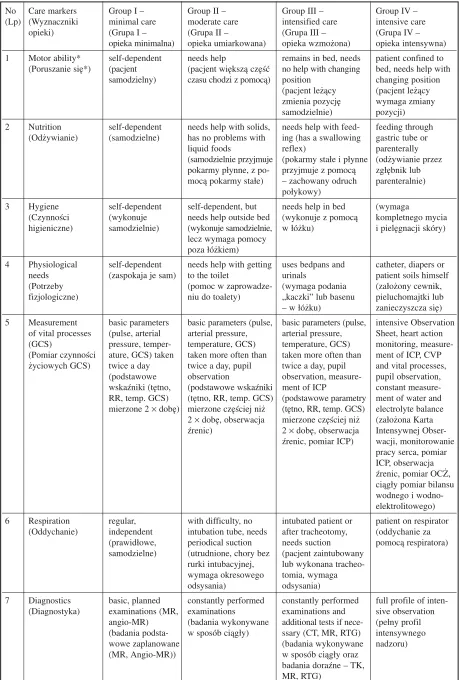
The Functional Capacity Scale (FCS) (Table
1) may be used in early postoperative assessment
of a patient’s functional status [7, 8]. In develop−
ing the scale, two elements related to vascular
patients in the early postoperative period were
taken into consideration, i.e. the profile of a patient
with subarachnoid hemorrhage and the character−
istic features of the early postoperative stage. In
the early postoperative period, nurses should
assess a patient after aneurysmal subarachnoid
hemorrhage (aSAH) in three areas:
– the area indirectly related to clinical diagno−
sis and operation (diagnostics, preoperative prepa−
ration, postoperative care, dressings, drainage, and
pharmacotherapy);
– the area related to the patient’s self−care and
functional status (mobility, nutrition, physiological
needs, and respiration);
– the area related to the patient’s self−observa−
tion and self−control (measurement of vital signs,
pain intensification, mental state).
Based on the above assumptions, the FCS
enables the nurse to recognize the patient’s func−
tional abilities and assess the degree of the
patient’s dependence on the nursing staff, which
means that the nurse estimates deficits in particu−
lar care markers. Care−marker profiles of patients
in particular groups can be made based on obser−
vation and the FCS (Table 1).
Group I (patient does not need assistance):
This is an independent patient who can walk by
himself, has no special dietary needs, takes care of
his hygiene, and does not require assistance in sat−
isfying physiological needs. The diagnostic process
and preparation for the operation are performed
according to schedule. There are no postoperative
complications. The patient needs dressing over the
intravenous insertion. Pharmacotherapy is not
complicated, the patient is given oral drugs, and in
case of pain he can receive an analgesic. The
patient is mentally balanced and placid.
Group II (patient needs assistance): The
patient needs a nurse’s help with some activities,
e.g. walking, eating solid food (‘meal prepara−
tion’), getting to the toilet, and hygienic activities
outside bed. The measurement of life activities is
made more often than twice a day. Also, the
patient’s pupils are monitored. The patient has dif−
ficulties with breathing and periodical suction is
therefore necessary. Diagnostic examinations are
constantly performed (systematically, for example
glycemic profile). It is necessary to prepare the
operation field and secure venous access. After the
operation, a postoperative dressing is applied and
venous access is maintained. The patient receives
oral, intramuscular, and intravenous drugs. The
patient’s mood is slightly elevated or lowered.
Group III (patient needs significant help): The
patient must stay in bed but can change position by
himself, needs help with solid and liquid foods,
performs hygienic activities in bed, and uses bed−
pans and urinals. Vital parameters are measured
more often than twice a day, the patient’s pupils are
monitored, and intracranial pressure (ICP) is mea−
sured if necessary. An intubated patient or a patient
after tracheostomy needs suction. Diagnostic
examinations are constantly performed. The patient
undergoes additional tests, such as computer
tomography (CT) or magnetic resonance (MR). It
is necessary to prepare the operation field. Venous
access is secured and central cannulation is per−
formed. After the operation, drainage and dressings
are applied. Drugs are administered intravenously
and intramuscularly, including analgesics. The
patient is depressed and weepy or presents with
long periods of elevated mood.
Group IV (patient needs intensive care): The
patient needs extensive nursing care, i.e. change of
position, feeding through gastric tube or parenter−
ally, and bed bathing. The patient has a catheter
applied or/and he wears diapers. Heart action,
pupils, and water and electrolyte balance are con−
stantly monitored. Central venous pressure (CVP)
and ICP are measured if necessary. Observations
are recorded on an Intensive Observation Sheet.
The patient is on a respirator. For diagnostic pur−
poses, a complete profile of intensive supervision
is necessary. The patient must be carefully pre−
pared for the operation. Venous access, central
cannulation, and ventricular drainage are per−
formed. After the operation, a suction drainage
and dressings are applied. Drugs are administered
intravenously only, sometimes through an infusion
pump. The patient receives a constant analgesic
infusion. Mentally, the patient presents with deep
apathy or inappropriately euphoric mood.
Each care marker is assigned from 4 points to
1 point depending on the group within the scope of
a given care marker (Table 2). Based on this score,
a functional Capacity Coefficient (CC) can be cal−
culated using the following formula:
CC = KI
×
4 + KII
×
3 + KIII
×
2 + KIV
×
1,
where:
CC – functional capacity coefficient of
a patient,
Tabela 1.Skala Wydolności Funkcjonalnej – SWF (opis narzędzia)
No Care markers Group I – Group II – Group III – Group IV – (Lp) (Wyznaczniki minimal care moderate care intensified care intensive care
opieki) (Grupa I – (Grupa II – (Grupa III – (Grupa IV – opieka minimalna) opieka umiarkowana) opieka wzmożona) opieka intensywna) 1 Motor ability* self−dependent needs help remains in bed, needs patient confined to (Poruszanie się*) (pacjent (pacjent większą część no help with changing bed, needs help with
samodzielny) czasu chodzi z pomocą) position changing position (pacjent leżący (pacjent leżący zmienia pozycję wymaga zmiany samodzielnie) pozycji) 2 Nutrition self−dependent needs help with solids, needs help with feed− feeding through
(Odżywianie) (samodzielne) has no problems with ing (has a swallowing gastric tube or
liquid foods reflex) parenterally
(samodzielnie przyjmuje (pokarmy stałe i płynne (odżywianie przez pokarmy płynne, z po− przyjmuje z pomocą zgłębnik lub mocą pokarmy stałe) – zachowany odruch parenteralnie)
połykowy)
3 Hygiene self−dependent self−dependent, but needs help in bed (wymaga
(Czynności (wykonuje needs help outside bed (wykonuje z pomocą kompletnego mycia higieniczne) samodzielnie) (wykonuje samodzielnie, w łóżku) i pielęgnacji skóry)
lecz wymaga pomocy poza łóżkiem)
4 Physiological self−dependent needs help with getting uses bedpans and catheter, diapers or needs (zaspokaja je sam) to the toilet urinals patient soils himself (Potrzeby (pomoc w zaprowadze− (wymaga podania (założony cewnik, fizjologiczne) niu do toalety) „kaczki” lub basenu pieluchomajtki lub
– w łóżku) zanieczyszcza się) 5 Measurement basic parameters basic parameters (pulse, basic parameters (pulse, intensive Observation
of vital processes (pulse, arterial arterial pressure, arterial pressure, Sheet, heart action (GCS) pressure, temper− temperature, GCS) temperature, GCS) monitoring, measure− (Pomiar czynności ature, GCS) taken taken more often than taken more often than ment of ICP, CVP życiowych GCS) twice a day twice a day, pupil twice a day, pupil and vital processes,
(podstawowe observation observation, measure− pupil observation, wskaźniki (tętno, (podstawowe wskaźniki ment of ICP constant measure− RR, temp. GCS) (tętno, RR, temp. GCS) (podstawowe parametry ment of water and mierzone 2 ×dobę) mierzone częściej niż (tętno, RR, temp. GCS) electrolyte balance 2 ×dobę, obserwacja mierzone częściej niż (założona Karta źrenic) 2 ×dobę, obserwacja Intensywnej Obser−
źrenic, pomiar ICP) wacji, monitorowanie pracy serca, pomiar ICP, obserwacja źrenic, pomiar OCŻ, ciągły pomiar bilansu wodnego i wodno− elektrolitowego) 6 Respiration regular, with difficulty, no intubated patient or patient on respirator
(Oddychanie) independent intubation tube, needs after tracheotomy, (oddychanie za (prawidłowe, periodical suction needs suction pomocą respiratora) samodzielne) (utrudnione, chory bez (pacjent zaintubowany
rurki intubacyjnej, lub wykonana tracheo− wymaga okresowego tomia, wymaga odsysania) odsysania)
7 Diagnostics basic, planned constantly performed constantly performed full profile of inten− (Diagnostyka) examinations (MR, examinations examinations and sive observation
angio−MR) (badania wykonywane additional tests if nece− (pełny profil (badania podsta− w sposób ciągły) ssary (CT, MR, RTG) intensywnego wowe zaplanowane (badania wykonywane nadzoru)
(MR, Angio−MR)) w sposób ciągły oraz
Table 1. Functional Capacity Scale (FCS): a description of the tool – continued
Tabela 1.Skala Wydolności Funkcjonalnej – SWF (opis narzędzia) – cd.
No Care markers Group I – Group II – Group III – Group IV – (Lp) (Wyznaczniki minimal care moderate care intensified care intensive care
opieki) (Grupa I – (Grupa II – (Grupa III – (Grupa IV – opieka minimalna) opieka umiarkowana) opieka wzmożona) opieka intensywna) 8 Preparation for the preparation as preparation of operation preparation of operation preparation of
operation and post− planned, no post− field, secured iv field, secured iv operation field, operative care operative insertion site insertion site, central secured iv insertion (Przygotowanie do complications (przygotowanie pola cannulation site, central cannul− zabiegu i opieka po) (przygotowanie operacyjnego, zabez− (przygotowanie pola ation, measurement planowe, przebieg pieczenie dostępu operacyjnego, zabez− of ICP, vital processes pooperacyjny bez żylnego) pieczenie dostępu and ventricular
powikłań) żylnego, centralna drainage
kaniulacja) (przygotowanie pola operacyjnego, zabez− pieczenie dostępu żylnego, centralna kaniulacja, pomiar ICP, OCŻ, drenaż komorowy) 9 Dressings, drainage dressings over the postoperative dressing postoperative dressing, other dressings,
(Opatrunki, drenaż) IV insertion site (opatrunek drainage sucking drainage (zaopatrywanie pooperacyjny) (opatrunek (inne opatrunki, wkłuć dożylnych) pooperacyjny, drenaż) drenaż ssący, prze−
pływowy lub inny 10 Degree of pain slight pain, anal oral analgesics intramuscular, intra− constant analgesic
intensification** gesics given as (przeciwbólowe leki venous analgesics infusion
(Stopień nasilenia necessary doustne) (przeciwbólowe leki (przeciwbólowe leki bólu**) (ból niewymagający domięśniowe, dożylnie) we wlewie w sposób
leczenia, ewentual− ciągły)
nie podaż leków doraźnie)
11 Pharmacotherapy oral drugs oral, intramuscular, intramuscular and intravenous drugs (Farmakoterapia) (leki doustne) and intravenous drugs intravenous drugs only, administered
(leki doustne, (leki domięśniowe, through infusion domięśniowe, dożylne) dożylne) pump, central
cannulation (leki wyłącznie dożylne, w pompie infuzyjnej, założona centralna kaniulacja) 12 Mental state stable mood slightly elevated or constant depression despair, deep apathy
(mood) *** (nastrój lowered mood and tearfulness or long or inappropriate (Stan psy− wyrównany) (nastrój nieznacznie periods of elevated euphoric mood
chiczny***) podwyższony lub mood (rozpacz, całkowita
obniżony) (ciągłe przygnębienie, apatia lub nastrój płaczliwość lub długo euforyczny z zacho− utrzymujące się okresy waniem nieadekwat− podwyższonego nym do sytuacji) nastroju)
* Bed regimen (patient confined to bed) for Group III and IV patients. ** An unconscious patient (8–3 GCS) receives Group IV for this care marker. *** An unconscious patient (8–3 GCS) receives Group IV for this care marker. * Reżim łóżkowy (chory nie opuszcza łóżka) dla chorych w grupie III i IV.
Therefore, each group can be assigned a defi−
nite scope of scores:
Group I (48–40 points) – independence (self−
sufficient patient)
Group II (39–31 points) – moderate indepen−
dence (patient needs some help)
Group III (30–21 points) – moderate depen−
dence (patient needs significant help)
Group IV (20–12 points) – dependence
(patient needs intensive care)
The above Functional Capacity Scale is a typ−
ical numeric scale and its structure is similar to
other scales which have been described in litera−
ture [2, 9–11]. A study verifying the psychometric
features of the Functional Capacity Scale shows
that the scale is reliable and valid and therefore
suitable for practical use [12, 13].
Nursing as a scientific domain is introducing
theoretical principles for patient assessment into
practice. Unfortunately, there are few data con−
cerning the practical use of scales by nurses
assessing patients with subarachnoid hemorrhage.
Recent studies (in the field of neurological and
neurosurgical nursing) assessing patients’ condi−
tion during hospitalization focus on assessment of
patients’ self−care skills [1–6]. Because there are
no standardized tools for nursing assessment of
patient’s condition, it is impossible to compare the
final outcomes. The suggested Functional
Capacity Scale (FCS) for assessing SAH patients
will be continually verified to assess its basic psy−
chometric features, reliability, and predictive accu−
racy. At present the practical use of the FCS in
nursing is being studied.
No Care markers Care group (category)
(Lp) (Wyznaczniki opieki) (Grupa opieki)
I II III IV
1 Motor ability* 4 3 2 1
(Poruszanie się*)
2 Nutrition 4 3 2 1
(Odżywianie)
3 Hygiene 4 3 2 1
(Czynności higieniczne)
4 Physiological needs 4 3 2 1
(Potrzeby fizjologiczne)
5 Measurement of vital processes (GCS) 4 3 2 1
(Pomiar czynności życiowych GCS)
6 Respiration 4 3 2 1
(Oddychanie) 7 Diagnostics
(Diagnostyka) 4 3 2 1
8 Preparation for the surgery and postoperative care 4 3 2 1
(Przygotowanie do zabiegu i opieka po)
9 Dressings, drainage 4 3 2 1
(Opatrunki, drenaż)
10 Degree of pain intensification** 4 3 2 1
(Stopień nasilenia bólu**) 11 Pharmacotherapy
(Farmakoterapia) 4 3 2 1
12 Mental state (mood)***
(Stan psychiczny***) 4 3 2 1
* Patient confined to bed (for group III and IV patients).
** An unconscious patient (GCS 8–3) receives 1 point for this care marker. *** An unconscious patient (8–3 GCS) receives 1 point for this care marker.
Grading system: 4 points – patient does not require care, 3 points – patient needs moderate care, 2 points – patient needs intensified care, 1 point – patient needs intensive care.
* Reżim łóżkowy (chory nie opuszcza łóżka) dla chorych w grupie III i IV. ** Chory nieprzytomny (8–3 GCS) w zakresie tego wyznacznika otrzymuje 1 pkt. *** Chory nieprzytomny (8–3 GCS) w zakresie tego wyznacznika otrzymuje 1 pkt.
System punktacji: 4 pkt – pacjent nie wymaga opieki, 3 pkt – pacjent wymaga umiarkowanej opieki, 2 pkt – pacjent wyma− ga wzmożonej opieki, 1 pkt – pacjent wymaga intensywnej opieki.
References
[1] Adamczyk K: Preparation of cerebral stroke patients for self−care. Cereb Stroke 2000, 2, 75–80.
[2] Adamczyk K:Self−care in selected care models – nursing experiment. Post−doctoral thesis, Lublin 2000.
[3] Kaniewska B, Jędrys B, Stadnicka G, Turowski K: Wartość kliniczna Skali Wydolności Chorych w Zakresie Samoopieki. Organizacja opieki pielęgniarskiej a zmiany w systemie ochrony zdrowia. Materiały Konferencyjne [The clinical value of the Patient Capacity Scale of Self−care. The organization of nursing and changes in the pub− lic health system. Conference materials]. Wydawnictwo Edukacji Medycznej, Warsaw 1994, 142–145.
[4] Rola J, Turowski K: Ocena stanu klinicznego i wydolności w zakresie samoopieki chorych z nowotworami mózgu [Evaluation of clinical status and capacity of self−care in brain tumor patients]. Ann Univ Mariae Curie Skłodowska (Med). Lublin 2002, Suppl. XI, 317–325.
[5] Stadnicka G, Sieplińska J, Turowski K: Wpływ zaburzeń ruchowych na wydolność w zakresie samoopieki chorych neurochirurgicznych [The influence of movement disturbances on capacity of self−care of neurosurgery patients]. Problemy Pielęgniarstwa 1993, 26–31.
[6] Zarzycka D:Obiektywizacja wydolności samoopiekuńczej pacjenta w pielęgnowaniu opartym o założenia D. Orem. Kształcenie podyplomowe i doskonalenie zawodowe pielęgniarek i położnych. Materiały z Konferencji Naukowej [Objectivizing patient self−care capacity based on D. Orem. Postgraduate and in−service training of nurses and midwives]. Warsaw 19–20 March 1999, 155–159.
[7] Ślusarz R, Michalska A, Beuth W, Jachimowicz−Wołoszynek D:Patient Categorisation Sheet as a practical tool in neurosurgical nursing assessment. Valetudinaria – Progress in Clinical and Military Medicine 2003, 1–2, 78–83.
[8] Ślusarz R, Beuth W, Kasprzak HA:Clinimetrics as a way of assessing patients with aneurysmal subarachnoid haemorrhage. Ann Acad Med Bydg 2004, 1, 57–64.
[9] Opara J: The analysis of usefulness of selected stroke scales for evaluation of the results of rehabilitation in hemi− plegic patients. Post−doctoral thesis, Katowice 1996.
[10] Mahoney FI, Barthel DW: Functional evaluation: The Barthel Index. Md Med J 1965, 14, 56–61.
[11] Zarzycka D: Measurement of social support in in−patient care. Post−doctoral thesis, University of Medicine, Lublin 1998.
[12] Ślusarz R, Beuth W, Kasprzak HA: Psychometric features of the Functional Capacity Scale. Valetudinaria – Progress in Clinical and Military Medicine 2003, 3–4, 100–104.
[13] Ślusarz R, Beuth W, Śniegocki M, Kasprzak HA, Grzelak L, Woźniak B: Functional Capacity Scale in assess− ment of patients in the early period following aneurysmal surgery. Ann Univ Mariae Curie Skłodowska (Med). Lublin 2004, Suppl. 5, 248–254.
Address for correspondence:
Robert Ślusarz
Zakład Pielęgniarstwa Neurologicznego i Neurochirurgicznego CM UMK ul. Techników 3
85−801 Bydgoszcz Poland
tel.: +48 052 585 21 93 e−mail: [email protected]
Conflict of interest: None declared
Received: 8.09.2005 Revised: 5.10.2005 Accepted: 5.10.2005
Praca wpłynęła do Redakcji: 8.09.2005 r. Po recenzji: 5.10.2005 r.