18
Meloxicam Loaded Floating Sustained Release Matrix Tablet
V.K Sharma*
School of Pharmacy, Bharat Institute of Technology, By-Pass Road, Partapur, Meerut,
U.P., India
*Corresponding author: [email protected]
ABSTRACT
The objective of this present research is to formulate floating sustained release matrix
tablets using hydroxyl propyl methyl cellulose (HPMC) K15M as matrix forming polymer
and sodium bicarbonate as a gas generator. Meloxicam was used as model drug. The
directly compressed tablets were evaluated for physical parameters such as weight
uniformity, hardness, friability, drug content, in-vitro buoyancy, and swelling index. It
was observed that the buoyancy lasted for up to 24 h and supported by
in-vitro dissolution studies. The dissolution data was subjected to various release kinetic
models.
Keywords: Floating tablet, HPMC K15M, Meloxicam, sodium bicarbonate
INTRODUCTION
Floating drug delivery system (FDDS) shows buoyancy in stomach for extended time
period thus offers extended gastric residence time for the dosage form ensuring optimal
bioavailability (BA). [1] The residence time of the dosage form in the stomach depends
upon various factors like pH, size of the dosage form, food intake, and biological factors
which include age, body mass index, gender, posture, and diseased states (hepatic
failure, diabetes, chrons disease). Other techniques for gastro retentive dosage forms
involve swelling, mucoadhesion, sedimentation, microballoons[2],[3] and low density
systems. Out of all systems available, the floating beads, floating tablets and floating
microspheres have gained major importance. FDDS possess lower bulk density than the
gastric fluid exerting buoyancy in the stomach leading to slow drug release in an
extended manner before it reaches absorption window. [4] In this present formulation,
dual benefits of buoyancy as well as sustained action is achieved with an intention to
maintain the steady state of drug release.[5] Hydrophilic matrix system is one of the
easiest approaches for developing modified and sustained release dosage forms. A
19
gelling agent and drug release is shown by swelling and erosion mechanism occurring
simultaneously contributing to overall drug release. [6]
Matrix system is the commonly used method for modulating the drug release. [7] The
manufacture of matrix tablets by direct compression is cheaper, simpler process, broad
regulatory acceptance, and allows flexibility in obtaining desirable release profiles. [8] In
spite of the poor flow property of controlled release polymers, by admixture of directly
compressible microcrystalline cellulose (MCC) and other excipients, excellent flow
property is being achieved. This investigation is restricted to floating tablets of
meloxicam with sustained release by employing various concentrations of release
retarding polymers, HPMC K15M, and gas generators. [9]
MATERIALS AND METHODS
Materials:
Meloxicam was obtained as gift sample from (Micro Labs, India). HPMC K15M, talc,
magnesium stearate, microcrystalline cellulose, lactose and sodium bicarbonate were
procured from SD Fine chemicals, India. All the materials used were analytical grade,
purchased from India.
Methodology:
Formulation of floating matrix tablet
Sustained release floating matrix tablets were prepared by direct compression method.
All the excipients were weighed accurately and sifted through 40# mesh screen. Drug
was geometrically mixed with excipients followed by addition of the matrix forming
polymer and gas generating agent. Mixing was done and final sifting was carried
through 22# mesh screen. Pre-lubrication and lubrication was done for 5 and 2
minutes, respectively. Compression was carried out by manual single punching
machine. The formulated tablets were further evaluated of the tablet parameters. In all
the formulations, polymers concentration was varied from 10 to 50% of the total weight.
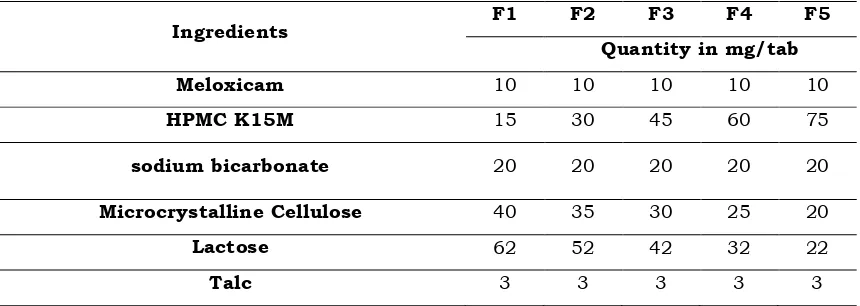
The composition of various formulations is shown in the Table 1.
Characterization of floating matrix tablet
Thickness and weight variation test
Six tablets were selected randomly for thickness measurements by using vernier
20
10 tablets of each formulation were weighed individually using an electronic balance
(Shimadzu, Japan) and the test was performed. [10]
Table 1: Formulation Table of Meloxicam loaded Floating Matrix Tablet
Ingredients F1 F2 F3 F4 F5
Quantity in mg/tab
Meloxicam 10 10 10 10 10
HPMC K15M 15 30 45 60 75
sodium bicarbonate 20 20 20 20 20
Microcrystalline Cellulose 40 35 30 25 20
Lactose 62 52 42 32 22
Talc 3 3 3 3 3
Drug content
10 tablets of same weight were selected and crushed using mortar and pestle. Powder
equivalent to the average weight of the tablet was weighed and dissolved in 0.1 M HCl
and diluted suitably. The concentration of drug in the samples was detected using ultra
violet (UV)-visible spectrophotometer. [11]
Hardness and friability
Six tablets from each formulation were subjected for crushing strength and friability by
using the Monsanto hardness tester (Cadmach, Ahmedabad, India) and the Roche
friabilator (Veego, Mumbai, India), respectively. [12]
In-vitrobuoyancy study
The in-vitro buoyancy was determined by observing the floating lag time and the total
floating duration (floating capacity). For determining the floating lag time, 0.1 N HCl
was taken as the media and three tablets were placed in it. The time required for the
matrix tablet to rise from the bottom to the surface of the media for floating was
determined. The time was observed visually and recorded using stop watch. For
observing the total floating duration, three individual tablets from each formulation
were put in a beaker containing 900 ml of 0.1N HCl media. Then the time taken for
each tablet to constantly float on the media was measured. The sample mean and
21
Hydration responseThe swelling properties of matrices containing drug were determined by placing the
tablet in the dissolution test apparatus containing 900 ml of 0.1 N HCl and maintained
at 37 ± 0.5°C. At periodic time intervals, the tablets were taken out of the medium and
the weight gain in each tablet was checked using electronic weighing balance (Model:
BL-220H, Shimadzu Corporation, Japan). The swelling characteristics were expressed
in terms of the percentage water uptake (WU %) according to the equation. [14]
WU= Weight of swollen tablet-initial weight of tablet X 100
In-vitro dissolution studies
Dissolution studies were performed using 900 ml 0.1M HCl with pH 1.2 using paddle
method at 100 rotations per minute (rpm) and 37°C. Samples of 10 ml were withdrawn
from each basket at periodic time intervals. Equal amount of fresh dissolution media
was replaced to maintain the sink condition. [15] The amount of meloxicam release in
each sample was determined at wavelength of 339 nm using UV-Visible
spectrophotometer (Shimadzu). Release data is shown in Figure 1.
RESULT AND DISCUSSION
Tablet Characterization
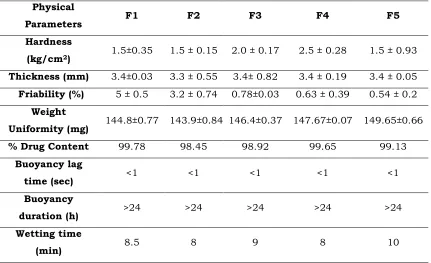
The average weight of the tablet ranges from 143 to 149 mg for all the formulations
22
mechanical strength, these formulations exhibited satisfactory hardness of 1.5 to 2.5
kg/cm 2 and the same fact was further supported by friability of less than 1%. Drug
content of all the formulations ranged between 98.94 to 99.34 %, which was within the
standard limits of 90.00 - 110.00 %. The average wetting time for the formulation F-1 to
F-5 was in the range of 8-10 minutes and buoyancy lag time showed less than one
minute, and the buoyancy duration showed more than 24 h [Table 2]. The tablets
showed elegant appearance and excellent floating property
In-vitro Dissolution Studies
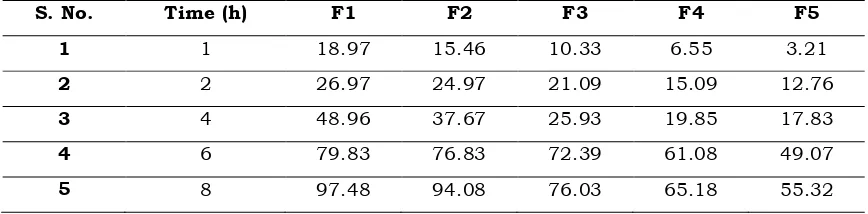
As shown by in-vitro dissolution data, the increase in the polymer concentration of
HPMC K15M progressively retarded the drug release. The lowest polymer concentration
(F-1) showed faster release 97.8% in 8 hrs and the highest polymer concentration (F-5)
released only 55.32% drug after 8 h as shown in Table 3. When the concentration of the
hydrophilic polymer was increased, the time taken for its swelling and erosion in the
media was increased due to high viscous gel strength. Therefore, the diffusion of the
water insoluble drug from the matrix was retarded to its maximum and the drug release
was slowed down.
Table 2: Physical Evaluation of Compressed Matrix tablet
Physical
Parameters F1 F2 F3 F4 F5
Hardness
(kg/cm2) 1.5±0.35 1.5 ± 0.15 2.0 ± 0.17 2.5 ± 0.28 1.5 ± 0.93 Thickness (mm) 3.4±0.03 3.3 ± 0.55 3.4± 0.82 3.4 ± 0.19 3.4 ± 0.05
Friability (%) 5 ± 0.5 3.2 ± 0.74 0.78±0.03 0.63 ± 0.39 0.54 ± 0.2
Weight
Uniformity (mg) 144.8±0.77 143.9±0.84 146.4±0.37 147.67±0.07 149.65±0.66
% Drug Content 99.78 98.45 98.92 99.65 99.13
Buoyancy lag
time (sec) <1 <1 <1 <1 <1
Buoyancy
duration (h) >24 >24 >24 >24 >24
Wetting time
23
Table 3: In Vitro Drug Release Data for All Formulations
S. No. Time (h) F1 F2 F3 F4 F5
1 1 18.97 15.46 10.33 6.55 3.21
2 2 26.97 24.97 21.09 15.09 12.76
3 4 48.96 37.67 25.93 19.85 17.83
4 6 79.83 76.83 72.39 61.08 49.07
5 8 97.48 94.08 76.03 65.18 55.32
CONCLUSION
Floating drug delivery system can be successfully formulated by direct compression
technique and combination of polymers. The present investigation proved that a
hydrophobic drug can be designed as modified release dosage form with desired
qualities, using a hydrophilic polymer HPMC K15M and sodium bicarbonate as a
buoyancy initiator.
REFERENCES
1. Jiménez-Martínez I, Quirino-Barreda T, Villafuerte-Robles L. Sustained delivery of
Captopril from floating matrix tablets. Int J Pharm 2008;362:37-43.
2. Arora G, Malik K, Singh I, Arora S, Rana V. Formulation and evaluation of
controlled release matrix mucoadhesive tablets of domperidone using Salvia
plebeian gum. J Adv Pharm Tech Res 2011;2:163-9
3. Nagaich U, Chaudhary V, Tonpay SD, Karki R. Design and evaluation of a
metronidazole central core matrix tablet. J Adv Pharm Tech Res 2010;1(1)-88-96.
4. Sathiyaraj S, Devi RD, Hari VB. Lornoxicam gastro retentive floating matrix tablets:
Design and in vitro evaluation. J Adv Pharm Tech Res 2011;2:156-62.
5. Negi JS, Trivedi A, Khanduri P, Negi V, Kasliwal N. Effect of Bioadhesion on initial in
vitro buoyancy of effervescent floating matrix tablets of ciprofloxacin HCl. J Adv
Pharm Tech Res 2011;2:121-127.
6. Samyuktha Rani B, Vedha Hari BN, Brahma Reddy A, Punitha S, Devi P,
Rajamanickam V. The recent developments on gastric floating drug delivery
systems: A overview. Int J PharmTech Res 2010;2:524-34.
7. Yadav A, Jain DK. In-vitro characterization of gastroretentive microballoons
prepared by the emulsion solvent diffusion method. J Adv Pharm Tech Res
24
8. Yadav A, Jain DK. Gastroretentive microballoons of metformin: Formulation
development and characterization. J Adv Pharm Tech Res 2011;2:51-5.
9. Prajapati ST, Patel LD, Patel DM. Studies on formulation and in vitro evaluation of
floating matrix tablets of Domperidone. Indian J Pharm Sci 2009;71:1
10. Mandsaurwale RR, Vanshiv SD. Evaluation of effervescent floating matrix tablet formulations of Salbutamol sulphate using full factorial design. Asian J Pharm
2009;3:43-9
11.Patra CN, Kumar AB, Pandit HK, Singh SP, Devi MV. Design and evaluation of
sustained release bilayer tablets of propronalol hydrochloride. Acta Pharm
2007;57:479-89.
12. Ajay LB, Santosh NS, Monali SS, Kunal DI, Vishnu PC, Bhanudas SK. Fabrication
of controlled release metoprolol succinate matrix tablet: Influence of some
hydrophilic polymers on the release rate and in-vitro evaluation. Int J Pharma World
Res 2010;1:1-15.
13. Baskar GV, Narayanan N, Gaikwad R, Samad A. Formulation and evaluation of Gastro-retentive floating Multi-particulate system of metoprolol tartarate. Trop J
Pharm Res 2010;9:181-6.
14. Hamza Yel-S, Aburahma MH. Design and in vitro Evaluation of novel
sustained-release double-layer tablets of Lornoxicam: Utility of cyclodextrin and xanthan gum
combination. AAPS Pharm Sci Tech 2009;10:1357-66.
15.Santosh Kumar Narla, Nageswara Reddy MVV, Chandrasekhara Rao G. Formulation
and evaluation of sustained release metoprolol succinate matrix tablets by direct