Key Aspects for Developing
Your Instructional Materials
Aspectos cruciales para elaborar materiales instruccionales
Astrid Núñez Par
Astrid Núñez Par
Astrid Núñez Par
Astrid Núñez Par
Astrid Núñez Pardo
do
do
do*
do
[email protected]Clelia Pineda Báez, Ph.D
Clelia Pineda Báez, Ph.D
Clelia Pineda Báez, Ph.D
Clelia Pineda Báez, Ph.D
Clelia Pineda Báez, Ph.D**
María Fernanda Téllez Téllez
María Fernanda Téllez Téllez
María Fernanda Téllez Téllez
María Fernanda Téllez Téllez
María Fernanda Téllez Téllez***
Universidad Externado de Colombia
This article describes crucial aspects that EFL teachers must consider for the elaboration of materials to support the instructional design component of their classes. It also emphasizes that language educators should not only maintain a balance between theory and practice when developing their didactic resources, but they also should keep themselves updated in terms of the latest research in the language education field. The article also addresses key questions teachers should formulate before beginning the process of design, and provides useful ideas to develop dynamic, content enriching, and visually attractive materials.
K KK K
Key worey worey worey worey words: ds: ds: ds: ds: Course Design, Material Design, Motivational Design, Content
Enriching Materials, Attractive Layouts, Teachers’ Creativity
Este artículo describe aspectos cruciales que los docentes de inglés como lengua extranjera deben tener en cuenta para la elaboración de materiales de apoyo del componente de instrucción de sus clases. También enfatiza que los
*Astrid Núñez ParAstrid Núñez ParAstrid Núñez ParAstrid Núñez ParAstrid Núñez Pardo,do,do,do,do, Degree in Hotel and Tourism Business Management, Universidad Externado de Colombia. Postgraduate
Diploma in Linguistic Studies, University of Essex, Colchester, England. Currently, English Program coordinator, teacher-researcher and material designer, School of Education, Universidad Externado de Colombia and author of the series “Economics and Business Readings for English 1, 2, 3, and 4” (Publicaciones Externado).
**Clelia Pineda Báez,Clelia Pineda Báez,Clelia Pineda Báez,Clelia Pineda Báez,Clelia Pineda Báez, PhD in Education and Master of Arts in TEFL, Southern Illinois University at Carbondale, USA. B.A.
in Philology and Languages (Spanish-English), Universidad Nacional de Colombia. Currenlty, English coordinator, teacher-researcher and director of the research group “English Didactics”, officially recognized by Colciencias, School of Education, Universidad Externado de Colombia.
***María FMaría FMaría FMaría FMaría Fernanda Téllez Téllez,ernanda Téllez Téllez,ernanda Téllez Téllez,ernanda Téllez Téllez,ernanda Téllez Téllez, B.A in Teaching Modern Languages, Universidad de Los Andes, Bogotá, Colombia.
docentes de lengua extranjera no solamente deben mantener un balance entre la teoría y la práctica al desarrollar sus ayudas didácticas, sino que también deben mantenerse actualizados en términos de los más recientes avances de la investigación en el campo de la educación en lenguas. El artículo discute preguntas claves que los maestros deben formular antes de comenzar el proceso de diseño y brinda ideas útiles para el desarrollo de materiales con contenidos enriquecedores y que resulten dinámicos y atractivos visualmente.
Palabras claves:
Palabras claves: Palabras claves:
Palabras claves: Palabras claves: Diseño de Cursos, Diseño de Materiales, Contenidos
Enriquecedores, Esquemas Llamativos, Creatividad Docente
WHY DESIGN WHY DESIGN WHY DESIGN WHY DESIGN WHY DESIGN Y
YY
YYOUR OWN MAOUR OWN MAOUR OWN MAOUR OWN MAOUR OWN MATERIALS?TERIALS?TERIALS?TERIALS?TERIALS?
There are a good number of commercial books that are used as support for the instructional component of many EFL/ESL classes. These textbooks have been developed considering learning principles and research on what works best for learners. There are many advantages to these commercial texts. Inside those we find colourful pictures, nice layouts, variety of designs, etc. However, do we teachers not feel that sometimes the textbook is not enough? This may be due partly to the fact that through everyday experience, we become aware of our immediate realities. Such consciousness allows us to become sensitive to the needs of our students and to examine if the materials employed are helping them to achieve their particular language objectives. According to Kessler (as cited by Menezes, 2001), “the need for materials developed by teachers in our field is essential because these individuals are the most immediate experts on the needs of ESOL learners, the cognitive abilities of different age groups and the learning process of their specific learners”. Indeed, it is teachers in their contact with learners who
perceive their most salient characteristics and needs. Yet, how often do we, teachers engage in the task of adapting and/or creating our own materials? The answer may be that we very seldom do so. This article is intended to encourage teachers to develop their own materials and is an invitation to explore their own capabilities. It focuses on considerations for material design.
at the center of the language program while acquainting them with the current world.
Teachers, as innovative professionals, have the potential to explore their creativity by designing materials for their classes. Notwithstanding, there is a word of caution for anyone interested in this field. It should not turn into a meaningless task with the sole purpose of enjoying and keeping the students busy. Certainly, we should develop materials that motivate our learners. Nonetheless, the fact that those activities are enjoyable does not automatically imply that students are learning properly (Dick and Reiser, 1989). As Dewey (1938) once stated, an experience could be enjoyable and yet promote a careless attitude. This implies that the teacher must develop meaningful tasks that emphasize learning which is relevant for students’ lives and that helps them understand and challenge their own views of the world.
PREREQUISITES PREREQUISITES PREREQUISITES PREREQUISITES PREREQUISITES FOR MA
FOR MA FOR MA FOR MA
FOR MATERIAL DESIGNTERIAL DESIGNTERIAL DESIGNTERIAL DESIGNTERIAL DESIGN
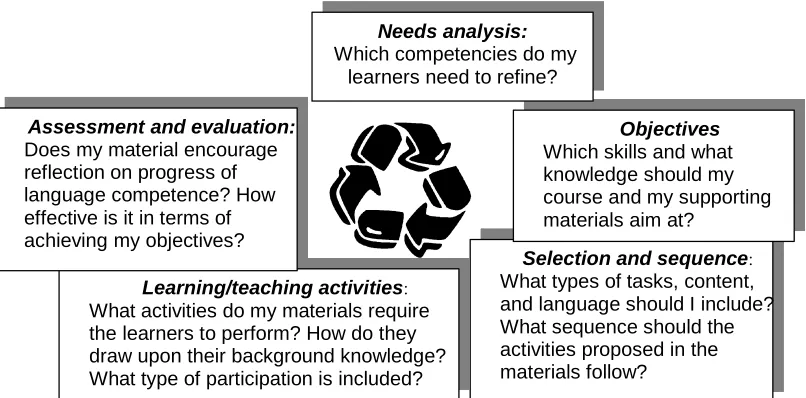
It is also important to highlight that the process of material design is embedded in the sequence of a language course design. Learners should know in advance what their learning process will consist of. Therefore, objectives must be stated in the materials and should be clearly defined so that learners can accurately interpret them. The materials should reflect opportunities for the learners
to achieve the objectives set up. In other words, there must be congruency between the objectives and the materials.
Figure 1.
Figure 1. Figure 1.
Figure 1. Figure 1. The Process of Course and Material Design
000000000000000000000000000000000000000000000000000000000000000000000000000000000000000000000000000000000000000000000000000000000000000000000000000000000000000 000000000000000000000000000000000000000000000000000000000000000000000000000000000000000000000000000000000000000000000000000000000000000000000000000000000000000 000000000000000000000000000000000000000000000000000000000000000000000000000000000000000000000000000000000000000000000000000000000000000000000000000000000000000 000000000000000000000000000000000000000000000000000000000000000000000000000000000000000000000000000000000000000000000000000000000000000000000000000000000000000 000000000000000000000000000000000000000000000000000000000000000000000000000000000000000000000000000000000000000000000000000000000000000000000000000000000000000 000000000000000000000000000000000000000000000000000000000000000000000000000000000000000000000000000000000000000000000000000000000000000000000000000000000000000 000000000000000000000000000000000000000000000000000000000000000000000000000000000000000000000000000000000000000000000000000000000000000000000000000000000000000 000000000000000000000000000000000000000000000000000000000000000000000000000000000000000000000000000000000000000000000000000000000000000000000000000000000000000 000000000000000000000000000000000000000000000000000000000000000000000000000000000000000000000000000000000000000000000000000000000000000000000000000000000000000 000000000000000000000000000000000000000000000000000000000000000000000000000000000000000000000000000000000000000000000000000000000000000000000000000000000000000 000000000000000000000000000000000000000000000000000000000000000000000000000000000000000000000000000000000000000000000000000000000000000000000000000000000000000 000000000000000000000000000000000000000000000000000000000000000000000000000000000000000000000000000000000000000000000000000000000000000000000000000000000000000 000000000000000000000000000000000000000000000000000000000000000000000000000000000000000000000000000000000000000000000000000000000000000000000000000000000000000 000000000000000000000000000000000000000000000000000000000000000000000000000000000000000000000000000000000000000000000000000000000000000000000000000000000000000 000000000000000000000000000000000000000000000000000000000000000000000000000000000000000000000000000000000000000000000000000000000000000000000000000000000000000
Selection and sequence:
What types of tasks, content, and language should I include? What sequence should the activities proposed in the materials follow?
00000000000000000000000000000000000000000000000000000000000000000000000000000000000000000000000000000000000000000000000000000000000000000000000000000000000000000000000000000000000000000000000000000000000000000 00000000000000000000000000000000000000000000000000000000000000000000000000000000000000000000000000000000000000000000000000000000000000000000000000000000000000000000000000000000000000000000000000000000000000000 00000000000000000000000000000000000000000000000000000000000000000000000000000000000000000000000000000000000000000000000000000000000000000000000000000000000000000000000000000000000000000000000000000000000000000 00000000000000000000000000000000000000000000000000000000000000000000000000000000000000000000000000000000000000000000000000000000000000000000000000000000000000000000000000000000000000000000000000000000000000000 00000000000000000000000000000000000000000000000000000000000000000000000000000000000000000000000000000000000000000000000000000000000000000000000000000000000000000000000000000000000000000000000000000000000000000 00000000000000000000000000000000000000000000000000000000000000000000000000000000000000000000000000000000000000000000000000000000000000000000000000000000000000000000000000000000000000000000000000000000000000000 00000000000000000000000000000000000000000000000000000000000000000000000000000000000000000000000000000000000000000000000000000000000000000000000000000000000000000000000000000000000000000000000000000000000000000 00000000000000000000000000000000000000000000000000000000000000000000000000000000000000000000000000000000000000000000000000000000000000000000000000000000000000000000000000000000000000000000000000000000000000000 00000000000000000000000000000000000000000000000000000000000000000000000000000000000000000000000000000000000000000000000000000000000000000000000000000000000000000000000000000000000000000000000000000000000000000 00000000000000000000000000000000000000000000000000000000000000000000000000000000000000000000000000000000000000000000000000000000000000000000000000000000000000000000000000000000000000000000000000000000000000000 00000000000000000000000000000000000000000000000000000000000000000000000000000000000000000000000000000000000000000000000000000000000000000000000000000000000000000000000000000000000000000000000000000000000000000 00000000000000000000000000000000000000000000000000000000000000000000000000000000000000000000000000000000000000000000000000000000000000000000000000000000000000000000000000000000000000000000000000000000000000000 00000000000000000000000000000000000000000000000000000000000000000000000000000000000000000000000000000000000000000000000000000000000000000000000000000000000000000000000000000000000000000000000000000000000000000
Learning/teaching activities:
What activities do my materials require the learners to perform? How do they draw upon their background knowledge? What type of participation is included? 00000000000000000000000000000000000000000000000000000000000000000000000000000000000000000000000000000000000000000000000000000000000000000000000000000000000000
00000000000000000000000000000000000000000000000000000000000000000000000000000000000000000000000000000000000000000000000000000000000000000000000000000000000000 00000000000000000000000000000000000000000000000000000000000000000000000000000000000000000000000000000000000000000000000000000000000000000000000000000000000000 00000000000000000000000000000000000000000000000000000000000000000000000000000000000000000000000000000000000000000000000000000000000000000000000000000000000000 00000000000000000000000000000000000000000000000000000000000000000000000000000000000000000000000000000000000000000000000000000000000000000000000000000000000000 00000000000000000000000000000000000000000000000000000000000000000000000000000000000000000000000000000000000000000000000000000000000000000000000000000000000000 00000000000000000000000000000000000000000000000000000000000000000000000000000000000000000000000000000000000000000000000000000000000000000000000000000000000000 00000000000000000000000000000000000000000000000000000000000000000000000000000000000000000000000000000000000000000000000000000000000000000000000000000000000000 00000000000000000000000000000000000000000000000000000000000000000000000000000000000000000000000000000000000000000000000000000000000000000000000000000000000000 00000000000000000000000000000000000000000000000000000000000000000000000000000000000000000000000000000000000000000000000000000000000000000000000000000000000000 00000000000000000000000000000000000000000000000000000000000000000000000000000000000000000000000000000000000000000000000000000000000000000000000000000000000000 00000000000000000000000000000000000000000000000000000000000000000000000000000000000000000000000000000000000000000000000000000000000000000000000000000000000000 00000000000000000000000000000000000000000000000000000000000000000000000000000000000000000000000000000000000000000000000000000000000000000000000000000000000000 00000000000000000000000000000000000000000000000000000000000000000000000000000000000000000000000000000000000000000000000000000000000000000000000000000000000000 00000000000000000000000000000000000000000000000000000000000000000000000000000000000000000000000000000000000000000000000000000000000000000000000000000000000000
Assessment and evaluation:
Does my material encourage reflection on progress of language competence? How effective is it in terms of achieving my objectives?
000000000000000000000000000000000000000000000000000000000000000000000000000000000000000000000000000000000000000000000000000000000000000000000000000 000000000000000000000000000000000000000000000000000000000000000000000000000000000000000000000000000000000000000000000000000000000000000000000000000 000000000000000000000000000000000000000000000000000000000000000000000000000000000000000000000000000000000000000000000000000000000000000000000000000 000000000000000000000000000000000000000000000000000000000000000000000000000000000000000000000000000000000000000000000000000000000000000000000000000 000000000000000000000000000000000000000000000000000000000000000000000000000000000000000000000000000000000000000000000000000000000000000000000000000 000000000000000000000000000000000000000000000000000000000000000000000000000000000000000000000000000000000000000000000000000000000000000000000000000 000000000000000000000000000000000000000000000000000000000000000000000000000000000000000000000000000000000000000000000000000000000000000000000000000 000000000000000000000000000000000000000000000000000000000000000000000000000000000000000000000000000000000000000000000000000000000000000000000000000 000000000000000000000000000000000000000000000000000000000000000000000000000000000000000000000000000000000000000000000000000000000000000000000000000 000000000000000000000000000000000000000000000000000000000000000000000000000000000000000000000000000000000000000000000000000000000000000000000000000 000000000000000000000000000000000000000000000000000000000000000000000000000000000000000000000000000000000000000000000000000000000000000000000000000 000000000000000000000000000000000000000000000000000000000000000000000000000000000000000000000000000000000000000000000000000000000000000000000000000
Objectives
Which skills and what knowledge should my course and my supporting materials aim at?
000000000000000000000000000000000000000000000000000000000000000000000000000000000000000000000000000000000000000000000000000000000000000000000000000 000000000000000000000000000000000000000000000000000000000000000000000000000000000000000000000000000000000000000000000000000000000000000000000000000 000000000000000000000000000000000000000000000000000000000000000000000000000000000000000000000000000000000000000000000000000000000000000000000000000 000000000000000000000000000000000000000000000000000000000000000000000000000000000000000000000000000000000000000000000000000000000000000000000000000 000000000000000000000000000000000000000000000000000000000000000000000000000000000000000000000000000000000000000000000000000000000000000000000000000 000000000000000000000000000000000000000000000000000000000000000000000000000000000000000000000000000000000000000000000000000000000000000000000000000 000000000000000000000000000000000000000000000000000000000000000000000000000000000000000000000000000000000000000000000000000000000000000000000000000 000000000000000000000000000000000000000000000000000000000000000000000000000000000000000000000000000000000000000000000000000000000000000000000000000 000000000000000000000000000000000000000000000000000000000000000000000000000000000000000000000000000000000000000000000000000000000000000000000000000
Needs analysis:
Which competencies do my learners need to refine?
The sequence shown here implicitly emphasizes the idea that teachers’ theoretical background must be at the heart of material design. Teachers should posses a grasp of developments in the field of education and particularly in second language acquisition, and the ability to connect theory and research to practice. Teachers must be connoisseurs of their field. They should not only be familiar with theories of foreign language learning and teaching, but also be acquainted with the most recent findings of research. Materials could lack a solid rationale if they are not constructed considering principles in which the teacher believes. It is by combining their theoretical background and their teaching experience in the development of their materials that they create positive conditions for language learning. A combination of experience and theoretical background could guarantee a better developed product.
MA MA MA MA
MATERIAL DESIGNTERIAL DESIGNTERIAL DESIGNTERIAL DESIGNTERIAL DESIGN
AND MOTIV AND MOTIV AND MOTIV AND MOTIV
AND MOTIVAAAAATIONTIONTIONTIONTION
T T T T
Table 1. able 1. able 1. able 1. able 1. The ARCS Model of Motivational Design
Attention It deals with the creation of the concept of newness. It explores the way teachers activate curiosity among students and how to match students´ interest and needs through the use of different methods.
Relevance
It focuses on goal orientation, motive matching, and familiarity emphasizing objectives. It is fundamental for students to know what the objectives are and their importance. The selection of objectives should be focused on learners’ needs. Familiarity takes into account students’ experiences and values when designing the contents.
Confidence It is the link established between the learning process and students’ abilities.
Satisfaction It is the enjoyable experience faced by students when objectives are achieved.
It is worth noting that Small capitalizes on the importance of congruency among objectives, tasks and materials. However, the model also implies diversity. More concretely, materials should explore students’ personalities, learning styles, language development expectations, likes, dislikes, needs and the contexts they are embedded in. Apparently, this seems an overwhelming task, but it is possible if we observe our learners meticulously and learn to appreciate who they are, how they see the world, and how they interact with each other. Age in this sense is fundamental. Generations change and therefore we must bear in mind that contents and purposes in materials can vary according to learners’ ages. A way to bridge the gap between you as a teacher-material designer and your students is to plunge into their age and put yourself in their own shoes so that you understand the way they conceive life.
CONTEXTUALIZA CONTEXTUALIZA CONTEXTUALIZA CONTEXTUALIZA
CONTEXTUALIZATIONTIONTIONTIONTION
OF CONTENT OF CONTENT OF CONTENT OF CONTENT OF CONTENT
They include cartoon stories, matching exercises, memory games, board games such as taboo, stop and simulation of real conversations, games, etc.
VISUAL VISUAL VISUAL VISUAL
VISUAL LALALALALAYYYYYOUTOUTOUTOUTOUT
Finally, a crucial aspect in the design of materials concerns the visual layout. Although this is the aspect that requires continuous practice and some familiarization with computer programs such as Word and Paint Work, there are basic tips that aid in the elaboration of attractive materials. We will pinpoint the ones that have been of great usefulness for us:
• Include clear and short instructions
using everyday, plain language. Also, include a name or heading for each activity you plan in your materials.
• Provide a concise, straightforward
example before letting the students work by themselves. In short, model the behaviour.
• Avoid being stuffy. Distribute the
information and pictures in a visually-attractive layout so that looking at and reading the material do not become tiresome.
• Use legible fonts that are not too
elaborated and can easily be read.
• Recreate your activities with visuals.
Those should portray the meaning of the words or situations meant to be learned. Do
not include pictures just for the sake of it with no relationship whatsoever to the content. Design your own pictures or use resources from the Internet, but be aware of copyrighted material.
• Include a varied set of activities.
Examples are: tic-tac-toe, memory games, lotteries, bingos, jig-saw puzzles, stop and so forth. You can also create materials that promote interaction and teamwork such as hexagon games, contests, wall-dictation and mutual dictation and simulation games.
• Use eye-catching color in your
resources and make sure they are readable.
SAMPLES SAMPLES SAMPLES SAMPLES SAMPLES
ANSWER KEY THEY ARE ALL (1) …
ANSWER KEY THEY ARE ALL (2)…
1. They are all functions of money
2. They are all imperfect market structures 3. They are all economic growth sources 4. They are all imperfect market features 5. They are all national income variables 6. They are all perfect market features 7. They are all acronyms
8. They are all business cycle phases 9. They are all macroeconomic problems 10. They are all international trade key words 11. They are all negative consumption externalities 12. They are all crimes
1. They are all flowers.
2. They are all family members/ relatives. 3. They are all insects.
4. They are all clothes 5. They are all continents.
6. They are all pieces of furniture. 7. They are all colours.
8. They are all sports. 9. They are all verbs.
Play with a classmate. Take turns deciding how to label the features / aspects that appear in each of the petals. If you don’t answer, you miss your turn. The winner is the student who labels the highest number of petals.
12. Shoplifting, kidnapping, forgery, smuggling, murder, and
rape.
1. Means of exchange, unit of account and store of value.
7. IMF, VAT, GDP, GNP, CPI, L&PA, WB or IBRD, GATT and NAFTA.
11. Cigarette smoke, loud music at 2 A.M. and pollution caused by local automobiles.
10. Tariffs, quotas, exports and imports, trade balance, mutually beneficial trade.
9. Unemployment, inflation, economic growth and business cycles.
8. The peak, the downturn, the trough and the upturn.
6. Market forces interaction, price takers, many firms, many buyers, and a variety of products.
4. Price makers, market entry barriers, unique product, differentiated products, a multitude of buyers and one, or a few firms.
5. Total output, aggregate savings, total consumption and aggregate investment.
3. Entrepreneurship, investment in technology and human capital, capital accumulation and institutions that foster growth.
2. Oligopoly, duopoly and monopoly.
00000000000000000000000000000000000000000000000000000000000000000000000000000000000000000000000000000000000000000000000000000000000000000 00000000000000000000000000000000000000000000000000000000000000000000000000000000000000000000000000000000000000000000000000000000000000000 00000000000000000000000000000000000000000000000000000000000000000000000000000000000000000000000000000000000000000000000000000000000000000 00000000000000000000000000000000000000000000000000000000000000000000000000000000000000000000000000000000000000000000000000000000000000000 00000000000000000000000000000000000000000000000000000000000000000000000000000000000000000000000000000000000000000000000000000000000000000 00000000000000000000000000000000000000000000000000000000000000000000000000000000000000000000000000000000000000000000000000000000000000000 00000000000000000000000000000000000000000000000000000000000000000000000000000000000000000000000000000000000000000000000000000000000000000 00000000000000000000000000000000000000000000000000000000000000000000000000000000000000000000000000000000000000000000000000000000000000000 00000000000000000000000000000000000000000000000000000000000000000000000000000000000000000000000000000000000000000000000000000000000000000 00000000000000000000000000000000000000000000000000000000000000000000000000000000000000000000000000000000000000000000000000000000000000000 00000000000000000000000000000000000000000000000000000000000000000000000000000000000000000000000000000000000000000000000000000000000000000 00000000000000000000000000000000000000000000000000000000000000000000000000000000000000000000000000000000000000000000000000000000000000000 00000000000000000000000000000000000000000000000000000000000000000000000000000000000000000000000000000000000000000000000000000000000000000 00000000000000000000000000000000000000000000000000000000000000000000000000000000000000000000000000000000000000000000000000000000000000000 00000000000000000000000000000000000000000000000000000000000000000000000000000000000000000000000000000000000000000000000000000000000000000 00000000000000000000000000000000000000000000000000000000000000000000000000000000000000000000000000000000000000000000000000000000000000000 00000000000000000000000000000000000000000000000000000000000000000000000000000000000000000000000000000000000000000000000000000000000000000 00000000000000000000000000000000000000000000000000000000000000000000000000000000000000000000000000000000000000000000000000000000000000000 00000000000000000000000000000000000000000000000000000000000000000000000000000000000000000000000000000000000000000000000000000000000000000 00000000000000000000000000000000000000000000000000000000000000000000000000000000000000000000000000000000000000000000000000000000000000000 00000000000000000000000000000000000000000000000000000000000000000000000000000000000000000000000000000000000000000000000000000000000000000 00000000000000000000000000000000000000000000000000000000000000000000000000000000000000000000000000000000000000000000000000000000000000000 00000000000000000000000000000000000000000000000000000000000000000000000000000000000000000000000000000000000000000000000000000000000000000 00000000000000000000000000000000000000000000000000000000000000000000000000000000000000000000000000000000000000000000000000000000000000000
1. They are all __________________________ 7. They are all _____________________________
2. They are ____________________________ 8. They are _______________________________
3. They _______________________________ 9. They __________________________________
4. They are all __________________________ 10. They are all ____________________________
5. They are ____________________________ 11. They are ______________________________
Play with a classmate. Take turns to decide how to label the things, places, words, names, items, etc. that appear in each of the petals. If you don’t answer, you miss your turn. The winner is the student who labels the highest number of petals
1. They are all ____________________________ 7. They are all _____________________________
2. They are ______________________________ 8. They are _______________________________
3. They _________________________________ 9. They __________________________________
4. They are all ____________________________ 10. They are all ____________________________
5. They are _ ____________________________ 11. They are ______________________________
6. They _________________________________ 12. They _________________________________
1. Sunflowers, roses, irises, carnations, tulips and daffodils.
7. Red, green, mauve, navy, pink, yellow, purple, black, brown, orange and grey.
12. Pear, banana, orange, mango, pineapple and lemon. 11. Carrots,
cauliflowers, onions, cucumbers, green peas, lettuce and garlic.
10. London, Rome,
Paris,Bogotá,
Teheran, and Washington.
9. To talk, to write, to call, to greet, to love, to enjoy, to give, to forgive, and to admire.
8. Football, ice-hockey, swimming, tennis, basketball, hiking, and skating.
6. Chairs, tables, desks, wardrobes, cupboards, sofas, a puff and an armchair.
4. Shirts, jeans, scarves, blouses, underwear and jackets.
5. Europe, Asia, Africa, North, Central and South America, Australia and Antarctica.
3. Bees, ants, mosquitoes, butterflies and grasshoppers. 2. Uncles, aunties, mothers –in-law, cousins, siblings, and nieces.
Let’s play this boar
d game with a die. Thr
ow the die and do what is ask
ed in each bo
x by using modal verbs cor
rectly
. If you f
ail to do the
task, you must start again. The winner must get to the bo
x mark ed finished. 14 . T e ll y o u r c las sm ates ab ou t a po s s ibl e a p p lic at io n for an in te rn s h ip in a m u lt in at io na l fi rm . 13 . R e co mme nd y o u r fe llow s n o t to d ri n k and dr iv e be c a use it is da n g er o u s . 12 . Y o u ar e a c a ri n g p e rs o n . Te ll y o u r f rie nd s to dev ot e m o re ti m e to th ei r st ud ies . 11 . I n v ite y o ur fr ie nd s to g o f o r a w a lk . 10 . Ask y o ur teac he r p o lit e ly t o re p e a t th e la s t in s tr u cti o n s /h e g av e . 9 . In v ite y o u r g ir lf ri en d / b o yf ri en d to ha ve di nn er at a qu it e f a n c y re s tau ra nt . 8. Te ll y o u r c o llea gu e ab ou t th e m a in r e qu ir em en t to g o to th e U n it ed St a tes . 1 5 . S a y yo u ar e ab le to s p e a k fi v e la n g ua g es f lu ent ly. 7. Te ll y o u r cl as sm a te s ab ou t a po s s ib le t rip to Ca n a d a . 1 6 . A s k yo ur bo s s fo r pe rm is s ion to h a v e a da y of f. 6 . A s k so me o n e p o lite ly n o t to s m o k e in th e ha ll. 17 . Y o u r g ran df at he r i s re c o v e rin g f ro m sur g er y . Te ll hi m to st a y i n be d. 1 . Ask yo ur pa rt n e r po lit e ly f o
r a bi
SOME RECOMMEND SOME RECOMMEND SOME RECOMMEND SOME RECOMMEND
SOME RECOMMENDAAAATIONSATIONSTIONSTIONSTIONS
Finally, we advise teachers to systematize their process. In other words, keep the template used for further reference so that more information can be adapted later. Teacher-designers should compile their materials in a diskette or CD to have easy access and retrieval. They also should label their designs with pertinent information such as the type of activity and the target audience. Besides, it is advisable to maintain a file with printed laminated copies of all materials and categorize them in a folder. Thus, the process will turn into a versatile resource pack that not only assists teachers in their endeavours, but also helps them to visualize their creative side.
It is also important to note that many textbooks and teaching resource packs contain materials that can be adapted according to the needs of the learners. Teachers do not have to reinvent the wheel, and time and energy can be saved that way. However, there are ethical issues that must be considered. We strongly caution teachers about “piracy” and invite them to become aware of copyrights. Any selected material that is adapted, even if it is slightly modified, must explicitly include a reference to the original sources. According to the Purdue University Online Writing Lab (2004), anybody using others’ work needs to document the reference when:
• Referring to somebody else’s words
or ideas from a magazine, book, newspaper, song, TV program, movie, Web page, computer program, letter, advertisement, or any other medium.
• Including information gained through interviews.
• Copying the exact words or a “unique phrase”.
• Reprinting diagrams, illustrations, charts, figures or pictures.
• Applying ideas that others have given you in conversations or via e-mail.
It is by giving credit that we acknowledge and value the work of other people and begin fostering an ethical environment in our job. As can be inferred, creating and adapting materials is a challenging enterprise as it demands serious considerations in terms of curriculum and instructional alignment and ethical issues. It is also time-consuming and demanding. However, it provides teachers with opportunities to explore not only their teaching potential, but also their creative side.
REFERENCES REFERENCES REFERENCES REFERENCES REFERENCES
CIEL Project. (2000). Resources for independent language learning: design and use. Retrieved July 7, 2004, from http:// www.lang.ltsn.ac.uk/resources/goodpractice.aspx
Dewey, J. (1938). The Theory of Inquiry. New York: Holt, Rinehart & Wiston.
Dick , W. and Reiser, R. (1989). Planning effective instruction. New Jersey: Prentice Hall, Inc.
Menezes, A. (2001). Reflections on
Purdue University Online Writing Lab. (2004). Retrieved from http:// owl.english.purdue.edu/hadouts/research/r-plagiarism.html
Small, R. (1997). Motivation in instructional design. Retrieved July 15, 04 from http:// w w w . i l s . u n c . e d u / D a n i e l / 2 1 4 / MotivationSmall.html