ISSN 0975-928X
Research Note
Spectrum and frequency of mutations induced by gamma rays and EMS in
okra [
Abelmoschus esculentus
(L.) Moench]
Nivedita Gupta1*, Sonia Sood2 and V.K. Sood3
1,2
Department of Vegetable Science and Floriculture,
3Department of Crop Improvement, College of Agriculture, CSK HPKV Palampur, 176 062, Himachal Pradesh
E-mail: [email protected]
(Received: 30 Jan 2017; Revised: 19 Aug 2017; Accepted: 28 Aug 2017)
Abstract
The seeds of okra variety P-8 were treated with different concentrations of gamma rays (65kR, 75kR and 85kR), EMS (1.2%, 1.4% and 1.6%) and their combinations to obtain the phenotypic response during M2 generation. Different mutation
frequencies and width of mutation spectra were induced under the action of different concentrations of the applied mutagens. A progressive increase in mutation frequency of chlorophyll mutations was observed with increasing doses. Four different types of chlorophyll mutants, such as albino, xantha, viridis and chlorina were induced with effect of mutagens on plant population. The spectrum and frequency of chlorina mutants were highest followed by xantha, viridis and albino in all the treatments. The sole treatments of mutagens were found to be more efficient than combinations in inducing chlorophyll mutations. The highest frequency of chlorophyll mutations (0.044%) was reported in the 75kR+1.2% EMS. Based on the chlorophyll mutation frequency, it was found that EMS was most effective followed by gamma rays and combination of treatments.
Key words
Okra, Gamma rays, EMS, Chlorophyll mutations.
Okra [Abelmoschus esculentus (L.) Moench] is an economically important vegetable crop grown in tropical and sub-tropical parts of the world. Due to high nutritive value and long post harvest life, okra has captured a prominent position among export vegetables. It has a vast potential to earn foreign exchange and accounts for 60 percent export of fresh vegetables excluding potato, onion and garlic, the destinations being the Middle East, United Kingdom, Western Europe and United States of America. Fresh okra pod is an excellent source of vitamins A and C, and calcium (NARP, 1993). It also contains carbohydrates, potassium, magnesium and other vitamins at a significant level . There were also reports about anticancer (Vayssade et al., 2010), antimicrobial (De Carvalho et al., 2011), antiulcer (Atodariya et al., 2013), antihyperlipidemic (Sabitha et al., 2011) and hypoglycaemic activities (Tomoda et al., 1989, Sabitha et al., 2011) of okra.
Genetic diversity in okra is lost through fixation, genetic sweeps thereby increasing the dependency of breeders on smaller sets of superior genotypes that has created successive bottlenecks (Varshney, 2013).
Chlorophyll mutations are considered as the most dependable indices for evaluating the efficiency of different mutagens in inducing the genetic variability for crop improvement and are also used as genetic markers in basic and applied research. The occurrence of chlorophyll mutations after treatments with physical and chemical mutagens have been reported in several crops. Chlorophyll mutants are employed as markers for the
evaluation of gene action of mutagenic factors in induced mutation studies (Gaul, 1964). The mutagenic effect is reflected in the segregation of chlorophyll mutants. The present investigation was attempted to understand the comparative response of physical mutagen gamma rays and chemical mutagens EMS and combination of them on okra, with a view to determine the genotypic differences in response to induction of chlorophyll mutations in M2 generation.
The experiment was conducted at Department of Vegetable Science and Floriculture, CSK HPKV, Palampur, Himachal Pradesh, during kharif season 2014-2016. The experimental area comes under sub-temperate zone. A well adapted variety of okra P-8 had been used for this experiment. The plants of P-8 are 150 cm tall with purple pigmentation on stem, petiole and lower leaf surface having sparse hairs. Fruits of P-8 are medium long, thin, tender, green and five ridged. It had been released for general cultivation in Himachal Pradesh during 2010. Different mutagens like gamma rays and EMS were used to mutagenize the seeds. Six hundred healthy, well filled, mature and disease free dry seeds of P-8 variety of okra were irradiated with different levels of gamma rays viz., 35 kR, 40 kR, 45 kR, 50 kR, 55 kR, 60 kR, 65 kR, 70 kR, 75 kR, 80 kR and 85 kR of gamma rays in
60Co gamma-cell at Gamma chamber, Bhabha
Atomic Research Centre, Trombay, Mumbai, India.
Electronic Journal of Plant Breeding, 8(3): 967-972 (September 2017) ISSN 0975-928X
DOI: 10.5958/0975-928X.2017.00125.9
hours. The pre-soaking enhances the rate of uptake of the mutagen through increase in cell permeability and also initiates metabolism in seeds. Such pre-soaked seeds were later immersed in the mutagenic solution for 6 hours with intermittent shaking followed by 12 hours post treatment washing to wash out chemical residues. The different concentrations of EMS used for the chemical mutagenic treatments were 0.2%, 0.4%, 0.6%, 0.7%, 0.8%, 0.9%, 1.0%, 1.1%, 1.2%, 1.4% and 1.6%. Seeds soaked in distilled water for 6 hours served as control.
Treated seeds of each dose were placed in Petri plates over moistened germination paper under seed germinator with untreated seeds as control at 25±1⁰ C under laboratory conditions in three replications to work out LD50 value by recording
germination percentage and seedling length.
On the basis of LD50 values (75kR for gamma rays
and 1.2% for EMS), the preceding and succeeding doses of gamma rays (65kR, 85kR) and EMS (1.4%, 1.6%) were selected for further experiments. The treatment was given individually as well as in combination with each other (Table1). Harvested seeds were sown as single plant to progeny in M2 generation along with control in
rows of 2.25m length maintaining plant to plant and row to row spacing of 15 cm and 45 cm,
respectively in augmented design. The
recommended agronomic practices were followed to raise a good crop. The M2 population was
screened for frequency and spectrum of chlorophyll mutations. Lethal chlorophyll mutations were scored within 10 to 25 days after sowing, whereas viable chlorophyll mutations were scored throughout the cropping season. The spectrum of chlorophyll mutations was studied and the mutants were classified as per the scheme of Gustafsson (1940) and Blixt (1969).
The frequency of chlorophyll mutations was calculated by the following formula: Mutation frequency = Number of mutant plants/ Total number of M2 plants × 100
Chlorophyll mutations provide one of the most dependable indices for the evaluation of genetic effects of mutagenic treatments. Chlorophyll biosynthesis has been suggested to be controlled by several genes located adjacent to centromere and proximal part of chromosomes (Goud, 1967). Mutations in these chlorophyll genes are expressed in the M2 and coming generations in the form of
various types of mutants. To estimate the chlorophyll mutations, periodical scoring of plants is essential right from the seedling stage (Stumman
et al., 1980).
The spectrum of chlorophyll mutations were classified as per the scheme of Gustafson (1947).
In the present investigation, after recording the data on seedling length and germination percentage, LD50 values for gamma rays and EMS
was observed as 65kR and 1.4%, respectively. In M2 generation, four different types of chlorophyll
mutants were recorded for the different doses/ concentrations of gamma rays, EMS and their combinations i.e. albino, xantha, viridis and chlorina. Albino mutants were completely devoid of chlorophyll and could survive only a few days. The seedlings emerged white on germination and relatively smaller than the normal looking seedlings of same age, Xantha had pale yellow coloured seedlings, these mutants could not survive more than a few days due to block in chlorophyll synthesis. They all showed normal growth in the beginning, but withering after 8-10 days and ultimately died within two week (Blixt, 1961). Both these mutants were classified under lethal mutants.
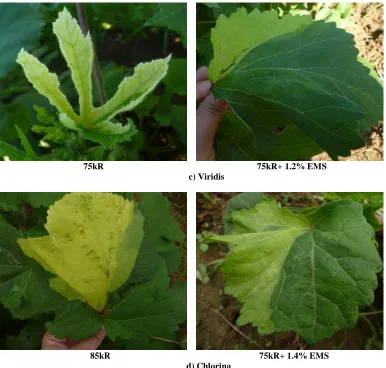
Several other types of chlorophyll deficient mutants such as chlorina and viridis (viable mutants) survived till maturity. Viridis mutants were light greenish in colour and remained so throughout the life cycle. Chlorina mutant seedlings were pale yellowish to yellow in colour. Some of these mutants were lethal or semi-lethal, few plants acquire greenish tinge, later fade in colour. The plants were semi dwarf to normal in height.
Poudel et al., 2016 observed different types of chlorophyll mutants viz., Albino, Xantha, Chlorina and Viridis and found Viridisand Chlorinatype of chlorophyll mutations were most frequent and least common, respectively. Significant variation in the spectrum and frequency of different chlorophyll mutations was recorded among the different treatments.
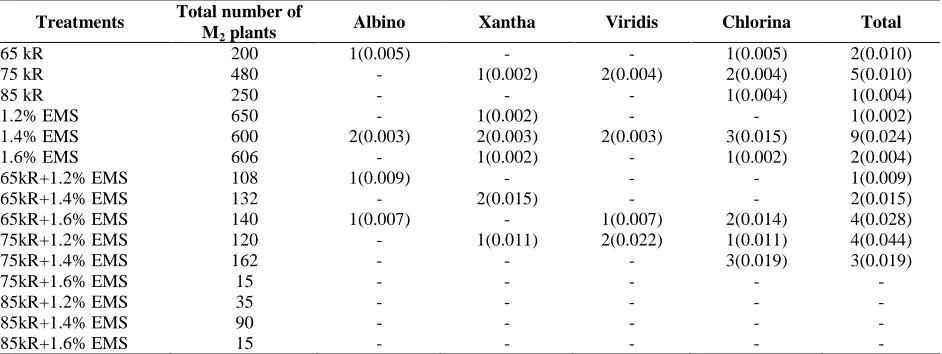
The chlorophyll mutation frequency was estimated as percentage of plants that segregated for chlorophyll deficiency on the basis of M2 seedlings
and presented in Table 2. The highest frequency of chlorophyll mutations (9.74%) was recorded in the 65kR+1.6% EMS treatment while lowest (0.004%) was found in 1.6% EMS treatment.
ISSN 0975-928X
The chlorophyll mutation acts not only as a scale for evaluating effectiveness and efficiency of mutagens, but also as indicators to predict the size of vital factor mutations These studies aimed at understanding the process of mutation, testing the efficacy of various mutagens, identifying optimum dose and best method of treatment, also isolates the mutants of basic and applied value which elucidates the biological effects of mutagens. Out of albina, chlorina, viresence, viridis and xantha; xantha type of chlorophyll mutations was predominant in both mutagenic treatments (Kausar
et al., 2013). The albino seedling itself has no
practical value; however, such seedlings may be used as genetic markers for estimation of natural selfing. The phenomenon of albinism is rarely exhibited by plants with characteristic deficiency of chlorophyll and subsequent whitish-yellow colour.
In the present investigation no dose dependent increase in the frequency and spectrum of chlorophyll mutations was observed. Chlorophyll mutations both lethal and viable have been shown in Fig 1 and Fig 2, respectively. For both EMS and gamma irradiation higher frequency of chlorophyll mutation with moderate doses of mutagens was observed. It seems that the strong mutagens reach their saturation point even at moderate doses in the highly mutable genotypes and further increase in dose does not add to the mutation frequency. With increase in dose beyond a point, the strong mutagens become more toxic than the higher doses of relatively weaker mutagens. That’s why in combination treatments with higher doses of both mutagens, no chlorophyll mutants were observed. The present findings are in accordance with Shah
et al., 2006; the viridis type chlorophyll mutations
were most frequent and albina were least common. Among the mutagens, chemical mutagen (EMS) was most effective and potent in inducing the chlorophyll mutations than physical mutagen gamma irradiation.
Induced mutations have been recognized as an important tool for crop improvement, and have sufficient scope in okra. Delayed in the development of chloroplast leading to chlorophyll deficient mutants. Mutations in these chlorophyll genes are expressed in the M2 and coming after
generations in the form of various types of mutants. It is therefore concluded in pigeonpea, that although the chlorophyll mutations do not have any economic value due to their lethal nature, such a study could be useful in identifying the threshold dose of a mutagen that would increase the genetic variability and number of economically useful mutants in the segregating generations (Sangle and Kothekar, 2013). Reddy and Chaudhary (2015) observed that gamma irradiation treatments seemed to be superior in producing greater frequencies over all doses in okra
germplasm. The occurrence of chlorophyll mutations after treatments with physical and chemical mutagens have also been reported in okra by different workers, viz., Jambhale and Nerkar (1982), Singh et al. (2000), Sasi et al. (2005), Kumar and Mishra (2006), Mishra et al. (2007) and Warghat et al. (2011). Khursheed and Khan (2016) in Vicia faba also reported that the frequency of chlorophyll mutations increased with increasing concentrations of both single and combined treatments. Combined treatments produced more chlorophyll mutations followed by individual concentrations/doses of EMS and gamma rays. Reason for higher frequency of chlorophyll mutants in combination treatments may be due to higher induction of mutations in genes controlling chlorophyll biosynthesis. Further isolation and characterization of chlorophyll genome of mutant may be helpful in understanding the nature of mutation at molecular level.
The present investigation revealed how chlorophyll genes respond to mutagens gamma rays and EMS. Chlorophyll genes are reflected in the M2 in the
form of different types of chlorophyll mutants which can be useful as marker in physiological and biochemical investigations. Among the different treatments, 1.4% EMS showed maximum spectrum and maximum frequency of chlorophyll mutants was found in 75kR+1.2% EMS. Chlorina type of chlorophyll mutations was most frequent and Albino type was least common. Based on the chlorophyll mutation frequency, EMS was most
effective followed by gamma rays and
combination of treatments. It is further suggested that as all the gamma radiations and EMS doses induced reasonable chlorophyll mutations, hence all these treatments could be used in mutation breeding programs for inducing viable mutations.
References
Blixt, S. 1961. Quantitative studies of induced mutations in peas. V. Chlorophyll mutations. Agri. Horti. Gen., 19: 1-402.
Blixt, S. 1969. Studies on induced mutation in peas. XV. Effect of environment of the XI generation on EMS treated and gamma irradiated Weitor pea. Agri. Horti. Gen., 24: 62-74.
Gaul, H. 1964. Mutations in plant breeding. Rad. Bot., 4: 155-232.
Goud, J.V. 1967. Induced polygenic mutations in hexaploid wheat. Rad. Bot., 7:119–133.
Gustafsson, A. 1940. The mutation system of the chlorophyll apparatus. Lunds Univ. Arsskr. 36: 1–40.
Gustafsson, A. 1947. Mutation in Agricultural plants. Hereditas., 33: 1–100.
Jambhale, N.D. and Nerkar, Y.S. 1982. Mutation studies in okra (Abelmoschus esculentus (L.) Moench). Prog. Horti., 14(2/3): 133-135.
Electronic Journal of Plant Breeding, 8(3): 967-972 (September 2017) ISSN 0975-928X
DOI: 10.5958/0975-928X.2017.00125.9
(Abelmoschus esculentus (L.) Moench). Int. J. Plant Sci., 1(1): 101-103.
Khursheed, S. and Khan, S. 2016. Screening of chlorophyll mutations in the mutagenized population of two cultivars of Vicia faba L. American J. Exp. Agri., 11(5): 1-7.
Mishra, M.N, Qadri, H. and Mishra, S. 2007. Macro and micro mutations in gamma-rays induced M2
population of okra (Abelmoschus esculentus (L) Moench). Int. J. Plant Sci., 2(1): 44-47.
NARP. 1993. National Agricultural Research Project, Horticultural crops. Vol. 3, July 1993. NARP, CSIR, Accra
Poudel, P.P., Saroj, S.K. and Singh, M.N. 2016. Induced genetic variability with EMS and studies on frequency and spectrum of chlorophyll mutations in Pigeonpea. Electronic J. Plant Breed., 7(2): DOI 10.5958/0975-928X.2016.00029.6
Reddy, P.S. and Chaudhary, V.P. 2015. Isolation of desirable induced morphological mutations in elite lines from a population of Abelmoschus esculentus (L.) Moench by gamma rays and EMS. Res. on Crops, 16(1): 116-122.
Sangle, S.M. and Kothekar, V.S. 2013.Mutagenic effectiveness and efficiency in pigeonpea. Int. J. Adv. Sci. Technol. Res., 3: 14-20.
Sasi, A., Pavadai, P. and Dhanavel, D. 2005. Studies on induced chemical mutagenesis in bhendi [Abelmoschus esculentus (L.) Moench]. Crop Res.
30(2): 255-258.
Shah, T.M., Mirza, J.I., Haq, M.A. and Atta, B.M. 2006. Induced genetic variability in chickpea (Cicer arietinum L.) I. Frequency and spectrum of chlorophyll mutations. Pakistan J. Bot.,
38(4):1217–1226.
Singh, A.K., Singh, K.P. and Singh, R.B. 2000. Seedling injury, reduced pollen and ovule fertility and chlorophyll mutations induced by gamma rays and EMS in okra (Abelmoschus esculentus L. Moench). Veg. Sci., 27(1): 42-44.
Stummann, B.M. and Henningsen, K.W. 1980. Characterization of chlorophyll deficient mutants in pea. Hereditas., 93:261–275.
Varshney, R.K. 2013. Draft genome sequence of chickpea (Cicer arietinum L.) provides a resource for trait improvement. Nature Biotechnol., 31: 240-246
ISSN 0975-928X
Table 1. Mutagen treatment based on lethal dose
S.No. Dose Mutagen Remarks
1. 65kR Gamma rays Below LD50
2. 75kR Gamma rays LD50
3. 85kR Gamma rays Above LD50
4. 1.2% EMS Below LD50
5. 1.4% EMS LD50
6. 1.6% EMS Above LD50
7. 65 kR+ 1.2% Gamma rays+ EMS Combination of below LD50 gamma rays and below LD50 EMS
8. 65kR+1.4% Gamma rays+ EMS Combination of below LD50 gamma rays and LD50 EMS
9. 65 kR+1.6% Gamma rays+ EMS Combination of below LD50 gamma rays and above LD50 EMS
10. 75 kR +1.2% Gamma rays+ EMS Combination of LD50 gamma rays and below LD50 EMS
11. 75 kR +1.4% Gamma rays+ EMS Combination of LD50 gamma rays and LD50 EMS
12. 75 kR +1.6% Gamma rays+ EMS Combination of LD50 gamma rays and above LD50 EMS
13. 85 kR +1.2% Gamma rays+ EMS Combination of above LD50 gamma rays and below LD50 EMS
14. 85 kR+1.4% Gamma rays+ EMS Combination of above LD50 gamma rays and LD50 EMS
15. 85 kR+1.6% Gamma rays+ EMS Combination of above LD50 gamma rays and above LD50 EMS
Table 2. Spectrum and frequency of chlorophyll mutants in M2 generation of okra
Treatments Total number of M2 plants
Albino Xantha Viridis Chlorina Total
65 kR 200 1(0.005) - - 1(0.005) 2(0.010)
75 kR 480 - 1(0.002) 2(0.004) 2(0.004) 5(0.010)
85 kR 250 - - - 1(0.004) 1(0.004)
1.2% EMS 650 - 1(0.002) - - 1(0.002)
1.4% EMS 600 2(0.003) 2(0.003) 2(0.003) 3(0.015) 9(0.024)
1.6% EMS 606 - 1(0.002) - 1(0.002) 2(0.004)
65kR+1.2% EMS 108 1(0.009) - - - 1(0.009)
65kR+1.4% EMS 132 - 2(0.015) - - 2(0.015)
65kR+1.6% EMS 140 1(0.007) - 1(0.007) 2(0.014) 4(0.028)
75kR+1.2% EMS 120 - 1(0.011) 2(0.022) 1(0.011) 4(0.044)
75kR+1.4% EMS 162 - - - 3(0.019) 3(0.019)
75kR+1.6% EMS 15 - - - - -
85kR+1.2% EMS 35 - - - - -
85kR+1.4% EMS 90 - - - - -
85kR+1.6% EMS 15 - - - - -
Note: The values outside parentheses refer to the spectrum while values in parentheses refer to the frequency.
65kR a) Albino
Electronic Journal of Plant Breeding, 8(3): 967-972 (September 2017)
ISSN 0975-928X DOI: 10.5958/0975-928X.2017.00125.9
1.6% EMS
b) Xantha
65kR+ 1.4% EMS
Fig. 1(a,b). Lethal chlorophyll mutants (albino and xantha) in M2 generation of okra
75kR 75kR+ 1.2% EMS c) Viridis
85kR 75kR+ 1.4% EMS d) Chlorina