I
nternational
J
ournal of
Agriculture
and Biosciences
www.ijagbio.com; [email protected]
Research Article
The Effect of Feeding Raw Castor Seed (Ricinus cummunis) Meal, its
Replacement Levels and Processing on the Productive Performance of Broilers
GG Mustapha
1*, JU Igwebuike
2, SB Adamu
2, ID Kwari
2and MM Gashua
31
Raw Materials Research and Development Council, 17, Aguiyi Ironsi Street, Maitama District, P.M.B. 232, Garki, Abuja, Nigeria; 2Department of Animal Science, University of Maiduguri, PMB 1069, Maiduguri, Nigeria; 3Department of Veterinary Public Health and Preventive Medicine, University of Maiduguri, PMB 1069, Maiduguri, Nigeria
*Corresponding author: [email protected]
Article History: Received: May 20, 2015 Revised: July 14, 2015 Accepted: August 22, 2015
A B ST R A C T
Two pilot studies were conducted. The first pilot study was to determine the effect of feeding graded levels of raw castor seed (Ricinus cummunis) meal to broilers. The second pilot study was to determine the effect of different replacement levels and differently processed castor seed meal on the productive performance of broilers. The processing of the meal was aimed at detoxifying the seed meal. The processing methods employed include boiling for 30 minutes; boiling for 30 minutes and fermentation for 3 days; soaking for 72 hours; and soaking for 72 hours and boiling for 20 minutes. All the birds fed graded levels of raw castor seed meal died within 7 to 14 days. Among the four processing methods employed the birds fed on castor seed meal boiled for 30 minutes and fermented for 3 days appeared to improve the daily feed intake, daily body weight gain and feed conversion ratio more than the other methods. Both studies lasted for 10 weeks each. In both pilot studies, the experimental diets and water were provided to the birds ad libitum. It was concluded that the castor seed meal (CSM) for subsequent experiments should be detoxified by boiling and fermentation.
Key words: Castor seed meal, detoxification, boiling, fermentation and soaking
INTRODUCTION
Feeding constitute about 60-70% of the cost of production in poultry. Competition between man and poultry on sources of plant protein such as groundnut cake and soya beans continues to keep the prices of these commodities beyond the reach of the common man. Therefore, there is the need to find alternative sources of plant protein, which are less expensive and not much utilized by humans. Castor seed meal (CSM) seems to be one of such alternatives. Castor seed meal which contains about 35 to 39.8% crude protein have potential as protein rich feed ingredient for livestock feeding ( Browning et al.,1990; Obioha 1992). However, the use of castor seed meal as feed ingredient in poultry ration is limited by the presences of phytotoxin primarily ricin and ricinine (Liener 1986), extremely potent allergen (Gohl, 1981; Helmenstine, 2007) and high fibre in undehulled feed (Browning et al., 1990).
The objective of this study is to determine the effect of feeding raw castor seed meal, its replacement levels
and processing on the productive performance of broiler chickens to serve as a bench mark or pilot study aimed at perfecting the research procedures before the commencement of a major feeding experiment on castor seed meal. This was necessitated by the fact that castor seed meal is poisonous.
MATERIALS AND METHODS
Pilot study I
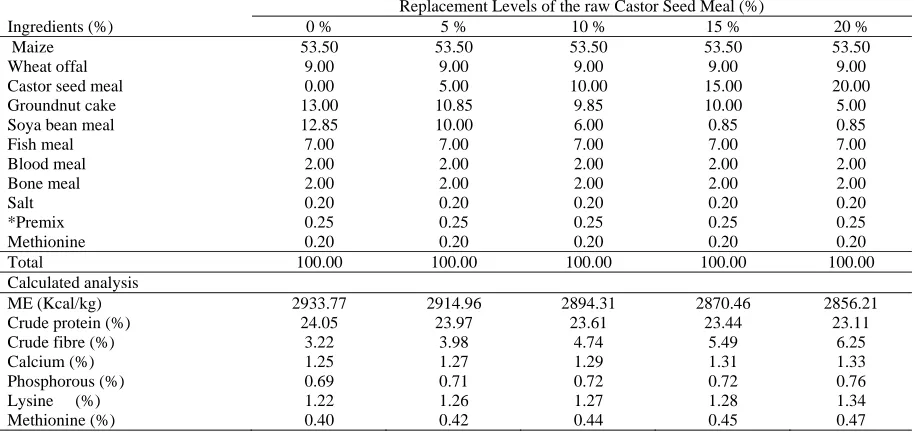
Raw castor seed meal obtained from manual oil extraction process was used to formulate broiler starter and finisher diets containing 0% (control), 5%, 10%, 15% and 20% castor seed meal. The compositions of the starter and finisher diets are presented in Tables 1 and 2. The raw castor seed meal replaces groundnut cake and soya beans meal in the diet. From 0 to 4weeks of age the broiler starters containing 0%, 5%, 10%, 15% and 20% raw castor seed meals were fed to the 5 respective groups of birds. Each group consists of 10 birds. From 5 to 10 weeks of age, the feeding continued with broiler finisher
diets containing the respective graded levels of the castor seed meal. During the period of the experiment the daily feed intake, mortality and weekly body weight were recorded. Routine vaccination and other standard management practices were undertaken. Postmortem examination was also carried out on 3 birds from each of the groups that died.
Pilot study II
The result obtained from the first pilot study (feeding of raw castor seed meal) emphasized the need for second pilot study. In the first pilot study, all the birds fed diets containing raw castor seed meal 5 to 20% died within 7 to 14 days. Therefore, there was the need to detoxify the meal before feeding the birds in subsequent experiment.
Four (4) CSM samples selected from several detoxification processes that showed lower anti-nutritional contents in the laboratory were used to formulate broiler starter and finisher diets containing graded levels at 0, 10 and 20%. These detoxification processes include: (i) Boiling the seed in water for 30 minutes;
(ii) Boiling the seed in water for 30 minutes and fermenting for 3 days;
(iii) Soaking the seed in water for 72 hours;
(iv) Soaking the seed in water for 72 hours followed by boiling for 20 minutes
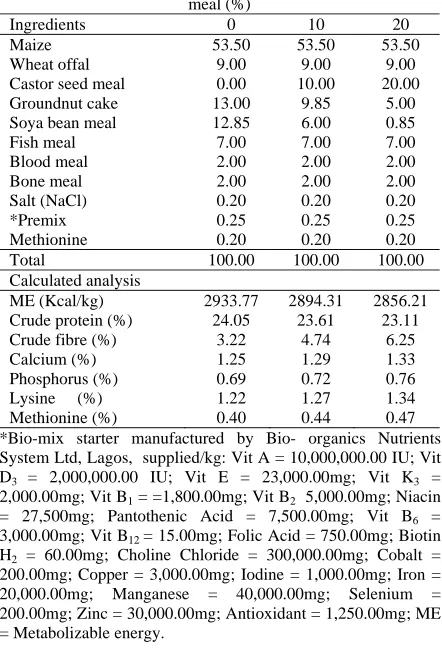
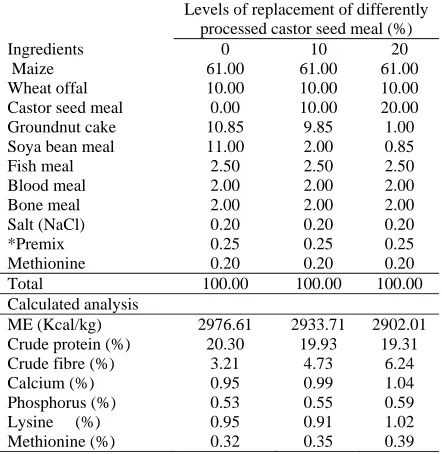
The ingredient composition of the diet are presented in Tables 3 and 4. For this second experiment, one hundred day-old Anak broiler chicks purchased from ECWA Farm, Jos, were used for this experiment. The birds were divided into two groups i.e. 10 and 20% replacement level groups. For each of the replacement groups, there were five treatments: control (0%) CSM, boiled CSM for 30 minutes, boiled CSM for 30 minutes and fermented for 3 days, soaked CSM for 72 hours; and soaked CSM for 72 hours and boiled for 20 minutes. Ten
(10) birds were allotted to each treatment for each of the replacement level group.
The birds were vaccinated against Gumboro disease at 2 and 5 weeks of age, while the vaccination against Newcastle disease was at 3 and 6 weeks of age. During the period of the experiment the daily feed intake and weekly body weight gain were recorded. The feed conversion ratio was calculated from these data. Daily mortality and observed abnormalities were recorded. Postmortem examination was also carried out on birds that died.
Statistical analysis
The data obtained from the study were subjected to analysis of variance (Randomized complete block design) using Statistix 9.0 software statistical package and significant difference among treatments means were separated by Duncan’s Multiple Range Test (Duncan, 1955).
RESULTS
(a) The effect of feeding raw castor seed meal
The productive performance of the birds fed raw castor seed meal at the inclusion levels of 0, 5, 10, 15 and 20% is presented in Table 5. No mortality was recorded for birds fed diet containing 0% castor seed meal from 0 to 10 weeks of age. The average daily feed intake, average daily body weight gain and FCR recorded were 115.95g, 50.74g, and 2.38 respectively for the control, which were significantly higher than those on 5%, 10% 15% and 20% raw CSM. The results further revealed that all the birds fed graded levels of raw CSM from 5 to 20% died within 7 to 14 days. The higher the level of inclusion of raw CSM the quicker was the rate of death. Thus all the birds fed 20% level of replacement died within 7 days, birds on 15% within 10 days and bird on 10% and 5% within 14 days.
Table 1: Composition of experimental broiler starter diets
Replacement Levels of the raw Castor Seed Meal (%)
Ingredients (%) 0 % 5 % 10 % 15 % 20 %
Maize Wheat offal Castor seed meal Groundnut cake Soya bean meal Fish meal Blood meal Bone meal Salt *Premix Methionine
53.50 9.00 0.00 13.00 12.85 7.00 2.00 2.00 0.20 0.25 0.20
53.50 9.00 5.00 10.85 10.00 7.00 2.00 2.00 0.20 0.25 0.20
53.50 9.00 10.00
9.85 6.00 7.00 2.00 2.00 0.20 0.25 0.20
53.50 9.00 15.00 10.00 0.85 7.00 2.00 2.00 0.20 0.25 0.20
53.50 9.00 20.00
5.00 0.85 7.00 2.00 2.00 0.20 0.25 0.20
Total 100.00 100.00 100.00 100.00 100.00
Calculated analysis
ME (Kcal/kg) Crude protein (%) Crude fibre (%) Calcium (%) Phosphorous (%) Lysine (%) Methionine (%)
2933.77 24.05
3.22 1.25 0.69 1.22 0.40
2914.96 23.97
3.98 1.27 0.71 1.26 0.42
2894.31 23.61
4.74 1.29 0.72 1.27 0.44
2870.46 23.44
5.49 1.31 0.72 1.28 0.45
2856.21 23.11
6.25 1.33 0.76 1.34 0.47 * Bio-mix starter, manufactured by Bio- organics Nutrients System Ltd, Lagos, supplied/kg: Vit A = 10,000,000.00 IU; Vit D3 =
2,000,000.00 IU; Vit E = 23,000.00mg; Vit K3 = 2,000.00mg; Vit B1 = =1,800.00mg; Vit B2 5,000.00mg; Niacin = 27,500mg;
Table 2: Composition of the experimental broiler finisher diets
Replacement levels of raw castor seed meal (%)
Ingredients (%) 0 % 5 % 10 % 15 % 20 %
Maize Wheat offal Castor seed meal Groundnut cake Soya bean meal Fish meal Blood meal Bone meal Salt *Premix Methionine 61.00 10.00 0.00 10.85 11.00 2.50 2.00 2.00 0.20 0.25 0.20 61.00 10.00 5.00 9.85 7.00 2.50 2.00 2.00 0.20 0.25 0.20 61.00 10.00 10.00 9.85 2.00 2.50 2.00 2.00 0.20 0.25 0.20 61.00 10.00 15.00 5.85 1.00 2.50 2.00 2.00 0.20 0.25 0.20 61.00 10.00 20.00 1.00 0.85 2.50 2.00 2.00 0.20 0.25 0.20
Total 100.00 100.00 100.00 100.00 100.00
Calculated analysis
ME (Kcal/kg) Crude protein (%) Crude fibre (%) Calcium (%) Phosphorous (%) Lysine (%) Methionine (%) 2976.61 20.30 3.21 0.95 0.53 0.95 0.32 2955.93 20.11 3.97 0.96 0.51 0.85 0.33 2933.71 19.93 4.73 0.99 0.55 0.91 0.35 2917.86 19.64 7.09 0.89 0.65 0.92 0.44 2902.01 19.31 6.24 1.04 0.59 1.02 0.39 *Bio-mix finisher, manufactured by Bio- organics Nutrients System Ltd, Lagos, supplied/kg: Vit A = 8,500,000.00 IU; Vit D3 =
1,500,000.00 IU; Vit E = 10,000.00mg; Vit K3 = 1,500.00mg; Vit B1 = =1,600.00mg; Vit B2 4,000.00mg; Niacin = 20,000mg;
Pantothenic Acid = 5,000.00mg; Vit B6 = 1,500.00mg; Vit B12 = 10.00mg; Folic Acid = 500.00mg; Biotin H2 = 750.00mg; Choline
Chloride = 175,000.00mg; Cobalt = 200.00mg; Copper = 3,000.00mg; Iodine = 1,000.00mg; Iron = 20,000.00mg; Manganese = 40,000.00mg; Selenium = 200.00mg; Zinc = 30,000.00mg; Antioxidant = 1,250.00mg.
Table 3: Ingredients composition (%) and calculated analysis of experimental broiler starter diets (Pilot Study II)
Levels of replacement of the differently processed castor seed meal (%)
Ingredients 0 10 20
Maize Wheat offal Castor seed meal Groundnut cake Soya bean meal Fish meal Blood meal Bone meal Salt (NaCl) *Premix Methionine 53.50 9.00 0.00 13.00 12.85 7.00 2.00 2.00 0.20 0.25 0.20 53.50 9.00 10.00 9.85 6.00 7.00 2.00 2.00 0.20 0.25 0.20 53.50 9.00 20.00 5.00 0.85 7.00 2.00 2.00 0.20 0.25 0.20
Total 100.00 100.00 100.00
Calculated analysis ME (Kcal/kg) Crude protein (%) Crude fibre (%) Calcium (%) Phosphorus (%) Lysine (%) Methionine (%) 2933.77 24.05 3.22 1.25 0.69 1.22 0.40 2894.31 23.61 4.74 1.29 0.72 1.27 0.44 2856.21 23.11 6.25 1.33 0.76 1.34 0.47 *Bio-mix starter manufactured by Bio- organics Nutrients System Ltd, Lagos, supplied/kg: Vit A = 10,000,000.00 IU; Vit D3 = 2,000,000.00 IU; Vit E = 23,000.00mg; Vit K3 =
2,000.00mg; Vit B1 = =1,800.00mg; Vit B2 5,000.00mg; Niacin
= 27,500mg; Pantothenic Acid = 7,500.00mg; Vit B6 =
3,000.00mg; Vit B12 = 15.00mg; Folic Acid = 750.00mg; Biotin
H2 = 60.00mg; Choline Chloride = 300,000.00mg; Cobalt = 200.00mg; Copper = 3,000.00mg; Iodine = 1,000.00mg; Iron = 20,000.00mg; Manganese = 40,000.00mg; Selenium = 200.00mg; Zinc = 30,000.00mg; Antioxidant = 1,250.00mg; ME = Metabolizable energy.
The signs and symptoms observed on the birds that died include diarrhoea, stunted growth, ruffled feathers, dehydration, emaciation, and weakness of the beaks, more
especially in birds fed 20% CSM. The post mortem examination of the dead birds showed no observable lesions of infections, but the livers, kidneys and lungs were inflamed. The right ventricles were filled with coagulated blood. These signs were more pronounced in birds on 20% CSM where the coagulated blood further hemolyzed.
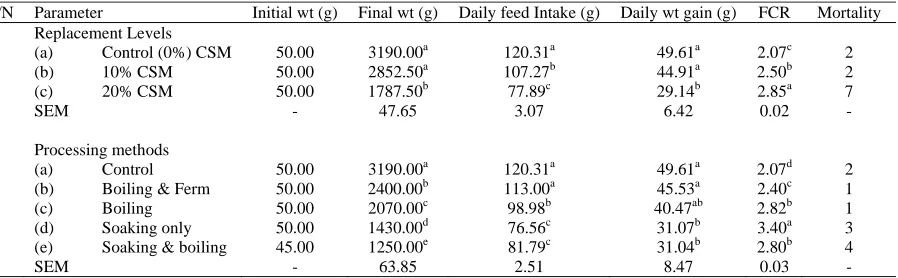
(b) The effects of replacement levels and processing The result of the effects of replacement levels and processing is presented in Table 6. The average daily feed intake of the birds on the control (0%) diet which was 120.31g is significantly (P<0.05) higher than those of the birds on 10 and 20% level of CSM which recorded 107.27 and 77.89 g, respectively. The average daily feed intake of the birds on 10% level of CSM which recorded 107.39 g is also significantly (P<0.05) higher than those on 20% level of CSM replacement which has a value of 77.89 g. However, there were no significant difference in both the daily weight gain and the final weight between the birds on the control and those on 10% level of replacement, but were significantly (P<0.05) higher than those on 20% level of replacement. The FCR showed that the birds on control (0), 10 and 20% CSM recorded 2.07, 2.50 and 2.85, respectively. On mortality, the birds on 20% CSM diet recorded the highest mortality of seven (7) birds, while the birds on the control (0) and 10% CSM replacement levels recorded two (2) birds each.
Table 4: Ingredients composition (%) and calculated analysis of the experimental broiler finisher diets (Pilot Study II)
Levels of replacement of differently processed castor seed meal (%)
Ingredients 0 10 20
Maize Wheat offal Castor seed meal Groundnut cake Soya bean meal Fish meal Blood meal Bone meal Salt (NaCl) *Premix Methionine
61.00 10.00 0.00 10.85 11.00 2.50 2.00 2.00 0.20 0.25 0.20
61.00 10.00 10.00 9.85 2.00 2.50 2.00 2.00 0.20 0.25 0.20
61.00 10.00 20.00 1.00 0.85 2.50 2.00 2.00 0.20 0.25 0.20
Total 100.00 100.00 100.00
Calculated analysis ME (Kcal/kg) Crude protein (%) Crude fibre (%) Calcium (%) Phosphorus (%) Lysine (%) Methionine (%)
2976.61 20.30
3.21 0.95 0.53 0.95 0.32
2933.71 19.93
4.73 0.99 0.55 0.91 0.35
2902.01 19.31
6.24 1.04 0.59 1.02 0.39 *Bio-mix finisher, manufactured by Bio- organics Nutrients System Ltd, Lagos, supplied/kg: Vit A = 8,500,000.00 IU; Vit D3 = 1,500,000.00 IU; Vit E = 10,000.00mg; Vit K3 =
1,500.00mg; Vit B1 = =1,600.00mg; Vit B2 4,000.00mg; Niacin
= 20,000mg; Pantothenic Acid = 5,000.00mg; Vit B6 =
1,500.00mg; Vit B12 = 10.00mg; Folic Acid = 500.00mg; Biotin
H2 = 750.00mg; Choline Chloride = 175,000.00mg; Cobalt =
200.00mg; Copper = 3,000.00mg; Iodine = 1,000.00mg; Iron = 20,000.00mg; Manganese = 40,000.00mg; Selenium = 200.00mg; Zinc = 30,000.00mg; Antioxidant = 1,250.00mg: ME = Metabolizable energy.
of the birds on the processed CSM-based diets. The average final weight (2400.00g) of the birds on boiled and fermented CSM was significantly (P<0.05) higher than the birds on boiled, as well as those on soaked and boiled CSM-based diets. The FCR for the birds on control (0%) CSM, boiled and fermented CSM, soaked and boiled CSM, boiled CSM and soaked CSM were 2.07, 2.40, 2.80, 2.82 and 3.40 respectively. The FCR of the birds on boiled and fermented CSM (2.40) was next to the control and better (P<0.05) than those fed on the other processing methods (2.80, 2.82 and 3.40) employed. The mortality figures recorded for the control, boiled and fermented, boiled, soaked, soaked and boiled CSM were 2,1,1,3 and 4 respectively.
DISCUSSION
(a) The effect of feeding raw castor seed meal
In addition to the absences of any mortality, the general performance of birds on the control diet (0% CSM) which recorded the average final live weight of 3010g at 10 weeks was quiet encouraging. This was an improvement on the report of Dafwang (2002) which showed that well managed good quality broiler should be ready for market by 8 weeks at which time they should be averaging 1.7 to 2.0 kg or more each.
The symptoms of ricin poisoning include haematemesis, diarrhoea and death after 6 to 14 days as a result of dehydration, hypovolumemia and circulatory
collapse (Doan, 2004; Rauber and Heard, 1985). Aslani et al. (2007) reported that pathology of disease animal also revealed gastro- enteritis, necrosis and haemorrhage in the heart and kidney. The causes of the death of the birds fed diet containing raw CSM (5-20%) could be due to the ricin poisoning which cause coagulation of blood in heart. The toxicity of raw castor bean due to the presence of ricin is well documented (Wikipedia, 2009).
(b) The effects of replacement levels and processing. The daily feed intake, the daily weight gain and the final body weight decrease as the replacement levels of CSM increased. The decrease in feed intake may be due to the presence of appetite depression factor and partly may be attributed to increase in fibre level especially in 20% CSM diet. Both Clemens (1963) and Jerkin (1963) have reported the presence of appetite depressing castor allergen in CSM and implicated it as a factor depressing feed intake in birds fed CSM. The observed decrease in weight gain especially in birds on 20% CSM may be attributed to low feed intake and poor feed conversion. Thus, the birds may not have enough nutrients required for normal growth. Ani and Okorie (2004) reported that the presences residual ricin in CSM might also contributed to growth depression. Ricin has been shown to interfere with the digestion and absorption of nutrients in gastro-intestinal tract and to exhibit protein synthesis (Liener 1986).
On FCR, the lower the value, the better the feed utilization by the birds and this implies that the birds on the control (0%) diet had better feed utilization, followed by those on 10 and the poorer – those on 20%. Thus, the FCR of the birds on 20% was poorer because of the lower feed intake and high fibre content of the diet. The FCR value obtained in birds fed CSM diets (2.50 and 2.85) in this study were higher than 2.28 reported by Olomu (2011) in broilers. The highest mortality of seven (7) birds recorded by the birds on 20% CSM replacement may not be unconnected with the decrease in feed intake, poor FCR and possibly higher concentration of residual ricin in 20% CSM diet.
Processing of CSM through boiling and fermentation improved the daily feed intake and final weight more than the other the other methods. The processing through boiling and fermentation of CSM might probably have neutralized the appetite depressing factor of CSM. The ingestion of CSM causes loss of appetite in animals (Jenkin 1963). Ogazi et al (1977) recommended fermentation as a safe way of preparing castor seed for human use.
Table 5: Growth Performance of Broilers Fed Graded Levels of Raw Castor Seed Meals (CSM).
Replacement Levels of Raw Castor Seed Meal
S/N Parameters 0% 5% 10% 15% 20% S.E.M
(i) (ii) (iii) (iv) (v) (vi) (vii) (viii) (ix) ( x)
Initial ave body weight(g/bird) Ave body weight at 2 weeks(g/bird)
Ave daily body weight gain at 2 weeks (g/bird) Ave daily feed intake at 2 weeks (g/bird) Feed Conversion Ratio at 2 weeks Final ave body weight at 10 weeks (g/bird) Ave daily feed intake (g/bird) at 10 weeks Daily body weight gain(g/bird) at 10 weeks Feed Conversion Ratio at 10 weeks Mortality (%)
50.00 420.00a 32.86a
58.81a 1.86 3010 115.95
50.74 2.38
0%
49.00 90.00b 2.14b
11.50b 1.10 -
-
- - 100%
48.00 70.00bc 1.76b
4.57b 0.87 - - - - 100%
50.00 50.00cd 0.71b
5.57b 4.13 - - - - 100%
50.00 45.00d 0.24b
1.60b 2.23 - - - - 100%
2.03NS 9.40* 7.66*
13.99* 1.63NS - - - - - Where: Ave = Average; S.E.M = Standard Error of Means; a, b = Means within the same row bearing different superscripts differ significantly (P<0.05); *=Significant (P<0.05).
Table 6: The effect of replacement levels and processing methods (detoxification) of castor seed meal (CSM) on the performance of broiler chickens
S/N Parameter Initial wt (g) Final wt (g) Daily feed Intake (g) Daily wt gain (g) FCR Mortality
1.
2.
Replacement Levels
(a) Control (0%) CSM
(b) 10% CSM
(c) 20% CSM
SEM
Processing methods
(a) Control
(b) Boiling & Ferm
(c) Boiling
(d) Soaking only
(e) Soaking & boiling SEM
50.00 50.00 50.00
-
50.00 50.00 50.00 50.00 45.00
-
3190.00a 2852.50a
1787.50b 47.65
3190.00a 2400.00b 2070.00c 1430.00d 1250.00e 63.85
120.31a 107.27b
77.89c 3.07
120.31a 113.00a 98.98b 76.56c 81.79c 2.51
49.61a 44.91a
29.14b 6.42
49.61a 45.53a 40.47ab 31.07b 31.04b 8.47
2.07c 2.50b
2.85a 0.02
2.07d 2.40c 2.82b 3.40a 2.80b 0.03
2 2 7 -
2 1 1 3 4 - SEM= Standard Error of Means; Ferm = Fermentation; a,b = Mean in the same column bearing different superscript differ significantly.( P<0.05); FCR = Feed conversion ratio.
be responsible for the difference in the results. The process of boiling in water may bring about hydrolysis through which some anti-nutritional factors like phytic acids and tannins may be lost or eliminated. Fermentation process further enriches diets by enhancing the flavour, protein, essential amino acid and vitamins and eliminating anti- nutritional factors (Wikipedia, 2013). On mortality, in relative terms and to some extent all the processing methods employed for this pilot study had reduced the toxicity in CSM when compared to the raw CSM which recorded 100% mortality.
Conclusion and recommendations
From the study, it could be said that the feeding of raw castor seed meal to broiler chickens is toxic. Therefore, there is the need to find ways of detoxifying the meal before feeding it to broilers. The detoxification by boiling and fermentation could further be improved in an economical manner so that farmers can easily adopt the method (s).
REFERENCES
Armstrong WP, 2000. The Castor Beans. A plant named after tick. http/:waynesward.palonar.edu/p/mar99.htm Retrieved 15/5/2007.
Ani AO and AU Okorie, 2004. Response of broiler finishers to graded levels of dietary castor oil beans
Ricinus cummunis meals supplemented with
L-Lysine. Animal Science Association of Nigeria Proceedings of Annual Conference. September
13-16th 2004. Ebonyi State University, Abakaliki, Nigeria, pp: 81- 85.
Aslani MR, M Maleki, M Mohri, K Sharifi, V Najjar-Nezhad and E Afshari, 2007. Castor beans Ricinus
cummunis toxicosis in a sheep flock. Toxicon 49:
400-406.
Browning J, C Ken, R Harkin and R Vignolo, 1990. National Workshop on Castor Production. Sponsored by US Dept of Agriculture and Texas A and M University, Plainview, Texas.
Clemens E, 1963. Landwirtschafilche Forschung, 17: 202-211.
Dafwang II, 2002. Broilers and broiler production in Nigeria. In: Poultry production in Nigeria. A training manual. National Animal Production Research Institute, Shika, ABU Zaria, Nigeria. pp: 95-114. Doan LG, 2004. Ricin. Mechanism of toxicity, clinical
manifestation and vaccine development. A review. Journal of Toxicology. 42: 201-208.
Duncan BD, 1955. Multiple Range Test and Multiple F-test. Biometrics 11: 1-42.
European Food Safety Authority (EFSA), 2008. Ricin from Ricinus cummunis as undesirable substance in Animal Feed: Scientific Opinion of the Panel on contaminants in the food chain. The EFSA Journal. 726: 1-38.
Gohl BO, 1981. Tropical Feeds, Feed Information Summary and nutrient Value. FAO Animal Production Series No. 12, FAO, Rome. pp: 386. Helmenstine AM, 2007. Ricin and RCA-Castor Beans
20RCA%20-%20Castor%20Bean%20Toxins.htm http://waynesward.palonar.edu/p/mar99.htm
Jenkins JP, 1963. Allergenic and toxic components of castor oil bean meal. Review of literature and studies of inactivation of these components. Journal of the Science of Food and Agriculture.14: 775-780. Liener IE, 1986. The Lectins properties, functions and
applications, in: Liener IE, N Sharon and IJ Goldstein (editors), .Biology and Medicine. Acad. Press New York, Pp 527-552.
Munro DB, 2007. Ricinus cummunis Castor beans. file// liccil/sharedoc/castorbeans2.htm Retrieved 16/8/ 2007. Obioha FC, 1992. A guide to Poultry Production in the
Tropics. Acena Publisher, Enugu, Nigeria. Pp 79-85. Ogazi PO, UA Hassan and AA Ogunwusi, 1997.Boosting
the Production of Agricultural raw Materials for Industrial Use: The RMRDC Experience. Published by Raw Materials Research and Development Council, Garki, Abuja, Nigeria.
Okorie AU and FOI Anugwa, 1987. The feeding value of roasted castor oil bean Ricinus communis to growing chicks. Plant Foods for Human Nutrition. 37: 97-102.
Olomu JM, 2011. Monogastric Animal Nutrition. Principles and Practice. A Jachem Publication, Benin City, pp: 67-107.
Oso AO, WA Oluyemi, MA Bamgbose and OF Fowoyo, 2011. Utilization of fermented castor seed oil meal
(Ricinus cummunis) meal in the diet of cockerel
chicks. Arch. Zootec. 60: 75 -82.
Rauber, A and J Heard, 1985. Castor beans toxicity re- examined: A new perspective. Veterinary and Human Toxicology, 27: 498-502.
Wikipedia, 2009. Castor oil plant. http://en.wikipedia.org/ wiki/castor oil plant. Retrieved 12/12 /2009.
Wikipedia, 2013. Fermentation in Food Processing. http://en Wikipedia.org/wiki/fermentation in _food –