ISSN 0975-928X
Research Article
Selection, variation and heritability of candidate plus trees (CPT’s) of
Salix alba
P.A. Paray*1, S.A. Gangoo1, T.H. Masoodi1, K.N. Qaiser1, A.I. Islam1 and S. Maqbool2
1
Faculty of Forestry, SKUAST-K, Benhama, Ganderbal, J&K-191201
2Faculty of Agriculture, SKUAST-K, Wadura, Sopore, J&K-193201
E-mail: [email protected]
(Received: 02 Jan 2017; Revised: 05 Sep 2017; Accepted: 20 Sep 2017)
Abstract
Clonal trial of 100 CPT’s of Salix alba was laid out in common garden experiment at Faculty of Forestry nursery, SKUAST-K. Wide variation was recorded for all the CPT’s of Salix alba with respect to various morphometric (growth, biomass and leaf) characters. Maximum values of growth, biomass and leaf characters were registered by CPT-26, CPT-53, CPT-56, CPT-75, CPT-37 and CPT-45. Genetic parameters estimated for the clonal material revealed fair differences between PCV and GCV. High heritability was registered by all the characters with maximum (0.982) for shoot height which was followed by high to moderate genetic gain indicating additive gene action. Correlation coefficient analysis revealed strong and positive association between most of the growth, biomass and leaf traits with maximum genotypic (0.874) and phenotypic (0.849) correlation between collar diameter and volume index.
Key words
CPT’s, Salix alba, clonal trial, genetic parameters, correlation
Introduction
Salix alba (white willow) is a moderate to a large deciduous tree with ascending branches and spreading but light crown, attaining a height of 20-25 m and a diameter of 60 cm. Under its native habitat, trees are known to attain a height of 30 m and I m in diameter (Luna, 1995). There are about 450-520 species of Salix known from all around the world which are distributed mostly in the Northern Hemisphere (Argus, 1997). Salix alba is one of the tree willows among the 33 known Salix
species of India. It was introduced to Kashmir from England in 1927 and raised first in compartment: 1a of Haran, Ganderbal (Anon, 1983). The growth statistics of Salix alba can be compared with a good clone of poplar. In order to diversify the plantation of tree species with integration of agriculture crops, willow is most eco-friendly and farmer’s choice. The cricket bat and artificial limbs industry is solely depending on the wood of Salix alba and there is ready made market for willow based wood industry.
The Salix species are eco-friendly, multipurpose, fast growing and are widely used for plantation world over. These are being cultivated for a variety of end uses viz. baskets, cricket bats, hurdles, furniture, plywood, paper and pulp, rope making etc. White willow is primarily utilized for cricket bats and polo balls, fruit boxes, artificial limbs, match-wood, honey-comb frames, tool handles, fibre-boards, agricultural implements, boats and used as a fence post. It is as durable as oak (Luna, 1995). The essential purpose of tree improvement is to develop a suitable clone/variety that eventually brings about economic returns and related benefits to growers. An efficient and practical means of screening the genetic resources
is essentially required. Knowledge of variances and heritability within and between hybrid populations is important in various breeding decisions. High genetic variances due to hybrids are reflected in high broad sense heritability and provide an estimate of the proportion of the variation within apopulation that is due to genetic differences among individuals. Inter character association is equally important as it helps in indirect selection. This study was undertaken keeping in view the significance of Salix alba and lack of information with regard to its variability studies in Kashmir valley. The study will determine the extent of its variation, genetic parameters and inter-character association which is considered essential for a tree improvement programme.
Materials and Methods
ISSN 0975-928X
ground biomass (g), Below ground biomass (g), Total biomass (g), R/S ratio, Leaf length (cm), Leaf width (cm), L/W ratio, Petiole length (mm), Position of maximum width (cm), Branches/plant and Branch angle (o)at the end of growing season. The experimental data was subjected to the statistical analysis following the RCBD and the variation among the treatment means was tested for significance by analysis of variance technique described by Gomez and Gomez (1984). The genetic parameters were worked as follows: Phenotypic coefficient of variation (PCV) and Genotypic coefficient of variation (GCV) were computed as per the method suggested by Burton (1952):
and
Where, Vp is phenotypic variance and Vg is genotypic variance
Heritability (H2) in broad sense was estimated as per the procedure presented by Johnson et al.
(1955):
H2 =
Where, Vg is genotypic variance and Vp is phenotypic variance
Genetic advance (GA) was worked out using the formula given by Lush (1949) and Johnson et al.
(1955).
GA = 0.5 x K
Where, Vg is genotypic variance of the trait, Vp is phenotypic variance of the trait and K is selection differential, (K=2.06 at 5 percent selection intensity).
Genetic gain (GG) was estimated as per the method suggested by Johnson et al. (1955).
GG =
Where, GA is genetic advance of the trait
Genotypic (rg) and phenotypic (rp) correlation
coefficients were worked out for all the possible pairs of characters (Goulden, 1952).
rg and
rp
Where, Cov.xy(g) and Cov.xy(p)are the genotypic and phenotypic covariance for a pair of characters and Vx(g), Vy(g), Vx(p) and Vy(p) are the genotypic and phenotypic variances for the respective characters.
Results and Discussion
It is axiomatic for successful breeding programme that sufficient variability should be available in the material. The efficiency of selection in terms of sizeable genetic advance depends upon the amount of additive genetic variability and the magnitude of masking effect of environment and the interaction components of variability on the additive genetic variability (Allard, 1960). The greater the variability of the germplasm, better are the chances of selection of superior genotypes. The selected morphometric (growth, biomass and leaf and branch) traits of Salix alba have been recorded and presented under table 2. From the perusal of data presented under table 2, it is clearly revealed that there exists significant variation among the CPT’s for these characteristics. Variation with respect to these characters among the CPT’s of Salix alba
were shoot height (75.3 - 113.3 cm), collar diameter (4.5 - 7.6 mm), volume index (15.47 - 65.69 cm3), above ground biomass (6.20 - 10.63 g), below ground biomass (3.47 - 7.63 g), total biomass (10.23 - 17.86 g), root/shoot ratio (0.510.83), leaf length (6.8 11.5 cm), leaf width (1.1 -1.9cm), length/width ratio (4.8 - 7.3), petiole length (1.3 - 3.6 mm), position of maximum width (2.4 - 4.8 cm), number of branches per plant (1.8-4.6) and branch angle (50.9o - 64.1o). The results are in conformity with findings of Huse et al.
(2008) and Singh et al. (2012) on willow clones. Satoh et al. (2011) in a study on the above ground biomass yield of willow (Salix spp.) clones found the difference in productivity in different clones. This was in conformity with the present study. Variability was reported in leaf characteristics of willow clones by Singh et al. (2012) which lend support to the present findings.
ISSN 0975-928X
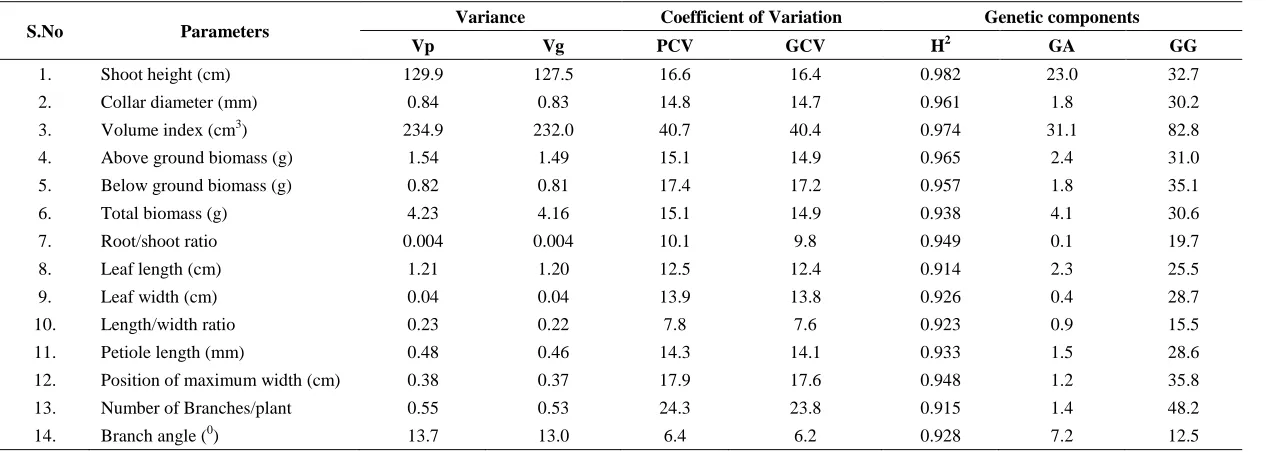
High heritability estimates have been reported for growth and biomass characters by Huse (2004) and Singh et al. (2012), Genetic advance ranged from 0.4 to 31.1 whereas genetic gain ranged from 12.5 to 82.8 which is an indication of scope for improvement through clonal selection. Singh et al. (2012) while evaluating juvenile growth traits in various Salix clones reported maximum genetic gain (75.24%) for volume index which is in conformity with the present studies where maximum genetic gain (82.8%) was also recorded for volume index.
High heritability indicates the effectiveness of selection based on good phenotypic performance but does not necessarily mean a high genetic gain for a particular trait. Heritability estimates in broad sense will be reliable if accompanied by genetic gain. However, Johnson et al. (1955) reported that heritability estimates along with expected gain is more useful and realistic than heritability alone in predicting the resultant effect for selecting the best genotype. In the present investigation high estimates of heritability along with high to moderate genetic gain were observed for all the characters under study. This indicates the higher proportion of additive gene effects for expression of these traits. Hence individual clone selection would be effective for improvement of these characters.
Genotypic and phenotypic correlation coefficients:
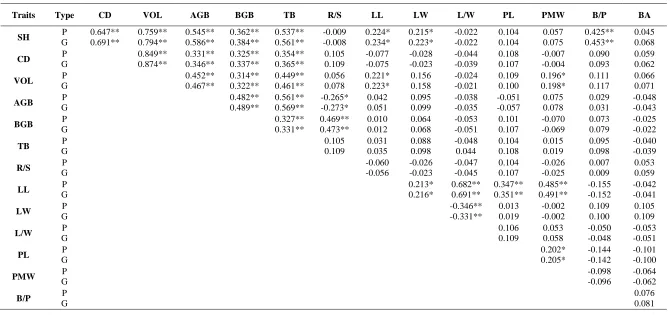
Inter character correlation coefficients were estimated at genotypic and phenotypic levels. The knowledge of genotypic inter-relationship between characters is of theoretical interest because a genetic correlation may be derived from genetic linkage, pleiotropy or from developmentally induced relationship between components that are only indirect consequence of gene action. In the present investigation, positive and significant correlation was observed among various morphometric traits at both genotypic and phenotypic level (Table 4). Shoot height was positively correlated with majority of traits. Significant correlation between height and diameter has been demonstrated in several tree species. Singh et al. (2012) reported significantly positive correlation between height, basal diameter and volume index in willow clones which is in line with the present findings. Maximum correlation (0.874, 0.849) was found between collar diameter and volume index. Studies conducted by Singh et al. (2012) also revealed highest correlation (0.959) between basal diameter and volume index while working on juvenile traits in the recently introduced clones of Salix species. Biomass traits were significantly correlated with each other and with growth characters. In the present study, leaf length was positively correlated with leaf width, length/width ratio, petiole length and position of maximum width. While evaluating Populus
deltoides clones for various morphological traits, Lone et al. (2013) revealed positive and significant correlation of leaf length with leaf breadth, petiole length and length/breadth ratio which is in conformity with the present findings.
Conclusion
From the present investigation, it is clearly evident that wide variation existed in morphometric characteristics of selected CPT’s of Salix alba. CPT-26, CPT-53, CPT-56, CPT-75, CPT-37 and CPT-45 performed better with respect to the rest of the CPT’s. Hence these are recommended for further tree improvement programmes however these should be tested for their stability by employing GxE interaction studies. Strong genetic association between growth, biomass and leaf characteristics revealed that selection can be effective in tree improvement programmes of the tree species in question.
References
Anonymous, 1983. Revised working plan of Haran forests from 1983-84 to 1998-99. J&K Govt. Forest Department, Srinagar, pp.12.
Argus, G.W. 1997. Infrageneric classification of Salix L. (Salicaceae) in the New World. Systematic Botany Monographs 52.
Burton, G.W. 1952. Quantitative inheritance in grasses. Proceedings of the 6th International Grassland Congress, 1: 227.283.
Gomez, K.A. and Gomez, A.A. 1984. Statistical procedure for Agricultural Research. 2nd edition. John Wiley ans Sons, Inc, New York.
Goulden, C.H. 1952. Some distance properties of latent root and vector methods used in multivariate analysis. Biometrica, 53: 325−338.
Huse, S.A., Singh, N.B., Gupta, A and Anand, R.K. 2008. Genetic improvement of tree willows in India. In: Exotics in Indian forestry (SK Chauhan, SS Gill, R Chauhan and SC Sharma eds). Agrotech publishing academy, Udaipur, India pp. 591-614.
Huse, S.K. 2004. Evaluation of arborescent willow clones for growth at nursery stage. M. Sc. Thesis. Dr. Y.S. Parmar University of Horticulture and Forestry, Solan H P (India) 81p.
Johnson, H.W., Robinson, H.F. and Comstock, R.E. 1955. Estimation of genetic and environmental variability in Soya beans. Agronomy J., 47: 314-318.
Lone, A., Bashir, A., Tewari, S.K., Majeed, M. and Ahmad, H. 2013. Estimates of inter- character association of Eastern Cottonwood (Populus deltoides Bartr.) clones. The Bioscan 8(1): 153-157.
Luna, R.K. 1995. Plantation trees. Publishing Corporation. IBD, Dehradun, pp 640-645 Lush, J.L. 1949. Heritability of quantitative characters in
farm animals. Proceedings of the 8th international congress on genetics. Genetics supliment volume. Heredits, 356-395. Sahoo, D.P., Rout, G.R., Das, S., Aparajita, S., and
ISSN 0975-928X
Pierre in Orissa, India. International Journal of Forestry Res.,1: 1-6.
Singh, N.B., Sharma, J.P., Huse, S.K., Thakur, I.K., Gupta, R.K. and Sankhyan, H.P. 2012. Heritability, genetic gain, correlation and principal component analysis in introduced willow (Salix species) clones. Indian Forester,
ISSN 0975-928X
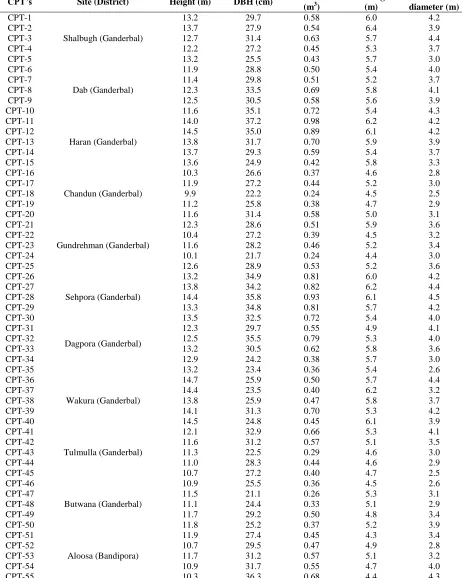
Table 1. Characteristics of the selected CPT’s of Salix alba
CPT’s Site (District) Height (m) DBH (cm) Volume (m3)
Bole height (m)
Crown diameter (m)
CPT-1
Shalbugh (Ganderbal)
13.2 29.7 0.58 6.0 4.2
CPT-2 13.7 27.9 0.54 6.4 3.9
CPT-3 12.7 31.4 0.63 5.7 4.4
CPT-4 12.2 27.2 0.45 5.3 3.7
CPT-5 13.2 25.5 0.43 5.7 3.0
CPT-6
Dab (Ganderbal)
11.9 28.8 0.50 5.4 4.0
CPT-7 11.4 29.8 0.51 5.2 3.7
CPT-8 12.3 33.5 0.69 5.8 4.1
CPT-9 12.5 30.5 0.58 5.6 3.9
CPT-10 11.6 35.1 0.72 5.4 4.3
CPT-11
Haran (Ganderbal)
14.0 37.2 0.98 6.2 4.2
CPT-12 14.5 35.0 0.89 6.1 4.2
CPT-13 13.8 31.7 0.70 5.9 3.9
CPT-14 13.7 29.3 0.59 5.4 3.7
CPT-15 13.6 24.9 0.42 5.8 3.3
CPT-16
Chandun (Ganderbal)
10.3 26.6 0.37 4.6 2.8
CPT-17 11.9 27.2 0.44 5.2 3.0
CPT-18 9.9 22.2 0.24 4.5 2.5
CPT-19 11.2 25.8 0.38 4.7 2.9
CPT-20 11.6 31.4 0.58 5.0 3.1
CPT-21
Gundrehman (Ganderbal)
12.3 28.6 0.51 5.9 3.6
CPT-22 10.4 27.2 0.39 4.5 3.2
CPT-23 11.6 28.2 0.46 5.2 3.4
CPT-24 10.1 21.7 0.24 4.4 3.0
CPT-25 12.6 28.9 0.53 5.2 3.6
CPT-26
Sehpora (Ganderbal)
13.2 34.9 0.81 6.0 4.2
CPT-27 13.8 34.2 0.82 6.2 4.4
CPT-28 14.4 35.8 0.93 6.1 4.5
CPT-29 13.3 34.8 0.81 5.7 4.2
CPT-30 13.5 32.5 0.72 5.4 4.0
CPT-31
Dagpora (Ganderbal)
12.3 29.7 0.55 4.9 4.1
CPT-32 12.5 35.5 0.79 5.3 4.0
CPT-33 13.2 30.5 0.62 5.8 3.6
CPT-34 12.9 24.2 0.38 5.7 3.0
CPT-35 13.2 23.4 0.36 5.4 2.6
CPT-36
Wakura (Ganderbal)
14.7 25.9 0.50 5.7 4.4
CPT-37 14.4 23.5 0.40 6.2 3.2
CPT-38 13.8 25.9 0.47 5.8 3.7
CPT-39 14.1 31.3 0.70 5.3 4.2
CPT-40 14.5 24.8 0.45 6.1 3.9
CPT-41
Tulmulla (Ganderbal)
12.1 32.9 0.66 5.3 4.1
CPT-42 11.6 31.2 0.57 5.1 3.5
CPT-43 11.3 22.5 0.29 4.6 3.0
CPT-44 11.0 28.3 0.44 4.6 2.9
CPT-45 10.7 27.2 0.40 4.7 2.5
CPT-46
Butwana (Ganderbal)
10.9 25.5 0.36 4.5 2.6
CPT-47 11.5 21.1 0.26 5.3 3.1
CPT-48 11.1 24.4 0.33 5.1 2.9
CPT-49 11.7 29.2 0.50 4.8 3.4
CPT-50 11.8 25.2 0.37 5.2 3.9
CPT-51
Aloosa (Bandipora)
11.9 27.4 0.45 4.3 3.4
CPT-52 10.7 29.5 0.47 4.9 2.8
CPT-53 11.7 31.2 0.57 5.1 3.2
CPT-54 10.9 31.7 0.55 4.7 4.0
ISSN 0975-928X
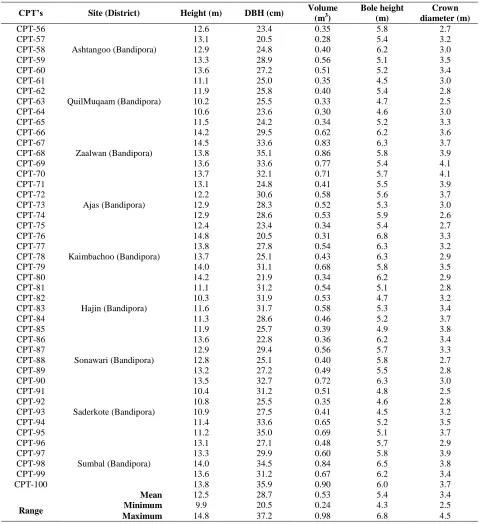
Table 1. Contd.,
CPT’s Site (District) Height (m) DBH (cm) Volume (m3)
Bole height (m)
Crown diameter (m)
CPT-56
Ashtangoo (Bandipora)
12.6 23.4 0.35 5.8 2.7
CPT-57 13.1 20.5 0.28 5.4 3.2
CPT-58 12.9 24.8 0.40 6.2 3.0
CPT-59 13.3 28.9 0.56 5.1 3.5
CPT-60 13.6 27.2 0.51 5.2 3.4
CPT-61
QuilMuqaam (Bandipora)
11.1 25.0 0.35 4.5 3.0
CPT-62 11.9 25.8 0.40 5.4 2.8
CPT-63 10.2 25.5 0.33 4.7 2.5
CPT-64 10.6 23.6 0.30 4.6 3.0
CPT-65 11.5 24.2 0.34 5.2 3.3
CPT-66
Zaalwan (Bandipora)
14.2 29.5 0.62 6.2 3.6
CPT-67 14.5 33.6 0.83 6.3 3.7
CPT-68 13.8 35.1 0.86 5.8 3.9
CPT-69 13.6 33.6 0.77 5.4 4.1
CPT-70 13.7 32.1 0.71 5.7 4.1
CPT-71
Ajas (Bandipora)
13.1 24.8 0.41 5.5 3.9
CPT-72 12.2 30.6 0.58 5.6 3.7
CPT-73 12.9 28.3 0.52 5.3 3.0
CPT-74 12.9 28.6 0.53 5.9 2.6
CPT-75 12.4 23.4 0.34 5.4 2.7
CPT-76
Kaimbachoo (Bandipora)
14.8 20.5 0.31 6.8 3.3
CPT-77 13.8 27.8 0.54 6.3 3.2
CPT-78 13.7 25.1 0.43 6.3 2.9
CPT-79 14.0 31.1 0.68 5.8 3.5
CPT-80 14.2 21.9 0.34 6.2 2.9
CPT-81
Hajin (Bandipora)
11.1 31.2 0.54 5.1 2.8
CPT-82 10.3 31.9 0.53 4.7 3.2
CPT-83 11.6 31.7 0.58 5.3 3.4
CPT-84 11.3 28.6 0.46 5.2 3.7
CPT-85 11.9 25.7 0.39 4.9 3.8
CPT-86
Sonawari (Bandipora)
13.6 22.8 0.36 6.2 3.4
CPT-87 12.9 29.4 0.56 5.7 3.3
CPT-88 12.8 25.1 0.40 5.8 2.7
CPT-89 13.2 27.2 0.49 5.5 2.8
CPT-90 13.5 32.7 0.72 6.3 3.0
CPT-91
Saderkote (Bandipora)
10.4 31.2 0.51 4.8 2.5
CPT-92 10.8 25.5 0.35 4.6 2.8
CPT-93 10.9 27.5 0.41 4.5 3.2
CPT-94 11.4 33.6 0.65 5.2 3.5
CPT-95 11.2 35.0 0.69 5.1 3.7
CPT-96
Sumbal (Bandipora)
13.1 27.1 0.48 5.7 2.9
CPT-97 13.3 29.9 0.60 5.8 3.9
CPT-98 14.0 34.5 0.84 6.5 3.8
CPT-99 13.6 31.2 0.67 6.2 3.4
CPT-100 13.8 35.9 0.90 6.0 3.7
Mean 12.5 28.7 0.53 5.4 3.4
Range Minimum 9.9 20.5 0.24 4.3 2.5
ISSN 0975-928X
Table 2. Top ten performers among the selected CPT’s of Salix alba
CPT’s
Shoot height (cm)
Collar diameter
(mm)
Volum e index
(cm3)
Above ground biomass
(g)
Below ground biomass
(g)
Total biomass
(g)
R/S ratio
Leaf length
(cm) Leaf width
(cm)
L/W ratio
Petiole length (mm)
Position of max. width
(cm)
Branches/ plant
Branch angle (o)
CPT-26 113.2 7.6 65.4 10.4 6.8 17.2 0.65 11.4 1.7 6.7 3.5 4.8 4.1 62.8
CPT-86 112.3 7.4 61.5 10.0 6.4 16.4 0.64 11.2 1.7 6.5 3.6 4.8 4.4 62.3
CPT-53 113.3 7.6 64.9 10.4 6.3 16.7 0.61 9.8 1.5 6.5 3.4 3.8 3.7 62.7
CPT-75 111.4 6.5 47.1 10.6 7.2 17.9 0.68 11.3 1.6 7.1 3.6 4.6 4.4 58.8
CPT-45 109.9 7.4 59.7 10.4 6.9 17.3 0.66 11.5 1.8 6.3 2.9 4.7 4.1 60.0
CPT-37 112.7 7.3 60.5 10.1 7.2 17.3 0.70 11.3 1.9 6.0 3.6 4.5 3.6 58.7
CPT-62 111.6 7.4 61.1 10.2 6.1 16.3 0.60 9.8 1.6 6.1 2.4 3.8 3.6 56.8
CPT-81 112.6 7.3 60.6 10.1 5.3 15.4 0.53 10.6 1.6 6.6 3.2 4.1 3.9 58.1
CPT-32 109.9 7.6 63.5 9.6 5.6 15.2 0.58 9.9 1.7 5.8 2.5 3.9 3.7 60.6
CPT-12 106.4 7.3 56.7 10.2 7.6 17.8 0.75 10.7 1.8 5.9 3.2 4.2 4.0 64.1
Table 3. Estimates of genetic parameters of selected characteristics of ramets of Salix alba CPT’s
S.No Parameters Variance Coefficient of Variation Genetic components
Vp Vg PCV GCV H2 GA GG
1. Shoot height (cm) 129.9 127.5 16.6 16.4 0.982 23.0 32.7
2. Collar diameter (mm) 0.84 0.83 14.8 14.7 0.961 1.8 30.2
3. Volume index (cm3) 234.9 232.0 40.7 40.4 0.974 31.1 82.8
4. Above ground biomass (g) 1.54 1.49 15.1 14.9 0.965 2.4 31.0
5. Below ground biomass (g) 0.82 0.81 17.4 17.2 0.957 1.8 35.1
6. Total biomass (g) 4.23 4.16 15.1 14.9 0.938 4.1 30.6
7. Root/shoot ratio 0.004 0.004 10.1 9.8 0.949 0.1 19.7
8. Leaf length (cm) 1.21 1.20 12.5 12.4 0.914 2.3 25.5
9. Leaf width (cm) 0.04 0.04 13.9 13.8 0.926 0.4 28.7
10. Length/width ratio 0.23 0.22 7.8 7.6 0.923 0.9 15.5
11. Petiole length (mm) 0.48 0.46 14.3 14.1 0.933 1.5 28.6
12. Position of maximum width (cm) 0.38 0.37 17.9 17.6 0.948 1.2 35.8
13. Number of Branches/plant 0.55 0.53 24.3 23.8 0.915 1.4 48.2
ISSN 0975-928X
Table 4. Genotypic (G) and phenotypic (P) correlation matrix between selected characteristics of ramets of Salix alba CPT’S
Traits Type CD VOL AGB BGB TB R/S LL LW L/W PL PMW B/P BA
SH P
G 0.647** 0.691** 0.759** 0.794** 0.545** 0.586** 0.362** 0.384** 0.537** 0.561** -0.009 -0.008 0.224* 0.234* 0.215* 0.223* -0.022 -0.022 0.104 0.104 0.057 0.075 0.425** 0.453** 0.045 0.068
CD P
G 0.849** 0.874** 0.331** 0.346** 0.325** 0.337** 0.354** 0.365** 0.105 0.109 -0.077 -0.075 -0.028 -0.023 -0.044 -0.039 0.108 0.107 -0.007 -0.004 0.090 0.093 0.059 0.062
VOL P
G 0.452** 0.467** 0.314** 0.322** 0.449** 0.461** 0.056 0.078 0.221* 0.223* 0.156 0.158 -0.024 -0.021 0.109 0.100 0.196* 0.198* 0.111 0.117 0.066 0.071
AGB P
G 0.482** 0.489** 0.561** 0.569** -0.265* -0.273* 0.042 0.051 0.095 0.099 -0.038 -0.035 -0.051 -0.057 0.075 0.078 0.029 0.031 -0.048 -0.043
BGB P
G 0.327** 0.331** 0.469** 0.473** 0.010 0.012 0.064 0.068 -0.053 -0.051 0.101 0.107 -0.070 -0.069 0.073 0.079 -0.025 -0.022
TB P
G 0.105 0.109 0.031 0.035 0.088 0.098 -0.048 0.044 0.104 0.108 0.015 0.019 0.095 0.098 -0.040 -0.039
R/S P
G -0.060 -0.056 -0.026 -0.023 -0.047 -0.045 0.104 0.107 -0.026 -0.025 0.007 0.009 0.053 0.059
LL P
G 0.213* 0.216* 0.682** 0.691** 0.347** 0.351** 0.485** 0.491** -0.155 -0.152 -0.042 -0.041
LW P
G -0.346** -0.331** 0.013 0.019 -0.002 -0.002 0.109 0.100 0.105 0.109
L/W P
G 0.106 0.109 0.053 0.058 -0.050 -0.048 -0.053 -0.051
PL P
G 0.202* 0.205* -0.144 -0.142 -0.101 -0.100
PMW P
G
-0.098 -0.096
-0.064 -0.062
B/P P
G
0.076 0.081 **=significant at 5%, *= significant at 1%