Vol.9 (2019) No. 6
ISSN: 2088-5334
On Developing a New 5G Spectrum Usage Fee Model for Indonesia
Alfin Hikmaturokhman
#, Kalamullah Ramli
#, Muhammad Suryanegara
##
Department. of Electrical Engineering, Universitas Indonesia, Depok, Indonesia E-mail: [email protected], [email protected], [email protected]
Abstract—This paper reports on the development of the 5G spectrum usage fee in Indonesia. The fee was first applied in 2010 to
charge mobile network operators (MNOs) that provided cellular services. However, cellular technologies have improved rapidly from 2G, 3G, 4G to 5G, and many modern innovative cellular services demand larger spectrum bandwidth. Therefore, the existing spectrum usage fee must be revised to meet the needs of the community better and to improve the efficiency and effectiveness of spectrum use. This study modifies the characteristics of the existing cost structure of the Indonesian spectrum usage fee, designing and proposing a new 5G spectrum usage fee model to support 5G technology usage scenarios and maximize the benefits of the mid-band (3.5 GHz), mmWave, or high mid-band radio frequencies (26 GHz and 28 GHz). The new spectrum usage fee model includes spectrum-sharing parameters (non-orthogonal spectrum-sharing and orthogonal spectrum sharing) and private network to optimize the use of the available spectrum because the new proposing formula does not use the nationwide population, but instead, it uses the population within a specific area with both human and non-human (machine) populations. This new model is expected to help regulators prepare 5G technology regulations for application in Indonesia.
Keywords—5G spectrum usage fee; 5G bhp; 5G spectrum sharing; 5G frequency license fee; 5G private network.
I. INTRODUCTION
Among studies on 5G use for wireless communications, spectrum issues are cited as the most important factors in the move to 5G [1]. They include various issues, ranging from in which band 5G should be allocated to the issue of spectrum pricing management. The spectrum also influences network coverage and capacity, which directly affect mobile network operators’ (MNOs) expenses and profits [2]. These factors include technical, economic, and regulatory aspects.
Many countries have considered using the spectrum by technological operators as a source of state income. Meanwhile, the frequency spectrum is a restricted resource, which makes it very precious property for MNOs due to the amount that MNOs must pay in spectrum licensing fees.
With around 262 million people, Indonesia has the fourth-largest population density in the world. The widest archipelago on earth, Indonesia, has 13,000 inhabited islands. The inhabitants are spread over six main island territories, as shown in Fig. 1—the two most densely populated islands are Sumatra (20% of the population) and Java (60% of the population) [3]. Six major MNOs serve Indonesia (Telkomsel, Xl Axiata, Indosat, H3I, STI, and Smartfren).
Fig. 1. Demographics of the Indonesian population distribution in six of the major island territories [3]
have been obligated to pay the spectrum license fee Biaya
Hak Pengguna Frekuensi Izin Pita Frekuensi Radio (BHP IPFR) [in English: spectrum usage fee].
The fee payments affect the country’s gross domestic product (GDP), originating from the provision of frequency resource services and the post and information technology industries. This fee is included in the non-taxed state revenues Penerimaan Negara Bukan Pajak (PNBP). These revenues are federal government revenues that do not originate from tax revenues.
In 2018, the fee accounted for 5% of the country’s total GDP [4]. This large contribution to the GDP must be regulated in a new formula that benefits not only the government but also businesses—in this case, the MNOs.
There are several studies related to spectrum usage fees [5]–[7]. They explain how to arrange a spectrum license fee formula for use in Taiwan and Indonesia. The formula applied by these countries varies depending on the situation, such as MNO competition, geography, population, bandwidth, the government’s expected revenue from spectrum usage fees, etc. The objectives of each country are the same—namely, to formulate a fee model that is fair and technology-neutral in order to improve the efficiency of spectrum utilization.
Research published by [5]–[7] formulated a spectrum usage fee for the 2G, 3G, and 4G cellular technologies based solely on frequencies under 3 GHz. However, 5G offers three different usage scenarios that require simultaneous access to low, mid, and high bands to fulfill 5G needs for capacity, latency, coverage, and quality to comply with advanced use cases in the spectrum ranges [9], [10]. Based on an analysis of these studies, this paper recommends a new approach for delivering a new 5G spectrum usage fee model for Indonesia.
This paper is organized as follows. Section I discusses the introduction, literature review, overview of 5G technology, and the Indonesian spectrum case. Section II explains the materials and methods and the current model used for the spectrum license fee. Section III comprises the results and discussion about the weaknesses of the existing spectrum usage fee and proposes the new 5G spectrum usage fee for Indonesia. Section IV concludes and provides suggestions for future work.
A. Overview of 5G Technology
The next generation of cellular broadband technology is 5G. Its advanced data rate means that 5G may offer the highest-speed cellular broadband services ever and provide an alternative to last-mile access, such as fiber to the home (FTTH) connections [11].
According to ITU-R M.2083-0 [12], 5G services and applications can be grouped into three usage scenarios:
1) Enhanced mobile broadband (eMBB): 5G is supposed to yield much faster and more reliable cellular broadband, offering users a richer application experience.
2) Ultra-reliable and low latency communications (URLLC): The highest priorities for this usage scenario are latency and mobility parameters.
3) Massive machine-type communications (mMTC): This usage scenario is described by a very great scale or massive applications of the Internet of Things (IoT).
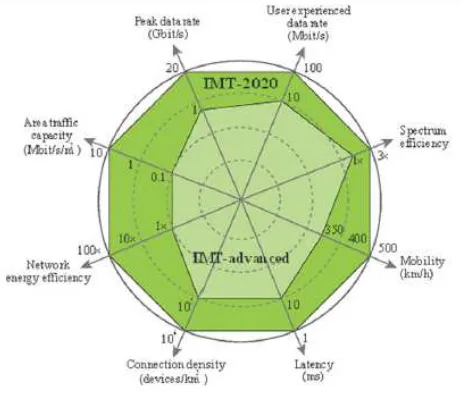
Fig. 2 shows 5G or IMT-2020 capabilities and Fig. 3 displays 5G usage scenarios.
Fig. 2. IMT-advanced to 5G key capabilities [12]
Fig. 3. 5G usage scenarios [12]
The spectrum is an important component of cellular broadband communication networks, especially in 5G. Future cellular broadband communication networks will have a relatively large amount of different coverage sizes, from macro to small cells. Small cells drive network capacity without requiring more of the spectrum, which is interesting for low-spectrum MNOs or where the spectrum is rare. Further, MNOs deploying small cells in dense urban areas that advertise the existing 4G LTE network quality are likely to promote the expected large-capacity needs of 5G networks, and champion early increased cellular broadband services. A multilayered spectrum approach is necessary to address such a wide range of 5G usage scenarios and requirements [9], [11].
1) Low band or coverage layer: The spectrum at a frequency below 1 GHz (e.g., 700 MHz) allows 5G to provide deep indoor coverage across a wide region.
2) Mid band or capacity and coverage layer: The spectrum at higher frequencies, between 1–6 GHz (e.g., the standard band and the extended C-band), convey the best compromise among coverage and capacity.
3) High band (mmWave) or super data layer: The band at very high frequencies above 24 GHz with a large bandwidth addresses certain usage scenarios that require dramatically higher data rates (e.g., 26 GHz and 28 GHz).
Fig. 4. The 5G radio spectrum and its uses [11]
Fig. 5 shows how many countries have considered, published, or issued spectrum that is set aside, or can be used, for 5G. It highlights clear centers of activity around 3,400– 3,800 MHz, 24.25–27.5 GHz, and 26.5–29.5 GHz. The standard C-band and the extended C-band are emerging as the major frequency bands for introducing 5G by 2020, creating the best harmony among capacity and coverage for expense-efficient implementation. The Global Mobile Suppliers Association (GMSA) believes that at least 80/100 MHz per MNO in a contiguous block will be needed to support 5G usage scenarios and maximize the benefits of the mid-band spectrum, mmWave, or high band, will also play a significant role in 5G support, as at least 800 MHz of contiguous spectrum per 5G network should be available to fulfill the 5G needs for a very large data rate [13]. Fig. 5 shows the level of variation by dividing the larger bands into smaller spectrum pieces.
Regional and global spectrum harmonization is essential to create economies of scale and interoperability and to enable roaming [14]. Currently, not all countries work with the same spectrum range.
Fig. 5. Countries that have 5G activity regulators (per band) based on regulatory proposals, consultations, or spectrum allocations [15]
B. Overview of the Current Spectrum in Indonesia
There are currently three major MNOs in Indonesia: Telkomsel, Indosat, and Xl Axiata. Customers of these three MNOs account for 80% of the total number of customers of all MNOs in Indonesia. Telkomsel has consistently served Indonesia since May 26, 1995; it has 178 million customers. Today, Telkomsel is the largest and leading MNO in Indonesia. In order to serve customers all over Indonesia, even in border areas, isolated areas, and outer islands, Telkomsel has built more than 146,000 base transceiver stations (BTSs).
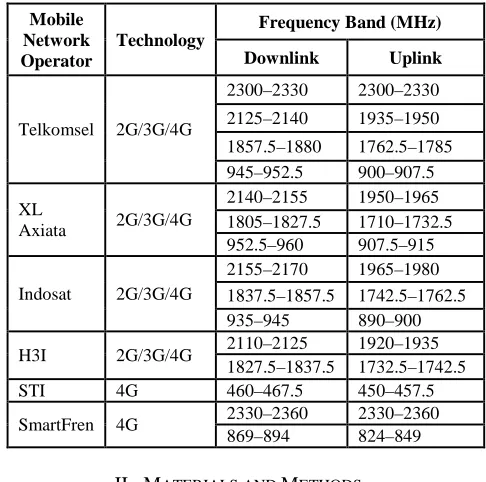
Current MNO frequency bands and technologies have already been identified for the cellular spectrum, as can be seen in Table I [16]–[19]. It demonstrates that almost all frequency ranges that MNOs use in Indonesia are focused in the spectrum below 3 GHz, whereas the spectrum used for cellular communications represents thousands of MHz.
TABLEI
MOBILE NETWORK OPERATOR,THE TECHNOLOGY USED,AND FREQUENCY BANDS IN INDONESIA [16]–[18]
Mobile Network Operator
Technology
Frequency Band (MHz)
Downlink Uplink
Telkomsel 2G/3G/4G
2300–2330 2300–2330
2125–2140 1935–1950
1857.5–1880 1762.5–1785 945–952.5 900–907.5
XL
Axiata 2G/3G/4G
2140–2155 1950–1965 1805–1827.5 1710–1732.5 952.5–960 907.5–915
Indosat 2G/3G/4G
2155–2170 1965–1980 1837.5–1857.5 1742.5–1762.5 935–945 890–900
H3I 2G/3G/4G 2110–2125 1920–1935
1827.5–1837.5 1732.5–1742.5
STI 4G 460–467.5 450–457.5
SmartFren 4G 2330–2360 2330–2360
869–894 824–849
II. MATERIALS AND METHODS
This study investigates spectrum usage fees with both qualitative and quantitative approaches featuring data collection from focus group discussions with a regulator about existing spectrum usage fees, data collection from MNOs’ annual reports, data collection from vendors and the GMSA, data collection from Badan Pusat Statistik (BPS) (in English: the Central Bureau of Statistics), and data from previous studies. The data were collected from 2010–2017, and future spectrum usage fee estimations were made up to 2028.
A. Data Collection
• Interviews with regulators to obtain data related to the value of the existing spectrum usage fee formula parameters and regulations
• Data related to MNOs’ annual reports
• Population data from BPS
B. Existing Spectrum Usage Fee Parameter Values
The spectrum will play a crucial role in the success of 5G. The well-timed availability of the spectrum in suitable circumstances will permit the cellular market to respond to customers’ and industrial requests for service. MNOs and regulators must determine the value of the spectrum. MNOs must do so for their cellular networks so that their carriers do not over-value the spectrum to be obtained. Regulators must decide the economic value of the spectrum to arrange appropriate reserve prices in order to set fees for spectrum licenses [20].
To ease the spectrum usage fee formula, and to provide more benefits to MNOs as the spectrum customers and the government as the regulator, in 2010, Indonesia, applied a new formula for spectrum use in the 800, 900, and 1,800 MHz frequency bands. MNOs must pay the spectrum usage fee in advance before they can use the spectrum [21], [22]. The fee based on the bandwidth license is shown in Eq. 1 in Indonesian currency (IDR) [21], [22]:
Indonesian spectrum usage fee = N × K × I × C × B (1) 1) Determining the Value of N
N is the normalization factor used to maintain the stability
of the government revenue from non-taxed state revenues or PNBP from the fee radio frequency spectrum. Each year is adjusted using Indeks Harga Konsumen (IHK) (in English: the consumer price index [CPI]). If the non-taxed state revenue targets change, the N-value can be adjusted. The IHK formula is shown in Eq. 2
(2)
where the CPI is the year before the calculation of BHP IPFR (n-1) and two years before the calculation of BHP IPFR (n-2), which is then multiplied by the N-value from the previous year. The value of the CPI is assigned by a non-ministerial government agency in charge of government affairs in the statistical field, or the BPS [23].
2) Determining the Value of K
K is the adjustment factor for each radio frequency band;
it is calculated by considering the economic value of the radio frequency band, which is based on the type of service and benefits obtained.
In order to find a reference for the K-value, a calculation method through the BHP formula with a bandwidth of 1 MHz was used; the K-value was then adjusted so that the value of the BHP per MHz did not exceed IDR 16 billion. The K-value that produces the BHP value that is closest to 16 billion is the maximum K-value.
3) Determining the Value of I
I is the basic radio frequency band price index according
to radiofrequency propagation characteristics (IDR/MHz). The government maintains the index according to [21], [22]. Table II shows the price index.
TABLEII
THE BASIC RADIO FREQUENCY BAND PRICE INDEX [19],[20] Frequency
Range (MHz) Units Tariff (IDR) 3,400–4,500 per MHz IDR 4,508
4,500–5,000 per MHz IDR 4,393
5,000–8,500 per MHz IDR 3,811
8,500–11,700 per MHz IDR 3,461
11,700–12,750 per MHz IDR 3,367
12,750–15,400 per MHz IDR 3,160
15,400–22,000 per MHz IDR 2,769
22,000–31,300 per MHz IDR 2,383
31,300–52,600 per MHz IDR 1,814
In this paper, there are two I-values that will be used in the BHP calculation. The first I-value is for the frequency of 3.5 GHz (3.4–4.5 GHz); it has a nominal value of IDR 4,508 per MHz. The second I-value is for the frequencies of 26 and 28 GHz (22–31.3 GHz); it has a nominal value of IDR 2,383 per MHz
4) Determining the Value of C
C is the total number of residents in a service area with a
permit for the allotted radio frequency spectrum band (per 1,000 people). The BPS data on population numbers use data on the population from one year before.
In this research, the data population is calculated from 2010–2028; the data are taken from the 2015–2045 population projection books obtained from the BPS [23], which discusses projections and predictions of population numbers in Indonesia for 2015–2045. Table III shows the projections and predictions of population numbers in Indonesia from 2018–2027.
TABLEIII
PROJECTIONS AND PREDICTIONS OF POPULATION NUMBERS IN INDONESIA FROM 2018–2027[23]
No Year Population Number
1 2018 264,161,60
2 2019 266,911,90
3 2020 269,603,40
4 2021 272,248,50
5 2022 274,859,10
6 2023 277,432,40
7 2024 279,965,20
8 2025 282,454,50
9 2026 284,895,90
10 2027 287,285,30
5) Determining the Value of B
B is the radio frequency bandwidth that MNOs occupy,
In this paper, there are two bandwidth scenarios for frequencies of 3.5 GHz, 26 GHz, and 28 GHz. Table IV shows the bandwidth scenarios for the various frequencies.
TABLEIV
BANDWIDTH SCENARIOS FOR FREQUENCIES OF 3.5GHZ,26GHZ, AND 28GHZ
Parameters Scenario 1 Scenario 2
Bandwidth for a
frequency of 3.5 GHz 50 MHz 100 MHz
Bandwidth for a
frequency of 26 GHz 50 MHz 100 MHz
Bandwidth for a
frequency of 28 GHz 50 MHz 100 MHz
C. Calculating the Spectrum Usage Fee for 5G Using an Existing Formula.
Data from the N-, K-, I-, C-, and B-values are needed to calculate the spectrum usage fee. The assumption for each of the aforementioned values is taken from the values the government set (see the previous section at Existing Spectrum Usage Fee Parameter Values) along with data from the MNOs’ annual reports. Calculation of the spectrum usage fee uses two scenarios, explained in the Table V scenario parameters [23]–[26].
TABLEV SCENARIO PARAMETERS
Parameters Scenario 1 Scenario 2
Bandwidth for a frequency of 3.5 GHz
50 MHz 100 MHz
Bandwidth for a frequency of 26 GHz
50 MHz 100 MHz
Bandwidth for a frequency of 28 GHz
50 MHz 100 MHz
I (IDR/MHz)
4,508 for 3.5 GHz and 2,383 for 26 or 28 GHz
4,508 for 3.5Ghz and 2,383 for 26 or 28 GHz
C (per 1,000 people)
BPS data from 2018–2027
BPS data from 2018–2027
N 1.0072 1.0072
K
12.9 for 3.5 GHz and 24.4 for 26 or 28 GHz
12.9 for 3.5 GHz and 24.4 for 26 or 28 GHz
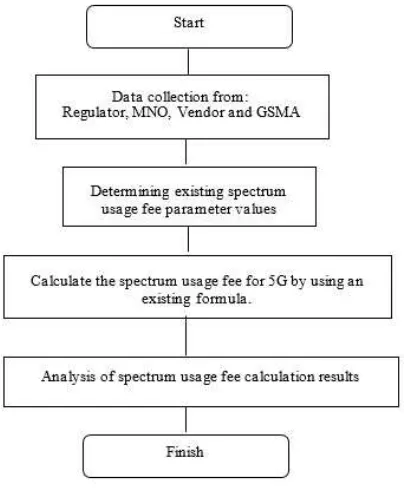
D. Analysis of Spectrum Usage Fee Calculation Results
Fig. 6 illustrates the procedure for calculating the spectrum usage fee from the government side as the regulator verses from the MNO side.
Fig. 6 Step-by-step procedures of the experiment III.RESULTS AND DISCUSSION
A. Examples of Calculations of the Existing Spectrum Indonesia Usage Fee Formula
An example of calculating the spectrum usage fee formula N × K × I × C × B for the 1,800 MHz radio frequency band for 4G LTE in Indonesia is as follows:
If
N = 0.08884 K = 219.80924 B = 45 MHz I = IDR 5,465/MHz
C = 261,891 per 1,000 people, then
Indonesia Spectrum Usage fee = N × K × I × C × B
= 0.08884 × 219.80924 × 5,465 × 261,891 × 45 = IDR 1,257,701,991,409
Table VI contains examples of fee calculations using different frequencies and bandwidths, with an N-value of 0.0805; C-value of 6,285 for frequencies No 1–3 and an N-value of 0.09163; C-N-value of 5,308 for frequency No 4.
TABLEVI
INDONESIAN SPECTRUM USAGE FEE CALCULATIONS USING DIFFERENT FREQUENCIES AND BANDWIDTHS
No Freq
(MHz) K
I (IDR/ MHz)
B (MHz)
Spectrum Usage Fee (IDR)
Fig. 7 shows the nominal Indonesian spectrum usage fee paid by the three biggest MNOs as non-taxed state revenues or PNBP from 2010–2018.
Fig. 7. Indonesian spectrum usage fee for the three biggest MNOs in Indonesia
According to Fig. 7, Operator 1 has paid 42% of the total fees paid to the government.
B. The Weaknesses of the Existing Indonesia Spectrum Usage Fee
The Indonesian spectrum usage fee for MNOs has several weaknesses, which are discussed in the following sections.
Researchers [27] and MNOs [28] have conducted trials for 5G band candidates to evaluate their deployment. The analyses revealed that the most appropriate nominee bands for the first deployment of a 5G network in Indonesia were in the 3.3–4.2 GHz band for the mid-band candidate. However, this frequency spectrum is used for satellites for the standard C-band (uplink: 5,925–6,425 MHz, downlink: 3,700–4,200 MHz, bandwidth: 50 MHz) and extended C-band (uplink: 6,425–6,650 MHz, downlink: 3,400–3,625 MHz, bandwidth: 225 MHz). For high-band candidates, the frequency is 24.25–29.5 GHz. Table VII and Table VIII show the relation between the frequencies that will be used in Indonesia and the bands as determined by IMT-2020.
TABLEVII MID-BAND FREQUENCIES NR
Operating Band
Uplink Operating Band (MHz)
Downlink Operating
Band (MHz)
Duplex Mode
n77 3,300–4,200 3,300–4,200 TDD
n78 3,300–3,800 3,300–3,800 TDD
TABLEVIII HIGH-BAND FREQUENCIES NR Operating
Band
Uplink and Downlink (MHz)
Duplex Mode
n257 26,500–29,500 TDD
n258 24,250–27,500 TDD
n260 37,000–40,000 TDD
n261 27,500–28,350 TDD
The resulting calculations from Table V when 5G technology is applied in 2022 (13th year) by using two scenarios are shown in Fig. 8. The data were collected from 2010 (1st year)–2017 (7th year); then, spectrum usage fee estimations until 2028 (19th year) were made, yielding Fig. 7 based on Scenario 1 and Scenario 2.
(a)
(b)
Fig. 8. (a) Scenario 1 (b) Scenario 2; effect of 5G implementation in Indonesia in 2022
Based on Fig. 8 (a) and (b), the existing fee formula can no longer be used because when MNOs use a bandwidth of 150 MHz in Scenario 1, only Telkomsel will still achieve a profit; however, the firm’s revenues will decrease, and in 2027 (18th year), Telkomsel will suffer losses. The other MNOs will lose money in 2022 at the beginning of the 5G implementation.
Scenario 2 has an even worse result because, at the beginning of the 5G implementation, each operator will use a wider bandwidth compared to Scenario 1. The total bandwidth used in Scenario 2 is 300 MHz. The results for Scenario 2 show that Indosat and XL Axiata will lose money at the beginning of the 5G implementation, with larger losses than in Scenario 1. Telkomsel will begin to lose money in 2026 (17th year).
C. Lack of Incentive for Spectrum Sharing
Spectrum flexibility and spectrum sharing have not been accommodated in the Indonesian spectrum usage fee; this would permit allotment such that the available spectrum’s efficiency would be maximized, which is especially of interest regarding rural areas [29].
cellular broadband features exclusive licensing. However, due to growing demand, sharing the spectrum could serve as a tool for improving the efficient use of the available spectrum [30]–[32].
D. No Regulation of Private 5G Networks
The regulator grants exclusive licensing for cellular communications via supplying spectrum access to MNOs, usually for a period of 10 years. This does not accommodate a large amount of local private operators. Therefore, there is a a demand for a new spectrum authorization design that permits new private operators to participate in 5G [29].
E. On Developing a New 5G Spectrum Usage Fee for Indonesia
The Indonesian spectrum usage fee is calculated based on bandwidth combined with potential economic value, which is unique in terms of the frequency band and spectrum spectral used. Problems might occur if the fee is implemented with a wide bandwidth, such as in Scenario 1 and Scenario 2 in Section III; 5G requires a very large bandwidth. Each operator needs access to 1 GHz in mmwave or high bands (28 GHz or 26 GHz) and 80–100 MHz in the mid-band radio frequencies (3.5 GHz). This is economically unfeasible for MNOs in Indonesia.
Therefore, it is necessary to propose a new and feasible spectrum usage fee. It is hoped that the new spectrum usage fee model can accommodate 5G featuring very wide bandwidth usage and regulations for spectrum sharing and private 5G networks.
The proposed method is a modification of the existing fee formula. There are several alternatives for the spectrum usage fee formula.
1) First Alternative
Spectrum sharing is input into the existing spectrum usage fee formula. The schema for spectrum sharing are non-orthogonal spectrum-sharing (frequency bands are concurrently provided to two MNOs) and orthogonal spectrum sharing (frequency bands are dynamically and exclusively provided to one MNO) [31]:
= N × K × I × C × α, (3)
where α is the bandwidth per MHz divided by the number of cellular operators using the shared spectrum for their networks.
2) Second Alternative
The private 5G network is input into the existing spectrum usage fee formula. The mean formula does not use the C or nationwide population, but instead, it uses the population within a specific area (e.g., in factories). The population includes humans and non-human entities, such as IoT devices [32]:
Indonesia spectrum usage fee = N × K × I × β × B (4)
where β is the population within a specific area, including humans and non-human entities.
IV.CONCLUSIONS
This paper has reported on the development of a proposed new spectrum usage fee model for Indonesia, evaluating the fee for the 3.5, 26, and 28 GHz spectrum frequencies for 5G technology. It elaborated upon the weaknesses of the existing model, which can no longer be used for the 5G frequency because when MNOs use very large bandwidths, almost all of them will lose money the first year the fee formula for 5G technology is implemented. The new spectrum usage fee model includes spectrum-sharing parameters to optimize the use of the available spectrum. The 5G technology that uses mmWave causes the area covered to be very small; thus, the use of the nation’s entire population in the existing usage fee formula is no longer relevant. National coverage can be changed to a limited area with both human and non-human communities.
Future work includes developing regulatory references for the Indonesian government by using the new spectrum usage fee model proposed here.
ACKNOWLEDGMENTS
This article publication is supported by Universitas Indonesia through Q1Q2 International Journal Publication Grant Scheme under the contract number NKB-0306/UN2.R3.1/HKP.05.00/2019, in which Kalamullah Ramli is the corresponding author.
REFERENCES
[1] T. Wang, G. Li, J. Ding, Q. Miao, J. Li, and Y. Wang, “5G spectrum: is China ready?” IEEE Commun., vol. 53, no. 7, pp. 58–65, 2015. [2] Y. Wei and S.-H. Hwang, “Spectrum values in suburban/urban
environments above 1.5 GHz,” Electronics, vol. 7, issue 12, p. 401, 2018.
[3] M. Suryanegara et al., “What are the Indonesian concerns about the Internet of Things (IoT)? Portraying the profile of the prospective market,” IEEE Access, vol. 7, pp. 2957–2968, 2019.
[4] Sumber daya dan perangkat pos dan informatika, “Buku data statistik direktorat jenderal sumber daya dan perangkat pos dan informatika semester I tahun 2018,” Jakarta, 2018.
[5] H.-C. Yu, Z.-L. Lee and H.-Y. Lee, “Revising Taiwan’s frequency usage fee regulation,” Telecommun. Pol., vol. 28, no. 9–10, pp. 679– 695, 2004.
[6] I. Ismail et al., “Refining spectrum fee to increase utilization efficiency by adopting ITU-R SM 2012-2 case study: cellular service in Indonesia,” J. ICT Res. Appl., vol. 4, no. 1, pp. 1–22, 2010. [7] Ismail et al. "Techno-Economic Model for Policy Assessment to
Optimize Spectrum Frequency Utilization Study Case: Frequency Fee for FWA and GSM Services in Indonesia." , 2010
[8] B. A. Shaw, H. F. Beltrán, and K. W. Sowerby, “Valuing spectrum at mm wavelengths for cellular networks,” 14th International Telecommunications Society (ITS) Asia-Pacific Regional Conference, Kyoto, 2017.
[9] P. S. M. Tripathi and R. Prasad, “Spectrum for 5Gp services,” Wireless Personal Commun., vol. 100, no. 2, pp. 539–555, 2018. [10] Global Mobile Suppliers Association, “Asia Pacific – thought leaders
in the 5G spectrum domain – key spectrum aspects,” Forum Global the 5th annual Asia Pacific Spectrum Management Conference, Kuala Lumpur, 2019.
[11] Huawei Technologies, “5G spectrum public policy position,” 2017. [12] “IMT Vision: Framework and overall objectives of the future
development of IMT for 2020 and beyond,” Recommendation ITU-R M.2083-0, 2015.
[13] Global mobile Suppliers Association, "GSA Views On 5G Spectrum Awards In 3400-3800 Mhz In Europe", April 2019
[15] Global Mobile Suppliers Association, “Global progress to 5G - trials, deployments, and launches,” 2019.
[16] A. Hikmaturokhman, K. Ramli and M. Suryanegara, "Spectrum Considerations for 5G in Indonesia," 2018 International Conference on ICT for Rural Development (IC-ICTRuDev), Badung Regency, Indonesia, 2018, pp. 23-28. DOI: 10.1109/ICICTR.2018.8706874. [17] Penataan Ulang (Refarming) Pita Frekuensi Seluler 2.1 Ghz [Online].
Available: https://postel.go.id/berita-penataan-ulang-refarming-pita-frekuensi-seluler-2-1-ghz-27-3397. Accessed on July 28, 2018. [18] Penerbitan surat edaran menteri perihal kebijakan penataan pita
frekuensi radio 1800 MHz [Online]. Available: https://www.postel.go.id/berita-penerbitan-surat-edaran-menteri-perihal-kebijakan-penataan-pita-frekuensi-r%7d-26-2278. Accessed July 28, 2018.
[19] D. Setiawan, alokasi frekuensi kebijakan dan perencanaan spektrum Indonesia, 2010.
[20] B. A. Shaw, H. F. Beltrán, and K. W. Sowerby, “Valuing spectrum at mm wavelengths for cellular networks,” 2017.
[21] Peraturan pemerintah Republik Indonesia nomor 76 tahun 2010, tentang jenis dan tarif atas jenis penerimaan negara bukan pajak yang berlaku pada departemen komunikasi dan informatika.
[22] Peraturan pemerintah Republik Indonesia nomor 80 tahun 2015, tentang jenis dan tarif atas jenis penerimaan negara bukan pajak yang berlaku pada departemen komunikasi dan informatika.
[23] BPS DKI Jakarta, “proyeksi penduduk 2015-2045,” 2018. [24] Telkomsel and Telkom, Annual Report, 2018.
[25] XL Axiata, Annual Report,” 2018. [26] Indosat, Annual Report, 2018.
[27] S. A. Ekawibowo, M. P. Pamungkas, and R. Hakimi, “Analysis of 5G band candidates for initial deployment in Indonesia,” 2018 4th International Conference on Wireless and Telematics (ICWT), IEEE, 2018.
[28] A. C. Situmorang, D. Gunawan, and V. G. Anggraini, "5G Trials on 28 GHz Band in Indonesia," presented at the 28th Wireless and Optical Communication Conference (WOCC 2019), Beijing, China, 9-10 May 2019, 2019.
[29] K. B. S. Manosha, M. Matinmikko-blue, and M. Latva-aho, “Framework for spectrum authorization elements and its application to 5G micro-operators,” 2017.
[30] ITU, “Setting the Scene for 5G: opportunities & challenges,” 2018. [31] J. Luo, E. Jorswieck, E. Karipidis, T. Fahldieck, and L. Badia,
“Spectrum sharing improves the network efficiency for cellular operators,” IEEE Commun. Mag., vol. 52, no. 3, pp. 129–136, 2014. [32] M. Suryanegara, “5G as disruptive innovation: standard and
![Fig. 1. Demographics of the Indonesian population distribution in six of the major island territories [3]](https://thumb-us.123doks.com/thumbv2/123dok_us/9967691.1985075/1.595.310.554.426.657/fig-demographics-indonesian-population-distribution-major-island-territories.webp)
![TABLE PROJECTIONS AND PREDICTIONS FROM III OF POPULATION NUMBERS IN INDONESIA 2018–2027 [23]](https://thumb-us.123doks.com/thumbv2/123dok_us/9967691.1985075/4.595.323.509.517.708/table-projections-predictions-iii-population-numbers-indonesia.webp)