Vol.8 (2018) No. 4
ISSN: 2088-5334
A Hybrid Algorithm for Improving the Quality of Service in MANET
Mustafa Hamid Hassan
#, Salama A. Mostafa
#,
Avon Budiyono
*, Aida Mustapha
#, Saraswathy Shamini
Gunasekaran
$#
Faculty of Computer Science and Information Technology, Universiti Tun Hussein Onn Malaysia, 86400 Batu Pahat, Johor, Malaysia E-mail: [email protected], [email protected], [email protected]
*
School of Industrial Engineering, Telkom University, 40257 Bandung, West Java, Indonesia
$
College of Computer Science and Information Technology, Universiti Tenaga Nasional, 43000, Selangor, Malaysia E-mail: [email protected]
Abstract— A mobile ad-hoc network (MANET) exhibits a dynamic topology with flexible infrastructure. The MANET nodes may
serve as both host and router functionalities. The routing feature of the MANET is a stand-alone multi-hop mobile network that can be utilized in many real-time applications. Therefore, identifying paths that ensure high Quality of Service (QoS), such as their topology and applications is a vital issue in MANET. A QoS-aware protocol in MANETs aims to find more efficient paths between the source and destination nodes of the network and, hence, the requirements of the QoS. This paper proposes a different hybrid algorithm that combines Cellular Automata (CA) with the African Buffalo Optimization (ABO), CAABO, to improve the QoS of MANETs. The CAABO optimizes the path selection in the ad-hoc on-demand distance vector (AODV) routing protocol. The test results show that with the aid of the CAABO, the AODV manifests energy and delay-aware routing protocol.
Keywords— mobile ad-hoc network; cellar automata; African Buffalo Optimization; ad-hoc on-demand distance vector; quality of
service
I. INTRODUCTION
A Mobile Ad-hoc Network (MANET) is a type of ad-hoc network consists of numerous wireless mobile nodes that can dynamically create a temporary network without requiring a central infrastructure or administration [1]. The major characteristic of MANET includes the absence of pre-existing infrastructure, autonomous nodes, dynamic network topology, device heterogeneity, multi-hop routing, controlled physical security, along with some capacity links having a restricted bandwidth [2], [3]. These characteristics are seen to be helpful in circumstances which do not contain a fixed or defined infrastructure [4].
Due to MANET typical characteristics, it is useful for applications in business, education and military fields [5], [6]. Another feature of MANET that they are all connected to the internet, hence they do not need to operate by themselves and could be integrated into many devices. This makes MANET services accessible to users even outside the physical network. Nonetheless, it is a crucial task to create a robust path from a source node to the destination node, when applying this technology for delivering a data packet in order
to satisfy the QoS requirements, like; end-to-end delay, throughput, and consumption of energy [5].
Routing can be divided into many categories; single or multi-path routing, source routing, centralized and distributed routing, hierarchical flat routing, event-driven and queue-based routing, data address-centric routing and the energy-based routing [7], [8]. Numerous artificial algorithms are applied in MANET to optimize the routing protocols [1], [9]. MANET employs an independently connects mobile nodes via wireless links. These nodes have the option to leave or join the network randomly and simultaneously they usually act as routers [10]. Even if there are no pre-installed base stations, these networks nodes can move freely. The networks' topologies are considered highly dynamic. Multi-hop routes are used to forward the data packets due to the limited transmission range of each node [11].
nodes start the communication through radio waves, where each node possesses an ability to act as a router [10]. The network would continue to operate as long as neighboring nodes within each other's transmission ranges are identified. MANET does not use fixed infrastructure due to its topology characteristics. Some characteristics of this network are dynamic network topology, energy-constrained operation, multi-hop routing, non-dependency on fixed infrastructure, limited physical security, device heterogeneity and links possessing the bandwidth-constrained variable capacity, as well as, autonomy. Even though various limitations bind a MANET, its features are useful in various applications [11]. For example, the high availability feature of MANET can be leveraged in conditions when there is no fixed infrastructure available.
Even in emergency conditions, MANETs can be employed, like in fire-fighting, policing, support for doctors and nurses in hospitals, search and rescue operations, etc. Also, it can be employed in tactical networks applications such as military communications and operations. MANETs find applications in the educational field, such as universities and campus settings, virtual classrooms and ad-hoc communications for lectures and meetings, amongst others [12]. MANET not only do as a stand-alone method, also its can operate via establishing a connection to the internet and linking numerous devices, furthermore makes their services available to other users.
Since MANET nodes can freely move randomly in ad hoc networks with different speeds, there can be a random modification in network topology at certain unpredictable time periods. While arbitrarily traveling around, the nodes of a MANET construct their networks via setting up of routing dynamically amongst themselves. In most cases, the mobile nodes of MANET have reduced CPU capability, low power storage, and small memory size. The wireless communication medium can be accessed by any entity that has adequate resources and the appropriate equipment. Thus, restricting the channel accessibility is not possible
Many researchers have proposed different artificial and heuristic QoS routing algorithms for the MANETs [13], [14]. It is important to consider the power usage while designing the mobile wireless networks, especially the MANETs. The battery life of the nodes will be increased if their energy consumption decreases. One study has suggested an energy-efficient delay-constrained multicast routing algorithm, which is a source-based algorithm that considered the energy consumption along with the end-to-end delay while selecting the routes. This algorithm is then directly applied the crossover and the mutation operations on the trees, simplifying the coding operations by omitting the coding/ decoding procedure. The heuristic mutation procedure improves the overall power consumption of the multicast tree.
Ayyasamy and Venkatachalapathy [15] use a fuzzy genetic algorithm for QoS routing. Because it is not possible to obtain precise information regarding protection of the global network status when the nodes belong to a real dynamic network, the QoS parameters are seen to be fuzzy. Therefore, the work applied a genetic algorithm with fuzzy logic when optimizing the fitness functions. One report applied the multiple QoS routing algorithm, which is based
on the genetic algorithm alone [14]. Another metaheuristic method that has been used in the QoS multiple routing processes includes the Evolutionary Optimization (EO) strategy [3], [15].
In one study, the researchers propose an evolutionary multi-purpose quick process called the Multi-Objective Evolutionary Algorithm (MOEAQ) process for determining the optimized QoS path. This process provided better convergence results in comparison to the basic technique along with higher diversity. This algorithm is seen to be better than a popular Genetic Algorithm (GA)-based algorithm [3] which is generally used for producing solutions for resolving issues related to the search and the optimization problems [16]. The QoS routing problem has also been compared to many intelligent techniques [17]. One such intelligent method includes the swarm intelligence, which is a modern technique based on the swarming behavior of various animals [12]. It can be noted that the cellular model stimulates the natural evolution based on an individual’s perspective, which can encode a probable (search, learning, optimization) problem solution.
Cellular Automata (CA) is one such popular technique that possesses the ability to solve numerous complex systems like the MANET and other problems related to its applications, like routing [18]. On the other hands, the CA-based approach used in routing includes the Lee algorithm, which identifies the path with the minimum aggregate weight value on the grid [5]. In the case where all the weight values of the nodes (grid points) are configured as one, the algorithm establishes a smallest route leading from the source node to the destination node. According to the authors, a relationship existed between the number of states and the longest route or the maximum aggregate weight value which could arise.
A prevalent protocol applied in the MANETs is the AODV protocol because it establishes the shortest route from the source to the destination nodes, hence decreases the delay. However, the AODV protocol consumes much energy. Different researchers have proposed numerous approaches for solving the energy-related problems in the AODV routing protocol. The study of [12] altered the path selection strategy in the AODV protocol based on two parameters, which are the number of hops as well as the efficient energy. This research proposes a combined parameter to make up a new protocol called the Power Hop AODV (PH-AODV) protocol.
The leading contribution of this paper is proposing a different hybrid algorithm based on the Cellular Automata (CA) and African Buffalo Optimization (ABO) algorithm. The new CAABO algorithm is used to optimize the path selection in MANET, this, in turn, increases the packet delivery ratio and the node lifespan. The algorithm is similar to the QoS-based methods with regards to the mean end-to-end delay value [13], [15]. The proposed hybrid algorithm is integrated with Ad-hoc On-demand Distance Vector (AODV) routing protocol for further improving its QoS. The CAABO algorithm is a reliable, convenient, efficient, and readily applicable algorithm that exhibits a good ability to explore and exploit the search space of the MANET environment.
presents the materials and methods. It includes the simulation, the standard algorithms, and the proposed hybrid algorithm. Section III discusses the evaluation methods and the results of this work. Lastly, section IV concludes the work and suggests future work.
II. MATERIALS AND METHODS
The research methodology encompasses a simulation of the MANET along with the research contraptions. A simulation is defined as a combination of software and hardware that minimizing a particular event’s limiting behavior. It is crucial for the academic and industrial sectors to conduct analysis and gain insight into some theoretical models at the conceptual level. There are different types of networks, and the research aspect for each of which encompasses improving the performance that is associated with the efficiency, flexibility, security and elasticity qualities [19], [20]. The simulation has a highly important in MANET for many reasons. MANET has a complex nature. Hence, the researchers can use the simulator to implement different scenarios with a different number of nodes to assessment their model, which be expensive if implement in the real word. The Network Simulator 2 (NS-2) tool is used in different networking studies to evaluate networks performance as in [7]-[8] and [21].
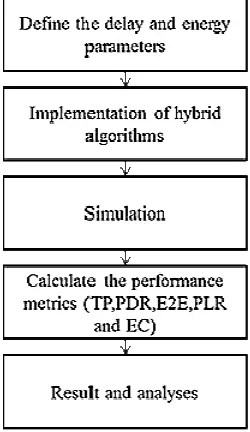
This paper offers a different hybrid algorithm that combines Cellular Automata (CA) with the African Buffalo Optimization (ABO), CAABO, to improve the QoS of MANETs. The NS-2.33 version is used in this work for the implementation of the CAABO in the MANET environment. Fig. 3 shows the conducted research methodology for this work. It includes the development and evaluation of the hybrid algorithm in MANET. The evaluation includes applying different performance metrics, on the proposed algorithm and compares it with a standard AODV routing protocol.
Fig. 3 The research methodology
A. Quality of Services Parameters
The Quality of Service (QoS) is the measurement or description of the overall performance quality of networks. The performance presents the amount of data that is sent from a source node and received by destination node within a specific time. To quantitatively measure QoS, several parameters are used to assess the quality of the network, such as bit rate, packet loss, throughput, E2E delay, energy consumption, jitter and so on. All these parameters influence the behavior of routing protocols in MANET [22]. This paper utilizes two parameters which are delay and energy due to their significant impact on the overall performance of MANET.
1) Delay: Delay is an outstanding performance
characteristic of communications networks, which also indicates the time required for a data packet to travel through the network, i.e., from the source node to the destination node. Some aspects can be associated with packet delay in a network:
• Processing delay is the time required to perform processing of the headers of the packets'.
• Queuing delay indicates the time that required for packets queues.
• Transmission delay denotes the time that requires transmitting the data packets from the source to the destination nodes.
• Propagation delay refers to the time required for pushing the data packet into the link. Hence, path E2E delay is denoted as the summation of all types of delay that occur in the network within simulation time.
2) Energy: The route discovery process is employed to
calculate the shortest path in protocols such as on-demand protocols. This selected path is used until it gets destroyed. Thus, in this route, the energy of the node decreases. Messages cannot be sent if energy is lost by a node, resulting in the exclusion of the node from the network. The lifetime of the ad-hoc network is negatively affected by this. Thus, the routing protocol aims to identify nodes that have high battery energy to prolong the network lifetime. As an energy constraint, a portion of initial energy is taken.
There are different evaluation metrics of networks’ performance [23], [24]. The performance of the suggested algorithm is measured by the metrics deliberated in the following subsections.
1) Throughput: The throughput (TH) is found from the
actual number of bytes that are handled by a host node for
the period. The average throughput ATH of attempts is calculated by Equation 1:
(1)
2) Packet Delivery Ratio: The PDR is the percentage of
destination node, , to the number of the data packets that
are sent by the source nodes, . The Average Packet
Delivery Ratio (APDR) of attempts is calculated by Equation 2:
(2)
3) End-to-End Delay: The E2E delay is the time that is
spent to transmit the actual data from the source node, , to
the time that is spent to reach the host nodes, . The E2E delay includes all the types of delays that occur in the network such as buffering delay during the route discovery latency, the interface queue time, retransmission at the MAC time, the propagation time, along with the transfer time. The
average E2E, AE2E, delay of attempts is calculated by Equation 3:
(3)
4) Packet Loss Ratio: The packet loss includes the
difference in ratio between the number of data packets received and sent. In a scenario where a packet is obtained by a router when dealing with another packet, in the input buffer, the received packet has to be saved until its turn comes. The input buffer of a router is size restricted. There could be a situation when there is a complete occupancy of the buffer, and the next data packet is required to be released. In such situations, there is a packet loss and that packet is re-transmitted, which results in an overflow, and subsequently increase the packet loss. This is a decent parameter showing the paths selection by our technique. Also, it demonstrates the reliability of the route that is chosen by our technique. Equation 4 shows the determination of PLR:
(4)
5) Energy Consumption: Energy consumption can be
defined as the aggregate amount of energy that consumed by nodes within simulation time [11]. The initial energy of each node is factored, and then the energy level of each node is determined. The energy consumption can be determined at the end of the simulation. Equation 5 is used to determine the consumption of energy within simulation time.
(5)
Here, the nodes number is signified by , the energy level of each node at the end of the simulation time is represented by, and the initial energy of each node is represented with
.
B. Cellular Automata
In both time and space, Cellular Automata (CA) is considered as a discrete dynamic system. Cells are understood to have a finite value range and finite state automata. Based on the local update rule, states change according to the neighboring nodes’ states. In fact, with the same update rule, all the cells change their states simultaneously [11].
CA includes an n-dimensional lattice that has synchronous and similar finite state machines. Based on the transition function (or transition rule), an update is done for state S (synchronously). This suggests that all automata cells are updated synchronously. A neighborhood implies the set of cells that have a direct impact on a specific cell. In a homogeneous cellular model, all cells possess identical shape [24].
The Moore and Von Neumann neighborhood are the two types of prominent neighborhoods. Four cells are present in the von Neumann neighborhood of a cell I, which touch it orthogonally (Fig. 4a) in a two-dimensional (2D) cellular grid that has a neighborhood radius = 1. Meanwhile, the cell is found in a Moore neighborhood has a set of eight cells sharing a vertex or edge with it (Fig. 4b).
Fig. 4 (a) Von Neumann neighborhood (b) Moore neighborhood
C. African Buffalo Optimization
African Buffalo Optimization (ABO) is an effort to develop an accessible, robust, effective, efficient, yet, a simple-to-implement algorithm that will demonstrate exceptional capability in the exploitation and exploration of the search space. Equation 6 is divided into two parts [25].
The first part indicates the cooperative elements of the animal’s lp1 (bg-maxw.k). Buffaloes can track the optimal
Fig. 5 The ABO algorithm
D. The Hybrid Algorithm in MANET
Generally, the reactive routing protocols can create a route by considering two kinds of messages, i.e., the Route REQuest (RREQ) and the Route REPly (RREP). After that, the source nodes broadcast the RREQ for determining the most probable path by which the message reaches the destination node. Upon receiving the RREQ message, the destination node transmits an RREP message to the primary source node.
In many of the protocols, including the AODV, a path is generated after the transmission of an RREQ message by the source node and the reception of the RREP signal from the destination node. However, the AODV protocol selects the path based on the initial RREP message arising from the destination node, instead of considering the energy levels present in the nodes, which could exhaust the nodes present in the route and increase a link failure probability. A link failure negatively affects QoS of a network like energy consumption, end-to-end delay or throughput.
This work attempts to establish a robust route which can satisfy the QoS requirements of end-to-end delay and energy consumption that the AODV neglects in MANET. The CA and ABO are integrated with the AODV routing protocol. The work follows the same methodology of [25] who integrates CA with a genetic algorithm to enhance the QoS in MANET. The study is carried out in two steps. In Step 1, the CA algorithm discovered all the probable routes based on the minimal time; while the Step 2 selected the route based on the maximal energy level present in every node in the path, using the ABO algorithm. A hybrid algorithm has been proposed in this study which could help in the discovery of the routes in the MANET which satisfied the
delay and the simple energy constraints (based on the principle that each node in the path had a maximal energy level). Fig. 6 presents the hybrid CAABO algorithm.
Fig. 6 The proposed CAABO hybrid algorithm
As stated, CA generated a route from the source to the destination node based on a minimum delay value. Therefore, the RREQ message sent by a CA includes a threshold value which ensures all the routes satisfy the delay requirement. After that, the ABO algorithm checked the status of all the routes based on their energy levels.
The ABO algorithm is based on the behavior of animals in nature who search for the most favorable pasturing grounds. The herd of the buffaloes determines the best pasturing area by sending every buffalo to different pasturing areas. All buffaloes communicate with one another by producing two types of sounds (i.e., ‘maaa’ and ‘waaa’). If the ‘maaa’ sound is produced, it indicates that the area is favorable for the whole herd, while the ‘waaa’ sound indicates that the area is not favorable for the herd (i.e., either not good for pasturing or presence of some danger) [25].
In the proposed hybrid algorithm, the CA process determines the initial population based on the low delay values. Next, the ABO algorithm selects this initial population (generated by the CA) for selecting the best route based on the energy consumption values. Every node in this network represents a buffalo in the ABO algorithm. As stated earlier, every buffalo (or node) generates two sounds (or rather messages) which describe the energy levels of the node in the network. All the nodes forward the energy-related information to the primary source node (i.e., herd). Various paths are seen to arise from the source to the destination node. Finally, the fitness function of the ABO algorithm determines the quality of the different paths and sorts them based on their values. The buffalos’ fitness of the population is updated by Equation 6 [25].
where:
and are the factors of learning
updates the location of buffalo .
An optimal solution is obtained from all the probable solutions. This mechanism is expected to provide an optimal path which can satisfy all the QoS requirements (high energy levels, and a less end-to-end delay).
III. RESULTS AND DISCUSSION
The efficiency of the suggested technique is measured by changing the mobility of nodes. The simulation conducted in the 3000m2 network area, the Constant Bit Rate (CBR) is employing as a traffic source. A broadcast range is 250 , and the introductory energy level of each node is 100 . Table1 shows the setting of the simulation parameters.
TABLEI SIMULATION PARAMETERS
Parameter Value Unit
Network size 3000 m2
No. of nodes 125 Node
Simulation time 50 Second
Mobility 5, 10, 15, 20, 25 m/s
Traffic type CBR
Packet size 64 Byte
Pause time 30 Second
Transmit power 1.4 Joule
Reception power 1.0 Joule
Idle power 0.05 Joule
Based on Table 1, the mobility is changed as 5, 10, 15, 20, and 25 . Pause time is 30 second and the simulation time is 50 second. These factors and values are chosen based on state-of-the-art. In this scenario, we fixed the nodes number as 125 nodes. The network is simulated to show the effectiveness of energy cost on AODV routing protocol using hybrid CAABO algorithm.
After the simulation is completed for the proposed algorithm, performance analysis is conducted using the evaluation metrics, which are the PDR, E2E delay, energy consumption, PLR, and TP. Table 2 shows the summary of the simulation results.
TABLEII SIMULATION RESULTS
Mobility 5 10 15 20 25
PDR in AODV 96 95.6 92 88.2 86.6
PDR in CAABO 97 96.6 95 94 92
E2E Delay in
AODV 0.21 0.31 0.315 0.4 0.45
E2E Delay in
CAABO 0.16 0.18 0.2 0.26 0.3
EC in AODV 10.5 11 11.8 14 14.3
EC in CAABO 9.9 10 11.1 12.6 12.8
PL in AODV 9 11 17 33 36
PL in CAABO 7 9 11 18 25
TP in AODV 0.95 0.933 0.923 0.9 0.89 TP in CAABO 0.99 0.98 0.962 0.949 0.94
Fig. 7 shows the PDR for AODV protocol and our improved routing protocol that has a different PDR.
Fig. 7 The packet delivery ratios
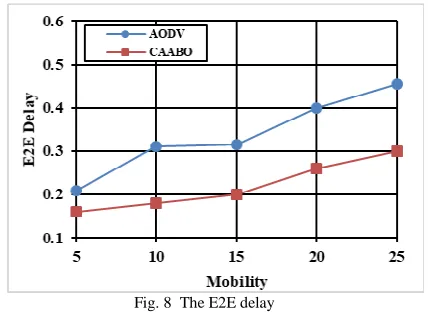
Based on Fig. 7, the proposed approach has a better PDR than AODV protocol. Due to the CAABO algorithm establish the path rely on the highest energy and minimum delay. This approach decreases the probability of packet loss as well as link failure. Next, Fig. 8 illustrates the E2E delay for AODV and CAABO.
Fig. 8 The E2E delay
The variation in E2E delays when increasing the node speed is shown in Fig. 9. In E2E delay terms, the CAABO is better than the standard AODV protocol. This is because CAABO creates a path from source to destination based on less delay. The following Fig. 9 shows the variation in the consumption of energy for AODV and CAABO.
Based on Fig. 9, when the speed of the node increases the consumption of energy increases too. The results show that CAABO preserves energy better than AODV. Due to the proposed protocol selects the optimum path, furthermore use the same path to transmit packets. Next, Fig. 10 shows the alteration in packet loss with mobility. When the mobility rises, the packet loss rises also. The CAABO achieved superior performance than AODV in packet loss term. Because of CAABO chooses the path with highest energy and minimum delay, which keeps time to transmit data packets over the network.
Fig. 10 The packet loss
Finally, the variation throughput for protocols is shown in Fig. 11. It can be seen that the node mobility increased as the throughput decrease in routing protocols (5, 10, 15, 20, 25). CAABO has higher throughput than AODV, as it selects the path that has most active nodes to the target. This route has the highest level of energy and minimum delay than other routes; therefore, the path is more stable, this in turn to minimize the packets dropped, as well as increases the throughput.
Fig. 11 The throughput
IV. CONCLUSIONS
MANET is a collection of nodes that connect to each other without infrastructure. It is applied in a wide range of applications such as commercial, military applications and so on. Establishing an optimized path from sender to target nodes is essential to certify that the packet delivered encounters the QoS requirements. Path selection in MANET relies on different parameters such as some hops, E2E delay,
energy consumption, packet loss, throughput, etc. there are three main types of a routing protocol in MANET; reactive, proactive and hybrid. The AODV is one of the reactive routing protocols that have a popular used in MANET. AODV select the path based on the shortest path, however, does not care about other parameters (such as energy and delay). The energy and delay parameters have a significant impact on network performance. Subsequently, this paper proposed a QoS routing algorithm CAABO in MANET that attempt to tackle the energy and delay constraints in AODV. The overall MANET system is simulated using NS-2 simulator. The results show the CAABO achieves better performance than Standard AODV. The ACABO algorithm enhances the network lifetime as well as the E2E delay.
ACKNOWLEDGMENT
Universiti Tun Hussein Onn Malaysia fully supports this research.
REFERENCES
[1] Conti M, Giordano S. Mobile ad hoc networking: milestones, challenges, and new research directions. IEEE Communications Magazine, 2014, 52(1):85-96.
[2] Basagni S, Conti M, Giordano S, Stojmenovic I. Mobile Ad Hoc networking: the cutting edge directions: John Wiley & Sons; 2013. [3] Karthikeyan P, Amudhavel J, Infanta E, Deepika P, Saranya M,
Nandhini C, editors. Impact on Self-Organization in Mobile Adhoc Networks: A Comprehensive Review. Proceedings of the 2015
International Conference on Advanced Research in Computer Science Engineering & Technology (ICARCSET 2015); 2015: ACM.
[4] Bang AO, Ramteke L. MANET: History, Challenges and Applications. International Journal of Application or Innovation in Engineering & Management (IJAIEM), 2013, 2(9):249-51.
[5] Liu F-H, Lo H-F, Juan SC, Lee W-T, Liao J-c. Energy-efficient ant-colony-based routing algorithm for the MANETs. J Internet Technol. 2013; 14(1):21-30.
[6] Jubair, M. & Muniyandi, R. Ns2 Simulator to Evaluate the Effective of Nodes Number and Simulation Time on the Reactive Routing Protocols in MANET. International Journal of Applied Engineering
Research, 2016, 11(23):11394-11399.
[7] Mohammed, M. A., Ghani, M. K. A., Hamed, R. I., Mostafa, S. A., Ibrahim, D. A., Jameel, H. K., & Alallah, A. H. (2017). Solving vehicle routing problem by using improved K-nearest neighbor algorithm for the best solution. Journal of Computational Science, 21, 232-240.
[8] Mohammed, M. A., Ghani, M. K. A., Hamed, R. I., Mostafa, S. A., Ahmad, M. S., & Ibrahim, D. A. (2017). Solving vehicle routing problem by using an improved genetic algorithm for the optimal solution. Journal of Computational Science, 21, 255-262.
[9] Fahad, A. M. & Muniyandi, R. C. Research Article Harmony Search Algorithm to Prevent Malicious Nodes in Mobile Ad Hoc Networks (MANETs), 2016.
[10] Mohammad, S., Alsanabani, M., & Alahdal, T. (2014). A comparison study of routing protocols in MANET. International Journal of Ad Hoc, Vehicular and Sensor Networks, 1(1), 1-9.
[11] Hassan, M. H., & Muniyandi, R. C. An Improved Hybrid Technique for Energy and Delay Routing in Mobile Ad-Hoc Networks. International Journal of Applied Engineering Research, 2017, 12(1):134-139.
[12] Abu-Ein, A., & Nader, J. (2014). An enhanced AODV routing protocol for MANETs. International Journal of Computer Science Issues, (1):1694-0814.
[13] Nivetha S, Asokan R, Senthilkumaran N. ACO-GA Hybrid Meta-Heuristic (AGHM) Optimization for Multi-constrained Quality of Service Routing in MANETs. 2014.
[15] Ayyasamy A, Venkatachalapathy K. Context-aware adaptive fuzzy based QoS routing scheme for streaming services over MANETs. Wireless Networks. 2015; 21(2):421-30.
[16] Lu T, Zhu J. Genetic algorithm for energy-efficient QoS multicast routing. Communications Letters, IEEE. 2013; 17(1):31-4.
[17] Kiani F, Amiri E, Zamani M, Khodadadi T, Manaf AA. Efficient, intelligent energy routing protocol in wireless sensor networks. International Journal of Distributed Sensor Networks. 2015; 2015:15. [18] Falk W, Williams J. Deformed Cellular Automata. 2015.
[19] Amini, A., Jamil, N., Ahmad, A. R., & Zaba, M. R. (2015). Threat Modeling Approaches for Securing Cloud Computing. Journal of Applied Sciences, 15, 953-967.
[20] Amini, A., Jamil, N., Ahmad, A. R., & Sulaiman, H. (2017, April). A Fuzzy Logic Based Risk Assessment Approach for Evaluating and Prioritizing Risks in Cloud Computing Environment. In International Conference of Reliable Information and Communication Technology (pp. 650-659). Springer, Cham.
[21] Salih, A. I., Abdelouhahab, A., Mostafa, S. A., & Zaiter, M. J. (2015). Updating the NCTUns-6.0 tool to simulate parallel optical burst switching of all-optical ultra-dense WDM systems. Photonic
Network Communications, 29(1), 106-117
[22] Taha, A., Alsaqour, R., Uddin, M., Abdelhaq, M., & Saba, T. (2017). Energy efficient multipath routing protocol for mobile ad-hoc network using the fitness function. IEEE Access, 5, 10369-10381. [23] Hameed, A. H., Mostafa, S. A., & Mohammed, M. A. (2013).
Simulation and evaluation of WIMAX handover over homogeneous and heterogeneous networks. American Journal of Networks and Communications, 2(3), 73-80.
[24] Ahmadi M, Shojafar M, Khademzadeh A, Badie K, Tavoli R. A Hybrid Algorithm for Preserving Energy and Delay Routing in Mobile Ad-Hoc Networks. Wireless Personal Communications. 2015; 85(4):2485-505.