Vol.8 (2018) No. 3
ISSN: 2088-5334
Efficient Handwritten Digit Classification using User-defined
Classification Algorithm
R. Vijaya Kumar Reddy
#, U. Ravi Babu
*#
Research Scholar, Dept. of. CSE, Acharya Nagarjuna University, Guntur, India. E-mail: [email protected]
* Principal, DRK College of Engineering & Technology, Hyderabad, India. E-mail: [email protected]
Abstract— In automatic numeral digit recognition system, feature selection is most important factor for achieving high recognition
performance. To achieve this, the present paper3 proposed3 system3 for isolated handwritten33numeral recognition33using number3 of
contours3, skeleton features, Number of watersheds, and ratio between the numbers of foreground33pixels in33upper half3 3part and3
3lower half-part3 3of the numerical digit image. Based on these features the present paper designed user-defined classification
algorithm for handwritten digit recognition. To find the effectiveness of the proposed features, these features are given as an input for standard classification algorithms like k–nearest neighbor classifier, Support Vector Machines and other classification algorithms and evaluate the results. The experimental result proves that the proposed features are well suited for handwritten digit recognition for both user and standard classification algorithms. The33novelty of33the proposed33method is33size 3invariant.
Keywords— digit recognition; classifier; k–nearest neighbor; support vector machines classifier; hand-written digit.
I. INTRODUCTION
Handwrittendigit recognition plays animportant role i3n
pattern3 3recognition and Optical Character3 3Recognition
(OCR). It has33a widerange of practicalapplications3 inreal
life, suchaas zipcode recognitionin postal mail sorting [1], writer identification and verification, form processing, and handwritten digit recognition on bank check. Over the past decades, lots of machine learning methods have been employed for effective handwritten digit recognition , such as Linear and Non-Linear Classifier, Support Vector Machines (SVMs),Neural Networks (NNs), Boosted Stumps, CNNSVM Classifier, etc.
Despite333 3the fact333 3that the33 33Handwritten Digit33 3Recognition3 3problem3 3has3 3been3 3studied3 3extensively3 3for3 3a33number33of3a3years3, one33of its3333benchmark databases333is
still33 3actively used333a3by researchers3333till date33[2, 3, 4]. The3
conventional3 3applications of3 3OCR are3 3numerous and3 3include diverse3 3a reassuch3 3as automatic3 3bank cheque3 3processing, immigration3 3data processing, health3 3data
record3 conversion3 3into electronic3 3format, tax3 3forms data3 3conversion and3 3many other3 3applications. Despite3 3being
one3 of33the earliest33researchand3 3applicationaareas3 3ofAI,
the3 3digit and3a3character recognition3 Vremains an3 3active
research3a3topic. The3a3present dayS3 3popularity and3 3mass
availability3 3of smart3 3phones with3 3sophisticated camera3 3technology enable33users to capture33imagesof handwritten3 3notes containinga digits3 3and characters3. Subsequently3 3there is3a3a need3 3to extract3a3the handwritten3 3notes
information3 3from these33images to3 3convert them3a3into text3 3files. Analysis3 3of documents3 3and images3 3with texts3 3continues to3 3be active3 3research topics3a [5,6,7,8, 9].
Hence3a3the need33for developing33efficient handwritten33digit
and3 3character recognition3 3algorithms and techniques3 3are
still33live in33today.
The3 3feature extraction plays3 3major role3 3in numerical
recognition3 3system. Numbers3 3of feature3 3extraction
methods3 3are stated3 3in the3 3literature, like3 3template a3matching, projection3 3histogram, 3zoninga, and3 3various
moment3 3techniquesa [10] to3 3enable for3 3specific a3applications. Some3methods33include fuzzy33features [11,12]
invariant3 3moments features3a [16], template3 3and
deformable3 3Templates [13, 14] structural3 3and statistical3 3features [12,15] a3extraction.
Ravi33et.al [16] proposedan approachfor33Teluguprinted3 3numeral digits3 3recognition using3 3number of3 3contours,
skeleton3 3feature, water3 3reservoir features3, and ratio3 3of
length3a33of Top33line to bottom33line of the3 3a3image. The3a3
proposed method3 3is applied with3 3 successa ato3 3 a
database3 3 of 3,1503 3 3printed multi-font3 3printed Telugu3
3offline handwritten3 3numeral recognition3 3based on3 3structural and3 3statistical 3features. Five3a33skeleton3 3features
and33two-geometrical features33anddistribution33featuresare3 3used for the3 3recognition of3 3numerals. The3 3proposed
method3 3experimented with3 MNIST adatabase3. 3 A3 3Euclidian minimum3 3distance criterion3 3is used3 3to find3 3minimum distances3 3and k-nearest3 3neighbor classifier3 3is
used to3 3classifythe3 3anumerals. MNIST3 3database is3 3used
for33both training33and testing33the 3system.
Ravi et.al [18] proposed3 3another approach 3for
handwritten digit recognition asystem. This approach extractsdigit imagefeatures basedon distancemeasure33and
derives3 3an algorithm3 3to classify3 3the digit3 33images. The3 3distance measure33can beperformed33onthe thinned33image.
Kumar et.al [19] proposed33an approach33for handwritten3 3digit recognition3 33system. The33present paper33extract digit3
image3 3features based33on distance33measureand3 3derive an3 3algorithm to3 3classify the3 3digit 3images. The3 3distance
measure33can be3 3performed on3 3the Skelton3 3image. The3 3present approach3 3experimented with3 3MNIST 3database,
CENPARMI, aCEDAR and33newlya collected33data.
Based3 3on the3 3critical survey3 3of existing3 3methods, all3 3the existing3 3methods are3 3used standard3 3classification
algorithms3 3are used3 3for 3classification. The3 3present 3study
aimed is33to classify3 3the isolated33handwritten digits3 3using
user3 3defined classification3 3algorithm not3 3with standard3 3classification 3algorithms. The3 3main objective3 3of the3 3present study3 3is that3 3classify the3a3isolated handwritten
digits with a minimum number of features. To achieve this, we proposed a new approach for classification without using any standard approchas for isolated digits. It is generally based on the feature extracts such as numberof contoursin an image [12], Number of end points and Junctions of a thinned digit image, number of water reservoir sheds and ratio between the number of foreground pixels in upperhalf part and lowerhalf-part of the numerical digit image. Totally five features are extracted for this algorthim. No such method is available to classify the digits with a minimum number of digits.
Rest3 3of the3 3paper is3 3organized as3 3follows; Section3 3II
contains3 3Database and the3 3preprocessing. Feature3 3extraction process333is3 described3 in Section,3 3the3 3proposed
algorithm and 3Classifications method.3 results3 and
discussion 3obtained are3a33presented in3 3Section III. Section3
IV contains33the conclusion3part.
II. MATERIAL AND METHOD
The3 3proposed method3 3is mainly consists3 3of 4 phases asteps. In3 3the firsta phase, collecting3 3the numerals3 3data
from3 3various data3 3bases and3 3gathering images3 3from
various 3people in3both telugu states. After3 3collecting the3 3numeral data33preprocess data33i.e. elimination33of noise33and
conversion3 3of gray3 3scale images into3 3binaryimages3 3and
also33the normalization33ofthe binary33images by33using the3 3normalization techniques33in thesecond aphase. In33the third
phase, extracted3 3the features3 3from individual3 3digit image3 3and derive an3 3algorithm for3 3recognition of3 3handwritten
numerals3 3systemin thelast phase. The33blockdiagram3 3of
the33proposedmethod33isshown33belowa3figure 1.
Fig 1: Block diagram proposed handwritten digit recognition system
A. Database creation and the preprocessing
1) Collection of numeral image database:
Several33standard datasets33of digits33are found33in English.
Someof3 3themare3 3aCENPARMI, a3CEDAR, and3 3MNIST 3datasets. The3 3CENPARMI (Centre3 3for Pattern3 3Recognition and33Machine a3Intelligence) digit33dataset [20]
is3 3available33from3CENPARMI, Concordia3 3University. In3 3this dataset3 34,000 3images (4003 3samples per3 3classa) are3 3specified for33training purpose33and 2,00033images are33used
for3 3testing 3purpose. These3 3digit datasets3 3were collected3 3from United33States Postal33Service (3USPS). The33Center of3 3Excellence for3 Document3 3Analysis and3 3Recognition
(3CEDAR) digit3 dataset3 3is available3 3from a3CEDAR, The3 3State University33of NewYork, and33Buffalo. The3a3training
and3 3test sets3 3contain 18,4683 3and 2,7113 3digits, a3respectively. The3 3number of3 3samples in3 3both training3 3and test3 3sets differ3 3for each3 3class. The3a3 Modified
National33Instituteof33Standardsand33Technology3 (MNIST3a) adataset3 [21] was3 3extracted from33the NIST33datasets SD33 3and a3SD7. The3 3training and3 3test sets3 3are composed3 3of
bothSD333and aSD73. 3Samplesare33normalized into3320×20
grayscale3 3images with3 3aspect ratio3 reserved, and3 3the
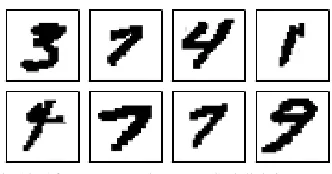
normalized3 3images are3 3located in3 3328×28 aframe. The3 3number of33training and33test samples33is 60,0003and 10,0003 3respectively. The33sample images33of the33MNISTdataset33is
shown33in figure3 2.
Fig 2: MNIST database
Fig. 2. Sample3 3digit images3 3of MNIST3 3database The3 3plain paper3 3was used3 3for data3 3collection. Each3 3person
was3 instructed3 3to write3 3the digits3 (fully3 3unconstrained)
along3 3the vertical3 3direction. The3 3dataset contains3 3about
1003 3isolated samples3 3each of3 3103 3numerals written3 3bya
3school 3children, and33adults. Around33fifty percent33data is3 3from high3 3school 3children. A3 3flatbed scanner3 3was used3 3for 3digitization, with3 images3 3in agray3 3tonea at3 3300 dpi.
These3 3were stored3 3has3 3Bit Map3 3Filea (BMP3) format3 3using a33standard technique33for converting33them into33black
and3 3white 3images. Data3 3was manually3 3extracted from3 3scanned images3 3andnormalized3 3into 50×50 size3 3using a3 3standard bi-cubic3 3approach. After3 3processing scanned3 3images about3 3digits and 3a total3 3of 14,40003a (100×1440)
images3 3of numerals3 3are a3obtained. Dataset3 3developed
planned3 3to be made3 3available3 3publicly for3 3research a3purpose. Some3 3of the3 3sample images3 3after extracting3 3from the33scannedimage33areshown33infigure333.
Fig 3. Sample Scanned document of digit images Step
2) Preprocessing:
The3 recognition of3 3handwritten numerals3 3can achieve3 3high performance33based on33preprocessing stage33also. The3 3handwritten digit3a3databaseimages3 3used in3 3this approach3 3are in33gray scale33images, convert33images in3database33into
binary3 3images. Converting3 3the gray3 3level images3 3into
binary33based on33the threshold33value. After3converting33the
images3 3into 3binarya, images3 3may 3have surplus3 3elements
one’s3 3 (black) at3 3undesirable places3 3in the3 3background 3image. For33efficient a3classification, need33to remove33athea
surplus33from undesirable33places.
To33remove these33unwanted one’s33from the33background,
noise3 3removal 3algorithm[8] is3 3used. The3 3present paper3 3used own3×333templates are33used. It33is assumed33that the3 3pixel (p, q) as33center pixel33and aneighbors3 of33the center3 3pixelare33 (ap- 1, qa), (ap-1, aq+1), a (p, aq+1), (p+1, aq+1),
(ap+1, q), (ap+1, aq-1), (ap, aq-1), aand (ap-1, q-1), as3 3is3 3shown in33figure 4. Noise3 3removal in3 3an image3 depends3 3on the3 3type of3 3noise in3 3that 3image. The3 3noise can3 3identified by33using 3×333templates. The33template shown33in
figure 333isused to33identify the33single pixel33surplus data33in
digit33image. In33the same33way 32-pixel, 33-pixel and 34-pixel
noise3 3can be33identified by using33the templates3 3shown in3 3figure 4, 5 and336 3respectively.
Once3 3the 1-4-pixel3 3noise (Black pixel) 3identified, the3 3black pixel33is replaced33with white-pixel. Figure 9shows3 3the digit3 3database contains3 3some amount3 3ofa noisea.
Figure103 3shows the3 3resultantimages3 3after removing3 3the
noise3 33by using3 3the 3×33 3window patterns3 3shown figures3 3from5 to8.
aP1 (ap-1, aq-1) aP2(p-1, aq) aP3(p-1, aq+1)
P8 (p, aq-1)
P1(p, aq) P4 (p, aq+1)
P (p+1, aq-1)
P6 (p+1, aq)
P5 (p+1, aq+1)
Fig 4: 8-neighbors of a 3×3 window
Fig 5: Isolate pixel pattern
Fig 6: Two pixel patterns for noise removal
Fig 7: Three pixel patterns for noise removal
Fig 8: Four pixel patterns for noise removal
Fig 10: After preprocessing numerical digit images
B. Feature Extraction
1) The number of contours / aholes:
The3 number of3 3digit image3 3contours is3 3a structural3 3feature. The3 3contour is3 3a boundary3 3of a3object, a3 3population of33points (pixels), and33separating object33from a3 3background. The3 3contour contains3 3the necessary3 3information onthe33object3shape. In33systems of3 vcomputer 3vision, so33many approachesare33thereto33findthe33number
of contours3 3of a3 3digit 3imagea. Some3 3of the3 3approaches
are3 3Freeman chain3 3code approach [22], two-dimensional3
coding system3[23], polygonal3 3coding, and3 3the connected3
component labeling3 3algorithm3 [24] and3 etc. From3 3them,
the3 3connected component3 3labeling algorithm3 3is most3
popular. In3 3connected component3 3labeling 3algorithm, the3 3number of33contours is3equal33to thenumber33ofbackground3
components (white33components) minus33one. For3example,
the33digits 0, 2, 4, 6, 9 have33two33contours. The33333number of3 3contours33of the333digitsfrom 0 to 9 shownin table1.
TABLEI
NUMBER OF CONTOURS IN NUMERICAL DIGIT
Digita 0a 1a 2a 3a 4a 5a 6a 7a 8a 9a
Numbera
of
acontours
2 1 1 or
2 1
1 or 2
1 2 1 3 2
2) Skeleton feature
Thinning33is usually33a pre-processing33stage in33character
recognition3 3where the3 3character image3 3is reduced3 3to a3
simplified3 3one-pixel 3wide a3skeleton. In3 3this paper3 3use
Fast3 3thinning algorithm3 3which gives3 3good skeletons3 3for
digitimages3a[325] for3 3finding the3 3Skeleton 3feature:
Endpoint33 (EP) and33Junctions.
Thinning: A3 3binary digitized3 3picture is3 3defined by3 3a
matrixM3 3whereeach3 3pixel3M(i, j) is3 3either 133or 30. The3 3pattern consists33of athose3 3pixelsthat33havevalue3 31. Each3 3stroke in3 3the pattern3 3is more3 3than one3 3element a3thick.
Iterative3 3transformations are3 33applied to3 3matrix IT3 3point
by3 3point according3 3to the3 3values of3 3a small3 3set of3 3neighboring 3apoints. It3 3is assumed3 3that the3 3neighbors of3 3the point3 (p, q) are (p - 1, q), (p - 1, q + 1), (p, q + 1), (p + 1,
q + 1), (p+ 1, q), (p + 1, q - 1), (p, q- 1), and (p - 1, q - 1), as3 3is shown33in Figure34.
In33parallel picture33processing, the33new value33given to33a
point33at the33nth iteration33dependson its33own value33as well
as33thoseof33its eight33neighbors at33thea (n - 1) tha
3iteration,
so33that all33picture points33canbeprocessed33simultaneously.
It3 3is assumed3 3that a3 33×3window3 3is 3used, and33that each3 3element is33onnectedwith its33eight neighboring33elements.
The33algorithm requires33only simple33computations.
Parallel33Thinning3 Algorithm:
It3consists of33two Sub33iterations
• Step1: deleting3 3the south-east3 3boundary points3 3and
north-west33corner 3points
• Step2: north-west3 3boundary points3 3and3 3south-east 3corner points33are 3deleteda
• Step3: end3 3points and3 3pixel connectivity3 3are 3preserved
The3above procedure33is done33until there33are no33changes
in33the 3image.
Procedure:
In3a3order to3 3preserve the3 3connectivity of3 the3 3skeleton,
divide3 3each iteration3 3into two3 3sub a3iterations. In3 3first 3iteration, the3 3contour pixel3 3P1 is3 3deleted frompattern3 if3
the3 following33conditionsare3a3satisfied
(a) 2 <= B(P1) <= 6a
(b) A(P) a = 1a
(c) P2a * P4 * P6 = 0a
(d) P4a * P6 * P8 = 0a
where3 (P1) is3 3the number3 of 01 patterns in the
orderedset P2, P3, P4, - • - P8, P9 that are the33 3eight
neighbors33of a3P1 (Figure4), and33B(Pi) is33the number3
of33nonzeroneighbors33ofP1,that33is,
B(P1) = P2 + P3 + P4 + • • • + P8 + P9.
If any3 condition is3 3not3 3satisfied, e.g., the3 3values of3 3P2,P3, P4, • • - P9 as3 3shown in3 3Figure 2, then3 3A(Pi) = 2
Therefore, P1is not deletedfrom thepicture.
In33the second33sub-iteration, only33conditions (c) aand3 (d)
are3changed3 (Figure 11) as33follows:
(c') P2*P4*P8 = 0
(d') P2*P6*P8 = 0 and33the rest3 3remain the33same.
By conditions (c) and (d) of3 3the first3 3sub-iteration, it3 3will be3 shown3 3that the3 3first sub-iteration3 3removes only3 3the3 3south-east3 3boundary points3 3and the3 vnorth-west
cornerpoints3which donot belongto anideal skeletonwhich
shows in figure 12. The proof for the first sub-iteration is given, thatis,the pointsto bedeleted satisfyconditions:
Fig 11: Countinga the 01 patterns in the ordered set P2, P3, P4, .... P8, P9.
a
Fig 12: Points under consideration and their locations
(c) P2*P4*P6 = 0 (1) a
The3 solutions to3 3the set3 3of equations3 (1) aand (2) are3 3P4= 0 or P6 = 0 or (P2 = 0 and Ps = 0). So3 3the point3 3P1,which3 3has been3 3removed, might3 3be an3 3east or3 3south
boundary33pointor33anorth-west33cornerpoint. 3Similarly, it3 3can beproved33thatthe33point P1 deleted33in the33second
sub-iteration3 3might be3 3aa north-west3 3boundary point3 3or a3 3south-eastcorner33point.
Fig 13: Thinned digit images
By3using the33skeleton (single33pixelwidth) of33the digit’s3 3body to3 3extract one3 3feature: feature3 3point. can3 3be easily
found 3from the3 3skeleton by3 3examining the3 3eight
immediate3 3neighbors of3 3every black3 3pixel p3 3shown in3 3figure 6. Theresultant imageof thething operation of digit
database inshown infigure 13. 3) End point:
Endpoint (EPa) [26] is33a digit33point (black33pixel) with3 3only one3 3black neighbora. The3 3patterns used3 3to find3 3endpointsof33animage33when the33image is33scan from33top
left33corner33tobottom33rightcorner33isshown33infigure a14.
The33table23 shows33the number33ofend33pointsof33the each3 3numerical3 3digit. The3 3figure 14shows3 vthe end points3 3of
each33numeral adigit.
TABLEII
NUMBER OF END POINTS OF IN NUMERICAL DIGIT
Digit 0a 1a 2a 3a 4a 5a 6a 7a 8a 9a
Numbera of contours
0 2 2 2
or 3
2 or 3 or 4
2 1 2 or 4
0 or 1
1
Fig 14: End point Images
4) Junction in thinned image:
Junction (JP) [25] is a digit point (black pixel) with any 4 black neighbors. Generally the digit 2, 4 and 8 forms the junctions. The present approach uses the number of junction points (NoJ) is used as feature for the digit recognition.
5) Number of Water Reservoir Area:
The33water reservoir33principle is33as 3follows. If33water is3
dispensed from a side of a component, the cavity regions
3of the3 3component where3 3water will3 3be stored3 3are
considered33as reservoir3 [27]. The3 3opening regions of33the
components33where water33will be33stored are33considered as3 3reservoir. Handwritten3 3digits generat3e reservoirs3 3which
are3 used33for 3classification. The3 water33reservoir extraction3 3scheme of33Handwritten 3Digits.
Top3 3reservoir: By3 3top reservoirs3 3of a3 3digit, it33means
the33reservoirs obtained33when water33is poured33from top33of
the3 3digit. The3 3water reservoir3 3is appeared3 3when digit3 3image is33unconnected. The33figure 15 shows33Top reservoir3
area3 3of the3 3Digit4. If3 3digits are3 3unconnected then3 3the
cavitya3 3regions are3 3generated. Figure 16 illustrates3 3the
unconnected33digits of330, a6, 8 and a9
Fig 15:. Top reservoir area of the digit 4
Fig 16: Unconnected digit that causes generate the cavity regionsa.
Bottom reservoir: By3 3bottom reservoirs3 3of a3 3digit, it3 3means the333reservoirs obtained33when water33is poured from3
bottom3 3of the3 3digit. A3 3bottom reservoir3 3of a digit3 3is
visualized3 3as a33top reservoir3 3when water3 3will be33poured
from3 3top after3 3rotating the3 3digit image3 3by 1803 3degrees.
Generally3, bottom33reservoir is33not obtained for33any image3 3except if3 3the image is3 3slant towards3 3the bottom. The3 3figure 1733shows that333illustrations
3
Fig 17. Bottom reservoirs of the digits 3 and 7 when they slant to abottom.
Left33 (right) 3reservoir: If33water is33poured from3 3the lef3
(right) side of a3c3omponent, the33cavity regions33of the 3digit
where3 3water will3 3be stored3 3are considered3 3as left (right) 3reservoirs. The3 3figure 18 and 19 illustrates3 3the left3 3and
right33reservoirs.
Fig 18: Left reservoirs of the digits 3 and 5
Fig 19: Right reservoirs of the digits 6 and 4
C. Proposed user defined classification algorithm for handwritten digit Recognition
Algorithm1: Recognition33of Handwritten 3Digits
Input: Isolated numeral image
Output: Classification33of the Numeral33Digit 0 or 1 or 2 or 3
or 4 or 5 or 6 or 7 or 7a or a8 or 9.
Method: 3Structural, 3Statistical 3features aextraction.
• Step1: Pre-Process the image
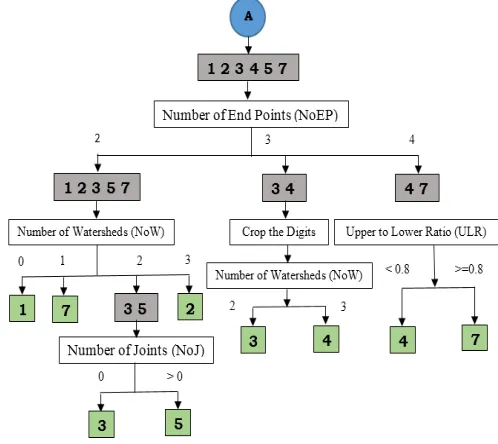
• Step2: Find the Number of Contours (NoC) and classify the digit as Group1 or Group2 or digit 8. • Step3: Find out the Skeleton of input image and extract
the Skeleton feature number of end points (NoEP) in Group1 and Group2.
• Step4: Based on NoEP in digits in Group1 further divide into 3 sub-groups Group1, Group1b, Group1c, Group2 and classify the digits 0, 2, 4
• Step5: Calculate the Number of watersheds (NoW) of the Digits in Group1.
• Step6: Based on NoW values further divide into Subgroup Group1a nd classify the digits 1, 7, and 2. • Step7: Calculate the Number of Joints of digits in
Group1.
• Step8: Based on the NoJ values classify the image is either digit 3 or 5.
• Step9: Crop the Digits in Gropu1b.
• Step10: Calculate the Number of watersheds (NoW) of the Digits in Group1b.
• Step11: Based on NoW values classify the digits either 3 or 4.
• Step12: Calculate the ratio between the numbers of foreground pixels in upper half part and lower half-part (ULR) of the numerical digit images in Grop1c. • Step13: Based on the ULR value classify the digit
either 4 or 7.
• Step 14: Calculate ULR value of the digits in Group2a • Step15: Based on the ULRvalue classify the digit either
6 or 9.
The graphical representation of the user define algorithm is shown in figure 20 nd 20b.
Fig 20a: Flow chart of user defined algorithm
Fig 20b: Flow chart of user defined algorithm
From the above algorithm, it is identified3 3that the3 3proposed method33needs the33feature at33maximum 4 for33the
classification3 3of handwritten3 3digits every digit does
notneed all these 4 features. The number of features required to recognize the digits is shown in the table3.
TABLEIII
FEATURE COUNT REQUIRED FOR FOR EACH DIGIT
Digit 0 1 2 3 4 5 6 7 8 9
Number of Features
2 2 2/3 3/4 3 4 3 3 1 3
III.RESULT AND DISCUSSION
We evaluated the performance of user-defined recognition algorthim with a standard handwritten numerals database set which are collected33from MNIST33database that contains of3360,000 training and 310,000 testing33datasets where as from CENPARMI database with 4,000 training set3 3and 2,000 testing 3set, CEDAR database with total trainingand testing datasets 21,179 respectively.And finally USPS database which consists of 7,291 training set and 2,007 testing test. The some of the images collected from students in Hyderabad city who are studied from first class to UG by giving the format to the students is shown in figure 3. Scan the individual digits and created own database which consists of 1,20,000 images as a training set and 24,000 images as a training set. Collectively, the dataset contains 2,12,470 digit images used for training and 38,007 images for testing. No such method has tested using with huge database.
All3 3experiments are33carried out33on a33PC 3machine with3 3i3 processor332.7GHz CPU33and 3 GB RAM33memory under3 3MatLab 11.0 aplatform. From the training set images extract
Classifier3 3performance depends3 3greatly on3 3the
characteristics3 3of the3 3data to3 3be 3classified. There3 3is no
single33classifier that33works best33on all33given3 problems3 (a
phenomenon33that may33be explained33by the33no-free-lunch3 3theorem). Various33empirical tests33have been33performed to
compare3 classifier3 3performance and3 3to find the 3characteristics of3 3data that3 3determine classifier3 3performance. Determining33a suitable33classifier for33a given3 3problem is33however still3 3more an33art than33a 3science. An3 3intriguing problem33in pattern33recognition yet33to be solved3 3is the3 3relationship between3 3the problem to3 3be solved
(data3 3to be3 classifieda) and3 3the performance3 3of various3 3pattern recognition3 3algorithms (classifiers3). In this3 3paper
used3 3user-defined3 3classification 3algorithm,
k-Nearest-Neighbor33Classifier and3 3Support Vector Machines (SVM)
are33used individually33and classify33test database3 digit 3images.
A. User defined algorithm
By using the algorithm defined in section 3, the digits are classified. The proposed algorithm is tested with 38007 images and the individual results of the test database is listed in table 4.
TABLEIV
RESULTS OF NUMERICAL RECOGNITION FOR 38007 TEST IMAGES USING USER-DEFINED CLASSIFIER
Digit No.of images Correctly
Classified Not Correctly Classified % accuracy
0 3,878 3,850 28 99.28
1 3,891 3,854 37 99.05
2 3,743 3,717 26 99.31
3 3,907 3,868 39 99.00
4 3,679 3,645 34 99.08
5 3,815 3,794 21 99.45
6 3,962 3,924 38 99.04
7 3,756 3,738 18 99.52
8 3,794 3,753 41 98.92
9 3,582 3,549 33 99.08
Average Recognition Percentage 99.17
B. K-Nearest neighbor classification (k-nn Classifier) The3 3proposed method3 3uses k-nearest3 3neighbor (k-nn)
classification3 3algorithm for3 3classifying the3 3test database3 3digit images3 3in test3 3database using33the feature3 3vector of3 3training database. The33k-nearest neighbor33algorithm (k-NN3)
is33classification technique3 3to classify33the digits3 3based on3
training3 3features 3space. In33K-nn object3 3is classified3 3to a3
particular33class which33has majority33of 3votes. In33the k-nn3 3classification, compute3 3the3 3distance between3 3feature
values33of the33test sample33and the33feature vector33values of3 3every training33image and33the class33of majority33mong the3 3k-nearest3 3training samples3 3is based3 3on the3 3Euclidian
distance3 3ameasures. The3 3training vector3 3is3 a
multidimensional33 3array. Each3 3row in3 3an array3 3contains
feature3 3values and3 3corresponding class3 3label of3 3the
training33images where33as test33vector contains33only feature3
values. In classification process, for each row in test
3vector assign3 3the class3 3label based3 3on the3 3Euclidian
distance3 3measures and3 3number of3 3neighbors (k) 3considered. The33k value is33defined by33the user.
The33algorithm is executed33with the33value of3 3k is331, 3,
aand 5. The3 3graphical representation3 3of the3 3accuracy of3 3classification in3 3using various3 3k values are3 3shown in3 3figure 10 and3 3the overall3 3classification results3 3are listed3 3out in33table 5. From33table 5, it33is clearly evident33that the3 3optimal3 value of3 3k is3 33 for3 3classification of3 3considered 3numerical digits3 by using33k-nearest neighbor3 classification 3technique. The33recognition rate33of the individual33digits in3 3test samples by using k-nearest neighbor classification
lgorithma (with k value 3) is listed in table 6 and from that table the overall recognition rate of the test database ias 98.62%.
TABLEV
ACCURACY RATE USING DIFFERENT VALUES OF K WITH KNN CLASSIFIER
NN classifiers with different K values Numbera of training samples Numbera of testinga digits images Accuracy in percentage
1 2,12,470 38,007 98.15
2 2,12,470 38,007 99.44
3 2,12,470 38,007 97.87
TABLEVI
RESULTS OF NUMERICAL RECOGNITION FOR 38007 TEST IMAGES USING K
-NN CLASSIFIER
Digit No.of images Correctly
Classified Not Correctly Classified % accuracy
0 3,878 3,829 49 98.74
1 3,891 3,833 58 98.51
2 3,743 3,696 47 98.74
3 3,907 3,847 60 98.46
4 3,679 3,624 55 98.51
5 3,815 3,773 42 98.90
6 3,962 3,903 59 98.51
7 3,756 3,717 39 98.96
8 3,794 3,732 62 98.37
9 3,582 3,528 54 98.49
Average Recognition Percentage 98.62
C. Support Vector Machines (SVM) based classification
In Artificial Intelligence (AI) and Machine Learning (ML), Support Vector Machine (SVM) algorithm is a powerful classification tool. It is a supervised learning model used for classification and regression. The SVM algorithm was developed by Vapnik developed the SVM algorthim for ML tasks. In this amodel, the present approach is given a set of training examples ain which each one of them is marked to be belonginga to one of the two classes.
margin learning algorithm is then applied. The present paper uses SVM classifier and statistical feature sets for classification.
The extracted features of both training data set and test database and are given to a SVM machine. The recognition rate of the individual digits in test samples by using SVM algorithm is shown in table 7 and from that table the overall recognition rate of the test database is 98.49%.
TABLEVII
RESULTS OF NUMERICAL RECOGNITION FOR 38007 TEST IMAGES USING
SVM CLASSIFIER
Digit No.of images Correctly Classified
Not Correctly Classified
% accuracy
0 3,878 3,824 54 98.61
1 3,891 3,828 63 98.38
2 3,743 3,691 52 98.61
3 3,907 3,842 65 98.34
4 3,679 3,619 60 98.37
5 3,815 3,768 47 98.77
6 3,962 3,898 64 98.38
7 3,756 3,712 44 98.83
8 3,794 3,727 67 98.23
9 3,582 3,523 59 98.35
Average Recognition Percentage 98.49
When comparing the three classifiers for the same test database and same feature set, User defined classifier shows better results it concludes that classification results not only depends on features extracted from the image but also depends on type of classification technique used. The overall recognition rate is about 98.76%. The time consumed for the testing of the test database for user defined algorithm is about 19.0025 sec, for k-nn classifier need 59.032 sec and SVM classifiers need 60.732 sec. The advantage of use defined classifier is once the algorithm is e defined no need to calculate the feature values. Any numbers of images can be tested.The confusion matrix generated by the user-defined classifier is shown in table 8.
TABLEVIII
CONFUSION MATRIX GENERATED WHEN USER DEFINE CLASSIFIER APPLIED ON TEST DATABASE
Digit 0 1 2 3 4 5 6 7 8 9
0 3850 4 2 0 0 0 3 8 6 5
1 2 3854 9 0 0 2 3 12 3 6
2 0 5 3717 3 2 2 2 3 2 7
3 0 2 1 3868 2 3 4 5 13 9
4 0 0 3 4 3645 5 2 3 11 6
5 0 0 2 3 0 3794 9 0 0 7
6 3 2 2 0 0 7 3924 7 9 8
7 0 12 0 1 0 0 0 3738 2 5
8 1 6 4 15 0 3 5 0 3753 7
9 5 0 3 4 2 1 7 3 8 3549
D. Comparison of the proposed approach with other
existing approaches:
The efficiency of the proposed method is compared with other existing methods like aDeep Learning proposed by Anuj Dutt et.al [28], MCS HOG Features and SVM classifer by Hamayun [29], and Convolutional Neural Network as a Classifierproposed by Jisha et.al [30]. Anuj Dutt proposed Machine Learning, Deep Learning and Computer Vision algorithms. The overall efficiency of the deep learing approach is about 98.72%. Hamayun proposed Multiple-Cell Size (MCS) approacha was aproposed for utilizing Histogram of Oriented Gradient (HOG) features and a Support Vector Machine (SVM) based classifier for efficient classification of Handwritten Digits. The HOG based techniques sensitive to the cell size selection used in the relevant feature extraction computations. Hence a new MCS aapproach has been used to perform HOG analysis and
compute the HOG features. This approach got 99.36% when applied on MNIST database. But while applying on other databases it is decreased to 97.13. Jisha proposed Convolution Neural Networks (CNNs) consist of multiple layers. It is a powerful technique for classification of visual inputs like handwritten digits nd faces recognition. The classification task is performed using aConvolution Neural Network (CNN). The actually purpose of developing the multilayer neural network is to reduce the meansquare error, between the actual output and the final output. But each subnet between the input and the hidden-layer are initialized with random weights and also trained with different feature maps. This is applied on only 1000 image but applied on large database it decreased to 96.36%. The3 3performance 3evolution of3 3the proposed method3 with3 other3 3existing
methods3 3is listed3 3out in3 3table 103 3and the3 3classification
321, it3 3is clearly3 3evident 33that, the3 3proposed method3 3exhibits a33high recognition33rate than33the existing33methods.
TABLEIX
ACCURACY OF HWDCLASSIFICATION OF DIFFERENT APPROACHES
Database
Deep learning
[28]
HOG based technique
[29]
Convolution Neural Networks
[30]
Proposed Approach
MNIST 98.98 97.28 95.72 98.95
CEDAR 98.73 97.45 96.39 99.24
CEPARMI 98.33 96.52 97.45 99.23
Scanned
images 98.85 97.28 95.88 99.29
Fig 21: Graphical representation of the % recognition of the proposed method and other existing method
IV.CONCLUSIONS
The novelty of this method is that, free from size normalization, fast, accurate, independent of size and Writer style/ink independent. The present paper defined classification of isolated handwritten digits with good classification results. The proposed method was tested with large database. No such method is available in the literature to test the large test data set. The proposed approach extracts only 5 features. The time complexity of the proposed method is also very less. The proposed method shows high recognition rate when compare with the test results of standard classification algorithms.
REFERENCES
[1] Y.LeCuu, B.Boser, J.S. Denker, D. Henderson, R.E. Howard, W. Hubbard and L.D. Jackel, Handwritten Digit Recognition with a Back-Propagation Network. AT&T Bell Laboratories, Holmdel, N.J.07733, 1990.
[2] Zhou, Z.H. and Feng, J, Deep Forest: Towards an Alternative to Deep NeuralNetworks.Proceedings of the Twenty-Sixth International Joint Conference on Artificial Intelligence, pp. 3553-3559, 2017 [3] Nielsen, M.A, Neural Networks and Deep Learning. Determination
Press, http://neuralnetworksanddeeplearning.com, 2015.
[4] Bengio, Y.I., Goodfellow, J. and Courville, A, Deep Learning. MIT Press, Cambridge, MA, http://www.deeplearningbook.org, 2016. [5] Farulla, G.A, Murru, N. and Rossini, R. A Fuzzy Approach for
Segmentation of Touching Characters, arXiv:1612.04862v1, https://arxiv.org/abs/1612.04862, pp.1-18, 2016.
[6] Chen, G., Li, Y. and Srihari, S.N, Word Recognition with Deep ConditionalRandom Fields. Proceedings of the IEEE International Conference on Image Processing (ICIP ), Phoenix, AZ, 25-28 September 2016.
[7] Liu, Z., Li, Y., Ren, F. and Yu, H. A Binary Convolutional Encoder-DecoderNetwork for Real-Time Natural Scene Text Processing. arXiv: 1612.03630v1, 2016.
[8] Jaderberg, M., Simonyan, K., Vedaldi, A. and Zisserman.A, Reading Text inthe Wild with Convolutional Neural Networks. International Journal of Comput Vision, vol 116, pp.1-20, 2016.
[9] Yin, X.C., Yin, X., Huang, K. and Hao, H.W, Robust Text Detection in NaturalScene Images. IEEE Transactions on Pattern Analysis and Machine Intelligence, vol 36, pp. 970-983, 2013.
[10] Oivind Trier, Anil Jain, Torfiinn Taxt, A feature extraction method for character recognition-A survey, pattern Recognition, vol 29, pp641-662, 1996.
[11] Shamic Surel, P.K.Das, Recognition of an Indian Scripts Using Multilayer Perceptions and fuzzy Features. Proc. Of 6th Int. Conf. on Document Analysis and Recognition (ICDAR), Seattle, pp 1220-1224, 2001.
[12] P.Nagabhushan, S.A.Angadi, B.S.Anami,A fuzzy statistical approach of Kannada Vowel Recognition based on Invariant Moments, Proc. Of NCDAR-2003, Mandy, Karnataka, India, pp.275-285, 2003.
[13] J.D. Tubes, A note on binary template matching. Pattern Recognition, vol 22, pp:359-365, 1989.
[14] Anil K.Jain, Douglass Zonker, Representation and Recognition of handwritten Digits using Deformable Templates, IEEE, Pattern analysis and machine intelligence, vol 19, pp:1386 – 1390,1997. [15] L.Heutte, T.Paquest, J.V.Moreau, Y.Lecourtier, C.Oliver, A
structural/ statistical feature based vector for handwritten character recognition, Pattern Recognition,vol 19, pp.629-641, 1998. [16] U Ravi Babu, Y V V Satyanarayan nd S. Marthu Perumal , Printed
Telugu Numeral Recognition based on Structural, Skeleton and Water Reservoir Features, International Journal Of Computers & Technology, Vol 10, pp.1815-1824, 2013.
[17] U Ravi Babu , U Venkateswralu and Anil Kumar, Handwritten Digit Recognition Using Structural, Statistical Features and K-nearest Neighbor Classifier. International Journal of Information Engineering and Electronic Business, vol 1, pp.62-68, 2014.
[18] U Ravi Babu and G Charles babu, Novel Technique for the Handwritten Digit Image Features Extraction for Recognition. International Journal of Video & Image Processing and Network Security IJVIPNS-IJENS Vol 15, pp: 1-9, 2015.
[19] Pullela S V V S R Kumar, Appana Naga Lakshmi, U Ravi Babu, New approaches for the Features Extraction on Handwritten Digit Image for Recognition. International Journal of Digital Content Technology and its Applications (JDCTA) Vol 10, pp: 33-44, 2016. [20] M. D. Garris, J. L. Blue and G. T. Candela, NIST form-based
handprint recognition system. National Institute of Standards and Technology, 1997.
[21] P. J. Grother, NIST special database 19 hand printed forms and characters database. National Institute of Standards and Technology, 1995.
[22] G. G. Rajput, Rajeswari Horakeri, Sidramappa Chandrakant, Printed and Handwritten Kannada NumeralRecognition Using Crack Codes and Fourier Descriptors Plate. IJCA Special Issue on RecentTrends in Image Processing and Pattern Recognition pp.53-58 2010 [23] Graham, D.N, Image transmission by two-dimensional contour
coding. Proceedings of the IEEE Vol55, pp.336 – 346, 1967. [24] U. Pal, T. Wakabayashi, N. Sharm nd F. Kimura,Handwritten
Numeral Recognition of Six Popular IndianScripts. In Proc. 9th International Conference on Document Analysis and Recognition. pp. 749-753, Curitiba,Brazil, September 24-26, 2007.
[26] Seong- W han Lee,Multi layer cluster neural network for totally unconstrained handwriritten numeralrecognition. Neural Networks. Vol 8, pp.409-418, 1984.
[27] U Pal and P.P.Roy, Multi-oriented and curved text lines extraction from Indian documents. IEEE Trans on system,Man and Cybernetics-Part B, Vol 34, pp.1667-1684, 2004.
[28] Anuj Dutt, AashiDutt, Handwritten Digit Recognition Using Deep Learning. International Journal of Advanced Research in Computer Engineering & Technology (IJARCET), Vol 6, pp: 990-997,2017.
[29] Hamayun A. Khan, MCS HOG Features and SVM Based HandwrittenDigit Recognition System. Journal of Intelligent Learning Systems and Applications, vol 9, pp.21-33, 2017,. [30] Jisha Mol L, Femy John, Handwritten Digit Recognition: