www.ann-geophys.net/30/1107/2012/ doi:10.5194/angeo-30-1107-2012
© Author(s) 2012. CC Attribution 3.0 License.
Annales
Geophysicae
Multifractal analysis of interplanetary magnetic field obtained
during CME events
M. J. A. Bolzan1and R. R. Rosa2
1Laborat´orio de F´ısica, Universidade Federal de Goi´as, Campus de Jata´ı, UFG, Brazil
2Laborat´orio Associado de Computac¸˜ao e Matem´atica Aplicada, Instituto Nacional de Pesquisas Espaciais, INPE, Brazil
Correspondence to: M. J. A. Bolzan ([email protected])
Received: 1 March 2012 – Revised: 3 July 2012 – Accepted: 6 July 2012 – Published: 1 August 2012
Abstract. In this paper, we have analyzed the interplane-tary magnetic field (IMF) obtained by ACE satellite during the coronal mass ejection events. The characterization of the IMF fluctuations was performed using the singular power spectra deviations obtained from a wavelet transform mod-ulus maxima (WTMM) approach. The results suggest the existence of different multifractal processes driving the in-termittency during and after the CME events on the IMF time series. The characteristic time scales found, using the WTMM, and possible related physical mechanisms are dis-cussed in the context of nonlinear interplanetary magnetic field response.
Keywords. Interplanetary physics (Interplanetary magnetic fields)
1 Introduction
Geophysics time series are often generated by complex spatio-temporal dynamics of which nonlinearity and scal-ing are the most important processes. In particular, the time series from a space environment such as the interplanetary magnetic field (IMF) presents several kinds of phenomena which are important to study due to the consequences over the Earth (Gonzalez et al., 1999). It presents a regular com-ponent (e.g. the solar daily variation or “Sq”), whereas it presents other irregular components due to geomagnetic dis-turbances caused by the solar wind-magnetosphere coupling, which is a remarkable nonlinear process. From the point of view of space weather, the study of irregular geomagnetic oscillations in solar-terrestrial physics is very important due to adverse effects on data transmission by satellites, power lines, and many others. Thus, the systematic study of the
statistical properties of complex magnetospheric variability and their relations to the solar wind has attracted a grow-ing interest (e.g. Chapman et al., 1998; Chang, 1999; Kov´acs et al., 2001; Lui, 2002; V¨or¨os et al., 2002). Recently, Papa et al. (2006) and Papa and Sosman (2008), who have been working with time series of the geomagnetic field time series obtained during disturbances, have shown that it is possible to find some universal characteristics such as a threshold sys-tem as the source of such perturbations.
Fig. 1. Three time series of interplanetary magnetic field for months shown in legends. The CME events are indicated by a number and a short bar.
sense, the continuous wavelet transform and its maxima can be used to reveal the structure of this irregular time series and its correspondent relevant time scales.
2 Data and methodology
Figure 1 shows the three IMF fluctuations corresponding to the 16-s time resolution Bz-component time series ob-served during (a) the month of March 2001, (b) the month of August 2003, and (c) the month of November 2003 at ACE satellite (http://www.srl.caltech.edu/ACE/ASC/DATA/ level3/index.html). In this figure, regions where the CME occurred were marked according to the classification from Richardson and Cane (2004) (http://www.ssg.sr.unh.edu/ mag/ace/ACElists/ICMEtable.html), totalizing four events. Thus, the analysis has been carried out in two parts of the time series: the first part includes the CME event and the other part after the CME event. Table 1 shows the days of the year for each event. It is important to mention that the main objective was to select different events in the sense that each one has a peculiar variability pattern. Thus, we believe that we would be getting the most general results. There may be other types of events between March 2001 and Novem-ber 2003. However, considering a common physical process, its statistical characteristics related to the pattern of variabil-ity should not vary significantly. Moreover, we consider the present analysis a complementary one of those events with which we had earlier work (Bolzan et al., 2005a, 2009b; Sa-hai et al., 2005).
[image:2.595.50.284.64.246.2]Several authors have analyzed the interplanetary data records of solar wind speed (slow/fast) to study the inter-mittency degree (for an extensive review, see Bruno et al., 2001). Burlaga (1991) concluded that the solar wind is made
Table 1. Start and end of CME events used in this work. This clas-sification was carried out by Richardson and Cane (2004).
Event Start of CME End of CME
1 4 March 2001 5 March 2001
2 17 August 2003 20 August 2003
3 31 October 2003 2 November 2003
[image:2.595.310.547.93.377.2]4 20 November 2003 21 November 2003
Fig. 2. Three time series of solar wind velocity for months shown in legends. The CME events also are indicated by a number and a short bar.
of a mixture of sheets and space-filling eddies of different sizes. Marsch and Liu (1993) showed that the slow solar wind is more intermittent than the fast solar wind. Bruno et al. (2001), by using a new method based on the wavelets, identified the flux tubes convected by the wind, which tan-gle up in space. Due to the importance of the solar wind on the intermittence in interplanetary environment, Fig. 2 shows the solar wind time series for the same periods of the IMF time series used in this work. Data sets were obtained from SOHO satellite on the home page (http://sohowww.nascom. nasa.gov/). We can notice that the first two events of CME (numbers 1 and 2) are characterized by a slow solar wind (≈550 km s−1), approximately, while the two last events are characterized by a fast solar wind (more than 750 km s−1). Besides, Marsch and Liu (1993) have mentioned that the slow solar wind is more intermittent than the fast solar wind; both kinds of solar winds contribute to intermittence on in-terplanetary environment.
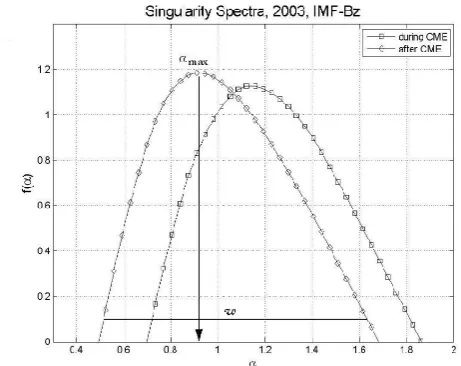
variability is intermittent and multifractal turbulence can co-exist with coherent global processes and self-organized criti-cality (V¨or¨os et al., 2002). As the inhomogeneity involves the singular behavior of the energy distribution in physical space resulting in strong gradients, or intermittency in the time-series of the energy related physical quantities of the sys-tem, e.g. velocity (Rodrigues Neto et al., 2001; Ramos et al., 2004), temperature (Bolzan et al., 2002) or magnetic fields (Kov´acs et al., 2001; Lui, 2002), an appropriate characteriza-tion of the IMF fluctuacharacteriza-tions is insured based on the multifrac-tal spectra,τ (q), and singularity spectra,f (α), which quan-tifies the deviations of the observed singularitiesαfrom the expected value and gives a measurement of the intermittency level (V¨or¨os, 2000). The underlying time scales involved in the intermittent level and their different types of τ (q) and f (α)spectra can characterize the fluctuation-driven mech-anism, for example, involving coherent structures or inter-mittent interplanetary magnetic field responses from CME events influence.
Among a few methods for multifractal analysis, we have considered, in order to obtain the singularity spectrum,f (α), the wavelet transform modulus maxima (WTMM) (Muzy et al., 1991). The basic idea behind the WTMM method is to describe the partition function over only the modulus max-ima of the wavelet transform of the signal. Thus, as given by Enescu et al. (2006), this transform is written as
(Wf ) (s, b)=1 s Z
f (t ) ψ∗ t−b
s
dt , (1)
wheresis the scaling factor,bis the location parameter,ψ∗ is the complex conjugate of the continuous wavelet function andf (t ) is the time series under analysis. Due to the vari-ability pattern of our data, we have used the Morlet wavelet function given by
ψ (t )=eiK t·e−t2/2, (2)
whereK=5 is recommended in practice, but can be modi-fied. The scaling and translation of this wavelet function are performed by the parameterssandb. While the scale param-etersstretches (or compresses) the mother wavelet to the re-quired resolution, the translation parameterbshifts the basis functions to the desired location.
It can be shown that the wavelet transform can reveal the local characteristics off at a point x0. More precisely, we have the following power-law relation:
Wf (s, x0)≈ |s|α(x0), (3)
whereα (x0)is the H¨older exponent (or singularity strength). The wavelet transform off (t )is able to show the invari-ance with respect to some renormalization operations involv-ing multiplicative cascades. This means that there is a hier-archy of the WTMM that has been used to define the parti-tion funcparti-tion based on the multifractal formalism (Arneodo
et al., 1995). The moment q of the measure distributed on the WTMM hierarchy is used to define the dependence of the scaling function on the momentq, so that the partition func-tionZ (q, s), of theq-th moment of the measure distributed over the WTMM at the scales, and it can be written as Z(q, s)=X
n
|Wf (yn, s)|q, (4)
whereyn is the position of all local maxima at a fixed scale s. Often scaling behavior observed forZ (q, s)and the spec-trumτ (q), which describes howZscales withS, can be de-fined as follows:
Z (q, s)≈Sτ (q). (5)
Then, the multifractal spectrum is obtained by applying the Legendre transformations toτ (q). If there is a system that has a monofractal structure, then we obtain a straight line in linear plot ofτversusq. When theτ (q)exponents in Eq. (5) are in the form of straight line, the time series is a monofrac-tal; otherwise, the time series is a multifractal (Oswiecimka et al., 2006).
3 Results and discussion
In order to analyze the influence of quasi-periodic oscilla-tions from CME on the multifractal spectra, we applied the Eq. (5) in the four time series with CME part and after CME time series ones. The multifractal spectra method was ap-plied to the length of the time series equivalent to the dura-tion of the CME intervals, as shown on Table 1. Thus, we use the same length of the time series after the same CME events. Figure 3 shows the values of theτ-spectrum for all the time-series data. Note that the bothτ-spectra are curved, in-dicating the multifractal nature. However, theτ-spectrum for the case where the CMEs are present is less curved, if com-pared with results after these CME events. Thus, it is possible to conjecture that, during the CME events, there are physical phenomena that are well defined, such as magnetic coherent structures, as shown in Fig. 5 (Chang et al., 2006).
Fig. 3. Multifractal spectral from time series during CME events, after CME events and monofractal case (straight black line). The legends indicate every event studied.
Fig. 4. Mean values of the singularity spectra,f (α), for two cate-gories: with and without CME events.
contributes to decrease the multifractal characteristics on the time series. The same result also was observed in another kind of the time series, specifically the vertical total electron content (VTEC) (Bolzan et al., 2009a).
Before we try to explain both distinct behaviors (during and after CME), it is necessary to have in mind the follow-ing concepts. Chang et al. (2006) have defined the term of dynamical complexity which refers to the nonlinearly inter-acting dynamics among magnetic coherent structures of dif-ferent sizes. One kind of such structures is shown in Fig. 5.
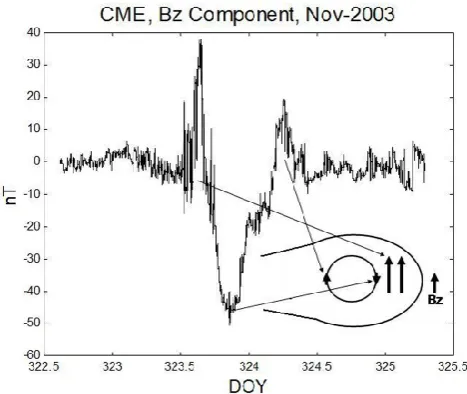
[image:4.595.310.548.66.198.2]According to the idea mentioned before, it is possible to visualize the action of these structures over an IMFBz com-ponent time series of November 2003. Figure 6 shows a
Fig. 5. Magnetic coherent vortex. Figure extracted from work of Chang et al. (2006).
schematic approach. These structures are energetic physical phenomena that have a geometric form predominant in the CME, causing an almost well-deterministic behavior that re-duces the multifractality degree, because this phenomenon privileges only a few scales. After the CME, the system presents several kinds of the small structures and its different sizes, causing the increase of multifractality degree, where this elevation of the multifractal degree is necessary to pro-mote the re-distribution of energy from CME down to dissi-pation scales.
Our result corroborates with results from Telesca et al. (2004), who found also a decrease of multifractality de-gree in geomagnetic time series due to the presence of the powerful oscillations. Thus, it is possible to conjecture that, for the CME events, there are physical phenomena that are well defined, such as magnetic coherent structures, and are responsible for the decrease of the multifractality degree ob-served in our results.
[image:4.595.55.286.321.504.2]Fig. 6. Schematic approach of the action of the magnetic coherent vortex over IMF-Bzcomponent.
4 Concluding remarks
In this article, we analyze a set of characteristic data of the IMF-Bz component obtained by ACE satellite during the coronal mass ejection (CME) events. These events are inter-preted as a nonlinearly interacting dynamical system charac-terized by the presence of large-scale coherent structures of different sizes (Chang et al., 2006). Our multifractal analysis showed that the presence of these strong and well-behaved structures in the CME decreases the multifractality degree, if compared with periods after the CME events. This result cor-roborates with Telesca et al. (2004), who have also observed this behavior on geomagnetic time series where, according to them, the multifractality degree of the signal is strongly reduced by the presence of powerful oscillations. This be-havior was also observed in our previous works using a dif-ferent kind of time series from geomagnetic fluctuations and related data (Bolzan et al., 2009a, c). Our results, together with others which characterize the global environment inter-planetary plasma, suggest that low values of the degree of multifractality can be directly associated with the presence of coherent structures. Thus, the technique used here serves as a tool to detect coherent structures present in the geomag-netic dynamics, especially when studied within the context of solar-terrestrial physics.
Acknowledgements. This work was supported by CNPq (grants
no. 301457/2009-3). Thanks also to referees for fruitful comments given by this work.
Topical Editor R. Nakamura thanks two anonymous referees for their help in evaluating this paper.
References
Arneodo, A., Bacry, E., and Muzy, J. F.: The thermodynamics of fractals revisited with wavelets, Physica A, 213, 232–275, 1995. Balasis, G., Daglis, I. A., Papadimitriou, C., Kalimeri, M., Anas-tasiadis, A., and Eftaxias, K.: Dynamical complexity in Dst time series using non-extensive Tsallis entropy, Geophys. Res. Lett., 35, L14102, doi:10.1029/2008GL034743, 2008.
Bolzan, M. J. A., Ramos, F. M., S´a, L. D. A., Rodrigues Neto, C., and Rosa, R. R.: Analysis of fine-scale canopy turbulence within and above na Amazon Forest using Tsal-lis’ generalized thermostatistics, J. Geophys. Res., 107, 8063, doi:10.1029/2001JD000378, 2002.
Bolzan, M. J. A., Sahai, Y., Fagundes, P. R., Rosa, R. R., Ramos, F. M., and Abalde, J. R.: Intermittency analysis of geomagnetic storm time-series observed in Brazil, J. Atmos. Solar-Terr. Phys., 67, 1365–1372, doi:10.1016/j.jastp.2005.06.008, 2005a. Bolzan, M. J. A., Sahai, Y., Fagundes, P. R., Rosa, R. R.,
Ramos, F. M., and Abalde, J. R.: Generalized thermo statis-tics and wavelet analysis of solar wind and proton den-sity variability, J. Atmos. Solar-Terr. Phys., 67, 1843–1851, doi:10.1016/j.jastp.2005.01.015, 2005b.
Bolzan, M. J. A., Becker-Guedes, F., Fagundes, P. R., Sahai, Y., Pillat, V. G., and Wrasse, C. M.: Statistical analysis of the total electron content observed at 23oS in the Brazilian sector, Adv. Space Res., 44, 385–394, doi:10.1016/j.asr.2009.03.012, 2009a. Bolzan, M. J. A., Guarnieri, F. L., and Vieira, P. C.: Compar-isons between two wavelet functions in extracting coherent struc-tures from solar wind time series, Brazilian J. Phys., 39, 12–17, doi:10.1590/S013-97332009000100002, 2009b.
Bolzan, M. J. A., Rosa, R. R., and Sahai, Y.: Multifractal analysis of low-latitude geomagnetic fluctuations, Ann. Geophys., 27, 569– 576, doi:10.5194/angeo-27-569-2009, 2009c.
Bruno, R., Carbone, V., Veltri, P., Pietropaolo, E., and Bavassano, B.. Identifying intermittency events in the solar wind, Planet. Space Sci., 49, 1201–1210, 2001.
Burlaga, L.: Intermittent turbulence in the solar wind, J. Geophys. Res., 96, 5847–5851, 1991.
Chang, T.: Self-organized criticality, multi-fractal spectra, sporadic localized reconnections and intermittent turbulence in the mag-netotail, Phys. Plasmas, 6, 4137–4145, 1999.
Chang, T., Tam, S. W. Y., and Wu, C.-C.: Complexity in Space Plasmas – A Brief Review, Space Sci. Rev., 122, 281–291, doi:10.1007/s11214-006-5957-4, 2006.
Chapman, S. C., Watkins, N. W., Dendy, R. O., Helander, P., and Rowlands, G.: A simple avalanche model as an analogue for magnetospheric activity, Geophys. Res. Lett., 25, 2397–2400, 1998.
Enescu, B., Ito, K., and Struzik, Z.: Wavelet-based multiscale resolution analysis of real and simulated time-series of earth-quakes, Geophys. J. Int., 164, 63–74, doi:10.1111/j.1365-246X.2005.02810.x, 2006.
Frisch, U.: Turbulence, Cambridge University Press, New York, 1995.
Gonzalez, W. D., Tsurutani, B. R., and Gonzalez, A. L. C.: In-terplanetary origin of geomagnetic storms, Space Sci. Rev., 88, 529–562, 1999.
1986.
Kolmogorov, A. N.: The local structure of turbulence in an incom-pressible viscous flow for very high Reynolds numbers, C. R. Acad. Sci., SSSR, 30, 301–305 (see also in Proc. R. Soc. London A., 434, 9–13, 1991), 1941.
Kov´acs, P., Carbone, V., and V¨or¨os, Z.: Wavelet-based filtering of intermittent events from geomagnetic time-series, Planet. Space Sci., 49, 1219–1231, 2001.
Lui, A. T. Y.: Multiscale phenomena in the near-Earth magneto-sphere, J. Atmos. Solar-Terr. Phys., 64, 125–143, 2002. Marsch, E. and Liu, S.: Structure functions and intermittency of
ve-locity fluctuations in the inner solar wind, Ann. Geophys., 11, 227–238, 1993.
Meneveau, C. and Sreenivasan, K. R.: Simple multifractal cascade model for fully developed turbulence, Phys. Rev. Lett., 59, 1424– 1427, 1987.
Muzy, J. F., Bacry, E., and Arneodo, A.: Wavelets and Multifractal formalism for singular signals: Application to turbulence data, Phys. Rev. Lett., 67, 3515–3518, 1991.
Oswiecimka, P., Kwapien, J., and Drozdz, S.: Wavelet versus de-trended fluctuation analysis of multifractal structures, Phys. Rev. E, 74, 016103, doi:10.1103/PhysRevE.74.016103, 2006. Papa, A. R. R. and Sosman, L. P.: Statistical properties of
geo-magnetic measurements as a potential forecast tool for strong perturbations, J. Atmos. Solar-Terr. Phys., 70, 1102–1109, doi:10.1016/j.jastp.2008.01.010, 2008.
Papa, A. R. R., Barreto, L. M., and Seixas, N. A. B.: Statistical study of magnetic disturbances at the Earth’s surface, J. Atmos. Solar-Terr. Phys., 68, 930–936, doi:10.1016/j.jastp.2006.01.004, 2006.
Ramos, F. M., Bolzan, M. J. A., S´a, L. D. A., Rosa, R. R., and Rodrigues Neto, C.: Atmospheric turbulence within and above an Amazon Forest, Physica D-Nonlinear Phenomena, 193, 278– 291, doi:10.1016/j.physd.2004.01.026, 2004.
Richardson, I. G. and Cane, H. V.: Identification of interplane-tary coronal mass ejections at 1 AU using multiple solar wind plasma composition anomalies, J. Geophys. Res., 109, A09104, doi:10.1029/2004JA010598, 2004.
Rodrigues Neto, C., Zanandrea, A., Ramos, F. M., Rosa, R. R., Bolzan, M. J. A., and S´a, L. D. A.: Multiscale analysis from tur-bulent time series with wavelet transform, Physica A – Statistical Mechanics and its Applications, 295, 215–218, 2001.
Sahai, Y., Fagundes, P. R., Becker-Guedes, F., Bolzan, M. J. A., Abalde, J. R., Pillat, V. G., de Jesus, R., Lima, W. L. C., Crow-ley, G., Shiokawa, K., MacDougall, J. W., Lan, H. T., Igarashi, K., and Bittencourt, J. A.: Effects of the major geomagnetic storms of October 2003 on the equatorial and low-latitude F re-gion in two longitudinal sectors, J. Geophys. Res., 110, A12S91, doi:10.1029/2004JA010999, 2005.
Telesca, L., Lapenna, V., Vallianatos, F., Makris, J., and Saltas, V.: Multifractal features in short-term time dynamics of ULF geo-magnetic field measured in Crete, Greece, Chaos, Solitons and Fractals, 21, 273–282, doi:10.1016/j.chaos.2003.10.020, 2004. V¨or¨os, Z.: On multifractality of high-latitude geomagnetic
fluctua-tions, Ann. Geophys., 18, 1273–1282, doi:10.1007/s00585-000-1273-6, 2000.
V¨or¨os, Z., Jankoviˇcov´a, D., and Kov´acs, P.: Scaling and singu-larity characteristics of solar wind and magnetospheric fluctua-tions, Nonlin. Processes Geophys., 9, 149–162, doi:10.5194/npg-9-149-2002, 2002.