USF Scholarship: a digital repository @ Gleeson Library | Geschke
USF Scholarship: a digital repository @ Gleeson Library | Geschke
Center
Center
Master's Theses Theses, Dissertations, Capstones and Projects
1999
A Comparison of Problem-Centered Learning Model and
A Comparison of Problem-Centered Learning Model and
Guided-Practice Model on High-School Students' Mathematics
Practice Model on High-School Students' Mathematics
Performance and Attitude
Performance and Attitude
Samer G. Malouf
Unauthorized reproduction of any portion of this thesis is prohibited. The quality of this reproduction is
contingent upon the quality of the original copy submitted.
University of San Francisco Gleeson Library/Geschke Center
2130 Fulton Street
A COMPARISON OF PROBLEM-CENTERED LEARNING MODEL AND GUIDED-PRACTICE MODEL ON HIGH-SCHOOL
STUDENTS' MATHEMATICS PERFORMANCE AND ATTITUDE
A Dissertation Presented to
The Faculty of the School of Education Leaming and Instruction
In Partial Fulfillment
Of the Requirements for the Degree Doctor of Education
by
Samer G. Malouf San Francisco. CA
candidate's dissertation committee and approved by the
members of the committee, has been presented to and
accepted by the Faculty of the School of Education in partial
fulfillment of the requirements for the degree of Doctor of
Education.
The content and research methodologies
presented in this work represent the work of the candidate
alone.
Candidate
Dissertation Committee
~ {
~JJ.W
Chairperson
~
~ ~
-Fourth Reader (if applicable)
Sf
LJ {
9
9
Date
4 H~'-~q9
My debts begin with Dr. Mathew Mitchell who helped me since my first day in
my doctorate program and served as a chair on my dissertation committee. Dr. Mitchell
was a source of wisdom throughout the project. I greatly appreciate the efforts of Dr.
Patricia Busk who served as a second reader on my dissenation committee. Dr. Busk is a
professor with a critical mind, who spent lots of time reading proofs, making last-minute suggestions, and helping me meet deadlines. I want to acknowledge Dr. Linda Shore. who
made time in her busy schedule to read my dissertation, correct proofs, and make necessary quenes.
I like to extend my thanks to my wife, Hi yam, and my child Samuel-George, without whose confidence and encouragement against all odds, this dissertation wouldn't have been possible.
Finally, and most important, I like to thank my Lord, Jesus Christ. without whose love, support, and blessings this book would never have seen the light of day.
I dedicated this book to my wife, Hiyam. son. Samuel-George, and my Lord. Jesus
Christ.
Topic .
Acknowledgments
List of Tables .
CHAPTER I INTRODUCTION
Statement of the Problem
Purpose of the Study
Definitions of Key Terms
Background and Need
Theoretical Rationale
Research Questions
CHAPTER II REVIEW OF THE LITERATURE
Heuristics
Constructivism
Attitudes Toward Mathematics
CHAPTER III METHODOLOGY
Purpose of the Study
Research Questions
Design and Variables .
Protection of Human Subjects
Instrumentation
Procedure
Data Analysis .
98
99
107
110
Chapter IV Findings 111
Introduction 111
Reliability Data 111
Data Analysis for Stanford Achievement Test 115
Data Analysis for Pretest and Posttest 116
Correlation Between Attitude and Performance 128
Gender Effect for Both the Algebra and IMP Students 130
Summary 133
Chapter V Discussion, Limitations, Implications and Recommendations 134
Limitations 134
Mathematical Problem-Solving Performance. 135
Attitudes Toward Mathematics 141
Problem-Solving Performance Instrument 143
Implications 146
Recommendations for Future Research 14 7
References 149
Appendices
165
A. Survey.
165
B. Problem-Solving Test.
169
C. Parent-Information Letter 174
D. SFUSD Approval Letter 177
E. Course Description
179
F. Sample Assignments 21 l
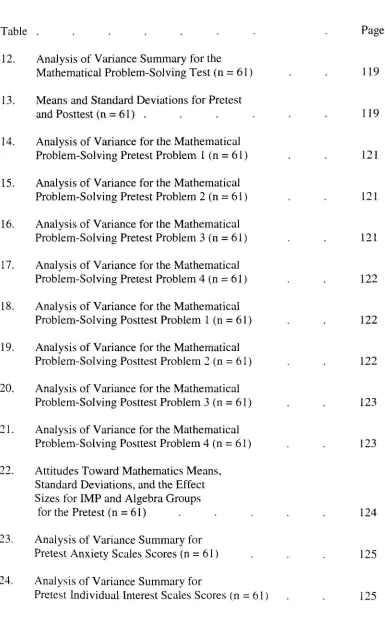
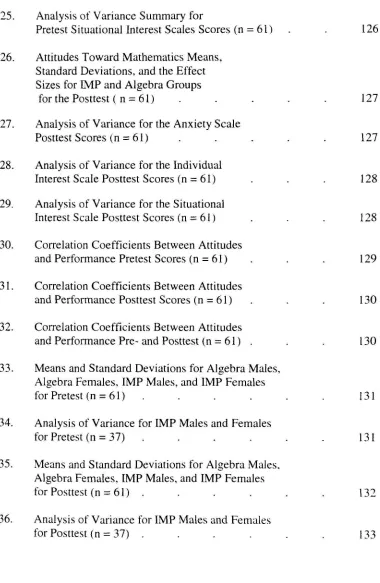
Table Page
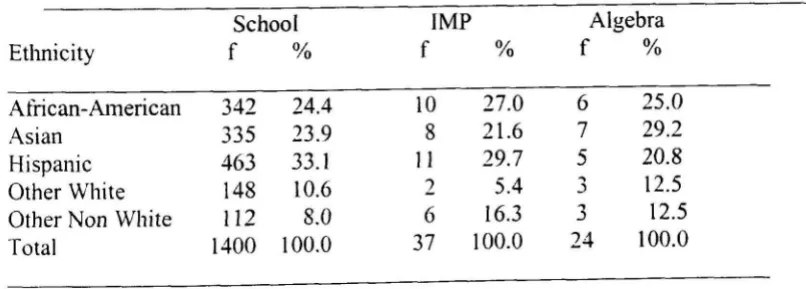
1. Ethnicity of the Students in the Study. 98
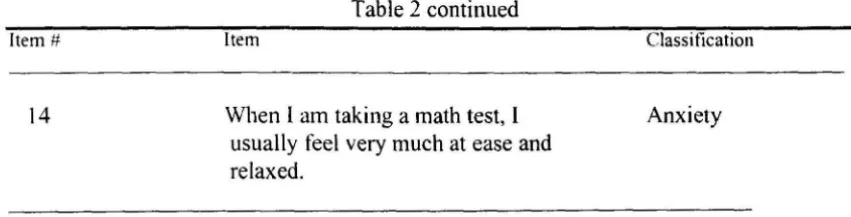
2. Classification of the Survey Items 105
3. Percentage of Agreement Between the Two Readers on the Mathematical
Problem-Solving Pretest 112
4. Percentage of Agreement Between the Two Readers on the Mathematical
Problem-Solving Posttest 113
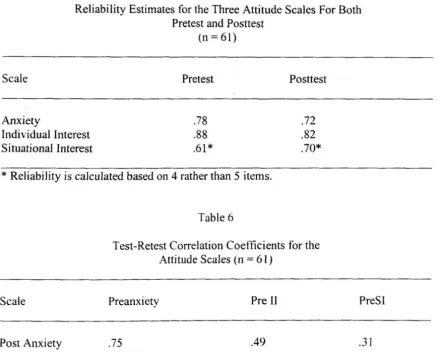
5. Internal Consistency for the three Attitude
Scales for Both Pretest and Posttest (n = 61) . 114
6. Test-Retest Correlation Coefficients
for the Attitude Scales 114
7. Stanford Achievement Test Means, Standard Deviations, and Effect Sizes
For IMP and Algebra Students (n =40) 115
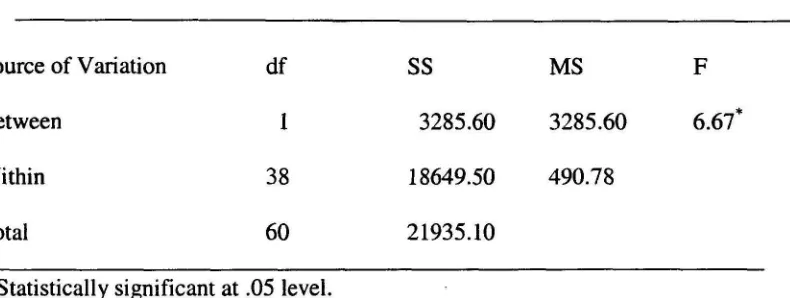
8. Analysis of Variance Summary for
the Stanford Achievement Test 116
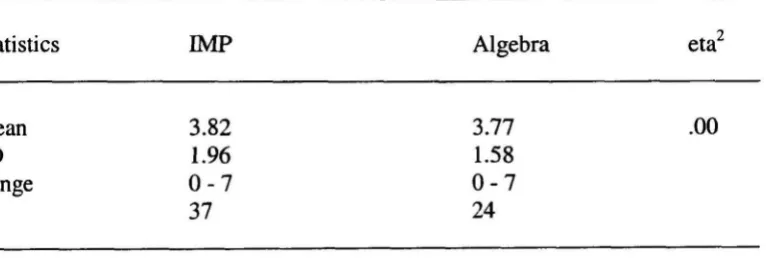
9. Mathematical Problem-Solving Test Means, Standard Deviations, Range of Scores, and Effect Sizes for IMP
and Algebra Students for the Pretest (n = 61) 117
10. Analysis Summary for the Mathematical
Problem-Solving Pretest 118
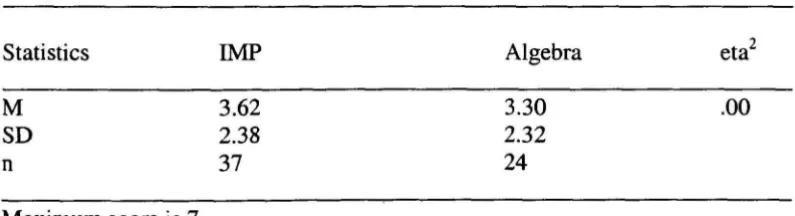
11. Mathematical Problem-Solving Test Means. Standard Deviations, and Effect Sizes for
IMP and Algebra Students for Posttest (n = 6 l) 118
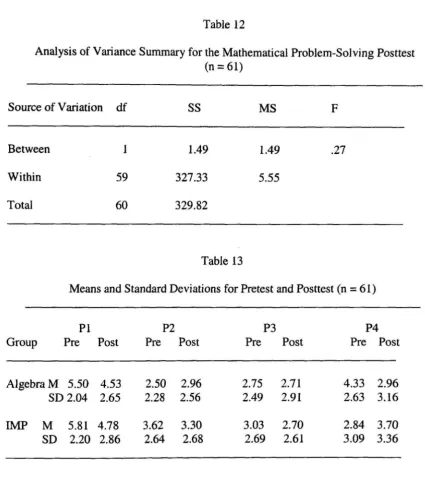
12. Analysis of Variance Summary for the
Mathematical Problem-Solving Test (n
=
61) 11913. Means and Standard Deviations for Pretest
and Posttest (n
=
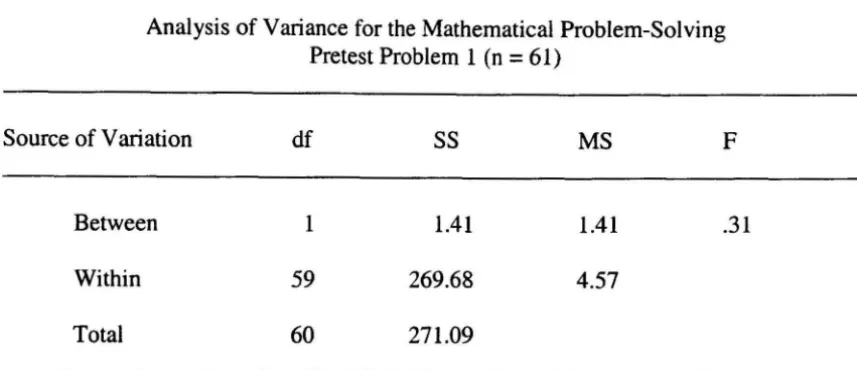
61) 11914. Analysis of Variance for the Mathematical
Problem-Solving Pretest Problem 1 (n
=
61) 12115. Analysis of Variance for the Mathematical
Problem-Solving Pretest Problem 2 (n
=
61) 12116. Analysis of Variance for the Mathematical
Problem-Solving Pretest Problem 3 (n
=
61) 12117. Analysis of Variance for the Mathematical
Problem-Solving Pretest Problem 4 (n
=
61) 12218. Analysis of Variance for the Mathematical
Problem-Solving Posttest Problem 1 (n
=
61) 12219. Analysis of Variance for the Mathematical
Problem-Solving Posttest Problem 2 (n
=
61) 12220. Analysis of Variance for the Mathematical
Problem-Solving Posttest Problem 3 (n
=
61) 12321. Analysis of Variance for the Mathematical
Problem-Solving Posttest Problem 4 (n
=
61) 12322. Attitudes Toward Mathematics Means, Standard Deviations, and the Effect Sizes for IMP and Algebra Groups
for the Pretest (n
=
61) 12423. Analysis of Variance Summary for
Pretest Anxiety Scales Scores (n
=
61) 12524. Analysis of Variance Summary for
Pretest Individual Interest Scales Scores (n
=
61) 12525. Analysis of Variance Summary for
Pretest Situational Interest Scales Scores (n
=
61) 12626. Attitudes Toward Mathematics Means, Standard Deviations, and the Effect Sizes for IMP and Algebra Groups
for the Posttest ( n
=
61) 12727. Analysis of Variance for the Anxiety Scale
Posttest Scores (n
=
61) 12728. Analysis of Variance for the Individual
Interest Scale Posttest Scores (n
=
61) 12829. Analysis of Variance for the Situational
Interest Scale Posttest Scores (n
=
61) 12830. Correlation Coefficients Between Attitudes
and Performance Pretest Scores (n
=
61) 12931. Correlation Coefficients Between Attitudes
and Performance Posttest Scores ( n
=
61) 13032. Correlation Coefficients Between Attitudes
and Performance Pre- and Posttest (n
=
61) 13033. Means and Standard Deviations for Algebra Males, Algebra Females, IMP Males, and IMP Females
for Pretest (n
=
61) 13134. Analysis of Variance for IMP Males and Females
for Pretest (n
=
37) 13135. Means and Standard Deviations for Algebra Males, Algebra Females, IMP Males, and IMP Females
for Posttest (n
=
61) 13236. Analysis of Variance for IMP Males and Females
for Posttest (n
=
37) 133Statement of the Problem
Introduction
What mathematics skills should be most central in the high-school curricula?
What type of mathematics curricula is needed to ensure successful learning of these most
central skills? Reports from the National Council of Teachers of Mathematics (NCTM,
1980, 1989) indicated that problem solving should be the focus of school mathematics
and declared the 1980s as the "decade of problem solving" (NCTM, 1980). Lester
( 1994) wrote that " problem solving has come to be regarded as a fundamentally
important aspect of mathematics education" ( p. 662). More important, Lester argued
that most mathematics educators agree that the development of students' problem-solving
abilities is a primary objective of instruction.
Research studies, hO\vever, indicate that high-school students have not developed
appropriate problem-solving skills. For example, a published report of the National
Assessment of Educational Progress (Dossey, Mullis,
&
Jones, 1993) indicated that onextended constructed-response tasks, which required students to solve problems and then
explain their solutions, the average percentage of students producing satisfactory or better
responses was 16 % at grades 4 and 8 and 9% at grade 12. Lester wrote, " the situation in
the American schools with respect to student perfom,ance in mathematical problem
solving is desperate. Although the conference reports. curriculum guides, and textbooks
insist that problem solving has become central to instruction at e\'ery level. the evidence
suggests otherwise" (p. 660). Lester argued that no mathematics program has been
focus of the cuniculum. Indeed, there seem to be few examples of effective
problem-solving curricula.
Purpose of the Study
The purpose of this study was to compare and correlate the mathematical
problem-solving skills and attitudes of high-school students using two different teaching
approaches: (a) problem-centered learning approach and (b) teacher- guided approach.
This study predicted that using problem-centered learning approach would not only
produce better problem-solving students but also students with better attitudes toward
mathematics. In this study, problem-solving skills were defined by Polya 's four-phase
problem-solving model. Polya's model includes four steps: (a) understanding the
problem, (b) devising a plan, (c) carrying out the plan, and (d) looking back at the
completed solution (Polya, 1957).
Problem-centered learning has three essential components: assigning tasks,
working in small groups, and sharing results. ln this model, the teacher provides students
with a problem. Students, working in small groups, find an answer to this problem. Then
the teacher provides some sharing time at which students present their answers to the
whole class ( Wheatley, 1989).
For the purpose of this study, the teacher-guided approach was defined as
lecturing for most of the class time then giving students drill practice exercises to practice
what has been lectured. This teacher-guided approach is what is practiced in most
classrooms and served as a control in this study. [n this studv, the instructional strate2:v
-
The two dependent variables that were investigated are as follO\vs: a) mathematics
performance as measured by a problem-solving test and b) attitude toward mathematics
as measured by a questionnaire.
Definitions of Key Terms
Attitude Toward Mathematics: In this study, the tenn "Attitude toward mathematics"
was defined as a mental position or feeling with regard to a mathematics as a field of
study. A Likert scale was used to measure attitude toward mathematics.
Problem Solving: Problem solving refers to the process of moving from a starting point
of information toward some goal (Mayer, 1985). In this study, the tenn problem solving
was defined by Polya's four-phase problem solving that includes understanding the
problem, devising a plan, carrying out the plan, and looking back (Polya, 1957). Students
are expected to communicate their solution strategies to mathematics problems by writing
down their explanations on paper using the above four steps.
Mathematics Achievement or Perfonnance: In this study, mathematics achievement was
defined as the students' ability to become better problem solvers. Mathematics
achievement was measured by a problem-solving test (Van Akkeren, 1995).
Teacher-Guided approach: In this study, teacher-guided approach was defined as
lecturing for most of the class then giving students drill and practice exercises to practice
class.
Problem-Leaming Centered: In this study, problem-learning centered was defined as a
teaching strategy that includes three components: assigning tasks, working in small
groups, and sharing results. In this strategy, the teacher provides students with a problem
then allows students to work in small groups to find a solution to this problem. Finally,
the teacher provides some sharing time at which students present their solution to the
whole class (Wheatley, 1989). The problem-centered approach was utilized in an IMP
class.
Problem: In this study, the term •'problem" was defined as a task that is difficult for the
individual who is trying to solve it (Schoenfeld, 1985). According to Schoenfeld ( 1985),
this difficulty should be an intellectual impasse rather than a computational one.
Schoenfeld (1985) argued that, if the person has ready access to a solution schema for a
mathematical task, the task is an exercise and not a problem.
Heuristics: In this study, heuristics were defined as strategies and techniques for making
progress on unfamiliar problems (Scheonfeld, 1985). Examples of how students are
expected to use heuristics in this study include drawing figures, making tables, finding
patterns, or a combination of these approaches.
Background and Need
Different approaches to teaching mathematical problem solving have been
identified in the literature. One purpose of this section is to discuss five of these
new mathematics approach. (d) Polya and heuristics approaches, and (e)
problem-centered learning cun-icula. Looking at this research literature will provide not only basic
understanding of different approaches to teaching mathematical problem solving but also
highlight what is lacking in the previous research.
Real life-situations curricula. Research has indicated that mathematical
problem-solving curricula has been adapted around life situations since the 1930s ( Ornstein &
Hunkins, 1993). As the name indicates, the emphasis of this teaching approach is on life
functions or life situations. In this approach, students learn the mathematics they need
around the context of real-world problem solving (Hiebert et al., 1996). Thus, these
ctmicula attempt to make mathematics useful.
Recent reform recommendations also place a heavier emphasis on meaningful
applications and connecting mathematics to the real world (NCTM, 1989, 1991 ). In
addition, many real-life problems are proposed as an appropriate context for learning and
assessment (Burhardt. 1981; Cognition and Technology Group at Vanderbilt, 1990; Lesh
& Lemon, 1992; Romberg, 1992).
This mathematical problem-solving approach was built upon three major
assumptions as described by Ornstein and Hunkins ( 1993 ). First, persistent life
situations such as (a) protecting life and health, (b) getting a living. and (c) improving
material conditions are essentials to society successful functioning, thus it is important to
organize the curriculum around these situations. Second. the curriculum will be
meaningful to students if the content is organized around aspects of community life.
improve society but also directly \Viii be involved in such improvement. There are three
major strengths of this instructional design. First, its focus is on the problem-solving
procedures for learning. Both content and process are integrated effectively into the
curricular experience. Second, it utilizes the past and the current experiences of learners
as a mean of getting them to analyze the basic areas of living. Third, it presents
mathematics in an integrated fonn by cutting across the separate subjects areas and across
related categories of social life.
But, like other teaching approaches, this approach has several deficiencies. First
detennining the scope and sequence of the essential areas ofliving is difficult. The scope
of the present time is different from the scope of the future. Second, this design does not
expose adequately students to their cultural heritage. Third, this design is not appropriate
for teachers, because they lack adequate preparation for it. More important, the textbooks
and other teaching materials inhibit the teaching of this curriculum (Ornstein & Hunkins,
1993). Therefore, it is difficult to implement this approach unless there is an adequate
training for teachers and students and a good mathematical problem-solving curricula that
addresses mathematics topics and relates mathematics to real-life situations. An example
of the mathematical real-Ii fe situations curriculum is the "anchored-instrnction" approach
implemented by members of the Technology Group at Vanderbilt. The goal of this
curriculum is to help students develop the confidence, skills, and knowledge needed to
solve problems and become independent thinkers and learners (Cognition and
Technology Group at Vanderbilt. I 990).
Members of the Technology Group at Vanderbilt have been influenced by the
recalled when people are asked explicitly to do so but is not used spontaneously in
problem solving even though it is relevant (Whitehead, 1929). For instance, a teacher of
educational psychology gave her students a long article and told them they had I 0
minutes to learn as much as they could about it. Despite of the fact that these students
had classes that taught them to skim for main ideas, consult section headings, and so
forth, they were not able to recall what they have been learned. Instead, students in this
class began with the first sentence of the article and started to read as fast as they could
until their time was up. Later, when discussing their strategies, the students
acknowledged that they knew better than to simply begin reading. but, they did not use
spontaneously this problem-solving strategy they had been taught when it would have
been useful ( Bereiter, l 984 ).
To help students overcome the problem of inert knowledge, the Cognition
and Technology Group at Vanderbilt ( 1990) has implemented the concept of
cmchored instruction. According to the Cognition and Technology Group at
Vanderbilt ( l 990), the tem1 anchored instruction is instructions that are situated
in videodisc-based instmctions that include problem-solving environments for
both teachers and students to explore. Using the concept of anchored instruction, the
Vanderbilt Group has created environments that enable both teachers and students to
explore and understand the kinds of problems and opportunities that --experts" encounter
and the knowledge that experts use as tools.
These adventures were designed for fifth and sixth graders. In these projects,
students have to generate the problems to be solved and then have to find relevant
The "Jasper Series" by the Vanderbilt Technology Group ( 1990) was designed to develop and evaluate a series of videodisc adventures whose primary focus is on
mathematical problem fommlation and solving. The main character of these adventures is Jasper. In these adventures, Jasper goes to Cedar Creek to look at an old cruiser that he is interested in buying. He sets out for Cedar Creek in his little motorboat. On the video, Jasper is shown consulting a map of the area, listening to his marine radio, and so forth. As the story continues. Jasper stops for gas at Larry's dock. He leaves Larry's after buying gas with his only cash-- a 20-dollar bill-- and sets out up river. He runs into a bit of trouble when he hits something in the water and breaks the shear pin of his propeller. Jasper goes to a repair shop where he pays to have his shear pin replaced. He finally reaches Cedar Creek boat dock where he locates Sal, the cruiser's owner. He and Sal test drive the cruiser and find out the boat's cruising speed. They return to the dock where they fill the cruiser's gas tank. Jasper decides to buy the crniser, and he and Sal conclude the transaction.
Students are challenged to do three things including (a) identify Jasper's major goal. which is to get home before the sunset without running out of gas, (b) generate subproblems that represent obstacles to this goal such as rnnning out of gas, and (c) devise strategies to deal with and solve these subproblems.
realistic settings and opportunities for training for transfer (Cognition and Technology
Group at Vanderbilt, l 990). The students were given opportunities to discuss similarities
and differences among problem situations that helped in facilitating the degree to which
the transfer occurred (Brandsford, Stein, Delcos, & Littlefield, 1986). It also was found
that teachers have been enthusiastic about Jasper, because their students seem to be
challenged to solve the problem and because even students who normally are not good in
mathematics can contribute to problem solving by noticing information in the video that
is relevant for solving Jasper's problem.
The situated instruction has three major problems that make it an incomplete
approach to teaching mathematical problem solving. First, it is built on the assumption
that mathematical procedures and concepts should not be taught as isolated bits of
information, and the instruction should be designed so that students build connections
with prior knowledge. It is less clear what connections are most important or what kind of
instmction is most effective for promoting these connections (Hiebert & Carpenter,
1992). Therefore. it is difficult for mathematics teachers who are implementing the
real-life approach to design daily lessons that builds on students' previous knowledge and that
is connected to real life.
Second, the research on anchored instmction does not suggest how knO\vledge is
integrated into a fully developed network including concepts, procedures, and symbols of
in-school mathematics (Hiebert & Carpenter. 1992).
Third, one of the dangers in attempting to build upon students· kno\vledge is that
students· informal conceptions may be limiting. The problem situations that initially are
develop a full understanding of a given construct. For example. children as young as first
graders can begin to develop an initial understanding of multiplication as a group of sets
containing the same number of objects; by the third grade, these students relate
multiplication to repeated addition (Kouba, 1989). This narrow conception of
multiplication does not extend well to fractions and decimals and results in such
misconceptions as "multiplication always makes bigger" (Bell et al., 1989; Fischbein et
al., 1985). Thus if you limit all instructions to students' prior knowledge, students might
find it difficult to build more complex mathematical concepts on that knowledge. For
example, much research on the effect of prior knowledge on learning advanced
mathematical topics like proportional reasoning and algebra has analyzed how prior
knowledge from arithmetic leads to misconceptions when generalized to more advanced
topics (Hart, 1988; Matz, 1980).
Process-focused approach: Expert-novices studies. Expert-novice studies
generally provide a model of how knowledge might be connected once it is acquired
(Chi, Feltovich, & Glaser, 1981). The goal of the expert-novice studies is to teach
students to use the same kinds of strategies that experts use by focusing on the process of
expert thinking rather than the products of experts.
Focusing on the process has its roots in the 1950s. The first major attempt to help
remedial college students improve their problem-solving perfonnance was carried out bv
Bloom and Broder at the University of Chicago in 1950. In order to help these students
improve their problem-solving perfonnance. Bloom and Broder focused on t\VO major
issues: "what to teach" and "how to teach." To detennine what to teach. Bloom and
Problem Solving." Products of problem solving were defined as whether the students arrive at the correct final answer or not. Process of problem solving was defined as the strategies people use to get to the answer. Previous research had placed too much
emphasis on the product of problem solving, ignoring the processes of problem solving
(Bloom & Broder, 1950). So, Bloom and Broder decided that instruction in problem solving should not focus on reinforcing students for getting the correct answer but rather on problem-solving strategies that are useful in generating answers. More important, they argued that these strategies could be altered by appropriate training and practice.
To find out what problem-solving strategies were used by successful problem solvers, Bloom and Broder ( 1950) used think-aloud procedures. These procedures involved asking model solvers to describe what was going on in their heads as they solved given problems. These procedures involved asking model solvers to describe what was going on in their heads as they solved given problems. Broder decided to teach remedial students to imitate and make use of the processes used by model students. The results of the study indicated that students who participated in the training not only scored an average of .49 to .68 points higher than matched groups who did not participate in the training but also expressed high levels of confidence and optimism concerning their newly acquired problem-solving abilities.
Expert-novice research suggests expert problem solvers can be distinguished from worse problem solvers in at least five major respects:
worse problem solvers of their strengths and weaknesses as problem solvers, (d) expert problem solvers are better than worse problem solvers at monitoring and regulating their problem-solving efforts, and (e) expert problem solvers tend to be more concerned than worse problem solvers about obtaining "elegant" solutions to problems (Schoenfeld, 1985, 1987a, 1987b).
A major problem that been identified with the process-focused approach is that because this approach intends to teach students specific symbols and procedures that are not related to real-life situations or with what they already know, students may develop two separate systems of mathematics: (a) an infom1al system that they use to solve problems that are meaningful to them and (b) a school mathematics system consisting of procedures that they apply to symbols or artificial story problems they are given in school (Carraher, Carraher,
&
Schliemann, 1987; Cobb, 1988; Ginsburg, 1982; Lave, 1988; Lawler, 1981 ). These two systems operate independently of one another, thus, studen+ts will not see readily the connections between these two. ln addition, because this approach to teaching mathematics does not make contact with what students already know,students may have difficulty relating to the formal mathematical structures (Hiebert & Carpenter, 1992).
approach may result in making mathematical problem-solving procedures very difficult to understand.
The new math approach. The new math is a similar approach to
discovery math and was implemented in the 1960s as a result of a mathematics reform. Two factors led to implementing the new math curricula including widening discontinuities between the mathematics taught in universities and
that taught in the lower schools and growing concern over declining enrollments in university mathematics courses (Cooper, 1985; Howson, Keitel, & Kilpatrick. 1981; Moon, 1986). The major goal of the "new math" approach was to change the focus of mathematics curriculum from rote learning to understanding. Four elements of concern were the major issues in the new math curriculum including learning by discovery, readiness for learning, processes oflearning, and aptitude for learning (Shulman, 1970).
The new math was built upon Bnmer's principle that you can teach anything to anyone at any age if you do it right (Bruner, 1961 ). Bruner's theory includes the notion that any complex idea can be reduced into simpler ideas. Bruner's approach makes it possible for a child to learn the foundation of any subject that is presented in a meaningful fonn at any stage of development.
Bruner argued that regardless of how stimulating and enriching the
environment may be, the child must be motivated to do something on his or her
In the new math approach, learning is viewed as goal centered. A child is motivated by tension (a special kind of eagerness) to accomplish a certain goal. The better the child perceives his or her goal, the stronger his or her motivation to act toward achieving it. Motivation may be thought of as a way to activate interest that is presented already in a child.
The new math curriculum was enhanced by Bruner's idea that students should be provided with situations that permit them to use their own capacities to pursue self-interests. Students must see the meaning for themselves in order to learn.
The way that the new math implemented this idea at the elementary-school level was to take complex abstractions and make them " grade appropriate" by reducing them to, and teaching them as, simple abstractions (Schoenfeld, l 994 ). Pupils were not able to cope with the abstractions. In fact, there was a mismatch between what the pupils were capable of grasping psychologically and the mathematical structures they were asked to struggle with. Schoenfeld ( 1994) argued that in order for students to understand
mathematics better, mathematics educators need to look at the world from their point of view as educators design and implement the curriculum. There were two additional reasons that led to the failing of the new math including the fact that elementary-school teachers \Vere uncomfortable with teaching the new mathematics curriculum, and that the new mathematics curriculum appeared alien to parents as well as teachers (Schoenfeld, 1994).
In summary, the New math curricula failed, because it did not take into
Polya
and
heuristics. Polya ( 1945) introduced his approach to problem solving called heuristics. Heuristics is defined as mental operations "typically" useful for thesolution of problems (Polya, 1945). Polya's work on problem solving is held in high
regard by both mathematicians and mathematics educators (Schoenfeld, 1985). Heuristics have been the focus of much problem-solving research in mathematics education and the foundation for many development efforts in problem-solving instruction (Schoenfeld, 1985).
Pol ya ( 1957) argued that planning is the key process in mathematical problem solving. Polya further suggested several strategies for devising a solution plan, such as
finding a related problem that one can solve or breaking the problem into parts that one already knows how to solve. Polya's model of problem solving is composed of four steps: understanding the problem, devising a plan, carrying out the plan, and looking back.
dramatic than one might expect, because learning to use heuristics strategies is not sufficient to ensure competent problem-solving performance. In addition, inconsistent results have occurred because the complexity of heuristic strategies combined with the amount of knowledge necessary to implement them.
More recent studies, however, indicate the usefulness of Polya' s heuristics and provide better results regarding these strategies. For example, two studies at the elementary-school level reported that instruction using the Polya's model enhanced problem-solving performance in mathematics (Charles & Lester, 1984; Lee, 1982). Using first-year algebra students, Conlon (1992) determined that students who received
heuristics training did better on a measurement of problem solving than did a control group. Ghunaym ( 1985) compared two kinds of instructional strategies and found that advanced mathematics students at the secondary-school level who received an
explanation for the underlying structure of problem-solving strategies did better on a measure of performance than those who received no explanation but were just told how to solve the problems.
Morgan-Brown ( 1990) applied modeling of Polya's four-phase approach to problem solving in mathematics with sixth-grade students in an urban middle school. Results indicated that the modeling group (the group that received instructions on Polya's model) outperformed the control group immediately after treatment and again 4 weeks after the conclusion of the treatment. A similar study conducted at the fourth-grade level ( Yan Akkeren. 1995) provided same results.
perfonnance and other studies showed that Polya ·s model is indeed sufficient to enhance
problem-solving performance.
What the research is lacking is a description of a mathematics-classroom
environment that promotes and ensures successful use of Polya's model for enhancing
problem-solving.
Problem-centered learning. The problem-centered approach has three components:
assign tasks, work in groups, and share results. In preparing for a class, a teacher selects
tasks that have a high probability of being problematic to students. The students work on
these tasks in small groups. Finally, the class is convened as a whole for a time of
sharing (Wheatley, 1991).
An example of problem-centered learning is the Integrative Mathematics Program
(IMP). IMP's 4-year program of mathematics problem solving replaces the traditional
Algebra I, Geometry, Algebrall / Trigonometry, and Calculus sequence. IMP integrates
algebra. geometry, and trigonometry with probability and statistics and uses technology
in order to enhance students' understanding.
The IMP curriculum challenges students to explore open-ended situations.
in a way that closely resembles the inquiry method used by mathematicians in
their work (Alper, Fendel, Fraser,
&
Resek, 1995). Unlike the traditionalmathematics curricula that have emphasized rote learning of
isolated-mathematical skill. IMP calls on students to experiment with examples. think
about articulate patterns, and make. test. and prove conjectures (Alper et al.,
1995 ). In IMP classes. students work in small groups t1ying to solve mathematics
these mathematics problems to other students in class.
The IMP curriculum is problem based, consisting of units that require
from 5 to 6 weeks of class time and that are organized around a central problem
or theme. Motivated by the central problem, students solve a variety of smaller
problems, both routine and nonroutine. Solving these problems helps students develop
the skills and concepts needed to solve the central problem (Alper et al., 1995). For
example, during the second year ofIMP, students spend about 5 weeks on a unit called
Cookies. The goal of this unit is to teach students how to manipulate equations and how
to reason using graphs. This unit begins by posing a linear programming problem with
two variables. The problem was chosen because it provides a mathematically rich set of
circumstances that requires students to solve two equations in two unknowns (Alper et
al., 1995). Alper and other IMP developers argued that if the unit had been built around a
situation that required solving just one system, students would be able to use
guess-and-check or could use the graphing calculator to arrive at a solution. They would not be
motivated to find an algebraic procedure that could be used to solve any system of two
equations in two unknowns.
The "Cookies" unit encourages students to work in small groups to find
solutions to certain mathematics problems, share ideas, and reason about mathematical
concepts. Even when students are tested, they are allowed to work together in small
groups to answer test questions. Typically, when students are first put in small groups
and asked to reason mathematically, they will resist. This resistance is due usually to their
being unsure of themselves. It may due also to their thinking that mathematics classes
developers argued that in a 4-year program almost all students overcome these feelings.
Presenting the small groups findings to the whole class is an essential part of
IMP, because presenting solutions to mathematics problems improves students'
understanding and may be used as an assessment tool by the teacher. After finding
solutions to a challenging mathematics problem, students present this solution to the
whole class.
Research studies have shown that IMP students are staying with mathematics
longer than students in traditional mathematics programs. For instance, only 60% of U.S.
high-school students graduating in 1993 completed 3 years of college-preparatory
mathematics. In contrast, 90% of 1993 IMP graduates completed 3 years of IMP
college-preparatory sequence (Webb, Schoen, & Whitehurst, 1993).
Another study has shown that IMP students taking the SAT test had a higher
mean mathematics score (545 compared with 531) than Algebra students, even though a
higher portion oflMP students took the test (83% compared with 72%), and both IMP
and Algebra students had comparable pretest results. Furthermore, of students taking the
test, lMP students also had a higher percentage doing "very well" (600 or higher) than the
Algebra students (Webb et al., 1993).
More research is needed to determine the impact of problem-centered curricula
such as IMP on mathematical problem-solving perfonnance and attitude toward
mathematics. Research needs to be conducted to find out if IMP is an effective
environment for teaching problem solving. Currently there is not enough studies of a
successful hi oh-school mathematical curricula for teaching problem-solving skills. ~
been measured explicitly regarding their problem-solving abilities. Equally important, the
attitudes of the students who have been taking lMP classes have not been measured nor
compared with students who are taking the traditional mathematics courses.
The purpose of this study is to measure high-school mathematical
problem-solving performance and attitude toward mathematics by comparing first-year Algebra
classes with first-year IMP classes at an urban high school in California.
Theoretical Rationale
The purpose of this study is to compare and correlate the mathematical
problem-solving skills and attitudes of high-school students using two different teaching
approaches: (a) the problem-centered learning approach and problem-solving skills and
attitude.
Wheatley ( 1991) argued that much of current school practice is determined by
textbooks where learning is seen as the slow accumulation of knowledge through
practice. Wheatley emphasized the fact that the content of learning is broken down into
small units and carefully sequenced for the learner by his or her teacher. In other words,
teachers are expected to write behavioral objectives to tell learners what they will learn.
Thus. the emphasis is on observable behavior rather than mental activity and competence.
As a result of this behavioristic influence. school learning tends to be ntle oriented. For
example, Eisner ( 1980) found that most of the time students are applying or memorizing
skills. Students spend most of their class time practicing skills. In mathematics, this
means memorizing facts and practicing computational procedures (Tobin & Gallagher,
It is conjectured that better conditions for learning exist, however, when a person
is given a problem for which no known procedure is available (Wheatley, 1991 ). In other
words, learning mathematics requires a problematic situation. Moreover, Wheatley
argued that in order to identify potential problematic situations, the teacher should focus
on his or her students' understanding. Instead of trying to persuade students to see things
their teacher's way, the teacher should understand the thought patterns of students, so he
or she can frame tasks that might be considered as problematic to students.
Most educators consider mathematics to be the most factual of subjects and that
students must first become proficient with a set of facts and skills before problem solving
can take place (Wheatley, 1991 ). But, Wheatley argued that adding two numbers could be
a problem to a first-grade student who has not developed a procedure for adding
numbers. In fact, research studies revealed that first-grade students faced with the
problem of adding two numbers will develop their own procedures for this task. By
inventing these processes, students build meanings that provide the foundation for rapid
advancement in mathematics learning (Cobb & Wheatley, 1988). Indeed, mathematics
can be taught from a problem-centered perspective with considerable benefit to students
at all stage levels.
The problem-centered model communicates several important messages to
students (Wheatley, 1991 ). First, it builds "mathematical instincts" to constmct meaning.
This improves the students' attitude toward mathematics; they start realizing that they are
capable of problem sol\·ing and do not have to wait for the teacher to show them the
procedure of doing a certain problem or to give them the correct answer. Second, the
problems should always be completed in 5 minutes (Schoenfeld, 1985 ). Both
D 'Anderade ( 1981) and Schoenfeld (1988) argued that there is nothing wrong with these
beliefs about mathematics; what needs to be changed is the curriculum that encourages
such beliefs. Third. students come to believe that learning is a process of
meaning-making rather than a game of pleasing the teacher and figuring out what he or she wants.
All of these variables are part of an academic game played by students in a direct
instruction environment. Rather than playing this academic game, problem-centered
learning has the potential for students to become task-oriented rather than ego-involved
( Nicholls, 1983 ), focusing on learning for its own sake.
Problem-centered learning has three components including (a) selecting and
assigning tasks, (b) working in small groups, and (c) sharing results (Wheatley, 1991). In
preparing for class. teachers select a task that is problematic to students. Then, students
work on this task in small groups. During this time, the teacher attempts to facilitate
collaborative work in the groups. Finally, students present and discuss their answers to
the \vhole class. In these discussions, the teacher role is to facilitate and to encourage
nonlectured dialogue.
Selecting tasks is the first component of problem-centered learning. although,
tasks in conventional textbooks are designed using the explain-practice mode, tasks used
in the problem-centered learning are problematic tasks that focus attention on the key
concepts of the discipline that will guide students to construct effective ways of thinking
about the subject. Wheatley ( I 991) provided a description of a such task. This task should
be accessible to everyone at the start. invite students to make decisions, encourage
replete with patterns, lead somewhere, have an element of surprise, be enjoyable, and be
extendable.
An example of a task that is used in the problem-centered learning practice is
stated below.
Five cubes, each three inches on a side. are to be wrapped as a single present. What is the size (area) of the paper needed to wrap the package'! (Do not overlap the paper).
although, most of the classroom mathematics problems are tightly worded such that there
is only one "logical" interpretation and thus one "correct" answer, this problem allows for
a variety of solutions. This mathematical activity encourages students to make decisions
and gives them the opportunity to frame their own problems and thus to explore
mathematics.
Selecting tasks for a mathematics classroom requires the teacher to look at the
world through his or her students' eyes and consider their thinking (Wheatley, 1991 ). In
traditional mathematics, the issue for teachers is what procedures and knowledge students
have learned in their classes. In the problem-centered learning practice. however, the
concern for educators is what concepts students have constructed, the cognitive level at
which they are operating, their belief, and intentions.
In order for tasks to be effective, they should require students to restructure their
thinking and elaborate on what they already know ( Wheatley, 1991 ). This approach
avoids the error of teaching materials students already know and the error of presenting
ideas beyond the students' level of comprehension.
Working in small groups is the second component of the problem-centered
learning. Using small groups provides opportunities for students to explain and defend
( 1985) argued that students can profit greatly by working together. Although students
make sense of ideas for themselves, this does not happen in isolation from others
(Bishop, 1985; Sigel, 1981 ). Piaget and Inhelder ( 1969) included socialization as one of
the four factors in cognitive growth. A study by Haste ( 1987) indicated that participating
in small-group problem solving will result in a measurable change over time in the
structure of students' thinking. Another study by Doise and Mugny ( 1984) demonstrated
that children working in pairs and in groups to solve logical problems produce more
adequate solutions than when they are working alone. Working in small groups also will
help students improve their attitude toward mathematics. For example, Grouws and
Cramer ( 1989) found that the classrooms of effective teachers of mathematical problem
solving were characterized by a support classroom environment where social norms
encouraged students to be enthusiastic and to enjoy mathematical problem solving.
Wheatley ( 1991) argued that learning occurs in the social context of the classroom
that is heavily influenced by interactions of students. More importantly, knowledge is
constructed through interactions with others. As students exchange ideas, students
develop shared meanings of these ideas, which allows them to communicate effectively
with each other. Thus, the importance of the social setting in which learning takes place
cannot be overemphasized.
In this step, students work together trying to understand the problem, find out a
plan or a strategy that will help them solve the problem, carry out the plan to arrive to a
solution to the given problem, and finally look back and check their results to detennine
if their solution to the problem makes sense. These steps are the same as Polya's
class utilizing problem-centered learning approach, one needs to describe Polya's
four-phase problem-solving model.
Presenting solutions is the third component of problem-centered learning. After
working in small groups on tasks provided by their teacher, students come together as a
whole class to present their solutions, inventions, and insights and to explain their
methods to their classmates.
Class discussions initiate "conversations," which students learn to carry on within
themselves. By continuing these discussions within themselves, students begin to act
mathematically (Wheatley, 1991 ). More important, Wheatley emphasized that class
discussions provide a fornm for students to constmct explanations of their reasoning. As
students tell others how they thought through a problem, they elaborate and refine their
thinking and deepen their understanding.
Wheatley's model extends the thinking of Polya's four-step model. The first step
of Polya's model is understanding the problem. Jn attempt to understand the problem,
students define the unknown, find out what is given, and if there is a figure connected
with the problem, they should draw this figure and label the unknown and the data on it.
Ideally, the students should not only understand the problem but also desire its solution.
In comparison v,:ith the traditional mathematics class at which the role of the teacher is to
explain the problem to his or her students and be sure that they understand
it.
inproblem-centered learning approach students working in small groups not only attempt to
understand the meaning of the problem themselves but also construct a solution for it.
In order to ensure basic understanding of the problem and prevent students from
Jifficult), meaningful, and interesting. More important, the verbal statements of the problem should be understood.
The teacher can find out if the students understand the problem by having them restate the question in the problem in their own words and by making a list of only the relevant facts given in the problem. Understanding the problem requires students to point out the unknown, the data, and the condition that links the unknown to data.
The following problem, is an example of a traditional mathematics problem that is found in many geometry text books:
Find the diagonal of a rectangular parallelepiped of which the length, the width, and the height are known.
The teacher can make this problem more interesting and concrete by relating it to
the physical classroom structure, which is an example of a rectangular parallelepiped. The student's task is to find out the diagonal of the classroom. In order to help the student understand the problem, Polya (1957) suggested that the teacher might start a dialogue \Vith his or her students similar to the following:
Teach er: What is the unknown?
Students: The diagonal of the classroom. Teacher: What are the data?
Students: The length, width, and the height of the classroom.
Teacher: Which letter should denote the unknown?
Students:
x.
Teacher: Which letter would you choose for the length, the width, and the height?
Students: l,w.and h.
Teacher: What is the condition, linking l.w,h, and x'?
Students: xis the diagonal of the classroom of which 1.w, and hare the length,
width. and the height of the classroom. . . . Teacher: Is it a reasonable problem? In other words, is the cond1t1on sufficient
to determine the diagonal of the classroom? . Students: Yes. Knowing the length, width, and height of the classroom, will
Teacher: Is it a reasonable problem? In other words, is the condition sufficient to determine the diagonal of the classroom'?
Students: Yes. Knowing the length, width, and height of the classroom, will enable us to determine the diagonal of the classroom (Polya, 1957, p. 8).
Thus. using a teacher-student dialogue may not only help students understand a
given problem but also help the teacher understand how the students think about the
problem.
The second step in Polya's model is ''devising a plan." Devising a plan means
finding out all the appropriate solution strategies that are useful to solve a given problem
and knowing which calculations, computations. or constructions needed to be perfonned
in order to obtain the unknown. Examples of these strategies are finding a pattern, guess
and check, drawing tables and diagrams, and making lists. In order to come up with
these strategies, students need to find the connection between the data and the unknown.
One way that may help students "devising a plan" to solve a certain problem is to
help them find a familiar-related problem or a theorem that could be useful in solving the
problem. Once students find a related or a similar problem that they solved before, they
can apply the strategies that were used to solve this problem to solving the new problem.
Finding a related problem, however, may be difficult for most students to do. The teacher
can help his or her students find a related problem by starting a dialogue with them. For
example, in order to help students find out a related problem to the above diagonal
problem, Polya ( I 957) suggested that the teacher might sta11 a dialogue with his or her
students similar to the following dialogue:
Teach er: Can you think of a related problem'? Students: No clue!
Teacher: Can you find a related problem that has the same unknown? Students: No clue!
Students: teacher: Students: ofa Teacher: Students: Teacher: Students: Teacher: Students:
The diagonal of a parallelepiped.
Can you think of a similar problem with the same unknown? No. We have not dealt with any problem that included the diagonal parallelepiped.
Do you know any problem with similar unknown? No clue.
The diagonal is a segment of a straight line. Have you ever solved a problem \vhose unknown was a segment of a line?
Yes. we have solved many related problems. Can you give me an example.
Find a side of a right triangle (Polya, 1957, pp. l 0-1 l ).
A second way that also may help students devising a plan is having them
simplifying the problem. In other \VOrds. the teacher may have his or her students look
for ways to make the problem easier. Students may be able to simplify the problem by
exploiting symmetry or reducing the number of variables they might have to consider
(Schoenfeld, 1985).
More important ways that may help students devising a plan are making
them rewrite the problem using relevant mathematical notations, making
sure quantities are clearly labeled. and express it in a concise and convenient
mathematical form that can be manipulated easily.
Devising a plan is the most difficult step in the problem-solving process.
Teaching students some of the above problem-solving strategies, however. will not only
help students devise a plan for a given problem but also provide them with some
techniques that may help them solve a new or unfamiliar problem.
The third step in Pol ya· s model is "Carrying Out The Plan." In this step, students
are expected to carry out and explain the strategies obtained in the second step. For
example. if students. in the second step, decided to make a table as a strategy. then in the
to this strategy. This step requires checking each step in the plan and being able to prove
that these steps are correct. ln addition, students should be able to perform the steps and
get the solution to the given problem. This is the step that most teachers and students are
familiar with.
The last step in Polya's model is "Looking Back." In this step, students are
expected to state in writing what their answer is, explain what it means, and label
it correctly. The purpose ofthis step is to examine the solution obtained. This step
requires that students check the results, determine other methods or plans to get to these
results, and finally be able to use the obtained results or the methods used to solve other
related problems. Checking the results means comparing them to observed numbers or to
a common sense estimate of observable numbers. For example, if students found out that
the diagonal of a classroom is 16,130 ft, they should realize that there is something
wrong with their answer.
In summary, there are four major reasons for using Polya's model to teach
problem solving: Polya's model provides essential steps for solving a mathematical
problem, it provides students with an understanding of a problem and its solution. it
engages students with activities that force them to reason about mathematics and
communicate mathematical ideas. and it encourages students to connect mathematical
ideas, procedures, and concepts.
In summary, Polya ( l 957) proposed that students need to understand not only
the solution to a problem but also the motives and procedures of the solution. His model
provides the essential steps that not only help students obtain the correct solution but also
prove that the solution is correct. ln addition, Polya's model suggests teaching methods.
For example, it indicates to teachers what questions they need to ask in order to help their
students solve the problem without giving them the answer. Examples of such questions
are "what is the unknown?" and "what are the data?" Furthermore, Polya's model can be
applied to all sorts of problems and is not restricted by subject matter. For example, the
problem could be algebraic, geometric mathematical or nonmathematical, theoretical, or
practical, and still could be solved using Polya's model.
Polya's model emphases "doing" mathematics. It is the "doing"--the
experimenting, abstracting, generalizing, and specializing-- that constitutes mathematics,
and leads to learning it. Polya (l 965) argued that learning should be active, not passive;
merely reading books or listening to lectures or looking pictures without adding some
action of student's own mind, the student will learn very little. Polya (1965) also argued
that the best way to learn anything is to discover it by yourself. Many reports such as the
Cockcroft Report (Committee oflnquiry into the Teaching of Mathematics in Schools,
1983 ), the Cuni.culum and Evaluation Standards for School Mathematics (National
Council of Teachers of Mathematics, 1989), and Everybody Counts (National Research
Council. 1989) similarly recommend engaging students in purposeful activities that grow
out of problem situations; requiring reasoning and creative thinking; gathering and
applying infomrntion; discovering, inventing, and communicating ideas, and testing these
ideas through critical reflection and argumentation. ~ ~
Pol ya 's model promotes connecting mathematical ideas and procedures. A
mathematical idea, procedure, or fact is understood thoroughly if it is linked to existing
Understanding mathematical ideas involves recognizing relationships between pieces of
infonnation. For example, using Polya's model, students try not only to figure out what
they are looking for (i.e., the unknown), but also how is the unknown connected to what
is given in the problem. In addition, students attempt to find the relationship between
problems; how problems differ from or are similar to each other, and how the solution to
one problem may help them in solving another problem.
Research Questions
This study attempted to answer the following research questions:
1. To what extent does implementing the problem-centered learning
approach enhance high-school students' mathematics performance compared with
using the teacher-guided approach?
2. To what extent does implementing the problem-centered learning
approach enhance high-school students' attitude toward mathematics compared
CHAPTER II
Review of the Literature
This chapter is divided into three parts. The first part focuses on mathematics
education research that has examined the effect of instruction of heuristics on process
problem-solving performance. The second part covers research studies on constructivism
in mathematics and problem-solving learning. The final part consists of research
examining the relationship between students' attitudes toward mathematics and
mathematics achievement and problem-solving learning.
Heuristics
The term heuristics was defined by Schoenfeld ( 1985) as strategies and
techniques for making progress on unfamiliar problems. Schoenfeld described heuristics
as "rules of thumb for effective problem solving, including drawing figures, exploiting
related problems, reformulating problems, and testing and verification procedures" (p.
15).
Heuristics were reintroduced to the literature by Polya ( 1945). According to
Polya, Heuristics are "mental operations typically useful for the solution of problems" (p.
2). Polya (1945, 1957) laid the groundwork for the exploration in heuristics in his book
How to Solve It. This book is a classic introduction to heuristics at an elementary level
and a source on mathematical problem solving. In this book, Polya not only reintroduced
the word "heuristic., to the literature but also introduced strategies and techniques that
may help students in solving mathematical problems including: understanding the
explained the process of solving problems by using specific examples taken largely from geometry. His aim was to teach a method that can be applied to the solutions of other problems. More important, Polya tried successfully to show both teachers and students how to strip away the irrelevancies that, in some ways, clutter their thinking and guide them toward a clear and productive mind. In his book, Polya included a "Short Dictionary of Heuristic" that supplies the reader with the history, techniques, and terminology of heuristic. In addition, the book is concluded with a section of 19 problems, hints, and solutions. Schoenfeld ( 1983), wrote that "this pioneering work and his other books (referring to "How To Solve It" and Polya's other books) are .!llilfil..reading for anyone interested in the way we think when we solve mathematical problems" (p. 98).
Since the publication of Polya's book on heuristics, heuristics have been the focus of most problem-solving research in mathematics education and the foundation for most development efforts in problem solving ( Schoenfeld, 1985). This section of the literature review will cover research regarding the effect of using heuristics on problem-solving abilities and mathematical performance.
The review of literature reveals some contradictions regarding the effect of heuristics on students' mathematical performance. In other words, although some studies have indicated that heuristic strategies have not worked and consistently produced less than what was hoped for, other studies have shown that teaching a set of strategies to students can improve problem-solving abilities. This section reviews both types of research.
heuristics have the power that the experimenter hoped they would have. Schoenfeld
pointed out that the faith in mathematical heuristics as useful problem-solving strategies
has not been justified by results from the literature. Begle ( 1979) summarized the results
of 75 empirical studies on problem-solving strategies by writing," This brief review of
what we know about mathematical problem solving is rather discouraging." (p. 146). For
example, studies by Wilson ( 1967) and Smith ( 1973) indicated that general heuristics did
not transfer well to a new situation.
One-hundred seventy-six college students were studied by Smith ( 1973) to
determine the effect of heuristic training on problem-solving performance. Smith divided
his students into two treatment groups. One group received only task-specific heuristic
advise, whereas the second treatment group was given advice only on general heuristics.
Students were given programmed booklets on finite geometry, Boolean algebra, and
symbolic logic. The experiment was conducted over a 3-week period.
Results of the experiment showed that students in the task-heuristic group solved
significantly more logic problems and completed the Boolean algebra and logic tests
faster than the general heuristics group. Subjects who received general heuristic
instruction did not solve more transfer problems than did the subjects who received
task-specific heuristics. The conclusion of the experiment was that general heuristics appear
not to have strong influence on transfer and that task-specific heuristics instruction is
more effective than instruction in general heuristics in improving problem-solving
perfonnance.
An earlier and similar study conducted by Wilson ( 1967) investigated the
instruction in which the level of generality of problem-solving heuristics taught was the
independent variable. Three levels of problem-solving heuristics were used: task specific
heuristics, means-ends heuristics, and planning heuristics. The results favored the
teaching of general heuristics for transfer tasks, whereas the problem solving
performance on the training tasks was independent of the generality of the heuristics.
Wilson also concluded that problem-solving performance was enhanced by the
combination of different types of heuristics and that the planning heuristic was superior
to both means-ends and the task-specific heuristic.
Reports by Kantowski (1977), Kilpatrick (1967). Lucas (1974), and Post and
Brennan (1976) based on the examinations of problem-solving protocols, do indicate that
the use of heuristics is related to scores on ability tests and to success on problem-solving
tests; however, the results are far less dramatic than one might expect.
Kantowski ( 1977) conducted a study on the processes involved in mathematical
problem solving. The purpose of the study was to gain information about the processes
involved in solving complex. nonroutine problems. The primary interest in this study
\vere processes indicating the use of heuristics and the relationship between their use and
deductive processes observed during the solution of a problem.
Subjects in this study were 8 students selected from among the high-ability
ninth-grade algebra students at a private school in a suburb of Atlanta. During this study,
students went through four phases. First. the pretest phase; during this phase, students
were asked to think aloud as they solved eight problems. Second, the
readiness-instruction phase; this phase lasted 4 weeks and students \Vere taught three lessons per