R E S E A R C H
Open Access
Hirano body expression impairs spatial working
memory in a novel mouse model
Matthew Furgerson
1,2†, Jason K Clark
3†, Jonathon D Crystal
4, John J Wagner
3, Marcus Fechheimer
1and Ruth Furukawa
1*Abstract
Introduction:Hirano bodies are actin-rich intracellular inclusions found in the brains of patients with neurodegenerative conditions such as Alzheimer’s disease or frontotemporal lobar degeneration-tau. While Hirano body ultrastructure and protein composition have been well studied, little is known about the physiological function of Hirano bodies in an animal model system.
Results:Utilizing a Cre/Lox system, we have generated a new mouse model which develops an age-dependent increase in the number of model Hirano bodies present in both the CA1 region of the hippocampus and frontal cortex. These mice develop normally and experience no overt neuron loss. Mice presenting model Hirano bodies have no abnormal anxiety or locomotor activity as measured by the open field test. However, mice with model Hirano bodies develop age-dependent impairments in spatial working memory performance assessed using a delayed win-shift task in an 8-arm radial maze. Synaptic transmission, short-term plasticity, and long-term plasticity was measured in the CA1 region from slices obtained from both the ventral and dorsal hippocampus in the same mice whose spatial working memory was assessed. Baseline synaptic responses, paired pulse stimulation and long-term potentiation measurements in the ventral hippocampus were indistinguishable from control mice. In contrast, in the dorsal hippocampus, synaptic transmission at higher stimulus intensities were suppressed in 3 month old mice with Hirano bodies as compared with control mice. In addition, long-term potentiation was enhanced in the dorsal hippocampus of 8 month old mice with Hirano bodies, concurrent with observed impairment of spatial working memory. Finally, an inflammatory response was observed at 8 months of age in mice with Hirano bodies as assessed by the presence of reactive astrocytes.
Conclusion:This study shows that the presence of model Hirano bodies initiates an inflammatory response, alters hippocampal synaptic responses, and impairs spatial working memory in an age-dependent manner. This suggests that Hirano bodies may promote disease progression. This new model mouse provides a tool to investigate how Hirano bodies interact with other pathologies associated with Alzheimer’s disease. Hirano bodies likely play a complex and region specific role in the brain during neurodegenerative disease progression.
Keywords:Hirano bodies, Alzheimer’s disease, Radial arm maze, Electrophysiology, Open field test, Transgenic mouse model, Inflammation, Neurodegeneration, Hippocampal slice
Introduction
Neurodegenerative diseases are characterized by neuronal loss which results in progressive cognitive decline, motor impairments, and changes in behavior [1]. The most preva-lent neurodegenerative disease is Alzheimer’s disease [2,3] which is characterized pathologically by the deposition
of protein aggregates [1]. The brains of Alzheimer’s dis-ease patients develop extracellular amyloid beta plaques and intracellular neurofibrillary tangles (NFTs) [4,5]. In addition, patients with Alzheimer’s disease and other neurodegenerative diseases may also develop a second-ary pathology known as Hirano bodies [6-10].
Hirano bodies are intracellular, eosinophilic rod-shaped inclusions found in both neurons and glia of the central nervous system [6-12]. Hirano bodies are paracrystalline structures primarily composed of filamentous actin (F-actin) and actin-associated proteins [7,13]. Hirano bodies are * Correspondence:[email protected]
†Equal contributors
1
Department of Cellular Biology, University of Georgia, Athens, GA 30602, USA
Full list of author information is available at the end of the article
differentiated from other types of actin inclusions based on their ultrastructure [14]. They have a distinct orien-tation and spacing of F-actin, the appearance of which changes based on the plane of section. These filaments are approximately 6–10 nm wide with 10–12 nm spa-cing between parallel filaments [15,7,16]. In addition to actin-associated proteins, amyloid precursor protein intracellular domain (AICD) and tau are present in Hirano bodies, implicating these structures in the pathogenesis of Alzheimer’s disease [17-19].
Despite decades of research, very little is known about the physiological role of Hirano bodies. Due to a lack of a mammalian model system, research has been limited to studying Hirano body frequency, components, and struc-ture in post-mortem tissue. However, the development of a model system for studying Hirano bodies was made pos-sible through expression of a c-terminal 34 kDa actin-binding protein truncation mutant (CT, amino acids 124–295) inDictyostelium discoideum[20,21]. Expression of CT does not affect total actin levels, but causes redistri-bution in the ratio of globular to F-actin [21]. These struc-tures slow Dictyostelium growth and development only moderately, and are not detrimental to cell survival [21]. Ultrastructural analysis of CT-induced actin-rich deposits revealed highly ordered actin filaments identical to Hirano bodies from human tissue [21]. Formation of model Hirano bodies through expression of CT has also been successful in immortal mammalian cell lines as well as pri-mary neurons [22]. Cells expressing CT experience no growth or migration phenotypes [22]. Model Hirano bod-ies formed in mammalian cells contain many of the same protein components as Hirano bodies found in humans as well as the same hallmark ultrastructure and filament spacing [22-24].
In addition to structural characterization of model Hirano bodies, limited physiological aspects of these in-clusions has also been investigated. Both Hirano bodies found in humans and model Hirano bodies are often seen enclosed in membranes thought to be derived from autop-hagosomes [12,22]. Consistent with this hypothesis, model Hirano bodies are degraded through both the autophagy and proteasome pathways determined through use of pharmacology and an autophagy mutant Dictyostelium
[25]. The impact of model Hirano bodies on AICD and tau was investigated in cell culture since these proteins are colocalized with both human and model Hirano bodies [19,24,23,22]. Normally AICD is abundant in the nucleus, where it plays a role in transcription [26,27]. The presence of model Hirano bodies drastically reduces AICD nuclear localization [23]. The presence of model Hirano bodies was also found to decrease AICD- and tau-induced cell death and AICD-induced transcription [23,24]. These re-sults imply both a potentially protective and deleterious role for Hirano bodies.
While cell culture is useful for mechanistic characterization at the cellular level, anin vivomodel is needed to provide the appropriate anatomical and physiological context for an informative assessment of systemic pathology. There-fore, a mouse with brain specific expression of CT fused to green fluorescent protein under control of the Rosa promoter and induced by Cre/lox technology was gener-ated by crossing a CT-GFP transgenic mouse (R26CT) with a Thy1.2-CRE mouse [28]. These mice developed rod-shaped eosinophilic inclusions primarily in the CA3 region of the hippocampus. In addition, these inclusions had an ultrastructure indistinguishable from Hirano bod-ies found in humans [28]. The formation of model Hirano bodies in the mouse hippocampus did not induce neur-onal loss or impact long-term plasticity. However, a deficit in presynaptic short-term plasticity in the CA1 region was observed [28]. Despite these interesting findings, complex behavioral studies such as motor or learning tasks were not evaluated. Furthermore, Hirano bodies in human dis-ease are found predominately in the CA1 region of the hippocampus, not the CA3 as seen in the previous mouse model [12,16]. In order to generate Hirano bodies in the CA1 region of the hippocampus, R26CT mice were crossed with a CamKIIa-CRE mouse, which directs CRE expression predominately to the CA1 region of the hippo-campus and forebrain [29,30]. In the current study, this new mouse model is characterized utilizing electrophysio-logical, pathoelectrophysio-logical, and behavioral methods to evaluate the impact of model Hirano bodies on neurophysiology and cognition.
Materials and methods Animals
C57Bl/6-Gt(ROSA)26Sor tm1(CT-GFP)UGA (R26CT) mice (previously described [28]) were crossed with CamKIIa-CRE mice (B6.Cg-Tg(Camk2a-cre)T29-1Stl/J, Jax ID: 005359) [29] to induce expression of CT-GFP (R26CT-CRE). During breeding, CRE was carried maternally and all mice were homozygous for the CT-GFP transgene. All R26CT and R26CT-CRE mice used in behavioral and electrophysiological studies were male.
PCR was utilized to genotype the presence of R26CT with primers: P1 5′-TTGGAGGCAGGAAGCACTTG -3′;
P2 5′ -CATCAAGGAAACCC TGGACTACTG- 3′; and
P3 5′ –CCGACAAAACC GAAAATCTGTG-3′ using
genomic DNA obtained from the tail as a template. Amp-lification using P1 and P2 yields a 230 bp product from the R26CT allele and P1 and P3 yields a 369 bp product from the wild type Rosa26 allele. To detect Cre transgene utilizing PCR, the primers were: 5′-CCAGGCCTTTTCT
GAGCATACC- 3′and 5′-CAACACCATTTTTTCTGAC
CCG-3′, producing a product of 641 bp.
All animal protocols and experiments were approved by the University of Georgia Institutional Animal Care and Usage Committee.
Statistics
Tests of significance were performed using both paired and unpaired t-test, and mixed ANOVA. Results were considered significant if p < 0.05.
Brain sectioning and histology
For cryosections utilized in immunofluorescence, dis-sected whole brains were fixed in 4% paraformaldehyde in phosphate buffered saline, pH 7.4 (PBS) overnight, followed by cryoprotection in 30% sucrose, embedding in OCT (Optical Cutting Temperature, Tissue-Tek 4583), and storage in liquid nitrogen. 6–8 μm thick sagittal sections were cut from frozen tissue using a cryostat (Leica CM3050 S, Richmond, IL) and electro-statically attached to Superfrost Plus glass slides (Fisher Scientific, Pittsburgh, PA). For paraffin sections, dis-sected brains were fixed in 4% paraformaldehyde in PBS, pH 7.4, at 4°C overnight, dehydrated in a graded series of 50, 75, 90, 96 and 100% ethanol, equilibrated with xy-lene, embedded in paraffin, and sectioned on a sliding microtome (Leica RM2155, Richmond, IL) at a thickness of 5–8 μm and mounted on slides. H&E staining was performed as follows: after dewaxing with xylene, sec-tions were stained with Gill’s No. 2 hematoxylin (Sigma-Aldrich Chemical Co., St. Louis, MO) and eosin solution (Sigma-Aldrich Chemical Co., St. Louis, MO).
Immunohistochemistry
Mounted paraffin sections were dewaxed in xylene and rehydrated in graded ethanol solutions prior to antigen retrieval in boiling 50 mM sodium citrate plus 0.01% Tween20 for 25 minutes. Endogenous peroxidase activity was inhibited through incubation of sections in 3% hydrogen peroxide for 10 minutes prior to washing with PBS and blocking with 10 mg/ml bovine serum al-bumin (BSA) in PBS overnight. Slices were incubated in mouse anti-GFAP (1/1000) (Sigma-Aldrich Chemical Co., St. Louis, MO) or mouse anti-ED1 (1/400) (Abcam, Cambridge, MA) primary antibodies for 1 hour. Second-ary biotinylated goat anti-mouse and goat anti-rabbit antibodies were used at 1/450 dilution for 1 hour. Slices were incubated with streptavidin-HRP polymer complex (1/1000) (Vector Laboratory, Burlingame, CA) for 30 mi-nutes. Slices were washed 3 times for 5 minutes each between antibody and enzyme incubations with TBST
(10 mM Tris–HCl, pH 7.4, 150 mM NaCl, 0.1%
Tween20). Diaminobenzidine (DAB) enhanced substrate system was used according to the manufacturer's instruc-tions (Vector Laboratory, Burlingame, CA). After wash-ing off excess DAB substrate, slides were counterstained
with Gill’s No. 2 Hematoxylin (Sigma-Aldrich Chemical Co., St. Louis, MO) prior to mounting. Sections were viewed with a Leica DM6000 B microscope (Wetzlar, Germany) with Hamamatsu ORCA-ER digital camera (Hamamatsu, Bridgewater, NJ).
Immunofluorescence
Cryosections were blocked for 1 hour in 2% BSA in TBST and incubated in primary antibody at room temperature overnight. The sections were washed three times in 4% milk in TBST for 5 min each, followed by 1 hour incubation with rabbit anti-GFP (1/500) (Sigma-Aldrich Chemical Co., St. Louis, MO), FITC-labeled goat anti-rabbit secondary (1/1000) (Sigma-Aldrich Chemical Co., St. Louis, MO), TRITC-conjugated phalloidin (1/40) (Sigma-Aldrich Chemical Co., St. Louis, MO), and 264μM Hoechst 33258 with appropriate washes in between. Slides were visualized with a Zeiss Axioobserver Z1 equipped with an AxioCam MRm controlled by AxioVision4.6 software.
Transmission electron microscopy (TEM)
TEM was performed as previously described with slight modification [28]. Whole mouse brains were dissected to separate hippocampus from cortex. Hippocampal tis-sue blocks were fixed by immersion in 4% paraformalde-hyde and 2% glutaraldeparaformalde-hyde in 0.1 M cacodylate buffer, pH 7.4 overnight, and postfixed in 1% osmium tetroxide for 2 hours. After serial dehydration in ethanol solutions, tissues were embedded in Epon (Embed-812; Electron Microscope Science, Hatfield, PA). Semithin sections were stained with 1% toluidine blue in 1% sodium tetra-borate. Ultrathin sections were collected on nickel grids, counterstained with uranyl acetate for 30 minutes, and followed by lead citrate for 5 minutes at room tem-perature. Samples were observed with a JEOL 100CX with an accelerating voltage of 80 kV.
Western blot
Blots were blocked in 5% nonfat dry milk in TBST and probed using either mouse anti-GFAP (1/2000) (Sigma-Aldrich Chemical Co., St. Louis, MO), rabbit anti-GFP (1/5000) (Sigma-Aldrich Chemical Co., St. Louis, MO), mouse anti-ED1 (1/5000) (Abcam, Cambridge, MA), mouse anti-synaptophysin (1/2000) (AbD Serotec, Raleigh, NC), or mouse anti-alpha tubulin (1/8000) (Millipore, Billerica, MA). After three washes with TBST, blots were incubated with either goat anti-mouse or goat rabbit HRP conjugated secondary anti-bodies (1/10000) (Pierce-lab, Rockford, IL) and detected by chemiluminescence using SuperSignal Western Dura Extended Duration Substrate (Thermo Scientific, Rockford IL). Images were captured utilizing ChemiDoc™ MP system and Image Lab™ software (Bio-Rad Laboratories, Hercules, CA).
Assessment of learning and memory in the radial arm maze
Learning and memory assessments were conducted using an 8-arm radial mouse maze (Med Associates, St. Albans, VT) as similarly described for rats [32]. This maze consists of eight arms extending from a central chamber with eight guillotine doors positioned at the interface of the central chamber and arms. A 20-mm food dispenser and trough are at the end of each arm. Each arm has two sets of photosensors to track move-ment of mice in and out of the arms. In addition, the food trough also contains photosensors that detect mouse head entries and dispense food. The sides and top of each arm are composed of clear plastic to allow mice to use visual cues in the room to spatially navigate the maze. A computer in an adjacent room controlled the maze events and data collection. Photosensor, food, and door data were collected using MED-PC software 4.0 (Med Associates, St. Albans, VT) with a resolution of 10 ms. A video camera was mounted above the maze to visualize the mice during the procedure.
Behavioral assessment in the radial arm maze was performed at either 3 or 8 months of age. Thirteen days prior to the start of behavioral testing, mice were individually housed and a three-day average of indi-vidual body weight was determined. Mice were diet restricted to reduce and maintain a body weight of ~87.0% of their ad libitum food body weight for the duration of the behavioral assessment. For four days prior to testing, mice were pre-trained to associate the maze with the experience of obtaining a sucrose-flavored food reward (Bio-Serve F0071, Frenchtown, NJ) by allowing each animal free access to four of the eight arms until one food reward from each arm was retrieved.
The maze was cleaned between subjects with 1/1250 diluted Coverage Plus NPD disinfectant (Steris Life
Sciences, Mentor, OH) to prevent a previous mouse’s scent from interfering with a subsequent mouse’s per-formance. To further prevent a mouse from using its own scent cues, the entire maze was scent saturated using cotton bedding from the mouse’s home cage.
Radial arm maze training phase (8 arms open, 8 arms baited) to assess spatial short-term memory
Each mouse was placed in the central chamber of the maze for a two minute acclimation period before begin-ning the procedure. After acclimation, all eight doors opened with the objective of collecting a food reward available at the end of each arm (8 arms open, 8 arms bai-ted). Only one food reward is delivered per arm, and a re-visit to a previously re-visited food trough is considered an error in spatial short-term memory. After either collecting the last food reward or after 15 minutes of elapsed time, the session ends and the doors close. These training phase sessions are performed once a day, at the same time of day per mouse for 10 consecutive days. Results are re-ported as the mean total errors ± standard error of the mean (SEM) from the first 3 days or last 3 days of training. Following 10 days of consecutive spatial memory training, animals proceeded directly to the spatial working memory test with a retention interval.
Radial arm maze test phase (delayed spatial win-shift) to assess spatial working memory
Open field test
Apparatus
Activity was measured in 43.2 × 43.2 cm square cham-bers with clear plastic walls and a smooth metal floor (Med Associates, St. Albans, VT, USA). The chambers are individually housed in sound attenuating cubicles with a 20 lux bulb in each of the two rear corners and a ventilation fan. Two strips containing 16 infrared photo-beams perpendicular to each other, with paired photode-tectors mounted across from them create a 16 × 16 photobeam grid 2 cm from the floor. Activity Monitor software counts interruptions in the photobeam to de-termine both ambulatory (sequential) and stereotypic (repetitive) movements based on patterning of beam interruptions.
Locomotor activity
Five days after completion of radial arm maze testing, each mouse was placed in the center of the open field apparatus and allowed to roam freely for 60 minutes. Both ambulatory and stereotypic counts were com-bined into total horizontal counts and binned into 10 minute increments. For center zone analysis, a square zone of 26.3 × 26.3 cm (37.5% of total area) in the center of the chamber was designated to count crossings into this area.
Extracellular field recording
Hippocampal slices were prepared from 3 and 8 month old R26CT and R26CT-CRE mice 10–17 days after com-pletion of radial arm maze testing. Mice were deeply anesthetized with halothane prior to decapitation. The brain was removed and submerged in ice-cold, oxygen-ated (95% O2/5% CO2) dissection artificial cerebrospinal
fluid (ACSF) containing: 120 mM NaCl, 3 mM KCl, 4 mM MgCl2, 1 mM NaH2PO4, 26 mM NaHCO3, and
10 mM glucose. The brain was sectioned into 400 μm thick horizontal slices using a vibratome. Horizontal and coronal sections were prepared from either half of the brain to obtain both the ventral (vH) and dorsal (dH) hippocampal slices, respectively, from the same mice. The hippocampus was sub-dissected out and a majority of the CA3 portion removed. Slices were placed in a submersion recording chamber and perfused at approxi-mately 1 ml/min with oxygenated (95% O2/5% CO2)
standard ACSF containing: 120 mM NaCl, 3 mM KCl, 1.5 mM MgCl2, 1 mM NaH2PO4, 2.5 mM CaCl2,
26 mM NaHCO3, and 10 mM glucose at room
temp-erature. Slices recovered for 45 minutes at room temperature and an additional 45 minutes at 30°C. All recordings were obtained under continuous perfusion of oxygenated ACSF at 30°C. A bipolar stimulating elec-trode (Kopf Instruments, Tujunga, CA) was placed within the stratum radiatum of CA1 and an extracellular
recording microelectrode (1.0 MΩ tungsten recording microelectrode, World Precision Instruments, Sarasota, FL) was positioned in the same layer. Field excitatory post-synaptic potentials (fEPSPs) were recorded at CA3-CA1 synapses using a stimulus pulse consisting of a sin-gle square wave of 270 μs duration. Data were digitized at 10 kHz, low-pass filtered at 1 kHz, and analyzed with pCLAMP 10.2 software (Axon Instruments, Sunnyvale, CA). The initial slope of the population fEPSP was mea-sured by fitting a straight line to a 1 ms window imme-diately following the fiber volley. Stimulus response curves were obtained at the beginning of each experi-ment with stimulus pulses delivered at 30, 40, 50, 60, 75, 90, 110, 130, 150, and 170 μA once every 60 s (0.0167 Hz). To begin baseline recording, the stimulation intensity was adjusted to obtain a fEPSP of approximately 35-40% of the linear range between the minimum and maximum response. Paired-pulse responses were per-formed at intervals of 50, 100, 200, and 500 ms. The slope of paired-pulse responses was measured from an average of five pairs of pulses for each interval. Synaptic responses for long-term potentiation (LTP) experiments were normalized by dividing all fEPSP slope values by the average of the five responses recorded during the 5 mi-nutes immediately prior to high frequency stimulation (HFS). The HFS protocol used to induce LTP in all experi-ments consisted of three episodes of 100 Hz stimulus trains (100 pulses) for 1 s administered at 20 s inter-train intervals. LTP values for the 1, 2, and 3 hour time points were determined by averaging 5 minutes of normalized slope values immediately prior to the 60, 120, and 180 min time marks post-HFS, respectively. Reported n-values (x(y)) indicate the number of slices (x) and the number of mice (y) assessed.
Results
Mouse characterization
Mice expressing CT-GFP in the hippocampus and frontal cortex were generated by crossing R26CT mice (as described previously [28,29]) to CamKIIa-CRE mice. To verify that CT-GFP was expressed, immunofluores-cence was performed on cryosections of 1 month old R26CT and R26CT-CRE mice using anti-GFP antibodies (Additional file 1: Figure S1). The presence of CT-GFP was also verified by western blot analysis using tissue from cerebral cortex and hippocampus of R26CT and R26CT-CRE mice (Additional file 1: Figure S1).
old R26CT-CRE mice exhibited eosinophilic inclusions in the CA1 region of the hippocampus, but not in the cortex (Figure 1). In 8 month old R26CT-CRE mice, eosinophilic inclusions appear predominantly in the CA1 of the hippocampus (dorsal and ventral) and are found rarely in the pre-frontal cortex (Figure 2). To verify that the eosinophilic inclusions found in the brains of R26CT-CRE animals have the same ultrastructure as Hirano bodies found in human brains, hippocampal sam-ples from 8 month old mice were processed and viewed using transmission electron microscopy. R26CT-CRE mice show electron dense inclusions with 10–12 nm spa-cing similar to human Hirano bodies (Additional file 2: Figure S2). Structures with the characteristic ultrastruc-tural features of Hirano bodies were not observed in sam-ples from R26CT control mice.
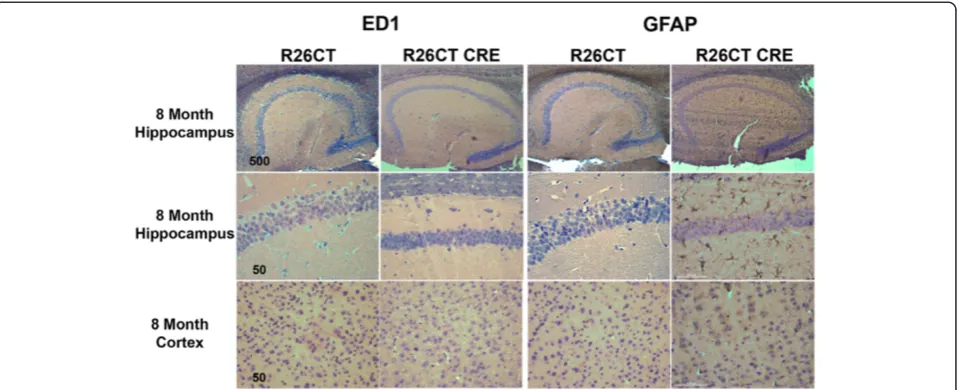
Since inflammation has been widely reported in neuro-degenerative diseases [33], we determined whether the presence of model Hirano bodies induces an inflamma-tory response in the brains of 3 and 8 month old R26CT and R26CT-CRE mice. Paraffin embedded brain sections were stained with antibodies against known markers of reactive astrocytes (GFAP) and activated microglia (ED1)
Figure 2Model Hirano bodies detected as eosinophilic inclusions in 8 month old R26CT-CRE mice.Paraffin embedded brain sections from 8 month old R26CT and R26CT-CRE mice were dewaxed and stained with Gill’s hematoxylin and counterstained with eosin. 8 month old R26CT mice show no rod-shaped eosinophilic inclusions in the pyramidal cells of the hippocampus or cerebral cortex. R26CT-CRE mice have eosinophilic inclusions predominantly in the CA1 pyramidal cell layer of the hippocampus and rarely in the cerebral cortex. Arrows indicate inclusions. Scale bars represent 20 or 500μm.
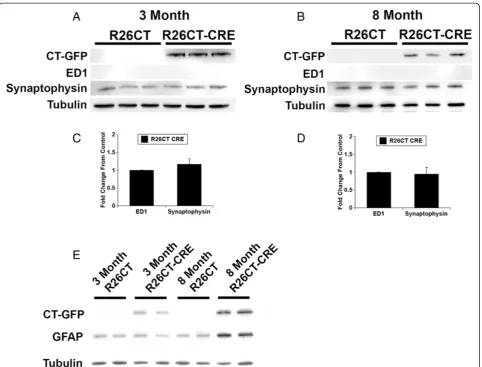
8 months of age, ED1 levels were not different between R26CT and R26CT-CRE mice (Figure 5A,B). In contrast, at 8 months of age, GFAP levels were increased in R26CT-CRE mice compared to R26CT mice (Figure 5C,D). These results are consistent with the immunohistochemistry results indicating that older R26CT-CRE mice have in-flammation in the hippocampus as indicated by positive GFAP staining in reactive astrocytes.
Behavioral assessment
Changes in anxiety and cognition are two possible clin-ical symptoms of patients suffering from neurodegenera-tive conditions presenting Hirano bodies [36]. Behavioral performance of R26CT and R26CT-CRE mice was assessed in an open field test and radial arm maze. In the open field test, locomotor activity and center zone entrances were evaluated in both R26CT (3 month old, n = 11; 8 month old, n = 11) and R26CT-CRE mice (3 month old, n = 12; 8 month old, n = 12). There was no difference in locomotor activity between R26CT and R26CT-CRE mice at either age (Figure 6A,B). R26CT and R26CT-CRE mice also made a similar number of entrances to the center zone, suggesting no differences in anxiety at either age (Figure 6C).
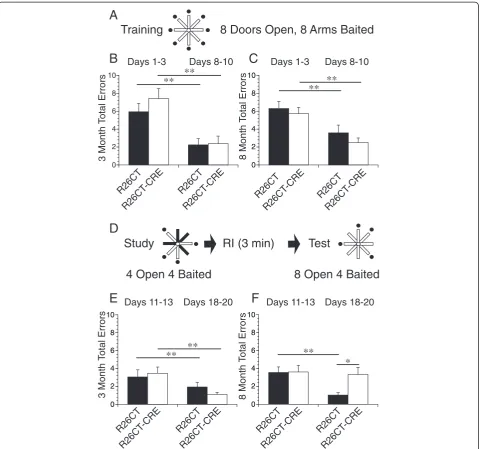
Spatial memory performance of R26CT and R26CT-CRE mice was evaluated at both 3 and 8 months of age utilizing a radial arm maze. The training phase (8 arms open, 8 arms baited) consisted of collecting a food re-ward at the end of each of the 8 arms without revisiting any previously visited locations as described in materials and methods (Figure 7A). R26CT (3 month old, n = 11;
8 month old, n = 11) and R26CT-CRE mice (3 month old, n = 12; 8 month old, n = 12) performed similarly in this task, as both groups showed significant improve-ment in performance across sessions from day 1 to day 10 at both 3 and 8 months of age (Figure 7B,C). These observations were confirmed by subjecting this training data to an experience (early versus late sessions) X genotype X age analysis of variance (ANOVA). The number of errors declined with experience (F(1,42) = 56.94, p < 0.001); none of the other variables or interac-tions were significant.
At day 11, the same mice from the training phase were evaluated using a delayed spatial win-shift task (Figure 7D). In the initial study phase (4 arms open, 4 arms baited), the mice have free access to only 4 arms with 1 food reward per accessible arm. Upon completion of the study phase, mice experience a short retention interval of 3 minutes. In the subsequent test phase (8 arms open, 4 arms baited), mice have free access to all 8 arms, but only the 4 arms not previously visited (inaccessible during study phase) are now baited and have food rewards. During the study phase, both 3 and 8 month old mice showed no difference between groups or improvement across sessions (data not shown). This was expected, as they had already displayed high performance for this type of task by the end of the training phase.
mice did not. There was a statistically significant difference between R26CT and R26CT-CRE mice (*p < 0.05) at the end of the 10 day testing period (Figure 7F, days 18–20). These test phase data were subjected to an experience X genotype X age ANOVA. The number of errors declined with experience (F(1,42) = 28.03, p < 0.001). There was also a significant three-way interaction of days X geno-type X age (F(1,42) = 8.61, p < 0.01); none of the other variables or interactions were significantly different. Next, we conducted experience X genotype ANOVAs separately for ages 3 and 8 months. At both time points, there was a significant effect of experience (3 months: F(1,21) = 17.05, p < 0.001; 8 months: (F1,21) = 11.25, p < 0.01). Moreover, the interaction of experience and genotype was significant at 8 months (F(1,21) = 14.37,
p < 0.05) but not at 3 months (F(1,21) = 2.16, p = 0.16); none of the other variables were significant. These re-sults indicate R26CT-CRE mice develop impairment in spatial working memory by 8 months of age.
Neurophysiological evaluation
Several neurodegenerative conditions are characterized by synaptic loss or reduction in synaptic density that coin-cides with cognitive impairment [37-40]. Since 8 month old R26CT-CRE mice show cognitive impairments in spatial working memory as measured in the radial arm maze, levels of synaptophysin were measured as a quali-tative indicator of synaptic density. In both 3 and 8 month old mice, levels of synaptophysin are approximately equal between R26CT and R26CT-CRE mice suggesting Figure 5Western blot analysis of inflammatory response in 3 and 8 month old mice.Brain homogenate from 3 and 8 month old
that spatial working memory impairments in R26CT-CRE mice are not due to decreases in synaptic density (Figures 5A-D).
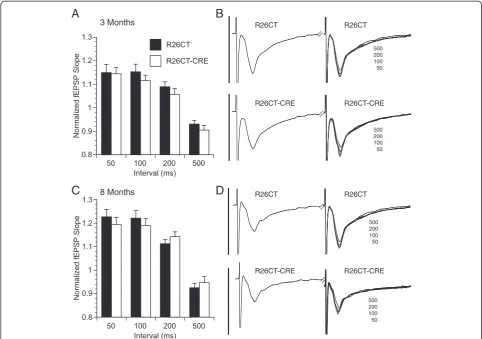
Electrophysiological studies were performed on slices obtained from both the ventral and dorsal hippocampus of each mouse. Recordings from the ventral hippocam-pus were performed in order to compare the physio-logical consequences of model Hirano bodies formed in the CA1 (this study) versus the CA3 region [28]. In order to determine whether the presence of Hirano bodies impact synaptic function, field excitatory post-synaptic po-tentials (fEPSPs) were recorded at the Schaffer collateral synapses in the stratum radiatum layer of the CA1 region in slices from the ventral half of the hippocampus. In 3 and 8 month old mice, there was no difference in synaptic response between R26CT (3 month: 10(19) and 8 month: 10(20)) and R26CT-CRE (3 month: 12(18) and 8 month: 12(19)) mice for fEPSPs at any stimulus intensity recorded (Figure 8). Short-term synaptic plasticity was evaluated using paired pulse stimulus protocols. There was no dif-ference in the amount of facilitation between R26CT (3 month, n = 10(19); 8 month, n = 10(20)) and R26CT-CRE (3 month, n = 12(18); 8 month, n = 12(21)) mice at any stimulus interval at either 3 or 8 months of age (Figure 9). These results indicate that impairments in spatial working memory in 8 month R26CT-CRE mice are likely not attributed to differences in synaptic transmission or short-term plasticity in the ventral hippocampus.
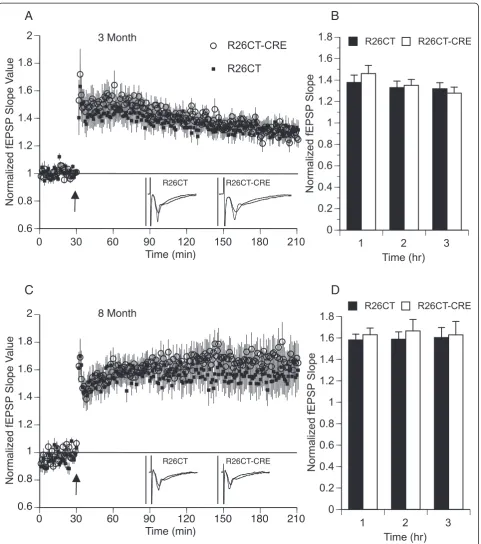
Long-term synaptic plasticity was evaluated by the in-duction of long-term potentiation (LTP) using a strong stimulus protocol (3 × 100Hz/1 sec at 20 sec intervals). Following LTP induction, fEPSP slopes were recorded for 3 hours post-induction to measure early (1 hours) and late (3 hours) phases of LTP. At both 3 and 8 months of age, fEPSP slope values obtained from the ventral hippocampus were not significantly different between R26CT (3 month, n = 10(17); 8 month, n = 9(18)) and R26CT-CRE (3 month, n = 11(16); 8 month, n = 11(18)) mice at both early and late phases of LTP (Figure 10).
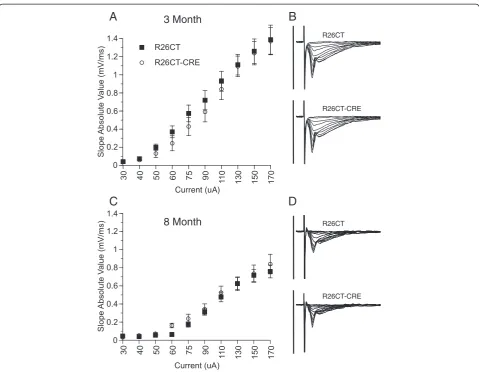
Electrophysiology studies were also performed on slices from the dorsal hippocampus since this region has been clearly implicated in spatial memory performance. The specific role of the dorsal hippocampus in spatial working memory in particular is unclear (see Discus-sion). Field excitatory post-synaptic potentials (fEPSPs) were recorded at the Schaffer collateral synapses in the stratum radiatum layer of the CA1 region in slices from the dorsal half of the hippocampus as shown in Figure 11. There was a significant difference at the high-est stimulus intensities thigh-ested at 3 months of age be-tween R26CT (n = 10(10)) and R26CT-CRE (n = 12(13)) mice (*p < 0.05). In contrast, there was no difference in dorsal synaptic response between 8 month old mice R26CT (n = 10(10)) and R26CT-CRE (n = 12(12)) mice
10 20 30 40 50 60
0 500 1000 1500 2000 2500 3000 T otal Counts Time (Min)
10 20 30 40 50 60
0 500 1000 1500 2000 2500 3000 T otal Counts Time (Min) R26CT R26CT-CRE
3 Months
8 Months
A
B
0 50 100 150 200 250 300 350 400 0 50 100 150 200 250 300 350 400Center Zone Entries (First 30 Min)
R26CT
R26CT-CRE
3 Months
8 Months
C
Figure 6Analysis of the open field test for 3 and 8 month old
R26CT and R26CT-CRE mice.Locomotor activity and center zone
for fEPSPs at any stimulus intensity recorded. In addition, there was no difference in the magnitude of the stimulus response between the 3 and 8 month old R26CT-CRE mice, unlike the R26CT mice which declined with age.
Short-term synaptic plasticity was evaluated using paired pulse stimulus protocols. There was no difference in the amount of facilitation in the dorsal hippocampus between R26CT (3 month, n = 10(10); 8 month, n = 10(10)) and
Training
8 Doors Open, 8 Arms Baited
4 Open 4 Baited
8 Open 4 Baited
Study
RI (3 min)
Test
Days 8-10 8 Month T otal Errors R26CT R26CT -CRE R26CT R26CT -CRE Days 1-3 3 Month T otal Errors R26CT R26CT -CRE R26CT R26CT -CRE Days 8-10 Days 1-3 3 Month T otal Errors 8 Month T otal Errors R26CT R26C T-CRE R26CT R26CT -CRE R26CT R26CT -CRE R26CT R26CT -CRE Days 11-13 Days 18-20 Days 11-13 Days 18-20
A
B
C
D
E
F
*
**
**
**
**
**
**
0 2 4 6 8 10 0 2 4 6 8 10 0 2 4 6 8 10 0 2 4 6 8 10 0 2 4 6 8 10 0 2 4 6 8 10 0 2 4 6 8 10**
R26CT-CRE (3 month, n = 12(13); 8 month, n = 12(12)) mice at any stimulus intensity at either 3 or 8 months of age (Figure 12).
Long-term synaptic plasticity was evaluated by the in-duction of long-term potentiation (LTP). Following LTP induction, fEPSP slopes were recorded for 3 hours post-induction to measure early and late phases of LTP. At 3 months of age, fEPSP slope values obtained from the dorsal hippocampus were not significantly different be-tween R26CT (n = 10(10)) and R26CT-CRE mice (n = (12 (13)) (Figure 13). However, at 8 months of age, fEPSP slope values were significantly higher for the R26CT-CRE mice (n = (10(10)) than R26CT mice (n = 12(12)), during both early (<1 hr) (**p < 0.01) and late (3 hr) (*p < 0.05) LTP. This result is unexpected given that the 8 month old
R26CT-CRE mice show profound spatial working memory deficits (Figure 7F).
These results suggest that expression of CT-GFP and subsequent formation of model Hirano bodies have no significant impact on baseline synaptic transmission, short-term synaptic plasticity, or long-term synaptic plasticity in the CA1 region of the ventral hippocampus in mice as old as 8 months. In contrast, baseline synaptic transmission is significantly decreased at the highest in-tensities with no impact on either short-term or long-term synaptic plasticity in the dorsal CA1 region for mice presenting model Hirano bodies at 3 months of age. At 8 months of age, there is no effect on baseline synaptic transmission or short-term synaptic plasticity responses. However, there is significant enhancement of
A
B
C
D
R26CT
R26CT R26CT-CRE
R26CT-CRE
3 Month
8 Month
LTP that coincides with the impaired spatial working memory observed in the 8 month R26CT-CRE mice.
Discussion
Incidence and ultrastructure of Hirano bodies in transgenic model mice
A new transgenic mouse model was created to study the impact of Hirano bodies in vivo to more closely resem-ble the presentation of Hirano bodies in Alzheimer’s dis-ease. A mouse with model Hirano bodies had been previously studied by crossing R26CT mice with Thy1.2-CRE mice. While Hirano bodies were produced in the hippocampus of homozygous R26CT x Thy1.2-CRE mice, Hirano bodies were predominantly reported in the CA3 subregion [28]. This is not surprising since the Thy1.2-CRE mouse has been shown to have higher ex-pression of the CRE transgene in the CA3 subregion, ra-ther than the CA1 [28]. In the present study, R26CT mice were crossed with a CamKIIa-CRE mouse, which is
known to express CRE predominantly in the forebrain and in the CA1 subregion of the hippocampus [29,30,41]. This CRE driver was chosen in an attempt to more closely recapitulate human disease conditions in which Hirano bodies are normally found, the pyramidal cell layer of the CA1 region [15,16,6,42,8,12,43]. Eosinophilic inclusions were seen predominately in the CA1 region of R26CT x CamKIIa-CRE mice. In contrast with the previously char-acterized model Hirano body mice (R26CT x Thy1.2-CRE) in which model Hirano bodies were not detected by light microscopy until 6 months of age, eosinophilic inclusions were found in the hippocampus of R26CT-CamKIIa-CRE mice as early as 3 months of age. It is un-clear why eosinophilic inclusions are detected earlier in R26CT mice crossed with CamKIIa-CRE than in R26CT mice crossed with Thy1.2-CRE. Perhaps CA1 pyramidal neurons have a greater propensity to facilitate CT-induced Hirano body formation than do CA3 pyramidal neurons. In human disease, the number of Hirano bodies increases
500 200 100 50
500 200 100 50
500 200 100 50
500 200 100 50
A
B
C
D
3 Months
8 Months
R26CT
R26CT-CRE
R26CT
R26CT-CRE
R26CT
R26CT-CRE
R26CT
R26CT-CRE
Figure 9Paired-pulse field excitatory post-synaptic potentials (fEPSP) recorded from the ventral hippocampus in R26CT and
R26CT-CRE mice. A)Paired-pulse ratios at 50, 100, 200, or 500 ms in R26CT (black bars, n = 10(19)) and R26CT-CRE (white bars, n = 12(18)) mice at
R26CT R26CT-CRE
3 Month
R26CT R26CT-CRE
8 Month
A
B
C
D
Figure 10Long-term potentiation of field excitatory post-synaptic potentials (fEPSP) recorded from the ventral hippocampus in R26CT
and R26CT-CRE mice. A)Summary time course of normalized fEPSP slope values in 3 month old R26CT mice in LTP (black square, (n = 10(17))
with age and disease severity [7,15,43]. Hirano body ap-pearance in humans coincide with aging since pathologists have noted that Hirano bodies are never seen in the brains of humans younger than 11 years old [15]. Consistent with these findings, an age-dependent increase in the formation of Hirano bodies was also observed in our mouse model.
There are several characterized actin inclusions found in human disease such as ADF/cofilin rods (AC rods) and hyaline bodies [44-46]. Hirano bodies are differenti-ated from these other actin aggregates by their eosino-philic nature, ability to bind to phalloidin, and distinctive
ultrastructure [47,8,7,45]. To definitively prove an actin inclusion is a Hirano body, electron microscopy must be performed for ultrastructural analysis. There are a variety of presentations. In humans, they often appear as finger-print or spheroid/spindle shape [8]. Hirano bodies in R26CT-CRE mice also display these alternative patterns (Additional file 2: Figure S2 A-B). In humans, smaller Hirano bodies observed by electron microscopy (not vis-ible via light microscopy) are more frequent than larger Hirano bodies [16]. These smaller Hirano bodies are noted to appear less compact and more irregular than those
A
B
C
D
3 Month
8 Month
R26CT
R26CT R26CT-CRE
R26CT-CRE
*
*
visible through light microscopy [16]. R26CT-CRE mice also show similar smaller structures which contain both ordered filaments and amorphous electron dense material (Additional file 2: Figure S2 D). Expression of CT in cell culture systems often results in alternative fibrillar struc-tures or small aggregates [22,25]. These smaller strucstruc-tures have also been noted in the brains of humans [48] and in the brains of R26CT-CRE mice (Additional file 2: Figure S2 C). InDictyostelium, small nascent model Hirano body structures observed by TEM fuse together by an unknown process involving microtubules and myosin II to form lar-ger Hirano bodies [21,49,50]. It is likely that a similar formation process of Hirano bodies is occurring in R26CT-CRE mouse brains since several small aggregates can be seen in close proximity in TEM samples (Additional file 2: Figure S2 C).
Inflammation
Inflammation is a phenomenon occurring in neurode-generative conditions such as Alzheimer’s disease and Parkinson’s disease and is characterized by activated microglia and reactive astrocytes [34]. Many mouse models of neurodegenerative disease recapitulate react-ive microglia or reactreact-ive astrocytes as a predominant phenotype [35,51-53]. Markers of reactive astrocytes or activated microglia were utilized in order to determine if Hirano bodies accompany an innate immune response in the brain. 3 month old R26CT-CRE mice had no signs of inflammation (Figures 3, 5). However, by 8 months of age, R26CT-CRE mice had significantly higher levels of GFAP compared to age matched R26CT mice (Figures 4, 5). There are several factors that can initiate astrogliosis in-cluding cell damage, ischemia, neuronal hyperactivity, and
500 200 100 50
500 200 100 50
500 200 100 50
500 200 100 50
A
B
C
D
3 Months
8 Months
R26CT
R26CT-CRE
R26CT
R26CT-CRE
R26CT
R26CT-CRE
R26CT
R26CT-CRE
Figure 12Paired-pulse field excitatory post-synaptic potentials (fEPSP) recorded from the dorsal hippocampus in R26CT and
R26CT-CRE mice. A)Paired-pulse ratios at 50, 100, 200, or 500 ms in R26CT (black bars, n = 10(10)) and R26CT-CRE (white bars, n = 12(13)) mice at
foreign pathogens including abnormal protein aggregates [54]. In Alzheimer’s disease, reactive astrocytes are often found in close proximity with deposits of amyloid
beta plaques and neurons containing intracellular NFTs [35,55-59]. In addition to intracellular NFTs, extracellu-lar NFTs (ghost tangles) have also been reported in 3 Month
R26CT R26CT-CRE
8 Month
R26CT R26CT-CRE
A
B
C
D
**
*
*
Figure 13Long-term potentiation of field excitatory post-synaptic potentials (fEPSP) recorded from the dorsal hippocampus in R26CT
and R26CT-CRE mice. A)Summary time course of normalized fEPSP slope values in 3 month old R26CT mice in LTP (black square, (n = 10(10))
brains [60,61]. Reactive astrocytes have been reported to surround ghost tangles where they are thought to be clearing these structures from the brain [62,63]. Simi-larly, intracellular Lewy bodies comprised of alpha sy-nuclein can be exocytosed from neurons in Parkinson’s patients and initiate astrogliosis [64-66]. Hirano bodies have also been reported to be extruded from neurons and model Hirano bodies can be cleared from cells through exocytosis [15,25]. It is possible that extruded Hirano bodies or intermediate aggregates may initiate an astrocytosis response in the brain. While 3 month old R26CT-CRE mice have sparse model Hirano bodies, they are more abundant in 8 month old mice. In 8 month old mice, extracellular model Hirano bodies were observed (Additional file 2: Figure S2 A). Release of model Hirano bodies may explain why 8 month old R26CT-CRE mice exhibit reactive astrocytes.
Behavioral studies of Hirano body model mice
A central feature of this study is to assess the impact of the behavioral and physiological consequence(s) of Hirano bodies in the brain. To assess the effect of CT-GFP expression and subsequent formation of model Hirano bodies, behavioral studies were performed using both an open field test and an 8-arm radial maze. The open field test has been utilized to measure locomotor activity and anxiety [67]. At 3 and 8 months of age, R26CT and R26CT-CRE mice show similar levels of locomotor activity (Figure 6A, B). General anxiety was measured by recording the number of center zone en-tries between R26CT and R26CT-CRE mice (Figure 6C). No differences between genotypes at either age were found, implying that the presence of model Hirano bod-ies does not contribute to anxiety or impaired locomotor function.
The training phase (8 arms open, 8 arms baited) of the radial arm maze demonstrated that both R26CT and R26CT-CRE mice have intact spatial learning and navi-gation since both genotypes learn the reference memory rules associated with completion of the radial arm maze training task. In addition, both R26CT and R26CT-CRE mice appear to have equivalent perception of spatial cues, levels of motivation, and motor control. In the training phase, the task is continuous and thus the spatial working memory load is low, making the proced-ure primarily dependent upon immediately accessible in-formation from short-term memory [68]. The same mice were subsequently tested in a 2-phase delayed spatial win-shift task (with a 3 minute retention interval delay) to more stringently examine spatial working memory. The incorporation of a time delay forces retention of trial-unique spatial information (i.e., the mice must re-member which arms were visited in phase 1 in order to successfully complete phase 2, increasing the spatial
working memory load). At 3 months of age, spatial working memory appears unimpaired since both R26CT and R26CT-CRE mice perform equally well and improve with training. However, at 8 months of age, the more stringent memory load resulted in discrimination of per-formance between the R26CT and R26CT-CRE mice. The R26CT mice showed improvement across trials, where the R26CT-CRE mice did not. The test phase re-sults suggest that 8 month R26CT-CRE mice have im-paired spatial working memory, (i.e. memory for daily, item-specific locations). This is likely a specific impair-ment in spatial working memory since the training phase results indicated intact acquisition of reference memory rules, making a general impairment in learning capability unlikely. Furthermore, the memory deficiencies observed at 8 months coincides with the observed increase in fre-quency of Hirano bodies.
The effect of model Hirano bodies on synaptic plasticity Assessments of spatial memory are known to depend upon intact hippocampal function [69,70]. With respect to the specific spatial working memory task we have uti-lized in our assessments, it is uncertain whether the ven-tral or dorsal hippocampus is the predominant region primarily responsible for behavioral performance. Dorsal and ventral hippocampal lesions, fMRI data, and genetic manipulation of NMDA and AMPA receptor subunits have revealed that the ventral and dorsal hippocampus have differential roles during behavioral and memory tasks (reviewed in [71,72]). The actin cytoskeleton plays a key role in the cellular processes and structures that memory is thought to reside in. Actin binding proteins regulate the polymerization and depolymerization of actin into dynamic, transient structures required for syn-aptic transmission and memory function. Mutant forms of the Dictyostelium 34 kDa actin bundling protein are gain-of-function actin bundling proteins that induce the formation of model Hirano bodies [21,73,50]. Expression of these proteins causes a shift in the ratio of F:G-actin in the cell [21], and slower turnover of actin filaments in the model Hirano body [50]. Thus, the presence of model Hirano bodies cause a large perturbation to the actin cytoskeleton and potentially to synaptic functions and memory. Our studies of the electrophysiological properties of the dorsal as well as the ventral hippocam-pus created a unique opportunity to enhance both our understanding of the role of the actin cytoskeleton in re-gional hippocampal function and assess the impact of Hirano bodies on spatial working memory.
Effect of Hirano bodies in the CA3 and CA1 regions of the hippocampus
paired-pulse facilitation from R26CT-CRE mice was indistin-guishable from R26CT mice (Figure 10). These results are in contrast with the previous characterization of the R26CT-CRE mice with a Thy1.2 CRE driver, which ex-hibited significant paired-pulse depression at a 50 ms stimulus interval [28]. The most obvious explanation for this is due to differences in the expression pattern of CT-GFP between the two mouse strains. In the current study, CT-GFP expression and Hirano body formation was more predominant in the CA1 subregion of the hippocampus versus the previous mouse model that had predominantly CA3 subregion expression and subse-quent Hirano body formation [28-30]. In both cases, field potential recordings were performed in the stratum radiatum layer of CA1 by activating the Schaffer collat-eral axons (which originate in CA3) and synapse on the apical dendrites of the CA1 pyramidal neurons. In the previous mouse (R26CT x Thy1.2-CRE), Hirano bodies were formed in presynaptic CA3 neurons [28]. Paired-pulse stimulation is a measurement that reflects the ac-tive transport recovery of calcium and trafficking of neurotransmitter-containing vesicles to replenish the ready releasable pool of vesicles [74]. The trafficking of these neurotransmitter-containing vesicles is modulated by the actin cytoskeleton. The paired-pulse depression seen in the R26CT x Thy1.2-CRE mice was explained as a change in vesicular trafficking due to sequestration of F-actin in model Hirano bodies [28,75], decreasing the amount of cellular actin available for cytoskeletal func-tions. In the current study using R26CT x CamKIIa-CRE mice, Hirano bodies were primarily formed in the post-synaptic CA1 pyramidal neurons. Thus, the difference in the effect of Hirano bodies on paired-pulse responses between the Thy1.2 CRE and CamKIIa-CRE driver models can be readily understood. Furthermore, these results show that the effect of model Hirano bodies on synaptic function depend on the specific location (i.e. presynaptic versus postsynaptic) in which they form.
In addition to evaluating short-term synaptic plasticity, a form of long-term synaptic plasticity, LTP, which has been shown to be involved in spatial learning and mem-ory, was also investigated [76,77]. Long-term potenti-ation has both an early and a late phase. The early phase relies on redistribution and rearrangement of available synaptic proteins while the latter requires gene expres-sion and protein synthesis to maintain changes in synap-tic strength [78]. Both the early and late phases of LTP are associated with an increase in actin assembly [79-81]. The actin assembly associated with the late stage of LTP involves an increase in the number and size of dendritic spines and expansion of the postsynaptic density [79,80]. Model Hirano bodies are known to shift the filamentous to monomeric actin ratio [21], in-creasing the proportion of cellular F-actin which may
consequently impact synaptic plasticity. Therefore, LTP was monitored for 3 hours post induction to determine if the presence of model Hirano bodies could impact either the early (1 hours) or late (3 hours) phases of LTP. Inter-estingly, despite the important role of actin in LTP, we found that there was no measurable difference between R26CT and R26CT-CRE mice at either 3 or 8 months of age (Figure 10) in the ventral hippocampus. These results are in contrast with those observed in our earlier study in which R26CT x Thy1.2-CRE mice showed a deficit in the early, but not the late phase LTP [28]. Thus, presence of model Hirano bodies in the CA1 region of the ventral hippocampus of R26CT-CRE mice (current R26CT × CamKIIa-CRE mouse) appears to have negli-gible effects on synaptic plasticity as assessed by paired-pulse and LTP measurements. Once again, the presynaptic expression of model Hirano bodies in the CA3 of the Thy1.2-CRE mouse resulted in significant effects in the former report [28] that were not observed with the post-synaptic expression pattern in the CA1 of the current CAMKIIa-CRE mouse.
Effect of Hirano bodies in the dorsal versus ventral hippocampus
Measurements of synaptic transmission and either short-term or long-short-term plasticity obtained from the ventral hippocampus of R26CT and R26CT-CRE mice showed no difference between the genotypes at either 3 or 8 months of age. This contrasts with the result that R26CT-CRE mice exhibited profound spatial working memory deficits at 8 months of age.
significantly enhanced in the dorsal hippocampus of 8 month old R26CT-CRE mice, when profound spatial memory impairment was also observed (Figure 7F). The relationship between the occurrence of enhanced LTP that is coincident with memory impairments in these mice at 8 months of age is surprising as most memory impairments are accompanied by decreased LTP.
Previous studies utilizing drugs affecting actin assembly have shown the importance of dynamic actin, i.e. the ability of actin to polymerize and depolymerize rapidly for maintenance of LTP but not synaptic transmission [84-86]. Two distinct pools of F-actin have been identified in spines: a dynamic pool with a high turnover rate of actin located near the tip of the spine and a more stable pool in the core of the spine [87,88]. The turnover rate was esti-mated as 40 s and 17 min for the dynamic and stable F-actin pools, respectively [87,89]. F-F-actin in model Hirano bodies formed inDictyosteliumwith the gain-of-function 34 kDa mutant E60K are very stable in the presence of latrunculin A. The F-actin content of the model Hirano body measured by the fluorescence of rhodamine-labeled phalloidin decreased 31% after 2 hours [50]. This in-creased F-actin stability could cause spines to form and refashion more slowly, thus impacting memory functions.
Taken together, the effects of expression of model Hirano bodies in the presynaptic CA3 of R26CT x Thy1.2-CRE mouse [28] were readily discernable com-pared to the postsynaptic expression in the CA1 of the current R26 x CamKIIa-CRE mouse. 8 month old R26CT-CRE mice have an impairment in spatial working memory assessed utilizing the spatial win-shift task in the radial arm maze despite no significant differences in either short-term or long-term plasticity measurements in the ventral hippocampus that could readily explain this cognitive deficit [90,91]. This seeming discrepancy could be due to involvement of both the hippocampus and pre-frontal cortex in spatial working memory [68,92]. The CamKIIa promoter used to drive CRE ex-pression is activated in the hippocampus as well as the frontal cortex [29,30]. Thus, it is possible that the elec-trophysiological measurements in the CA1 of ventral hippocampus performed in the current study either do not detect changes in synaptic physiology relevant for this form of spatial working memory, or that postsynaptic localization of model Hirano Bodies does not significantly impact either paired-pulse or long-term potentiation forms of synaptic plasticity in the ventral hippocampus. In contrast, significantly enhanced LTP was observed in the dorsal hippocampus for 8 month old R26CT-CRE, coinci-dent with spatial working memory impairments. Thus with respect to the measurements of synaptic transmis-sion and plasticity assessed in the current study, the pres-ence of Hirano bodies differentially affects both the CA1 and CA3 regions, as well as the dorsal and ventral sectors
of the hippocampus. In the future, it will be important to perform electrophysiological recordings in the prefrontal cortex to evaluate the contribution of that brain region to spatial working memory in the 8 month old R26CT-CRE mice. In addition, it will be important to characterize the morphology of the hippocampal spines to assess the effect of perturbing the actin cytoskeleton by the presence of Hirano bodies in the CA1 region.
Conclusion
The physiological impact of Hirano bodies in the brain has remained elusive. The transgenic mouse generated in this study provides an animal model of Hirano body formation in the mammalian brain. Consistent with humans, this transgenic mouse develops Hirano bodies in the CA1 region of the hippocampus as well as in the frontal cortex. Behavioral analyses of mice, which de-velop model Hirano bodies, indicate that Hirano bodies negatively impact spatial working memory. This study shows that Hirano body formation initiates an inflamma-tory response in the hippocampus and suggests that Hirano bodies may independently contribute to disease progression or exacerbate the disease state. This model mouse provides a tool to investigate how the presence of Hirano bodies may impact the progression of Alzheimer’s disease and other neurodegenerative diseases.
Additional files
Additional file 1: Figure S1.Immunofluorescence and western blot of CT-GFP expression in R26CT-CRE mice. A) Immunofluorescence microscopy was performed on cryosections from 1 month old R26CT and R26CT-CRE mouse brains. Sections were stained with anti-GFP antibodies to visualize expression of CT-GFP and counterstained with DAPI and TRITC-labeled phalloidin to visualize nuclei and F-actin, respectively. R26CT-CRE mice show expression of CT-GFP in the hippocampus while R26CT control mice do not. B) A western blot was performed using brain homogenate from hippocampus and cortex of 1 month old R26CT and R26CT-CRE mice using anti-GFP antibodies to detect CT-GFP expression. To ensure no expression of CT-GFP is detectable in R26CT mice, twice the amount of protein from R26CT samples was loaded compared to R26CT-CRE samples. R26CT-CRE mice show strong expression of CT-GFP in the hippocampus and weak expression in the cortex. R26CT mice have no detectable CT-GFP in either hippocampus or cortex. Scale bar represents 40 or 200μm.
Additional file 2: Figure S2.Electron micrographs of inclusions in 8 month R26CT-CRE mice. Hippocampal tissue from 8 month old R26CT and R26CT-CRE mice was isolated and prepared for transmission electron microscopy. R26CT-CRE tissue contained electron dense inclusions which are identical to the ultrastructure of Hirano bodies. These structures were not observed in R26CT mice (data not shown). A, B) The ultrastructure of model Hirano bodies resembling a spheroid or fingerprint pattern similar to those seen in humans [8]. C) Intermediate structures were seen in the brains of R26CT-CRE mice similar to those seen in humans and cell culture models [22,25,48]. D) R26CT-CRE mice exhibit model Hirano bodies which contain both ordered filaments and amorphous electron dense material. Arrows indicate Hirano bodies or intermediates magnified in the panels to the right. Scale bars are in nm.
Competing interests
Authors’contributions
All authors in this manuscript contributed to the design of the study, analysis/interpretation of data, and drafting of this manuscript. MFurgerson, JKC, and RF carried out all experiments under the supervision of
MFechheimer, RF, or JJW. MFurgerson performed the immunohistochemistry, western blot analysis, immunofluorescence, and electron microscopy. JKC performed the electrophysiology experiments, open field measurements and analysis. MFurgerson, RF, and JKC performed the radial arm maze
experiments. JDC provided and designed the radial arm maze protocol as well as performed statistical analysis of the radial arm maze data. All authors have read and approved this manuscript for publication.
Acknowledgements
Funding for this work was provided by NIH R01 N5046451 (www.ninds.nih.gov/) to R. Furukawa and M. Fechheimer. Disclosure statement: We would like to thank Drs. Richard Meagher and Steve Hajduk for providing access to their microscopes. We would also like to thank the UGA College of Veterinary Medicine, Electron Microscopy Laboratory for their technical support and expertise with a special thanks to Mary Ard. Finally, we would like to thank Drs. Jim Lauderdale and Nancy Manley for providing access to their cryostat and microtome. All animal protocols and experiments were approved by the University of Georgia Institutional Animal Care Committee.
Author details
1Department of Cellular Biology, University of Georgia, Athens, GA 30602,
USA.2Department of Biochemistry and Molecular Biology, University of Georgia, Athens, GA 30602, USA.3Department of Physiology and
Pharmacology, University of Georgia, Athens, GA 30602, USA.4Department of Psychological and Brain Sciences, Indiana University, Bloomington, IN 47405, USA.
Received: 23 May 2014 Accepted: 15 August 2014 Published: 2 September 2014
References
1. Ross CA, Poirier MA (2004) Protein aggregation and neurodegenerative disease. Nat Med 10(Suppl):S10–S17
2. Ratnavalli E, Brayne C, Dawson K, Hodges JR (2002) The prevalence of frontotemporal dementia. Neurology 58:1615–1621
3. As A, Thies W, Bleiler L (2011) Alzheimer’s disease facts and figures. Alzheimers Dement 7:208–244
4. Terry RD (1963) The fine structure of neurofibrillary tangles in Alzheimer’s disease. J Neuropathol Exp Neurol 22:629–642
5. Lynch T, Sano M, Marder KS, Bell KL, Foster NL, Defendini RF, Sima AA, Keohane C, Nygaard TG, Fahn S, Mayeux R, Rowland LP, Wilhelmensen KC (1994) Clinical characteristics of a family with chromosome 17-linked disinhibition-demenstia-parkinsonism-amyotrophy complex. Neurol 44:1878–1884
6. Gibson PH, Tomlinson BE (1977) Numbers of Hirano bodies in the hippocampus of normal and demented people with Alzheimer’s disease. J Neurol Sci 33(1–2):199–206
7. Hirano A, Dembitzer HM, Kurland LT, Zimmerman HM (1968) The fine structure of some intraganlionic alterations. J Neuropathol Expt Neurol 27(2):167–182
8. Schochet SS Jr, Lampert PW, Lindenberg R (1968) Fine structure of the Pick and Hirano bodies in a case of Pick’s disease. Acta Neuropathol (Berl) 11(4):330–337
9. Martinez-Saez E, Gelpi E, Rey M, Ferrer I, Ribalta T, Botta-Orfila T, Nos C, Yague J, Sanchez-Valle R (2011) Hirano body - rich subtypes of Creutzfeldt-Jakob disease. Neuropathol Appl Neurobiol doi:10.1111/j.1365-2990.2011.01208.x 10. Cartier L, Galvez S, Gajdusek DC (1985) Familial clustering of the ataxic form
of Creutzfeldt-Jakob disease with Hirano bodies. J Neurol Neurosurg Psychiatry 48(3):234–238
11. Okamoto K, Hirai S, Hirano A (1982) Hirano bodies in myelinated fibers of hepatic encephalopathy. Acta Neuropathol 58(4):307–310
12. Gibson PH (1978) Light and electron microscopic observations on the relationship between Hirano bodies, neuron and glial perikarya in the human hippocampus. Acta Neuropathol (Berl) 42(3):165–171 13. Galloway PG, Perry G, Gambetti P (1987) Hirano body filaments contain
actin and actin-associated proteins. J Neuropathol Exp Neurol 46(2):185–199
14. Hirano A (1994) Hirano bodies and related neuronal inclusions. Neuropathol Appl Neurobiol 20(1):3–11
15. Ogata J, Budzilovich GN, Cravioto H (1972) A study of rod-like structures (Hirano bodies) in 240 normal and pathological brains. Acta Neuropathol 21(1):61–67
16. Schochet SS Jr, McCormick WF (1972) Ultrastructure of Hirano bodies. Acta Neuropathol (Berl) 21(1):50–60
17. Maciver SK, Harrington CR (1995) Two actin binding proteins, actin depolymerizing factor and cofilin, are associated with Hirano bodies. Neuroreport 6(15):1985–1988
18. Galloway PG, Perry G, Kosik KS, Gambetti P (1987) Hirano bodies contain tau protein. Brain Res 403(2):337–340
19. Munoz DG, Wang D, Greenberg BD (1993) Hirano bodies accumulate C-terminal sequences of beta-amyloid precursor protein (beta-APP) epitopes. J Neuropathol Exp Neurol 52(1):14–21
20. Lim RWL, Furukawa R, Eagle S, Cartwright RC, Fechheimer M (1999) Three distinct F-actin binding sites in theDictyostelium discoideum34,000 dalton actin bundling protein. Biochemistry 38:800–812
21. Maselli AG, Davis R, Furukawa R, Fechheimer M (2002) Formation of Hirano bodies inDictyosteliumand mammalian cells induced by expression of a modified form of an actin cross-linking protein. J Cell Sci 115:1939–1952 22. Davis RC, Furukawa R, Fechheimer M (2008) A cell culture model for
investigation of Hirano bodies. Acta Neuropathol (Berl) 115(2):205–217 23. Ha S, Furukawa R, Fechheimer M (2011) Association of AICD and Fe65 with
Hirano bodies reduces transcriptional activation and initiation of apoptosis. Neurobiol Aging 32(12):2287–2298. doi:10.1016/j.neurobiolaging.2010.01.003 24. Furgerson M, Fechheimer M, Furukawa R (2012) Model Hirano bodies
protect against tau-independent and tau-dependent cell death initiated by the amyloid precursor protein intracellular domain. PLoS ONE 7:e44996 25. Kim DH, Davis RC, Furukawa R, Fechheimer M (2009) Autophagy contributes
to degradation of Hirano bodies. Autophagy 5:44–51
26. Cao X, Südhof TC (2001) A transcriptionally active complex of APP with Fe65 and histone acetyltransferase Tip60. Science 293:115–120 27. Cao X, Südhof TC (2004) Dissection of amyloid-beta precursor
protein-dependent transcriptional transactivation. J Biol Chem 279:24601–14611 28. Ha S, Furukawa R, Stramiello M, Wagner JJ, Fechheimer M (2011) Transgenic
mouse model for the formation of Hirano bodies. BMC Neurosci 12(1):97, doi:10.1186/1471-2202-12-97
29. Tsien JZ, Chen DF, Gerber D, Tom C, Mercer EH, Anderson DJ, Mayford M, Kandel ER, Tonegawa S (1996) Subregion- and cell type-restricted gene knockout in mouse brain. Cell 87:1317–1326
30. Shimizu E, Tang YP, Rampon C, Tsien JZ (2000) NMDA receptor-dependent synaptic reinforcement as a crucial process for memory consolidation. Science 290:1170–1174
31. Smith PK, Krohn RI, Hermanson GT, Mallia AK, Gartner FH, Provenzano MD, Fujimoto EK, Goeke NM, Olson BJ, Klenk DC (1985) Measurement of protein using bicinchoninic acid. Anal Biochem 150:76–85
32. Babb SJ, Crystal JD (2006) Episodic-like memory in the rat. Curr Biol 16:1317–1321
33. Kaushik DK, Basu A (2013) A friend in need may not be a friend indeed: role of microglia in neurodegenerative diseases. CNS Neurol Disord Drug Targets 12:726–740
34. Glass CK, Saijo K, Winner B, Marchetto MC, Gage FH (2010) Mechanisms underlying inflammation in neurodegeneration. Cell 140:918–934 35. Oakley H, Cole SL, Logan S, Maus E, Shao P, Craft J, Guillozet-Bongaarts A,
Ohno M, Disterhoft J, Van Eldik L, Berry R, Vassar R (2006) Intraneuronal beta-amyloid aggregates, neurodegeneration, and neuron loss in transgenic mice with five familial Alzheimer’s disease mutations: potential factors in amyloid plaque formation. J Neurosci 26:10129–10140
36. Rosen HJ, Hartikainen KM, Jagust W, Kramer JH, Reed BR, Cummings JL, Boone K, Ellis W, Miller C, Miller BL (2002) Utility of clinical criteria in differentiating frontotemporal lobar degeneration (FTLD) from AD. Neurology 58:1608–1615
37. Koffie RM, Hyman BT, Spires-Jones TL (2011) Alzheimer’s disease: synapses gone cold. Mol Neurodeg 6:63–72
38. Picconi B, Poccoli G, Calabresi P (2012) Synaptic dysfunction in Parkinson’s disease. Adv Exp Med Biol 970:553–572