USF Scholarship: a digital repository @ Gleeson Library | Geschke
USF Scholarship: a digital repository @ Gleeson Library | Geschke
Center
Center
Master's Theses Theses, Dissertations, Capstones and Projects
2000
Critical Reflections of Middle School Participants in the Students
Critical Reflections of Middle School Participants in the Students
as Multicultural Educators Program: A Participatory Study
as Multicultural Educators Program: A Participatory Study
Gwenn Lei
CRITICAL REFLECTIONS OF MIDDLE SCHOOL PARTICIPANTS IN THE "STUDENTS AS MULTICULTURAL EDUCATORS PROGRAM":
A PARTICIPATORY STUDY
A Dissertation
Presented to
The Faculty of the School of Education
International and Multicultural Education Department
In Partial Fulfillment
Of the Requirements for the Degree
Doctor of Education
by
Gwenn~i
Candidate's dissertation committee and approved
by the members of the committee, has been
presented to and accepted by the Faculty of the
School of Education in partial fulfillment of the
requirements for the degree of Doctor of Education.
The content and research methodologies presented
in this work represent the work of the candidate
alone.
Candidate
Dissertation Committee
Chairperson
Second Reader ·
tk-~-~
ThirdRea er~0
Date
jo
/11
/oo
Date I 1
Jo/tlfoo
~IList of Tables ... .iv
Acknowledgments ... v
CHAPTER I- The Research Problem ... 1
Introduction ... 1
Statement of the Problem ... 4
The Students as Multicultural Education Program ... .4
Purpose of the Study ... 10
Research Questions ... 11
Theoretical Framework ... 12
Scope and Delimitation of the Study ... 13
Significance of the Study ... 14
CHAPTER II- Review of Related Literature ... 17
Introduction ... 17
Multicultural Education ... 18
Critical Pedagogy and Education ... 24
Anti-Bias Curriculum ... 30
Research in Multicultural Education ... 33
Summary ... 37
CHAPTER III- Methodology ... .39
Introduction ... 39
Research Design ... 39
The Participatory Class Project ... 40
Portrait of the Participant ... 41
Emergent Themes ... 42
Research Setting ... 46
Research Participants ... 47
Questions Used To Guide the Dialogues ... 53
Data Collection and Analysis Procedures ... 55
Conducting the First Dialogue ... .56
Transcribing and Reviewing the First Dialogue ... 56
Conducting the Second Dialogue ... ,. ... .57
Conducting the Final Dialogue ... 57
Analyzing the Data ... 58
Protection of Human Subjects ... .59
Background of the Researcher ... 59
Findings ... 63
Cultural Identity ... 63
The S.A.M.E. Experience ... 74
Discussion ... 82
CHAPTER V-Summary, Conclusions, Recommendations, and Reflections ... 88
Introduction ... 88
Summary ... 88
Conclusions ... 90
Recommendations for Educational Practice ... 105
Recommendations for Further Research ... 106
Reflections of the Researcher ... 107
REFERENCES ... 110
APPENDICES ... 115
A: Letter of Invitation to Participate ... 115
B: Parental Consent Form ... 117
Table Page
1. Taylor Middle School Student Racial Background ... 5
This dissertation is dedicated to the memory of Terry Huie, his love and
support enabled the Students as Multicultural Educators Program to touch the
lives of many children, which in turn continues to make impacts we have yet to
discover.
This dissertation would not have been possible if not for Dr. Rosita Galang, who encouraged me to choose this topic. She gave this topic legitimacy
and helped validate its importance. I am grateful for her eternal patience for the
many revisions she had carefully supervised. She encouraged me with
thoughtful guidance and her warmth.
I also am indebted to Dr. Alma Flor Ada for showing me the
methodology that this study employed. The thoughtfulness of the methodology
was modeled eloquently in her class. Her great knowledge and insight is
founded in love and dedication to children. I admire her courage and all she
stands for and more importantly, what she won't stand for.
I also thank Dr. Rebeca Garcia-Gonzalez for agreeing to be a reader on my
committee. I am grateful for her commitment to teacher education and
appreciate her feedback.
I thank my partner, Matt for his support and his encouragement to see me
through an often grueling and frustrating process. His love and support helped
me through the toughest times.
continued inspiration and encouragement. I take from them the strength of their
love and their support. Individually, each has given me gifts that make up who I
am.
I thank Sharon Fritz, retired principal of Taylor Middle School. As a role
model and friend, she encouraged me and supported S.A.M.E. when it was in its
infancy. My success as a professional and teacher is due to her guidance and
leadership.
I thank my colleagues at Taylor Middle School, particularly Julie Fiore,
who at many times in the last three and a half years, helped carry the weight of
my teaching to allow me the time to complete this dissertation.
I thank my fellow students in the International and Multicultural
Education program. The quality and kindness of these people gave me hope in
times when hope was hard to find.
Finally, I thank the participants of this study, Tak, Quiara, Anne, Derek,
Priscilla, Gen, and Sam who have helped to open a dialogue. They spoke
through their hearts about an experience that changed all our lives. Their
dedication to this project came directly from the experiences we shared which
will remain important memories for all of us
The Research Problem
Introduction
The crux of educational reform should strengthen what already exists in
our schools. As a classroom-based practitioner, I have seen students fail
repeatedly. Our society currently imposes the responsibility of education upon
the educator and students; not on the system that has steadily recreated and
reproduced an education for a dominant culture (Banks, 1996; Cummins, 1996;
Freire, 1998).
I have chosen to work in education in order to be an agent of social
change. Educators have claimed that they are addressing all the inequities of
education, and that inequities in the classroom are diminishing. However,
evidence within my classroom suggests that this has not occurred. Traditional
methods of education that are not inclusive of all students' culture has not served
all students equally. The power of cultural identity is an important factor in the
development of an adolescent. Further, the development of identity can affect an
adolescent's self-esteem, self-worth, and self-importance. Students now face
poly-rhythmic realities, socio-economic status, inequity in access to technology,
and non-representation in curriculum. Students of color, especially, can not buy
Issues of prejudice, discrimination, inequity, and non-representation continue to
influence our learners.
Programs sensitive to the needs and the histories of all children are long
overdue. Multicultural education should permeate all areas of education (Banks,
1993); however, traditionally marginalized cultures are rarely represented in our
current curriculum or teaching practices. Most history textbooks have been
written to include primarily the history of the dominant culture of this country.
Although newer and more inclusive histories have been written, they still neglect
to include perspectives, cultures, values, and traditions of all people of color
(Nieto, 1996). Further, few schools address the problems of intolerance, and the
value of cultural heritage in everyday practices. In the Bay Area, people of color
are not a "minority" anymore. Thus, the challenge remains to provide an
education that honors as well as teaches with all cultural groups in mind.
Middle school students are at a stage of development where they have
impressionable identities. Generally, in the middle school, adolescents are
developing their adult personalities. They begin to form friendships that are
based on similarities other than playground games. Therefore, when these
friendships are established, adolescents should be prepared to meet their peers
with a knowledge of different perspectives and an understanding of how culture
and history affect each of us differently.
The anti-bias approach to multiculturalism is based on the premise of
a "level playing field" for all cultures, students can be empowered as
individuals. Advocates of this approach seek to emphasize individuality and
preservation of cultures by honoring and learning about them (Derman-Sparks &
Phillips, 1997; Nieto, 1996).
It was the assumption of this study that middle school students could develop these types of ideals through a program that provided students with the
tools to understand and honor all cultures. Takaki (1993) suggests that our
various ethnic groups develop a greater understanding of each other. Through
dialogue and opportunities to share their cultures with other students, their
cultural voice and identities can begin to emerge (Freire, 1973). Rather than focus
on specific cultures, students can learn how cultures are identified and will be
equipped with strategies when facing racism and bias. Students who have
participated in the Students as Multicultural Educators program were given
opportunities to dialogue with the researcher about their experiences within the
program. Furthermore, the participants discussed how race and culture had and
continued to affect them at home and in their school setting. These dialogues not
only provided the researcher with a deeper understanding of the outcomes of the
program but also provided an opportunity for the emergence of voice among
Statement of the Problem
There has been much written on the subject of multicultural education
and anti-bias theory. However, there is little research on the voices of its
participants. Further, adolescents rarely have opportunities to express their
opinions and thoughts on racial tension and cultural issues. This study has
provided a way for adolescent voices to emerge. Former adolescent participants
in the Students as Multicultural Educators Program at Taylor Middle School
were the participants of this study. An investigation of their experience as
participants in the program, S.A.M.E. was the focus in this study.
The Students as Multicultural Educators Program
Students as Multicultural Educators, S.A.M.E., was developed to celebrate
diversity, promote awareness, and lessen racial bias and tensions within our
school environment. Although, Taylor did not significant problems regarding
racial issues, the normal name-calling and intolerance still existed. The
demographics at Taylor Middle School in Millbrae, California suggested a need
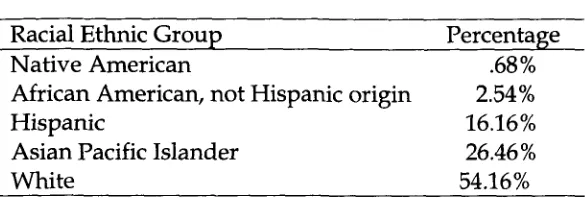
for this type of program. The racial/ ethnic composition of Taylor Middle School
Table 1
Taylor Middle School Student Racial Breakdown
Racial Ethnic Group Native American
African American, not Hispanic origin Hispanic
Asian Pacific Islander White
Percentage .68% 2.54% 16.16% 26.46% 54.16%
Our students speak 36 different languages; 23% of our school population are
English Language Learners and 24% fluent English speaking. Nearly one half of
our 860 students spoke another language before they spoke English (Millbrae
School District Handbook, 1999-2000).
Program Description
Students as Multicultural Educators, S.A.M.E., was a program that aimed
to empower students by providing them opportunities to teach peers about their
heritage and cultures. Consistent with anti-bias theory, this program gave
students voice and encouraged a deeper understanding of the cultures they
interacted with each day. Students were taught to foster their individual culture
and concurrently develop an appreciation for our connection as humans.
Students were encouraged to go beyond merely discussing holidays and food
and gave thoughtful presentations that included traditions, family experience,
and values. Students volunteered to give presentations about their culture at
year, there were over 150 sixth through eighth grade students attending these
meetings. In the spring, the programs culminating activity was a multicultural
fashion show that involved families, former students, and the community.
Due to the success of the program, after five years, the administration
asked if I could transform S.A.M.E. into an elective course. Thus, for the past 2
years, S.A.M.E. has been a 7th and 8th grade elective where three groups of
students move through a cross-cultural communications class. This opportunity
allowed for the instruction of the S.A.M.E. principles at a much deeper academic
level.
Innovative Approach
The lunchtime program provided a place where students could eat their
lunch and observe peer presentations. These presentations went beyond the
scope of the foods and holidays approach to multiculturalism, thus providing a
deeper look into the culture and individual families. Presenters often brought
authentic artifacts to complement their presentations. The multicultural fashion
show was initially created to draw a large audience with whom S.A.M.E. could
share its vision. The multicultural fashion show in its final year involved a cast
of 25 teachers and 90 students. Additionally, it involved approximately 50
volunteers consisting of parents in the community, community businesses, and
the feeder high school. Incorporating innovative music, choreography, and a
awareness about the importance of multicultural education. Our 1998 show
drew an audience of approximately 1000 people, turning away 100 people at the
door. Interwoven into the show, students shared with the audience the
importance of working together and learning about each other's cultures.
Evidence of Promoting Student Success
As a former student of Taylor Middle School, I was one of very few Asian
students. Rather than embrace my culture, I denied it and consequently lost
much of my identity during my middle and high school years. hooks (1994) had
similar experiences with her identity as a Black woman. Obviously, it is not a
unique experience for many people of color. Upon returning as a teacher, I
noticed that the population had changed dramatically. Taylor Middle School's
student population was widely diverse; thus, I began S.A.M.E. with the intention
of celebrating that diversity. I wanted to prevent the loss of identity that I had
experienced as a sh1dent. This program began in 1993 with the hope of reaching
a handful of students. The original program began with approximately 60
students. There have been over 500 members in the lunch program. For the first
five years, we held a fundraiser in the spring to raise money for a special
multicultural library for students and teachers and to bring multicultural
assemblies for the entire student body. During the culminating fundraiser, the
multicultural fashion show, we had approximately 60 cast members, 20 alumni
promoting communication between the high school and middle school students,
we began inviting students from Mills High School's multicultural council to
participate in our show. This became so successful that each year we have
invited back our former students and the numbers of these participants
continued to increase. In 1998, we had 45 high school students (alumni of Taylor
Middle School) return to participate in the fashion show and other S.A.M.E.
events. These students volunteered their time to work with our cast and crew
who provided a rich relationship between past and present students. All
students involved in S.A.M.E. become part of a family that encouraged one
another and as a result strengthened each other's individual self-confidence and
self-esteem.
Replicability
This program could be replicated and only requires one faculty advisor to
be present at lunch meeting. Training or education regarding multicultural
education would be advised so that an authentic multicultural process could be
implemented, rather than something that becomes merely a foods and holiday
festival. As this program empowers students of all abilities, ages, gender, and
color, it could be implemented in any socio-economic and demographic area.
The multicultural fashion show is a collaborative effort that requires both
students and the faculty advisor to organize the volunteers, and supervise the
could become one more multicultural activity that lacks authenticity. Care must
be taken to avoid this by choosing an advisor that is well versed in anti-bias
curriculum and critical pedagogy.
Relationships with the Community
The S.A.M.E. program not only involved students at Taylor but their
families as well. Our video technology class videotaped the meetings and clips
were shown during our announcement telecast. The multicultural fashion show
directly involved the community, too. Local merchants donated time to
photograph the cast and crew. Twelve different clothing sponsors lent clothing
to the show each year. Local hair salons and make-up artists donated their time
on the night of the event to help create the final touches. Large groups of parents
helped in all aspects of the show. Parents participated by driving students to
fittings, organizing the cast party, and volunteering their services during the
evening of the event. This event had become very popular for the teachers as
well. Over 20 teachers and two of our administrators participated in the 1998
event. We communicated with our parents through PTA meetings and the
newsette of the school.
Program Assessment
This program can be assessed through the participation of its members.
has directly involved over 700 students since its inception. As S.A.M.E.
continued to invite its alumni back, current students were able see how S.A.M.E.
had touched the lives of former students by their willingness to share their time
and talents with us while maintaining busy high school schedules. This year a
former student, the participant in the participatory class project, was able to
secure faculty advisors and begin the program at the feeder high school. Finally,
S.A.M.E. had raised over $7,000 through its multicultural fashion show; allowing
Taylor to purchase multicultural literature, bring in outside resources for cultural
school-wide assemblies, and produce of the show itself. Faculty support had
also proven to be a form of assessment. With more than half of our staff
participating in the event, students continually observed that both
administration and staff supported them. In addition, the number of racial
incidents have decreased over the years (Fritz, 1998). For example, the
occurrences of racial slurs, racially inspired fights, and racial graffiti have
lessened. Far less tolerance of racial name calling or racial incidents is evident at
Taylor Middle School compared to schools with similar populations (Fritz, 1998).
Purpose of the Study
The main purpose of the study was to investigate the reflections of the
participants of the Students as Multicultural Educators Program. Specifically,
the study aimed to provide former student participants the opportunity to
Dialogues between the researcher and the students provided opportunities for
the emergence of voice in the participating adolescents. Furthermore, I, being the
researcher, was able to critically reflect upon my experience as the founder and
facilitator of the program.
Research Questions
This participatory research study aimed to address the following
questions:
1. What are the major issues concerning their ethnic identity faced by the
middle school student participants?
2. How do issues concerning ethnic identity affect the participants'
self-esteem, peer relationships, and academic performance?
3. How do former students perceive their experience in the Students as
Multicultural Educators Program?
4. What did they learn from the program? What experiences did they
have that differ from those in other programs or curriculum at school?
5. What recommendations do they have for teachers of culturally diverse
populations?
Furthermore, this study hoped to provide student participants an opportunity to
Theoretical Framework
Educators are faced with the challenge of bringing forth a curriculum that
engages all students to become active participants. The challenge lies in how to
teach multiethnic students of all races. Struggles of all people and both genders
first should be recognized. This is a problem for many teachers due to conflicts
that emerge from uncomfortable dialogue. I know many teachers that want to
embrace multiculturalism but do not because they fear they may not do it
authentically or that it may create uncomfortable situations. It is a difficult
agenda to shift paradigms and abandon conventional canons.
Current theories in education call for a more inclusive, comprehensive
approach to multicultural education. The anti-bias theory of curriculum is one
that allows for all students to enjoy a more equitable education. Critical
pedagogy calls for transformation and requires that both teachers and students
engage in liberatory dialogue (Freire, 1970). Thus, liberatory education
encourages both the teacher and student to take risks, and to question. In turn,
both teacher and student can take action that can lead to empowerment.
The theoretical framework of this study is based on the anti-bias theory
and critical pedagogy. Liberatory dialogue is the heart of critical pedagogy.
These theories are discussed in detail later in part two, the review of the
literature.
The anti-bias theory of curriculum rests on the premise of incorporating a
beyond the patronizing "tourist curriculum". It calls for inclusiveness and
addresses bias, stereotypes, and origins of racial intolerance (Derman-Sparks, &
Phillips, 1997).
Critical pedagogy relies on reflection and social action. This theory
encourages individuals to name their world, then take action to change their
world. This theory works against the existing "banking education" that is the
foundation of many schools today. Students are encouraged to aid in the
construction of knowledge (Freire, 1970).
This study sought to use critical pedagogy as a relevant and valid form of
examining how middle school students voice their opinions regarding cultural
issues.
Scope and Delimitation of the Study
This study engaged six former participants of the Student as
Multicultural Educators program. The findings of this study cannot be
generalized to populations similar to the demographics of the S.A.M.E. program.
These findings are specific to each individual engaged in dialogue with the
researcher and is not meant to be applicable to students of the same ethnic
background nor reflect the feelings of all the student participants in the S.A.M.E.
program. Not all participants of the S.A.M.E. program are included, thus
findings do not include parent participants, community participants, or teacher
experience in the S.A.M.E. program since it cannot be assumed that any or all
reflections are due to their participation.
Significance of the Study
The results of this study were multi-faceted. First, the participants
engaged in meaningful dialogue that empowered and validated their cultural
heritage. The researcher was able to gain insight into how culture affects
adolescents and their reflection of cultural identity.
Furthermore, I as the researcher, was able to engage in critical reflection
and dialogue about the program I founded. This has provided a further
understanding of the direction my role in education will take and in turn affect
the teaching practices that follow. This study provides a model for practitioner
research which can only lead to more reflective teaching and developing
programs that could be significant to curriculum and instruction. Practitioner
research could help with reform efforts in all areas of education.
Dialogues with the student participants have allowed important themes to
emerge that suggest further direction for multicultural practice, as well as
demonstrated the importance of providing opportunities for adolescents to
dialogue. This study has provided new opportunities for the emergence of
student voice. The adolescent voices that were heard through participation in
this study provide new directions for those seeking to reform educational
could be a road to follow to increase communication between cultures. The
analysis of the dialogues provided important insight on the importance of
multicultural and anti-bias curriculum in schools. The voice of adolescents prove
to be an important instrument to encourage better curricular practices and
educational programs. Further, the dialogues suggest significant findings in the
strengthening of cultural identity, in turn leading to an increase in
self-confidence and self-esteem.
It was beneficial for adolescents to have the opportunity to voice their concerns about racial tension and cultural issues that may have been plaguing
them. Although there has been much progress made regarding
multiculturalism, existing racial tensions still lie between the different groups of
marginalized people. Programs that may lessen tensions would have to include
a way to increase understanding between the cultures while focusing on uniting
them. Unlike assimilation, anti-bias theory asks for individual preservation of
the cultures and individual empowerment. If this could be achieved, peaceful
coexistence could become a reality. It was the intent of the S.A.M.E. program to recover and embrace these simple yet profound ideals. In addition, marginal
groups most want to see their faces and their histories represented. How can a
person of color possibly live out the "American Dream" when no role models in
his/her history books represent who they are? This research study provided the
opportunity to hear the dialogue of students that participated in a program that
This study has also provided much needed research regarding the
implementation of anti-bias curriculum theory and critical pedagogy. Further,
the findings of this study helps to validate the objectives of the S.A.M.E. Program
encouraging its use in the future. The positive effects that this study reveals
should provide new opportunities to explore the impact that critical pedagogical
practices could provide. The unseen possibilities of using anti-bias curriculum
theory in all curricular areas can be witnessed through the findings of this study
and should motivate more research regarding the benefits of the implementation
of the theory. This study also provides a starting point for those who are
supporters of critical pedagogy to ignite a push to further develop curriculum
CHAPTER II
Review of Related Literature
Introduction
Our students are faced with curriculum that does not reflect their histories
or their cultures. Students of the new millennium need an education that
addresses all people. Educators must address the fact that racism still flourishes
in our schools forty years after desegregation laws went into effect in this
country. Yet, given the fact that schools are the societal institutions that reflect
the problems and power structure of the larger social order, we should not be
surprised. One could argue that "good teaching" could alleviate this, but the
continued failure that students of color experience does not reflect this simple
solution. New educational pedagogy suggests that teachers offer challenging,
exciting, and "fun" learning opportunities; yet there still exists a lack of
experiences that will allow students to transgress cultural boundaries. There
now is a collective call for transformation and rejuvenation of educational
practices. Since the topics for this literature review are so large in scope and so
much has been written about the topics discussed, I will focus this discussion on
the more recent theories of multicultural education, anti-bias theory, and critical
Multicultural Education
Teachers' work is fluid, delving into various roles to educate students,
deal with administration, and develop thoughtful curriculum. It seems even
more critical that in times where students now face realities of violence
stemming from displaced peers, that we reform current educational practices to
be more inclusive, thus multicultural.
Many theorists in education challenge the "banking of knowledge" that
has been on the forefront of educational practice for many years (Freire, 1970).
Education has been an indoctrination of the dominant culture's ideologies. As
the status quo is continued, students have found themselves less and less able to
obtain it. The inequities continue to grow as the technology age is upon us, thus
giving more validity to those who argue that education is neither neutral, nor
equitable (Freire, 1970; hooks, 1994; Nieto, 1992). As Cummins (1996) states in
the foreword to" Affirming Diversity,"
Nieto (1996) carefully suggests that both students and teachers are
products of an educational system that has excluded the cultural history and
experiences of all students. As the perpetuation of the status quo has continued
to be embedded in the educational practices of our society, we must look for
solutions that will liberate our students and teachers. Multicultural education
may not be the only answer to aid our failing students, but it is at least part of a
collection of practices that could empower students and give educators the
strategies to improve all students' educational experiences.
According to Nieto, multicultural education can be defined as having the
characteristics that can empower all students. Nieto's seven constructs for
multicultural education are the following:
1. Multicultural education is antiracist education.
2. Multicultural education is basic education
3. Multicultural education is important for all students.
4. Multicultural education is pervasive.
5. Multicultural education is education for social justice.
6. Multicultural education is a process.
7. Multicultural education is critical pedagogy.
Multicultural education as an antiracist way of teaching goes far beyond
the usual celebration of diversity. Rather than a simple festival of cultures, it calls
for the recognition of the racism that has preceded, the acknowledgment of
horrific acts of racism in history and the teaching of the effects that racism has
other things, the already racist practices that are pervasive in existing social
structures, including those found in schools.
Multicultural education as basic education would entail infusion of
inclusionary worldviews into the existing curriculum and not merely be a
contribution approach. Inclusive histories of all cultures would be included in
student textbooks. Thus, multicultural literacy would find its way into reading,
language arts, social studies, and computers (Nieto, 1996). Many schools fall
short in this respect because a mono-cultural perspective drives most of the
curriculum. The dominant group in this country is the major viewpoint that
students encounter throughout their elementary and secondary school
experience.
Since so many students of the dominant group are not equipped with the
knowledge of cross-cultural strategies and more importantly define themselves
as having no culture, multicultural education is for all students. Multicultural
education has been misconstrued to be a pedagogy for only students of color;
yet, if we are to produce citizens that are sensitive to the needs and experiences of all people, developing awareness of both the dominant and marginalized
groups is crucial.
Multicultural education must be pervasive to avoid it being seen as
"other". This would mean that multicultural education should be the perspective
from which educators teach, not by adding isolated snippets. It requires that
multicultural perspective, thus incorporating a world view rather that a singular
perspective.
Multicultural education would incorporate social justice. Both teachers
and students would employ methods of "praxis" which Freire (1970) calls the act
of reflection and action. Students would be given opportunities to connect their
learning to real-life problems for which they could reflect upon social problems
and take action in alleviating those problems. Students would engage in learning
about social structures and power struggles and be able to construct their own
democratic society.
As a process, Nieto (1996) claims that multicultural education should be
ongoing and dynamic. Students as well as teachers do not stop becoming
multicultural people. Because the knowledge of the world is so vast, one would
continue to learn from the world he/ she is a part of. Because multicultural
education does not operate from one canon, it is important that teachers
emphasize that humans constantly change and incorporate new sensitivities,
knowledge, and understanding of the world that surrounds them.
As critical pedagogy, multicultural education views knowledge as neither
neutral nor apolitical. Historically humans have been engaged in constant
struggles, changes in ideologies, and debates that have often been political. Nieto
suggests that as educators, "all the decisions we make, no matter how neutral
they seem, may impact in unconscious but fundamental ways the lives and
experiences of our students" (p. 318). The choices made in curriculum are
and linguistic diversity; however, critical pedagogy acknowledges this and uses
multiple perspectives in the process. Critical pedagogy includes the students in
the process; thus, not having something imposed upon them, students'
experiences help to shape their own curriculum. A more detailed account of
critical pedagogy is included in a forthcoming section of this chapter.
Banks' (1996) dimensions of multicultural education parallel Nieto's in
many ways. His model of multicultural education includes five parts. The first is
content integration whereby teachers would use content from a variety of cultures
and groups. This content would allow for teachers to present major concepts
through a variety of methodologies in all subject areas. Next is knowledge
construction process, which teaches students how to recognize bias, stereotypes,
and frames of reference, which are constructed within all disciplines. Prejudice
reduction would include activities and lessons to develop positive attitudes about
all people and groups. This would also entail dispelling stereotypes and
misconceptions that students and teachers may have about a particular group of
people. The fourth dimension calls for equity pedagogy. This asks teachers to
modify teaching to accommodate all learners. Finally an empowering school culture
and social structure should exist where schools and organizations would be
restructured to suit the needs of all students. Banks suggests that creating a
school culture that empowers all students must occur for multicultural education
to be transformative.
Tolerance, acceptance, and respect are the first three levels of Nieto's
means allowing the person to have "the capacity to bear something, although at
times it may be unpleasant. To be tolerant of differences means to endure them,
although not necessarily to embrace them" (p.354). Acceptance, the next level,
refers to the acknowledgment of the importance of culture and language. Respect
being the third step means that diversity would be held in high respect; thus
curriculum could include additive pieces of curriculum that may honor one
culture or another. The last step of multicultural education is what many schools
have failed to incorporate. Affirmation, solidarity, and critique comes with some
struggle because students may engage in activities where they may disagree but
are working together help issues of social justice for all groups. At this stage,
students not only celebrate diversity but also reflect upon it. It is more active
because conflict is not avoided but used as a strategy for critique.
Multicultural education has been criticized and called the stepchild of
education. Its lack of legitimacy calls for strenuous research agenda that will
allow multicultural education to be considered a solution to real-world
problems. Theorists in the field will have to unite in order to continue important
educational research as well as develop the agenda and direction of multicultural
education (Banks, 1996).
Since multicultural education is not static, neither should be those who
adopt its pedagogy. Multicultural education is necessary for all students. It
provides the necessary tools for educators to use what would increase the chance
incorporates good teaching strategies that honor all students and provides a
worldview that is necessary in our multicultural world.
Critical Pedagogy and Education
Critical pedagogy is defined as a method that incorporates critical
reflection and action. The outcome of critical pedagogy is empowerment for all
parties involved in the process. As a process of learning and teaching critical
pedagogy requires both the learner and the teacher to become authors of their
own existence (Ada, 2000; Collins, 2000; Freire, 1973). As a philosophy, it calls for
those who are oppressed to become agents in changing their world, thus
liberating themselves as well as others. Its constructs directly deal with social
justice and change.
Bell (1997) believes that social justice education is a goal that envisions a
society where resources and their distribution are equitable. This process should
be participatory in nature, inclusive, and affirm our connections as human
beings. As Bell (1998)defines the need for social justice education, she proposes
that in order to recognize social justice, oppression must be recognized as a
theoretical construct that social justice tries to resolve. The features of oppression
as Bell defines it are pervasiveness, restricting, hierarchical, complex, multiple,
cross-cutting relationships, internalized, and "isms."
Pervasiveness means that prejudice and bigotry are embedded into most
aspects of our society. It includes institutionalized and systemic oppression.
chances and sense of possibility ... ," (Bell, 1997, p.). This includes restriction of
movement within groups, across cultural boundaries, and between
socio-economic classes. Hierarchical identifies the benefits that non-oppressed groups
experience such as Whites' access to social power and privilege in comparison to
a person of color. Issues between those in the same group are identified by Bell
as complex, multiple, cross-cutting relationships and are also oppressive in nature;
for example the professional advantage that an African American man may enjoy
versus that of a woman. Internalized oppression represents the oppression that is
not only inflicted upon a person, but also the oppression that he/ she inflicts
upon him/herself. Victims often internalize the oppression that their benefactors
impose on them, thus believing that the oppression is somehow deserved. "Isms"
refer to the belief in politicizing the terms by which specific forms of oppression
are defined. In all forms (ableism, classism, sexism, heterosexualism, and racism)
the difference between power and privilege are clear.
Because identities and the way in which people define themselves can
constantly change, it is not as important to define each identity but look at the
ways by which the oppression is perpetuated. In particular, Freire (1970) calls for
those in oppressive situations to "name" their oppression, in order to reflect
upon it, thus being equipped with the tools to change it. The oppressed must
first recognize the oppression. Morrow and Torres (1995) discuss this oppression
in terms of having voluntary consent to be oppressed by the dominant group.
As Tong (1989) describes hegemony being how a dominant group is successful
to challenge oppression, Freire (1970) insists that one must make visible the
underlying principles that perpetuate the domination in order to collectively
imagine possibilities for restructuring it.
Freire (1970) argues that oppression hurts everyone. Both the subordinate
group and dominant group become dehumanized. If the reasons for domination are not demystified then, the oppressor still is dehumanized. The dominant
group's view themselves and society through a distorted lens as those who are
dominated begin to internalize the oppression.
Critical pedagogy is needed in education because education is not neutral
(Shor, 1992). This falls in line with Freire's notion of "banking knowledge,"
where students are simply given information, mostly from a singular perspective
and not able to construct the knowledge themselves. Further, Nieto (1996) agrees
that the education that is gained by students is not reflective of their cultures nor
inclusive of their experiences. Thus, critical pedagogy calling for "praxis", action,
and reflection, is a critical part of multicultural education.
Freire (1970) insists that education be a practice of freedom. He believes
in active dialogue that encourages reflection upon the world and in turn an
active participation to change it. Another theorist who argues that teachers
should be facilitators of change is Thich Nhat Hanh (1994). He also calls upon
both teachers and students to be active participants. Thich Nhat Hanh focuses on
the whole person; namely, a complete being including a union of the mind, body
succeed. Therefore, in order for teachers to understand their role in alleviating
the injustices within the cultures of our classrooms and increase the "buy in" of
our students, they must first be encouraged to examine their own biases.
hooks (1994) suggests in both her feminist and educational writings that
we as individuals must transform our thinking. This standpoint suggests a
world view that sees all individuals, white and/ or people of color, as responsible
agents in institutional racism, and therefore, need to be agents of change. All
individuals must understand the constructs that society has perpetuated. Upon
reflection of her own teaching practices, hooks states, "While it is utterly
unreasonable for students to expect classrooms to be therapy sessions, it is
appropriate for them to hope that the knowledge received in these settings will
enrich and enhance them" ( p.19). hooks further acknowledges that teachers are
empowered in the process of empowering students when encouraged to be
reflective upon their situations. Transformation is duly addressed in her
reflections about Freire's work where she states ... "in its global understanding of
liberation struggles, always emphasizes that this is the important initial stage of
transformation---that historical moment when one begins to think critically about
the self and identity in relation to one's political circumstance" (hooks, 1994, p.
47).
Shor (1999) discusses the value of teaching critically when defining how
education can be empowering:
Empowering education, as I define it here, is critical-democratic pedagogy for self and social change. It is a student-centered program for
growth as an active, cooperative, and social process, because the self and society create each other. Human beings do no invent themselves in a vacuum, and society cannot be made unless people create it together. The goals of this pedagogy are to relate personal growth to public life, by developing strong skills, academic knowledge, habits of inquiry and critical curiosity about society, power, inequality, and change. (p. 69)
Thus, as teachers we are called to the duty to bring about social change, and
teach our students how to implement that change.
Freire (1970) believes that if we are to bring about critical consciousness,
we must build community among ourselves and within our classroom. As
hooks (1994) concurs with Shor and Freire, "no education is politically
neutral"(p. 37). The old patterns that exist in education are still the political
perspectives that shaped this nation. Although passing these ideologies on may
not necessarily be the intention of the teacher, the passive acceptance of this way
of teaching perpetuates biases that encourage a White supremacist ideology.
hooks (1994) claims that in order to make a democratic classroom, everyone
including the teacher should feel the responsibility to contribute. A safe place for
all to have a voice is the goal of transformative pedagogy. Like Freire, she
believes a feeling of community would create a common sense of commitment
towards a common goal that binds us. As educators, it is necessary to recognize
that we live in a multicultural world that can benefit from building community
and giving voice to all students.
Often educational theory and more specifically, critical pedagogy has been
It is easy to read about what gaps there are in educational practice but more
difficult to fill those gaps through practice and application.
Giroux and McLaren (1983) emphasize that teachers who embrace cultural
studies must combine "theory and practice in order to affirm and demonstrate
pedagogical practices engaged in creating a new language, rupturing
disciplinary boundaries, de-centering authority, and rewriting the institutional
and discursive borderlands in which politics becomes a condition for reasserting
the relationship between agency, power, and struggle" (p. xvi). Thus, not only do
students need to engage in dialogue but educators would benefit as well.
Educators must share experiences, discomfort, ideas, and commitment in order
for a true praxis to come forth. The praxis being that action and reflection must
co-exist before change can occur.
Trachtenberg (1990) voices similar concerns about educators and
awareness. He supports the notion that students must know their roots and
those of their peers in order to become productive citizens. Trachtenberg feels
that the debate over multiculturalism has three problems. First, he states that
there is confusion over the different meanings of culture. One meaning denotes
"high culture," namely works of art literature, philosophy, and music; the other
traces its origin to the modern social sciences and refers to the ways in which
different groups of people organize their daily lives within national or ethnic
groups, urban neighborhoods, companies and professions, and other settings.
has always been intertwined with other cultures. Third, people do not recognize
the difficulty in understanding that multiculturalism is a means to the national
survival of the United States; namely, our ability to reach students of color and
help them become skilled and productive contributors to the economy will
determine our success or failure in the international marketplace. Trachtenburg
calls for schools to repeat the words of an ancient Roman playwright:"N othing
human can be alien to me."
Teaching with critical pedagogy as a strategy can create not only a more
reflective community of pratictioners and students, but also develop a more
human connection between all those involved. hooks (1994) claims that although
there is a focus on multiculturalism in education, there is a lack of practical
discussion about the ways classrooms and schools can be transformed into
inclusive settings. As hooks (1994) also believes, "When we, as educators, allow
our pedagogy to be radically changed by our recognition of a multicultural
world, we can give students the education they desire and deserve. We can teach
in ways that transform consciousness, creating a climate of free expression that is
the essence of a truly liberatory liberal arts education." (p.44)
Anti-Bias Curriculum
Anti-bias curriculum is defined as incorporating positive intent of
multiculturalism, where one goes beyond the "tourist curriculum".
emphasizes the exotic features of cultures; thus, inadvertently seems as though it
is meant for only children of color. An anti-bias curriculum calls for a real
understanding between cultures. It is more inclusive and directly addresses the impact of stereotypes, prejudice, and intolerance. The anti-bias approach to
challenging prejudice, stereotyping, bias, and the "isms" is active where
individuals actively intervene and challenge the behaviors that perpetuate
oppression. An example of this type of curriculum would be to empower
individual students with a strong cultural identity by incorporating studying
one's own heritage in school.
Derman-Sparks and Phillips (1997) also recognize the need to transform
the existing theories into practice. They begin first by outlining the dynamics of
racism then offering how to transgress in anti-racist teaching. Derman-Sparks
and Phillips explain their conceptual framework of racism in the United States.
This framework rests on four major principles that drive racism. First, racism
operates both overtly and covertly, the latter having particular significance for
anti-racism education. They argue that overt manifestations of racism are easy to
distinguish but it is covert racism that is harder to identify especially in
education. IQ testing, tracking, a lack of understanding of differences in cultural
learning styles, and curriculum centered on Euro-American culture all aid to
create unequal opportunities and maintain institutional racism. Second, racism
itself operates on a political construct. The construct of race has no scientific
rooted in developmental capitalism and colonialism that Europeans cultivated in
the New World. Derman-Sparks and Phillips state that enslaved labor played an
essential role in the process of developing capitalism and colonial expansion,
their main support being slavery. Lastly, racism operates in complex ways with
sexism and classism. These all interact due to the oppressive forces that can
dominate in all three arenas. Those in power justify oppression based on gender
and class using arguments of inferiority.
Derman-Sparks and Phillips are quick to contend that racism is still much
in existence. They support this by using the University of California Regents as
an example. The regents' decision to end affirmative action admissions for
people of color caused many debates over the race issue. However, the Los
Angeles Times investigated and revealed that many of the regents had pulled
strings to get their own friends and relatives admitted to the system. The
students who would benefit most from ending affirmative action would be
White students. "Whites as Victims" has been the new face of racism where
Whites are blaming people of color for social and economic problems. The big
complaint here is that multiculturalism ignores White culture and hurts White
children's self-esteem.
As indicated in an earlier section, multicultural education is for all
students. Nieto (1996) suggests that if multicultural education is not embraced then the opposite is a monocultural education that looks very much like the
failure for large numbers of students is largely based on structural factors such as
racism, and policy and practice that perpetuate inequity among students.
Linguistic and cultural discontinuities also impact our students where their
native languages are not honored in their classrooms, just another way of their
cultures being made invisible. If education is to remain monocultural, it will maintain that only one reality exists for all students (Nieto, 1996). The research
Nieto (1996) has done with 12 students that are reflective of our nation's ever
changing demographics clearly identifies the need to reform our existing
practices. Nieto's work is an important example of anti-bias curriculum. The case
studies revealed that students felt that their academic success could be improved
by (a) maintaining and affirming pride in native language and culture; (b)
engaging in activities beyond academics in the school, home, and community;
and( c) the developing supportive environments in school, home, and
community.
Research in Multicultural Education
Nieto (1996) claims that research in multicultural education has been
limited but the resurgence of interest in the field is producing an increase in the
number of studies. She states that Allport has found that indirect approaches to
the study of cultural groups are better than programs that taught directly about
the group differences. Effective programs fostered acquaintance among diverse
students, led to equity regarding social status, avoided non authentic
In Nieto's (1996) case studies, she classifies ten students as successful
based on the following criteria: still in school and planning on graduating, good
grades, had thoughts regarding their futures, generally enjoyed school, critical of
their school experiences, and lastly described themselves as successful. In trying
to identify what factors affected a student's success, Nieto states that each
student came from different cultures, conditions, and overall experiences but
feels that the students still report similar conditions which helped them to be
successful. The case studies identify emergent themes that provide evidence that
multicultural education is important to students. The students who were
successful in school claimed that they were able to use their native language in
school and that their teachers respected its use. Another lesson that Nieto learns
from students is the lack of multicultural inclusive curriculum in schools today.
She says that when the students did identify that there was some cultural time
spent during the school day, it was usually on a very superficial basis such as
holidays or food. Although the students do not suggest that multicultural
education be comprehensively infused, Nieto (1996) argues that because they
spoke so often about culture, home life, and their native languages, these
students would have benefited by a comprehensive approach to multicultural
education. Students also continued to identify outside extracurricular activities
such as sports or after school clubs were one of the key components of their
success. The type of activity may have varied from sports, community events,
school clubs or religious groups; yet, it was the support that these activities
studies revealed that students often struggle with their cultural identities and
find that teachers who care about them, acknowledge student identity struggles,
and honor student cultures were the ones that had the most impact on them.
Grant and Sleeter, (1994) looked at human relations approach (or
intergroup relations) to multicultural education which has its theoretical
foundations in general and social psychology. They reviewed much of the literature regarding human relations theory and ethnicity and found that many
researchers find benefits from learning about their cultural groups. Furthermore,
this synthesis of the studies and research regarding human relations, suggest that
learning about one another's race would help to reduce the stereotype that
people have regarding each other and increase tolerance.
Grant and Sleeter (1994) looked directly at self-concept theory and suggest
that educators oversimplify a child's self-concept. Since children develop their
self-concepts through their interactions with people, they argue that school is an
important place for developing self-concept and self-esteem. As stated by the
Grant and Sleeter," ... school is a part of that wider society an my be transmitting
damaging messages to which children then react (p.99). Furthermore, self
concept theory also state that children 's self-esteem begins to drop by late
elementary and junior high school. By adolescence, if students continue to get negative messages about themselves whether it be about race or even sexuality,
their self-esteem is affected. In Grant and Sleeter's (1994), analysis they quote
When a student with low self-esteem enters a classroom, self
concept becomes one of the most challenging individual differences in how he or she will learn. Because students with a negative self-image are not fully able to learn, school becomes an arena for failure that prevents them from achieving the success needed for high self-esteem. (p. 131)
This supports Nieto (1992) who feels that self-concept is a result of policies and
practices of schools and society that affirm some cultural groups while rejecting
others.
Grant and Sleeter (1994) offer strategies for educators as a result of their
analysis. These strategies come directly from human relations theory. They
found the most effective practices included children to be active participants in
their learning. In addition, they stress the importance of provide accurate
cognitive information regarding ethnicity issues. Not only should the
information presented be authentic but it should also stress the commonality of
people while celebrating the individual. They suggest addressing issues of
intolerance and bias so that students see how people do react to differences they
do not understand. This can be compared to Nieto's theory of multicultural
education (1996).
Banks (1991) reported after numerous studies on the impact of content
about race and gender, that the results are inconsistent. However, he claims that
many looked at short term effects but reported that there were more positive
Much of the research in multicultural education consists of single group
studies that look primarily at one group, such Chinese, or Latino students rather
than heterogenous groups. This is often the shape that many high school and
college courses take, such as a deep analysis of a particular group. The general
findings do indicate that an increased awareness of one's own ethnic group is
beneficial and that understanding one's self is an important first step in
understanding others. Most of the advocates of single group studies recommend
that the content of single groups be integrated into the mainstream curriculum
(Grant & Sleeter, 1994). Grant and Sleeter (1994) point out that the single group studies, is an easier choice for many educators because it does not involve trying
to develop multidisciplinary curriculum that includes all cultural groups.
In the 1996 curriculum pilot of S.A.M.E., and anti-bias curriculum,
students that experienced a five day sample of anti-bias lessons showed a
statistically significant difference in the alleviation of bias (Lei, 1996). The overall
growing number of studies suggest that only by reforming the entire school
environment can the effects of multicultural education be successful.
Summary
The authors and theorists identified all believe that education can be
transformative. Furthermore, the literature supports the notion that students
would indeed benefit from a curriculum that was inclusive of all cultural
perspectives and revealed the inequities of our society. Critical pedagogy would
individuals to name the world, namely their oppression, reflect upon it, and then
begin a journey to transformation. Existing research studies on the effects of
multicultural education may not be consistent, however, the studies do suggest
that the effects are positive. I am not naive enough to believe that one program,
like S.A.M.E. can change how multicultural education may be viewed by all
teachers or students, nor that it can alleviate all the educational problems that
exist in our schools. Yet, as the literature suggests, programs that address
cultural issues and inclusive education provide students with the tools that can
CHAPTER III
Methodology
Introduction
This study describes the critical reflections of adolescent student
participants in the Students as Multicultural Educators Program. The dialogues
with former student participants have given important insights within the areas
of cultural identity and emergence of voice. Former student participants were .
asked questions regarding for their thoughts on multicultural education, cultural
issues, and cultural identity. Students were also able to add questions they felt
were relevant and important to the study. Students had the right to remain silent
if they were uncomfortable and skip any questions that made them feel uneasy. Throughout the dialogue process, students were encouraged to add or question
the procedures presented. Through dialogues and the analysis of dialogue
transcripts, I identified and described the emerging themes in chapter IV of this
study.
Research Design
This study utilized the methodology of participatory r~s~~~ch. I chose to
-use participatory research beca-use of its founding premise of critical reflection
and dialogue. Dialogue is the tool that opens communication and allows an
honest critical reflection (Ada & Beutel, 1993; Maguire, 1987). The method has
been utilized to investigate social injustices and has given many oppressed
people a voice (Ada & Beutel, 1993). As a means for social change and critical
conscientiousness (Freire, 1983), it has provided both the researcher and the
participants meaningful new consciousness about their experience in the
S.A.M.E. Program. Furthermore, it has revealed important themes regarding
participants' experiences in a multicultural/ anti-bias program that may
encourage additional practice for schools in the future. Finally, this method
allowed for the critical reflection on my own involvement in the program, thus,
provides an increased awareness of my role as a practitioner. Former students
participated in two to three dialogues. The students and the researcher
dialogued for a period of about two weeks. The initial dialogue was done in
writing with follow up session held either on the phone or in person at a place
most convenient for the participant. The participants were given opportunities to
provide feedback regarding the questions, their reflections and the themes that
emerged.
The Participatory Class Project
In order to develop the dialogue questions more genuinely, I engaged one
former student in a dialogue through a class project that served as the model for
in the S.A.M.E. Program for 4 years and had recently taken action himself by
initiating the S.A.M.E. program and implementing it at his high school.
Portrait of the Participant
Takahiro is a 17- year-old Japanese American. Tak was born in Long
Island, New York on December 22nd, 1981. He spent his first three years in New
York City and then moved to Chicago, Illinois. Tak attended two different
elementary schools and a middle school. The moves were during the break up of
his parents. In each school the student body was predominantly white. Tak
moved to the San Francisco Bay area in the 7th grade when he was 12 years old.
He attended Taylor Middle School. When he first moved to Millbrae, he moved
with his father and a year later his father remarried and his step mother moved
in. They are now in the process of splitting up. Tak's mom remained in Chicago
and remarried when he was a freshman, which relocated her to Japan. Tak's
mom and step-dad and little brother that is two years old will move back to
Chicago this year.
After Tak accepted the invitation to participate in this preliminary study, I
discussed with him how we could proceed with the dialogues. On our first
meeting, I asked a few of the questions but noticed that Tak needed time to
reflect upon the questions. He asked if he could see all of the questions and
upon looking at them asked if he could respond in writing. Tak felt he could
response. I readily agreed and we met again after he finished the first set of
questions. This allowed me as the researcher to ask Tak to elaborate on certain
issues or clarify anything I needed. We continued with the same procedure for
the second set of dialogue questions.
After two dialogue sessions with Tak Shimada, I was encouraged by the
amount of thought and reflection he was able to give to the issues presented to
him. After reviewing the transcripts of both dialogue sessions, I began to see
four emergent themes. They are the following: cultural identity, family and
culture, school and culture, and the effects of the Students As Multicultural
Educators Program. The importance of these emergent themes to multicultural
education is discussed in more detail in following chapters.
Emergent Themes
Cultural identity. Tak was born in the United States. Many of his answers
during the dialogue revealed how much Tak felt like an outsider during much of
his childhood. Tak was frustrated with the fact that he was born in this country,
but was not able to enjoy the privileges his white friends enjoyed due to being
Japanese. Due to his growing up in the suburbs of Illinois, he was one of very
few students of color. He experienced many incidents of racial discrimination,
and being called hurtful names. Tak says he had tried to adopt the backgrounds
of the people around him, which were white. He tried desperately to "be like