Res Dev Med Educ, 2013, 2(1), 25-30 doi:10.5681/rdme.2013.006
http://journals.tbzmed.ac.ir/rdme
*Corresponding authors: Soleiman Ahmady, Email: [email protected]
Copyright © 2013 by Tabriz University of Medical Sciences Introduction
Effective Factors in the Design and Implementation of the
Interprofessional Education from the Faculty Members’ Perspective: A
Qualitative Study
A RT I C L E I N F O A B S T R A C T
Article Type:
Original Research
Article History: Received: 12 Dec 2012 Revised: 27 March 2013 Accepted: 04 Apr 2013 ePublished: 30 May 2013 Keywords:
Interprofessional education Multiprofessional education Health system
Content thematic analysis
Introduction: A new training strategy in many medical universities around the world, which has been considered by educational planners, is interprofessional education (IPE). The main aim is designing and implementing IPE, reinforcing teamwork and collaboration among the health team members. This study has been done aiming to explore effective factors in the designing and implementing IPE in health system of Iran from the perspective of faculty members. Methods: This qualitative study used content thematic analysis methodology. A purposive sampling was used and continued until the data were saturated. The participants were six faculty members with more than 5 years of teaching experience or educational activities in Educational Development Center (EDC)
or Educational Development Office (EDO). Results: The four main themes emerged from
the interviews were classified as follows: the structure of the educational system, economic
issues, cultural atmosphere, and social conditions. They were all associated with some positive factors such as curriculum changes and reforms, design and implementation of the interprofessional education in various forms and some negative factors such as lack of physical structure appropriate for the IPE in the universities, promotion of culture of individualism and uni-professionalism, etc. Conclusion: The results of this study showed that in our country, the effect of educational, cultural, social and economic barriers on the development and implementation of IPE, and also, unfamiliarity of educational system with the various aspects of IPE, has made the implementing of these programs in the
curricula of different professions of health sciences difficult.
Mahboobeh Khabaz Mafinejad1, Soleiman Ahmady2*, Seyyed Kamran Soltani Arabshahi1, Sholeh Bigdeli1
1Department of Medical Education, Faculty of Medicine, Tehran University of Medical Sciences, Tehran, Iran.
2Department of Medical Education, School of Medical Education, Shahid Beheshti University of Medical Sciences, Tehran, Iran
T
oday, along with complex needs of patients’ health care, the health team collaboration in running the process of caring is needed as well. While reviewing the documents related to collaboration between different medical professions, you reach to this fact that thedisability of health team member makes it difficult to
achieve this goal.1 Kennedy says that the patients are
not belonging to one profession, but the people who are caring them are responsible for them.2 So one of the
more important special capabilities felt to be achieved by the team members is the reinforcement of the sense of teamwork and interprofessional collaboration which have
great influence on the process of patient care.3 It is obvious
that the traditional approach to multiprofessional education provides students having of different professions with
little opportunity to know the principle of interprofessional collaboration.4 Romanov in his report about “the future of
health care in Canada” mentions that to achieve the effective health care services, the interprofessional collaboration should be considered as the essential component in the curricula.5
Hence, following the manifestation of the World Health Organization in 1988 titled “Learning together to work together for health” made the education authorities to increase the mutual understanding and upgrade the interaction of students of different professions through the development of the education of interprofessional education in the curricula of the higher education institutes and universities.6 Several organizations and institutions
Khabaz Mafinejad
concept of collaboration and teamwork as one of the main strategies for improving the quality of health care services among the health team members specially in developed countries such as United states, England and Canada in recent three decades.7
Also in Iran, the scientific secretary of first national
conference on the prevention of medical errors, Dr. Delfan, stated that the main cause of medical errors are contradictions in the organizations of health care services, and the best method of preventing it is coordinating the activities of the medical team in a health care system.8
Hence, there are some factors such as the movement toward reform of curricula in Iran, special interest to the integrated curriculum, the necessity of accountability of educational programs to the health needs of the society and the increasing need to improve the communication and collaboration among members of the health team suggest the need for greater attention to provide programs for strengthening the interprofessional collaboration among members of the health team.9-10 However, despite
achieving many benefits from the implementation of these
programs and clarifying the importance of this issue, the unique role of faculty members in providing and receiving such training programs, very few researches have been done in this regard, particularly in terms of their views on the factors affecting the design and implementation of interprofessional education in the education system of Iran.
In this regard, the researchers believed that understanding the perception of faculty members through the factors affecting the interprofessional education can provide appropriate information for educational programmers to begin the designing and running this program in our country. Furthermore, since the qualitative researches pave the way for studying of new phenomena in different sciences, in this study, qualitative research methods were used in order to be understandable for faculty members. Indeed qualitative researches emphasize on dynamic, comprehensive and individual aspects of human experiences and try to examine these aspects in the context
and the field of phenomena and the from viewpoint of
those who have experienced them.11
Methods
This study has been done by using content thematic analysis approach, which is one of qualitative research approach. Content analysis is a research method that aims to provide a new understanding, promote the researcher’s understanding of the phenomena, and determine operational strategies.12 So, considering the new nature
of this educational method in medical education in Iran, the complexity of different aspects of the interprofessional education and researchers’ interest to review this subject, and explaining the factors affecting the design and implementation of interprofessional education, the content thematic analysis method was used.
First, considering the research objectives and meeting the research questions, inclusion criteria of the participants
in the study were determined, afterwards the participants were determined with regard to diversity of educational
fields and academic ranks using purposive sampling
method. In this regard, the selected participants were the faculty members of Tehran University of Medical Sciences who had teaching experience or educational activities in EDC and EDO for at least 5 years. To conduct pilot study, two faculty members of others universities (Esfahan and Mashhad University of Medical Sciences) who had the experience of interprofessional and interdisciplinary programs were invited to participate in the research. In this study, semi-structured interviews done with the presence of the researcher and each of the participants was the data collection method. Approximate duration of interviews was 30-50 minutes depending on the interaction between the participant and the interviewee and Interviewees’ responses.
The interview guide including an interview introduction, consent form and some questions offered to each person. In individual interviews, the process of the interview began with general questions, and then participants had the opportunity to express their perceptions in details. First, participants were asked to describe their understanding of this education and then the interview continued with
asking some specific questions such as how to design
and implement education programs for interprofessional education in the health system in Iran?, what are the effective factors in designing and implementing this educational method?, what effects will each of these factors have?
The content of the interviews was recorded with the consent of each participant and transcribed as soon as possible. Finally the content of the transcribed interviews were compared with the recorded tapes by a colleague, ensuring the accuracy of the data. Data collection continued until data saturation. So that in the last two interviews, participants pointed to the similar issues or data collected from previous interviews and nothing new was obtained. The content thematic analysis method was used to analyze the data. First, the content of each interview was read several times, then the text of the interview is divided into several short meaningful units orderly, research codes were obtained through the summarizing of the relevant
meaningful units which were classified into several
categories and sub-categories by examining the differences and similarities of the extracted code. In this stage, the extracted codes, classes and sub classes were examined
and revised by a researcher, and finally by analyzing the
Table 1. Description of Demographiccharacteristics ofparticipants
Characteristics Number
Gender Female 3
Male 3
Specialty/field
Medicine 2
Dental 1
Nursing 2
Hygiene 1
Teaching experience
Between 5 - 10 years 1
Between 10 - 20 years 4
More than 20 years 1
data very carefully and to get sure of its accuracy they sent a part of the original interview with initial codes to the number of participants and made the transcripts of the interviews and tape-recorded ones reviewed by a
colleague. For confirm ability of the data, all reports, we
put manuscripts and Researcher’s notes at a colleague's disposal to compare his perception with the codes and
findings obtained by the researcher. Also, for transferability
and relevance of the data, we tried to show that the obtained data were indicating the whole existing data by collecting information from key informants, during the study.
Results
A total of six key informants participated in this study. The characteristics of faculty members participating in the study are shown in Table 1.
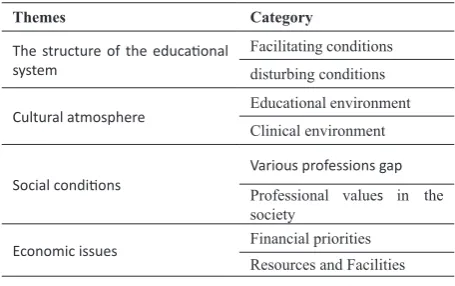
Based on the findings, the factors affecting the interprofessional education have been classifies in to the
four main themes including the structure of educational system, the economic issues, cultural atmosphere, and social conditions. The summary of the main themes and
the categories obtained from findings were presented in
Table 2. These themes and categories were explained by using some quotes derived from the data.
The structure of the educational system
From the perspective of faculty members, the structure of the educational system was one of the most important
factors influencing the design and implementation of the
interprofessional education. There were various facilitating and disturbing factors which were frequently mentioned by participants. Reforming current curricula, continuing medical Education Policy based on strengthening the sense of collaboration among health team members, the possibility of designing the interprofessional education in various forms were listed as the facilitating factors in implementation of these programs. The following is the comment of one of participant on the possibility of the implementing the interprofessional education in various forms as an educational strategy:
“I want to say that it could run both in the theoretical program and clinical practice, both in the internship and in the skill lab i.e. practical environment but it should be simulation. It means that it is applicable both in theoretical
and practical course and in clinical and field settings”
(Interviewee 1).
Furthermore, the participants believed that several forms of designing and implementation of interprofessional training programs were considered as the facilitating factors. Thus, continuing medical education (CME) will be one of the opportunities for implementation of interprofessional education which mentioned by the participants. One of the faculty members said that:
“However, we can start from the post registration in the form of continuing medical education …apart from the continuing medical education, there is a possibility of clinical interprofessional education even possible for some courses, especially theoretical ones, but in the present condition, I think CME is a good chance for implementing interprofessional education. In order to start this job we should do this in CME and then for those who are working because the subjects are more tangible for them, then gradually it can be implemented in clinical and basic
sciences.” (Interviewee 2)
The participants in the study noted the barriers such as centralization of the current educational programs and resistance of different professional department to interprofessional education, and lack of creativity and innovation in educational programs have created obstacles in implementing these programs which have affected the facilitating conditions for implementing these programs in our country and led to the less implementation of them. One faculty member said that:
“There is a fact that our educational system is highly centralized system; it means that the board of different
fields compiles the educational content which is sent to
all universities even Azad universities as their educational
program. Since it is centralized, there is not any defined
Table 2. Themes and categories within the data analysis
Themes Category
The structure of the educational
system
Facilitating conditions disturbing conditions
Cultural atmosphere Educational environment
Clinical environment
Social conditions Various professions gapProfessional values in the
society
Economic issues Financial priorities
Khabaz Mafinejad
position for interprofessional education in educational
programs of various fields!” (Interviewee 4)
The other participant in this regard said:
“We have a centralized system now; they cannot plan
interdisciplinary method of teaching.” (Interviewee 1)
One of participant suggested specific planning for different
universities as an executive strategy and explained that:
“As you know in many parts of the world they have different programs in their different universities. This let the different Universities set up and run a variety of different programs. We have similar ones in our country. Even our own curricula let every university change 20% of courses. These show that we can stop this discussion and enlarge our view in order to have a good implementation and development." (Interviewee 3)
Economic issues
One of the most important factors affecting the process of design and implementation of special interprofessional
education is financial and human resources, and providing
necessary funding to train large numbers of learners from different professions. It is so impressive which has made implementation of these programs in the current education system face with serious challenges.
One of the participants believed that, independent budget of each faculty can be considered as an obstacle for the time being. This participant has also made a suggestion for providing funding to joint educational program:
“When we're budgeting, by offering better budget to the matched universities, we can encourage them to cooperate
more.” (Interviewee 3)
On the other hand, the lack of adequate funding to implement these programs, lack of adequate physical resources, particularly in the clinical environments have been mentioned as the major challenges in the implementation of these programs. While the Participants were discussing the unequal allocated budget in different universities, they also mentioned the long distance of different faculties and departments of some medical universities. One of the participants said that:
“As a result, that small university has no facilities and
deals with the problem.” (Interviewee 6)
The implications of all factors in the economic issues have led to the decreasing of motivation and interest in providing these programs in the curricula of medical universities in the country.
Cultural background
Apart from the discussion of education and economic factors, the inappropriate cultural atmosphere of education
in universities and hospitals, especially educational hospitals has caused other factors to be affected by it, and
finally has created an inappropriate learning environment
for the interprofessional education. Furthermore, the system policy toward the providing of the interprofessional education has some negative effects in thecurrent cultural condition such as concerns about the lack of attention to values of other professions, unconstructive competitive cultural atmosphere between different professions due to lack of familiarity with the responsibilities of other professions. The idea of one of the participants about the lack of attention to the values of each profession was as follows:
“It depends on people's personality traits, people usually believe that there are some factors such as the level of knowledge, and learning abilities which determine which major they should choose, they don't talk about interest , for in stance, a nurse has already decided to major in nursing or she/he may choose nursing because of its labor
market.”(Interviewee 5)
Thus, in the majority of the educational programs, inappropriate culture of professionalism and individualism is encouraged. And this inappropriate cultural atmosphere for inte rprofessional education has been created by authorit ies ranging from the curriculum planners and designers to the role of academic members in this process. One of the participants described the role of educational planners in creating the current cultural atmosphere of the education as follows:
“When you get into any university, they are busy with own
works when they gather together.” (Interviewee 3)
And then said that to overcome to this inappropriate cultural atmosphere of the universities, education authorit ies of different professions should have more interact ion with each other. So the opportunities for creating interprofessional condition can be provided:
“The aut horities and experts and all these instructive elements must have interaction in universities and
different fields. They should put aside their cultural and
mental barriers, and to have an interactive and adaptive relationship to solve this problem. Unfortunately we never
had the integrated culture.” (Interviewee 3)
The problem is seen not only in universities but also in the clinical settings. One of participants said that:
“Unfortu nately in our society, our universities and our
hospital s, everyone just accepts himself! Everyone in
the hospital says that I’m better than the others…doctor with nurse…nurse with midwife…everyone wants to say that I’m better, my course is better than yours and yours is nothi ng… how can they work with each other while
One of the participants suggested the creating a culture of interprofessional collaboration as a way to solve this problem:
“When there is enough collaboration and interaction,
she/he finds it out easy to call a nurse or paramedical and ask for help when he happens to do an experiment.”
(Interviewee 5)
Social conditions
Without a doubt social condition is one of most effective factors. Society’s negative view to some professions and
valuing some specific professions has increased the gap
among different professions. Participants believed that the improvements in social conditions will certainly help to change the attitude of different professions to each other and indirectly affect the acceptance and the tendency in participating in these programs.
“Unfortunately in our country some fields are not valued,
it may happen that those who have got A.S, B.S, and M.S
in paramedic and Clinical fields have effective roles, but unfortunately they are not seen as they must be.”
(Interviewee 1)
Discussion
The aim of this study was to examine the factors affecting the interprofessional education from the faculty members’
point of view. Based on research findings, these factors
were divided into four themes: the structure of the educational system, economic issues, cultural atmosphere, and social conditions.
Researchers believe that although the importance of economic issues and the structure of the educational system in implementation of the interprofessional education are very high, but as long as the current cultural atmosphere is inappropriate, the implementation of these
programs will be so difficult. So lack of trust among the
practioners of various professions at workplace even in universities has made these factors act as a barrier to effective interprofessional communication, and consequently makes the learners of different professions lose shared educational opportunities. Lack of such trust has been mentioned as a negative factor in implementation of interprofessional education in different studies.5,13-14
This problem is seen in not only clinical environments but also in the universities and educational environments. Hence, the centralization of the educational program, the resistances of different educational departments, academic members and even learners of some professions in participating interprofessional education have made the structured development and implementation of IPE in current curricula face with many problems. Thus, the uni-professional educational programs are still followed. However, most faculty members participated in the study stated that despite the physical and structural barriers, there was possibility of implementing interprofessional
education in the small scale in the form of shared educational workshops as an start for implementing interprofessional education and even a good opportunity for implementing the program in form of continuing medical education which was also stated by the participants. Headrick et al have expressed that one of the opportunities for interprofessional education is continuing medical education for the members of health team.15 Finch also believed that the educational
institutions had to have an obvious understanding of the function of these programs in offering services before deciding to develop and implement interprofessional education then make decisions on how to implement these programs.16 According to viewpoints of the researchers,
although these educational opportunities could be used as a tool for development of interprofessional education, the negative effects caused by the lack of interprofessional collaboration were enough to act seriously. However, the implementation of interprofessional education can be started in forms of shared educational rounds with students of different professions, shared educational workshops, and continuing medical education. In this regard, Dandasan and Rius stated that the trainers had to always try to use the shared and related learning experiences to educate the learners of different professions and use special educational strategies for effective interprofessional learning.17
In addition, in social situations, dissatisfaction of the patients and client for getting inadequate services from health care centers as one of society’s members will certainly lead to negative attitude to some professions. It determines necessities of attention to interprofessional education and subsequently the collaboration of health team members. Finally, it will have desirable effects on providing health care services and patient satisfaction. Payl et al also in their research have pointed to the role of interprofessional collaboration on promoting health care services. The researchers believed that the satisfaction of patients, as a representative of the community, with the received care would lead to changes in society attitude and improve social conditions for providing interprofessional education.18
Conclusion
The final goal that most educational institutions are
always looking for is training the specialist with particular professional capabilities for providing perfect services to clients. But today, there have also been particular attention to their interprofessional skills as well as training different professional skills of health sciences. Generally, in our country, the effect of educational, cultural, social and economic barriers on the development and implementation of interprofessional education, and also unfamiliarity of educational system with the various aspects of interprofessional education, have made the implementing of these programs in the curricula of different professions
Khabaz Mafinejad
Acknowledgment
We would like to thank the participants for their frankness and honesty in contributing to this study.
Competing interests
Authors declared no conflict of interests.
References
1. Dent JA(MMedEd.), Dent JA, Harden RM. A practical guide for medical teachers. 2end ed.USA: Elsevier Churchill Livingstone;2005.
2. Kennedy I. Final report: Bristol Royal Infirmary
Inquiry. London: HMSO;2001.
3. Barnsteiner JH, Disch JM, Hall L, Mayer D, Moore SM. Promoting interprofessional education. Nurs Outlook 2007;55:144-50.
4. Horsburgh M, Lamdin R, Williamson E. Multiprofessional learning: the attitudes of medical, nursing and pharmacy students to shared learning. Med Educ 2001;35:876–83.
5. Romaow RJ. Building on values: The future of health care in Canada—final report. Ottawa (ON): Commission on the Future of Health Care in Canada; 2002.
6. Parsell G, Spalding R, Bligh J. Shared goals, shared learning: evaluation of a multiprofessional course for undergraduate students. Med Educ 1998;32:304–11. 7. Faresjö T, Wilhelmsson M, Pelling S, Dahlgren
LO, Hammar M. Does interprofessional education jeopardize medical skills? J Interprof Care 2007;21:573–6.
8. World News. The mortality of medical errors is more than cancer and accidents each year. The first national conference on the prevention of medical errors. Khorramabad: Khorramabad University of Medical Sciences; 2004.
9. Yamani N, Shater-Jalali M. Curriculum Integration, with Emphasis on Integration in Medical Education. Iranian Journal of Medical Education 2012;11:1202-13.
10. Momeni S, Ashouriuon S, Abdolmaleki MR, Irajpour A, Naseri K. Interprofessional Education: a Step towards Team Work Improvement in Cardio-Pulmonary Resuscitation. Iranian Journal of Medical Education 2011;10:660-7.
11. Haj Bagheri A, Parvizi S, Salsali M. Qualitative Research methods. Iran: Bushra press; 2007.
12. Graneheim UH, Lundman B. Qualitative content analysis in nursing research: concepts, procedures and measures to achieve trustworthiness. Nurse Educ Today 2004;24:105–12.
13. Hammick M. Interprofessional education: evidence from the past to guide the future. Med Teach 2000;22:461–7.
14. McPheson K, Headrick L, Moss F. Working and learning together: good quality care depends on it, but how can we achieve it? Qual Health Care 2001;10:ii46-ii53.
15. Headrick LA, Wilcock PM, Batalden PB. Interprofessional working and continuing medical education. BMJ 1998;316:771–4.
16. Finch J, Chancellor V. Interprofessional education and teamworking: a view from the education providers.
BMJ 2000;321:1138-40.
17. Oandasan I, Reeves S. Key elements for Interprofessional education. Part 1: the learner, the educator and the learning context. J Interprof Care 2005;19:21–38.