Vol. 14, No. 2, 2017, 179-189
ISSN: 2320 –3242 (P), 2320 –3250 (online) Published on 11 December 2017
www.researchmathsci.org
DOI: http://dx.doi.org/10.22457/ijfma.v14n2a2
179
International Journal of
Hesitancy Fuzzy Graph Coloring
A. Prasanna1, M.A.Rifayathali2 and S. Ismail Mohideen3PG and Research Department of Mathematics, Jamal Mohamed College (Autonomous) Tiruchirappalli-620020, Tamilnadu, India.
Email:[email protected], 2[email protected], [email protected]
Received 2 November 2017; accepted 10 December 2017
Abstract. In this paper, the concept of coloring the hesitancy fuzzy graph, strong hesitancy fuzzy graph and complete hesitancy fuzzy graph are introduced with illustrative examples.
Keywords: Chromatic number, Vertex coloring, Edge coloring, Total coloring, Hesitancy fuzzy graph.
AMS Mathematics Subject Classification (2010): 05C72, 05C15
1. Introduction
Graph coloring dates back to 1852, when Francis Guthrie come up with the four color conjecture. Gary Chartrand and Ping Zhang [3] discussed various colorings of graph and its properties in their book entitled Chromatic Graph Theory. A graph coloring is the assignment of a color to each of the vertices or edges or both in such a way that no two adjacent vertices and incident edges share the same color. Graph coloring has been applied to many real world problems like scheduling, allocation, telecommunications and bioinformatics, etc.
The concept of fuzzy sets and fuzzy relations were introduced by Zadeh in 1965 [22]. Rosenfeld who considered fuzzy relations on fuzzy sets and developed the theory of fuzzy graphs in 1975 [19]. The concept of chromatic number of fuzzy graph was introduced by Munoz et.al. [20]. Later Eslahchi and Onagh introduced fuzzy graph coloring of fuzzy graph [2]. Lavanya and Sattanathan discussed total fuzzy coloring [10]. Kishore and Sunitha discussed chromatic number of fuzzy graph [1]. Hussain and Kanzul Fathima conferred about fuzzy coloring of fuzzy graph, using strong arcs and dominator coloring of fuzzy graph [5, 6, 7]. Nagoor Gani and Fathima Kani deliberated about Fuzzy vertex order colouring [11].
Intuitionistic fuzzy sets [9] and Intuitionistic fuzzy graph [8] were introduced by Atanassov in 1986 and 1999 respectively. Parvathi et.al. discussed the intuitionistic fuzzy graph and its properties [16, 17]. Mohideen et.al. introduced coloring of intuitionistic fuzzy graph using , -cuts [4] and strong intuitionistic fuzzy graph coloring [18].
180
intricacy that occurs during a selection of membership degree of an element from some possible values that makes one to hesitate.
In this paper the attempt has been made to focus the hesitancy fuzzy graph (HFG), strong hesitancy fuzzy graph and complete hesitancy fuzzy graph. In addition to the above graphs, it is also proposed to define the vertex coloring, edge coloring and total coloring of hesitancy fuzzy graphs in terms of a family of hesitancy fuzzy sets satisfying certain conditions and the chromatic number is the least value of k such that k-coloring exists.
2. Preliminaries
Definition 2.1. Let X be a non-empty set. Then a fuzzy set A in X (i.e., a fuzzy subset A of X) is characterized by a function of the form : → 0,1, such a function is called the membership function and for each ∈ , is the degree of membership of (membership grade of ) in the fuzzy set A.
In other words, = , / ∈ where : → 0,1.
Definition 2.2. A fuzzy graph = , is a pair of functions : → 0, 1and μ: × → 0, 1, where for all , ∈ , we have , ≤ ˄.
Definition 2.3. An Intuitionistic Fuzzy set A in a set X is defined as an object of the form
= 〈, , "〉/ ∈ where: → 0,1 and ": → 0,1 define the degree of membership and the degree of non-membership of the element ∈ respectively and for every ∈ ; 0 ≤ + " ≤ 1.
Definition 2.4. Intuitionistic Fuzzy Graph (IFG) is of the form = , %, where
(i) = &, ', … , ) such that &: → 0,1 and "&: → 0,1 denote the degrees of membership and non-membership of the element * ∈ respectively and 0 ≤ &* + "&* ≤ 1, for every * ∈ , + = 1,2, … , -. (ii) % ⊂ × where ': × → 0,1 and "': × → 0,1 are such that
'*, / ≤ min3&*, &4/56 "'*, / ≤ max3"&*, "&4/56 And 0 ≤ '4*, /5 + "'*, / ≤ 1 for every 4*, /5 ∈ %.
Definition 2.5. Hesitancy Fuzzy Graph (HFG) is of the form = , %, where
(i) = &, ', … , ) such that &: → 0,1, 9&: → 0,1 and &: → 0,1 denote the degrees of membership, non-membership and hesitancy of the element *∈ respectively and &* + 9&* + &* = 1, for every * ∈ , + = 1,2, … , -, where &* = 1 − &* + 9&*, and 0 ≤ &* + 9&* ≤ 1. (ii) % ⊆ × where ': × → 0,1, 9': × → 0,1 and ': × → 0,1 are such that,
181
Here the 4*, &*,9&*, &*5 denote the vertex, the degree of membership, degree of non-membership and hesitancy of the vertex *. And the 4<*/,'*/,9'*/, '*/5 denote the edge, the degree of membership, degree of non-membership and hesitancy of the edge relation <*/= 4*, /5 on × .
Definition 2.6. If = , is such a fuzzy graph where = 1,2,3, … , - and is a fuzzy number on the set of all subsets of × . Assume > = ∪ 0 where = &< '< ⋯ < B is the fundamental set (level set) of G. For each ∈ >, C denote the crisp graph C= , %C where %C= +, D/ 1 ≤ + < D ≤ -, +, D ≥ and FC= FC denote the chromatic number of crisp graph C. By this definition the chromatic number of the fuzzy graph G is the fuzzy number F = G4+, +5/+ ∈ H where + = max ∈ >/+ ∈ C and C= 1, … , FC.
Definition 2.7. A family I = 9&, … , 9B of fuzzy sets on V is called a k-fuzzy coloring of = , , if
a) ∨ I = , b) 9*∧ 9/= 0,
c) For every strong edge Lof , min 9*, 9*L = 01 ≤ + ≤ M.
Definition 2.8. A family I = 9&, … , 9B of fuzzy sets on ∪ % is called a k-fuzzy total coloring of = , , if
a) NO*9* = for all ∈ and NO*9* = for all edge ∈ % b) 9*∧ 9/= 0,
c) For every adjacent vertices , of min 9*, 9* = 0 and for every incident edges
min P9*4/, B5 //, B OQ< R<S TU +-V+W<-S <WX<R UQTN Sℎ< <QS< /,
D = 1, … , || [
Definition 2.9. A family I = 9&, … , 9B of intuitionistic fuzzy sets on a set V is called a k-vertex coloring of \ = , % if
a) ∨ 9* = , for all ∈ b) 9*∧ 9/= 0
c) For every edge L of \, minG9*4&5, 9*4&L5H = 0 and maxG9*4"&5, 9*4"&L5H = 1, 1 ≤ + ≤ M
The least value of k for which the \ has a k-vertex coloring denoted by F4\5, is called the chromatic number of the intuitionistic fuzzy graph \.
Definition 2.10. A hesitancy fuzzy graph, = , %is said to be strong hesitancy fuzzy graph if
182
Definition 2.11.A hesitancy fuzzy graph, = , %is said to be complete hesitancy fuzzy graph if '*/ = min4&*, &/5, 9'*/ = max49&*, 9&/5 and '*/ = min4&*, &/5for every *, /∈ .
3. Hesitancy fuzzy graph coloring Definition 3.1.
1. The arc , in hesitancy fuzzy graph is said to be a strong arc if &
'min&, & ≤ ', , &'max9&, 9& ≤ 9', and &
'min&, & ≤ ', .
2. Two vertices and in hesitancy fuzzy graph are called adjacent if , is strong arc in otherwise weakly adjacent.
3. If two distinct edges , and , ] in hesitancy fuzzy graph are incident with a common vertex , then they are called incident edges.
Definition 3.2. (Vertex coloring)
A family ^ = V&, … , VB of hesitancy fuzzy sets on a set V is called a k-vertex coloring of = , % if
(i) ∨ V* = , for all ∈ (ii) V*∧ V/= 0
(iii) For every strong edge L of , minGV*4&5, V*4&L5H = 0, maxGV*49&5, V*49&L5H = 1 and minGV*4&5, V*4&L5H = 0, 1 ≤ + ≤ M
The least value of k for which the has a k-vertex coloring denoted by F, is called the chromatic number of the hesitancy fuzzy graph .
Example 3.3. (Hesitancy fuzzy graph vertex coloring)
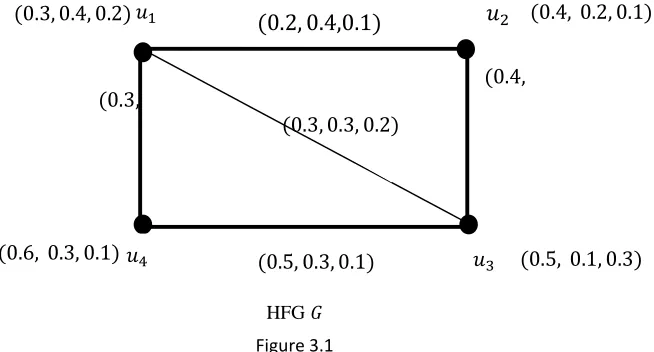
Consider the hesitancy fuzzy graph = , % in figure 3.1, with four vertices and five edges.
Let ^ = V&, V', V_ be a family of hesitancy fuzzy sets defined on as follows
0.2, 0.4,0.1
0.5, 0.3, 0.1 0.3, 0.3, 0.2
0.4, 0.3,
'
&
_ b
HFG
Figure 3.1
0.3, 0.4, 0.2 0.4, 0.2, 0.1
183
V&* = d0.3,0.4,0.2,0,1,0, TSℎ<Q]+R< + = 1e V'* = f
0.4,0.2,0.1, + = 2 0.6,0.3,0.1, + = 4 0,1,0, TSℎ<Q]+R<
e
V_* = d0.5,0.1,0.3,0,1,0, TSℎ<Q]+R< + = 3e
Hence the family ^ = V&, V', V_ satisfies our definition of vertex coloring of hesitancy fuzzy graph. We find that any family of hesitancy fuzzy sets having less than three members could not satisfy our definition. Hence in this case the chromatic number F is 3.
Example 3.2. (Strong hesitancy fuzzy graph vertex coloring)
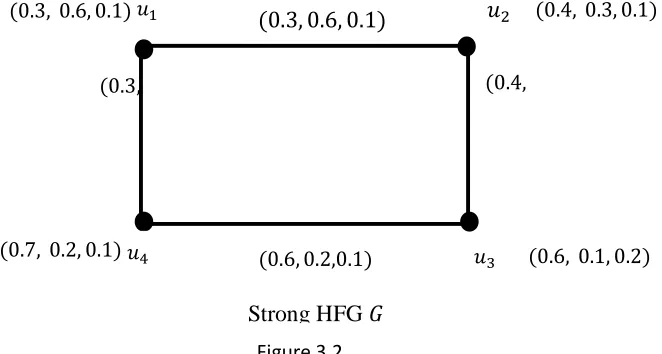
Consider the strong hesitancy fuzzy graph = , % in figure 3.2, with four vertices and four edges.
Let ^ = V&, V' be a family of hesitancy fuzzy sets defined on as follows
V&* = f
0.3,0.6,0.1, + = 1 0.6,0.1,0.2, + = 3
0,1,0, TSℎ<Q]+R<e V'* = f
0.4,0.3,0.1, + = 2 0.7,0.2,0.1, + = 4 0,1,0, TSℎ<Q]+R<
e
Hence the family ^ = V&, V' satisfies our definition of vertex coloring of strong hesitancy fuzzy graph. We find that any family of hesitancy fuzzy sets having less than two members could not satisfy our definition. Hence in this case the chromatic number F is 2.
Example 3.5. (Complete hesitancy fuzzy graph vertex coloring)
Consider the complete hesitancy fuzzy graph = , % in figure 3.3, with four vertices and six edges.
0.3, 0.6, 0.1
0.6, 0.2,0.1
0.4, 0.3,
'
&
_ b
Strong HFG
Figure 3.2
0.3, 0.6, 0.1 0.4, 0.3, 0.1
184
Let ^ = V&, V', V_, Vb be a family of hesitancy fuzzy sets defined on as follows V&* = d0.3,0.6,0.1,0,1,0, TSℎ<Q]+R< + = 1e V'* = d0.2,0.5,0.2,0,1,0, TSℎ<Q]+R<+ = 2e V_* = d0.4,0.1,0.3,0,1,0, TSℎ<Q]+R< + = 3e Vb* = d0.5,0.2,0.2,0,1,0, TSℎ<Q]+R< + = 4e Hence the family ^ = V&, V', V_, Vb satisfies our definition of vertex coloring of complete hesitancy fuzzy graph. We find that any family of hesitancy fuzzy sets having less than four members could not satisfy our definition. Hence in this case the chromatic number F is 4.
3.6. Bound for chromatic number of HFG
Proposition 3.6.1. For any HFG, the chromatic number F ≤ ∆ + 1 where ∆ is the maximum number of edges incident to a vertex of .
Proposition 3.6.2. The chromatic number of complete HFG is - where - is the number of vertices of , i.e., F = -.
(Since ∆ = - − 1 is the maximum vertex degree of the complete HFG , chromatic number F = ∆ + 1)
Proof: Since '*/ = min4&*, &/5 9'*/ = max49&*, 9&/5 and '*/= min4&*, &/5for every *, /∈ . Every pair of vertices are adjacent and degree of each vertex is - − 1. By (iii) of definition [3.2], minGV*4&5, V*4&L5H = 0,
maxGV*49&5, V*49&L5H = 1 and minGV*4&5, V*4&L5H = 0,
for adjacent vertices , L. Since all vertices are adjacent, every member of the family defining hesitancy fuzzy graph coloring have value for only one vertex and 0,1,0 for all other vertices. By (ii) of definition [3.2], V*∧ V/= 0, so ∨ V** = for all ∈ + = 1,2, … , - where - = ||. Thus, F = -.
0.2, 0.6,0.1
0.4, 0.2,0.2
0.3, 0.6,0.1
0.2, 0.3,
'
&
_ b
Complete HFG
Figure 3.3
0.3, 0.6,0.1 0.2, 0.5,0.2
0.4, 0.1, 0.3 0.5, 0.2, 0.2
185 Definition 3.7. (Edge coloring)
A family ^ = V&, … , VB of hesitancy fuzzy sets on % is called a k-edge coloring of = , % if
a) ∨ V*L = %, for all edge L ∈ % b) V*∧ V/= 0
c) For every incident edges L on vertex ∈ of , min GV*4'L5H = 0 , maxGV*49'L5H = 1, O-W min GV*4'L5H = 0 1 ≤ + ≤ M
The least value of k for which the has a k- edge coloring denoted by Fi, is called the edge chromatic number of the hesitancy fuzzy graph .
Example 3.8. (Hesitancy fuzzy graph edge coloring) Consider the HFG = , % given in Example 3.3.
Let V = V&, V', V_ be a family of hesitancy fuzzy sets defined on % as follows
V&4*/5 = f
0.2,0.4,0.1, +D = 12 0.5,0.3,0.1, +D = 34
0,1,0, TSℎ<Q]+R< e V'4*/5 = f
0.3,0.4,0.1, +D = 14 0.4,0.2,0.1, +D = 23 0,1,0, TSℎ<Q]+R<
e
V_4*/5 = d0.3,0.3,0.2,0,1,0, TSℎ<Q]+R< +D = 13e
Hence the family ^ = V&, V', V_ satisfies our definition of edge coloring of hesitancy fuzzy graph. We find that any family of hesitancy fuzzy sets having less than three members could not satisfy our definition. Hence in this case the edge chromatic number Fi is 3.
Example 3.9. (Strong hesitancy fuzzy graph edge coloring) Consider the strong HFG = , % given in Example 3.4.
Let ^ = V&, V' be a family of hesitancy fuzzy sets defined on % as follows
V&4*/5 = f
0.3,0.6,0.1, +D = 12 0.6,0.2,0.1, +D = 34
0,1,0, TSℎ<Q]+R< e V'4*/5 = f
0.3,0.6,0.1, +D = 14 0.4,0.3,0.1, +D = 23 0,1,0, TSℎ<Q]+R<
e
Hence the family ^ = V&, V' satisfies our definition of edge coloring of strong hesitancy fuzzy graph. We find that any family of hesitancy fuzzy sets having less than two members could not satisfy our definition. Hence in this case the edge chromatic number Fi is 2.
Example 3.10. (Complete hesitancy fuzzy graph edge coloring) Consider the complete HFG = , % given in Example 3.5.
Let ^ = V&, V', V_ be a family of hesitancy fuzzy sets defined on % as follows
V&4*/5 = f
0.2,0.6,0.1, +D = 12 0.4,0.2,0.2, +D = 34
0,1,0, TSℎ<Q]+R< e V'4*/5 = f
0.2,0.5,0.2, +D = 23 0.3,0.6,0.1, +D = 41 0,1,0, TSℎ<Q]+R<
e
V_4*/5 = f
0.3,0.6,0.1, +D = 13 0.2,0.5,0.2, +D = 24 0,1,0, TSℎ<Q]+R<
186
Hence the family ^ = V&, V', V_ satisfies our definition of edge coloring of complete hesitancy fuzzy graph. We find that any family of hesitancy fuzzy sets having less than three members could not satisfy our definition. Hence in this case the edge chromatic number Fi is 3.
3.11. Bound for edge chromatic number of HFG
Proposition 3.11.1. For any HFG, the edge chromatic number Fi ≤ ∆ + 1 where ∆ is the maximum number of edges incident to a vertex of .
Proposition 3.11.2. The edge chromatic number of complete HFG on - vertices is - if -is odd and - − 1 if - is even whatever may be the membership, non-membership and hesitancy functions.
Definition 3.12. (Total coloring)
A family ^ = V&, … , VB of hesitancy fuzzy sets on ∪ % is called a k- total coloring of = , % if
a) ∨ V* = , for all ∈ and ∨ V*L = %, for all edge L ∈ % b) V*∧ V/= 0,
d) For every strong edge Lof , minGV*4&5, V*4&L5H = 0, maxGV*49&5, V*49&L5H = 1 and minGV*4&5, V*4&L5H = 0. And for every incident edges L on vertex ∈ of , min GV*4'L5H = 0, maxGV*49'L5H = 1, minGV*4'L5H = 0 1 ≤ + ≤ M.
The least value of k for which the has a k- total coloring denoted by Fj, is called the total chromatic number of the hesitancy fuzzy graph .
Example 3.13. (Hesitancy fuzzy graph total coloring) Consider the HFG = , % given in Example 3.3.
Let ^ = V&, V', V_, Vb be a family of hesitancy fuzzy sets defined on ∪ % as follows
V&* = d0.3,0.4,0.2,0,1,0, TSℎ<Q]+R< + = 1e V'* = f0.4,0.2,0.1,0.6,0.3,0.1, + = 2+ = 4 0,1,0, TSℎ<Q]+R<
e
V_* = d0.5,0.1,0.3,0,1,0, TSℎ<Q]+R< + = 3e
V&4*/5 = d0.4,0.2,0.1,0,1,0, TSℎ<Q]+R< +D = 23e V'4*/5 = d0.3,0.3,0.2,0,1,0, TSℎ<Q]+R< +D = 13e
V_4*/5 = d0.3,0.4,0.1,0,1,0, TSℎ<Q]+R< +D = 41e Vb4*/5 = f
0.2,0.4,0.1, +D = 12 0.5,0.3,0.1, +D = 34 0,1,0, TSℎ<Q]+R<
e
187
Example 3.14. (Strong hesitancy fuzzy graph total coloring) Consider the strong HFG = , % given in Example 3.4.
Let ^ = V&, V', V_, Vb be a family of hesitancy fuzzy sets defined on ∪ % as follows
V&* = f0.3,0.6,0.1,0.6,0.1,0.2, + = 1+ = 3
0,1,0, TSℎ<Q]+R<e V'* = f
0.4,0.3,0.1, + = 2 0.7,0.2,0.1, + = 4 0,1,0, TSℎ<Q]+R<
e
V_4*/5 = f
0.3,0.6,0.1, +D = 12 0.6,0.2,0.1, +D = 34
0,1,0, TSℎ<Q]+R< e Vb4*/5 = f
0.4,0.3,0.1, +D = 23 0.3,0.6,0.1, +D = 41 0,1,0, TSℎ<Q]+R<
e
Hence the family ^ = V&, V', V_, Vbsatisfies our definition of total coloring of strong hesitancy fuzzy graph. We find that any family of hesitancy fuzzy sets having less than four members could not satisfy our definition. Hence in this case the total chromatic number Fj is 4.
Example 3.15. (Complete hesitancy fuzzy graph total coloring) Consider the strong HFG = , % given in Example 3.5.
Let ^ = V&, V', V_, Vb, Vk be a family of hesitancy fuzzy sets defined on ∪ % as follows V&* = d0.3,0.6,0.1,0,1,0, TSℎ<Q]+R< + = 1e V'* = d0.2,0.5,0.2,0,1,0, TSℎ<Q]+R<+ = 2e
V_* = d0.4,0.1,0.3,0,1,0, TSℎ<Q]+R< + = 3e Vb* = d0.5,0.2,0.2,0,1,0, TSℎ<Q]+R< + = 4e V&4*/5 = d0.2,0.5,0.2,0,1,0, TSℎ<Q]+R< +D = 24e V'4*/5 = d0.3,0.6,0.1,0,1,0, TSℎ<Q]+R< +D = 13e
V_4*/5 = d0.3,0.6,0.1,0,1,0, TSℎ<Q]+R< +D = 41e Vb4*/5 = d0.2,0.5,0.2,0,1,0, TSℎ<Q]+R< +D = 23e
Vk4*/5 = f
0.2,0.6,0.1, +D = 12 0.4,0.2,0.2, +D = 34 0,1,0, TSℎ<Q]+R<
e
Hence the family ^ = V&, V', V_, Vb, Vk satisfies our definition of total coloring of complete hesitancy fuzzy graph. We find that any family of hesitancy fuzzy sets having less than five members could not satisfy our definition. Hence in this case the total chromatic number Fj is 5.
3.16. Bound for total chromatic number of HFG
Proposition 3.16.1. Any HFG = , % can be totally colored using at most ∆ + 2 colors. That is, the total chromatic number of HFG Fj4\5 ≤ ∆ + 2 where ∆ is the maximum number of edges incident from a vertex in .
4. Conclusion
188 REFERENCES
1. S.Samanta and M.Pal, Fuzzy planar graphs, IEEE Transaction on Fuzzy System, 23(6) (2015) 1936 – 1942.
2. C.Eslahchi and B.N. Onagh, Vertex strength of fuzzy graphs, International journal of Mathematics and Mathematical Sciences, 2006, Article ID 43614, Pages 1–9 . 3. Gary Chartrand and Ping Zhang, Chromatic Graph Theory, CRC Press, A Chapman
& Hall book (2009).
4. S. Ismail Mohideen and M.A. Rifayathali, Coloring of Intuitionistic Fuzzy Graph using , -cuts, International Research Journal of - Mathematics, Engineering and IT, 2(12) (2015) 14-26.
5. R. Jahir Hussain and K.S. Kanzol Fathima, Fuzzy chromatic number of middle, subdivision and total fuzzy graph, International Journal of Mathematical Archive, 6(12) (2015) 90-94.
6. R. Jahir Hussain and K.S. Kanzol Fathima, Fuzzy dominator chromatic number of bipartite, middle and subdivision fuzzy graph, International Journal of Fuzzy Mathematics and Systems, 5(1) (2015) 99-106.
7. R. Jahir Hussain and K.S. Kanzol Fathima, On fuzzy dominator coloring in fuzzy graphs, Applied Mathematical Sciences, 9(23) (2015) 1131 – 1137.
8. K. T. Atanassov, Intuitionistic Fuzzy Sets: Theory and applications, Physica-Vergley, New York (1999).
9. K. T. Atanassov, Intuitionistic fuzzy sets, Fuzzy Sets and Systems, 20 (1986) 87-96. 10. S. Lavanya and R. Sattanathan, Fuzzy total coloring of fuzzy graph, International
Journal of Information Technology and Knowledge Management, 2 (2009) 37-39. 11. A. Nagoor gani and B. Fathima Kani, Fuzzy vertex order colouring, International
journal of Pure and Applied Mathematics, 107(3) (2016) 601-614.
12. T. Pathinathan, J. Jon Arockiaraj and J. Jesintha Rosline, Hesitancy fuzzy graphs, Indian Journal of Science and Technology, 8(35) (2015) 1-5.
13. T. Pathinathan and J. Jon Arockiaraj, Various Cartesian products of vertex degree and edge degree in hesitancy fuzzy graphs, International Journal of Multidisciplinary Research and Modern Education, 2(2) (2016) 2454-6119.
14. T. Pathinathan, J. Jon Arockiaraj and E. Mike Dison, Constant hesitancy fuzzy graphs, Global Journal of Pure and Applied Mathematics, 12(2) (2016) 287-292. 15. T. Pathinathan, and J. Jon Arockiaraj, On regular hesitancy fuzzy graphs, Global
Journal of Pure and Applied Mathematics, 12(3) (2016) 512-518.
16. R. Parvathi and M.G. Karunambigai, Intuitionistic fuzzy graphs, Computational Intelligence, Theory and Applications, 6 (2006) 139-150.
17. R. Parvathi, M.G. Karunambigai and K. T. Atanassov, Operations on Intuitionistic fuzzy graphs, FUZZ-IEEE (2009), 20-24.
18. A. Prasanna, M.A. Rifayathali and S. Ismail Mohideen, Strong intuitionistic fuzzy graph coloring, International Journal of Latest Engineering Research and Applications, 2(8) (2017) 163-169.
19. A. Rosenfeld, Fuzzy graphs. In Fuzzy Sets and their Applications to Cognitive and Decision Processes. Zadeh LA, Fu KS, Shimura M, editors. New York: Academic press, (1975) 77–95.
189
21. L.A. Zadeh, Fuzzy sets, Information and Computation, 8 (1965) 338-353.
22. S.Samanta, T.Pramanik and M.Pal, Fuzzy colouring of fuzzy graphs, Afrika Matematika, 27(1-2) (2016) 37-50.