IJPAR |Vol.7 | Issue 1 | Jan - Mar -2018
Journal Home page: www.ijpar.com
Research article Open Access
Simultaneous estimation of rabeprazole and diclofenac sodium in tablet
dosage form by RP-HPLC method
Jogu Chandrudu
1*, Srikanth Choudary Pallothu
21
Assistant Professor, Scient Institute of Pharmacy, Nagarjuna Sagar Highway, Rangareddy,
Ibrahimpatnam, Telangana 501506.
2
Associate Professor, Omega College of Pharmacy, Edulabad, Hyderabad, Ghatkesar,Telangana 501301.
*Corresponding Author: Jogu Chandrudu Email: [email protected]
ABSTRACT
A novel, simple, selective, rapid, precise and accurate reverse phase high pressure liquid chromatographic method has been developed for the simultaneous estimation of diclofenac sodium and rabeprazole sodium from pharmaceutical formulations. The method was developed using a Inertsil - C18, ODS column column with a mobile phase el carried out at 210 nm. The developed method was validated for linearity, accuracy, precision, limit of detection and limit of quantization. The proposed method can be used for the estimation of these drugs in combined dosage forms.
Keywords:
RP HPLC method, Diclofenac sodium, Rabeprazole and tablet dosage forms.INTRODUCTION
Highly specific and sensitive analytical techniques hold the key in the designing, development, standardization and quality control of medicinal products. They are equally important in drug metabolism and pharmacokinetics studies, both of which are fundamental to the evaluation of bioavailability and duration of clinical response. Modern physical methods of analysis are very sensitive, precise and providing thorough information even from minute samples of material. They are for the most part quickly applied and in general are readily amenable to automation. For these reasons they are now widely used in product development, control of manufacture, quality
control, as a check on stability during storage and monitoring the use of drugs and medicines [1-7].
attraction between the non-polar compounds and the stationary phase. Polar compounds are retained for longer periods of time because of their higher affinity with the stationary phase. These compounds, therefore take more time to elute. Hence, normal phase separation is not commonly used because most of the drug molecules are polar in nature and hence take longer time to elute. In reversed phase, the stationary phase is non-polar and the mobile phase is polar. An aqueous mobile phase allows the use of secondary solute chemical equilibrium (such as ionization control, ion pairing, ion suppression and complexation) to control retention and selectivity [8]. The polar compounds get eluted first in this mode and non-polar compounds are retained for longer time. As nearly
all the drug/s are moderately polar or polar with varying degree in nature, they are not retained for longer times and thus elute more rapidly. The different HPLC columns used are C4, C8, octa decyl-silane (C18 or ODS) etc.
MATERIALS AND METHODS
Chemicals and Reagents
Reference standards of Diclofenac Sodium (DF) and Rabeprazole (RB) were obtained from Hetero Drugs, India. HPLC grade acetonitrile, water and triethylamine were obtained from Rankem, Ranbaxy Fine Chemical Limited, New Delhi, India. Potassium dihydrogen orthophosphate AR.
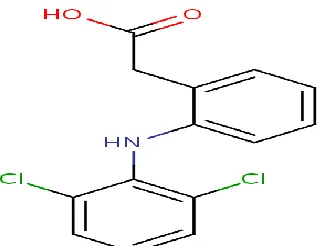
Fig 1: Structure of Diclofenac sodium
Chemical Formula : C14H11Cl2NO2. Molecular Weight : 296.149 g/mole
IUPAC : 2-{2-[(2,6-dichlorophenyl)amino]phenyl}acetic acid Category : Anti inflammatory agents,.
Fig 2: Structure of Rabeprazole
Instrumentation
The HPLC –Waters Model NO.2690/5 series Compact System Consisting of Inertsil-C18 ODS column, Electronic balance (SARTORIOUS), Sonicator (FAST CLEAN), vacuum degasser, rheodyne injector with a 20μl loop, UV-Visible detector and C-8 column[9-11].
Chromatographic conditions
The isocratic mobile phase consisting of methanol– potassium dihydrogen phosphate buffer Methanol: Water (80:20), pH 3.5 ± 0.02, adjusted with orthophosphoric acid) was used at a flow rate of 1.0 ml/min. The variable wavelength UV–visible detector was set at 284 nm. All analyses were performed at ambient temperature.
Preparation of stock solution
Reference solution: The solution was prepared by dissolving 20.0 mg of accurately weighed Rabeprazole and 25.0 mg Diclofenac sodium in Mobile phase, in two 100.0 mL volumetric flasks separately and sonicate for 20min. From the above solutions take 10.0 mL from each solution into a 50.0 mL volumetric flask and then makeup with mobile phase and sonicate for 10min.
Preparation of working standard solution
The stock solutions equivalent to 20ppm to 80ppm with respect to both drugs were prepared in combination of Rabeprazole and Diclofenac sodium above, sonicated and filtered through 0.45µ membrane.
Preparation of sample drug solution for
pharmaceutical formulations
Twenty tablets were weighed accurately and a quantity of tablet powder equivalent to 10 mg Rabeprazole and 50 mg Diclofenac sodium was weighed and dissolved in the 70 mL mobile phase with the aid of ultrasonication for 20 min. The content was diluted to 100 mL with mobile phase to furnish a stock test solution. The stock solution was filtered through a 0.45 µm Nylon syringe filter and 10.0 mL of the filtrate was diluted into a 50.0 mL volumetric flask to give a test solution containing 10 µg/mLRabeprazole and 50 µg/mL Diclofenac sodium.
Method Validation
Linearity of Test Method
A Series of solutions are prepared using Rabeprazole and Diclofenac sodium working standards at concentration levels from 25ppm to 150 ppm of target concentration .Measure the peak area response of solution at Level 1 and Level 6 six times and Level 2 to Level 5 two times.
Specificity
Rabeprazole and Diclofenac sodium
Solutions of standard and sample were prepared as per the test method are injected into chromatographic system.
Precision
Repeatability
System precision: Standard solution prepared as per test method and injected five times. Method precision: Prepared six sample preparations individually using single as per test method and injected each solution.
Accuracy (Recovery)
A study of Accuracy was conducted. Drug Assay was performed in triplicate as per test method with equivalent amount of Rabeprazole and Diclofenac sodium into each volumetric flask for each spike level to get the concentration of Rabeprazole and Diclofenac sodium equivalent to 50%, 100%, and 150% of the labeled amount as per the test method[12, 13]. The average % recovery of Rabeprazole and Diclofenac sodium were calculated.
Limit of Detection And Quantitation (LOD
And LOQ)
From the linearity data calculate the limit of detection and quantization, using the following formula. LOD= 3.3 σ
S
σ = standard deviation of the response
S = slope of the calibration curve of the analyte. LOQ = 10 σ
S
σ = standard deviation of the response
RESULTS AND DISCUSSION
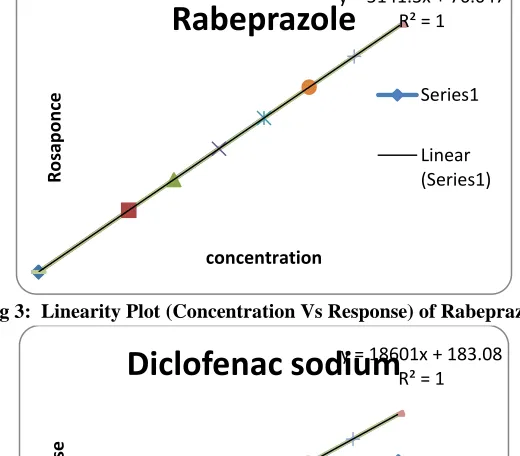
Fig 3: Linearity Plot (Concentration Vs Response) of Rabeprazole
Fig 4: Linearity Plot (Concentration Vs Response)ofDiclofenac sodium
Table 1: Analysis report
S.No Drug RSD (%) % Assay
1 Rabeprazole (RB) 1.24 100.19 2 Diclofenac sodium (DF) 1.183 100.37
Table 2: Percentage recovery data Drug Percentage simulated dosage
nominal
% Mean (n=6)
% RSD
RB 50 99.69 0.92
DF 50 100.6 0.18
RB 100 99.83 0.41
DF 100 100.04 0.091
RB 150 99.97 0.31
DF 150 100.2 0.09
System suitability data
System Suitability Parameters
For system suitability parameters, six replicate injections of mixed standard solution were injected
and parameters such as the Retention time, Theoritical plates, tailing factor
y = 5141.3x + 76.047 R² = 1
R
o
sap
o
n
ce
concentration
Rabeprazole
Series1
Linear (Series1)
y = 18601x + 183.08 R² = 1
re
sp
o
n
se
Concentration
Diclofenac sodium
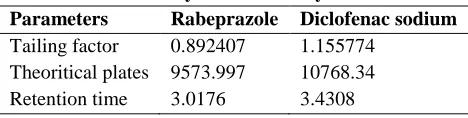
Table 3: System suitability data
Parameters Rabeprazole Diclofenac sodium Tailing factor 0.892407 1.155774
Theoritical plates 9573.997 10768.34 Retention time 3.0176 3.4308
CONCLUSION
Proposed study describes an RP-HPLC method for the estimation of RB and DF combination. The method has been found to be better than previously reported method, because of use of an economical and readily available mobile phase and UV
detection. The method gives good resolution for both the drugs with a short analysis time. The method was validated and found to be simple, sensitive, accurate and precise. Percentage recovery shows that the method is free from interference.
REFERENCES
[1]. Hinz B, Auge D, Rau T, Rietbrock S, Brune K et al. Simultaneous determination of Aceclofenac and three of its metabolites in human plasma by high performance liquid chromatography. Biomed Chromatogr; 17(4), 2003, 268-275.
[2]. Indian Pharmacopoeia, Controller of Publication, Govt. of India, Ministry of Health and Family Welfare, New Delhi, 3, 2007, 1647.
[3]. Jin Y, Chen H, Gu S, Zeng F. Determination of Aceclofenac in human plasma by reversed phase high performance liquid chromatography. Chinese J Chroma-togr; 22(3), 2004, 252-254.
[4]. Joshi R, Sharma R. Development and validation of RP-HPLC method for simultaneous estimation of three com-ponent tablet formulation containing Acetaminophen, Chlorzoxazone and Aceclofenac. Anal Letters; 41(18), 2008, 3297-3308.
[5]. Kulkarni VL, Mahulikar PP. Estimation of Rabeprazole sodium in tablet dosage form by rapid isocratic reversed phase high performance liquid chromatography using volatile buffer additives. J Scientific & Ind Res; 65, 2006, 992-994.
[6]. Merck index, Merck and Co. Inc. London: White House Station, 13, 2001, 1450.
[7]. Mishra P, Garg G. Spectrophotometric estimation of Aceclofenac in tablets. J Indian chem. society; 83(1), 2006, 103-104.
[8]. Musmade P, Subramanian G, Srinivasan KK. High performance liquid chromatography and pharmacokinetic of Aceclofenac in rats. Anal Chemica Acta; 585(1), 2007, 103-109.
[9]. Park CW, Rhee YS, Go BW, Kam SH, Lee KH, Lee HS, et al. High performance liquid chromatographic analysis of Rabeprazole in human plasma and its pharmacokinetic application. Arch Pharm Res; 31(9), 2008, 1195-1199.
[10]. Patel BH, Suhagia BN, Patel MM, Patel JR. (2007) HPLC Analysis for simultaneous determination of Rabeprazole and Domperidone in pharmaceutical formulation. J Liq Chromatogr & Rel Tech; 30(3): 439-445. [11]. Rahman N, Bano Z, Azmi SNH. Quantitative analysis of Rabeprazole sodium in commercial dosage forms by
spectrophotometry. Chem. Pharm. Bull; 56(7), 2008, 995-1001.
[12]. Ramakrishna NVS, Vishwottam KN, Wishu S, Koteshwara M, Kumar SS. High performance liquid chromatogra-phy method for the quantification of Rabeprazole in human plasma using solid phase extraction. J Chromatogr; 816(1-2), 2005, 209-214.