Fitting Data with Different
Error Models
Béla Paláncz
A maximum likelihood estimator has been applied to find
regression parameters of a straight line in case of different error models. Assuming Gaussian-type noise for the measurement errors, explicit results for the parameters can be given
employing Mathematica. In the case of the ordinary least squares (OLSy), total least squares (TLS), and least geometric mean deviation (LGMD) approaches, as well as the error model of combining ordinary least squares (OLSx and OLSy) in the Pareto sense, simple formulas are given to compute the parameters via a reduced Gröbner basis. Numerical examples illustrate the methods, and the results are checked via direct global minimization of the residuals.
‡
Introduction
Generally, to carry out a regression procedure one needs to have a model MHx,y,qL=0, an error definition eMHx,y:qL, and the probability density function of the error PDFHeMHx,y:qLL. Considering the set 8Hx1,y1L,Hx2,y2L, …,Hxn,ynL< as measurement
points, the maximum likelihood approach aims at finding the parameter vector q that maxi-mizes the likelihood of the joint error distribution. Assuming that the measurement errors are independent, we should maximize (see eg. [1])
(1) PDFHeMHHx1,y1L:qL, eMHHx2,y2L:qL, ...,eMHHxn,ynL:qLL=
‰ i=1
n
PDFHeMHHxi,yiL:qLL.
Consider the Gaussian-type error distribution as NH0,sL; then our estimator is
(3) LHqL= -‚
i=1
n
ln e
-eMHHxi,yiL:qL 2
2s2 2p s
=nlnK 2p sO+‚ i=1
n e
MHHxi,yiL:qL2
2s2 .
In our case the model is a line,
(4) LHm,bLdef= ‚
i=1
n He
MHHxi,yiL:Hm,bLLL2
2s2 .
It can be seen that (in the case of Gaussian-type measurement noise) only the type of the error model determines the parameter values, since we should always minimize the least squares of the errors. There are different error models, which can be applied to fitting a line in a least-squares sense. The error model frequently employed, assuming an error-free independent variable x, is the ordinary least squares model (OLSy)
(5) eMHHx,yL:Hm,bLL= y-mx-b.
Similarly, one may also consider an error-free dependent variable y. Then the error model (OLSx) is
(6) eMHHx,yL:Hm,bLL= x- -b+y
m .
These approaches are called the algebraic approach.
Another error model considers the geometrical distance between the data point and the line to be fitted. This type of fitting is also known as orthogonal regression, since the distances of the sample points from the line are evaluated by computing the orthogonal projection of the measurements on the line itself. The error in this case [2] is
(7) eMHHx,yL:Hm,bLL= y-m x-b
1+m2
.
This geometrical approach or total least squares (TLS) approach can also be considered as an optimization problem with constraints; namely, one should minimize the errors in both variables [3]:
(8)
‚ i=1
n
Dxi2+ Dyi2Ømin
under the conditions
In addition, one can also combine OLSx and OLSy to construct an error model. The first
possibility is to consider the geometric mean of these two types of errors,
(10) eMHHx,yL:Hm,bLL= H-b-m x+yL x- -b+y
m .
These error models are illustrated in Figure 1.
GraphicsA9
Arrow@88-1, 0<, 810, 0<<D, Arrow@880, -1<, 80, 7<<D, Line@883, 2<, 88, 2<<D, Line@883, 2<, 83, 6<<D,
8Thick, Line@883, 6<-.285, -4<, 88, 2<+.285, -4<<D<, Line@883, 2<, 83, 2<+880ê41, 100ê41<<D,
StyleATextA"OLS"Style@"x",ItalicD, H83, 2<+88, 2<L ê2, 80, 2<E,
16E,
StyleATextA"OLS"Style@"y",ItalicD, H83, 2<+83, 6<L ê2, 81.5, 0<E, 16E,
Style@Text@"TLS", H283, 2<+880ê41, 100ê41<L ê2,
8-1.8, 0<D, 16D, Style@
Text@Row@8Style@"y", ItalicD, " = ", Style@"m", ItalicD, " ", Style@"x", ItalicD, " + ", Style@"b", ItalicD <D,
H83, 6<+88, 2<L ê2, 8-1.5,-1<D, 16D =
OLS
xOLS
yTLS
y
=
m x
+
b
Ú Figure 1. The different error models in the case of fitting a straight line.
This model is also called the leastgeometric mean deviation approach or LGMD model (see [4)]. As a second possibility, one may consider OLSx and OLSy as competing
func-tions of the parameters and find their Pareto-front representing a set of optimal solufunc-tions for the parameters q. Since this multi-objective problem is convex, the objective can be ex-pressed as a linear combination of these error functions, namely
(11) eMHHxi,yiL:Hm,bLL= lH-b-m x+yL+H1- lL x
--b+y
m ,
where l is a parameter, 0§ l §1, and the set of optimal solutions of the parameters be-longing to the Pareto-front is q=qHlL. You can choose the value of l depending on your trade-off preference between OLSx and OLSy [5].
‡
Application of Symbolic Computation
·
SuperLog
Function
SuperLog@Q_D:=Module@ 8erk<,
Which@
Q===On,
Unprotect@LogD; Clear@LogD;
Log@Product@x_, 8k_. a_, b_<DD:=
Log@Product@Times@erk, xD, 8k, a, b<DD ê. erkØ1; Log@Product@HoldPattern@Times@x__DD, 8k_, a_, b_<DD:=
Simplify@
Map@Sum@Ò, 8k, a, b<D&,
PlusüüMap@Expand@PowerExpand@Log@ÒDDD&, List@xDDD êê.
Sum@u_, w_, 8kk_, aa_, bb_<Dß
u Sum@w, 8kk, aa, bb<D ê; FreeQ@u, kkDãTrueD; Protect@LogD;
Print@"SuperLog is now On."D,
Q===Off,
Unprotect@LogD; Clear@LogD; Protect@LogD; Print@"SuperLog is now Off."D,
True,
Print@"Please use SuperLog@OnD or SuperLog@OffD!"D DD
Let us activate this function.
SuperLog@OnD
SuperLog is now On.
Then this is the ML estimator for Gaussian-type noise.
L= ‰
i=1
n
PDF@NormalDistribution@0,sD, eMiD
‰
i=1
n ‰-IeMMi2 2s2
·
Ordinary Least Squares (
OLS
y)
Now let us consider the OLSy problem.
LogLAOLSyE=Log@Lê.eMi Øyi-m xi -bD êêSimplify
- b
2n
2s2
-1
2 nLog@2D
-1
2 nLog@pD-nLog@sD+
‚
i=1
n
-b m xi s2 +‚
i=1 n -m 2x i 2
2s2 +‚
i=1
n b yi
s2 +‚ i=1
n m xi yi
s2 +‚ i=1
n
- yi
2
2s2
Here are the necessary conditions for the optimum.
eq1AOLSyE=DALogLAOLSyE, mEã0
‚
i=1
n
-b xi s2 +‚
i=1
n
-m xi
2
s2 +‚ i=1
n x
i yi
s2 ã0
eq2AOLSyE=DALogLAOLSyE, bEã0
-b n s2 +‚
i=1
n
-m xi s2 +‚
i=1
n y
i
s2 ã0
Let us introduce the following constants:
(12)
a=‚
i=1
n
xi,
(13)
b=‚
i=1
n
xi2,
(14)
c=‚
i=1
n
yi,
(15)
d=‚
i=1
n
yi2,
(16)
e=‚
i=1
n
In those terms, here are the necessary conditions for the optimum.
Eq1AOLSyE= -ab-bm+eã0
e-ab-bmã0
Eq2AOLSyE= -b n- am+cã0
c-am-b nã0
Then this is the optimal solution of the parameters.
solmbG=SolveA9Eq1AOLSyE, Eq2AOLSyE=, 8m, b<E êêFlatten
:mØ --a c+en
a2-bn , bØ
-b c-a e
a2-bn >
·
Total Least Squares (
TLS
)
Although the equation system for the parameters of OLSy is linear, for other error models
we get a multivariable algebraic system. Now consider the TLS problem. Here is the maxi-mum likelihood function.
LogL@TLSD=LogBLê.eMi -> yi-m xi -b
1+m2
F êêSimplify
- b
2n
2I1+m2Ms2
-1
2 nLog@2D
-1
2 nLog@pD-nLog@sD+i=1‚
n
- b m xi I1+m2Ms2 +
‚
i=1
n
- m
2x i 2
2I1+m2Ms2 +‚
i=1
n b yi
I1+m2Ms2 +‚ i=1
n m xi yi
I1+m2Ms2 +‚ i=1
n
- yi
2
Therefore here is the equation system to be solved.
eq1@TLSD=D@LogL@TLSD, mDã0êêSimplify
b2m n
I1+m2M2s2
+‚
i=1
n 2b m2x i
I1+m2M2s2
- b xi
I1+m2Ms2 +
‚
i=1
n m3x
i 2
I1+m2M2s2
- m xi
2
I1+m2Ms2 +‚ i=1
n
- 2b m yi I1+m2M2s2
+
‚
i=1
n m y
i 2
I1+m2M2s2
+‚
i=1
n
- 2m
2x iyi
I1+m2M2s2
+ xi yi
I1+m2Ms2 ã0
eq2@TLSD=D@LogL@TLSD, bDã0êêSimplify
‚
i=1
n
- m xi
I1+m2Ms2 +‚ i=1
n yi
I1+m2Ms2 ã
b n
I1+m2Ms2
Since 1+m2¹≠0, the conditions are as follows.
Eq1@TLSD=
b2m n+a 2b m2-aI1+m2Mb+ bm3- bmI1+m2M-2 cb m+ dm-2 em2+eI1+m2Mã0
dm-2 cb m-2 em2+2 ab m2+bm3+
eI1+m2M-abI1+m2M-bmI1+m2M+b2m nã0
Eq2@TLSD= -b n-am+cã0
c-am-b nã0
A Gröbner basis solves this system, eliminating b.
gbm@TLSD=GroebnerBasis@8Eq1@TLSD, Eq2@TLSD<, 8m, b<, 8b<D êê
Simplify
solm@TLSD=Solve@gbm@TLSDã0,mD êêFlatten
:mØ 1
2Ha c-enL -a
2+c2+bn-dn
-Ia2-c2-bn+dnM2-4Ha c-enL H-a c+enL ,
mØ 1
2Ha c-enL -a
2+c2+bn-dn+
Ia2-c2-bn+dnM2-4Ha c-enL H-a c+enL >
Since the second equation is linear, it is reasonable to compute m first, then b.
solb@TLSD=Solve@Eq2@TLSD, bD êêFlatten
:bØ c-am
n >
·
Least Geometric Mean Deviation (
LGMD
)
The LGMD error model also leads to a second-order polynomial equation system. Now here is the ML estimator.
LogL@LGMDD=LogBLê.eMiØ H-b-m xi+yiL xi
--b+yi m F êê Simplify
b2n
2ms2
-1
2 nLog@2D
-1
2 nLog@pD-nLog@sD+
‚
i=1
n b xi
s2 +‚ i=1
n m x
i 2
2s2 +‚
i=1
n
- b yi
ms2 +‚
i=1
n
-xiyi s2 +‚
i=1
n y
i 2
Consequently, here is the system to be solved for the parameters.
eq1@LGMDD=D@LogL@LGMDD, mDã0êêSimplify
‚
i=1
n x
i 2
2s2 +‚
i=1
n b yi
m2s2 +‚ i=1
n
- yi
2
2m2s2 ã
b2n
2m2s2
eq2@LGMDD=D@LogL@LGMDD, bDã0
b n
ms2 +‚
i=1
n xi
s2 +‚ i=1
n
- yi
ms2 ã0
Assume m¹≠0.
Eq1@LGMDD= -b2n+m2b+2bc-dã0
-d+2 cb+bm2-b2nã0
Eq2@LGMDD=b n+ma-cã0
-c+am+b nã0
Again a Gröbner basis gives a second-order system.
gbm@LGMDD=
GroebnerBasis@8Eq1@LGMDD, Eq2@LGMDD<,8m, b<, 8b<D êê
Simplify
9c2-a2m2-dn+bm2n=
solmT=Solve@gbm@LGMDDã0, mD êêFlatten
:mØ - c
2-dn
a2-bn
, mØ c
2-dn
a2-bn
>
When m is known, the other parameter can be computed.
solbT=Solve@Eq2@LGMDD, bD êêFlatten
:bØ c-am
·
Pareto Approach
In the case of the Pareto approach, the system is already fourth order.
LogL@ParetoD=
LogBLê.:eMiØ lH-b-m xi+yiL2+H1- lL xi
--b+yi m 2 >F êê Simplify - b 2n
2m2s2
-b2nl
2s2 +
b2nl
2m2s2
-1
2 nLog@2D
-1
2 nLog@pD-nLog@sD+
‚
i=1
n
- b xi
ms2 +‚
i=1
n blxi
ms2 +‚
i=1
n
-b mlxi s2 +‚
i=1
n
- xi
2
2s2 +‚
i=1
n lx
i 2
2s2 +
‚
i=1
n
-m
2lx i 2
2s2 +‚
i=1
n b y
i
m2s2 +‚ i=1
n bly
i
s2 +‚ i=1
n
-blyi
m2s2 +‚ i=1
n x
i yi
ms2 +
‚
i=1
n
-lxiyi
ms2 +‚
i=1
n mlxi yi
s2 +‚ i=1
n
- yi
2
2m2s2 +‚
i=1
n
-lyi
2
2s2 +‚
i=1
n ly
i 2
2m2s2
Here is the system.
eq1@ParetoD=D@LogL@ParetoD,mDã0êêSimplify
b2n
m3s2 +‚ i=1
n b x
i
m2s2 +‚ i=1
n
-blxi s2 +‚
i=1
n
-blxi
m2s2 +
‚
i=1
n
-mlxi
2
s2 +‚ i=1
n
-2b yi
m3s2 +‚ i=1
n 2blyi
m3s2 +‚
i=1
n
- xi yi
m2s2 +
‚
i=1
n lxi yi
s2 +‚ i=1
n lxiyi
m2s2 +‚
i=1
n y
i 2
m3s2 +‚ i=1
n
- lyi
2
m3s2 ã
b2nl
m3s2
eq2@ParetoD=D@LogL@ParetoD,bDã0êêSimplify
b nl
m2s2 +‚ i=1
n
- xi
ms2 +‚
i=1
n lxi
ms2 +‚
i=1
n
-mlxi s2 +
Here is the system in compact form.
Eq1@ParetoD=
b2n-b2nl +m ba-m3bla-m bla-m4lb-2bc+2blc -me+m3le+mle+d-dl ã0
d-2 cb-em+ab m+b2n-dl +2 cbl +
eml -ab ml +em3l -ab m3l -bm4l -b2nl ã0
Eq2@ParetoD=
-b n-m2b nl +b nl -ma+mla-m3 la+c+m2lc- lcã0
c-am-b n-cl +aml +cm2l -am3l +b nl -b m2nl ã0
Here is the Gröbner basis for the first parameter.
gbm@ParetoD=
GroebnerBasis@8Eq1@ParetoD, Eq2@ParetoD<, 8m, b<, 8b<D êê
Simplify
9I1+I-1+m2MlM Idn-em n+c2H-1+ lL+a2m4l
-dnl +em nl +em3nl -bm4nl -a cmI-1+ l +m2lMM=
Assume that 1+I-1+m2Ml¹≠0.
Gbm=dn-em n+c2H-1+ lL+a2m4l -dnl +em nl +em3nl
-bm4nl -a cmI-1+ l +m2lM êêExpand
-c2+a cm+dn-em n+c2l -a cml
-a cm3l +a2m4l -dnl +em nl +em3nl -bm4nl
After solving this polynomial for m, the other parameter can be solved from the second equation, which is linear in b.
solbP=Solve@Eq2@ParetoD, bD êêFlatten
:bØ c-am
‡
Numerical Example
·
Data Samples
Consider some data on rainfall x (in mm) and the resulting groundwater level changes y (in cm) from a landslide along the Ohio River Valley near Cincinnati, Ohio [7].
xydata=881.94, 2.5<, 83.33, 1.89<, 83.22, 1.67<,
85.67, 1.31<, 84.72, 1.02<, 83.89, 0.96<, 82.78, 1.1<,
810.56, 0.15<, 89.44, 3.92<, 812.78, 5.23<,
814.72, 4.22<, 813.61, 3.63<, 820.39, 4.32<,
838.89, 5.89<<;
There are 14 measurements.
Length@xydataD
14
This displays the measured data.
ListPlot@xydata, AxesLabelØ8"x@mmD", "y@cmD"<,
PlotStyleØ[email protected], PlotRangeØ880, 40<, 80, 7<<D
0 10 20 30 40 x@mmD
0 1 2 3 4 5 6 7
y@cmD
·
Computation of the Constants for the Equation Systems
The constants a, b, c, d, and e in equations (12) to (16) are needed.
This separates the data.
8xdata, ydata<=Transpose@xydataD;
This transforms the data into dimensionless form.
xS=Hxdata-Min@xdataDL ê HMax@xdataD-Min@xdataDL; yS=Hydata-Min@ydataDL ê HMax@ydataD-Min@ydataDL;
p2=ListPlot@Transpose@8xS, yS<D, AxesLabelØ8x, y<, PlotStyleØ[email protected],
PlotRangeØ88-0.1, 1.1<, 8-0.1, 1.1<<D
0.2 0.4 0.6 0.8 1.0 x
0.2 0.4 0.6 0.8 1.0
y
Ú Figure 3. The measured data: rainfall versus water level change in dimensionless form.
Now the constants can be computed.
abcden=
Join@
Thread@8a, b, c, d, e<Ø
Totalêü8xS, xS ^ 2, yS, yS ^ 2, xS yS<D, 8nØLength@xydataD< D
8aØ3.21461, bØ1.67216,
·
Computation of the Parameters of the Fitted Line
ü OLSy Model
Here are the estimated parameters employing the explicit solutions.
solmbGê. abcden
8mØ0.885963, bØ0.240945<
This checks the result.
Fit@Transpose@8xS, yS<D, 81, t<, tD
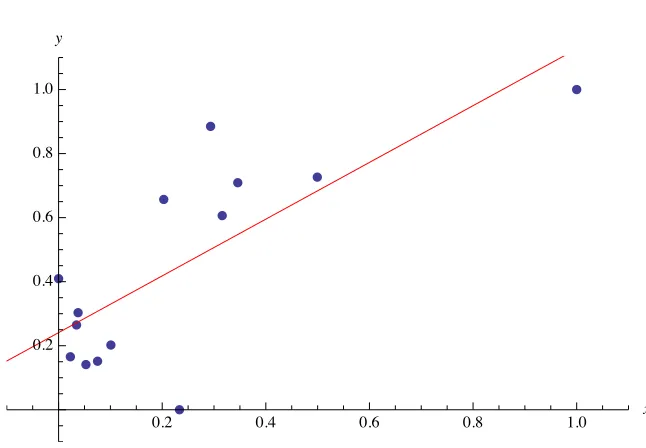
0.240945+0.885963 t
Figure 4 shows the estimated line with the sample points.
p3=Plot@%, 8t, -0.1, 1.1<, PlotStyleØRedD;
Show@8p2, p3<D
0.2 0.4 0.6 0.8 1.0 x
0.2 0.4 0.6 0.8 1.0
y
ü TLS Model
Here are the first and second parameters.
solm@TLSD ê. abcden
8mØ1.23716, mØ -0.808306<
solb@TLSD ê. solm@TLSD ê. abcden
8bØ0.160305<
Here is a check of this result on the basis of the TLS definition. Equation (8) gives the ob-jective function.
obj@TLSD=TotalATableADxi2+ Dyi2, 8i, Length@xydataD<EE
Dx12+ Dx22+ Dx32+ Dx42+ Dx52+ Dx62+ Dx72+ Dx82+ Dx92+ Dx102 + Dx
11 2 + Dx
12 2 + Dx
13 2 + Dx
14 2 + Dy
1 2+ Dy
2 2+ Dy
3 2+ Dy
4 2+
Dy52+ Dy62+ Dy72+ Dy82+ Dy92+ Dy102 + Dy112 + Dy122 + Dy132 + Dy142
The constraints are yi+ Dyi-mHxi+ DxiL-b=0,i=1, …,n.
Hcons=Table@yS@@iDD+ Dyi-mHxS@@iDD + DxiL-bã0,
8i, Length@xydataD<DL êêColumn
0.409408-b-mH0.+ Dx1L+ Dy1ã0
0.303136-b-mH0.0376184+ Dx2L+ Dy2ã0
0.264808-b-mH0.0346414+ Dx3L+ Dy3ã0
0.202091-b-mH0.100947+ Dx4L+ Dy4 ã0
0.151568-b-mH0.0752368+ Dx5L+ Dy5ã0
0.141115-b-mH0.052774+ Dx6L+ Dy6 ã0
0.165505-b-mH0.0227334+ Dx7L+ Dy7ã0
0.-b-mH0.233288+ Dx8L+ Dy8ã0
0.656794-b-mH0.202977+ Dx9L+ Dy9 ã0
0.885017-b-mH0.293369+ Dx10L+ Dy10ã0
0.709059-b-mH0.345873+ Dx11L+ Dy11ã0
0.606272-b-mH0.315832+ Dx12L+ Dy12ã0
0.726481-b-mH0.499323+ Dx13L+ Dy13ã0
The unknown variables are not only the parameters, but the adjustments HDxi,DyiL as well.
vars=Join@Table@8Dxi,Dyi<, 8i, Length@xydataD<D, 8m,b<D êê Flatten
8Dx1, Dy1, Dx2, Dy2, Dx3, Dy3, Dx4, Dy4, Dx5, Dy5,
Dx6, Dy6, Dx7, Dy7, Dx8, Dy8, Dx9, Dy9, Dx10, Dy10,
Dx11, Dy11, Dx12, Dy12,Dx13, Dy13, Dx14, Dy14, m, b<
This uses a built-in global optimization method. (This takes a long time to compute.)
Timing@
sol=NMinimize@8obj@TLSD, cons<, vars,
MethodØ8"RandomSearch", "SearchPoints"Ø200<D;D
8257.582130, Null<
Drop@sol@@2DD, 81, 2 Length@xydataD<D
8mØ1.23716, bØ0.160305<
The TLS estimation gives a result quite different from the OLSy model; see Figure 5.
p4=Plot@mt+bê.%, 8t, -0.1, 1.1<, PlotStyleØGreenD;
Show@8p2, p3, p4<D
0.2 0.4 0.6 0.8 1.0 x
0.2 0.4 0.6 0.8 1.0
ü LGMD Model
Now here is the first parameter.
solmTê. abcdenêêChop
8mØ -1.17471, mØ1.17471<
This uses the result.
solbTê. solmT@@2DD ê. abcdenêêChop
8bØ0.174644<
Here is a numerical check of the objective.
obj@LGMDD=
TotalB
TableB. H-b-mxS@@iDD+yS@@iDDL2 xS@@iDD-yS@@iDD-b m
2 ,
8i, Length@xydataD<FF;
solT=NMinimize@obj@LGMDD, 8m, b<D
80.5394, 8mØ1.17471, bØ0.174644<<
Figure 6 shows this result together with the OLSy and TLS models.
Show@8p2, p3, p4, p5<D
0.2 0.4 0.6 0.8 1.0 x
0.2 0.4 0.6 0.8 1.0
y
Ú Figure 6. The lines estimated with the OLSy (red), TLS (green), and LGMD (blue) models.
ü Pareto Approach
The first parameter is a fourth-order polynomial.
Gbmê. abcden
18.0448-11.5853m-18.0448l +
11.5853ml +11.5853m3l -13.0765m4l
The best trade-off between OLSy and OLSx is to let l =0.5.
solP=NSolve@Gbmê. abcdenê.l Ø1ê2, mD
88mØ -1.0602<, 8mØ0.404042-0.99016Â<,
8mØ0.404042+0.99016Â<, 8mØ1.13808<<
This is the real positive solution.
Using this value gives the second parameter.
solbPê. solP@@4DD ê. abcdenêêFlatten
8bØ0.183054<
We compute the solution using direct global minimization. Here is the objective.
obj@ParetoD=
TotalB
TableB
lH-b-mxS@@iDD+yS@@iDDL2+
H1- lL xS@@iDD-yS@@iDD-b
m
2
,8i, Length@xydataD<FF;
This gives the result.
solP=NMinimize@8obj@ParetoD ê.l Ø1ê2<, 8m, b<, MethodØ8"RandomSearch", "SearchPoints"Ø200<D
80.545029, 8mØ1.13808, bØ0.183054<<
Figure 7 shows this solution with the results of the other models.
Show@8p2, p3, p4, p5, p6<D
0.2 0.4 0.6 0.8 1.0 x
0.2 0.4 0.6 0.8 1.0
y
Ú Figure 7. The lines estimated with the OLSy (red), TLS (green), and LGMD (blue) models, and the
Pareto approach with l =1ê2 (magenta).
‡
Conclusion
The numerical computations show that the formulas developed by an ML estimator via symbolic computation to determine the parameters of a straight line to be fitted provide correct results and require considerably less computation time than the direct methods based on global minimization of the residuals. Our examples also illustrate that the TLS, LGMD, and Pareto approaches give more realistic solutions than the traditional OLSy,
since Figure 7 shows there are at least two outliers in the sample set.
‡
References
[1] W. H. Press, S. A. Teukolsky, W. T. Vetterling, and B. P. Flannery, Numerical Recipes in C, 2nd ed., Cambridge: Cambridge University Press, 1992.
[2] M. Zuliani. “RANSAC for Dummies.” (Jan 10, 2014)
vision.ece.ucsb.edu/~zuliani/Research/RANSAC/docs/RANSAC4Dummies.pdf.
[5] B. Paláncz and J. L. Awange, “Application of Pareto Optimality to Linear Models with Errors-in-All-Variables,” Journal of Geodesy, 86(7),2012 pp. 531–545.
doi:10.1007/s00190-011-0536-1.
[6] C. Rose and M. D. Smith, “Symbolic Maximum Likelihood Estimation with Mathematica,” The Statistician, 49(2), 2000 pp. 229–240. www.jstor.org/stable/2680972.
[7] W. C. Haneberg, Computational Geosciences with Mathematica, Berlin: Springer, 2004.
B. Paláncz, “Fitting Data with Different Error Models,” The Mathematica Journal, 2014. dx.doi.org/doi:10.3888/tmj.16-4.
About the Author
Béla Paláncz received his D.Sc. degree in 1993 from the Hungarian Academy of Sciences and has wide-ranging experience in teaching and research (RWTH Aachen, Imperial Col-lege London, DLR Köln, and Wolfram Research). His main research fields are mathemati-cal modeling and symbolic-numeric computation.
Béla Paláncz
Department of Photogrammetry and Geoinformatics, Budapest University of Technology and Economics 1521 Budapest, Hungary