Published online 2015 September 23. Research Article
Comparing the Effect of Concept Mapping and Conventional Methods on
Nursing Students’ Practical Skill Score
Nasrin Rasoul Zadeh,
1Hamidreza Sadeghi Gandomani,
2Masoumeh Delaram,
3,*and Zohre
Parsa Yekta
11Department of Medical and Surgical, Faculty of Nursing and Midwifery, Tehran University of Medical Sciences, Tehran, IR Iran 2Trauma Nursing Research Center, Faculty of Nursing and Midwifery, Kashan University of Medical Sciences, Kashan, IR Iran 3Department of Midwifery, Faculty of Nursing and Midwifery, Shahrekord University of Medical Sciences, Shahrekord, IR Iran
*Corresponding author: Masoumeh Delaram, Department of Midwifery, Faculty of Nursing and Midwifery, Shahrekord University of Medical Sciences, Shahrekord, IR Iran. Tel: +98-9132824869, Fax: +98-3833346714, E-mail: [email protected]
Received: February 2, 2015; Revised: June 21, 2015; Accepted: June 24, 2015
Background: Development of practical skills in the field of nursing education has remained a serious and considerable challenge in nursing education. Moreover, newly graduated nurses may have weak practical skills, which can be a threat to patients’ safety.
Objectives: The present study was conducted to compare the effect of concept mapping and conventional methods on nursing students’ practical skills.
Patients and Methods: This quasi-experimental study was conducted on 70 nursing students randomly assigned into two groups of 35 people. The intervention group was taught through concept mapping method, while the control group was taught using conventional method. A two-part instrument was used including a demographic information form and a checklist for direct observation of procedural skills. Descriptive statistics, chi-square, independent samples t-tests and paired t-test were used to analyze data.
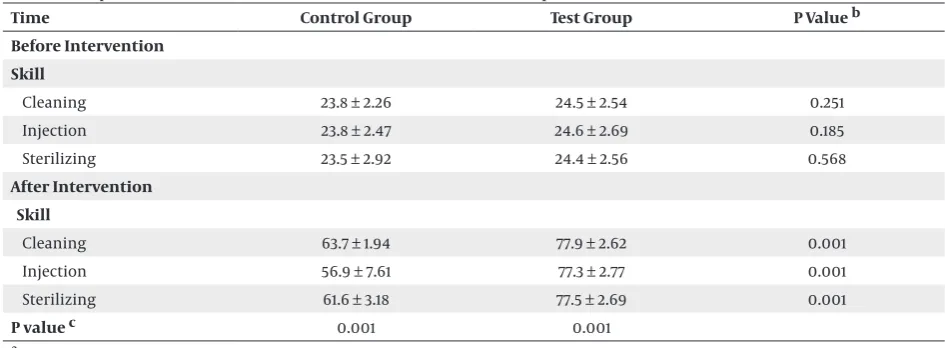
Results: Before education, no significant differences were observed between the two groups in the three skills of cleaning (P = 0.251), injection (P = 0.185) and sterilizing (P = 0.568). The students mean scores were significantly increased after the education and the difference between pre and post intervention of students mean scores were significant in the both groups (P < 0.001). However, after education, in all three skills the mean scores of the intervention group were significantly higher than the control group (P < 0.001).
Conclusions: Concept mapping was superior to conventional skill teaching methods. It is suggested to use concept mapping in teaching practical courses such as fundamentals of nursing.
Keywords: Students; Nursing; Practical Skills; Concept Mapping; Conventional Teaching Method
Copyright © 2015, Kashan University of Medical Sciences. This is an open-access article distributed under the terms of the Creative Commons Attribution-Non-Commercial 4.0 International License (http://creativecommons.org/licenses/by-nc/4.0/) which permits copy and redistribute the material just in noncommercial usages, provided the original work is properly cited.
1. Background
Nursing education aims to provide an appropriate level of knowledge and skills in nursing students. Improving the quality of nursing care requires obtaining high levels of knowledge and skills during nursing training period (1). However, skills acquisition is a complex process and needs students to acquire a combination of psychomo-tor, cognitive and affective skills and incorporate such skills with their theoretical knowledge, procedural skills and critical thinking. Several studies in different coun-tries reported that nursing education does not always prepare its students for the demands of working as a pro-fessional registered nurse (2, 3). Newly graduated nurses may have weak practical skills, which can be a threat to patients’ safety (4). A meta-analysis concluded that clini-cal skills training in nursing had not led to deep learning (5). Papastavrou et al. investigated student nurses’ experi-ence of learning in clinical environments and reported similar findings (6). Shah et al. studied the process of motor skill acquisition and reported that most students
complain about their problems in transferring what they learned at clinical skills centers to the real clinical setting (7). Several factors are involved, among them education methods play a crucial role (8). Therefore, it is imperative for nurse trainers to use the best methods to promote learning and skill acquisition in their students (4).
is an active teaching method, which helps nurse edutors to develop critical thinking and problem solving ca-pabilities in graduates (11).
Several studies in the field of medical education used concept mapping in teaching theoretical courses (11, 12), teaching and evaluation of creativity skills (13), teach-ing students to develop and record care plans (14). How-ever, most studies used grades and students’ academic achievement to measure the effect of concept mapping (15). Moreover, some studies had weaknesses in their de-sign and methodologies. For example, Adlaon compared the effect of a three-week teaching course using concept mapping and traditional teaching methods on students’ performance in responding multiple choice questions and reported that concept mapping was superior to tra-ditional teaching method. However, the short duration of intervention, the small sample size, the small numbers of concept maps used and the type of evaluation made the results difficult to be generalized (16). In another study, Hsu and Hsieh used concept maps as an assessment tool in a nursing course. However, the intervention did not affect students’ outcome significantly (14). Clayton et al. reported that contradictory results of concept mapping technique might be attributed to small sample size, in-appropriate gauges, non-random selection and lack of control group in different studies (17). Most studies as-sessed the effects of concept mapping on students cogni-tive learning domain (18, 19) and the effect of this method on students skill acquisition had not been assessed so far. Then, we cannot generalize the results of these studies to the psychomotor domain.
2. Objectives
This study was performed to compare the effects of training using concept mapping and traditional teach-ing methods on practical skills of nursteach-ing students.
3. Patients and Methods
3.1. Design and Participants
This quasi-experimental pretest and post-test study was conducted on 70 students enrolled for the first time in a practical course on fundamentals of nursing. The study was conducted in the second semester of the academic year 2013 - 2014 in the clinical skills center at Tehran uni-versity of medical sciences (TUMS). The inclusion crite-rion was having no previous experience on concept map-ping and direct observation of procedural skills (DOPS) methods. An absence of more than three sessions from the training sessions was the exclusion criterion.
The sample size was calculated using the results of a previous study by Karimi-Moneghi et al. in which s1, s2, μ1 and μ2 were respectively 1.5, 1, 16.2, and 15.25 (20). Then, with a type I error of 0.05 and a power of 0.80, the sample size was estimated as 29 students for each group.
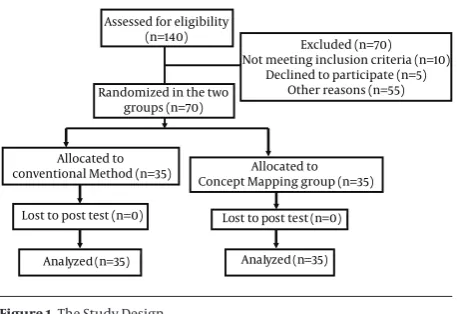
However, we recruited 35 students with inclusion crite-ria in each group to compensate for possible attritions. Then, among a total of 140 students, 70 students with inclusion criteria who consented to participate in the study were recruited. Then, the students were randomly assigned in the intervention (n = 35) or the control group (n = 35) using a random numbers table (Figure 1).
Before commencing the intervention, all the students were invited to the clinical skills center. Then, a pre-test was performed in both groups using the DOPS method. Afterward, each group was though 14 sessions of 45 minutes, two sessions per week, through either concept mapping (intervention group) or the traditional method (control group).
Lost to post test (n=0)
Analyzed (n=35) Analyzed (n=35)
Assessed for eligibility (n=140)
Randomized in the two groups (n=70)
Excluded (n=70) Not meeting inclusion criteria (n=10)
Declined to participate (n=5) Other reasons (n=55)
Allocated to conventional Method (n=35)
Lost to post test (n=0)
Allocated to Concept Mapping group (n=35)
Figure 1. The Study Design
3.2. Instruments
A two-part instrument was used to collect data in this study including a demographic data form and a checklist for assessing the students’ skills in selected procedures. The demographic data form consisted of questions re-garding students’ age, gender, grade point average (GPA), living location, marital status and the group in which the student was assigned to.
reli-ability was also checked through internal consistency method and the Cronbach’s alpha was 0.94 (23).
3.3. Intervention
The intervention group was trained using concept mapping method followed by demonstrating relevant skills by instructors and students’ practices. All maps were spider shaped so that the main concepts were in the middle of maps and sub-concepts were presented in the sides. In all maps, the teacher presented the material in a clockwise direction from the starting point. At the first session, the intervention group was informed that special software would be used to teach them in this course. Then, they were taught about us-ing FreeMind software to draw concept maps. Then, the main course started in the second session onward. Af-ter each session, every student was required to design a concept map of the whole proposed lecture for the next session individually; then, at the beginning of the next session, a few concept maps prepared by the stu-dents were reviewed and feedback was given to them. All training sessions of the intervention group were held on Saturdays and Sundays, at the clinical skills center of nursing school of TUMS. In this study, the in-structor (the second researcher drew concept maps us-ing offline method in Free-mind (GNU General Public License, Java), based on the literature on websites and specialized instructions (23).
The control group was also trained in 14 sessions using conventional method (i.e. lecturing, demonstration and then students’ practicing). The training sessions of this group were held on different days (Tuesdays and Wednes-days) to prevent exchanging the information about con-cept mapping between the two groups.
The curriculum of both groups was the same and the only difference was used teaching methods. The skills taught included intradermal injection, subcutaneous injection, intramuscular injection, intravenous cannu-lation, intravenous injection, intravenous fluids prepa-ration, nasogastric catheterization, feeding through a nasogastric catheter (gavage), nasogastric lavage, oxygen therapy methods (through nasal cannula and face mask), measuring the blood pressure, airway suctioning, trache-ostomy care and dressing change. The list of procedures was confirmed by the authorities in nursing school and the content validity of all concept maps were confirmed by 10 experienced nursing faculty members in the nurs-ing school of TUMS.
Four weeks after the last training session, DOPS functional test was conducted without previously in-forming in the clinical skills center for all students in the both groups. Two lecturers of the “fundamentals of nursing” course in nursing and midwifery school at Tehran university of medical sciences (who were trained on DOPS and how to observe the students us-ing special checklists, but did not know anythus-ing about
the project), conducted all testing procedures. Before starting the testing, all the students were gathered in a classroom and briefed about the DOPS and what should they do during the testing session.
Each student was required to select three procedures (i.e. cleaning, injection and sterilizing) among several procedures already taught to them. The name of pro-cedure was written on pieces of paper and put in three boxes. Each student was asked to select randomly one procedure from each box. The students performed the selected procedures under direct observation of the aforementioned specialists who completed the DOPS checklists. Finally the mean of students' scores was cal-culated for each individual skill and recorded at the top of the checklist.
3.4. Ethical Considerations
The present study was approved by the institutional re-view board and the research ethics committee of TUMS. All students were aware that they are under investiga-tion and signed an informed consent at the beginning of study. They also were assured about the confidentiality of their personal information.
3.5. Data Analysis
Statistical analysis was performed using SPSS-13 soft-ware (Spss Inc, Chicago, IL, USA). Kolmogorov-Smirnov test was performed and confirmed the normality of the DOPS scores. Independent samples T-test was used to compare the mean of procedural skills scores, the mean age and GPA of the two groups. Paired t-test was used to compare the mean scores on each group before and af-ter the inaf-tervention. Chi-square test was used to compare gender differences and Fisher’s exact test for marital sta-tus and residential area of the two groups. Statistical sig-nificance was considered at P value < 0.05.
4. Results
For gender distribution, 58.1% of the students in the control group and 56.9% of the intervention group were females. No significant difference was observed regarding demographic characteristics of the two groups (Table 1).
Table 1. Characteristics of Participants in the Concept Mapping and Control Group a, b
Variables Control Group Intervention Group P Value
Gender 0.68
Male 15 (41.9) 15 (43.1)
Female 20 (58.1) 20 (56.9)
Marital status 0.93
Single 31 (88.6) 34 (97.1)
Married 4 (11.4) 1 (2.9)
Residental area 0.96
With parents 25 (71.4) 23 (65.7)
Dormitory 10 (28.6) 12 (34.3)
Age, y 19.45 ± 0.86 19.16 ± 0.86 0.33
GPAb 17.51 ± 1.49 17.74 ± 1.38 0.51
a Data are presented as mean ± SD or No. (%). b GPA: grade point average
Table 2. Comparison of the Mean Score of Practical Skills Between Two Groups Before and After Intervention a
Time Control Group Test Group P Value b
Before Intervention Skill
Cleaning 23.8 ± 2.26 24.5 ± 2.54 0.251
Injection 23.8 ± 2.47 24.6 ± 2.69 0.185
Sterilizing 23.5 ± 2.92 24.4 ± 2.56 0.568
After Intervention Skill
Cleaning 63.7 ± 1.94 77.9 ± 2.62 0.001
Injection 56.9 ± 7.61 77.3 ± 2.77 0.001
Sterilizing 61.6 ± 3.18 77.5 ± 2.69 0.001
P value c 0.001 0.001
a Data are presented as mean ± SD. b Independent t-test.
c Paired t-test.
5. Discussion
To the best of our knowledge, this was the first study comparing the effect of concept mapping and tradi-tional methods of skill teaching on nursing students learning in practical skills. The study revealed that both methods could significantly increase the mean score of students at posttest. However, students’ posttest mean scores were significantly higher in the group taught via concept mapping method. Our finding on positive effect of concept mapping on learning was in line with some previous studies such as Van Bon-Martens (24), Gul and Boman (25) and Magnussen (26), Harrison and Gibbons (27), and Gonzalez et al. (10). Though not on psychomo-tor domain, all of these studies confirmed that concept mapping is superior to conventional methods in enhanc-ing students’ learnenhanc-ing in the cognitive domain. Although both teaching methods used in this study could enhance
re-main for a long-term and increase learning significantly (9). Concept mapping also allows students to understand the errors in theirs understanding of concepts and then would increase their motives to correct such errors (28). According to Tseng et al. concept mapping combines the problem-oriented learning, critical thinking, self-direct-ing learnself-direct-ing and enhances students’ performance in the training group (29). Scahill et al. also reported that con-cept mapping improves students’ learning and academic achievement with a positive effect on their attitudes (30). When a concept map is drawn by the students, they integrate their new knowledge with what they have learned previously. This method may help students to easily classify their knowledge, make them coherent to make a deeper understanding. This would assist students reaching higher levels of cognitive learning rather than memorizing a series of concepts.
This study showed that concept mapping was superior to conventional skill teaching methods. Considering the results of this study, it is suggested to use concept map-ping in teaching practical courses such as fundamentals of nursing. This method would perhaps be more effective if integrated with teachers’ conventional teaching methods. To this end, nurse teachers should be trained to integrate concept mapping in their teaching and learning activities.
However, the nature of each course, instructor’s mastery and types of learners can affect selecting teaching method. This study was implemented in a small sample and com-pared the concept mapping with conventional methods. Therefore, it is suggested to perform studies using concept mapping in other practical courses in nursing and to com-pare it with other active teaching methods.
In this study, the effect of intervention was assessed in the skill center not in the real clinical setting. There-fore, investigating the effect of concept mapping on students’ competencies in real clinical setting is sug-gested.
Acknowledgements
This manuscript was obtained from a research project approved by the research council of Tehran university of medical sciences and health services (contract no. 21938-61-02-92 dated 13 Feb 2014). We would like to take this op-portunity to express our gratitude to the research deputy of Tehran university of medical sciences for supporting this project and freshmen nursing students (2013 - 2014 academic year) for cooperating in this study.
Authors’ Contributions
Nasrin Rasoul Zadeh and Zohre Parsa Yekta designed the study and conducted data analysis, Hamidreza Sa-deghi Gandomani gathered the data, interpreted it and Masoumeh Delaram wrote and revised the manuscript.
Financial Disclosure
No conflicts of interest, were declared by the authors.
Funding/Support
None declared.
References
1. Chirema KD. The use of reflective journals in the promotion of reflection and learning in post-registration nursing students.
Nurse Educ Today. 2007;27(3):192–202.
2. Al-Elq AH. Medicine and clinical skills laboratories. J Family Com-munity Med. 2007;14(2):59–63.
3. Berg DA, Milner RE, Fisher CA, Goldberg AJ, Dempsey DT, Grewal H. A cost-effective approach to establishing a surgical skills labo-ratory. Surgery. 2007;142(5):712–21.
4. Duchscher JB. A process of becoming: the stages of new nurs-ing graduate professional role transition. J Contin Educ Nurs.
2008;39(10):441–50.
5. Poropat AE. A meta-analysis of the five-factor model of personal-ity and academic performance. Psychol Bull. 2009;135(2):322–38. 6. Papastavrou E, Lambrinou E, Tsangari H, Saarikoski M,
Leino-Kil-pi H. Student nurses experience of learning in the clinical envi-ronment. Nurse Educ Pract. 2010;10(3):176–82.
7. Shah A, Barto AG, Fagg AH. A dual process account of coarticu-lation in motor skill acquisition. J Mot Behav. 2013;45(6):531–49. 8. Kaddoura MA. New graduate nurses' perceptions of the effects of
clinical simulation on their critical thinking, learning, and con-fidence. J Contin Educ Nurs. 2010;41(11):506–16.
9. Novak JD, Gowin DB. Learning how to learn. Soth Africa: Cam-bridge University Press; 1984.
10. Gonzalez HL, Palencia AP, Umana LA, Galindo L, Villafrade M. Mediated learning experience and concept maps: a pedagogical tool for achieving meaningful learning in medical physiology students. Adv Physiol Educ. 2008;32(4):312–6.
11. Rendas AB, Fonseca M, Pinto PR. Toward meaningful learning in undergraduate medical education using concept maps in a PBL pathophysiology course. Adv Physiol Educ. 2006;30(1):23–9. 12. Kinchin IM, Cabot LB, Hay DB. Using concept mapping to locate
the tacit dimension of clinical expertise: towards a theoretical framework to support critical reflection on teaching. Learning Health Soc Care. 2008;7(2):93–104.
13. Sadeghi-Gandomani H, Delaram M, Naseri-Brugeni N. Compari-son of concept mapping and conventional teaching methods on creativity of nursing students. J Med Educ Dev. 2014.
14. Hsu L, Hsieh SI. Concept maps as an assessment tool in a nursing course. J Prof Nurs. 2005;21(3):141–9.
15. Hinck SM, Webb P, Sims-Giddens S, Helton C, Hope KL, Utley R, et al. Student learning with concept mapping of care plans in community-based education. J Prof Nurs. 2006;22(1):23–9. 16. Adlaon RB. Assessing effectiveness of concept map as instructional
tool in high school Biology. Faculty of the Louisiana State Univer-sity and Agricultural and Mechanical College. In partial fulfill-ment of the requirefulfill-ments for the degree of Master of Natural Sciences in The Interdepartmental Program in Natural Sciences by Ritchie Bagcat Adlaon BS; 2012. Available from: http://etd.lsu. edu/docs/available/etd-07092012-114044/unrestricted/adlaon-thesis.pdf.
17. Clayton LH. Concept mapping: an effective, active teaching-learning method. Nurs Educ Perspect. 2006;27(4):197–203. 18. Chiou CC. The effect of concept mapping on students’
learn-ing achievements and interests. Innovat Educ Teach Int.
2008;45(4):375–87.
19. Wu PH, Hwang GJ, Milrad M, Ke HR, Huang YM. An innovative concept map approach for improving students' learning perfor-mance with an instant feedback mechanism. Br J Educ Technol.
2012;43(2):217–32.
20. Karimi-Moneghi H, Valaei N, Mortazavi F. The effect of video-based instruction versus demonstration on learning of clinical skills. J Gorgan Uni Med Sci. 2003;5(2):77–82.
21. Wilkinson JR, Crossley JG, Wragg A, Mills P, Cowan G, Wade W. Implementing workplace-based assessment across the medical specialties in the United Kingdom. Med Educ. 2008;42(4):364–73. 22. Hsu LL. Developing concept maps from problem-based learning
23. Sadeghigooghari N, Jahantigh M. Assessment of Acceptability of Direct Observation of Procedural Skills (DOPS) Among Nursing Students and Faculty Members in Zahedane University of Medi-cal Sciences, IRAN. Procedia Soc Behav Sci. 2013;83:1023–6. 24. van Bon-Martens MJ, van de Goor LA, Holsappel JC, Kuunders TJ,
Jacobs-van der Bruggen MA, te Brake JH, et al. Concept mapping as a promising method to bring practice into science. Public Health. 2014;128(6):504–14.
25. Gul RB, Boman JA. Concept mapping: A strategy for teach-ing and evaluation in nursteach-ing education. Nurse Educ Pract.
2006;6(4):199–206.
26. Magnussen L. The use of the cognitive behavior survey to assess nursing student learning. J Nurs Educ. 2001;40(1):43–6.
27. Harrison S, Gibbons C. Nursing student perceptions of
concept maps: from theory to practice. Nurs Educ Perspect.
2013;34(6):395–9.
28. Hilbert TS, Renkl A. Concept mapping as a follow-up strategy to learning from texts: what characterizes good and poor map-pers? Instruct Sci. 2008;36(1):53–73.
29. Tseng HC, Chou FH, Wang HH, Ko HK, Jian SY, Weng WC. The ef-fectiveness of problem-based learning and concept mapping among Taiwanese registered nursing students. Nurse Educ Today.
2011;31(8):e41–6.
30. Scahill SL, Harrison J, Carswell P. What constitutes an effec-tive community pharmacy?--development of a preliminary model of organizational effectiveness through concept mapping with multiple stakeholders. Int J Qual Health Care.