Anale. Seria Informatică. Vol. IX fasc. 1 – 2011
Annals. Computer Science Series. 9th Tome 1st Fasc. – 2011
G
Ge
eo
oG
Ge
eb
br
ra
a
s
so
of
ft
tw
w
ar
a
re
e
i
in
n
t
te
ea
ac
ch
hi
in
ng
g-
-l
le
ea
ar
rn
ni
in
ng
g
p
p
ro
r
o
ce
c
es
ss
s
V
Vaalleerriiaann AAnnttoohhee
Pedagogical High School “D.P.Perpessicius”, Brăila, România
ABSTRACT: The development of computer technologies can be seen as a miracle in the modern civilization. What new reality of the IT surrounding environment have brought to us now was unthinkable several decades ago. The level of information and its flow on different communication channels, its impact on the individual are more and more difficult to quantify. A great challenge for educational systems is to create some harmonious co-existence between face book, wikis, virtual realities, virtual learning and traditional methods. The examples presented will illustrate the impact of GeoGebra software in this sense.
KEYWORDS: virtual learning, teaching, tactics, strategies.
Introduction
Anale. Seria Informatică. Vol. IX fasc. 1 – 2011
Annals. Computer Science Series. 9th Tome 1st Fasc. – 2011
1. Methodology, development tactics and strategies
It is a challenge to use the computer in learning processes. This implies the integration of educational software in education. The educational software and its applications are very helpful in teaching-learning methods for maths. An "educational software application” is something that you can use, without having advanced knowledge about computers and programming. One accept that investigating properties of a geometrical or algebraically domain, changing shape and size in order to establish if properties remain true and formulation of the theorem from this investigation, should be a real route for any mathematical provocation.[Ant2009].
Most of the teachers and school managers complain about the difficulties in working with the educational software provided by the Romanian Ministry of Education and about the lack of resources allocated for upgrades, for software acquisition from the free market and for appropriate training, [Ist07]. For these entire reasons one accept that the presence of open source software involved in education will become a special opportunity and GeoGebra software is one of the best example in this sense, [HL10].
The starting moment of the GeoGebra software operation is considered the moment in which this software was created and launched in the universal informational environment (It took place in the 1990s under the umbrella of “open source” systems) and was meant to be a dynamic structure, focused on the following goals:
to provide free access to a dynamic educational software;
to offer free teacher training courses;
to support and develop materials both for students and teachers with a view to improving education in the fields of mathematics, sciences and technology;
to contribute and to promote collaboration between practitioners and researchers in order to create a national users community.
Is the education system ready to accomplish the new tasks? The question is older than the latest developments.
Anale. Seria Informatică. Vol. IX fasc. 1 – 2011
Annals. Computer Science Series. 9th Tome 1st Fasc. – 2011
2. Educational software induce a great flexibility in teaching
There are some requirements for students and for teachers in order to develop activities in the mathematics curriculum with the help of the GeoGebra and these requirements are generally accepted and known in GeoGebra community.
Maths activities could be classified as: activities dedicated to reach competence in using GeoGebra software, activities dedicated to visualize mathematical results and theorems, activities dedicated to establish research in maths, finding new theorem and generalize results, special activities which are focused to discover "other open problems" in order to be rigorously demonstrated in other future activities.
2.1. Activities dedicated to reach competence in using GeoGebra software
Many activities of the first stage, using GeoGebra, have been developed around the GeoGebra community and a lot of these could be finding on GeoGebra wikis. Since the main objective of this lesson is to teach students to use the GeoGebra software, the maths involved with the lesson is a review of geometry and measurement previously covered.
2.2. Activities dedicated to visualize mathematical results and theorems
Speaking about the second issue, visualize results and maths theorem, one could give some examples:
Anale. Seria Informatică. Vol. IX fasc. 1 – 2011
Annals. Computer Science Series. 9th Tome 1st Fasc. – 2011
Figure 1. The Ceva’s Theorem file.ggb project realized with the GeoGebra software
A lot of web pages contain different proofs of this theorem, and one of this is contained in figure 2.
Figure 2. Virtual learning on dynamic geometry images, http://agutie.homestead.com/files/ceva.htm , Antonio Gutierrez 2005
The exponential and logarithmic function
Anale. Seria Informatică. Vol. IX fasc. 1 – 2011
Annals. Computer Science Series. 9th Tome 1st Fasc. – 2011
Figure 3. The equation f(x) = f-1(x), The equation f(x) = ax, a=0.02
These examples illustrate how it is possible to use the method of generating problems with generator problem, concretely with solving equation f(x) = f-1(x) for different types of function. The benefit of this purpose consists in connection between teaching mathematical analysis and both analytical and synthetic geometry at school. It is very important that the students’ knowledge be not isolated. A teacher has a possibility to explain the notions of inverse function, graphs of different function. Students can use the GeoGebra software by finding the numerical solutions for the equation f(x) = f-1(x) and this will visualize mathematical results, (Fig.3).
2.3. Activities dedicated to establish research in math, finding new theorem and generalize results
In this section, some of maths activities will be projected, considering that each maths teacher could adopt his own strategy because for most of all secondary maths teachers the ability to use an educational soft could be considered like a provocation.
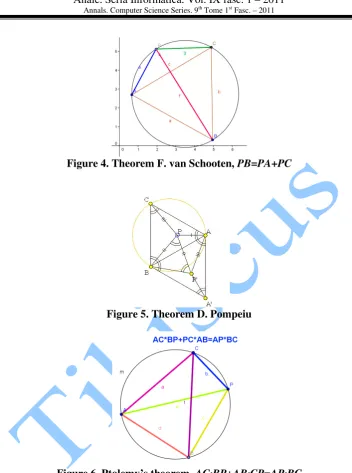
The applet illustrates two theorems discovered three hundred years ago. Let P be a point in the plane of an equilateral ∆ABC. Both theorems are concerned with the relative lengths of segments AB, BP and CP, joining P the vertices of ∆ABC.
Theorem (F. van Schooten, 1615 – 1660)
For P on the circumcircle of an equilateral ∆ABC, the longest of the three segments (PA, PB or PC) it is equals the sum of the shorter two, (Fig. 4).
Anale. Seria Informatică. Vol. IX fasc. 1 – 2011
Annals. Computer Science Series. 9th Tome 1st Fasc. – 2011
For P not on the circumcircle of ∆ABC, there exists a triangle with sides PA, PB and PC. (The triangle in question is known as Pompeiu’s triangle), (Fig.5).
Ptolemy’s theorem Let a convex quadrilateral ACPB be inscribed in a circle. Then the sum of the products of the two pairs of opposite sides equals the product of its two diagonals. In other words, AD·BC+AB·BD=AC·BD, (Fig.6).
Rotate triangle ACP around A through the angle CAB so that C is mapped onto a point, say C', on AB. P is mapped to P'.
In case ∆ABC is equilateral, my come up with the configuration in the proof of van Schooten’s theorem. When ∆ABC is equilateral the rotation places P' on the extension of BP. The same is true when ∆ABC is isosceles. In the general case, we may only claim that C'P'||BP. (The reason is the same in all three cases. Since the quadrilateral ABPC is cyclic ∠ACP + ∠ABP = 180°. After the rotation, ∠AC'P' = ∠ABP'', where P'' is the
intersection of AP' and BP.) Triangles ABP'' and AC'P' are similar, implying AC' / C'P' = AB / BP'' so that BP”=AB·C’P’/AC’.
Triangles ABC and AP''P are also similar because, in addition to ∠PAP''
= ∠CAB, ∠'AP''P = ∠AP'C' = ∠APC = ∠ABC (the latter as the two
inscribed angles subtended by the same arc.) This gives AC/AP=BC/PP” so that PP”=BC·AP/AC. But PP'' = BP + BP'' = BP + AB×CP / AC. We see that
BP+AB·CP/AC=BC·AP/AC. Multiplying by AC gives Ptolemy's identity. Ptolemy’s theorem offers one approach to proving theorems.
A proof below is more elementary.
Rotate the plane 60o around B so as to make vertex C overlap vertex A. Let A’ and P’ be the images of A and P, respectively. We’ll show that APP’ is Pompeiu’s triangle. By the construction, ∆BPP’ is equilateral, so that PP’=BP. In addition, AP’ is the image under the above rotation of CP, so that AP’=CP. The remaining side in ∆APP’ is just AP, and we are done with Pompeiu’s theorem.
Assuming A, P and P’ are collinear (i.e., when Pompeiu’s triangle is degenerate),
∠
APB is either 60o or 120o. (This is because it is either equal to ∠BPP’, which is 60o, or is supplementary to it.) But then the quadrilateralAnale. Seria Informatică. Vol. IX fasc. 1 – 2011
Annals. Computer Science Series. 9th Tome 1st Fasc. – 2011
Figure 4. Theorem F. van Schooten, PB=PA+PC
Figure 5. Theorem D. Pompeiu
Figure 6. Ptolemy’s theorem, AC·BP+AB·CP=AP·BC
The F. van Schooten’s theorem can be extended to triangles that are not equilateral.
Anale. Seria Informatică. Vol. IX fasc. 1 – 2011
Annals. Computer Science Series. 9th Tome 1st Fasc. – 2011
Lemma:
In ∆ABC, h = b·c/(2R), where h is the altitude from A and R is the circumradius. (For the proof see Metric Relation in a Triangle).
To continue with the theorem, for ∆PBC, lemma gives: da=PB·PC/(2R), and similarly for triangles PCA and PAB. Next we obtain:
(1)
a/da = a/(PB·PC)·(2R) = a·PA·(2R)/(PA·PB·PC), b/db = b/(PC·PA)·(2R) = b·PB·(2R)/(PA·PB·PC), c/dc = c/(PA·PB)·(2R) = c·PC·(2R)/(PA·PB·PC).
∆ABC divides its circumcircle into three arcs, say (BC), (CA), (AB). If, for instance, P is on arc (BC) then by Ptolemy’s theorem, a·PA=b·PB+c·PC. Therefore,
(2) a/da = b/db + c/dc,
as needed. It follows from (1) that say, when a = b = c, PA = PB + PC is equivalent to a/da = b/db + c/dc. However, while the latter holds for all triangles, the former holds only for the equilateral ones.
Observe that, as it follows from the proof, the ratio in the left-hand side of (2), (i.e., the largest ratio possible) corresponds to the arc that contains P.
The provocation of using GeoGebra software could be here the construction of a convex quadrilateral ACPB, inscribed in a circle. We need this construction in order to develop dynamic construction for Ptolemy’s theorem and prove that AD·BC+AB·BD=AC·BD. Four points must be on a circle in order to form a convex quadrilateral ABCD and, important, these four points must be in this order. We have two proposed construction in two GeoGebra file. First consider like a start point the construction of diagonals using two variable angles, first give the position of the first diagonal towards the abscises axis. The second diagonal will be rotated around a fixed point on the circle, (Fig.7).
The next construction will consider first a fixed diagonal of the convex quadrilateral ABCD and one coin will be mobile on one arc of the circle.
Anale. Seria Informatică. Vol. IX fasc. 1 – 2011
Annals. Computer Science Series. 9th Tome 1st Fasc. – 2011
Figure 8. Construction of the convex quadrilateral ABCD start from the fixed diagonal BC
Theorem 1 admits a further extension to polygons with more than three vertices.
Theorem 2: Given point P on the circumcircle of a cyclic convex polygon X1X2X3 ... Xn-1Xn (n > 2), we use following notations (I and j can be
interchanged):
• ai j = length of side XiXj ;
• di j = distance from P to sidelines XiXj ; • Ri j = ratio ai j/di j .
Without loss of generality we may assume that P is on the arc X1X2.
Then the set of ratios R12, R23, R34,..., R(n-1)n, Rn1 verify the relation:
R12 = R23 + R34 + ... + R(n-1) n + Rn1.
The theorem admits a demonstration by induction method.
For using GeoGebra software this theorem produce an open problem if we want to construct a dynamical imagines of a convex polygon with n sides inscribed in a circle. Could we fix one of the vertices and others n-1 vertices to be mobile on the circle, preserving the relation of order between vertices so that the polygon to remain convex? Ideas to realize this for n=4 was established in the examples above and theorem 2 is visualized for n=5 in figure 9.
Anale. Seria Informatică. Vol. IX fasc. 1 – 2011
Annals. Computer Science Series. 9th Tome 1st Fasc. – 2011
Conclusions
The teachers who use GeoGebra must be more specific, more "open minded", willing to allow for experimentation, and give more guidance at the start of any GeoGebra experiment. Flexibility of learning means flexibility of relation between teachers and students. This implies new situation of learning and a special development of new methods of teaching. The adequately integrating such approaches into projects can lead to the development of 'meta-mathematical' skills, which are particularly useful in technological instruction and technology applications. On the social side, the impact of GeoGebra may be important in shifting perceptions about mathematics as a solitary activity to the more harmonic view of mathematics as social activity.
References
[Ant09] V. Antohe - From “Nolite turbare circumos meos!” to “Don’t delete my folder”, Annals, Computer Science Series. 7th Tome, 2nd Fasc.p.98 - 2009
[Gun10] J. Gunčaga – GeoGebra as a tool for mathematical education in Slovakia, in Proceedings of the First Euroasia Meeting of GeoGebra (EMG), Istanbul, Turkey, 2010.
[HL10] M. Hohenwarter, Z. Lavicza - Gaining momentum: GeoGebra inspires educators and students around the world, GeoGebra The New Language For The Third Millennium, Vol.1 No.1, Zigotto Publishing House, Braila, 2010.