
N
N
U
U
M
M
E
E
R
R
I
I
C
C
A
A
L
L
R
R
E
E
S
S
U
U
L
L
T
T
S
S
O
O
F
F
S
S
O
O
M
M
E
E
I
I
N
N
I
I
T
T
I
I
A
A
L
L
A
A
N
N
D
D
B
B
O
O
U
U
N
N
D
D
A
A
R
R
Y
Y
V
V
A
A
L
L
U
U
E
E
P
P
R
R
O
O
B
B
L
L
E
E
M
M
S
S
I
I
N
N
M
M
E
E
C
C
H
H
A
A
N
N
I
I
C
C
S
S
M
M.
.
O
O.
.
O
Ol
la
ay
yi
iw
wo
ol
la
a,
,
M
M.
.
K
K.
.
K
Ko
ol
la
aw
wo
ol
le
e
Department of Mathematical and Physical Sciences, Faculty of Basic and Applied Sciences, College of Science, Engineering and Technology, Osun State University, Osogbo
Corresponding Author: M. O. Olayiwola, [email protected]
ABSTRACT: In this research article, the Variational Iteration method coupled with the polynomial approximation is used to find numerical solution to some homogenous and non-homogenous ordinary differential equations arising in mechanics. KEYWORDS: variational iteration method, boundary value problem, polynomial.
1. INTRODUCTION
Many researchers have used Variation Iteration Method (VIM) to find numerical solutions to different types of differential equations. In [OGA10], Olayiwola et al. proposed a modification of VIM to improve its convergence. The Variational Iteration Method was proposed by He J. H. [He99, He00, He06, He07] and has been successfully applied to solve many types of problems that arise in science and engineering [Alq11, Ola16a, Ola16b, Ola14].
In this study, the analytical and numerical solutions of fourth order homogenous and non-homogenous linear boundary value problems were investigated using a polynomial form of initial guess with the variational iteration method. We also make with the exact solution. We show that the method is a powerful technique for solving higher order boundary value problems.
2. VARIATIONAL ITERATION METHOD
The basic idea of application of general Lagrange multiplier and variational calculus was first proposed in 1978 by Inokuti et al [ISM78] in his method to solve nonlinear problems. Ji-Huan He modified the method of Inokuti and proposed the Variational Iteration Method (VIM). The idea of this method is constructing a correction functional by a general Lagrange multiplier.
The initial approximation can be freely chosen with possible unknown which can be determined by imposing the boundary and initial conditions.
To understand the basic procedure, we consider the following general differential equation. )
( ) ( )
(s Nu s f s
Lu (1)
where L is the linear operator, N is the non-linear operator and f(s)is an inhomogeneous term, according to the VIM ([He06, He07, Ola16a, Ola16b]).
The sequence
U
n can be constructed such that it converges to the exact solution through a correction functional as follows:
LU NU f d
s U s U
s
o
n n
n
n1( ) ( )
( ) ( ) ( ) ( )
(2)
where
is the general Lagrangian multiplier which can be optimally identified by the Variational theory ([He06]), the subscriptn
denotes the nth order approximation: the equation (2) is assumed stationary when.
0
n
u
) ( lim )
(s U s
U n
n
(3)
In this paper, we assumed the initial approximation of the form:
1
0 0( )
k
i i ix
a s
U (4)
where kis the order of the differential equation. 3. APPLICATION OF THE METHOD
Example 1: We consider the fourth order linear inhomogeneous differential equation ([TO11]):
x
e y dx
y d
dx y d
8 2
2 2
4 4
(5)
With the boundary conditions of
e y
y y y
) 1 ( " ) 1 ( '
1 ) 0 ( " ) 0 (
(6)
Applying equ. (2) and (4) in (5) we obtained:
(
)
2
(
)
(
)
8
.
)
(
)
(
)
(
"0
1
d
e
y
y
y
x
y
x
y
niv n ns
n
n
(7)Where
3 3 2 2 1
0
0
(
x
)
a
a
x
a
x
a
x
y
(8))! 1 (
) ( ) (
1
k
x k
(9)
29 28 27 26 25 24 23 22 21 20 19 18 17 16 15 3 14 2 13 1 3 12 2 0 11 3 1 10 2 0 9 1 3 8 0 2 7 1 3 6 0 2 5 1 3 4 0 2 3 3 2 2 1 0 5984000000 3915424810 3684067497 1 89000000 5488077520 1270368102 1 2000000 6743134003 4537028937 1 000000 0275234816 1680381088 1 0000 7212441600 6463004184 1 000 8884976640 2585201673 1 00 1202073600 1077167364 1 7400320000 4683336365 1 154560000 2128789257 1 07360000 1013709170 1 368000 5068545850 1 72000 2667655710 1 4000 1482030950 1 00 8717829120 1 5448642000 1 00 2179457280 1 3632428800 1 0 4358914560 1 259459200 1 6227020800 1 172972800 1 19958400 1 39916800 1 479001600 1 604800 1 2494800 1 9979200 1 1814400 1 226800 1 907200 1 120960 1 15120 1 7560 1 13440 1 5040 1 840 1 210 1 2520 1 280 1 30 1 360 1 120 1 15 1 120 1 10 1 3 1 24 1 6 1 ) ( x x x x x x x x x x x x x x x a x a x a a x a a x a a x a a x a a x a a x a a x a a x a a x a a x a x a x a a x y (10)
Imposing the initial and boundary conditions (6), we obtained the following system of algebraic equations.
0
0
a
(11)0
2
a
2
(12)0 598400000 3915424810 3684067497 983980979 8389987243 1618863452 00 2179457280 99 2405327336 0 4358914560 7 5122563154 889574400 881801009 479001600 457677527 3 2 1 0 a a a a (13) e a a a a 4 840000 4185783500 1134257234 313137 6445575457 7497408555 3773952 30774997 239500800 1020409631 39916800 7341410 3628800 2131561 3 2 1 0 (14)
Solving equations (11-14) simultaneously for ai,i0,1,2,3. Then
, 0 0 a (15) e a 49 5622615606 1874295930 0 4968929280 9985348905 215820800 2003448661 3217931961 4752352419 3744463141 0734814334 7082439005 2128727083
1
(16)
,
0
2
a
e a 49 5622615606 1874295930 0 6898457600 8968622266 46892800 9094044237 2016301782 4320320381 80108723 2926567534 2692445161 34583356903 (17)
The analytical solution of eqn. (5) is in [TO11] as:
x
e x x x
Table 1: Numerical results of equs. (5-6)
X Exact solution Numerical Solution Error
0 0 0 0.000E+00
0.1 0.099465383 0.099489031 2.365E-05
0.2 0.195424441 0.195470331 4.589E-05
0.3 0.28347035 0.283535633 6.528E-05
0.4 0.358037927 0.35811826 8.033E-05
0.5 0.412180318 0.412269774 8.946E-05
0.6 0.437308512 0.437399513 9.100E-05
0.7 0.422888069 0.422971413 8.334E-05
0.8 0.356086549 0.356151772 6.522E-05
0.9 0.22136428 0.221400812 3.653E-05
1 3.0179E-16 2.66E-10 2.659E-10
Example 2: We consider the fourth order linear homogeneous differential equation ([TO11]):
0
2
2 2 3 3 4 4
dx
y
d
dx
y
d
dx
y
d
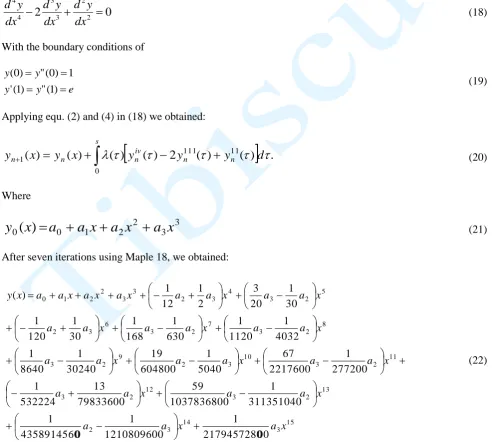
(18)With the boundary conditions of
e y y y y ) 1 ( " ) 1 ( ' 1 ) 0 ( " ) 0 ( (19)
Applying equ. (2) and (4) in (18) we obtained:
(
)
2
(
)
(
)
.
)
(
)
(
)
(
111 110
1
x
y
x
y
y
y
d
y
ivn n ns
n
n
(20)Where 3 3 2 2 1 0
0
(
x
)
a
a
x
a
x
a
x
y
(21)After seven iterations using Maple 18, we obtained:
15 3 14 3 2 13 2 3 12 2 3 11 2 3 10 3 2 9 2 3 8 2 3 7 2 3 6 3 2 5 2 3 4 3 2 3 3 2 2 1 0 00 2179457280 1 1210809600 1 0 4358914560 1 311351040 1 1037836800 59 79833600 13 532224 1 277200 1 2217600 67 5040 1 604800 19 30240 1 8640 1 4032 1 1120 1 630 1 168 1 30 1 120 1 30 1 20 3 2 1 12 1 ) ( x a x a a x a a x a a x a a x a a x a a x a a x a a x a a x a a x a a x a x a x a a x y (22)
1
0
a
(23)1
2
a
2
(24)e a a
a
a0 1 2 3
00 2179457280
71 3683553686 0
4358914560 9 3806028011
(25)
e a
a2 3
1037836800 9 1691005648 239500800
682189
(26)
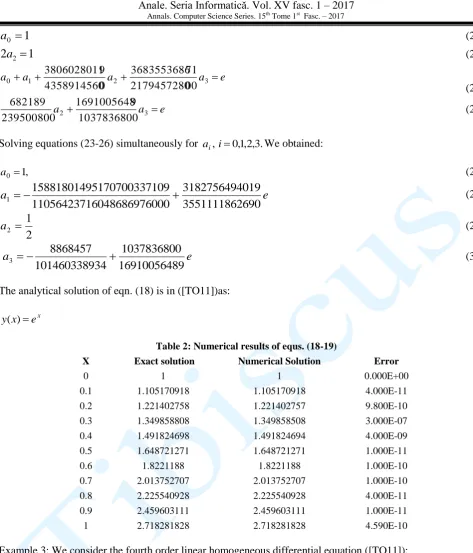
Solving equations (23-26) simultaneously for ai,i0,1,2,3.We obtained: ,
1
0
a (27)
e a
690 3551111862
019 3182756494 000
6048686976 1105642371
109 5170700337 1588180149
1 (28)
2 1
2
a (29)
e a
9 1691005648
1037836800 34
1014603389 8868457
3 (30)
The analytical solution of eqn. (18) is in ([TO11])as:
x
e x
y( )
Table 2: Numerical results of equs. (18-19)
X Exact solution Numerical Solution Error
0 1 1 0.000E+00
0.1 1.105170918 1.105170918 4.000E-11
0.2 1.221402758 1.221402757 9.800E-10
0.3 1.349858808 1.349858508 3.000E-07
0.4 1.491824698 1.491824694 4.000E-09
0.5 1.648721271 1.648721271 1.000E-11
0.6 1.8221188 1.8221188 1.000E-10
0.7 2.013752707 2.013752707 1.000E-10
0.8 2.225540928 2.225540928 4.000E-11
0.9 2.459603111 2.459603111 1.000E-11
1 2.718281828 2.718281828 4.590E-10
Example 3: We consider the fourth order linear homogeneous differential equation ([TO11]):
0
4 4
y
dx
y
d
(31)
With the boundary conditions of
0 ) 1 ( " ) 1 (
1 ) 0 ( " ) 0 (
y y
y y
(32)
Applying equ. (2) and (4) in (31) we obtained:
(
)
(
)
.
)
(
)
(
)
(
0
1
x
y
x
y
y
d
y
nivs
n
Where 3 3 2 2 1 0
0
(
x
)
a
a
x
a
x
a
x
y
(34)After seven iterations using Maple 18, we obtained:
23 3 22 2 21 1 20 0 19 3 18 2 17 1 16 0 15 3 14 2 13 1 12 0 11 3 10 2 9 1 8 0 7 3 6 2 5 1 4 0 3 3 2 2 1 0 00 4808294400 4308669456 1 8880384000 5620003638 1 1709440000 5109094217 1 176640000 2432902008 1 1472000 2027418340 1 864000 3201186852 1 96000 3556874280 1 8000 2092278988 1 00 2179457280 1 0 4358914560 1 6227020800 1 479001600 1 6652800 1 181440 1 362880 1 40320 1 840 1 360 1 120 1 24 1 ) ( x a x a x a x a x a x a x a x a x a x a x a x a x a x a x a x a x a x a x a x a x a x a x a a x y (35)
Imposing the initial and boundary conditions (32), we obtained the following system of algebraic equations.
1
0
a
(36)1
2a2 (37)
0 0 3698688000 3314361120 7 5759206567 3318307286 0 8880384000 5620003638 1 6807911956 5635617857 1709440000 5109094217 4285500441 5151684082 176640000 2432902008 094778681 2534333270 3 2 1 0 a a a a (38) 0 1766400 2432902008 330413 4059664476 728000 6402373705 962401 3210080802 0 6182824000 8515157028 4285500441 5151684082 088320000 1216451004 094778681 2534333270 1 0 3 2 a a a a (39)
Solving equations (36-39) simultaneously for ai,i0,1,2,3.We obtained:
,
1
0
a
(40), 43 0897349000 8961372930 9368183952 6530699693 44 8412509680 8300734982 1387259054 8575039137
1
a (41) , 2 1 2 a (42) 86 0179469800 5792274586 7873636790 1306139938 21 3328011317 9216556379 0462419684 2858346379
3
a (43)
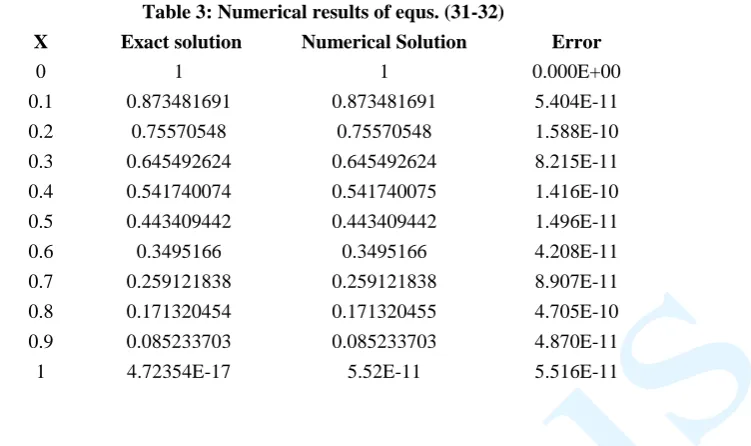
The analytical solution of eqn. (31) is in ([TO11]) as:
) ( ) 1 ( 2 1 )
( e1x ex1 Sinh
Table 3: Numerical results of equs. (31-32)
X Exact solution Numerical Solution Error
0 1 1 0.000E+00
0.1 0.873481691 0.873481691 5.404E-11
0.2 0.75570548 0.75570548 1.588E-10
0.3 0.645492624 0.645492624 8.215E-11
0.4 0.541740074 0.541740075 1.416E-10
0.5 0.443409442 0.443409442 1.496E-11
0.6 0.3495166 0.3495166 4.208E-11
0.7 0.259121838 0.259121838 8.907E-11
0.8 0.171320454 0.171320455 4.705E-10
0.9 0.085233703 0.085233703 4.870E-11
1 4.72354E-17 5.52E-11 5.516E-11
4. CONCLUSION
In this research article, we have successfully used the Variational Iteration Method coupled with the initial polynomial approximation to the fourth order boundary value problems. The results obtained were compared with the exact solution. It is apparently seen that the method is very powerful and efficient technique for finding the numerical solution to the fourth order boundary value problems.
REFERENCES
[Alq11] M. T. Alquran - Simulated results for deterministic model of HIV dynamics, Stud. Univ. Babes-Bolyai Math. Volume LVI, number 1, pp 165-178, 2011.
[He00] Ji-Huan He - Variational Iteration Method for autonomous ordinary differential systems, Comput. Applied Maths, 114, No. 2-3, 115-123, 2000.
[He06] Ji-Huan He - Some asymptotic methods for strongly nonlinear equations, International Journal of Modern Physics, 20, 1141-1199, 2006.
[He07] Ji-Huan He - Variational Iteration Method-some recent results and new interpretations, Comput. Applied Math., 207, No. 1, 3-17, 2007.
[He99] Ji-Huan He - Variational Iteration Method – a kind of nonlinear analytical techniques: some
examples, International Journal of nonlinear Mechanics, 34, No. 4, 699-708, 1999.
[ISM78] M. Inokuti, H. Sekine, T. Mura - General use of the Lagrange multiplier in nonlinear
mathematics Nemat-Nassers (Ed.). Variational Method in the Mechanics of Solids. Pergamon
Press, Oxford, 156-162, 1978.
[Kel14] O. Kelesoghe - The solution of fourth order boundary value problem arising out of the beam –
column theory using Adomian Decomposition method. Mathematical Problems in Engineering Vol.
2014, Article ID 649471, 6 pages, 2014.
[Ola16a] M. O. Olayiwola - The Variational Iteration Method for Solving Linear and Nonlinear Problems
that Arise in Mathematical Physics, Journal of the Nigerian Association of Mathematical Physics
Vol. 35, pp 65-72, 2016.
[Ola14] M. O. Olayiwola - An improved Algorithm for the solution of Generalized Burger-Fishers
[Ola16b] M. O. Olayiwola - Variational Iteration Method: A Computational Tool for Solving Coupled
System of Nonlinear Partial Differential Equations, Journal of Science and Arts (Mathematics)
Vol. 36, No.3, pp 243-248, 2016.
[OGA10] M. O. Olayiwola, A. W. Gbolagade, A. O. Adesanya - Solving Variable Coefficient
Fourth-Order Parabolic Equation by Modified initial guess Variational Iteration Method, Journal of the
Nigerian Association of Mathematical Physics Vol. 16, Pp 205-210, 2010.
[TO11] O. A. Taiwo, O. M. Ogunlaran - A non-polynomial spline method for solving linear fourth- order
boundary -value problems. International journal of the Physical sciences. Vol. 6(13), pp.
![2 Chloro N methyl N [2 (methylamino)phenyl]acetamide](data:image/gif;base64,R0lGODlhAQABAIAAAP///wAAACH5BAEAAAAALAAAAAABAAEAAAICRAEAOw==)