Journal of Information Security, 2011, 2, 39-49
doi:10.4236/jis.2011.21004 Published Online January 2011 (http://www.SciRP.org/journal/jis)
Effective and Extensive Virtual Private Network
Tarek S. Sobh, Yasser Aly
Information Systems Department, Egyptian Armed Forces, Cairo, Egypt E-mail: tarekbox2000@yahoo.com
Received November 13, 2010; revised December 22, 2010; accepted January 4, 2011
Abstract
A Virtual Private Network (VPN) allows the provisioning of private network services for an organization over a public network such as the Internet. In other words a VPN can transform the characteristics of a public which may be non-secure network into those of a private secure network through using encrypted tunnels. This work customized a standard VPN to a newly one called EEVPN (Effective Extensive VPN). It transmits a small data size in through a web based system in a reasonable time without affecting the security level. The proposed EEVPN is more effective where it takes small data transmission time with achieving high level of security. Also, the proposed EEVPN is more extensive because it is not built for a specific environment.
Keywords:Virtual Private Network, Network Security, Secure Data Transmission
1. Introduction
Connecting to the internet using Virtual Private Net-works (VPNs) [1,2] achieves a great security transmis-sion over the internet to the users.
Most computer systems today have 3 major lines of defense: access control, intrusion detection and preven-tion, and data encryption. In addipreven-tion, Access control and intrusion detection [3,4] are not helpful against compro-mising of the authentication module. If a password is weak and has been compromised, access control and intrusion detection cannot prevent the loss or corruption of information that the compromised user was authorized to access, and also it is not helpful when the intruder uses the system and software bugs to compromise the integ-rity, confidentiality, or availability of resources [5,6].
To improve security solution, this work introduces a customized Effective and Extensive Virtual Private Networks called (EEVPN). The proposed EEVPN used to secure war game as a web based system. It is more effective because it is faster than other VPNs where it takes less transmission time. Here we achieved this result after comparing the proposed model results with the cor-responding Cisco VPN and IBM VPN results over the same data transmission.
This paper is structured as follows: Section 2 explains VPN basic definitions and some related work. Section 3 introduces the proposed model idea and implemented algorithm. Section 4 explains the experimental results and finally Section 5 contains conclusion.
2. Virtual Private Networks
VPNs reduce remote access costs by using public net-work resources. Compared to other solutions, including private networks, a VPN is inexpensive [7].
A VPN uses data encryption and other security me-chanisms to prevent unauthorized users from accessing data, and to ensure that data cannot be modified without detection as it flows through the Internet [8,9]. It then uses the tunneling process to transport the encrypted data across the Internet. Tunneling is a mechanism for en-capsulating one protocol in another protocol as shown in
Figure 1.
2.1. VPN Architectures
depend-ing on the VPN model that is implemented.
The VPN server recovers the packet from the tunnel, unwraps it, and delivers it to the corporate network. Fig-ure 2 illustrates VPN architecture. There are four tun-neling protocols used to establish VPNs, and three are extensions of the Point-to-Point Protocol (PPP) [5,6,10,11]: 1) Point-to-Point Tunneling Protocol (PPTP). 2) Layer 2 Forwarding (L2F). 3) Layer 2 Tunneling Pro-tocol (L2TP). 4) IP Security (IPSec) ProPro-tocol Suite. In this Section we will discuss IPSec with some details be-cause IPSec can work with IP4 and IP6.
IPSec provides cryptography-based protection of all data at the IP layer of the communications stack. It pro-vides secure communications transparently, with no changes required to existing applications [12,13].
IPSec protects network traffic data in three ways [12, 13]: 1) Authentication: The process by which the identity of a host or end point is verified. 2) Integrity checking: The process of ensuring that no modifications were made to the data while in-transit across the network. 3) En-cryption: The process of “hiding” information while in-transit across the network in order to ensure privacy.
2.3 Commercial VPNs
Many companies produced a lot of VPNs deals with
dif-ferent data sizes. On the other hand a few works that deal with small data sizes especially less than 1 MB, because it is a special purpose for specific application such as War Game which needs high security with low time transmission.
Here we will discuss two popular VPN commercial products Cisco VPN and IBM VPN. There are different VPN products from both Cisco and IBM such as Cisco’s VPN 3000 Concentrator, Cisco VPN client 3.0, Cisco Easy VPN and IBM eNetwork. Cisco’s VPN (Virtual Private Network) 3000 Concentrator solution utilizes advanced PKI technology that enables mobile and re-mote users to securely transfer sensitive information in fully encrypted format [www.Cisco.com].
With eToken, there is only one password to remember. Users can take their authentication keys and digital cer-tificates with them wherever they go, on a key chain or in their pocket. Full two-factor authentication can easily be implemented from any computer that runs the Cisco VPN client 3.0 via Microsoft’s CAPI interface when communicating with a Cisco VPN 30XX Concentrator Series [www.Cisco.com].
[image:2.595.97.490.394.722.2]Cisco Easy VPN, a software enhancement for existing Cisco routers and security appliances, greatly simplifies VPN deployment for remote offices and teleworkers. Based
Figure 1. VPN Implementation [9].
T. S. SOBH ET AL. 41
on the Cisco Unified Client Framework, Cisco Easy VPN centralizes VPN management across all Cisco VPN devices thus reducing the complexity of VPN deploy-ments [www.Cisco.com].
Cisco Easy VPN enables an integration of VPN re-motes-Cisco routers, Cisco ASA & PIX Security Appli-ances, Cisco VPN concentrators or software clients- within a single deployment with a consistent policy and key management method thus simplifying remote side administration [www.Cisco.com].
eNetwork is IBM’s VPN Solutions [www.IBM.com]. Here we explain briefly the implementation of eNetwork VPN and describe its value. It is based on IPSec. How-ever, given the multitude of network environments and business needs, all scenarios have not been addressed in this section.
IBM added-value while many VPN solutions today consist only of firewalls, IBM eNetwork VPN solutions will also encompass multi-platform VPN-enabled clients and servers, routers, and management functions [www. IBM.com]. The advantages of IBM VPN solutions are: scalability; flexibility of VPN function placement; and the ability to have secure IP tunnels all the way from the client to IBM servers, where the majority of critical cor-porate data resides today. Also, IBM VPN solutions can be customized to be as secure or as flexible as required. It provides capabilities that can link your IT assets with Web technology to build secure e-business solutions [www.IBM.com].
2.4. War Games and VPN
War game is a simulated battle between two or more opposing fighting sides [3,4,14]. In most cases, there are two fighting sides and they are represented by the red and blue colors. Each side has its own goals to achieve at the expense of the other side, considering each side ca-pabilities, organization, weapons, and tactical experience of management armed forces during the battle. In addi-tion, environmental conditions such as battle terrain na-ture, battle timing, weather, surrounding environment must be considered. In addition to the fighting sides, one more side representing the arbitrator must be existed in the war game system. The arbitrator side is responsible of monitoring the fighting sides and evaluates their deci-sions.
Although it may be possible to play some forms of war games without the use of any prepared materials, most war games require a set of tools to keep track of and display data, force locations and movements, and interactions between opposing units. We have different instrumentality of war games [3,4]:
Manual games, which represented by simple tools:
maps, charts, notebook of data, and orders of bat-tles, perhaps a set of written rules and procedures and all decisions are man-made.
Computer-assisted games use machines ranging from desktop personal computers to very large mainframes. The machines are used to keep track of the force positions, their movement, weapon capabilities, and other critical, data-intensive piec-es of information.
Rand Corporation (fully automated) has been in the forefront of an effort to extend the role of the computer beyond that of capable assistant or some-times opponent. This game is carried out com-pletely on a computer, although usually with hu-man intervention to issue orders.
The integrated software components for implementing web based war games system of each side include: 1) Operating system component 2) Database component 3) GIS component.
Securing web based war games system is very impor-tant. The main task is to achieve a high level of security to the web based war game system [5] and controlling its sides’ behaviors. Since the entire network packets are going from or to the side LAN must be passed through the gateway computer, the security process is activated on the gateway computer. Encryption/decryption module is responsible of doing two tasks [14,15]. The first task is encrypting each network packet before going out from the side LAN to the web. The second is decrypting each network packet coming from the web before entering the side LAN. This is why we use a VPN for securing web based war games system. The main task of VPN here is to achieve a high level of security to the web based war games system and controlling its sides’ behaviors.
3. Proposed Model
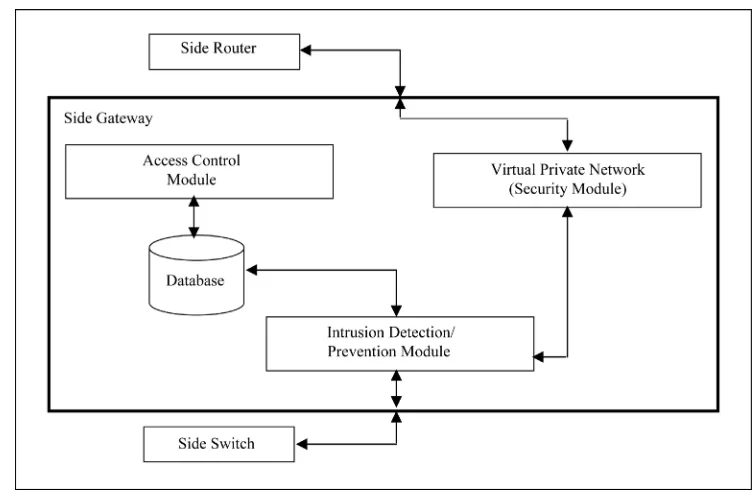
As shown in Figure 3, this work provides three levels of security to secure the web based war game system in the following manner:
Access control module: the access control is applied to our web based war game system using two access control mechanisms. The first mechanism is the server operating system access control mechanism. This mechanism is applied to the war game system resources (directories, files, printers …etc). The second mechanism is the DBMS access control mechanism and it is applied to the war game system database.
Figure 3. Security levels using a VPN.
side LAN.
Intrusion detection/prevention module: this module is responsible of checking each incoming network packet and test if it represents a normal or intrusive behavior. If the packet represents a normal behavior, the intrusion detection module forwards it to its destination; otherwise, an alarm is given to the system administrator and the packet will be blocked.
Some encryption schemes can be proven secure on the basis of the presumed hardness of a mathematical prob-lem. Some times the secure encryption schemes it has a mathematical meaning, and there are multiple different other definitions. The proposed model use a public-key cryptography as a part from encryption schemes of VPN but it is used within our context in which the scheme will be deployed securely as shown in Figure 3. We custom-ized both PPTP and IPSec for our EEVPN by erasing many overheads from them which are only needed for keeping security at large transmission time (i.e. large data size), so we became faster without affecting secu-rity.
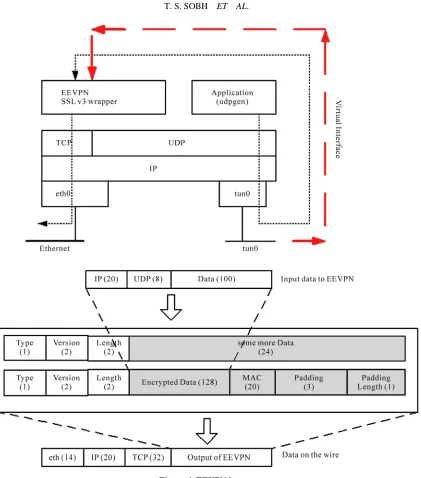
EEVPN is very easy to configure and install. It is ba-sically a wrapper for sending packets over an SSL (Ver. 3.0) connection. It supports public key encryption using client & server certificates (SSLv3). We have used a bit different approach here (i.e. we haven’t used amvpn- keytool). Figure 4 traces the path taken by a packet as it travels over the SSL3 tunnel created by EEVPN.
Each layer of protocol adds some bytes of overhead. This fact is illustrated in Figure 4. Since EEVPN just acts like a wrapper program to send packets over an SSL
connection, no overhead is introduced by the EEVPN program itself. However the underlying SSL layer does add some headers. Also, we put up small ssl-timeline details about SSL handshake procedure, along with in-troduction to using ssldump, which is very useful to cap-ture SSL sessions.
Figure 4 shows that the EEVPN layer produces two packets, a short packet of 29 bytes is generated with the normal packet of 152 bytes, for an input of length 128 bytes. We have found this behavior even for other wrap-pers like Stunnel. However, at this point, we are not yet sure as to why the shorter packet is generated and what it contains.
EEVPN does not provide mechanism to achieve com-pression (i.e. EEVPN does not support any compression mechanisms). Also no option is provided which can al-low a user to select a cipher suite. The cipher suite IN USE, can be only be found out by taking the SSLdump of the session.
We conducted a series of experiments with random packet sizes and measured the packet length on the wire. The experimental results can be accessed here from the results one can conclude that EEVPN solution adds an average of 155 bytes of overhead to the data.
EEVPN uses the cryptographic functions provided by your SSL implementation plugin. Hence, if someone needs to add his own algorithm, he has to look for plug-in support in the SSL implementation that he is us-ing or built his own code.
T. S. SOBH ET AL. 43
Figure 4. EEVPN layers.
algorithms to be used. However there is always the op-tion of patching the source code itself with new algo-rithms and recompile the code.
The PPP-over-SSL solution for forming VPN is highly scalable. For example if a company has ‘N’ different sites, then it would be necessary to have O(N^2) point-topoint PPP-over-SSH links and each site will have to maintain an entry in the routing table for (N-1) other sites. It is clear a full mesh will be necessary in this case, as the complexity of maintaining any other network infrastruc-ture will be prohibitively high.
Here the proposed EEVPN algorithm is embedded in a war game system [14] as a web based system to be one of the defense lines for securing the war game data over
the public network the Internet as shown in Figure 5. In our example we can now execute a war game as a web based application system in a secured manner be-cause we will be sure from achieving authentication, integrity, and confidentiality.
[We used Microsoft visual basic 6.0 enterprise edition to design and execute the security test program]
It includes identifying the remote IP address and using encryption for data transmitted or decryption for data received.
Figure 5. Hardware implementation of web based war game system.
But if we use the encryption mechanism in VPN (i.e. check for encryption) the data transmitted will not be understudiedable for anyone else the specific recipient how has the specific IP address, and has the decryption capability due to VPN security checks.
When the transmitted data has been received to the destination side that has the capability to decrypt the data and understand it, otherwise it will not be understandable data if not choosing VPN decryption mechanism.
Algorithm for testing security (Encryption & Decryp-tion)
Sub data send Read (data)
If check encryption sending is true then send en-crypt (data)
Else send (data) End Sub
Sub load port
Local port = value Remote port = value End Sub
Sub data arrive
If check decryption receiving is true then receive decrypt (data)
Else receive (data) End Sub
Sub encrypt (string)
Loop i from 1 to length (string) encrypt = encrypt & key(i) End Sub
Sub decrypt (string)
Loop i from 1 to length (string) decrypt = decrypt & key(i) End Sub
4. Experimental Results
Our objective is to measure & compare security level, transmission time for our created VPN with respect to other VPNs, via web based application. Measurements for transmission time with respect to data packet size:
In order to keep everything isolated, we created a new user/group (avpn/zvpn) on client (a) and server (z) using Linux command line, also passwordless login was cre-ated using SSH.
A series of tests [15-18] were run to determine the ef-fects of a VPN connection on wireless network formance. In particular, we were interested in the per-formance “hit” one might take when accessing a VPN via a wireless connection (we tested a wired connection for comparison). All tests were performed using Iperf and CMPmetrics as trusted benchmarks. The First test was done using a PPTP VPN connection. The second test was done using the Cisco IPSec client for Windows 2000. The range of nodes used is between 100 and 1500 nodes.
4.1. Proposed EEVPN and Cisco VPN Results
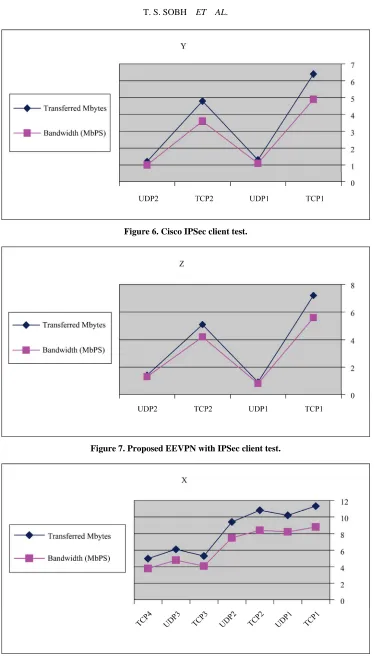
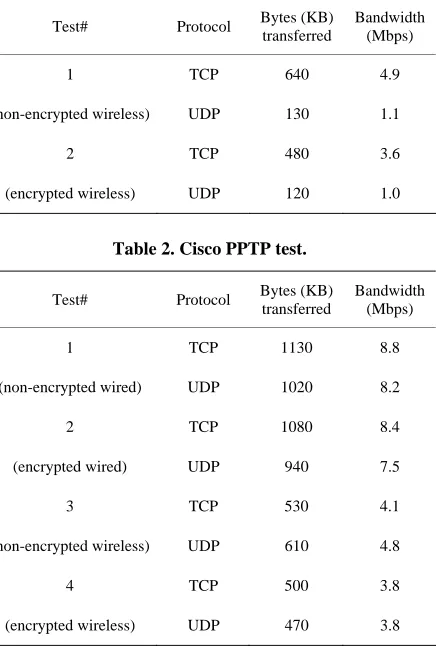
Table 1 is a summary result of IPSec client test in case of using Cisco VPN for both plain and encrypted wire-less traffic. Table 2 is a summary result of PPTP test for plain and encrypted traffic in case of wireless connection and traditional wired traffic.
Table 3 is a summary result of proposed EEVPN with IPSec client test for both plain and encrypted wireless traffic. Table 4 is a summary result of proposed EEVPN with PPTP test for plain and encrypted traffic in case of wireless connection and traditional wired traffic.
T. S. SOBH ET AL. 45
[image:7.595.111.484.82.339.2]Figure 6. Cisco IPSec client test.
Figure 7. Proposed EEVPN with IPSec client test.
[image:7.595.112.484.428.696.2]Figure 9. Proposed EEVPN PPTP test.
Table 1. IPSec client test in case of using Cisco VPN.
Test# Protocol Bytes (KB) transferred
Bandwidth (Mbps)
1 TCP 640 4.9
(non-encrypted wireless) UDP 130 1.1
2 TCP 480 3.6
[image:8.595.306.537.315.421.2](encrypted wireless) UDP 120 1.0
Table 2. Cisco PPTP test.
Test# Protocol Bytes (KB) transferred
Bandwidth (Mbps)
1 TCP 1130 8.8
(non-encrypted wired) UDP 1020 8.2
2 TCP 1080 8.4
(encrypted wired) UDP 940 7.5
3 TCP 530 4.1
(non-encrypted wireless) UDP 610 4.8
4 TCP 500 3.8
(encrypted wireless) UDP 470 3.8
Table 3. Proposed EEVPN with IPSec client test.
Test# Protocol Bytes (KB) transferred
Bandwidth (Mbps)
1 TCP 720 5.6
(non-encrypted wireless) UDP 90 0.8
2 TCP 510 4.2
(encrypted wireless) UDP 140 1.3
Table 4. Proposed EEVPN with PPTP test.
Test# Protocol Bytes (KB) transferred
Bandwidth (Mbps)
1 TCP 1110 9.2
(non-encrypted wired) UDP 1000 8.8
2 TCP 1090 9.1
(encrypted wired) UDP 810 7.4
3 TCP 410 3.0
(non-encrypted wireless) UDP 540 4.2
4 TCP 430 3.9
(encrypted wireless) UDP 360 3.2
4.2. Proposed EEVPN and IBM VPN Results
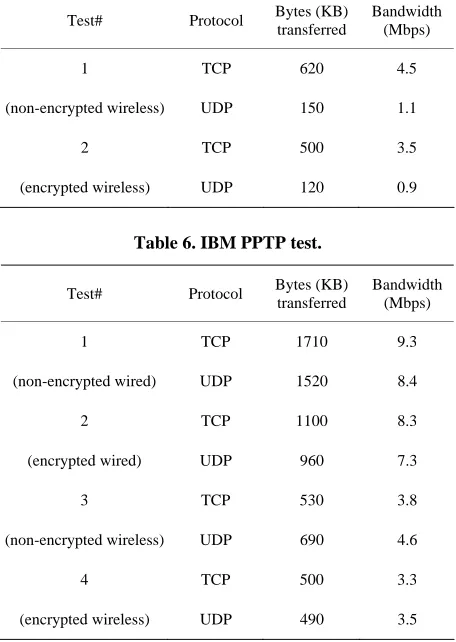
Table 5 is a summary result of IPSec client test in case of using IBM VPN for both plain and encrypted wireless traffic. Table 6 is a summary result of PPTP test for plain and encrypted traffic in case of wireless connection and
traditional wired traffic.
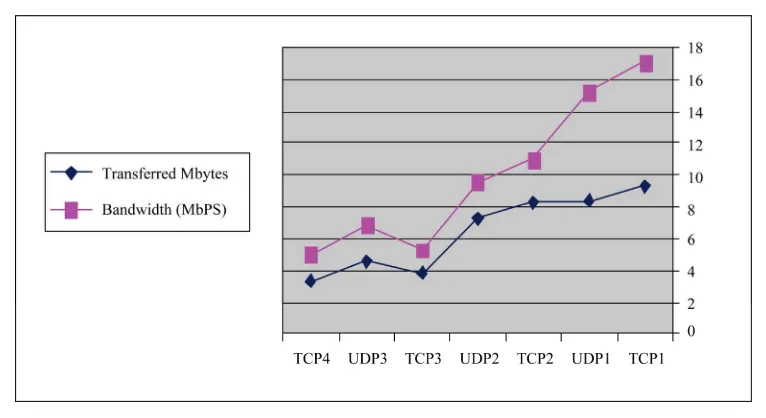
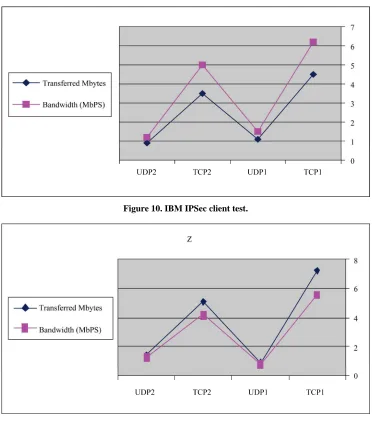
Figures 10-13 show another representation of the ex-perimental output results of the above tables.
[image:8.595.309.537.449.638.2]T. S. SOBH ET AL. 47
[image:9.595.112.485.73.495.2]Figure 10. IBM IPSec client test.
[image:9.595.114.481.498.702.2]Figure 11. Proposed EEVPN with IPSec client test.
Figure 13. Proposed EEVPN PPTP test.
Table 5. IPSec client test in case of using IBM VPN.
Test# Protocol Bytes (KB) transferred
Bandwidth (Mbps)
1 TCP 620 4.5
(non-encrypted wireless) UDP 150 1.1
2 TCP 500 3.5
[image:10.595.58.286.318.639.2](encrypted wireless) UDP 120 0.9
Table 6. IBM PPTP test.
Test# Protocol Bytes (KB) transferred
Bandwidth (Mbps)
1 TCP 1710 9.3
(non-encrypted wired) UDP 1520 8.4
2 TCP 1100 8.3
(encrypted wired) UDP 960 7.3
3 TCP 530 3.8
(non-encrypted wireless) UDP 690 4.6
4 TCP 500 3.3
(encrypted wireless) UDP 490 3.5
we have better bandwidth in CISCO and IBM VPN than EEVPN.
Comparing results ensures that low transmission time is for EEVPN.
We can say that if we will transfer smaller values of bytes, it is better to use EEVPN, like in our
implementa-tion in which we secured a war game, we will deal with smaller values of bytes, keeping high security level which we tested using our program & trying to hack messages during data transmission to ensure data integrity & con-fidentiality.
5. Conclusions
This work customized a standard Virtual Private Net-works (VPN) to a newly one called EEVPN (Effective Extensive VPN). In fact we need to transmit a small data size in our example war game as a web based system in a fastest way without affecting the security level. From the experimental results the proposed EEVPN is faster with losing to the security level.
The proposed EEVPN is more effective because it is faster than other VPNs in sending small data size; where it takes small data transmission time, achieving high lev-el of security. Also, the proposed EEVPN is more exten-sive because it is not built for a specific environment, which makes the customization of the VPN is very diffi-cult, so it can be installed at any environment which is faster and more secured than many other VPNs like CISCO VPN and IBM VPN incase of transmitting small data size (i.e. less than 1 MB).
We plan in the near future to implement some tech-niques in order to enhance quality of streaming over VPN.
6. References
[1] D. L. Clark, “IT Manger’s Guide to Virtual Private Net-works,” McGraw-Hill, New York, 1999.
T. S. SOBH ET AL. 49 Ph.D. Thesis, Military Technical College, Cairo, 2001.
[3] A. Farouk, “Intrusion Detection in a War a Game Web Based Application,” Master of Science Thesis, Ain Shams University, Cairo, 2004.
[4] A. E. Taha, “Secured Access Control in Web Based War Game Application,” Master of Science Thesis, Ain -Shams University, Cairo, Egypt, October 2002.
[5] N. Malheiros, E. Madeira, F. L. Verdi and M. Magal-haesb, “Managing Layer 1 VPN Services,” Optical Switching and Networking, Vol. 5, No. 4, 2008, pp. 196-218. doi:10.1016/j.osn.2008.02.002
[6] P. Juste, D. Wolinsky, P. Boykin, M. Covington and R. Figueiredo, “SocialVPN: Enabling Wide-Area Collabora-tion with Integrated Social and Overlay Networks,”
Computer Networks, Vol. 54, No. 12, August 2010, pp. 1926-1938. doi:10.1016/j.comnet.2009.11.019
[7] A. G. Yay1ml1, “Selective Survivability with Disjoint Nodes and Disjoint Lightpaths for Layer 1 VPN,” Optical Switching and Networking, Vol. 6, No. 1, 2009, pp. 3-9. doi:10.1016/j.osn.2008.05.002
[8] C. Xenakis, C. Ntantogian and I. Stavrakakis, “A Net-workassisted Mobile VPN for Securing Users Data in UMTS,” Computer Communications, Vol. 31, No. 14, 2008, pp. 3315-3327. doi:10.1016/j.comcom.2008.05.018 [9] M. N. Ismail and M. T. Ismail, “Analyzing of Virtual
Private Network over Open Source Application and Hardware Device Performance,” European Journal of Scientific Research, Vol. 28, No. 2, 2009, pp: 215-226. [10] R. Bolla, R. Bruschi, F. Davoli and M. Repetto, “Hybrid
Optimization for QoS Control in IP Virtual Private
Net-works,” Computer Networks, Vol. 52, No. 3, 2008, pp. 563-580. doi:10.1016/j.comnet.2007.10.006
[11] S. Gold, “Pirate Bay Develops Anonymous VPN User Protection,” Infosecurity, Vol. 6, No. 3, 2009, pp. 8. doi:10.1016/S1754-4548(09)70045-2
[12] D. Forte et al., “SSL VPN and Return on Investment: A Possible Combination,” Network Security, Vol. 10, No. 10, 2009, pp. 17-19. doi:10.1016/S1353-4858(09)70112-6 [13] T. Rowan, “VPN Technology: IPSEC vs SSL,” Network
Security, Vol. 2007, No. 12, December 2007, pp. 13-17. doi: 10.1016/S1353-4858(07)70104-6
[14] J. F. Dunnigan, “Wargames Handbook: How to Play and Design Commercial and Professional Wargames,” Writ-er’s Club Press, 2000.
[15] Y. Dakroury, I. A. El-ghafar and A. Taha, “Secured Web-Based War Game Application Using Combined Smart Certificate and Secure Cookies Techniques,” Pro-ceeding of the 1st IEEE International Symposium on Signal Processing and Information Technology, Cairo, December 2001, pp. 447-453.
[16] Downloading rpm’s for VPN, http://sourceforge.net/pro- jects
[17] G. F. Luger, “Artificial Intelligence Structures and Strat-egies for Complex Problem Solving,” 4th Edition, Addi-son Wesley, New York, 2001.
![Figure 1. VPN Implementation [9].](https://thumb-us.123doks.com/thumbv2/123dok_us/9009474.397662/2.595.97.490.394.722/figure-vpn-implementation.webp)