doi:10.4236/ica.2010.12007 Published Online November 2010 (http://www.SciRP.org/journal/ica)
Structures, Fields and Methods of Identification of
Nonlinear Static Systems in the Conditions of Uncertainty
Nikolay N. Karabutov
Moscow State Institute of Radio Engineering, Electronics and Automation, Russia E-mail: kn22@yandex.ru
Received March 8, 2010; revised September 2, 2010; accepted September 13, 2010
Abstract
The field of structures on set of secants is offered and methods of its construction for various classes of one-valued nonlinearities of static systems are considered. The analysis of structural properties of system is fulfilled on specially generated set of data. Representation on which modification it is possible to judge to nonlinear structure of static systems is introduced. It is shown, that structures of nonlinear static systems have a special V-point. The adaptive algorithm of an estimation of structure of nonlinearity on a class poly-nomial function is offered.
Keywords:Structure, Identification, Algorithm, Field of Structures, Nonlinear System
1. Introduction
Statistical methods are applied to a solution of a problem of structural identification basically, based on correlative and an analysis of variance [1,2]. Various approaches and methods are applied to identification of nonlinear systems. In [1-3] the statistical methods based on the correlation and dispersive analysis are used. In identifi-cation systems genetic algorithms [4-6] are widely ap-plied. For synthesis of models neural networks [7-11] and their combination with various methods of approxi-mation [12,13] also are used. Genetic and neural network algorithms allow to find structure of model of nonlinear systems on the set of approximating functions. In a number of works the aprioristic information [14-16] and the subsequent approximation on the set class of tions [17-19] is used. Thus the choice of a class of func-tions is not always proved. The carried out analysis shows, that despite set of the publications, any formal-ized procedures of an estimation of structure it was of-fered not as the considered subject domain is very diffi-cult for describing in existing language of mathematical concepts, objects and decision-making. The problem of structural identification even more becomes complicated for static systems as for them it is complicated to open the existing correlations, expressing through the inte-grated indicator - a system exit. Here a priori data can render the big help. In the conditions of a priori uncer-tainty informational synthesis of system can give the
additional information only.
Attempt to estimate area to which should belong re-quired nonlinear structure is natural. For nonlinear dy-namic systems the concept of a sector condition [20], to which should belong investigated nonlinearity has been introduced. This condition is applied only at a stage of synthesis of dynamic systems. In identification systems to formalize such condition till now it was not possible. For the first time such attempt has been undertaken in [21,22] for dynamic systems where on the basis of analysis of results of measurements the set which con-tains the information on nonlinearity has been generated, and also the method of structural identification is offered. Properties of nonlinear dynamic systems can be esti-mated on a phase or observable informational portrait (OIP). For static systems of such universal graphic rep-resentation does not exist. The problem even more be-comes complicated that in the majority of the real sys-tems described by static models, the informational set generated on the basis of results of measurements, has irregular character.
2. Field of Structures on Class
F
mThe plant is considered
,
T
n n n
y A U f U n (1)
, ,
, ,
, | : ,
, ,
, 1 ,
i n i n N
p m
m n ij i n j n
i j
u R u U f R J R
f U n f U u u
i j m p k
F ,
where k n
U R , ynR is an input and a output, k
A
A R is a vector of parameters, belong limited, but a priori unknown area A, ij is some numbers,
N
n J is discrete time, nR is a disturbance on an
output.
For (1) the informational set is known
IoIo y U, y Un, n, n J N 0,N
and mapping o:U y n JN corresponding to it.
Mapping o describes an observable informational
portrait. Restriction OIP i i
u
o o u U
i 1,k is de-fined and for everyone ui
o
secant
0, 1, ,
( , )y ui a i a ui i n
, where a0,i, a1,i is some real
numbers is constructed.
Secants ( ,y u ul j) for u ul jFm are constructed.
Let introduce the set of secants
U y,
y u, i
,
y u u, ,l j
,i i k l j, , ,
1
set on Io.
Definition 1. A field of structures SS of system (1) on class Fm we will name a collection of mappings
( , )y ui ui y i 1, ,k
( ,y u ul j)u ul jy
( , ) 1l j
on Euclidean plane
,
1, ,
,
, , ,
1
S m y ui i k y u ul j l j l j S F .
It is necessary on the basis of analysis o, Io to
construct a field of structures SS for system (1) on set ( , )U y
.
As mapping o at k2 does not give in to
obvi-ous interpretation, that, we will be limited to its restric-tions i
i
u
o o u U
i 1,k constructed on plane ( , )u yi . As a result we will receive some final set of
mappings ui
o
, u ul j
o
, which represents a field of struc-tures SS of system (1) on plane .
As secants with various ranges of definition the area of definition of field S FS( )m on plane will be equal
dom( )i
i u
are considered, and area of values S FS( )m
will coincide with a area of values of mapping o
rng SS rng o rng y .
Let construct mappings ui
o
, u ul j
o
on plane . We
will add to them elements of set ( , )U y . Further we will be limited only to the analysis of properties ( , )y ui ,
( ,y u ul j)
.
The field of structures allows to simplify the analysis of structure of system (1) and to estimate as degree of linearity (nonlinearity) of system through available set of secants, and influence of elements of vector URk on
shaping of a nonlinear part of system f U n( , ). Corre-sponding results are more low give. The problem of lo-calization of function f U n( , ) on the basis of available set of experimental data Io is not less important. In
conditions uncertainty the solution of the given problem is connected with overcoming of some problems. In work it is shown, that one of the approaches, allowing to localize required area, it is based on sector construction on set of secants. The quantity indicator (coherence coef-ficient), allowing on the basis of properties of secants to decision making about belong of nonlinearity to sector is introduced.
Theorem 1 [21]. The system (1) with nonlinearity
( , ) m
f U n F has a linear field of structures S FS( )m .
Let consider sector Sij S FS( )m limited to secants ( , )y ui
, ( , ) y uj . These secants have angular
coeffi-cients a1,i,a1,j. We consider, that a1,ia1,j. If it will
appear, that in this sector almost secant ( , , ) y u ul j
probably lays, i.e. Its angular coefficients belongs to in-terval (a1,i,a1,j) component u ui jF can be included
in structure of model for system (1). The substantiation of this statement will be more low given. The analysis of all candidates a priori entering into function f U n( , ) in (1) similarly realize.
With each element q ( , )U y , q1, # ( , )U y ,
where # ( , )U y is a cardinal number ( , )U y , we will associate local structures of static system. We will des-ignate through rqy coefficient of mutual correlation
between q and y.
Definition 2. We will say, that variable u ul j is
co-herent with y or has relationship with y, if secant ( , , )y u ul j Sij S( )m
S F almost sure. In this case sec-tor Sij we will name area of a coherence of variable
l j
u u .
For an estimation of closeness of relation u ul j with y we will introduce coherence coefficient
i j
ij u y u y
Q r r . (2) Let notice, that Qij 1 and, basically, should be close to ru u yi j . If the given condition is not fulfilled, it
speaks about incoherence to considered component
i j
u u .
Theorem 2 [21]. If the coefficient of coherence Qij
is equal Qij ij, where ij min(ru yi ,ru yj ), and i j
ij ru u y
secant ij ( ,y u ui j) belongs to sector Sij.
61 nonlinearities Fd
, ,
, , |
: ,
,
,
, 1 ,
j l
k
i i
N p m
d
d d
n lj l n j n
l j
u R u U U R
f R J R
f U n
f U u u
l j m p k
F ,
where dj, dl its are some numbers.
So, the method of secants allows to carry out the analysis of structural properties of static system on the basis of construction of a field of structures. The basic virtue of the given approach is the possibility of repre-sentation of structure of system on set of linear functions (secants). Analysis SS allows to select those elements from class Fm, for which
min ru yi ,ru yj Qij
&
u ui jSij
.The field of structures can be constructed for a wide class of static systems. On the basis of S FS( )m it is
pos-sible to make an inference about structure of static sys-tem in the conditions of uncertainty and by that essen-tially to narrow a class of research models.
The field of structures can be under construction on set
Ie [21-23], i.e. the set, the received ambassador of
elimination linear making of yn. It is easy to prove
cor-respondence of fields of structures on sets Io and Ie
only for those f U n( , )Fm for which for factor of
co-herence Qij the Theorem 2 is fulfilled.
The example of construction of a field of structures is reduced in [22,23].
3. Field of Structures on Class
F
sLet's spread the approach offered above to a class of nonlinearities
, , , | : ,
, , , .
k
i i N
d
i i i i
f U n u R u U U R f R J R
f u d u d
s
s
F
Let show, how for class Fs to receive coherence area, i.e. sector to which belong nonlinearity ( , ) ,i
d i n
f U n u ,
i
d . The further account is based on a straightening method [21,22]. The field of secants is under construc-tion on set {ke u n, ,i , en}, where enIe is an error of forecasting of an output signal of system yn by means
of model yˆnasˆ n, where T
n n
s I U , IRk is an
unit vector, ke,ui is coefficient structural properties [21]
, ,i , , ,
e u n s i n i n
k k e u n e u .
Let consider restriction e {ke u n, ,i } { } en and its contractions ke ui,
e
i 1,k. For everyone ke ui, e
we
will construct a secant
, ,i
,0 ,1 ,ii i
e u i e e e u
e k a a k
. Secants ( ,e ke u d, j, j) for mapping ke u d,j,j
e
dj
j s
u
F (j1) are set
e k, e u d, ,i i
i d, i ae,0,di ae d,1, ike u d, ,i i , (3)
where ae,0,di,ae d,1,i is some numbers,
, , , , , , , ,
j j j
d
e u d n s j j n j n j
k k e u d n e u d . (4)
Let’s introduce set of secants
K e,
K ee, ,
Ke d, ,e
en Ie ,
where (K ee, ) { ( , e ke u,i),i1, }k ,
1
, ,
[ , , k]T
e e u e u
K k k , ke u d, ,i iKe d, , ,
q e d
K R , q k ,
, , ,
(Ke d, ) { ( ,e e ke u dj j), j 1 }
.
Statement 1. Any secant ( ,e ke u,i) (K ee, ) at
j i limits element ( ,e ke u d, j, j) (Ke d, , )e from
below.
Upper bound of sector Sdi to which should belong
secant ( ,e ke u d, ,i i), on the basis of set (K ee, ) to define it is not possible. Therefore to the received field of structures we will add secant ( ,e ke s d, ,i i) , where
i
s R, T( / )
i i
s I U u . As ke s, represents a
transmis-sion coefficient between snR and en, and local
co-efficient structural properties ke u,i are stationary the same property will possess and ke s,i. Hence, the coeffi-cient of determination ( ,e ke s d, ,i i) will be not less
2 ui
k e
r
and 2, , e u di i
k e
r at least for 0di1. Thus, ( ,e ke s d, ,i i) it is possible to use as an upper bound of area of coherence
i
d
S . It is fair, as transformation ,i
d i n
u conducts to a modification only the statistical moments of signal uj,
but not its structures. In the supposition, that 0di1,
we receive reduction of the two first statistical moments that leads to a raise of factor of determination
, ,
( ,e ke s di i)
.
The field of structures for system (1) on class Fs
looks like
, ,
, , ,i i
S s K e e ke s d
S F ,
where di(0; 1), 1 i k.
In structure of model of system (1) we will include those functions di
i s
u F for which condition 2 2, , i e u di i
k e k e
r r is
satisfied. The evaluation of coefficient of a coherence (2) in this case leads to an inadequate estimation of connec-tion between e and di
i
u .
Let’s reduce algorithm of decision-making relative to structure of model of system (1) on class Fs.
1) We build secants ( ,e ke u,i) on plane (ke u,i, )e for
,
e ui
k e
.
2) We define coefficient of determination 2, e ui
k e
,
( ,e ke ui)
.
3) If 2, e ui
k e r
r , where r 0 is some set quantity
the system is linear on variable uiU.
4) If condition 2, e ui
k e r
r is not fulfilled, is find , ,
( ,e ke s di i)
and defined 2, , e u di i
k e
r . At 2, , e u di i
k e r
r ele-ment ,i
d
i n s
u F is included in model structure. Remark. Condition 2,
e ui
k e r
r is an indication of linearity of system on variable uiU.
e
for class Fs it is possible to present mapping
also in space (Ke,|en|). Thus result of synthesis will
not.
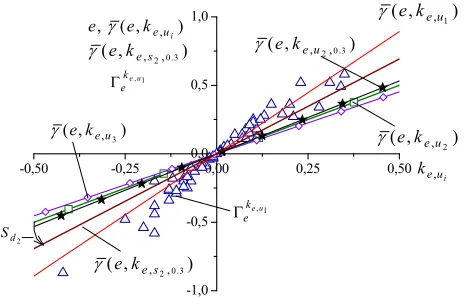
On Figure 1 the field of structures S FS( )s for plant
(1) with vector A[0.8 1.4 2]T, function
0,3 2,
( , ) 0,5 n
f U n u and limited noise n is reduced ary.
For secants e following values of coefficients of
de-termination are received:
, 1
2 0.97 e u
k e
r ,
, 2
2 0.91 e u
k e
r ,
, 3
2 0.98 e u
k e
r . r0.94. Comparison of received values
2
r with r has allowed to exclude Fs elements 11, d
u 3
3 d
u from set. For 2
2 d
u on the basis of a straightening method value d20.3, and , ,0,31
2 0.99
e u
k e
r is received. On Figure 1 the area of coherence Sd2 for variable
2
2 d
u is shown.
So, the method of construction of a field of structures
S
S on sets Fm and Fs for nonlinear system (1) is
of-fered. It is based on the analysis of an informational por-trait of system and in many respects depends on an kind of class Fm. Very often (class Fs) portrait e is under
construction in the space received by transformation of initial variables of system of identification. It speaks, in particular, complexity of a problem of structural identi-fication for which solution nontrivial approaches and methods should be attracted. In particular, on class Fs
for decision-making on structure of model of system (1) field of structures S FS( )s is under construction on set
of coefficients structural properties systems as it is a measure of linearity of system and allows to establish degree of a deviation from this indicator of performances of system.
4. Field of Structures on Class
F
fLet consider plant (1) with nonlinearity
, ,
, , | : ,
, , 1 ,
f i i N
i n i n
f U n u R u U f R J R
f u c u i
F (5)where c is some numbers.
Let on the basis of Io set Ie { , ,U e n Jn n N},
where en yˆnyn, yˆnasˆ n is generated.
It is necessary for class Ff on the basis of handling
of set Ie to construct a field of structures for system (1).
For a problem solution we will take advantage of the approach stated in Section 2. We take variable ui for
-0,50 -0,25 0,00 0,25 0,50
-1,0 -0,5 0,0 0,5 1,0 1 ,u e k e 2 d S ) , (e ke,s2,0.3
1 ,u e k e ) , (e ke,u2,0.3
) , (e ke,s2,0.3
) , (eke,u3
) , ( , e ke,ui e i u e k , ) , (e ke,u2
[image:4.595.309.541.80.229.2] ) , ( 1 ,u e k e
Figure 1. A field of structures of system (1) with ( , ) s
f U n F ary.
which condition ru ei e, where e0 is some set
magnitude is satisfied. We will construct for ui
map-ping e {ke u n, ,i } { } en and a secant
, ,i
,0 ,1 ,ii i
e u i e e e u
e k a a k
. Let consider function ui and for everyone
[1; ] J
we will define coefficient structural properties ke u, ,i, where J is some segment of the real numbers which choice will be given more low.
For everyone J we will construct secant , ,
( ,e ke ui)
(3) for mapping ke ui, ,
e
. we will change until for coefficient of determination of secant
, ,
( ,e ke ui)
the condition will be satisfied
, ,
2 e ui
k e e
r , (6)
where e e( ) 0e .
Let introduce set of secants
, , , , , , 2 , , such, that i i e uie u e u
k e e
k e e k J
r
.
Upper bound of interval J is defined from a condition of violation (6).
Definition 3. We will name set (ke u, ,i, )e a field of structures S FS( , (f ke u, ,i, ))e of the system (1), cover-ing nonlinearity f U n( , ) on class Ff.
The field of structures for system (1) on class Ff
looks like
, , ,i ,
, ,i , ,
, 1
S f ke u e ke u e J i
S F .
Let consider secant ( ,e ke u, ,i) with indicator
and sector S ( ( , e ke u, ,1i ), ( , e ke u, ,i)). We will define coefficient of coherence Q on class Ff
, , , ,1
e ui e ui
k e k e
Q r r .
63
S.
Let consider a choice of magnitude e in (6), and,
therefore, and . For everyone ui n, we will calculate
coefficient of correlation i
u e
r . We will define parameter
J
from a condition of violation of an inequality
max
i e
u e
r
. (7)
On the basis of we will set magnitude e in (6)
and we will find Q.
Theorem 3. Let for system (1) the field of structures
( )
S f
S F is constructed. If condition rf u e( ),i Q
nonlinearity f u( i n, )Ff is coherent with signal yn is
satisfied and it can be included in model structure. On set {ui n, } the field of structures be of the form
, ,
,
S f e ui e ui
S F .
Unlike classes F F, s, field S FS( )f allows to estimate
structure of nonlinearity f U n( , ) on final set of ap-proximating functions ui with index J. In some
cases by an amount of members of an approximating polynomial it is possible to set structure of function
( , )
f U n .
The example of a field of structures S FS( , (f ke u, ,i, ))e for system (1) with nonlinearity f u( ) sin( )1 u1 and a
[image:5.595.303.540.373.668.2] [image:5.595.63.284.528.686.2]vector of parameters A[1.3 1.6 1.7]T is shown on Figure 2.
In Figure 2 following symbols are used: a straight line with a rhomb is a secant with 1; a straight line with quadrate is a secant with 2; a straight line with a triangle is a secant with 2.5; a straight line with a circle is a secant with 3. Here the example of modi-fication en for case 1 is shown. Maximum value
in (7) is reached at 2.5. For this value e 0.81. 0.81
Q . rsin( ),u ei 0.83 and, therefore, f u( 1,n) is coherent with yn. Let’s notice, that at (0; 2)
-0,4 -0,2 0,0 0,2 0,4 0,6
-1,0 -0,5 0,0 0,5
1,0
S
n e
n e
, ,ui
e
k
) ,
( , ,
e keui
Figure 2. A field of structures of system (1) on class Ff
with nonlinearity f u( 1)sin(u1).
1 1
( ) cos( )
f u u , and at (1; 3) f u( ) sin( )1 u1 , and adequacy of model with f u( )1 fc cos( )u1 on set Ie
above, than with f u( )1 fs sin( )u1 . For
deci-sion-making concerning structure f u( )1 in the field , ,
( , ( i , ))
S f ke u e
S F we fulfil check of candidates fc, fs
on set Io. Results of an estimation of adequacy speak
about necessity for model to use element fsFf.
Remark. If to build a field of structures S FS( )f on
set Io owing to low coefficients of correlation for
deci-sion-making it is necessary to pass in space of coeffi-cients structural properties. Here it is completely appli-cable the approach stated above.
The offered approach allows to estimate nonlinearity structure through variable en. It is connected with that,
the problem of estimation ( , )f U n Ff on set Ie
de-mands performance double approximation, that in a con-sidered case is not realized. Further the method of identi-fication of function ( , )f U n Ff on a basis on the
adaptive approach is offered.
5. Adaptive Procedure of an Estimation of
Function
f U n
,
on Class
F
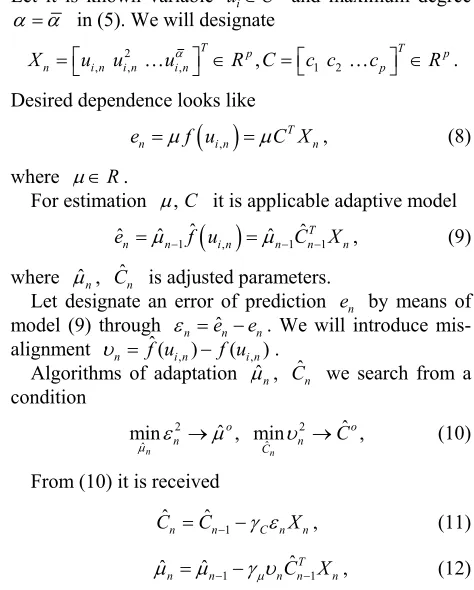
fLet it is known variable uiU and maximum degree
in (5). We will designate
2
, , , , 1 2
T p T p
n i n i n i n p
X u u u R Cc c c R .
Desired dependence looks like
, Tn i n n
e f u C X , (8) where R.
For estimation ,C it is applicable adaptive model
1ˆ , 1ˆ 1
ˆ ˆ ˆ T
n n i n n n n
e f u C X , (9) where ˆn, Cˆn is adjusted parameters.
Let designate an error of prediction en by means of
model (9) through n eˆnen. We will introduce mis-alignment n f uˆ ( )i n, f u( i n, ).
Algorithms of adaptation ˆn, Cˆn we search from a
condition
2 2
ˆ ˆ
ˆ ˆ
min , min ,
n n
o o
n n
C C
(10)
From (10) it is received
1
ˆ ˆ
n n C n n
C C X , (11)
1 ˆ 1
ˆ ˆ T
n n nC Xn n
, (12) where C 0, 0 is the parameters ensuring
con-vergence of algorithms.
As function f u( i n, ) is unknown, we will use
Let note the Equations (11), (12) are rather misalignment model parameters
1
n n C n n
C C X
, (13)
1 ˆ 1
T
n n nC Xn n
, (14)
where Cn CˆnCn, nˆnn.
Theorem 4. Let | | , ||Xn|| , and also ex-ists such 0 1
, that 2
n n n
. Then algo-rithms (13), (14) converge, if
2
2
0 C ,
n X
(15)
0 2 1 , (16) where |C XˆnT1 n| n 0, || || is Euclidean norm.
If en contains uncertainty n limited on level |n| Algorithms (13), (14) will converge if it is
fulfilled (15) and
1
max n n
,
2 1
0
,
where 1.
Theorem 5. Algorithms (13), (14) do not possess an asymptotic stability.
So, Algorithms (13), (14) do not allow to receive as-ymptotically an estimation of parameters of system (8). Here uncertainty in which algorithms are applied affects.
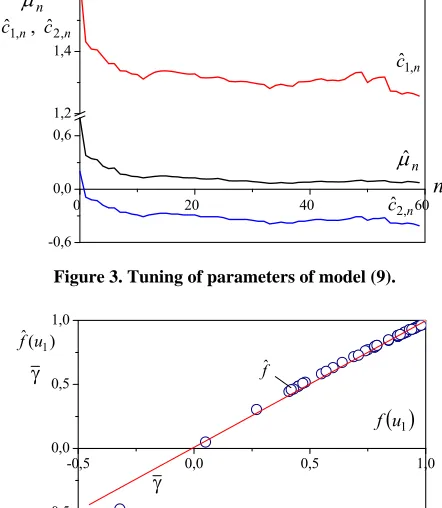
The example of work of adaptive system of identifica-tion of nonlinear system (1) with f u( ) sin( )1 u1 and
[1.3 1.6 1.7]T
A is shown on Figures 3, 4. Vector
2 , ,
[ ]T
n i n i n
X u u . The Figure 3 reflects process of tuning of parameters of model (9). On Figure 4 the informa-tional portrait reflecting results of adequacy of an esti-mation of function f u( )1 is shown. The determination
coefficient was equaled 0.99, that follows from position of secant ( , )f fˆ . The expectation and average quad-ratic deviation for f u( )1 and f uˆ ( )1 are accordingly equal:
1 0.78f u , f uˆ
1 0.767,
f u
1
0.26,
f uˆ 1
0.28
So, the mode of construction of a field of structures for nonlinear static system (1) on the basis of the analysis of set Ie is offered. The sector condition is introduced and
the mode of its construction for various classes of nonlinearities is offered. The analysis of structural prop-erties is fulfilled in space of secants of an observable informational portrait of system or its virtual analogues.
0 20 40 60
-0,6 0,0 0,6 1,2 1,4 1,6
n ˆ
n ˆ n
n c
cˆ1, , ˆ2,
n
cˆ2,
n
cˆ1,
[image:6.595.309.532.81.215.2]n
Figure 3. Tuning of parameters of model (9).
-0,5 0,0 0,5 1,0
-1,0 -0,5 0,0 0,5 1,0
fˆ
u1f
) ( ˆ
1
u f
Figure 4. An estimation of adequacy of model (9) on plane ˆ
( , )f f .
Algorithms and methods of identification of nonlinear component system are developed for various classes of nonlinearities.
6. Structures of Nonlinear Static Systems
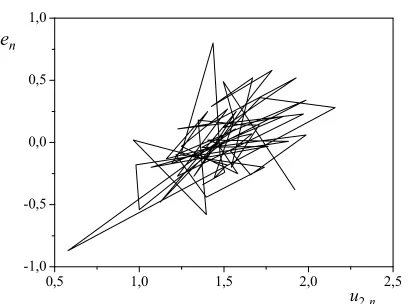
The approaches stated above allow to make for a various class of nonlinearities a solution on structure of model of system. Field SS gives conception about system struc-ture on a vector space of secants. Naturally there is a problem on search of mapping for nonlinear static sys-tem which would allow to make imprisonment before trail about its nonlinear properties. Complexities of in-troduction such mapping were considered above. Despite it, the informational structures, allowing to receive con-ception about nonlinearity of static system are more low offered.Let consider informational set
IeIe e U, e Un, n, n J N 0,N . Appropriate Ie informational portrait e:{ } { }Un en
[image:6.595.311.532.90.344.2]65 Figure 5 on which the informational portrait for the plant
considered in Section 3 is shown. Let consider set
IkIk e k, e kn, n, n J N 0,N ,
where knR is factor structural properties systems (1) on class Fr (r m s f , , ) for ui n, Un.
Let order values kn on increase on set JN, that is we will construct a variation number series. As a result we will receive set { }kqv , where v [0, ]
N
q J N . To everyone v
q
k there corresponds value v q
e . Hence
Ivk Ivk , v, v, v 0,
q q N
e k e k q J N
.
On Ivk we will construct mapping v:{ } { }v v
e kq eq
to which on Euclidean plane ( , )v v
q q
k e there corresponds some structure Svk e, . We assume, that function v
q
e is
simple, univalent and intersects axis v q
k in some point, that is Sk ev, has a singular point.
n
e represents an error of prediction of an exit of system (1) on the basis of lin-ear static model with input T
n n
s I U . v
q
k also is func-tion en. Therefore mapping
v e
will represent some function, tending growth. It is fair for any class Fr. It is
known [21], that for linear static systems the coefficient structural properties is an estimation of parameter of model for ui n, Un. For nonlinear systems it represents
the function varying in some limited range. Starting with Ivk it is concluded, that process of modification v
q
k at
magnification q has monotone character. The same character will be carried also by function v
q
e but as v q e
depends from f U n( , ) and n its modification will
differ from the linear. For an estimation of degree of nonlinearity we will construct secant ( , )v v
q q
e k
. Hence, unlike e mapping
v e
is structurally informative. So, fairly
Statement 2. For system (1) with f U n( , )Fr (r m s f , , ) on set Ikv there is mapping
:{ } { }
v v v
e kq eq
to which on Euclidean plane ( , )v v
q q
k e
there corresponds the informational structure Svk e, , al-lowing to analyze nonlinear properties of system.
Unlike Ie on set Ik
v structure ,
k e
v
S has more or-dered character. It is necessary to notice, that Sk ev, it is
applicable also for mapping of linear static systems. For
( , ) r
f U n
F (r m s f , , ) structure Sk ev, contains a
singular point, who unlike dynamic systems is not char-acteristic performance of a stability of system (1). She serves as confirmation of a monotonicity of the curve described by mapping v
e
. If to take advantage Lyapunov’s of characteristic indexes they, as one would expect, state the estimation of index close to zero.
Let state a method, allowing to define type of a singu-lar point for the given class of systems. We will intro-duce functions
0,5 1,0 1,5 2,0 2,5
-1,0 -0,5 0,0 0,5 1,0
n
e
n
u2,
Figure 5. Projection of informational portrait e to plane
2
(u e, ).
, ln v , , ln v
k q kq e q eq
(24)
Let find such value v N
q J , for which
,
minq k n qo, minq e n, qo.
Knowing qo, from (24) we define values v, q o
k , v,
q o
e ,
and, therefore, and singular point ( v, , v, ) q o q o
M k e . We name ( v, , v, )
q o q o
M k e V-point. This title follows from the following. Let's construct on plane (k q, ,e q, ) a portrait of system (1) to which there corresponds structure SLvk e, .
As show simulation data, for system (1) with
( , ) r
f U n F it will look like, shown on Figure 6.
On Figure 6 the structure of nonlinear system (1) in spaces (Yk q, ,Ye q, ) , (Kk q, ,Ee q, ) is presented. From Figure 6 we see, that (Yk q, ,Ye q, )structure k e,
v
SL con-tains V-point in space. In her the rate of motion of points of a trajectory with magnification q comes nearer to zero, reaching the minimum value at q q o. Then
o q q
the rate of motion of a point again increases. Such behaviour of a trajectory speaks properties of the logarithm. So, fairly
Statement 3. In space (Yk q, ,Ye q, ) structure k e,
v
SL
of system (1) has a special V-point. Structure Sk ev, in space
, ,
(Kk q,Ee q) allows to esti-mate nonlinear properties of system. From Figure 6 it is see, that Svk e, has nonlinear character and reflects a state
system (1) with f( ) Fs, 0,3 2,
( ) 0.5 n
f u . Representa-tion Svk e, is more informative, than a portrait on
Figure 5. For decision-making on that, how much the change of trajectory Sk ev, differs from linear, it is possible to take
advantage of methods of secants or straightening.
Representation Sk ev, for some class of nonlinearities
allows to make a solution on structure function f . Theorem 6. Let the coefficient structural properties kqv
is defined on segment v [ ,v v] q
k q
J k k , where v q
k ,
v q
k , v
N
-7 -6 -5 -4 -3 -2 -1 0 -6
-4 -2
0-1,5 -1,0 -0,5 0,0 0,5
-1,5 -1,0 -0,5 0,0 0,5 1,0 1,5
q e,
q e,
eqv
q e,
v
SLk,e
v
Sk,e
v q e v
q k
V-point
[image:8.595.62.280.85.261.2]q
Figure 6. Informational structures ,
v SLk e ,
v
Sk e of system
(1).
that
| 1
v v
q q
k k O ,
where O(1) is some neighborhood 1 f u d( , )i * defines
structure of nonlinearity of system (1) on class Fs. Remark. The Theorem 6 gives the new formulation of a method of the straightening stated in Section 3. In her the criterion of linearity directly is used.
The Theorem 6 is applicable only to so-called control-lable models [21].
Let consider structure Sk ev, of system (1) on class
f
F . In this case the theorem 6 is not applicable, so function
( , )
f U n explicitly does not contain the controllable
pa-rameter. For a choice of an amount of members in an approximating Polynomial (5) it is possible to take ad-vantage of the approach stated in Section 4. As informa-tional set it is necessary to use { , , ,i , }
v v
e u q q
k e , v
N
q J .
Let consider nonlinearity f u u( , )i j Fm, ( , )u ui j U.
Let generate sets I ( ,k ,i), I ( ,k , j), I ( ,k ,i j)
v v v
e u e u e u u
e k e k e k to
which there correspond structures k e, (I )vi
i v u
S S
, (I ), , (I )
k e j k e i j
v v
j v u ij v u u
S S S S . For each structure secant
is received (i j ij, , ), ( , , )
v v
e u
e k
. it is
characterized by parameters a0,i,a1,i.
Theorem 7. Let on Euclidean plane ( , ,i , )
v v
e u q q
k e
structures S S Si, ,j ij, sector S ( , )S Si j to which
be-long secants , i j , and a1,ia1,j are constructed.
Then Sij S, if for almost
v N
q J
, ,
, ,
, ,
v v v
i eq i ao i eq ij ao ij j eq j ao j
,
where
,
, ,
min min
max max
v
q q i
q q
i v
q q i q j
g g
e u
e u u
,
,
, ,
max max
min min
v
q q i
q q
j v
q q i q j
g g
e u
e u u
.
For Sk ev, it is possible to construct sector, using the
ideas explained in Section 2. For the nonlinearities be-longing to class Fm, it is easy to estimate influence which on her render the elements of vector Un setting structure of function f U n( , )Fm. For this purpose it is possible to take advantage of the approach offered in [21].
7. Conclusion
The concept of a field of structures for nonlinear static systems on set of secants is introduced. The mode of construction of a sector condition for a nonlinear part of system is offered. Algorithms and methods of deci-sion-making in the form of nonlinearity are described. For the nonlinearity described by a class polynomial of functions, the adaptive approach for an estimation of her structure in the conditions of uncertainty is offered. The structure on which it is possible to make a solution on nonlinearity of system is introduced.
8. References
[1] N. S. Rajbman and V. M. Chadeev, “Building of models of processes of manufacture,” Energy, Moscow, 1975. [2] L. Ljung, “System Identification: Theory for User,”
Pren-tice-Hall, Englewood Cliffs, New Jersey, 1987.
[3] Е. К. Berndt, В. Н. Hall, R. E. Hall, and J. A. Hausman, “Estimation and Inference in Nonlinear Structural Mod-els,” Annals of Economic and Social Measurement, Vol. 3, No. 4, 1974, pp. 653-665.
[4] J. Madár, J. Abonyi and F. Szeifert, “Genetic Program-ming for the Identification of Nonlinear Input−Output Models,” Industrial & Engineering Chemistry Research,
Vol. 44, No. 9, 2005, pp. 3178-3186.
[5] B. McKay, M. Willis, D. Searson, and G.Montague, “Non-Linear Continuum Regression Using Genetic Pro-gramming,” 2005. http://www.staff.ncl.ac.uk/d.p.searson/ docs/NLCR_GP3.pdf
[6] L. Ljung, “System Identification: Nonlinear Models,” Berkeley, 2005.
[7] G. R. Liu, “Nonlinear identification and control. A Neu-ral Network Approach,” Springer-Verlag, London, 2001. [8] M. Norgaard, O. Ravn, N. K. Poulsen and L. K. Hansen,
“Neural Networks for Modelling and Control of Dynamic Systems: A Practitioner’s Handbook,” Springer-Verlag, London, 2001.
67 [10] G. Dreyfus, “Neural Networks: Methodology and
Appli-cations,” Springer-Verlag, Berlin, Heidelberg, 2005. [11] N. Sundararajan, P. Saratchandran and Y. W. Lu, “Radial
Basis Function Neural Networks with Sequential Learn-ing: MRAN and its Applications,” World Scientific Pub-lishing Co, Singapore, 1999.
[12] E. Righeto, L. H. M. Grassi and J. A. Pereira, “Nonlinear Plant Identification by Wavelets,” ABCM Symposium Se-ries in Mechatronics, Vol. 1, 2004, pp. 392-398.
[13] T. Sato, and M. Sato, “Structural Identification Using Neural Network and Kalman Filter Algorithms,” Struc-tural Engineer/Earthquake Engineer, JSCE, Vol. 14, No. 1, 1997, pp. 23s -32s.
[14] S. F. Masri, J. P. Caffrey, T. K. Caughey, A. W Smyth and A. G. Chassiakos, “Direct Identification of the State Equation in Complex Nonlinear Systems,” ICTAM04- Complex Nonlinear Systems, 2003, pp. 1-2.
[15] L.A. Aguirre, M. F. S. Barroso, R. R. Saldanha and E. M. A. M. Mendes, “Imposing Steady-State Performance on Identified Nonlinear Polynomial Models by Means of Constrained Parameter Estimation,” IЕЕE Proceedings of Control Theory and Applications, Vol. 151, No. 2, 2004, pp. 174-179.
[16] V. M. Chadeev and V. B. Ilyushin, “Identification Tech-nique Concerning a Priori Information on Plant Parame-ters,” Proceedings of the V International Conference
“System Identification and Control Problems” SICPRO’06,
Institute of Control Sciences, Moscow,30 January-2 Fe-bruary 2006, pp. 1091-1105.
[17] S. M. Spottswood, “Identification of Nonlinear Parame-ters from Experimental Data for Reduced Order Models,” University of Cincinnati, Cincinnati, 2006.
[18] M. Espinoza, J.A.K. Suykens and B. De Moor, “Kernel Based Partially Linear Models and Nonlinear Identifica-tion,” IEEE Transactions on Automatic Control, Vol. 50, No. 10, 2005, pp. 1602-1606.
[19] D. Graupe, “Identification of Systems,” Robert E. Krieger Publishing Co., Huntington, New York, 1976.
[20] M. A. Ajzerman, “About One Problem, a Concerning Stability ‘in Big’ Dynamic Systems,” Successes of Mathematical Sciences, Vol. 4, 1949, pp. 186-188. [21] N. N. Karabutov, “Structural System Identification:
In-formation Structure Analysis,” URSS/Izd. Dom “Libro-kom”, Moscow, 2009.
[22] N. N. Karabutov, “Selection of the Structure of a Model in Processing the Results of Measurements in Control Systems,” Measurement Techniques, Vol. 51, No. 9, 2008, pp. 960-966.