ISSN Online: 2152-7199 ISSN Print: 2152-7180
DOI: 10.4236/psych.2019.107063 Jun. 21, 2019 958 Psychology
What Are Basic Human Needs? A Challenge to
the Self-Determination Theory in the SST
Context
Larry Sau Kei Leung
Department of Marketing, Monash University, Melbourne, Australia
Abstract
Self-determination theory suggests that autonomy, competence and related-ness are the sole basic human needs that foster volitional forms of motivation. Given that perceived control, ease of use and usefulness have been found to enhance intrinsic motivation in the context of self-service technology (SST), it is argued that these later factors are also basic human needs that nurture volitional forms of motivation. Hence, it is hypothesized that the relationships between perceived control, ease of use and usefulness and the use of SSTs are mediated by self-determined motivation. Results suggest that self-determined motivation mediated the relationships between ease of use, usefulness and the use of SSTs but not the relationship between perceived control and the use of SSTs. Thus, basic human needs are not limited to autonomy, competence and relatedness; perceived ease of use and usefulness may also need to be in-cluded. Theoretical and managerial implications are also discussed.
Keywords
Basic Human Needs, Self-Determined Motivation, SSTs, Ease of Use, Usefulness, Autonomy, Competence, Relatedness
1. Introduction
Technology has radically changed the business landscape in recent years (Gal-laugher, 2010). By using technology, organizations can reduce costs as well as increase access to, and exchange of, information (Parham, Roberts, & Sun, 2001). Amongst different technologies, self-service technologies (SSTs) have at-tracted a great deal of attention from marketing academics and practitioners
(Kelly, Lawlor, & Mulvey, 2010).
How to cite this paper: Leung, L. S. K. (2019). What Are Basic Human Needs? A Challenge to the Self-Determination Theory in the SST Context. Psychology, 10, 958-976. https://doi.org/10.4236/psych.2019.107063
Received: December 23, 2018 Accepted: June 18, 2019 Published: June 21, 2019
Copyright © 2019 by author(s) and Scientific Research Publishing Inc. This work is licensed under the Creative Commons Attribution International License (CC BY 4.0).
DOI: 10.4236/psych.2019.107063 959 Psychology
SSTs are defined as “technological interfaces that enable customers to produce a service independent of direct service employee involvement” (Meuter, Ostrom, Roundtree, & Bitner, 2000: p. 50). Examples of SSTs include automated teller machines (ATMs), pay-at-the-pump machines, automated hotel and grocery store checkouts, telephone banking, airline check-in systems for e-ticket holders, in-store kiosks for product information, web-based purchasing, Internet trans-actions and supermarket self-checkout systems (Yang & Klassen, 2008). As SSTs replace human-to-human contact with human-machine interaction (Parasura-man, 2000), consumers’ perceptions of how services are conceived, developed and delivered have changed (Meuter, Bitner, Ostrom, & Brown, 2005).
SSTs have become important contexts to further understand consumer moti-vation as customer’s willingness to participate in using SSTs determines their successful deployment (Vargo & Lusch, 2004; Mumani, Stone, & Wang, 2018; Taillon & Huhmann, 2019). Self-determination theory (SDT) has been used to understand consumers’ motivations to use SSTs (Leung & Matanda, 2013). It was found that basic human needs, such as autonomy, competence and related-ness, nurture volitional forms of motivation (Leung & Matanda, 2013). To date, limited research has questioned the dimensions of basic human needs. The current study aims to further understand the dimensions of basic human needs and test self-determination theory. Managerial implications are also suggested.
2. Theoretical Background
Self-determination theory (SDT) posits that human’s goals are achieved based on their psychological and cognitive responses to different levels of autonomy. According to SDT, different forms of motivation exist on a continuum (Deci & Ryan, 1991; Ryan & Connell, 1989).
Extrinsic motivation is regulated by different levels of autonomy or in-tra-psychic forces (Deci & Ryan, 2000a, 2012; Ryan & Connell, 1989). Extrinsic motivation comprises two forms of motivation: controlled and autonomous (Deci & Ryan, 1985, 1991). When behavior is not regulated by intrinsic forces (e.g., a sense of volition), motivation can be considered autonomous or self-determined. When behavior is regulated by external forces (e.g., coerced interpersonal forces), motivation can be considered controlled or not self-determined (Deci & Ryan, 2000b, 2012; Gagne & Deci, 2005).
DOI: 10.4236/psych.2019.107063 960 Psychology
Extrinsic and intrinsic motivations are inter-related, as shown in Figure 1 (Deci & Ryan, 2000a, 2012; Gagne & Deci, 2005; Ryan & Connell, 1989). Intrin-sic motivation is behavior initiated for an individual’s own sake (e.g., due to personal interests, for excitement). When extrinsic motivation is relatively au-tonomous, it is similar to intrinsic motivation (Deci & Ryan, 1991). The type of motivation farthest from intrinsic motivation is a motivation, which refers to a lack of motivation.
Human behavior is driven when different forms of motivation are combined, which is referred to as self-determined motivation (Deci & Ryan, 2000a, 2012; Gagne & Deci, 2005). When motivation is self-determined, behavior is interna-lized (Deci & Ryan, 2000b, 2012; Gagne & Deci, 2005).
Empirical evidence suggests that self-determined motivation positively affects human well-being (Deci & Ryan, 2008) and is important to students’ learning, perceived competence, and school performance (Deci, Koestner, & Ryan, 1999; Fortier, Vallerand, & Guay, 1995; Vallerand et al., 1992, 1993). It also affects school principals’ performance (Fernet, 2011), dental clinics’ patient attendance
(Halvari et al., 2010), and the use of information and communication technology (ICT) (Techatassanasoontorn & Tanvisuth, 2008).
SDT suggests that a sense of volition drives human behavior and well-being
(Deci & Ryan, 2000a). Autonomy, competence, and relatedness are basic human needs that foster volitional forms of self-determined motivation, the process of internalization, and engagement in activities (Deci & Ryan, 2000b, 2012). When extrinsic motivation is transformed into intrinsic motivation or the originally regulated motivation is assimilated into a personally endorsed value, it is re-ferred to as the internalization process (Ryan, 1995).
Autonomy is defined as a situation “in which significant others offer choice, provide a meaningful rationale, minimize pressure, and acknowledge the target individual’s feelings and perspectives” (Halvari, Halvari, Bjørnebekk, & Deci, 2010). SDT proposes that controlling social contexts hinder internalization, whereas autonomous social contexts enhance internalization (Deci & Ryan, 2000b). Self-determined and internalized behavior increases the likelihood that individuals will engage in uninteresting activities (Deci, Eghrari, Patrick, & Leone, 1994; Deci & Ryan, 2000a, 2012).
[image:3.595.208.540.626.709.2]Competence or self-efficacy represents the degree to which an individual be-lieves that he or she possesses the competence required to perform a task (Ban-dura, 1997). Individuals feel more effective and satisfied when engaging in activities
DOI: 10.4236/psych.2019.107063 961 Psychology
in which they feel competent (Deci & Ryan, 2000a), and therefore their behavior will be more internalized and self-determined (Deci & Ryan, 2000a). The inter-nalization process is also enhanced by relatedness, which can be defined as the need to feel connected to others or a sense of belonging (Deci & Ryan, 2000a, 2000b, 2012). When individuals feel connected, their values are more interna-lized (Deci & Ryan, 2000a, 2012).
Autonomy, competence and relatedness were found to drive self-determined motivation in different contexts (Halvari et al., 2010; Techatassanasoontorn & Tanvisuth, 2008; Leung & Matanda, 2013). To date, limited research has ques-tioned the dimensions of basic human needs set by SDT. The current study ar-gues that perceived control, ease of use and usefulness foster volitional forms of motivation and the use of SSTs. Therefore, these factors can be considered as ba-sic human needs in the SST context and discussed in the following sections.
3. Literature Review
Ease of use. Customers tend to feel more satisfied when SSTs are easy to use
(Meuter et al., 2000). When an innovation is easy to understand or use, it can be considered as possessing perceived ease of use (Zeithaml, Parasuraman, & Mal-hotra, 2002). Perceived ease of use is the degree to which a person believes a par-ticular system is free of effort (Davis, 1986). Perceived ease of use has positive effects on attitudes towards SSTs (Kim, Chun, & Song, 2009; Lanseng & An-dreassen, 2007) and the usage of SSTs in different contexts (Guriting & Ndubisi, 2006; Hernan-dez & Mazzon, 2007; Wang, Wang, Lin, & Tang, 2003; Venkatesh, 2000; Venkatesh & Davis, 2000). In retailing, when consumers can easily handle technology, they exhibit positive attitudes towards SSTs (Rangarajan, Falk, & Schillewaert, 2007). As attitudes towards SSTs are antecedents to the use of SSTs
(Dabholkar & Bagozzi, 2002; Wang & Namen, 2004; Lee, Castellanos, & Choi, 2012; Xie, Shen, & Zheng, 2011), perceived ease of use will be used as a determi-nant of the use of SSTs in the current study.
Usefulness. When technology is easier to use, customers perceive technology
to be more useful because they do not have to figure out how to use it and can complete their tasks more efficiently (Bruner & Kumar, 2005). Perceived useful-ness is defined as the subjective probability of using a technology to help a user complete a task (Eriksson, Bagozzi & Warshaw, 2001; Guriting & Ndubisi, 2006; Jaruwachirathanakul & Fink, 2005; Laforet & Li, 2005; Liao & Cheung, 2002; Polatoglu & Ekin, 2001). The usefulness of the SST service can positively affect users’ continued use of Internet banking (Eriksson & Nilsson, 2007). Perceived usefulness has different effects in different SST contexts (Curran & Meuter, 2005). However, it can positively affect the use of SSTs in the retailing context
(Lin & Chang, 2011). Because consumers tend to choose services with more po-tential benefits, SSTs perceived to be useful attract more consumers to use them
(Meuter et al., 2000; Parasuraman, Zeithaml, & Malhotra, 2005).
DOI: 10.4236/psych.2019.107063 962 Psychology
use of SSTs because it is related to the internalization process, which has a posi-tive effect on an individual’s engagement in activities (Deci & Ryan, 2000b). Empirically, self-determined motivation enhances persistence (Teixeira et al., 2012), student competence and school performance (Fortier, Vallerand & Guay, 1995; Deci, Koestner & Ryan, 1999; Vallerand et al., 1992, 1993). Given that self-determined motivation has been identified as a mediator in different con-texts, such as dental clinic attendance (Halvari et al., 2010), the use of ICT
(Techatassanasoontorn & Tanvisuth, 2008) and retailing SSTs (Leung & Matan-da, 2013), it can be considered a potential mediator of the use of SSTs in the current study.
4. Justification of the Mediating Effect
The justification of the mediating effects of self-determined motivation is based on the indirect effects of independent variables on dependent variables through the mediator (Judd & Kenny, 2010; MacKinnon & Luecken, 2008; MacKinnon et al., 2002; Shrout & Bolger, 2002; Zhao, Lynch, & Chen, 2010). In other words, based on empirical evidence, we argue that links are present between the inde-pendent variables, e.g. perceived control, ease of use, usefulness, and the media-tor, e.g. self-determined motivation. We also argue that a link is present between the mediator, e.g. self-determined motivation and the dependent variable, e.g. the use of SSTs.
5. Hypotheses and Conceptual Model
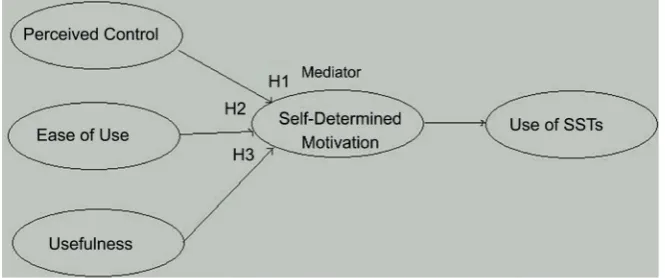
As customers are more intrinsically motivated when they can customize their experience, perceived control has been shown to have a positive effect on intrin-sic motivation (Collier & Sherrell, 2010). Moreover, ease of use affects intrinsic motivation when options are more easily found and procedures are less ambi-guous (Jaasma & Koper, 1999; Sargeant & Lee, 2004). Additionally, customers are more willing to learn how to use SSTs if they find the technology useful and advantageous (Meuter et al., 2005). Furthermore, self-determined motivation has a positive impact on the use of ICT (Techatassanasoontorn & Tanvisuth, 2008) and SSTs (Leung & Matanda, 2013). Considering these points, the direct effects of perceived control, ease of use and usefulness on self-determined moti-vation, and the direct effect of self-determined motivation on the use of SSTs are expected. Thus, the mediating effect of self-determined motivation on the rela-tionship between perceived control, ease of use, usefulness, and the use of SSTs is inferred as depicted in Figure 2.
It is hypothesized that:
H1: Self-determined motivation mediates the relationship between perceived
control and the use of SSTs.
H2: Self-determined motivation mediates the relationship between ease of use
and the use of SSTs.
H3: Self-determined motivation mediates the relationship between usefulness
DOI: 10.4236/psych.2019.107063 963 Psychology Figure 2. The conceptual model.
6. Method
6.1. Sample and Procedure
In the current study, a descriptive cross-sectional research design was used, be-cause the major aim of the current study was to discover factors affecting the use of SSTs (Burns & Bush, 2006). We administered the questionnaire using the on-line panel through Qualtrics. Australian shoppers over 18 years old and who had used supermarket self-checkout systems in the previous 12 months were invited to fill in the questionnaire. Prior to the study, the questionnaire was first eva-luated by 10 Australian shoppers, 3 SST experts from Australian universities and 1 Australian supermarket manager. Three hundred and sixty one participants completed the questionnaires with no missing values for further analysis.
6.2. Measures
All constructs in the current study were measured with seven-point Likert scales (1 - 7) (1—strongly disagree, 7—strongly agree) as discussed below:
Perceived control. Dabholkar (1996), Yen and Gwinner (2003) and Zhu
(2002) conceptualized perceived control as a uni-dimensional construct and de-fined it as the degree of individuals’ desire to exhibit mastery over the environ-ment. In the current study, the conceptualization of perceived control in five items used by Dabholkar (1996), Yen and Gwinner (2003) and Zhu (2002) was used.
Perceived ease of use. Ease of use is also viewed as the degree of complication
and confusion of using the SST in library self-checkouts (Dabholkar & Bagozzi, 2002; Zhao, Mattila, & Tao, 2008). The measure of ease of use from Dabholkar and Bagozzi (2002) and Zhao, Mattila and Tao (2008) was adopted for the cur-rent study. Five measurement items were used to measure ease of use.
Usefulness.Weijters, Rangarajan and Falk (2005) measured usefulness as the
efficiency, speed of shopping and waiting time associated with using self-scanning. The measure of perceived usefulness fromWeijters, Rangarajan and Falk (2005)
was adapted for the current study. Four measurement items were used to meas-ure usefulness.
di-DOI: 10.4236/psych.2019.107063 964 Psychology
mensions: intrinsic motivation, integrated, identified, introjected and external motivation. The current study adopted Halvari et al.’s (2010) self-determination scale. Intrinsic motivation as well as integrated and introjected regulations was measured with five items, identified regulation was measured with six items and external regulation was operationalised as a seven-item measure.
The use of SSTs. Dabholkar and Bagozzi (2002)measured the use of SSTs as
the likelihood or unlikelihood of an individual using the SST. Dabholkar and Bagozzi’s (2002) study was adopted in the current study.
7. Results
7.1. Purification of the Measurements
The measurements were firstly purifying using exploratory factor analysis (EFA). The current study retained factors with eigenvalues greater than 1 (Hair, Black, Babin, & Anderson, 2006) and with factor loading higher than or equal to .30 and with cross factor loadings < .30 (Field, 2000). After the analyses using oblique rotation method, 19 items and 4 dimensions (integrated regulation, in-trojected regulation, external regulation, & intrinsic motivation) remained in self-determined motivation scale with Eigenvalues 7.27, 4.01, 3.35 and 6.85. These items including items of perceived control, ease of use, usefulness and the use of SSTs were then evaluated by confirmatory factor analysis. Items removed according to the modification index resulted acceptable chi-square value (χ2
(224) = 572.495, p < .001), χ2/df = 2.556, RMSEA = .066, pclose < .000, GFI = .89,
AGFI = .85, NFI = .93 and CFI = .96 (IFI = .96, TLI = .95). The correlation ma-trix of variables and demographic information can be found in Appendix A and Appendix B.
7.2. Testing the Reliability
Reliability is the consistency of a set of measurements (Hair, Black, Babin, & Anderson, 2010). Reliability was assessed using composite reliability (CR) and
p-values of factor loadings in the current study (Zheng, 2006). The composite reliability of constructs in the current study ranged from .73 to .97, which ex-ceeded the acceptable level of .70 (Fornell & Larcker, 1981). All factor loadings were also highly significant, with p-values less than or equal to .001. Therefore, all measures had sufficient consistency.
7.3. Testing the Validity
Validity refers to the ability of a measure to describe what it intends to measure
(Haladyna, 1999). In validating the measurements for further analysis, the uni-dimensionality and convergent validity of constructs were tested (Steen-kamp & Van Trijp, 1991).
Uni-dimensionality. Uni-dimensionality can be assessed through estimating
An-DOI: 10.4236/psych.2019.107063 965 Psychology derson & Gerbing, 1988). The model fit indices suggested that the model was acceptable. Thus, the uni-dimensionality of constructs was established.
Convergent validity. Convergent validity is a measure of the convergence of
items of a construct. Convergent validity can be assessed using the average va-riances extracted (AVEs) (Fornell & Larker, 1981; Farrell & Rudd, 2009) and the t-test for factor loadings (Anderson & Gerbing, 1988). The AVEs of the structs in the current study ranged from .47 to .90. Because AVE is a more con-servative test, AVEs above or close to the cut-off point of .5 indicated sufficient convergent validity (Batra & Sinha, 2000). Additionally, all factor loadings were more than twice their standard errors and the t-values ranged from 2.98 to 13.08. Thus, the convergent validity of the constructs was acceptable.
7.4. Validating the Simplex Structure of the Self-Determined
Motivation Scale
To quantify self-determined motivation, a relative autonomous index (RAI) formula was used, e.g. RAI = external regulation × (−2) + introjected regulation × (−1) + integrated regulation × (+1) + intrinsic motivation × (+2) (Ryan & Connell, 1989). Positive and negative relative autonomous indices represented high and low levels of self-determined motivation. The RAI was formed only if the correlations of different dimensions of self-determined motivation scale conformed to a simplex structure (Guttman, 1954). Li and Harmer (1996) pro-posed that when a simplex structure exists, the lower level of constructs should have stronger significant direct effects on the adjacent constructs than the indi-rect effects on distant constructs. The current study tested the existence of the simplex structure on self-determined motivation scale. The direct effects of each construct were added to its adjacent constructs to form an analytical model. This model, which was further analysed using SPSS AMOS 21 with maximum like-lihood estimation (MLE), yielded a chi-square value (χ2 (34) =118.21, p < .001), χ2/df = 2.32, RMSEA = .06, pclose = .12, GFI = .95, AGFI = .93, NFI = .97 and
CFI = .98. The results surpassed Li and Harmer’s (1996) criteria that all direct effects to the adjacent constructs should be significant and all direct effects to the adjacent constructs were stronger than the indirect effects to more distant con-structs. Thus, the continuum of motivation was assumed.
7.5. Testing the Common Method Variance (CMV)
DOI: 10.4236/psych.2019.107063 966 Psychology
introjected regulation and the use of SSTs, indicate that the relationships be-tween predictors and the criterion—the use of SSTs cannot be accounted for by CMV. These findings attest that CMV only had a marginal effect on the rela-tionships between predictors and the criterion.
7.6. Testing the Mediating Effect of Self-Determined Motivation
The assumptions of normality, linearity, multicollinearity and homoscedasticity were tested. The skewness (−.84 to −.22) and kurtosis (−.36 to .44) values were between −2.0 and +2.0 (Balanda & Macgillivray, 1988). Linearity was checked using partial regression plot analysis (Bray & Maxwell, 1985). All plotted graphs were visually inspected, and no curvilinear or other non-linear relationships were found between the dependent and independent variables. The VIF values of the independent variables in the current study ranged from 1.23 to 2.86, which was well below the minimum cut-off level of 4.0 (Rud, 2000). Homosce-dasticity of variance was tested using Levene’s tests (Bray & Maxwell, 1985). None of these nonmetric variables had more than two problematic metric va-riables (Hair et al., 2006). The mediating effect of self-determined motivation was then analysed with the bootstrapping method (Preacher & Hayes, 2008). In this process, 1000 samples were bootstrapped using the PROCESS program with a 95% confidence interval (Hayes, 2012).
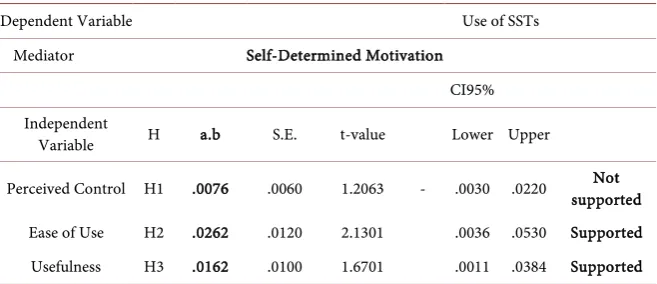
As shown in Table 1, self-determined motivation did not significantly me-diate the relationship between perceived control and the use of SSTs. Thus, H1 was not supported. However, self-determined motivation significantly mediated the relationship between ease of use and the use of SSTs (b = .0262, CIs 95% .0036 - .0530) and the relationship between usefulness and the use of SSTs (b = .0162, CIs 95% .0011 - .384). Thus, H2 and H3 were supported.
8. Discussion
[image:9.595.210.539.567.709.2]SDT has been widely used to explain human motivation and behavior, e.g. Hal-vari et al. (2010), Techatassanasoontorn and Tanvisuth (2008) and Leung and Table 1. The mediating effect of self-determined motivation on the relationship between perceived control, ease of use, usefulness and the use of SSTs.
Dependent Variable Use of SSTs
Mediator Self-Determined Motivation CI95% Independent
Variable H a.b S.E. t-value Lower Upper
Perceived Control H1 .0076 .0060 1.2063 - .0030 .0220 supported Not
DOI: 10.4236/psych.2019.107063 967 Psychology Matanda (2013). SDT proposes that volitional forms of motivation are impor-tant, because they enhance human-activity engagement (Deci & Ryan, 2000a). Autonomy, competence and relatedness are proposed as basic human needs that foster volitional forms of motivation. Previous studies have paid limited atten-tion to the dimensions of basic human needs. Hence, the current study attempts to extend the dimensions of basic human needs set by SDT.
Consistent with the prediction based on Jaasma and Koper (1999), Sargeant and Lee (2004), Techatassanasoontorn and Tanvisuth (2008) and Leung and Matanda (2013), self-determined motivation mediated the relationship between ease of use and the use of SSTs. Self-determined motivation also mediated the relationship between usefulness and the use of SSTs, which is consistent with the prediction based on Meuter et al. (2005), Techatassanasoontorn and Tanvisuth (2008) and Leung and Matanda (2013). Contrary to the prediction based on Col-lier and Sherrell (2010),Techatassanasoontorn and Tanvisuth (2008)and Leung and Matanda (2013), self-determined motivation did not mediate the relation-ship between perceived control and the use of SSTs. These results indicate that ease of use and usefulness can nurture volitional forms of motivation, hence the use of SST. In conclusion, ease of use and usefulness can also be considered as basic human needs in the SST context. Because perceived control did not en-hance the use of SSTs through self-determined motivation, it is not considered a basic human need in this context.
Perceived control, ease of use and usefulness were shown to enhance intrinsic motivation to use SSTs (Collier & Sherrell, 2010; Jaasma & Koper, 1999; Sargeant & Lee, 2004; Meuter et al., 2005). The results indicate that ease of use and use-fulness foster volitional forms of motivation. Ease of use has a close link with competence/self-efficacy (Dabholkar & Bagozzi, 2002). Competence is a form of basic human need that nurtures volitional forms of motivation. Therefore, as expected, ease of use also fosters volitional forms of motivation.
Moreover, usefulness is shown to foster volitional forms of motivation, but its links with autonomy, competence and relatedness are not clear. This finding re-veals a drawback in the SDT framework and also indicates a necessity to review the dimensions of basic human needs, at least in the SST context. These findings further suggest that basic human needs are not limited to autonomy, compe-tence and relatedness.
Additionally, perceived control does not foster volitional forms of motivation, although it appears to have a similar concept to autonomy. One plausible expla-nation is that customized options offered to customers (perceived control) may not create autonomous contexts, because they may still feel pressure to use SST because of the presence of other customers and/or long queues at service coun-ters. This suggests that autonomous contexts may be created only if customers have freedom/autonomy to choose to use SST to complete their transactions
(Leung & Matanda, 2013).
DOI: 10.4236/psych.2019.107063 968 Psychology
shortened queues, to foster volitional forms of motivation. Managers can also simplify steps for customers to complete transactions in order to enhance the perceived ease of use of SSTs to further enhance volitional forms of motivation in customers. As volitional forms of motivation are fostered, managers can dep-loy SSTs in mutually beneficial and cost-effective ways. Customers can feel more satisfied using SSTs when an internalization process is facilitated, while manag-ers can offer minimal external incentives, e.g. coupons or discounts, to encour-age customers to use SSTs. Furthermore, enhancing customized options of SSTs is insufficient to facilitate an internalization process. Therefore, service counters need to be provided so that autonomous contexts can be created for customers to choose to use SSTs.
Limitations and Future Research
Whilst the current study offers insights into the dimensions of basic human needs, it is subject to some limitations. The current study could be expanded to other contexts or countries, as consumer behavior may be different in different contexts (Arnould & Thompson, 2005; De Mooij, 2010). As autonomy, compe-tence and relatedness are considered sole basic human needs that drive students’ motivations and school performances (Deci, Koestner, & Ryan, 1999; Vallerand et al., 1992, 1993; Fortier, Vallerand, & Guay, 1995), it is meaningful to investi-gate the effect of perceived ease of use and usefulness on students’ motivations and school performances when using technology becomes more popular in edu-cational contexts. The current study did not investigate the effects of situational factors, such as waiting time and queue length, or other moderators, such as age, gender differences. Examining these factors in future research could provide ad-ditional insight into the possible moderating effects of situational factors and their effects on the model.
Conflicts of Interest
The author declares no conflicts of interest regarding the publication of this pa-per.
References
Anderson, J. C., & Gerbing, D. W. (1988). Structural Equation Modeling in Practice: A Review and Recommended Two-Step Approach. Psychological Bulletin, 103, 411.
https://doi.org/10.1037/0033-2909.103.3.411
Arnould, E. J., & Thompson, C. J. (2005). Consumer Culture Theory (CCT): Twenty Years of Research. Journal of Consumer Research, 31, 868-882.
https://doi.org/10.1086/426626
Balanda, K. P., & MacGillivray, H. L. (1988). Kurtosis: A Critical Review. The American Statistician, 42, 111-119.https://doi.org/10.1080/00031305.1988.10475539
Bandura, A. (1997). Self-Efficacy: The Exercise of Control. New York: Freeman.
DOI: 10.4236/psych.2019.107063 969 Psychology
https://doi.org/10.1016/S0022-4359(00)00027-0
Bray, J. H., & Maxwell, S. E. (1985). Multivariate Analysis of Variance (Vol. 54). Thou-sand Oaks, CA: Sage.https://doi.org/10.4135/9781412985222
Bruner, G. C., & Kumar, A. (2005). Applying TAM to Consumer Usage of Handheld In-ternet Devices. Journal of Business Research, 58, 553-558.
https://doi.org/10.1016/j.jbusres.2003.08.002
Burns, A. C., & Bush, R. F. (2006). Marketing Research (5th ed.). Upper Saddle River, NJ: Prentice Hall.
Collier, J. E., & Sherrell, D. L. (2010). Examining the Influence of Control and Conveni-ence in a Self-Service Setting. Journal of the Academy of Marketing Science, 38,
490-509.https://doi.org/10.1007/s11747-009-0179-4
Curran, J. M., & Meuter, M. L. (2005). Self-Service Technology Adoption: Comparing Three Technologies. Journal of Services Marketing, 19, 103-113.
https://doi.org/10.1108/08876040510591411
Dabholkar, P. A. (1996). Consumer Evaluations of New Technology-Based Self-Service Options: An Investigation of Alternative Models of Service Quality. International Journal of Research in Marketing, 13, 29-51.
https://doi.org/10.1016/0167-8116(95)00027-5
Dabholkar, P. A., & Bagozzi, R. P. (2002). An Attitudinal Model of Technology-Based Self-Service: Moderating Effects of Consumer Traits and Situational Factors. Journal of the Academy of Marketing Science, 30, 184-201.
https://doi.org/10.1177/0092070302303001
Davis, F. D. (1986). A Technology Acceptance Model for Empirically Testing New End-User Information Systems: Theory and Results. PhD Thesis, Cambridge, MA: Massachusetts Institute of Technology, Sloan School of Management.
De Mooij, M. (2010). Consumer Behavior and Culture: Consequences for Global Mar-keting and Advertising. Thousand Oaks, CA: Sage.
Deci, E. L., & Ryan, R. M. (1985). Self-Determination. Hoboken, NJ: John Wiley & Sons, Inc.
Deci, E. L., & Ryan, R. M. (1991). A Motivational Approach to Self: Integration in Perso-nality. In R. Dienstbier (Ed.), Nebraska Symposium on Motivation: Vol. 38, Perspec-tives on Motivation (pp. 237-288). Lincoln, NE: University of Nebraska Press.
Deci, E. L., & Ryan, R. M. (2000a). Self-Determination Theory and the Facilitation of In-trinsic Motivation, Social Development, and Well-Being. American Psychologist, 55,
68-78.https://doi.org/10.1037//0003-066X.55.1.68
Deci, E. L., & Ryan, R. M. (2000b). Intrinsic and Extrinsic Motivations: Classic Defini-tions and New DirecDefini-tions. Contemporary Educational Psychology, 25, 54-67.
https://doi.org/10.1006/ceps.1999.1020
Deci, E. L., & Ryan, R. M. (2008). Facilitating Optimal Motivation and Psychological Well-Being across Life’s Domains. Canadian Psychology, 49, 14-23.
https://doi.org/10.1037/0708-5591.49.1.14
Deci, E. L., & Ryan, R. M. (2012). Self-Determination Theory. In P. A. M. Van Lange, A. W. Kruglanski, & E. T. Higgins (Eds.), Handbook of Theories of Social Psychology (pp. 416-437, Vol. 1). Thousand Oaks, CA: Sage.
https://doi.org/10.4135/9781446249215.n21
Deci, E. L., Eghrari, H., Patrick, B. C., & Leone, D. R. (1994). Facilitating Internalization: The Self-Determination Theory Perspective. Journal of Personality, 62, 119-142.
DOI: 10.4236/psych.2019.107063 970 Psychology
Deci, E. L., Koestner, R., & Ryan, R. M. (1999). A Meta-Analytic Review of Experiments Examining the Effects of Extrinsic Rewards on Intrinsic Motivation. Psychological Bulletin, 125, 627-668.https://doi.org/10.1037/0033-2909.125.6.627
Eriksson, K., & Nilsson, D. (2007). Determinants of the Continued Use of Self-Service Technology: The Case of Internet Banking. Technovation, 27, 159-167.
https://doi.org/10.1016/j.technovation.2006.11.001
Eriksson, K., Bagozzi, R. P., & Warshaw, P. R. (2001). Customer Acceptance of Internet Banking in Estonia. International Journal of Bank Marketing, 23, 200-216.
https://doi.org/10.1108/02652320510584412
Farrell, A. M., & Rudd, J. M. (2009). Factor Analysis and Discriminant Validity: A Brief Review of Some Practical Issues. In D. Tojib (Ed.), Australia-New Zealand Marketing Academy Conference. Australia-New Zealand Marketing Academy.
Fernet, C. (2011). Development and Validation of the Work Role Motivation Scale for School Principals (WRMS-SP). Educational Administration Quarterly, 47, 307-331.
https://doi.org/10.1177/0013161X10385108
Field, A. (2000). Discovering Statistics Using SPSS for Windows. Thousand Oaks, CA: Sage Publications.
Fornell, C., & Larcker, D. F. (1981). Evaluating Structural Equation Models with Unob-servable Variables and Measurement Error. Journal of Marketing Research, 18, 39-50.
https://doi.org/10.1177/002224378101800104
Fortier, M. S., Vallerand, R. J., & Guay, F. (1995). Academic Motivation and School Per-formance: Toward a Structural Model. Contemporary Educational Psychology, 20,
257-274.https://doi.org/10.1006/ceps.1995.1017
Gagne, M., & Deci, E. L. (2005). Self-Determination Theory and Work Motivation. Jour-nal of OrganizatioJour-nal Behavior, 26, 331-362.https://doi.org/10.1002/job.322
Gallaugher, J. (2010). Information Systems: A Manager’s Guide to Harnessing Technolo-gy. Boston, MA: Flat World Knowledge.
Guriting, P., & Ndubisi, N. O. (2006). Borne Online Banking: Evaluating Customer Per-ceptions and Behavioral Intention. Management Research News, 29, 6-15.
https://doi.org/10.1108/01409170610645402
Guttman, L. (1954). A New Approach to Factor Analysis: The Radex. In P. F. Lazarsfeld (Ed.), Mathematical Thinking in the Social Sciences (pp. 258-348). New York: Free Press.
Hair, J. F., Black, W. C., Babin, B. J., & Anderson, R. E. (2006). Multivariate Data Analy-sis: A Global Perspective. New Jersey: Prentice Hall.
Hair, J. F., Black, W. C., Babin, B. J., & Anderson, R. E. (2010). Multivariate Data Analysis
(7th ed.). Englewood Cliffs, NJ: Prentice Hall.
Haladyna, T. M. (1999). A Complete Guide to Student Grading. Boston, MA: Allyn and Bacon.
Halvari, A. E. M., Halvari, H., Bjørnebekk, G., & Deci, E. L. (2010). Motivation and An-xiety for Dental Treatment: Testing a Self-Determination Theory Model of Oral Self-Care Behavior and Dental Clinic Attendance. Motivation and Emotion, 34, 15-33.
https://doi.org/10.1007/s11031-010-9154-0
Hattie, J. (1985). Methodology Review: Assessing Unidimensionality of Tests and Items.
Applied Psychological Measurement, 9, 139-164.
https://doi.org/10.1177/014662168500900204
DOI: 10.4236/psych.2019.107063 971 Psychology
Hernan-dez, J. M. C., & Mazzon, J. A. (2007). Adoption of Internet Banking: Proposition and Implementation of an Integrated Methodology Approach. International Journal of Bank Marketing, 25, 72-88.https://doi.org/10.1108/02652320710728410
Jaasma, M. A., & Koper, R. J. (1999). The Relationship of Student-Faculty Out-of-Class Communication to Instructor Immediacy and Trust and to Student Motivation.
Communication Education, 48, 41-47.https://doi.org/10.1080/03634529909379151
Jaruwachirathanakul, B., & Fink, D. (2005). Internet Banking Adoption Strategies for a Developing Country: The Case of Thailand. Internet Research, 15, 295-311.
https://doi.org/10.1108/10662240510602708
Judd, C. M., & Kenny, D. A. (2010). Data Analysis in Social Psychology: Recent and Re-curring Issues. Hoboken, NJ: John Wiley & Sons, Inc.
https://doi.org/10.1002/9780470561119.socpsy001004
Kelly, P., Lawlor, J., & Mulvey, M. (2010). A Review of Key Factors Affecting the Adop-tion of Self-Service Technologies in Tourism.
Kim, Y. J., Chun, J. U., & Song, J. (2009). Investigating the Role of Attitude in Technology Acceptance from an Attitude Strength Perspective. International Journal of Informa-tion Management, 29, 67-77.https://doi.org/10.1016/j.ijinfomgt.2008.01.011
Laforet, S., & Li, X. (2005). Consumers’ Attitudes towards Online and Mobile Banking in China. International Journal of Bank Marketing, 23, 362-380.
https://doi.org/10.1108/02652320510629250
Lanseng, E. J., & Andreassen, T. W. (2007). Electronic Healthcare: A Study of People’s Readiness and Attitude toward Performing Self-Diagnosis. International Journal of Service Industry Management, 18, 394-417.
https://doi.org/10.1108/09564230710778155
Lee, W., Castellanos, C., & Choi, C. H. S. (2012). The Effect of Technology Readiness on Customers’ Attitudes toward Self-Service Technology and Its Adoption; the Empirical Study of US Airline Self-Service Check-In Kiosks. Journal of Travel & Tourism Mar-keting, 29, 731-743.https://doi.org/10.1080/10548408.2012.730934
Leung, L. S. K., & Matanda, M. J. (2013). The Impact of Basic Human Needs on the Use of Retailing Self-Service Technologies: A Study of Self-Determination Theory. Journal of Retailing and Consumer Services, 20, 549-559.
https://doi.org/10.1016/j.jretconser.2013.06.003
Li, F., & Harmer, P. (1996). Testing the Simplex Assumption Underlying the Sport Moti-vation Scale: A Structural Equation Modeling Analysis. Research Quarterly for Exercise and Sport, 67, 396-405.https://doi.org/10.1080/02701367.1996.10607971
Liao, Z., & Cheung, M. T. (2002). Internet-Based e-Banking and Consumer Attitudes: An Empirical Study. Information and Management Archive, 39, 283-295.
https://doi.org/10.1016/S0378-7206(01)00097-0
Lin, J. S. C., & Chang, H. C. (2011). The Role of Technology Readiness in Self-Service Technology Acceptance. Managing Service Quality, 21, 424-444.
https://doi.org/10.1108/09604521111146289
Lindell, M. K., & Whitney, D. J. (2001). Accounting for Common Method Variance in Cross-Sectional Research Designs. Journal of Applied Psychology, 86, 114-121.
https://doi.org/10.1037/0021-9010.86.1.114
MacKinnon, D. P., & Luecken, L. J. (2008). How and for Whom? Mediation and Modera-tion in Health Psychology. Health Psychology, 27, S99.
https://doi.org/10.1037/0278-6133.27.2(Suppl.).S99
DOI: 10.4236/psych.2019.107063 972 Psychology
Comparison of Methods to Test Mediation and Other Intervening Variable Effects.
Psychological Methods, 7, 83.https://doi.org/10.1037/1082-989X.7.1.83
Malhotra, N. K. (2006). Marketing Research—An Applied Orientation (5th ed.). Upper Saddle River, NJ: Prentice Hall.
Meuter, M. L., Bitner, M. J., Ostrom, A. L., & Brown, S. W. (2005). Choosing among Al-ternative Service Delivery Modes: An Investigation of Customer Trial of Self-Service Technologies. Journal of Marketing, 69, 61-83.
https://doi.org/10.1509/jmkg.69.2.61.60759
Meuter, M. L., Ostrom, A. L., Roundtree, R. I., & Bitner, M. J. (2000). Self-Service Tech-nologies: Understanding Customer Satisfaction with Technology-Based Service En-counters. Journal of Marketing, 64, 50-64.https://doi.org/10.1509/jmkg.64.3.50.18024
Mumani, A., Stone, R., & Wang, Z. (2018). The Effect of Scanning Technology and UPC Placement on Supermarket Self-Checkout. Packaging Technology and Science, 31,
83-96.https://doi.org/10.1002/pts.2355
Parasuraman, A. (2000). Technology Readiness Index (TRI): A Multiple-Item Scale to Measure Readiness to Embrace New Technologies. Journal of Service Research, 2,
307-320.https://doi.org/10.1177/109467050024001
Parasuraman, P., Zeithaml, V., & Malhotra, A. (2005). E-SERVQUAL: A Multiple-Item Scale for Assessing Electronic Service Quality. Journal of Service Research, 7, 213-233.
https://doi.org/10.1177/1094670504271156
Parham, D., Roberts, P., & Sun, H. (2001). Information Technology and Australia’s Productivity Surge. https://doi.org/10.2139/ssrn.287799
Polatoglu, V. N., & Ekin, S. (2001). An Empirical Investigation of the Turkish Consum-ers’ Acceptance of Internet Banking Services. International Journal of Bank Marketing, 19, 156-165.https://doi.org/10.1108/02652320110392527
Preacher, K. J., & Hayes, A. F. (2008). Asymptotic and Resampling Strategies for Assess-ing and ComparAssess-ing Indirect Effects in Multiple Mediator Models. Behavior Research Methods, 40, 879-891.https://doi.org/10.3758/BRM.40.3.879
Rangarajan, D., Falk, T., & Schillewaert, N. (2007). Determinants and Outcomes of Cus-tomers’ Use of Self-Service Technology in a Retail Setting. Journal of Service Research, 10, 3-21.https://doi.org/10.1177/1094670507302990
Rud, O. P. (2000). Data Mining Cookbook CD-Rom: Modeling Data for Marketing, Risk and Customer Relationship Management. Hoboken, NJ: John Wiley & Sons, Inc. Ryan, R. M. (1995). Psychological Needs and the Facilitation of Integrative Processes.
Journal of Personality, 63, 397-427.https://doi.org/10.1111/j.1467-6494.1995.tb00501.x
Ryan, R. M., & Connell, J. P. (1989). Perceived Locus of Causality and Internalization: Examining Reasons for Acting in Two Domains. Journal of Personality and Social Psychology, 57, 749.https://doi.org/10.1037/0022-3514.57.5.749
Sargeant, A., & Lee, S. (2004). Trust and Relationship Commitment in the United King-dom Voluntary Sector: Determinants of Donor Behavior. Psychology & Marketing, 21,
613-635.https://doi.org/10.1002/mar.20021
Sharma, R., Yetton, P., & Crawford, J. (2010). A Critique of the Marker Variable Tech-nique: The Effect of Alternative Marker Variable Criteria. In European Conference on Information Systems (pp. 1-12).
Shrout, P. E., & Bolger, N. (2002). Mediation in Experimental and Nonexperimental Stu-dies: New Procedures and Recommendations. Psychological Methods, 7, 422.
DOI: 10.4236/psych.2019.107063 973 Psychology
Steenkamp, J. B. E., & Van Trijp, H. (1991). The Use of LISREL in Validating Marketing Constructs. International Journal of Research in Marketing, 8, 283-299.
https://doi.org/10.1016/0167-8116(91)90027-5
Taillon, B. J., & Huhmann, B. A. (2019). Strategic Consequences of Self-Service Technol-ogy Evaluations. Journal of Strategic Marketing, 27, 268-279.
https://doi.org/10.1080/0965254X.2017.1411387
Techatassanasoontorn, A. A., & Tanvisuth, A. (2008). The Integrated Self-Determination and Self-Efficacy Theories of ICT Training and Use: The Case of the Socio-Economically Disadvantaged. GlobDev 2008, 19.
Teixeira, P. J., Carraça, E. V., Markland, D., Silva, M. N., & Ryan, R. M. (2012). Exercise, Physical Activity, and Self-Determination Theory: A Systematic Review. International Journal of Behavioral Nutrition and Physical Activity, 9, 78.
https://doi.org/10.1186/1479-5868-9-78
Vallerand, R. J., Pelletier, L. G., Blais, M. R., Briere, N. M., Senecal, C., & Vallieres, E. F. (1992). The Academic Motivation Scale: A Measure of Intrinsic, Extrinsic and a Moti-vation in Education. Educational and Psychological Measurement, 52, 1003-1017.
https://doi.org/10.1177/0013164492052004025
Vallerand, R. J., Pelletier, L. G., Blais, M. R., Briere, N. M., Senecal, C., & Vallieres, E. F. (1993). On the Assessment of Intrinsic, Extrinsic and a Motivation in Education: Evi-dence of Concurrent and Construct Validity of the Academic Motivation Scale. Educa-tional and Psychological Measurement, 53, 159-172.
https://doi.org/10.1177/0013164493053001018
Vargo, S. L., & Lusch, R. F. (2004). Evolving to a New Dominant Logic for Marketing.
Journal of Marketing, 68, 1-17.https://doi.org/10.1509/jmkg.68.1.1.24036
Venkatesh, V. (2000). Determinants of Perceived Ease of Use: Integrating Control, In-trinsic Motivation, and Emotion into the Technology Acceptance Model. Information Systems Research, 11, 342-365.https://doi.org/10.1287/isre.11.4.342.11872
Venkatesh, V., & Davis, F. D. (2000). A Theoretical Extension of the Technology Accep-tance Model: Four Longitudinal Field Studies. Management Science, 46, 186-204.
https://doi.org/10.1287/mnsc.46.2.186.11926
Wang, J., & Namen, J. (2004). Adoption of Technology-Based Self-Service: A Case Study on Airport Self Check-In Service. Master’s Thesis, Lulea: University of Lulea.
Wang, Y. S., Wang, Y. M., Lin, H. H., & Tang, T. I. (2003). Determinants of User Accep-tance of Internet Banking: An Empirical Study. International Journal of Service Indus-try Management, 14, 501-519.https://doi.org/10.1108/09564230310500192
Weijters, B., Rangarajan, D., & Falk, T. (2005). Customers’ Usage of Self Service Tech-nology a Retail Setting (p. 19). Vlerick Leuven Gent Working Paper.
Xie, L., Shen, W., & Zheng, Y. (2011). Examining the Effect of Service Experiences on the Attitude towards and Intention on Using Self-Service Technology. In International Conference on Computer Science and Service System (pp. 2233-2240). New York: In-stitute of Electrical and Electronics Engineers.
Yang, J., & Klassen, K. J. (2008). How Financial Markets Reflect the Benefits of Self-Service Technologies. Journal of Enterprise Information Management, 21, 448-467.
https://doi.org/10.1108/17410390810904238
Yen, R., & Gwinner, K. P. (2003). Internet Retail Customer Loyalty: The Mediating Role of Relational Benefits. International Journal of Service Industry Management, 14, 483-500.
https://doi.org/10.1108/09564230310500183
DOI: 10.4236/psych.2019.107063 974 Psychology
Websites: A Critical Review of Extant Knowledge. Journal of the Academy of Market-ing Science, 30, 362-375.https://doi.org/10.1177/009207002236911
Zhao, X., Lynch, J. G., & Chen, Q. (2010). Reconsidering Baron and Kenny: Myths and Truths about Mediation Analysis. Journal of Consumer Research, 37, 197-206.
https://doi.org/10.1086/651257
Zhao, X., Mattila, A. S., & Tao, L. S. E. (2008). The Role of Post-Training Self-Efficacy in Customers’ Use of Self Service Technologies. International Journal of Service Industry Management, 19, 492-505.https://doi.org/10.1108/09564230810891923
Zheng, Z. K. (2006). Innovation, Imitation, and New Product Performance: The Case of China. Industrial Marketing Management, 35, 394-402.
https://doi.org/10.1016/j.indmarman.2005.10.006
DOI: 10.4236/psych.2019.107063 975 Psychology
Appendix A
Correlation Matrix (N = 361)
Constructs 1 2 3 4 5 6 7 8
1. Perceived Control
2. Ease of Use .47**
3. Usefulness .52** .42** 4. Use Of SSTs .70** .56** .65**
5. External Regulation .31** - .04 .18** .14* 6. Introjected Regulation .21** - .24** .03 - .03 .35** 7. Integrated Regulation .69** .53** .60** .71** .32** .21** 8. Intrinsic Regulation .67** .56** .60** .84** .29** .09 .80** Mean 12.74 14.62 14.95 14.61 12.29 7.51 12.01 12.97
SD 4.14 4.37 4.03 4.45 3.76 3.86 4.8 4.49
Composite Reliability .89 .92 .91 .95 .73 .9 .92 .97
AVE .72 .79 .77 .87 .47 .76 .79 .9
Square root of AVE .85 .89 .88 .93 .69 .87 .89 .95 Notes: Sample size = 361, **p < .01, *p < .05.
Appendix B
Demographic Profile of Respondents (N = 361)
Gender N
Female 51% 184
Male 49% 177
Age
19 - 20 4% 14
21 - 30 21% 76
31 - 46 26% 94
47 - 55 17% 61
56 - 65 21% 76
Over 66 11% 40
Income
20,000 and under 14% 51
20,001 - 40,000 25% 90
40,001 - 60,000 21% 76
60,001 - 80,000 13% 47
80,001 - 100,000 10% 36
DOI: 10.4236/psych.2019.107063 976 Psychology
Continued
Over 150,000 5% 18
Education Level
Secondary (Year 7 - 10) 14% 51
High School (Year 11 - 12) 22% 79
TAFE/Commercial Institutes/Diplomas 31% 112
Bachelor Degree 22% 79
Post Graduate Level 9% 32
PhD and above 2% 8
Ethnic Background
Australian 55% 199
European 28% 101
Asian 3% 11
African 2% 7
New Zealander 1% 4
Russian 1% 4