Journal of Optics
PAPER • OPEN ACCESS
Optimizing the spectro-temporal properties of photon pairs from
Bragg-reflection waveguides
To cite this article: H Chen et al 2019 J. Opt. 21 054001
Optimizing the spectro-temporal properties
of photon pairs from Bragg-re
fl
ection
waveguides
H Chen
1,2, K Laiho
3,7, B Pressl
2,4, A Schlager
2, H Suchomel
5, M Kamp
5,
S Hö
fl
ing
5,6, C Schneider
5and G Weihs
21
Department of Physics, National University of Defense Technology, Changsha, 410073, Peopleʼs Republic of China
2
Institut für Experimentalphysik, Universität Innsbruck, Technikerstraße 25, A-6020 Innsbruck, Austria 3
Technische Universität Berlin, Institut für Festkörperphysik, Hardenbergstr.36, D-10623 Berlin, Germany
4
Sektion für Biomedizinische Physik, Medizinische Universität Innsbruck, Müllerstraße 44, A-6020 Innsbruck, Austria
5Technische Physik, Universität Würzburg, Am Hubland, D-97074 Würzburg, Germany 6
School of Physics & Astronomy, University of St Andrews, St Andrews, KY16 9SS, United Kingdom
E-mail:[email protected]
Received 27 July 2018, revised 30 January 2019 Accepted for publication 14 March 2019 Published 2 April 2019
Abstract
Bragg-reflection waveguides(BRWs)fabricated from AlGaAs provide an interesting nonlinear optical platform for photon-pair generation via parametric down-conversion(PDC). In contrast to many conventional PDC sources, BRWs are made of high refractive index materials and their characteristics are very sensitive to the underlying layer structure. First, we show that the design parameters like the phase matching wavelength and the group refractive indices of the interacting modes can be reliably controlled even in the presence of fabrication tolerances. We then investigate how these characteristics can be taken advantage of when designing quantum photonic applications with BRWs. We especially concentrate on achieving a small differential group delay between the generated photons of a pair and then explore the performance of our design when realizing a Hong–Ou–Mandel interference experiment or generating spectrally multi-band polarization entangled states. Our results show that the versatility provided by engineering the dispersion in BRWs is important for employing them in different quantum optics tasks.
Keywords: Bragg-reflection waveguide, parametric down-conversion, phase matching, quantum state engineering and measurements
(Somefigures may appear in colour only in the online journal)
1. Introduction
Parametric down-conversion (PDC)offers means for compar-ably simple generation of non-classical light that can be used as a robust information carrier in a variety of quantum optics applications[1,2]. Nevertheless, the spectral properties of the PDC emission, which largely stem from the material disper-sion, play a crucial role in deciding for which applications a photon-pair source is suitable [3–7]. The intrinsic spectral
Journal of Optics
J. Opt.21(2019)054001(10pp) https://doi.org/10.1088/2040-8986/ab0fe9
7
Author to whom any correspondence should be addressed.
Original content from this work may be used under the terms of the Creative Commons Attribution 3.0 licence. Any further distribution of this work must maintain attribution to the author(s)and the title of the work, journal citation and DOI.
characteristics of PDC can even exclude the source from being directly applicable in a desired task, and therefore, spectral
filtering is often employed to counter this drawback [8–10]. Otherwise, sophisticated shaping of the spectral extent of the PDC photons based on modulation or nonlinear effects can be employed[11–14]. Still, the most direct and efficient approach is the modification of the source’s intrinsic properties. This is also the case for state engineering in semiconductor Bragg-reflection waveguides(BRWs)[15–19].
BRWs are usually made of AlGaAs, which is an excel-lent integrated optics platform and possesses a large second-order optical nonlinearity. The photon pairs—signal and idler
—emitted by PDC in BRWs, which need to fulfill energy and momentum conservation, can be engineered to be
counter-[20]or co-propagating[21,22]. We are interested in the latter case, in which both the fundamental and higher-order spatial modes propagating in the structure are utilized [23, 24]. However, adapting BRW sources to specific quantum optics tasks requires suitable joint spectral properties of signal and idler. For this purpose, one can benefit from the lack of birefringence in the underlying semiconductor platform. In addition, the strong dispersion of these high refractive index materials [25] can be taken advantage of. Luckily, accurate experimental methods exist for the verification of the group refractive indices and their dispersion in these multimode waveguides[26–28].
In this paper, we perform a detailed simulation of the optical properties of the PDC emission from the BRW sample designed in[29]. We investigate its performance in specific quantum optics applications that rely on spectral and temporal indistinguishability of the PDC photons. We start in section2
by exploring the robustness of our design with respect to variations in its structure. In section 3, we explore how to minimize the average differential group delay(DGL)between signal and idler. In section4, we show that the PDC emission from our BRW design produces a large spectral overlap between the photon pairs. Thereafter, in section5, we study the performance of our PDC source in two quantum optics tasks. We show that due to the optimized spectral and tem-poral overlap of signal and idler, our design can be used as a versatile source in Hong–Ou–Mandel (HOM) interference experiments and that it is well-suited for the generation of spectrally multi-band polarization entanglement.
2. Effect of variations in the BRW layer parameters on the phase matching wavelength
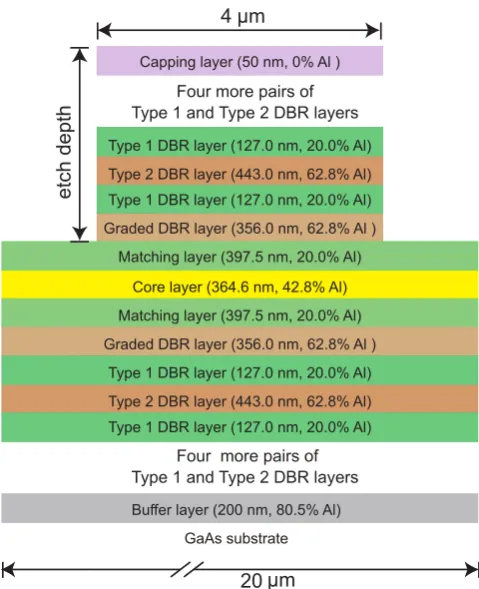
First, we investigate the effect of certain geometric and material parameters on the operating wavelength of our sample. We regard thegradedBRW design from[29], which was optimized for simpler fabrication while maintaining a high efficiency for the desired PDC process. Figure1shows the cross-section and main parameters of the structure. This ridge waveguide consists of a core layer and two matching layers (ML) around the core, which are surrounded by six pairs of distributed Bragg reflectors (DBRs). The phase matching condition is fulfilled by guiding the pump light in
the so-called Bragg mode, which is a higher-order spatial mode, whereas the PDC photon pairs are generated in total internal reflection modes. The phase matching is defined by the dispersion of the modes and is heavily affected by the material composition and geometric layout of the ridge. Therefore, it is very sensitive to the structural parameters, i.e. the layer thicknesses and their aluminum contents as well as the width and height of the ridge. Such deviations may arise for example due to imperfections in the fabrication process.
We employ a commercial mode solver[30]to determine the dispersion of the eigenmodes. The nominal design, which is depicted infigure1, has a ridge width of 4μm and a height of approximately 3.3μm denoted here as the etch depth. We use the model of Gehrsitzet alin[25]to estimate the refractive indices of the individual layers, which are greatly dependent on their aluminum concentrations. The graded BRW supports a type-2 PDC process such that signal and idler are cross-polarized. After solving the dispersion of the interacting modes, the phase matched wavelength triplets are found by searching for solutions ofns( )l ls s+ni( )l li i=np(lp) lp
with 1 ls+1 li=1 lp, in which nμ(λμ) (μ=s, i, p)
describe the effective refractive indices of the signal (s), idler
[image:3.595.307.547.65.360.2](i)and pump(p)modes in terms of the wavelengthλ. At the
degeneracyλs=λi=2λp, which we call the phase matching
wavelength. For the graded BRW as shown infigure1wefind a phase matching wavelength of 1553.8 nm.
We then vary each layer parameter listed in table1from its specified value by+1%, while keeping the others fixed, and calculate the change in the phase matching wavelength of the graded BRW shown as case (i). It is apparent, that an increment in the layer thicknesses also increases the phase matching wavelength, while when regarding the aluminum contents the opposite is observed. This effectively means that one can simply scale the structure to achieve another phase matching wavelength without having to re-engineer the epi-taxial structure. Moreover, we remark that these sensitivities have to be considered in the context of the practically achievable fabrication accuracies. We expect thickness accuracies better than 5% and aluminum content accuracies of 2 in absolute percentage points. As with case(ii)in table 1, we show the variation in the phase matching wavelength for the design infigure1 caused by the fabrication tolerance in the listed layer parameter, while the others are kept constant. The ridge width [31, 32] and etch depth allow some posterior changes of the phase matching wavelength. After the epitaxial growth of the layers, their thickness can be determined and the ridge width and height can be adjusted accordingly. We show this effect infigure2, which illustrates the phase matching wavelength in terms of a typical range of ridge widths for different etch depths. The deeper etches cause the phase matching wavelength to depend stronger on the ridge width. Additionally, one can clearly see the increased effect of the stronger horizontal confinement of the modes for very narrow waveguides. Thus, the tuning range provided by employing different ridge widths greatly depends on the used etch depth.
3. Temporal overlap of signal and idler
While the effective refractive indices of signal, idler and pump determine the exact phase matching wavelength, the
effective group refractive indices of these modes play a crucial role when regarding the spectro-temporal properties of the created photon pairs. For example, if signal and idler group velocities differ from each other, their wavepackets walk temporally off during the propagation in the BRW, which results in temporal distinguishability. Some applica-tions, such as the generation of polarization entanglement, which we investigate in more detail in section 5, are very sensitive to this average DGD. Only if it is negligible can such a scheme be implemented without external optical delay compensation[19,33]. The average DGD between the signal and idler wavepackets is given by
L
v v
L
c n n
DGD 2
1 1
2 , 1
s i
s i
= - =
-˜ ˜ ∣ ˜ ˜ ∣ ( )
where Lis the length of the waveguide,v˜s and v˜i (n˜s andn˜i)
indicate the group velocities (group refractive indices) of signal and idler, respectively, and cis the speed of light in vacuum. The group refractive index of each mode is defined as
n n dn
d 2
w w
= +
m m m
˜ ( )
in terms of its effective refractive index and angular frequency
ω=2πc/λ.
[image:4.595.306.549.63.255.2]One usually resorts to numerical simulations in order to accurately predict the BRW properties since an analytical solution yielding the effective refractive indices of BRW modes is only approximately possible for much simpler structures than the ones regarded here. In our graded BRW, the spatial modes of signal and idler mostly propagate in the ML and are confined by the surrounding core and graded DBR layers. Following West and Helmy [23], who showed that the aluminum content of the surrounding layers affect the dispersion of the total-internal reflection and Bragg modes strongly, we investigate the effect of these layers on the dispersion between signal and idler. As shown infigure3, we
Table 1.Shift in the phase matching wavelength(i)caused by+1% relative variation in the listed layer parameter and(ii)expected for the graded BRW fromfigure1within the fabrication tolerances
(+5% deviation in the layer thickness or+2 percentage point change in their Al contents). We note that the refractive index model is the main source of numerical imperfections in our approach. Due to the accuracy of 10−4in the refractive indices, we report the expected phase matching wavelength shifts in(ii)with the precision of 0.01 nm.
Parameter (i) (ii)
[image:4.595.74.268.163.275.2]ML thickness +3.066 nm +14.36 nm ML Al content −0.287 nm −2.45 nm CL thickness +1.856 nm +9.30 nm CL Al content −0.661 nm −3.46 nm Type 1 DBR thickness +0.098 nm +0.53 nm Type 1 DBR Al content −0.244 nm −0.61 nm Type 2 DBR thickness +0.044 nm +0.22 nm Type 2 DBR Al content −0.027 nm −0.27 nm
Figure 2.Phase matching wavelength in terms of the ridge width for different etch depths. The symbols illustrate the simulated values, while the solid lines provide guides for the eyes.
3
simulate the average DGD per length in our graded BRW as a function of the aluminum content of the core and graded DBR layers, while keeping the other parameters unchanged. We
find that a decrease of the aluminum content in the layers surrounding the ML leads to a lower average DGD.
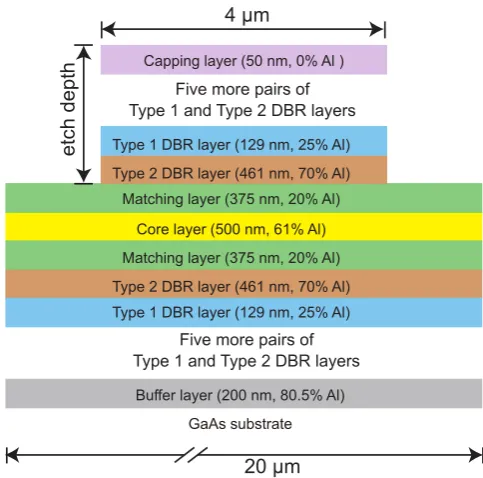
Next, we compare the average DGD in the graded BRW with the one in a typical structure, the multilayer core( M-core)structure shown infigure4, employed by us and others in the past[22,27,34,35]. First, by comparing the aluminum contents of the graded and M-core BRWs it is easy to judge that the graded BRW has a smaller average DGD than the M-core BRW, because the aluminum concentration contrast between core and ML is smaller. Second, we perform a complete simulation of the dispersion of the different modes in these two structures with commercial solvers and present in table2the group refractive indices of the relevant modes. In the graded BRW, the group index difference between signal and idler is only 2.6×10⁻³, which corresponds to a small remaining average DGD of only 4.4 fs mm−1, whereas that in the M-core BRW is 3.6 times larger.
4. Spectral overlap of signal and idler
The effective group refractive indices of signal and idler not only cause a temporal delay between their wavepackets, but also considerably influence their joint spectral properties. Since the signal and idler beams from our BRWs are cross-polarized, their group refractive indices differ slightly from each other as presented in table2. In our case, this leads to spectral distinguishability between signal and idler, since their allowed frequency ranges differ from each other. Next, we study its effect.
The photon-pair state generated in the PDC process is given as [36]
N f a a
1 d s d i s, i H s V i 0 , 3
yñ=
∬
w w w w w w ñ ∣ ( ) ˆ ( ) ˆ ( )∣† † ( )wheref(ωs,ωi)is the joint spectral amplitude(JSA)expressed
in terms of the signal and idler angular frequencies, respec-tively, and aˆH,V† is the photon creation operator generating photons either in horizontal(H)or vertical (V) polarization. With the help of the constant factorNthe JSA is normalized to 1 N
∬
dw wsd i∣ (f w ws, i)∣2 =1. Due to energyconserva-tion,ωs+ωi=ωpis maintained in the PDC process withωp
denoting the angular frequency of pump.
Following[27,34], we write the JSA as a product of the pump beam spectral envelopea w( p)=exp( (-wp-v)2 s2),
in whichσis related to the pump bandwidth andϖdenotes its central angular frequency, and the phase matching function
k L e
, sinc , 2
s i s i i k s, i L 2
[image:5.595.305.547.67.306.2]f w w( )= (D (w w) ) - D (w w) , in which Figure 3.Simulated differential group delay(DGD)per length near
1550 nm in terms of the aluminum content in the layers surrounding the matching layers. The red dot marks the position of the graded BRW structure fromfigure1in terms of its respective Al contents.
[image:5.595.50.293.69.260.2]Figure 4.Layer structure of the M-core BRW with different kinds of layers visualized with different colors. The waveguide core(yellow slab)is enclosed by the matching layers. The distributed Bragg-reflector(DBR)stacks surround this region on top and bottom. Each stack includes six layers of type 1 and type 2 DBR layers. The layer thicknesses and their aluminum contents are indicated in brackets.
Table 2.Comparison of the group refractive indices for the graded and M-core BRW structures. The group refractive indices of signal and idler andD =n˜ n˜s-n˜iare given near 1550 nm, whereas that of the pump mode is calculated near 775 nm.
Structure n˜s n˜i Dn˜ n˜p
Graded BRW(figure1) 3.3633 3.3607 0.0026 4.3921 M-core BRW(figure4) 3.3385 3.3292 0.0093 4.0363
[34] 3.33 3.32 0.01 4.05
[image:5.595.306.549.444.514.2]k w ws, i ks ws ki wi kp wp
D ( )= ( )+ ( )- ( )accounts for the phase mismatch. We describe it in terms of the propagation constants
km(wm)=nm(w wm) m c (μ=s,i,p)of signal, idler, and pump.
Moreover, we investigate the JSA around a phase matched frequency triplet w0s+wi0=w0p, for which k
, 0
s i
0 0 w w D ( )= . Thus, we re-write the phase mismatch in terms of the detunings
0
nm=wm-wmand approximate it as
k
K K K K K
1 2 1 2 ,
s s i i
s p 2s i p i2 p s i
k n k n
n n n n
D » +
+ ( - ) + ( - )
-in which κμ=1/c n np p
0 0
w - w
m m
[ ˜ ( ) ˜ ( )] and Km=
c
1 dndw 0
w w w=
m m ∣ ˜ ( )
are related to the effective group refractive indices of the interacting modes.
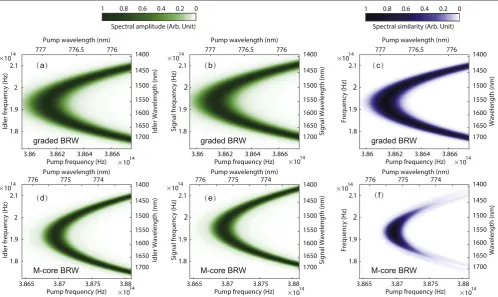
In table3, we list the phase matching parameters for the two investigated BRW designs. With these parameters we simulate the photon-pair characteristics assuming a Gaussian pump amplitude with a full width at half maximum(FWHM) of 0.25 nm and a waveguide length of 2 mm. We keep these parameters the same in all the following simulations. For the graded BRW structure we illustrate in figures 5(a)–(b) the
single-photon spectra of signal and idler, respectively, as well as in figure 5(c) their product for a better visualization of the similarity of their spectral extent. Infigures 5(d)–(f), we present the same for the M-core BRW structure. Since the spectral extent of signal and idler depends strongly on the group refractive indices of the interacting modes, a comparison between figures 5(c) and (f) clearly reveals the differences in the optical properties of PDC photons emitted from the two investigated BRW structures.
In order to investigate the spectro-temporal indis-tinguishability of signal and idler, we calculate their overlap given by[37,38]
f f e
f
d d , ,
d d , 4
s i s i i s i
s i s i 2
s i
*
t w w w w w w
w w w w =
w-w t
∬
∬
( ) ( ) ( )
∣ ( )∣ ( )
( )
[image:6.595.51.550.63.360.2]in terms of a temporal delay τ, which can be introduced by retarding the signal and idler wavepackets relative to each other. The overlap measures the symmetry of the JSA with respect to the exchange of signal and idler frequencies and includes also a temporal compensation. In figure 6(a) we
Table 3.Comparison of the JSA parameters for the graded and M-core BRW designs. The parameterλddenotes the design degeneracy
wavelength.
Structure κμ(fsμm− 1)
K fs2mm 1
m( -) λ
d(nm)
s i s i p
[image:6.595.145.452.429.491.2]Graded BRW(figure1) −3.429 −3.438 1.217 1.181 10.834 1 553.8 M-core BRW(figure4) −2.326 −2.358 1.370 1.358 5.068 1 550.6
Figure 5.Calculated single-photon spectrum of(a)signal and(b)idler for the graded BRW structure as well as(c)their product for visualizing the similarity of the generated spectral bands. In(d)–(f), we present the same for the M-core BRW structure.
5
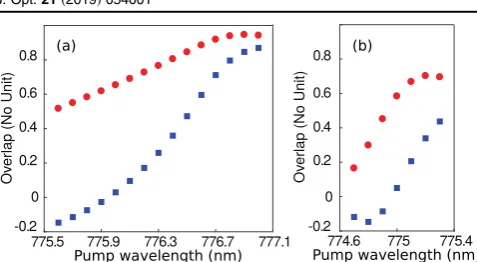
present the overlap values for the graded BRW structure and infigure6(b) for the M-core BRW structure with respect to the central wavelength of the pump beam. The overlap reaches a value as high as 85%(44%)for the graded(M-core) BRW structure without any temporal compensation. If the optimal temporal compensation∣ ∣tc =DGDof approximately
9 fs(31 fs)is applied, the value of the overlap increases to its maximal valuemax.of 94.6% (69.5%). When detuning the
pump towards shorter wavelengths, the overlap gradually decreases for both investigated BRWs. However, the decay is faster in the M-core BRW structure due to the worse spectral similarity. The overlap value can even become negative if the temporal delay between signal and idler is not compensated. This effect can be taken advantage of when investigating the bunching of photon pairs next in section5.
5. BRWs in quantum optics applications
The spectro-temporal properties of photon pairs play a crucial role when adapting a PDC source to a quantum optics task. Therefore, we compare the performance of both investigated BRW structures in such applications. We start by exploring their suitability for a HOM quantum interference experiment
[39–41] and thereafter study the preparation of spectrally multi-band polarization entanglement[17,18,33].
In the HOM interference experiment[3]as sketched in
figure 7, the probability Pof measuring a coincidence click between the output ports of a symmetric beam splitter, when sending a photon-pair from PDC to its input ports, is directly connected to the overlap in equation(4)and is given by[37]
P 1
2 1
2t 5
= - ( ) ( )
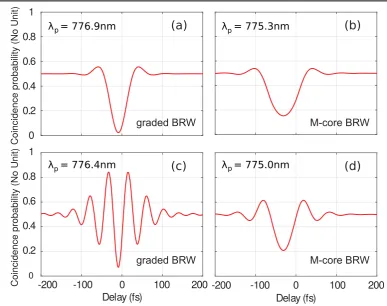
assuming that our BRW emits PDC with only a small amount of spurious noise such that the background from higher-photon number contributions can be neglected [42]. We simulate the HOM interference for the two investigated BRW structures at their respective degeneracy wavelengths and far away from them. In figures 8(a) and (b), we illustrate the HOM dips at the degeneracy, that is, the PDC processes in the
graded and M-core BRW structures are pumped at the wavelengths of 776.9 nm and 775.3 nm, respectively. Clearly, the graded BRW structure can produce photon pairs with a higher indistinguishability than the M-core BRW. By utilizing equation (5) the HOM dip visibility given by
P t ¥ -P t=tc P t ¥
[ ( ) ( )] ( ) reduces to max for
the cases infigures8(a)and(b)and takes the values reported in section 4. When detuning the central wavelength of the pump towards shorter wavelengths, the HOM interference starts showing fringes, if signal and idler are generated in two separate spectral regions [43]. In figure 8(c), we show this HOM interference pattern for the graded BRW structure at a pump wavelength of 776.4 nm, which illustrates that we can utilize the material dispersion to control the HOM dip char-acteristics without spectralfiltering. However, this is not the case with the M-core BRW structure, in which the visibility of the HOM dip drops as we tune the pump wavelength to 775.0 nm and hardly shows any fringes, as illustrated in
figure8(d).
Finally, we use the scheme in figure 9 for generating polarization entangled states with multiple spectral bands that are free from temporal delay compensation [17, 18,33]. In the absence of background light, the density matrix of the polarization entangled state takes the form[19],
HV HV VH HV
HV VH VH VH , 6
*
r a
b
= ñá + ñá
+ ñá + ñá
∣ ∣ ∣ ∣
∣ ∣ ∣ ∣ ( )
in which ∣Hñ and ∣Vñ describe a single-photon state with horizontal polarization (signal) and vertical polarization
(idler), respectively. In equation (6), the diagonal elements take the form α=1/
∬
dw wsd i∣ (g w ws, i)∣2 and β=1/
∬
dw wsd i∣ (h w ws, i)∣2 with being a normalizationconstant, whereas the off-diagonal elements are described as
h g
1 d sd i i, s * s, i 7
=
∬
w w (w w) (w w) ( )with
g(w ws, i)=f(w ws, i)G1( )ws G2( )wi T( ) ( )ws R wi , ( )8
and
[image:7.595.50.289.57.188.2]h(w ws, i)=f(w ws, i)G1( )wi G2( )ws T( ) ( )wi R ws . ( )9 Figure 6.The overlap in the(a)graded and(b)M-core BRW
structures calculated via equation(4)in terms of the pump wavelength. The red circles illustrate the overlap between signal and idler atτ=0, while the blue squares represent the overlap achieved, when the signal and idler wavepackets are delayed withτ=τcthat
[image:7.595.300.549.62.186.2]is−9 fs in(a)and−31 fs in(b).
In equations (8) and (9), G1 e
12
1 2
w = -w ws -( )
( )
and G2( )w = e
22
2 2
-w w
s
-( )
describe the amplitudes of Gaussian bandpassfilters with central angular frequenciesω1andω2and bandwidthsσ1
andσ2, respectively, whileT(ω)andR(ω)are the transmittance
and reflectance of the dichroic mirror infigure9, for whichT
(ω)+R(ω)=1. For simplicity, we takeT(ω)andR(ω)as step functions having the cut-off wavelength at the degeneracy.
Due to the normalization, the diagonal elements of the density matrix in equation (6)obey the relationα+β=1, while the off-diagonal elementsand*, called coherences, can be used to quantify the amount of entanglement. Ideally, for a maximally entangled statea=b=∣ ∣ =1 2. Thus, the behavior of the -parameter is especially interesting, because any decrease in its value means a reduced amount of created entanglement.
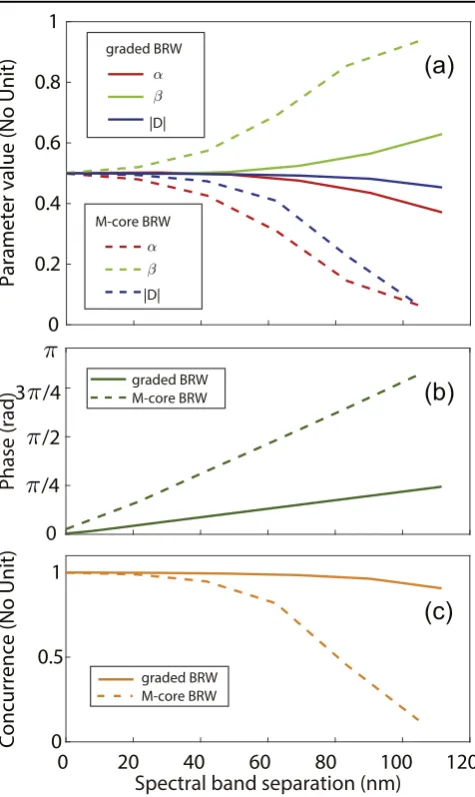
In figure10, we show the density matrix elements from equation (6) for the two investigated BRW structures with respect to the separation ∣w2-w1∣ of the signal and idler
spectral bands. We simulate the PDC processes at the degeneracy and and use narrowband spectral Gaussianfilters with a FWHM of 2 nm for creating entangled photon pairs in different spectral bands obeying the energy conservation
ω1+ω2=ωp. From figure 10(a), we see that the density
[image:8.595.101.489.62.368.2]matrix elements calculated for the graded BRW structure are more robust against a large spectral band separation than those calculated for the M-core BRW structure. Additionally, the phase of the -parameter infigure 10(b)is varying less for the graded BRW structure than for the M-core BRW structure. This indicates that the entangled states generated in different frequency bands have more uniform characteristics if the average DGD is small. Finally, in figure 10(c), we quantify the achievable entanglement in both BRW structures with the concurrence[44].
Figure 8.HOM interference in the two investigated BRW structures. The comparison of the HOM dips at the degeneracy for(a)the graded and(b)M-core BRW structures without anyfilters reveals the clear difference in the spectral indistinguishability of signal and idler. In
(c)and(d), we illustrate the coincidence click probabilities without anyfilters for the graded and M-core BRW structures when the pump wavelength is moved to 776.4 nm and 775.0 nm, respectively.
Figure 9.Scheme for generating polarization entangled states between the paths A and B. Abbreviations: DM: dichroic mirror; WDM: wavelength division multiplexer.
7
[image:8.595.51.289.429.606.2]Apart from the temporal walk-off of signal and idler, also their spectral overlap plays a crucial role in the generation of polarization entanglement. The asymmetry of the JSA with respect to the degeneracy as shown in figure 11 for the M-core BRW structure is the reason for the highly imbal-anced diagonal elementsαandβinfigure10(a)and the low concurrence infigure10(c). To summarize, our results show that the layer parameters of BRWs have to be carefully designed in order to optimize their performance in quantum optical applications.
6. Conclusion
Direct engineering of the spectro-temporal properties of PDC emission is of great importance for preparing quantum optical states with high quality. We investigated how the shape and the material composition of a BRW affect its optical prop-erties, like the phase matching wavelength and the group
indices of the interacting modes and showed that our design is to a well-manageable degree tolerant against variations. We further investigated, how the effective group refractive index difference between signal and idler can be manipulated. Our BRW design results in good spectral and temporal overlap between signal and idler, which makes our structure well-suited for different quantum optics tasks both at the degen-eracy and far away from it.
Acknowledgments
This work was supported by the Austrian Science Fund
(FWF)through the Project Nos.I-2065 and J-4125, the DFG Project No. SCHN1376/2-1, the State of Bavaria, China Scholarship Council Project No. 201503170272, and Natural Science Foundation of Hunan Province of China Project No. 2018JJ2467.
ORCID iDs
K Laiho https://orcid.org/0000-0003-3090-8629
B Pressl https://orcid.org/0000-0001-9098-555X
S Höfling https://orcid.org/0000-0003-0034-4682
G Weihs https://orcid.org/0000-0003-2260-3008
References
[image:9.595.51.289.62.461.2][1] Caspani L, Xiong C, Eggleton B J, Bajoni D, Liscidini M, Galli M, Morandotti R and Moss D J 2017 Integrated sources of photon quantum states based on nonlinear optics Light Sci. Appl.6e17100
Figure 10.Simulation of the properties of the density matrix in equation(6)for the two investigated BRW structures.(a)The simulated values ofα,βand∣ ∣,(b)the phase of the D-parameter
[image:9.595.308.548.67.250.2](∣arg( )∣ )and(c)the concurrence are illustrated with respect to the spectral band separation in the paths A and B infigure9.
[2] Flamini F, Spagnolo N and Sciarrino F 2019 Photonic quantum information processing: a reviewRep. Prog. Phys.82
016001
[3] Hong C K, Ou Z Y and Mandel L 1987 Measurement of subpicosecond time intervals between two photons by interferencePhys. Rev. Lett.592044
[4] Evans P G, Bennink R S, Grice W P, Humble T S and Schaake J 2010 Bright source of spectrally uncorrelated polarization-entangled photons with nearly single-mode emissionPhys. Rev. Lett.105253601
[5] Zhu E Y, Tang Z, Qian L, Helt L G, Liscidini M, Sipe J E, Corbari C, Canagasabey A, Ibsen M and Kazansky P G 2012 Direct generation of polarization-entangled photon pairs in a poledfiberPhys. Rev. Lett.108
213902
[6] Bruno N, Martin A, Guerreiro T, Sanguinetti B and Thew R T 2014 Pulsed source of spectrally uncorrelated and
indistinguishable photons at telecom wavelengthsOpt. Express2217246
[7] Kang D, Pang A, Zhao Y and Helmy A S 2014 Two-photon quantum state engineering in nonlinear photonic nanowires J. Opt. Soc. Am.B311581
[8] Laiho K, Christ A, Cassemiro K N and Silberhorn C 2011 Testing spectralfilters as gaussian quantum optical channels Opt. Lett.361476
[9] Bruno N, Cruzeiro E Z, Martin A and Thew R T 2014 Simple, pulsed, polarization entangled photon pair sourceOpt. Commun.3273
[10] Silverstone J Wet al2014 On-chip quantum interference between silicon photon-pair sourcesNat. Photon.8104
[11] Donohue J M, Mastrovich M and Resch K J 2016 Spectrally engineering photonic entanglement with a time lensPhys. Rev. Lett.117243602
[12] Wright L J, Karpinski M, Söller C and Smith B J 2017 Spectral shearing of quantum light pulses by electro-optic phase modulationPhys. Rev. Lett.118023601
[13] Grimau Puigibert M, Aguilar G H, Zhou Q, Marsili F, Shaw M D, Verma V B, Nam S W, Oblak D and Tittel W 2017 Heralded single photons based on spectral
multiplexing and feed-forward controlPhys. Rev. Lett.119
083601
[14] Ansari Vet al2018 Heralded generation of high-purity ultrashort single photons in programmable temporal shapes Opt. Express262764
[15] Zhukovsky S V, Helt L G, Kang D, Abolghasem P, Helmy A S and Sipe J E 2012 Generation of maximally-polarization-entangled photons on a chipPhys. Rev.A85 013838
[16] Horn R Tet al2013 Inherent polarization entanglement generated from a monolithic semiconductor chipSci. Rep.
32314
[17] Kang D, Anirban A and Helmy A S 2016 Monolithic semiconductor chips as a source for broadband wavelength-multiplexed polarization entangled photonsOpt. Express24
15160
[18] Autebert C, Trapateau J, Orieux A, Lemaître A,
Gomez-Carbonell C, Diamanti E, Zaquine I and Ducci S 2016 Multi-user quantum key distribution with entangled photons from an AlGaAs chipQuantum Sci. Technol.1
01LT02
[19] Schlager A, Pressl B, Laiho K, Suchomel H, Kamp M, Höfling S, Schneider C and Weihs G 2017 Temporally versatile polarization entanglement from Bragg reflection waveguidesOpt. Lett.422102
[20] Lanco L, Ducci S, Likforman J-P, Marcadet X,
Van Houwelingen J A W, Zbinden H, Leo G and Berger V 2006 Semiconductor waveguide source of
counterpropagating twin photonsPhys. Rev. Lett.97173901
[21] SarrafiP, Zhu E Y, Dolgaleva K, Holmes B M, Hutchings D C, Aitchison J S and Qian L 2013 Continuous-wave quasi-phase-matched waveguide correlated photon pair source on a III–V chipAppl. Phys. Lett.103251115
[22] Horn R, Abolghasem P, Bijlani B J, Kang D, Helmy A S and Weihs G 2012 Monolithic source of photon pairsPhys. Rev. Lett.108153605
[23] West B R and Helmy A S 2006 Analysis and design equations for phase matching using Bragg reflector waveguidesIEEE J. Quantum Electron.12431
[24] Helmy A S 2006 Phase matching using Bragg reflection waveguides for monolithic nonlinear optics applications Opt. Express141243
[25] Gehrsitz S, Reinhart F K, Gourgon C, Herres N,
Vonlanthen A and Sigg H 2000 The refractive index of AlxGa1-xas below the band gap: accurate determination and empirical modelingJ. Appl. Phys.877825
[26] Pressl B, Günthner T, Laiho K, Geßler J, Kamp M, Höfling S, Schneider C and Weihs G 2015 Mode-resolved Fabry-Perot experiment in low-loss Bragg-reflection waveguidesOpt. Express2333608
[27] Laiho K, Pressl B, Schlager A, Suchomel H, Kamp M, Höfling S, Schneider C and Weihs G 2016 Uncovering dispersion properties in semiconductor waveguides to study photon-pair generationNanotechnology27434003
[28] Misiaszek M, Gajewski A and Kolenderski P 2018 Dispersion measurement method with down conversion processJ. Phys. Commun.2065014
[29] Pressl Bet al2018 Semi-automatic engineering and tailoring of high-efficiency Bragg-reflection waveguide samples for quantum photonic applicationsQuantum Sci. Technol.3
024002
[30] COMSOL Multiphysics 2019www.comsol.comCOMSOL AB(Stockholm, Sweden)
[31] Bijlani B, Abolghasem P and Helmy A S 2008 Second harmonic generation in ridge Bragg reflection waveguides Appl. Phys. Lett.92101124
[32] Abolghasem P, Han J, Bijlani B J, Arjmand A and Helmy Continuous-wave A S 2009 Second harmonic generation in Bragg reflection waveguidesOpt. Express
179460
[33] Chen C, Zhu E Y, Riazi A, Gladyshev A V, Corbari C, Ibsen M, Kazansky P G and Qian L 2017 Compensation-free broadband entangled photon pair sourcesOpt. Express
2522667
[34] Günthner T, Pressl B, Laiho K, Geßler J, Höfling S, Kamp M, Schneider C and Weihs G 2015 Broadband
indistinguishability from bright parametric downconversion in a semiconductor waveguideJ. Opt.17125201
[35] Abolghasem P, Han J, Bijlani B J, Arjmand A and Helmy A S 2009 Highly efficient second-harmonic generation in monolithic matching layer enhanced AlxGa1-x as Bragg reflection waveguidesIEEE Photonics Technol. Lett.211462
[36] Grice W P, U’Ren A B and Walmsley I A 2001 Eliminating frequency and space-time correlations in multiphoton states Phys. Rev.A64063815
[37] Grice W P and Walmsley I A 1997 Spectral information and distinguishability in type-II down-conversion with broadband pumpPhys. Rev.A561627
[38] Avenhaus M, Chekhova M V, Krivitsky L A, Leuchs G and Silberhorn C 2009 Experimental verification of high spectral entanglement for pulsed waveguided spontaneous
parametric down-conversionPhys. Rev.A79043836
[39] Zhukovsky S V, Helt L G, Kang D, Abolghasem P, Helmy A S and Sipe J E 2013 Analytical description of photonic waveguides with multilayer claddings: towards on-chip generation of entangled photons and bell statesOpt. Commun.301127
9
[40] Jin R-B, Shiina R and Shimizu R 2018 Quantum manipulation of biphoton spectral distributions in a 2D frequency space toward arbitrary shaping of a biphoton wave packetOpt. Express2621153
[41] Graffitti F, Barrow P, Proietti M, Kundys D and Fedrizzi A 2018 Independent high-purity photons created in domain-engineered crystalsOptica5514
[42] Chen Het al2018 Time-bin entangled photon pairs from Bragg-reflection waveguidesAPL Photonics3080804
[43] Eckstein A and Silberhorn C 2008 Broadband frequency mode entanglement in waveguided parametric downconversion Opt. Lett.331825