51
Language Identification and Analysis of Code-Switched
Social Media Text
Deepthi Mave, Suraj Maharjan and Thamar Solorio
Department of Computer Science University of Houston
{dmave, smaharjan2}@uh.edu, [email protected]
Abstract
In this paper, we detail our work on comparing different word-level lan-guage identification systems for code-switched Hindi-English data and a stan-dard Spanish-English dataset. In this regard, we build a new code-switched dataset for Hindi-English. To understand the code-switching patterns in these lan-guage pairs, we investigate different code-switching metrics. We find that the CRF model outperforms the neural network based models by a margin of 2-5 percent-age points for Spanish-English and 3-5 percentage points for Hindi-English.
1 Introduction
Code-switching occurs when a person switches between two or more languages in a single instance of spoken or written communication (Gumperz, 1982; Myers-Scotton, 1997). Code-switching instances are prevalent in modern formal communications between multilingual in-dividuals specially, in social media platforms such as Facebook and Twitter. Given this prevalence of code-switching, there is value in automatic pro-cessing and understanding of such data. Language identification at the word level is the first step in computational modeling of code-switched data. Language identification is important for a wide variety of end user applications such as informa-tion extracinforma-tion systems, voice assistant interfaces, machine translation, as well as for tools to assist language assessment in bilingual children (Gupta et al.,2014;Chandu et al.,2017;Roy et al.,2013). Language detection, in addition, enables sociolin-guistics and pragmatic studies of code-switching behavior.
Code-switching in speech is well studied in
linguistics, psycholinguistic and sociolinguistics (Sankoff, 1970; Lipski, 1978; Poplack, 1980;
Gumperz, 1982; Auer, 1984; Myers-Scotton,
1997,2002). The alternation of languages across sentence boundaries is known as code-switching and the alternation within a sentence is known as code-mixing. In this paper we will refer to both instances as code-switching and differentiate be-tween the types of code switching when neces-sary. Table 1shows examples of code-switching for Hindi-English and Spanish-English.
Example 1
Good morning sirji,aaj kaweatherkaisa hai? (Good morning sir, How is the weather today?) Example 2
Styling daytrabajando con@username vestuario para#ElFactorXy soy hoy chofer. I will get you there in pieces im a Safe Driver. (Styling day working with @username
wardrobe for #ElFactorX and today I am a driver. I will get you there in pieces im a Safe Driver.)
Table 1: Example 1 shows code-switching be-tween Hindi-English and Example 2 bebe-tween Spanish-English (Molina et al.,2016).
Word level language identification of code-switched text is inherently difficult. First, a sin-gle code-switched instance can have mixing at the sentence or clause level, the word level, and even at the sub-word level (e.g. sir-ji, chapathi -s). Second, the typology of the languages involved in switching and their inter-relatedness further in-crease the task complexity. For example, a shared Latin influence on Spanish and English results in lexical relatedness (Smith, 2001; August et al.,
transliterated. Transliteration is conversion of a text from one script to another. In the case of Hindi, text is converted from native, Devanagari to Roman script. Due to lack of standardization in transliteration, a single Hindi word can have multiple surface forms (e.g. Humara, Hamara, Hamaaraaetc.). Some Hindi words can take the same surface form as an English word. The words
’hi’(an auxiliary verb),’is’(this), and’us’ (that) are some examples. Finally, the characteristics of social media text such as non-standard spelling, contractions, and not strictly adhering to the gram-mar of the language adds to the list of challenges.
In this work, we make three contributions. First, we build a new code-switched dataset for Hindi-English (HIN-ENG) language pair from Facebook public pages and Twitter. Second, we investi-gate different code-switching metrics for Hindi-English and a standard Spanish-Hindi-English (SPA-ENG) dataset. Third, we compare a traditional machine learning model - conditional random field (CRF), and two recurrent neural network (RNN) based systems, for word-level language identifica-tion of the above language pairs. In contrast to the CRF model, the RNN-based systems do not in-volve language specific resources or sophisticated feature engineering. We test these models, first for each of the language pairs individually, and then for a corpus with both the language pairs com-bined.
Among the language identification systems, the CRF model outperforms both the RNN-based sys-tems across language pairs. When both the lan-guage pairs are combined, the result from the best performing model (CRF) is 25% points higher than the baseline system. The RNN-based mod-els also give reasonable results.
2 Related Work
Over the last decade several researchers have ex-plored word-level language identification for dif-ferent language pairs and dialect varieties. The FIRE shared task series - (Roy et al.,2013; Choud-hury et al.,2014;Sequiera et al.,2015b) focuses on language identification of code-mixed search queries in English and Indian languages for in-formation retrieval. We use a larger set of labels compared to these tasks. The First and Second Shared Task on Language Identification in Code-Switched Data (Solorio et al.,2014;Molina et al.,
2016) show the necessity for automatic
process-ing of code-switched text and report comparison of different language identification systems. The best system from the second iteration of these shared tasks uses a logistic regression model and reports a token-level F1-score of97.3%for SPA-ENG. Our results are competitive with this score.
Das and Gamb¨ack (2014) use a dictionary based method and SVM model with various features for Hindi-English and Bengali-English. Their system achieves an F1-score of 79% for Hindi-English.
Barman et al. (2014) create a new dataset and study code mixing between the three languages -English, Hindi, and Bengali using CRF and SVM models. In another work,Gella et al.(2014) build a language detection system for synthetically cre-ated code-mixed dataset for 28 languages. Similar to some of the works in the above mentioned pa-pers, we model the language detection task as a sequence labeling problem and explore combina-tions of several features using the CRF model, but we use a larger set of labels. We obtain signif-icantly higher performance for the Hindi-English language pair thanDas and Gamb¨ack(2014).
Along with the traditional machine learning ap-proach, some researchers have also used mod-els based on artificial neural networks. Chang and Lin (2014) use an RNN architecture with pre-trained word2vec embeddings for SPA-ENG and the Nepali-English datasets from the First Shared Task on Language Identification in Code-Switched Data. Samih et al. (2016) build an LSTM based neural network architecture for SPA-ENG and MSA-DA datasets from the Second Shared Task on Language Identification in Code-Switched Data. Their model combines word and character representations initialized with pre-trained word2vec embeddings. We replicate their model with softmax output layer for SPA-ENG and run similar experiments for HIN-ENG, as well as with both the corpora combined. Our result for SPA-ENG match that ofSamih et al.(2016).
3 Data
We use the SPA-ENG dataset from the EMNLP Code-Switching Workshop 2016. This data is col-lected from Twitter, based on the geographical ar-eas with strong presence of Spanish and English bilingual speakers - California, Texas, Miami, and New York (Solorio et al., 2014; Molina et al.,
2016). The labels used are summarized in Table
la-Label Description HIN-ENG (%) SPA-ENG (%)
lang1 English words only 57.764 38.258
lang2 Hindi/Spanish words only 20.418 40.579
ne Proper names 6.582 1.935
other Symbols, usernames, emoticons 14.807 18.952 mixed Words partially in both the languages 0.04 0.018 ambiguous Can’t determine whether English or Hindi/Spanish 0.009 0.137 fw Words is not English neither Hindi/Spanish 0.369 0.01
[image:3.595.75.524.62.179.2]unk Unrecognizable word 0.012 0.11
Table 2: A brief description of the labels and label distribution for HIN-ENG and SPA-ENG datasets.
beled accordingly.
Corpus Creation for Hindi-English. For the HIN-ENG corpus, we consider Facebook pages of prominent public figures from India. Hindi-English bilingual users are highly active in these pages (Bali et al.,2014). We crawl posts and their comments from the Facebook public pages of var-ious sports-persons, political figures, and movie stars. We also crawl random tweets from geo-graphical locations Mumbai and Delhi using the Twitter API. From the crawled posts, we remove the posts in native scripts, and remove duplicate and promotional posts. We filter the posts con-taining URLs and those with less than 3 words.
Language Pair Tweets Tokens Unique
Pair (Posts) Tokens (%)
[image:3.595.314.517.538.588.2]SPA-ENG 25,130 294,261 35,153 (11.95) HIN-ENG 7,421 146,722 23,998 (16.36)
Table 3: Corpus statistics for the language pairs. Token ratio is the percentage of the total tokens that are unique. A higher token ratio implies a richer corpus vocabulary.
We follow EMNLP 2016 shared task annota-tion guidelines and use a semi-automatic approach to annotate the data. The labels are reviewed and corrected with the help of in-lab annotators. The inter-annotator agreement score over approx-imately 4,000 tokens is 0.935. A portion of the Facebook dataset is annotated using the En-glish lexicon and Hindi transliterated pairs.1,2We use pattern matching rules to label punctuations, emoticons, and usernames. These labels are then corrected manually forne,fw,mixed,ambiguous, and unk labels. We also make use of two exist-ing datasets - Facebook dataset from ICON2016 POS tagging shared task and the dataset from (
Se-1
http://wortschatz.uni-leipzig.de/en/download
2http://cse.iitkgp.ac.in/resgrp/cnerg/qa/fire13translit/
quiera et al., 2015a).3 We manually map the la-bels of these data sets to lala-bels in Table 2. We train a character n-gram based CRF model using the above mentioned three datasets (see Section 5.2) and predict the labels for all the posts crawled from Facebook and the random tweets from Twit-ter. From these, we identify the posts predicted as code-switched, correct the labels where necessary, and add them to the final dataset. The F1-weighted score for this model is close to 96 percent.
4 Code-Switching Analysis
In this section we provide some descriptive statis-tics about the corpora to understand the language distribution and language-relatedness. Table 4
shows the language distribution at post (tweet) level. The SPA-ENG dataset has a balanced dis-tribution where as, in the HIN-ENG dataset ma-jority of the instances are in English. The be-low statistics show that both the datasets have a good amount of code-switched instances to train and test the language identification systems.
Ta-Language CS lang1 lang2 other Pairs Instances
HIN-ENG 43.62 51.77 4.02 0.60
SPA-ENG 34.75 33.53 28.94 2.77
Table 4: Post-level language distribution in the datasets. Column 5 corresponds to the instances that do not have any words with language tags.
lang1: ENG,lang2: HIN/SPA.
ble 2presents the label-wise token distribution for the datasets. For HIN-ENG, majority of the words (58%) are in English, 20% are in Hindi, and 7% are named-entities. The SPA-ENG dataset in com-parison has a balanced distribution of the two lan-guages with 38% of the words in English, 41% in
Figure 1: Vocabulary overlap for labelslang1, lang2, andnefor HIN-ENG and SPAN-ENG.
Spanish, and 2% are named-entities. The higher instances of the named-entities in the HIN-ENG dataset is a result of the way the data is sourced.
Figure 1 shows the overlap between the to-kens belonging to lang1, lang2, and ne. These overlaps introduce ambiguity for the automatic la-beling task. Around 2.5% of the Hindi words in HIN-ENG share the same spelling as some En-glish words because of transliteration of Hindi text to Roman script. In comparison, there is a 6% overlap between Spanish and English words in the SPA-ENG dataset (e.g. no, a, final). This indi-cates higher degree of lexical relatedness between Spanish and English as compared to Hindi and En-glish. The overlap between language words and named-entities is due to words such asuniversity
andunited. These words can be part of names of organizations, movie titles or song titles and can also be used as language constructs in either of the languages.
Figure 2: Plot of character n-grams overlap be-tween the languages in the datasets, for n = 2,3,4,5and6.
In another analysis, we explore the similarity in character n-gram profiles of the languages in-volved (Maharjan et al., 2015). A higher
simi-larity in the character n-grams increases the dif-ficulty of the task. We generate character n-grams of length 2 to 6 from the language vocabularies of each corpora. We show the plot of the charac-ter n-gram overlaps for HIN-ENG and SPA-ENG in Figure 2. As expected, the overlap decreases rapidly with increase in n-gram length. The SPA-ENG n-gram overlap is higher than that of HIN-ENG for all n-gram lengths. This trend is consis-tent with the results in Figure 1. To further un-derstand the complexity involved, for an n-gram occurring in both the languages, we calculate the probability of that n-gram being a part of an En-glish word in the corpus. A probability closer to 50% indicates higher ambiguity in classifying that n-gram. We find that a significant fraction (25%) of these shared n-grams, averaged over all n-gram lengths, appear in the range 40%-60%.
5 Code-Switching Metrics
The coswitching behavior can be different de-pending on the medium of communication, con-text of language use, topic, authors (or speakers), and the languages being mixed among other fac-tors. We compute 3 different metrics to under-stand code-switching patterns in our datasets, as well as to rationalize the performance of the lan-guage identification models.
M-Index: Multilingual index is a word-count-based measure that quantifies the inequality of the language tags distribution in a corpus of at least two languages (Barnett et al.,2000). Equation (1) defines theM-Indexas:
M−Index= 1− P
p2j
(k−1)P
p2j (1)
[image:4.595.79.286.514.660.2]ranges between 0 and 1 where, a value of 0 corre-sponds to a monolingual corpus and 1 correcorre-sponds to a corpus with equal number of tokens from each language.
Integration Index: Integration Index is the ap-proximate probability that any given token in the corpus is a switch point (Guzman et al., 2016;
Guzm´an et al.,2017). Given a corpus composed of tokens tagged by language{lj}whereiranges from1ton−1, the size of the corpus. TheI-index
is computed as follows:
I−Index= 1
n−1
X
1≤i=j−1≤n−1
S(li, lj) (2)
whereS(li, lj)= 1 ifli 6=lj and 0 otherwise. For a corpus with ntokens, there aren−1 possible switch points. It quantifies the frequency of code-switching in a corpus.
Code-Mixing Index: At the utterance level, this is computed by finding the most frequent language in the utterance and then counting the frequency of the words belonging to all other languages present (Gamb¨ack and Das,2014). It is calculated using:
CM I = Pn
i=1(wi)−max(wi)
n−u (3)
wherePn
i=1(wi)is the sum over number of words for allN languages in the utterance,max(wi)is the highest number of words present from any lan-guage,nis the total number of tokens, anduis the number of language independent tokens. Here, we consider the labels lang1, lang2, and fw as lan-guage words and the rest as other. The range of CMI value is[0,100). If an utterance has language independent tokens or only monolingual tokens, then the corresponding CMI value is 0. A higher value of CMI indicates higher level of mixing be-tween the languages. CMI-allis an average over all utterances in the corpus andCMI-mixed is an average over only code-switched instances.
Language M-Index CMI-all CMI-Mixed I-Index Pairs
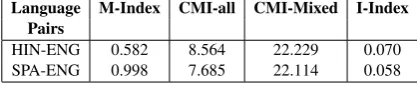
HIN-ENG 0.582 8.564 22.229 0.070
[image:5.595.76.285.631.674.2]SPA-ENG 0.998 7.685 22.114 0.058
Table 5: CS Metrics for the datasets.
SPA-ENG has higherM-Index(Table 5) value indicating a balanced ratio of words from the two languages. This is consistent with the dis-tribution of language words in the datasets (Ta-ble 2). The differences in CMI-all between
HIN-ENG and SPA-ENG is about0.9percentage points and 0.1 percentage points for CMI-mixed. The higher difference for CMI-all could be be-cause of the higher percentage of code-switched instances (9%) in HIN-ENG as compared to SPA-ENG (Table 4). Considering CMI-mixed and
I-Index metrics together, it is evident that HIN-ENG has more language mixing and higher num-ber of code-switching points than SPA-ENG. This is because HIN-ENG has more instances that have multiple word insertions. In SPA-ENG, instances with word insertion at more than one place in an utterance are less frequent. We also observe that a larger majority of code-switching happens be-tween language words in HIN-ENG (76%) than in SPA-ENG (69%). For example, a number of Hindi word insertions are due to the use of the honorary article ji with an address form (Sir/Madam). In general, observing more code-switching in HIN-ENG is due to the fact that code-switching be-tween Hindi and English is very widespread in In-dia (Parshad et al.,2016;Bali et al.,2014).
6 Language Identification Models
We provide below a brief description of each of the models used.
CRF: Language identification is a sequence label-ing task where the label of a token in a sequence is correlated with the labels of its neighboring to-kens. So we use CRF - a sequence labeling model to capture the structure in the data. We explore dif-ferent language independent features such as char-acter n-grams, word unigram, morphological fea-tures, affixes, and contextual information for the language pairs. For each word, we generate char-acter n-grams of length 1 to 5 and filter them based on a minimum threshold frequency of 5. To cap-ture the morphological information of the tokens, we use binary features - is digit, is special charac-ter, is all capital, is title case, begins with @ char-acter, has accent character (for SPA-ENG only) and has apostrophe.
based Hindi POS tagger.4,5 For SPA-ENG, we use Leipzig corpus Spanish along with the other two lexicons mentioned above and the output from monolingual TreeTaggers for Spanish and En-glish.6
Bidirectional LSTM: Long Short Term Memory networks (LSTMs) (Hochreiter and Schmidhuber,
[image:6.595.312.528.147.297.2]1997) are a variation of recurrent neural networks (RNNs), that address the vanishing gradient issue (Hochreiter,1998) by extending RNNs with mem-ory cells. A shortcoming of LSTM is that only the
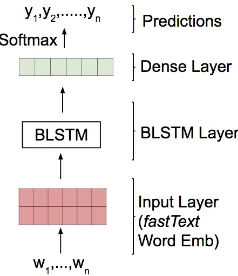
Figure 3: Bidirectional LSTM Model.
previous history in a sequence can be utilized. In a sequence labeling task like language identifica-tion, it is helpful to use the future context given in the sequence. Bidirectional LSTM (BLSTM) net-works can access both the preceding and succeed-ing contexts by involvsucceed-ing two separate hidden lay-ers. These networks can capture the long distance relations in the sequence efficiently, in both di-rections. We build an end-to-end sequence model with a single BLSTM layer layer (Figure 3). Word-Character LSTM: This model is a replica-tion of the model proposed bySamih et al.(2016) (Figure 4). The input layer in this model has word and character embeddings. The latter are used to capture morphological features of a word. We use two LSTMs to learn fixed-dimensional represen-tations from the embedding layers. At the out-put layer, we apply a softmax over the concate-nated word and character vectors to obtain the to-ken label. Unlike the BLSTM model, here current token and the neighboring tokens are considered to predict the label for the current token. We re-place the emoticons in the dataset with a re-
place-4
http://www.cs.cmu.edu/ ark/TweetNLP/
5
http://nltr.org/snltr-software/
6http://www.cis.uni-muenchen.de/ schmid/tools/TreeTagger/
holder character to reduce the vocabulary size and as a result reduce the dimension of character em-beddings. This decreases the number of train-able model parameters and thereby mitigates over-fitting to some extent.
Figure 4: Word-Character LSTM Model. The in-put layer of word-char LSTM is initialized with
fastTextword embeddings.
7 Experiments and Results
For CRF, we run experiments with different com-binations of hand-crafted features discussed in the previous section. We run three different sets of experiments- with no contextual information, and with surrounding words of context window sizes 1 and 2. Table 6and Table 7shows results from these experiments.
For the RNN-based systems, we use pre-trained
fastTextword embeddings.7 We learn the embed-dings using a large monolingual corpus for each of the languages and a smaller code-switched corpus for the language pairs. The rationale for using a large monolingual data is that it is readily available and that it can account for the different contexts in which words appear in different languages - thus providing an accurate separation between the lan-guages. We train three separate sets of embed-dings each for ENG, HIN-ENG, and SPA-ENG + HIN-SPA-ENG. The embeddings for SPA-SPA-ENG are trained by combining a portion of English Gi-gaword corpus (Graff et al., 2003) and Spanish Gigaword corpus (Graff, 2006), and a subset of tweets fromSamih et al. (2016). For HIN-ENG, we combine a portion of English Gigaword cor-pus, transliterated Hindi monolingual corcor-pus, and Facebook posts that contain code-switching. All
[image:6.595.116.235.227.365.2]Experiments Context-0 Context-1 Context-2
Baseline 85.02 -
-Word + 1 to 5 char
[image:7.595.164.435.62.186.2]n-grams (1) 96.89 96.79 96.77 (1) + word form (2) 96.95 96.77 96.78 (2) + affixes (3) 96.96 96.84 96.84 (3) + lexicons (4) 97.07 97.03 97.12 (4) + POS tags 97.05 97.16 97.11 (4) + Univ POS tags 97.1 97.15 97.12
Table 6: Token-level F1-weighted score of the CRF model for different feature combinations for HIN-ENG.
Experiments Context-0 Context-1 Context-2
Baseline 83.17 -
-Word + 1 to 5
[image:7.595.163.435.234.360.2]char n-grams (1) 97.02 96.81 96.82 (1) + word form (2) 97.21 97.09 97.01 (2) + affixes (3) 97.17 97.07 97.06 (3) + lexicons (4) 97.31 97.19 97.16 (4) + POS tags 97.24 97.19 97.17 (4) + Univ POS tags 97.25 97.19 97.21
Table 7: Token-level F1-weighted score of the CRF model for different feature combinations for SPA-ENG.
these corpora are used to train the embeddings for SPA-ENG + HIN-ENG. This helps to capture the word usage in the context of each language and eliminates the ambiguity for the words that have same surface form in multiple languages. We train 300-dimension embedding vectors using fastText
skip-gram model for 250 epochs with a learning rate of 0.001and a minimum word count thresh-old of 5.
For BLSTM model, we initialize the embedding layer with the pre-trained fastText word embed-dings and feed the output sequence from this layer to the BLSTM layer. At the output layer a soft-max activation function is applied over the hid-den representation learned in the BLSTM layer. For word-char model, we initialize the word em-bedding matrix withfastTextembeddings and use random initialization for character embedding ma-trix. We train both the RNN-based models by optimizing the cross entropy objective function withAdam(Kingma and Ba,2014) optimizer. We use dropout masks after BLSTM layer in BLSTM model, LSTM layers in word-char model, and embedding layer in each model to mitigate over-fitting. The reported BLSTM model and
word-char models have hidden units of size 80 and 100 respectively in the LSTM layers. For word-char model, for each token we try a neighboring token window size of 1, 2, and 3. The context window size of 2 gives better results and is reported here.
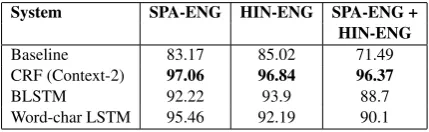
System SPA-ENG HIN-ENG SPA-ENG + HIN-ENG
Baseline 83.17 85.02 71.49
CRF (Context-2) 97.06 96.84 96.37
BLSTM 92.22 93.9 88.7
Word-char LSTM 95.46 92.19 90.1
Table 8: Token-level F1-weighted score for lan-guage identification systems.
[image:7.595.309.524.498.564.2]HIN-ENG SPA-ENG
Transitions Weights Transitions Weights
unk→unk 9.511 fw→fw 4.731
fw→fw 5.800 ne→ne 2.798
ambiguous→ambiguous 4.630 lang2→lang2 1.464
lang2→lang2 2.872 lang2→ne 1.005
ne→ne 2.824 lang1→ne 0.915
other→other 1.905 lang2→mixed 0.833
lang1→lang1 1.535 lang1→lang1 0.707
other→lang1 0.801 lang2→ambiguous 0.625
lang1→other 0.573 other→other 0.483
[image:8.595.137.462.60.227.2]lang1→mixed 0.353 other→mixed 0.427
Table 9: The top 10 most likely transitions learned by the best CRF model for HIN-ENG and SPA-ENG datasets.
trained mostly on monolingual data, this depen-dency does not constrain the systems.
7.1 Results and Evaluation
We use a simple lexicon-based model as baseline for our language identification systems. We use F1-weighted scores for model evaluations to ac-count for the imbalance in label distributions (Ta-ble 2). All the models improve the performance over the respective baseline models by 7 to 25 centage points. For CRF, which is the best per-forming model across language pairs, the current word and its character n-grams are the most portant features. Adding POS tags does not im-prove these results by much. This could be be-cause the POS taggers are optimized for monolin-gual data and their output for the code-switched data contains noise. Using contextual informa-tion improves the results for HIN-ENG, but not for SPA-ENG. In Table 8we compare the
RNN-Language Pair System lang1 lang2 ne
HIN-ENG BLSTM 0.96 0.94 0.77 Word-char LSTM 0.95 0.85 0.76 CRF (Context-2) 0.98 0.96 0.85
SPA-ENG BLSTM 0.89 0.95 0.32 Word-char LSTM 0.89 0.97 0.40 CRF (Context-2) 0.94 0.98 0.57
Table 10: Token-level F1-score of majority labels -lang1, lang2andnefor the models.
based models and the CRF model. We consider the performance of the CRF model using only the language independent features with a context size of 2 for a fair comparison. Among the RNN-based systems, while the results are competitive overall, there is no single system that performs the best
across language pairs. The BLSTM system per-forms better for HIN-ENG, while word-char sys-tem performs better for SPA-ENG. The BLSTM model captures long distance dependencies in a sequence and this is in line with the observation made above with the CRF model- more context helps for HIN-ENG. It is also consistent with the code-switching patterns discussed in Section 5. A majority of code-switched tweets in SPA-ENG have a single instance of word insertion and these are being miss-labeled by the models. The overall better results for SPA-ENG are because of a larger training data used.8 The baseline results for SPA-ENG + HIN-SPA-ENG is relatively low as compared to the individual language pairs. This shows that simultaneously identifying language for multiple language pair is harder. We obtain reasonable re-sults for these initial experiments with all the mod-els.
To understand these results better, we look at the label-wise F1-score forlang1, lang2andne(Table
10). The F1-scores for CRF is better across the la-bels and the difference is significantly high forne. The F1-scorene is relatively high for HIN-ENG, which can be attributed to the fact that around 58% of the named-entities in the test set appear in the training set. This overlap is only 17% for SPA-ENG. So, infrequent named-entities seems to be hardest to accurately label. In addition, the RNN-based models are more sensitive to amount of training samples.
Further, we examine the transitions learned by
8The F1-score drops by 10 percentage points for the
[image:8.595.77.284.568.640.2]our best CRF model for each of the language pairs (Table 9). For both language pairs, the transitions between the same languages are more likely than switching. But we also observe that the transitions fromlang1tolang2and vice-versa rank higher for HIN-ENG than SPA-ENG. This is because there are fewer code-switching points in SPA-ENG as compared to HIN-ENG in these datasets.
(a) BLSTM Model
[image:9.595.69.290.185.550.2](b) Word-char LSTM Model
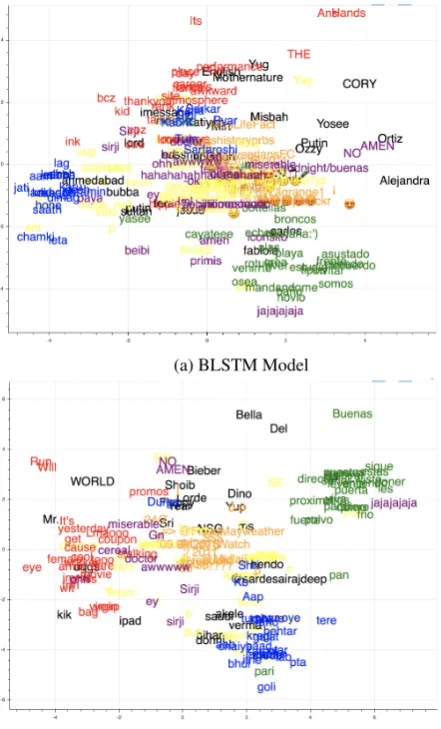
Figure 5: Projection of word representations learned by the neural networks model for HIN-ENG + SPA-HIN-ENG. We reduce the word vector di-mensions using PCA. The mapping of labels to colors:lang1- red,lang2- green,lang3- blue,ne
- black,other- orange,ambiguous- purple,mixed
- purple,fw- yellow,unk- yellow.
We also visualize the feature representations learned by the RNN-based models by projecting the word embeddings for a randomly selected sub-set of words from the development datasub-sets for SPA-ENG + HIN-ENG (Figure 5). The word-char model gives a clearer separation between the
three languages, the words belonging to the la-belsotherandne. While the BLSTM model also provides clear separation between the language words, there is an overlap with the tokens from
other. These results show that these models can be scaled to detect code-switching in multiple lan-guage pairs without any additional feature engi-neering.
8 Conclusions
The complexity of language identification of switched data depends on the data source, code-switching behavior, and the typology and relation between the languages involved. We find that the code-switching metrics complement each other in explaining the code-switching patterns across language pairs. The analysis of code-switching metrics shows that in our datasets Hindi-English speakers tend to switch languages more often than Spanish-English speakers. In future, it would be interesting to explore and compare the code-switching behavior of data from different sources such as movie scripts, song lyrics, and chat con-versations across different language pairs.
We successfully use two different deep learning architectures without involving sophisticated fea-ture engineering for the task and obtain competi-tive results. However a traditional CRF model per-forms better than the deep learning models for the language pairs considered. This is probably due to the amount of training data we have. The results show that word embeddings are able to capture the language separation well. Scaling these systems to identify languages in datasets with many lan-guage pairs and datasets with switching between more than two languages is a potential future di-rection to explore.
Acknowledgments
We would like to thank the National Science Foun-dation for partially supporting this work under award number 1462143 as well as the U.S. De-partment of Defense for the support received un-der grant W911NF-16-1-0422.
References
Peter Auer. 1984. Bilingual conversation. John Ben-jamins Publishing.
study of young learners. Washington, DC: Center for Applied Linguistics, 24:148–158.
Kalika Bali, Jatin Sharma, Monojit Choudhury, and Yogarshi Vyas. 2014. “I am borrowing ya mixing ?” An Analysis of English-Hindi Code Mixing in Facebook. In Proceedings of the First Workshop on Computational Approaches to Code Switching, pages 116–126, Doha, Qatar. Association for Com-putational Linguistics.
Utsab Barman, Amitava Das, Joachim Wagner, and Jennifer Foster. 2014. Code mixing: A challenge for language identification in the language of so-cial media. InProceedings of the First Workshop on Computational Approaches to Code Switching, pages 13–23, Doha, Qatar. Association for Compu-tational Linguistics.
Ruthanna Barnett, Eva Cod´o, Eva Eppler, Montse Forcadell, Penelope Gardner-Chloros, Roeland van Hout, Melissa Moyer, Maria Carme Torras, Maria Teresa Turell, and Mark Sebba. 2000. The LIDES Coding Manual: A document for prepar-ing and analyzprepar-ing language interaction data Version 1.1July, 1999. International Journal of Bilingual-ism, 4(2):131–271.
Khyathi Raghavi Chandu, Sai Krishna Rallabandi, Sunayana Sitaram, and Alan W Black. 2017. Speech Synthesis for Mixed-Language Navigation Instructions. In Interspeech 2017, 18th Annual Conference of the International Speech Communica-tion AssociaCommunica-tion, Stockholm, Sweden, August 20-24, 2017, pages 57–61.
Joseph Chee Chang and Chu-Cheng Lin. 2014. Recurrent-neural-network for language detection on Twitter code-switching corpus. arXiv preprint arXiv:1412.4314.
Monojit Choudhury, Gokul Chittaranjan, Parth Gupta, and Amitava Das. 2014. Overview of FIRE 2014 track on transliterated search. Proceedings of FIRE, pages 68–89.
Amitava Das and Bj¨orn Gamb¨ack. 2014. Identifying languages at the word level in code-mixed indian so-cial media text. InProceedings of the 11th Interna-tional Conference on Natural Language Processing, pages 378–387, Goa, India. NLP Association of In-dia.
Bj¨orn Gamb¨ack and Amitava Das. 2014. On measuring the complexity of code-mixing. In Proceedings of the 11th International Conference on Natural Lan-guage Processing, Goa, India, pages 1–7.
Spandana Gella, Kalika Bali, and Monojit Choudhury. 2014. ye word kis lang ka hai bhai? testing the limits of word level language identification. In Proceed-ings of the 11th International Conference on Natural Language Processing, pages 368–377.
Dave Graff. 2006. LDC2006T12: Spanish Gigaword.
Linguistic Data Consortium, Philadelphia.
David Graff, Junbo Kong, Ke Chen, and Kazuaki Maeda. 2003. LDC2003T05:English Gigaword.
John J Gumperz. 1982.Discourse strategies, volume 1. Cambridge University Press.
Parth Gupta, Kalika Bali, Rafael E. Banchs, Monojit Choudhury, and Paolo Rosso. 2014. Query expan-sion for mixed-script information retrieval. In Pro-ceedings of the 37th International ACM SIGIR Con-ference on Research & Development in Infor-mation Retrieval, SIGIR ’14, pages 677–686, New York, NY, USA. ACM.
Gualberto Guzm´an, Joseph Ricard, Jacqueline Serigos, Barbara E Bullock, and Almeida Jacqueline Toribio. 2017. Metrics for modeling code-switching across corpora. Proc. Interspeech 2017, pages 67–71.
Gualberto A Guzman, Jacqueline Serigos, Barbara E Bullock, and Almeida Jacqueline Toribio. 2016. Simple tools for exploring variation in code-switching for linguists. InProceedings of the Sec-ond Workshop on Computational Approaches to Code Switching, pages 12–20.
Bo Han, Paul Cook, and Timothy Baldwin. 2012. Au-tomatically constructing a normalisation dictionary for microblogs. In Proceedings of the 2012 Joint Conference on Empirical Methods in Natural guage Processing and Computational Natural Lan-guage Learning, pages 421–432, Jeju Island, Korea. Association for Computational Linguistics.
Sepp Hochreiter. 1998. The vanishing gradient lem during learning recurrent neural nets and prob-lem solutions.International Journal of Uncertainty, Fuzziness and Knowledge-Based Systems, 6(2):107– 116.
Sepp Hochreiter and J¨urgen Schmidhuber. 1997. Long short-term memory. Neural computation, 9(8):1735–1780.
Diederik P Kingma and Jimmy Ba. 2014. Adam: A method for stochastic optimization. arXiv preprint arXiv:1412.6980.
John Lipski. 1978. Code-switching and the problem of bilingual competence. Aspects of bilingualism, pages 250–264.
Suraj Maharjan, Elizabeth Blair, Steven Bethard, and Thamar Solorio. 2015. Developing language-tagged corpora for code-switching tweets. InProceedings of The 9th Linguistic Annotation Workshop, pages 72–84, Denver, Colorado, USA. Association for Computational Linguistics.
Giovanni Molina, Fahad AlGhamdi, Mahmoud
Ghoneim, Abdelati Hawwari, Nicolas
Carol Myers-Scotton. 1997. Duelling languages: Grammatical structure in codeswitching. Oxford University Press.
Carol Myers-Scotton. 2002. Contact linguistics: Bilin-gual encounters and grammatical outcomes. Oxford University Press on Demand.
Rana D Parshad, Suman Bhowmick, Vineeta Chand, Nitu Kumari, and Neha Sinha. 2016. What is India speaking? Exploring the Hinglish invasion. Phys-ica A: StatistPhys-ical Mechanics and its ApplPhys-ications, 449:375–389.
Shana Poplack. 1980. Sometimes ill start a sentence in Spanish y termino en espaol: toward a typology of code-switching. Linguistics, 18(7-8):581–618.
Rishiraj Saha Roy, Monojit Choudhury, Prasenjit Ma-jumder, and Komal Agarwal. 2013. Overview of the FIRE 2013 track on transliterated search. In Post-Proceedings of the 4th and 5th Workshops of the Fo-rum for Information Retrieval Evaluation, page 4. ACM.
Younes Samih, Suraj Maharjan, Mohammed Attia, Laura Kallmeyer, and Thamar Solorio. 2016. Multi-lingual code-switching identification via lstm recur-rent neural networks. InProceedings of the Second Workshop on Computational Approaches to Code Switching, pages 50–59. Association for Computa-tional Linguistics.
Gillian Sankoff. 1970. Social aspects of multilingual-ism in New Guinea. Ph.D. thesis, McGill Univer-sity.
Royal Sequiera, Monojit Choudhury, and Kalika Bali. 2015a. POS Tagging of Hindi-English Code Mixed Text from Social Media: Some Machine Learning Experiments. InProceedings of the 12th Interna-tional Conference on Natural Language Processing, pages 237–246.
Royal Sequiera, Monojit Choudhury, Parth Gupta, Paolo Rosso, Shubham Kumar, Somnath Baner-jee, Sudip Kumar Naskar, Sivaji Bandyopadhyay, Das Amitava Chittaranjan, Gokul, and Kunal Chakma. 2015b. Overview of fire-2015 shared task on mixed script information retrieval. In FIRE Workshops, volume 1587, pages 19–25.
Bernard Smith. 2001. Learner English: A teacher’s guide to interference and other problems. Ernst Klett Sprachen.
Thamar Solorio, Elizabeth Blair, Suraj
Mahar-jan, Steven Bethard, Mona Diab, Mahmoud