Proceedings of the 56th Annual Meeting of the Association for Computational Linguistics (Long Papers), pages 1520–1530 1520
Embedding Learning Through Multilingual Concept Induction
Philipp Dufter1, Mengjie Zhao2, Martin Schmitt1, Alexander Fraser1, Hinrich Sch ¨utze1 1Center for Information and Language Processing (CIS) LMU Munich, Germany
2Ecole Polytechnique F´ed´erale de Lausanne, Switzerland´
{philipp,martin,fraser}@cis.lmu.de, [email protected]
Abstract
We present a new method for estimat-ing vector space representations of words: embedding learning by concept induction. We test this method on a highly paral-lel corpus and learn semantic representa-tions of words in 1259 different languages in a single common space. An exten-sive experimental evaluation on crosslin-gual word similarity and sentiment analy-sis indicates that concept-based multilin-gual embedding learning performs better than previous approaches.
1 Introduction
Vector space representations of words are widely used because they improve performance on mono-lingual tasks. This success has generated inter-est in multilingual embeddings, shared representa-tion of words across languages (Klementiev et al.,
2012). Such embeddings can be beneficial in ma-chine translation in sparse data settings because multilingual embeddings provide meaning repre-sentations of source and target in the same space. Similarly, in transfer learning, models trained in one language on multilingual embeddings can be deployed in other languages (Zeman and Resnik,
2008; McDonald et al., 2011; Tsvetkov et al.,
2014). Automatically learned embeddings have the added advantage of requiring fewer resources for training (Klementiev et al.,2012;Hermann and Blunsom, 2014b; Guo et al., 2016). Thus, mas-sively multilingual word embeddings (i.e., cover-ing 100s or 1000s of languages) are likely to be important in NLP.
The basic information many embedding learn-ers use isword-context information; e.g., the em-bedding of a word is optimized to predict a rep-resentation of its context. We instead learn
[image:1.595.336.496.221.386.2]em-^
Figure 1: Example of a CLIQUE concept: “water”
beddings from word-concept information. As a first approximation, a concept is a set of seman-tically similar words. Figure1shows an example concept and also indicates one way we learn con-cepts:we interpret cliques in the dictionary graph as concepts. The nodes of the dictionary graph are words, its edges connect words that are trans-lations of each other. A dictionary node has the form prefix:word, e.g., “tpi:wara” (upper left node in the figure). The prefix is the ISO 639-3 code of the language; tpi is Tok Pisin.
Our method takes a parallel corpus as input and induces a dictionary graph from the parallel cor-pus. Concepts and word-concept pairs are then induced from the dictionary graph. Finally, em-beddings are learned from word-concept pairs.
English King James Version (KJV) German Elberfelder 1905 Spanish Americas And he said , Do it the second
time . And they did it the second time . . .
Und er sprach : F¨ullet vier Eimer mit Wasser , und gießet es auf das Brandopfer und auf das Holz . Und er sprach : Tut es zum zweiten Male ! Und sie taten es zum zweiten Male . . .
Y dijo : Llenad cuatro c´antaros de agua y derramadla so-bre el holocausto y soso-bre la le˜na . Despu´es dijo : Hacedlo por segunda vez ; y lo hicieron por segunda vez . . .
Table 1: Instances of verse 11018034. This multi-sentence verse is an example of verse misalignment.
on the verse level; most verses consist of a single sentence, but some contain several (see Table 1). PBC is a good model for resource-poverty; e.g., the training set (see below) of KJV contains fewer than 150,000 tokens in 6458 verses.
We evaluate multilingual embeddings on two tasks, roundtrip translation (RT) and sentiment analysis. RT on the word level is – to our knowl-edge – a novel evaluation method: a query word
wof languageL1 is translated to its closest (with respect to embedding similarity) neighborvinL2
and then backtranslated to its closest neighborw0
in L1. RT is successful if w = w0. There are well-known concerns about RT when it is used in the context of machine translation. A successful roundtrip translation does not necessarily imply thatv is of high quality and it is not possible to decide whether an error occurred in the forward or backward translations. Despite these concerns about RT on the sentence level, we show that RT on the word level is a difficult task and an effective measure of embedding quality.
Contributions. (i) We introduce a new em-bedding learning method, multilingual emem-bedding learning through concept induction. (ii) We show that this new concept-based method outperforms previous approaches to multilingual embeddings. (iii) We propose both word-level and character-level dictionary induction methods and present evidence that concepts induced from word-level dictionaries are better for easily tokenizable lan-guages and concepts induced from character-level dictionaries are better for difficult-to-tokenize lan-guages. (iv) We evaluate our methods on a corpus of 1664 editions in 1259 languages. To the best of our knowledge, this is the first detailed evaluation, involving challenging tasks like word translation and crosslingual sentiment analysis, that has been done on such a large number of languages.
2 Methods
2.1 Pivot languages
Most of our methods are based on bilingual dic-tionary graphs. With 1664 editions, it is com-putationally expensive to consider all editions
si-multaneously (more than106 dictionaries). Thus we split the set of editions in 10 pivot and 1654 remaining editions, and do not compute nor use dictionaries within the 1654 editions. We refer to the ten pivot editions aspivot languagesand give them a distinct role in concept induction. We refer to all editions (including pivot editions) astarget editions. Thus, a pivot edition has two roles: as a pivot language and as a target edition.
We select the pivot languages based on their sparseness. Sparseness is a challenge in NLP. In the case of embeddings, it is hard to learn a high-quality embedding for any infrequent word. Many of the world’s languages (including many PBC languages) exhibit a high degree of sparse-ness. But some languages suffer comparatively little from sparseness when simple preprocessing like downcasing and splitting on whitespace is em-ployed.
A simple measure of sparseness that affects em-bedding learning is the number of types. Fewer types is better since their average frequency will be higher. Table2shows the ten languages in PBC that have the smallest number of types in 5000 randomly selected verses. We randomly sample 5000 verses per edition and compare the number of types based on this selection because most edi-tions do not contain a few of the selected 6458 verses.
2.2 Character-level modeling (CHAR)
iso name family; (example) region types tok
ens
[image:3.595.72.291.66.191.2]lhu Lahu Sino-Tibetan; Thailand 1452 268 ahk Akha Sino-Tibetan; China 1550 315 hak Hakka Chinese Chinese; China 1596 242 ium Iu Mien Hmong-Mien; Laos 1779 191 tpi Tok Pisin Creole; PNG 1815 177 mio Pinotepa Mixtec Oto-Manguean; Oaxaca 1828 208 cya Highland Chatino Oto-Manguean; Oaxaca 1868 231 bis Bislama Creole; Vanuatu 1872 226 aji Aji¨e Austronesian; Houa¨ılou 1876 194 sag Sango Creole; Central Africa 1895 192
Table 2: Our ten pivot languages, the languages in PBC with the lowest number of types. Tokens in 1000s. Tok Pisin and Bislama are English-based and Sango is a Ngbandi-based creole. PNG = Papua New Guinea
8 has properties different from Chinese UTF-8. Thus, universal language processing is easier to design on the byte level.
We refer to this ngram representation as CHAR and to standard tokenization as WORD.
2.3 Dictionary induction
Alignment-based dictionary. We use fastalign (Dyer et al., 2013) to compute word alignments and use GDFA for symmetrization. All align-ment edges that occurred at least twice are added to the dictionary graph. Initial experiments indi-cated that alignment-based dictionaries have poor quality for CHAR, probably due to the fact that overlapping ngram representations of sentences have properties quite different from the tokenized sentences that aligners are optimized for. Thus we use this dictionary induction method only for WORD and developed the following alternative for CHAR.
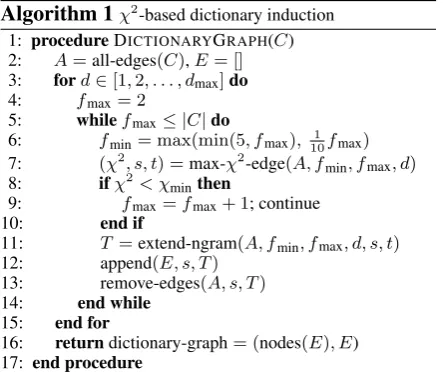
Correlation-based dictionary (χ2). χ2 is a greedy algorithm, shown in Figure2, that selects, in each iteration, the pair of units that has the high-estχ2 score for cooccurrence in verses. Each se-lected pair is added to the dictionary and removed from the corpus. Low-frequency units are se-lected first and high-frequency units last; this pre-vents errors due to spurious association of high-frequency units with low-high-frequency units. We per-formdmax= 5passes; in each pass, the maximum degree of a dictionary node is 1≤d≤dmax. So if the node has reached degree d, it is ineligible for additional edges during this pass. Again, this avoids errors due to spurious association of high-frequency units that already participate in many
Algorithm 1χ2
-based dictionary induction 1: procedureDICTIONARYGRAPH(C) 2: A=all-edges(C),E= [] 3: ford∈[1,2, . . . , dmax]do
4: fmax= 2
5: whilefmax≤ |C|do
6: fmin= max(min(5, fmax), 101fmax)
7: (χ2, s, t) =max-χ2-edge(A, fmin, fmax, d)
8: ifχ2< χminthen
9: fmax=fmax+ 1; continue
10: end if
11: T =extend-ngram(A, fmin, fmax, d, s, t)
12: append(E, s, T) 13: remove-edges(A, s, T) 14: end while
15: end for
16: returndictionary-graph= (nodes(E), E) 17: end procedure
Figure 2: χ2-based dictionary induction. C is a
sentence-aligned corpus. A is initialized to con-tain all edges, i.e., the fully connected bipartite graph for each parallel verse. E collects the se-lected dictionary edges. dis the edge degree: in each pass through the loop only edges are consid-ered whose participating units have a degree less thand.fmaxis the maximum frequency during this
pass. |C|is the number of sentences in the cor-pus. extend-ngram extends a target ngram to left / right; e.g., ifs =“jisas” is aligned with ngram
t=“Jesu” in English, then “esus” is added toT.t
is always a member ofT. remove-edges removes edges inAbetweensand a member ofT.
edges with low-frequency units. Recall that this method is only applied for CHAR.
Intra-pivot dictionary. We assume that pivot languages are easily tokenizable. Thus we only consider alignment-based dictionaries (in total 45) within the set of pivot languages.
Pivot-to-target dictionary. We compute an alignment-based and a χ2-based dictionary be-tween each pivot language and each target edition, yielding a total of 10*1664 dictionaries per dictio-nary type. (Note that this implies that, forχ2, the WORD version of the pivot language is aligned with its CHAR version.)
2.4 Concepts
[image:3.595.307.529.75.261.2]Algorithm 2CLIQUE concept induction 1: procedureCONCEPTS(I∈Rn×n,θ,ν)
2: G= ([n],{(i, j)∈[n]×[n]|Iij> θ}) 3: cliques=get-cliques(G,3)
4: Gc:= (Vc, Ec) = (∅,∅) 5: forc1, c2∈cliques×cliquesdo
6: if|c1∩c2| ≥νmin{|c1|,|c2|}then
7: Vc=Vc∪ {c1, c2},Ec=Ec∪ {(c1, c2)}
8: end if
9: end for
10: metacliques=get cliques(Gc,1) 11: concepts={flatten(c)|c∈metacliques}
[image:4.595.72.293.76.329.2]12: returnconcepts 13: end procedure
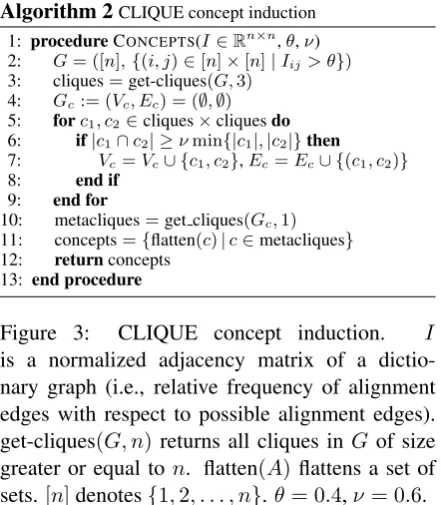
Figure 3: CLIQUE concept induction. I
is a normalized adjacency matrix of a dictio-nary graph (i.e., relative frequency of alignment edges with respect to possible alignment edges). get-cliques(G, n) returns all cliques in G of size greater or equal ton. flatten(A) flattens a set of sets.[n]denotes{1,2, . . . , n}.θ= 0.4,ν = 0.6.
to the pivot subset. We selected the ten “easiest” of the 1664 editions as pivot languages. Our premise is that semantic information is encoded in a simply accessible form in the pivot languages and so they should offer a good basis for learning concepts.
We induce concepts from the dictionary graph, a multipartite graph consisting of ten pivot language node/word sets and all target edition node/unit sets (where units are words orn-grams). Edges either connect pivot nodes with other pivot nodes or pivot nodes with target units.
2.4.1 CLIQUE concept induction
If concepts corresponded to each other in the overtly coding pivot languages, if words were not ambiguous and if alignments were perfect, then concepts would be cliques in the pivot part of the dictionary graph. These conditions are too strict for natural languages, so we relax them in our CLIQUE concept induction algorithm (Fig-ure3). The algorithm identifies maximal multilin-gual cliques (size≥3) within the dictionary graph of the pivot languages and then merges two cliques if they share enough common words. The merging lets us identify clique-based concepts even if, e.g., a dictionary edge between two words is missing. It also accommodates the situation where more than one word of a pivot language should be part of a concept. The merging step can also be interpreted as metaconcept induction.
Once we have identified the cliques, we project
N(t) ={bis:Jorim, ium:yo-lim, sag:Yorim, tpi:Jorim}
t∈T={ac0:Yorim,atg0:iJorimu,bav0:Jorim,bom0:Yorim, dik0:Jorim, dtp0:Yorim, duo0:Jorim, eng1:Jorim, engb:Jorim, fij2:Lorima, fij3:Jorima,
gor0:Yorim, hvn0:Yorim, ibo0:Jorim, iri0:Jorri, kmr0:Yorˆım, ksd0:Iorim, kwd0:Jorim, lia0:Yorimi, loz0:Jorimi, mbd0:Hurim, mfh0:Yorim, min0:Yorim, mrw0:Yorim,mse0:Jorimma,naq0:Jorimmi, smo1:Iorimo, srn1:Yorim, tsn2:Jorime, yor2:J´or´ım`u}
Figure 4: Target neighborhood concept example:
N(t) ∪T. N(t) is the target neighborhood for each of the target words inT.
them to the target editions: a target-unit is added to a clique if it is connected to a proportionν = 0.6
of its member words (to allow for missing edges). This identifies around 150k clique concepts that cover around 8k of the total vocabulary of 24k En-glish words (WORD).
As an alternative to cliques, Ammar et al.
(2016) use connected components (CCs). The reachability relation (induced by CC) is the tran-sitive closure of the edge relation. This results in semantically unrelated words being in the same concept for very low levels of noise. In contrast, cliques are more “strict”: only node subsets are considered whose corresponding edge relation is already transitive (or almost so for ν = 0.6). Transitivity across languages often does not hold in alignments or dictionaries; see, e.g., Simard
(1999). This is why we only consider cliques (which reflect already existent transitivity) rather than CCs, which impose transitivity where it does not hold naturally.
2.4.2 N(t)(target neighborhood) concept induction
LetN(t)be the neighborhood of target nodetin the multipartite dictionary graph, i.e., the set of pivot words that are linked tot. We refer toN(t)
astarget neighborhood. Figure4shows an exam-ple of such a target neighborhood, the set N(t)
consisting of four words.1 Atarget neighborhood conceptconsists of a setT of pivot words and all target wordstfor whichT =N(t)holds.
Motivation. Suppose N(t) = N(u) for tar-get nodes t and u from two different languages and |N(t)| covers several pivot languages, e.g.,
|N(t)| = |N(u)| = 4 as in the figure. Again, if units closely corresponded to concepts, if there were no ambiguity, if the dictionary were perfect,
1We use numbers and lowercase letters at the fourth
then we could safely conclude that the meanings oftanduare similar; if the meanings of tandu
were unrelated, it is unlikely that they would be aligned to the exact same words in four different languages. In reality, there is no exact meaning-form correspondence, there is ambiguity and the dictionary is not perfect. Still, we will see be-low that defining concepts as target neighborhoods works well.
2.4.3 Filtering target neighborhood concepts
In contrast to CLIQUE, we do not put any con-straint on the pivot-to-pivot connections within target neighborhoods; e.g., in Figure 4, we do not require that “bis:Jorim” and “sag:Yorim” are connected by an edge. We evaluate three post-filtering steps of target neighborhoods to increase their quality: restricting target neighborhoods to those that are cliques inN(t)-CLIQUE; to those that are connected components in N(t)-CC; and to those of size two that are valid edges in the dictionary inN(t)-EDGE. ForN(t)-EDGE, we found that taking all edges performs well, so we also consider edges that are proper subsets of tar-get neighborhoods.
2.5 Embedding learning
We adopt the framework of embedding learning algorithms that define contexts and then sample pairs of an input word (more generally, an input unit) and a context word (more generally, a con-text unit) from each concon-text. The only difference is that our contexts are concepts. For simplicity, we use word2vec (Mikolov et al., 2013a) as the implementation of this model.2
2.6 Baselines
Baselines formultilingual embedding learning. One baseline is inspired by (Vuli´c and Moens,
2015). We consider words of one aligned verse in the pivot languages and one target language as a bag of words (BOW) and consider this bag as a context.3
Levy et al. (2017) show that sentence ID fea-tures (interpretable as an abstract representation of the word’s context) are effective. We use a corpus with lines consisting of pairs of an identifier of a
2
We usecode.google.com/archive/p/word2vec 3The actual implementation slightly differs to avoid very
long lines. It does only consider two pivot languages at a time, but writes each verse multiple times.
verse and a unit extracted from that verse as input to word2vec and call this baseline S-ID.
Lardilleux and Lepage (2009) propose a sim-ple and efficient baseline: sample-based concept induction. Words that strictly occur in the same verses are assigned to the same concept. To in-crease coverage, they propose to sample many dif-ferent subcorpora.4We induce concepts using this method and project them analogous to CLIQUE. We call this baseline SAMPLE.
One novel contribution of this paper is roundtrip evaluation of embeddings. We learn embeddings based on a dictionary. The question arises: are the embeddings simply reproducing the information already in the dictionary or are they improving the performance of roundtrip search?
As a baseline, we perform RTSIMPLE, a sim-ple dictionary-based roundtrip translation method. Retrieve the pivot word p in pivot language Lp
(i.e.,p ∈ Lp) that is closest to the queryq ∈ Lq.
Retrieve the target unitt ∈Ltthat is closest top.
Retrieve the pivot wordp0 ∈ Lp that is closest to t. Retrieve the unitq0 ∈Lqthat is closest top0. If q=q0, this is an exact hit. We run this experiment for all pivot and target languages.
Note that roundtrip evaluation tests the capabil-ity of a system to go from any language to any other language. In an embedding space, this re-quires two hops. In a highly multilingual dataset of nlanguages in which not all O(n2) bilingual dictionaries exist, this requires four hops.
3 Experiments and results
3.1 Data
We use PBC (Mayer and Cysouw, 2014). The version we pulled on 2017-12-11 contains 1664 Bible editions in 1259 languages (based on ISO 639-3 codes) after we discarded editions that have low coverage of the New Testament. We use 7958 verses that have good coverage in these 1664 edi-tions. The data is verse aligned; a verse of the New Testament can consist of multiple sentences. We randomly split verses 6458/1500 into train/test.
3.2 Evaluation
For sentiment analysis, we represent a verse as the IDF-weighted sum of its embeddings. Senti-ment classifiers (linear SVMs) are trained on the training set of the World English Bible edition
4We use this implementation:
for the two decision problems positive vs. non-positive and negative vs. non-negative. We create a silver standard by labeling verses in English edi-tions with the NLTK (Bird et al.,2009) sentiment classifier.
A positive vs. negative classification is not rea-sonable for the New Testament because a large number of verses is mixed, e.g., “Now is come salvation . . . the power of his Christ: for the ac-cuser . . . cast down, which accused them before our God . . . ” Note that this verse also cannot be said to be neutral. Splitting the sentiment anal-ysis into two subtasks (“contains positive senti-ment: yes/no” and “contains negative sentisenti-ment: yes/no”) is an effective solution for this paper.
The two trained models are then applied to the test set of all 1664 editions. All embeddings in this paper are learned on the training set only. So no test information was used for learning the em-beddings.
Roundtrip translation. There are no gold stan-dards for the genre of our corpus (the New Tes-tament); for only a few languages out-of-domain gold standards are available. Roundtrip evalua-tion is an evaluaevalua-tion method for multilingual em-beddings that can be applied if no resources are available for a language. Loosely speaking, for a query q in a query language Lq (in our case
En-glish) and a target languageLt, roundtrip
transla-tion finds the unitwtinLtthat is closest toq and
then the English unitwethat is closest towt. If the
semantics ofqandweare identical (resp. are
unre-lated), this is deemed evidence for (resp. counter-evidence against) the quality of the embeddings. We work on the level of Bible edition, i.e., two editions in the same language are considered dif-ferent “languages”.
For a queryq, we denote the set of itskI
near-est neighbors in the target edition e by Ie(q) = {u1, u2, . . . , ukI}. For each intermediate entry we
then consider itskT nearest neighbors in English.
Overall we get a setTe(q)withkIkT predictions
for each intermediate Bible editione. See Figure5
for an example.
We evaluate the predictionsTe(q)using two sets Gs(q)(strict) andGr(q)(relaxed) of ground-truth
semantic equivalences in English. Precision for a queryqis defined as
pi(q) := 1/|E|Pe∈Emin{1,|Te(q)∩Gi(q)|}
where E is the set of all Bible editions and i ∈ {s, r}. We report the mean and median across a
inter-query mediate predictions
woman⇒ mujer ⇒wife woman women widows daughters daughter marry married
⇒esposa⇒marry wife woman married marriage virgin daughters bridegroom
Figure 5: Roundtrip translation example for KJV and Americas Bible (Spanish). In this example
min{1,|Te(q)∩Gi(q)|}equals0 for S1 and R1,
and1for S4 and S16.
connu(3), connais(3), connaissent(3), savez(2), sachant(2), sait(2), sachiez(2), savoir, sc¸ai, ignorez, connaissiez, sache connaissez, connaissais, savent, savaient, connoissez, connue, reconnaˆıtrez, sais, connaissant, savons, connaissait, savait
Figure 6: Intermediates aggregated over 17 French editions. q=“know”, N(t) embeddings, S16. Intermediates are correct with two possible ex-ceptions: “ignorez” ‘you do not know’; “re-connaˆıtrez” ‘you recognize’.
set of70queries selected fromSwadesh(1946)’s list of 100 universal linguistic concepts.
We createGs andGr as follows. For WORD,
we define Gs(q) = {q} and Gr(q) = L(q)
where L(q) is the set of words with the same lemma and POS as q. For CHAR, we need to find ngrams that correspond uniquely to the query
q. Given a candidate ngramgwe considercqg := 1/c(g)P
q0∈L(q),substring(g,q0)c(q0)wherec(x)is
the count of character sequencex across all edi-tions in the query language. We addgtoGi(q)if cqg > σi whereσs = .75andσr = .5. We only
consider queries whereGs(q)is non-empty.
We vary the evaluation parameters(i, kI, kT)as
follows: “S1” represents (s,1,1), “S4” (s,2,2), “S16”(s,2,8), and “R1”(r,1,1).
3.3 Corpus generation and hyperparameters
We train with the skipgram model and set vector dimensionality to 200; word2vec default parame-ters are used otherwise. Each concept – the union of a set of pivot words and a set of target units linked to the pivot words – is written out as a line or (if the set is large) as a sequence of shorter lines. Training corpus size is approximately 50 GB for all experiments. We write several copies of each line (shuffling randomly to ensure lines are differ-ent) where the multiplication factor is chosen to result in an overall corpus size of approximately 50 GB.
roundtrip translation sentiment analysis
WORD CHAR WORD CHAR
S1 R1 S4 S16 S1 R1 S4 S16
µMd µMd µMd µ Md N µMd µMd µMd µ Md N pos neg pos neg
1 RTSIMPLE 33 24 37 36 67 24 13 32 21 70
2 BOW 7 5 8 7 13 12 26 28 69 3 2 3 2 5 4 10 11 70 33 81 13 83
3 S-ID 46 46 52 55 63 76 79 91 65 9 5 9 5 14 9 25 22 70 79 88 65 86 4 SAMPLE 33 23 43 42 54 59 82 96 65 53 5959 7267 85 79 99 58 82 89 77 89 5 CLIQUE 43 36 59 63 67 77 93 99 69 42 46 48 55 60 76 73 98 53 84 89 69 88 6 N(t) 54 59 61 6980 87 94 10069 50 53 54 59 73 82 90 99 66 82 89 87 90
7 N(t)-CLIQUE 11 0 11 0 16 0 22 0 18 39 45 41 47 58 74 76 94 56 22 84 61 84
8 N(t)-CC 3 0 3 0 5 0 7 0 5 11 0 11 0 16 0 25 0 21 4 84 40 83
[image:7.595.76.496.62.194.2]9 N(t)-EDGE 35 30 43 36 56 55 87 94 69 39 29 49 52 64 78 8810063 84 90 84 89
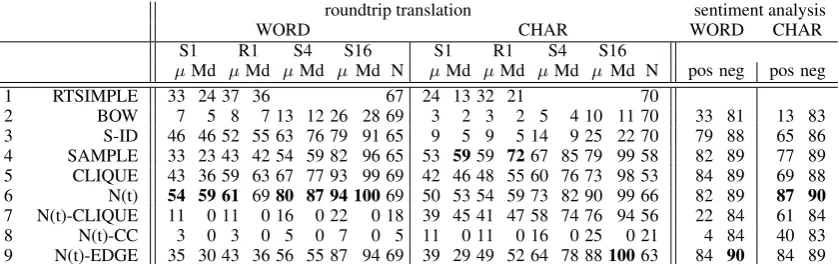
Table 3: Roundtrip translation (mean/median accuracy) and sentiment analysis (F1) results for word-based (WORD) and character-word-based (CHAR) multilingual embeddings. N (coverage): # queries con-tained in the embedding space. The best resultacross WORD and CHARis set in bold.
corpus is 10 times larger than the others. For S-ID, we useLevy et al.(2017)’s hyperparameters; in particular, we trained for 100 iterations and we wrote each verse-unit pair to the corpus only once, resulting in a corpus of about 4 GB.
We set the n parameter of n-grams to n = 4
for Bible editions with ρ < 2, n = 8 for Bible editions with2 ≤ ρ < 3 and n = 12for Bible editions withρ ≥ 3whereρ is the ratio between size in bytes of the edition and median size of the 1664 editions. Inχ2 dictionary induction, we set
χmin = 100. In the concept induction algorithm we setθ= 0.4andν= 0.6. Except for SAMPLE and CLIQUE, we filter out hapax legomena.
3.4 Results
Table 3 presents evaluation results for roundtrip translation and sentiment analysis.
Validity of roundtrip (RT) evaluation results. RTSIMPLE (line 1) is not competitive; e.g., its ac-curacy is lower by almost half compared toN(t). We also see that RT is an excellent differentiator of poor multilingual embeddings (e.g., BOW) vs. higher-quality ones like S-ID andN(t). This indi-cates that RT translation can serve as an effective evaluation measure.
The concept-based multilingual embedding learningalgorithms CLIQUE andN(t)(lines 5-6) consistently (except S1 WORD) outperform BOW and S-ID (lines 2-3) that are not based on con-cepts. BOW performs poorly in our low-resource setting; this is not surprising since BOW methods rely on large datasets and are therefore expected to fail in the face of severe sparseness. S-ID per-forms reasonably well for WORD, but even in that case it is outperformed byN(t), in some cases by a large margin, e.g., µof 63 for S-ID vs. 80 for
N(t) for S4. For CHAR, S-ID results are poor. On sentiment classification,N(t)also consistently outperforms S-ID.
While S-ID provides a clearer signal to the em-bedding learner than BOW, it is still relatively crude to represent a word as – essentially – its bi-nary vector of verse occurrence. Concept-based methods perform better because they can exploit the more informative dictionary graph.
Comparison of graph-theoretic definitions of concepts: N(t)-CLIQUE,N(t)-CC.N(t)(line 6) has the most consistent good performance across tasks and evaluation measures. Postfilter-ing target neighborhoods down to cliques (line 7) and CCs (line 8) does not work. The reason is that the resulting number of concepts is too small; see, e.g., low coverages ofN = 18 (N(t)-CLIQUE) andN = 5(N(t)-CC) for WORD and N = 21
(N(t)-CC) for CHAR.N(t)-CLIQUE results are highly increased for CHAR, but still poorer by a large margin than the best methods. We can inter-pret this result as an instance of a precision-recall tradeoff: presumably the quality of the concepts found by N(t)-CLIQUE and N(t)-CC is better (higher precision), but there are too few of them (low recall) to get good evaluation numbers.
Comparison of graph-theoretic definitions of concepts: CLIQUE.CLIQUE has strong perfor-mance for a subset of measures, e.g., ranks consis-tently second for RT (except S1 WORD) and sen-timent analysis in WORD. Although CLIQUE is perhaps the most intuitive way of inducing a con-cept from a dictionary graph, it may suffer in rela-tively high-noise settings like ours.
Comparison of graph-theoretic definitions of concepts: N(t) vs. N(t)-EDGE. Recall that
Page 1 of 1
extokenise 07/05/2018, 16:31
[ksw] ဒ"#တ◌"ကမၣ◌်လၢအပာ်လၢယလိၤခဲကနံၣ◌်အံၤ⋆, ⋆ထu#ပ(◌ၤအ3ၣ◌်အသးတန့"ဘၣ◌်⋆.
[cso] Hi³⋆sa³jun³⋆lɨ́¹³⋆ma³tson²⋆tsú²⋆
lɨ³ua³⋆cáun²⋆tso³⋆ñí¹⋆hná¹⋆ń²⋆ɨ . [eng] Neither⋆can⋆they⋆prove⋆the⋆things⋆
[image:8.595.81.272.224.365.2]whereof⋆they⋆now⋆accuse⋆me⋆.
Figure 7: Verse 44024013. “*” = tokenization boundary. S’gaw Karen (ksw) is difficult to to-kenize and CHAR >WORD forN(t). Chinan-teco de Sochiapan (cso) has few types, similar to a pivot language, and CHAR<WORD forN(t).
N(t) S-ID SAMPLE CLIQUE
[CHAR] [WORD] [WORD] [WORD]
iso ∆ iso ∆ iso ∆ iso ∆
arb1 54 pua0 61 jpn1 42 mya2 38 arz0 53 sun2 54 khm2 40 jpn1 36 cop3 49 jpn1 53 cap2 40 khm3 34 srp0 44 khm3 53 khm3 40 bsn0 28 cop2 44 khm2 50 mya2 39 khm2 27 . . . . pis0 -23 vie7 -24 eng8 -7 haw0 -22 pcm0 -23 kri0 -25 enm1 -9 eng4 -23 ksw0 -24 tdt0 -27 lzh2 -9 enm2 -26 lzh2 -41 eng2 -27 eng4 -12 enm1 -26 lzh1 -51 vie6 -29 lzh1 -13 engj -28
Table 4: Comparison of N(t)[WORD] with four
other methods. Difference in mean performance (across queries) in R1 per edition. Positive number means better performance ofN(t)[WORD].
only considering pairs of pivot words that are linked by a dictionary edge. This “quality” filter does seem to work in some cases, e.g., best perfor-mance S16 Md for CHAR. But results for WORD are much poorer.
SAMPLEperforms best for CHAR: best results in five out of eight cases. However, its coverage is low: N = 58. This is also the reason that it does not perform well on sentiment analysis for CHAR (F1 = 77for pos).
Target neighborhoodsN(t). The overall best method is N(t). It is the best method more of-ten than any other method and in the other cases, it ranks second. This result suggests that the as-sumption that two target units are semantically similar if they have dictionary edges with exactly the same set of pivot words is a reasonable approx-imation of reality. Postfiltering by putting con-straints on eligible sets of pivot words (i.e., the pivot words themselves must have a certain dictio-nary link structure) does not consistently improve upon target neighborhoods.
WORD vs. CHAR. For roundtrip, WORD is a better representation than CHAR if we just count the bold winners: seven (WORD) vs. three (CHAR), with two ties. For sentiment, the more difficult task is pos and for this task, CHAR is better by 3 points than WORD (F1 = 87, line 6, vs. F1 = 84, lines 9/5). However, Table 4
shows that CHAR<WORD for one subset of edi-tions (exemplified by cso in Figure7) and CHAR
> WORD for a different subset (exemplified by ksw). So there are big differences between CHAR and WORD in both directions, depending on the language. For some languages, WORD performs a lot better, for others, CHAR performs a lot better. We designed RT evaluation as a word-based evaluation that disfavors CHAR in some cases. The fourgram “ady@” in the World English Bible occurs in “already” (32 times), “ready” (31 times) and “lady” (9 times). Our RT evaluation thus dis-qualifies “ady@” as a strict match for “ready”. But all 17aligned occurrences of “ady@” are part of “ready” – all others were not aligned. So in theχ2
-alignment interpretation, P(ready|ady@) = 1.0. In contrast to RT, we only used aligned ngrams in the sentiment evaluation. This discrepancy may explain why the best method for sentiment is a CHAR method whereas the best method for RT is a WORD method.
First NLP task evaluation on more than 1000 languages. Table3presents results for 1664 edi-tions in 1259 languages. To the best of our knowl-edge, this is the first detailed evaluation, involv-ing two challenginvolv-ing NLP tasks, that has been done on such a large number of languages. For sev-eral methods, the results are above baseline for all 1664 editions; e.g., S1 measures are above 20% for all 1664 editions forN(t)on CHAR.
4 Related Work
FollowingUpadhyay et al.(2016), we group mul-tilingual embedding methods into classes A, B, C, D.
Group A trains monolingual embedding spaces and subsequently uses a transformation to create a unified space. Mikolov et al. (2013b) find the transformation by minimizing the Euclidean dis-tance between word pairs. Similarly, Zou et al.
simi-lar. These approaches need large datasets to obtain high quality monolingual embedding spaces and are thus inappropriate for a low-resource setting of 150,000 tokens per language.
Group B starts from the premise that repre-sentation of aligned sentences should be similar. Neural network approaches include (Hermann and Blunsom, 2014a) (BiCVM) and (Sarath Chandar et al., 2014) (autoencoders). Again, we have not enough data for training neural networks of this size. Søgaard et al. (2015) learn an interlingual space by using Wikipedia articles as concepts and applying inverted indexing. Levy et al. (2017) show that what we call S-ID is a strongly perform-ing embeddperform-ing learnperform-ing method. We use S-ID as a baseline.
Group C combines mono- and multilingual in-formation in the embedding learning objective.
Klementiev et al. (2012) add a word-alignment based term in the objective. Luong et al. (2015) extend Mikolov et al. (2013a)’s skipgram model to a bilingual model. Gouws et al. (2015) intro-duce a crosslingual term in the objective, which does not rely on any word-pair or alignment infor-mation. Forneditions, includingO(n2)bilingual terms in the objective function does not scale.
Group D creates pseudocorpora by merging data from multiple languages into a single corpus. One such method, due toVuli´c and Moens(2015), is our baseline BOW.
¨
Ostling (2014) generates multilingual con-ceptsusing a Chinese Restaurant process, a com-putationally expensive method.Wang et al.(2016) base their concepts on cliques. We extend their notion of clique from the bilingual to the multi-lingual case. Ammar et al.(2016) use connected components. Our baseline SAMPLE, based on (Lardilleux and Lepage, 2007, 2009), samples aligned sentences from a multilingual corpus and extracts perfect alignments.
Malaviya et al. (2017), Asgari and Sch¨utze
(2017),Ostling and Tiedemann¨ (2017) and Tiede-mann(2018) performevaluationon the language level (e.g., typology prediction) for 1000+ guages or perform experiments on 1000+ lan-guages without evaluating each language. We present the first work that evaluates on 1000+ lan-guages on the sentence level on a difficult task.
Somers (2005) criticizes RT evaluation on the sentence level; but see Aiken and Park (2010). We demonstrated that when used on the word/unit
level, it distinguishes weak from strong embed-dings and correlates well with an independent sen-timent evaluation.
Any alignment algorithm can be used for dic-tionary induction. We only used a member of the IBM class of models (Dyer et al., 2013), but presumably we could improve results by us-ing either higher performus-ing albeit slower align-ers or non-IBM alignalign-ers (e.g., (Och and Ney,
2003;Tiedemann,2003;Melamed,1997)). Other alignment algorithms include 2D linking (Kobdani et al.,2009), sampling based methods (e.g.,Vulic and Moens(2012)) and EFMARAL (Ostling and¨ Tiedemann, 2016). EFMARAL is especially in-triguing as it is based on IBM1 and Agi´c et al.
(2016) find IBM2-based models to favor closely related languages more than models based on IBM1. However, the challenge is that we need to compute tens of thousands of alignments, so speed is of the essence. We ran character-based and word-based induction separately; combining them is promising future research; cf. (Heyman et al.,2017).
There is much work on embedding learning that does not requireparallel corpora, e.g., (Vuli´c and Moens, 2012;Ammar et al.,2016). This work is more generally applicable, but a parallel corpus provides a clearer signal and is more promising (if available) for low-resource research.
5 Summary
We presented a new method for estimating vec-tor space representations of words: embedding learning by concept induction. We tested this method on a highly parallel corpus and learned semantic representations of words in 1259 differ-ent languages in a single common space. Our extensive experimental evaluation on crosslingual word similarity and sentiment analysis indicates that concept-based multilingual embedding learn-ing performs better than previous approaches.
The embedding spaces of the 1259 languages (SAMPLE, CLIQUE andN(t)) are available:
http://cistern.cis.lmu.de/comult/.
References
ˇ
Zeljko Agi´c, Anders Johannsen, Barbara Plank, H´ector Alonso Mart´ınez, Natalie Schluter, and An-ders Søgaard. 2016. Multilingual projection for parsing truly low-resource languages. Transactions of the Association for Computational Linguistics, 4.
Milam Aiken and Mina Park. 2010. The efficacy of round-trip translation for MT evaluation. Transla-tion Journal, 14(1).
Waleed Ammar, George Mulcaire, Yulia Tsvetkov, Guillaume Lample, Chris Dyer, and Noah A Smith. 2016. Massively multilingual word embeddings. arXiv preprint arXiv:1602.01925.
Ehsaneddin Asgari and Hinrich Sch¨utze. 2017. Past, present, future: A computational investigation of the typology of tense in 1000 languages. In Proceed-ings of the 2017 Conference on Empirical Methods in Natural Language Processing.
Steven Bird, Ewan Klein, and Edward Loper. 2009. Natural language processing with Python: Analyz-ing text with the natural language toolkit. O’Reilly Media.
Long Duong, Hiroshi Kanayama, Tengfei Ma, Steven Bird, and Trevor Cohn. 2017. Multilingual training of crosslingual word embeddings. InProceedings of the 15th Conference of the European Chapter of the Association for Computational Linguistics.
Chris Dyer, Victor Chahuneau, and Noah A Smith. 2013. A simple, fast, and effective reparameteriza-tion of ibm model 2. In Proceedings of the 2013 Conference of the North American Chapter of the Association for Computational Linguistics: Human Language Technologies.
Manaal Faruqui and Chris Dyer. 2014. Improving vec-tor space word representations using multilingual correlation. InProceedings of the 14th Conference of the European Chapter of the Association for Com-putational Linguistics.
Dan Gillick, Cliff Brunk, Oriol Vinyals, and Amarnag Subramanya. 2016. Multilingual language process-ing from bytes. InProceedings of the 2016 Confer-ence of the North American Chapter of the Associ-ation for ComputAssoci-ational Linguistics: Human Lan-guage Technologies.
Stephan Gouws, Yoshua Bengio, and Greg Corrado. 2015. Bilbowa: fast bilingual distributed represen-tations without word alignments. InProceedings of the 32nd International Conference on International Conference on Machine Learning.
Jiang Guo, Wanxiang Che, David Yarowsky, Haifeng Wang, and Ting Liu. 2016. A representation learn-ing framework for multi-source transfer parslearn-ing. In Proceedings of the 30th AAAI Conference on Artifi-cial Intelligence.
Karl Moritz Hermann and Phil Blunsom. 2014a. Mul-tilingual distributed representations without word alignment. InProceedings of the 2014 International Conference on Learning Representations.
Karl Moritz Hermann and Phil Blunsom. 2014b. Mul-tilingual models for compositional distributed se-mantics. InProceedings of the 52nd Annual Meet-ing of the Association for Computational LMeet-inguis- Linguis-tics.
Geert Heyman, Ivan Vuli´c, and Marie-Francine Moens. 2017. Bilingual lexicon induction by learning to combine word-level and character-level representa-tions. InProceedings of the 15th Conference of the European Chapter of the Association for Computa-tional Linguistics.
Alexandre Klementiev, Ivan Titov, and Binod Bhat-tarai. 2012. Inducing crosslingual distributed repre-sentations of words. Proceedings of the 24th Inter-national Conference on Computational Linguistics.
Hamidreza Kobdani, Alex Fraser, and Hinrich Sch¨utze.
2009. Word alignment by thresholded
two-dimensional normalization. InProceeedings of the 12th Machine Translation Summit.
Adrien Lardilleux and Yves Lepage. 2007. The con-tribution of the notion of hapax legomena to word alignment. InProceedings of the 4th Language and Technology Conference.
Adrien Lardilleux and Yves Lepage. 2009. Sampling-based multilingual alignment. In Proceedings of 7th Conference on Recent Advances in Natural Lan-guage Processing.
Omer Levy, Anders Søgaard, and Yoav Goldberg. 2017. A strong baseline for learning cross-lingual word embeddings from sentence alignments. In Proceedings of the 15th Conference of the European Chapter of the Association for Computational Lin-guistics.
Thang Luong, Hieu Pham, and Christopher D Man-ning. 2015. Bilingual word representations with monolingual quality in mind. InProceedings of the 1st Workshop on Vector Space Modeling for Natural Language Processing.
Chaitanya Malaviya, Graham Neubig, and Patrick Lit-tell. 2017. Learning language representations for ty-pology prediction. InProceedings of the 2017 Con-ference on Empirical Methods in Natural Language Processing.
Thomas Mayer and Michael Cysouw. 2014. Creating a massively parallel bible corpus. InProceedings of the 9th International Conference on Language Re-sources and Evaluation.
I. Dan Melamed. 1997. A word-to-word model of translational equivalence. InProceedings of the 35th Annual Meeting of the Association for Computa-tional Linguistics and 8th Conference of the Euro-pean Chapter of the Association for Computational Linguistics.
Tomas Mikolov, Kai Chen, Greg Corrado, and Jef-frey Dean. 2013a. Efficient estimation of word representations in vector space. arXiv preprint arXiv:1301.3781.
Tomas Mikolov, Quoc V Le, and Ilya Sutskever. 2013b. Exploiting similarities among languages for ma-chine translation. arXiv preprint arXiv:1309.4168.
Franz Josef Och and Hermann Ney. 2003. A systematic comparison of various statistical alignment models. Computational Linguistics, 29(1).
Robert ¨Ostling. 2014. Bayesian word alignment for massively parallel texts. InProceedings of the 14th Conference of the European Chapter of the Associa-tion for ComputaAssocia-tional Linguistics.
Robert ¨Ostling and J¨org Tiedemann. 2016. Efficient word alignment with Markov Chain Monte Carlo. Prague Bulletin of Mathematical Linguistics, 106.
Robert ¨Ostling and J¨org Tiedemann. 2017. Continuous multilinguality with language vectors. In Proceed-ings of the 15th Conference of the European Chapter of the Association for Computational Linguistics.
AP Sarath Chandar, Stanislas Lauly, Hugo Larochelle, Mitesh M. Khapra, Balaraman Ravindran, Vikas C. Raykar, and Amrita Saha. 2014. An autoencoder approach to learning bilingual word representations. In Proceedings of the 2014 Annual Conference on Neural Information Processing Systems.
Michel Simard. 1999. Text-translation alignment: Three languages are better than two. InProceedings of the 1999 Joint SIGDAT Conference on Empirical Methods in Natural Language Processing and Very Large Corpora.
Anders Søgaard, ˇZeljko Agi´c, H´ector Mart´ınez Alonso, Barbara Plank, Bernd Bohnet, and Anders Jo-hannsen. 2015. Inverted indexing for cross-lingual nlp. InThe 53rd Annual Meeting of the Association for Computational Linguistics and the 7th Interna-tional Joint Conference of the Asian Federation of Natural Language Processing.
Harold Somers. 2005. Round-trip translation: What is it good for? InProceedings of the Australasian Language Technology Workshop 2005.
Morris Swadesh. 1946. South Greenlandic (Eskimo). In Cornelius Osgood, editor,Linguistic Structures of Native America. Viking Fund Inc. (Johnson Reprint Corp.), New York.
J¨org Tiedemann. 2003. Combining clues for word alignment. In Proceedings of the 10th Conference of the European Chapter of the Association for Com-putational Linguistics.
J¨org Tiedemann. 2018. Emerging language spaces learned from massively multilingual corpora. arXiv preprint arXiv:1802.00273.
Yulia Tsvetkov, Leonid Boytsov, Anatole Gershman, Eric Nyberg, and Chris Dyer. 2014. Metaphor detec-tion with cross-lingual model transfer. In Proceed-ings of the 52nd Annual Meeting of the Association for Computational Linguistics.
Shyam Upadhyay, Manaal Faruqui, Chris Dyer, and Dan Roth. 2016. Cross-lingual models of word em-beddings: An empirical comparison. In Proceed-ings of the 54th Annual Meeting of the Association for Computational Linguistics.
Ivan Vuli´c and Marie-Francine Moens. 2012. Detect-ing highly confident word translations from compa-rable corpora without any prior knowledge. In Pro-ceedings of the 13th Conference of the European Chapter of the Association for Computational Lin-guistics.
Ivan Vulic and Marie-Francine Moens. 2012. Sub-corpora sampling with an application to bilingual lexicon extraction. InProceedings of the 24th Inter-national Conference on Computational Linguistics.
Ivan Vuli´c and Marie-Francine Moens. 2015. Bilin-gual word embeddings from non-parallel document-aligned data applied to bilingual lexicon induction. In Proceedings of the 53rd Annual Meeting of the Association for Computational Linguistics and the 7th International Joint Conference on Natural Lan-guage Processing, volume 2.
Rui Wang, Hai Zhao, Sabine Ploux, Bao-Liang Lu, Masao Utiyama, and Eiichiro Sumita. 2016. A novel bilingual word embedding method for lexical trans-lation using bilingual sense clique. arXiv preprint arXiv:1607.08692.
Min Xiao and Yuhong Guo. 2014. Distributed word representation learning for cross-lingual dependency parsing. InProceedings of the 18th Conference on Computational Natural Language Learning.
Daniel Zeman and Philip Resnik. 2008. Cross-language parser adaptation between related lan-guages. In Proceedings of the 3rd International Joint Conference on Natural Language Processing.