Munich Personal RePEc Archive
Tobin’s Q and Its Determinants: A Study
of Market Valuation in MISC Berhad
Syazwani, Anis
Universiti Utara Malaysia
7 May 2019
Tobin’s
Q and Its Determinants: A Study of Market Valuation in MISC
Berhad
Nur Anis Syazwani Binti Ab.Bari
School of Economics, Finance & Banking (SEFB), Universiti Utara Malaysia, Sintok 06010, Kedah, Malaysia.
*Email: [email protected]
ABSTRACT
The study examines the impact of Tobin’s Q or market valuation determinants on firm
corporate governance of MISC Berhad. Tobin’s Q of the firm represents the ratio of market capitalization plus long-term debt to total assets. This study employs time series regression analysis from 2012 to 2016. The findings show that only internal factors giving significant impact to the market valuation of the firm when it has been tested solely in Model 1 and combined for both internal and external factors in Model 3. Meanwhile, there is no significant result when the external factors were tested solely in Model 2. The multiple linear regression analysis shows that the Altman Z score is the most significant and positively influenced the market valuation of MISC Berhad.
Keywords: Tobin’s Q, Market Valuation, Internal Factors, External Factors
1. INTRODUCTION
In 2014, it has been reported that MISC involved in Oil and Gas bribery scandal allegations with RM33m. MISC taking bribery action that involving Dutch maritime engineering group SBM Offshore. MISC had received US$10 million (RM33 million) from SBM Offshore. The bribery action taken by MISC is aimed to fund the transaction of Kikeh Floating Production Storage and Offloading (FSPO) development off the Sabah Coast. MISC was named in a legal document allegedly leaked by an unsatisfied employee of Dutch SBM Offshore. Due to the bribery action, MISC and SBM had formed two joint-venture firms which are Malaysia Deepwater Floating Terminal Ltd and Malaysia Deepwater Production Contractors Sdn Bhd in order to own and operate the Kikeh FPSO project. When MISC had been contacted by The Malay Mail they denied any further knowledge of allegations. SBM scandal involved a total of US$250 million in bribes between 2005 and 2011 allegedly before it happened to MISC.
the issue of scandal that MISC was operated in a bad mannered dealing with corporate governance by taking bribery action in 2014 in order to fund the project in Sabah. It proved that MISC did not practice proper business policies and business ethics. Besides, in terms of sustainability, MISC had given the effort in order to make a profit but by taking bribe it might because of a harmful effect on the quality of the management. The management should be taking a legal way that complies with the policies of the company to fund the project by not having a conflict of interest such that bribery action. However, in the perspective of
transparency, the company should disclose the materials matters concerning the organization’s
performance and activities, factual information of financial. They violated the principle to be loyal to the agency of their company by not keeping a financial statement disclosed with true profits and losses information. It can be proved when The Malay Mail asked for the allegations the company denied it.
This study consists of three model to be tested which are Model 1 that considers internal factors, Model 2 examines the external factors and Model 3 include both of internal and external factors. The aim of this study is to investigate the factors that influenced the market valuation of MISC Berhad in Malaysia from 2012 to 2016. The objectives of this study are stated as to investigate the impact of Tobin;s Q and internal factors for Model 1. The objective of Model 2 is to
investigate the impact of Tobin’s Q and external factors. Meanwhile, Model 3 is to investigate
the impact of Tobin’s Q with firm internal factors and external factors.
2. Literature Review
2.1 Corporate Governance and Scandals
The collapses of the corporate governance of companies occur due to some of the internal factors and external factors. According to Agrawal and Chadha (2005), the companies whose boards or audit committees contribute an independent director with financial expertise have a lower probability of restatement. Whereas it is a higher probability in companies if the founding family held the position of chief executive officer. The findings are statistically significant with the idea of the financial expertise of independent directors play an important role in order to
provide well practices of a firm’s financial reporting.
2.2 Corporate Governance and Bankruptcy or Altman Z
accuracy in bankruptcy while small company tends to have low possibilities in bankruptcy. According to Darrat et al. (2016), the risk of bankruptcy can be reduced by having large participation of inside directors that have knowledge specialization in their position. As mentioned by Daily and Dalton (1994), firms that operate of duality in which the combined of CEO and board chairman structures that contribute the less proportion of independent directors are more likely to face bankruptcy.
2.3 Corporate Governance and Performance
Bhagat and Bolton (2008) found that better operating performance leads to better corporate governance in which it is positively significant in the study of performance and corporate governance of the firm. Good governance that created from the firm with more profitable, more valuable will associated the firm performance (Brown and Caylor, 2004). Whereas, it was stated that the firm will be associated with bad performance if the good governance considered bylaws. Haniffa and Hudaib (2006), mentioned that there is a significant relationship for accounting performance of the firm between the role of duality and management while the same goes to the board size which significantly to market and accounting performance.
2.4 Corporate Governance and Tobin’s Q
Black et al (2006) found that there is a positive significant of corporate governance index and market value of the firm in which the higher contribution of non-executive directors in the firm leads to the increase of share prices in emerging markets. According to Black et al (2006), higher share prices associated from firm-level corporate governance. Bai et al (2004), stated that the index has a statistically significant to the market valuation which indicates a significant premium has been paid by investors for a well-governed firm that benefited the firm in order to increase the control mechanisms.
2.5 Corporate Governance and Macroeconomic
3. Methodology
3.1 Data Source
This study carried out the ratio analysis from secondary data which is the annual report of MISC Berhad from 2012 to 2016. The financial statement which consists of the income statement and balance sheet of the annual report has been analysed to obtain the time series raw data.
3.2 Variables
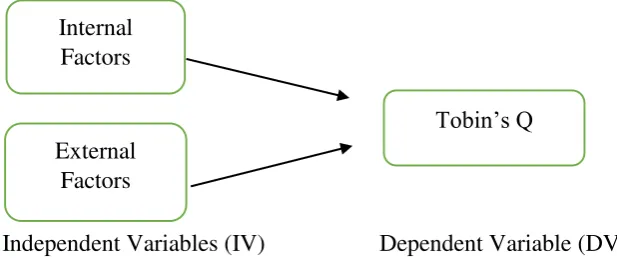
The study uses 4 internal factors and 4 external factors. Internal factors consist of return on asset, return on equity, Altman Z and corporate governance index. Meanwhile, external factors
employ Tobin’s Q, inflation rate, exchange rate and growth of domestic profit (GDP). Tobin’s
Q was used as a dependent variable measuring by market capitalization and long-term debt to total assets. Ordinary Least Square analysis was selected by using Multiple Linear Regression analysis in SPSS to study the significance variables against the dependent variable.
[image:5.595.134.443.364.493.2]Independent Variables (IV) Dependent Variable (DV)
Figure 1: Theoretical Framework
The following linear regression model were derived for the internal factors, external factors and the combination of both internal and external factors.
Model 1: Linear Regression Model of Tobin’s Q with internal factors.
Tobin’s Q Internal Factors = α + α1 ROA + α2 ROE + α3 ALTMAN Z + α4 CGI + ε
Model 2: Linear Regression Model of Tobin’s Q with external factors.
Tobin’s Q External Factors= α + α1 GDP + α2 Inflation + α3 Exchange Rate + ε
Model 3: Linear Regression Model of Tobin’s Q with internal and external factors.
Tobin’s Q Internal + External= α + α1 ROA + α2 ROE + α3 ALTMAN Z + α4 CGI + α5 GDP +
α6Inflation + α7 Exchange Rate +ε
External Factors
Tobin’s Q
4. FINDINGS
[image:6.595.74.527.139.283.2]4.1 Descriptive Statistics
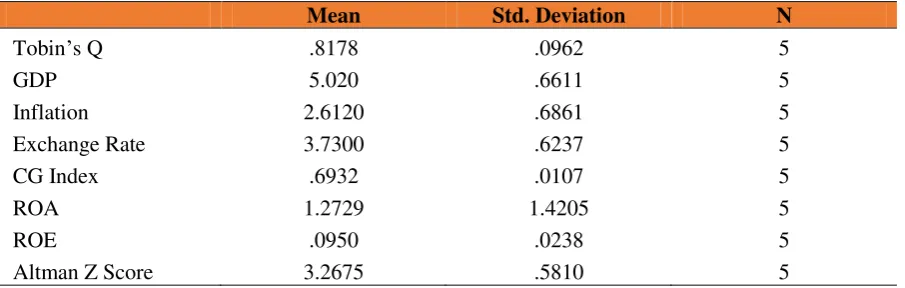
Table 3: Descriptive Statistics for Model 1, Model 2 and Model 3
Mean Std. Deviation N
Tobin’s Q .8178 .0962 5
GDP 5.020 .6611 5
Inflation 2.6120 .6861 5
Exchange Rate 3.7300 .6237 5
CG Index .6932 .0107 5
ROA 1.2729 1.4205 5
ROE .0950 .0238 5
Altman Z Score 3.2675 .5810 5
Based on the result of the descriptive statistics, the mean of Tobin’s Q is 0.8178 which indicates
that every RM1 of market capitalization will be covered by RM 0.8178 of assets. Its standard deviation has less volatility (0.0962) which means that the company has less difference in market capitalization during those five years. GDP contributes 5.02% of the mean and has
moderate volatility (0.6611) in five years’ time. Inflation and exchange rate indicate 2.61% and
4.2 Correlation
Table 3: Correlation result of Model 1, Model 2 and Model 3
TobinsQ GDP Inflation ExchangeRate CGIndex ROA ROE AltmanZScore Pearson
Correlation
TobinsQ 1.000
GDP .552 1.000
Inflation .756* .113 1.000
ExchangeRate .230 -.431 .801 1.000
CGIndex .356 -.025 .848 .879 1.000
ROA .899** .761 .400 -.217 -.034 1.000
ROE -.157 .143 -.352 -.436 -.234 .001 1.000
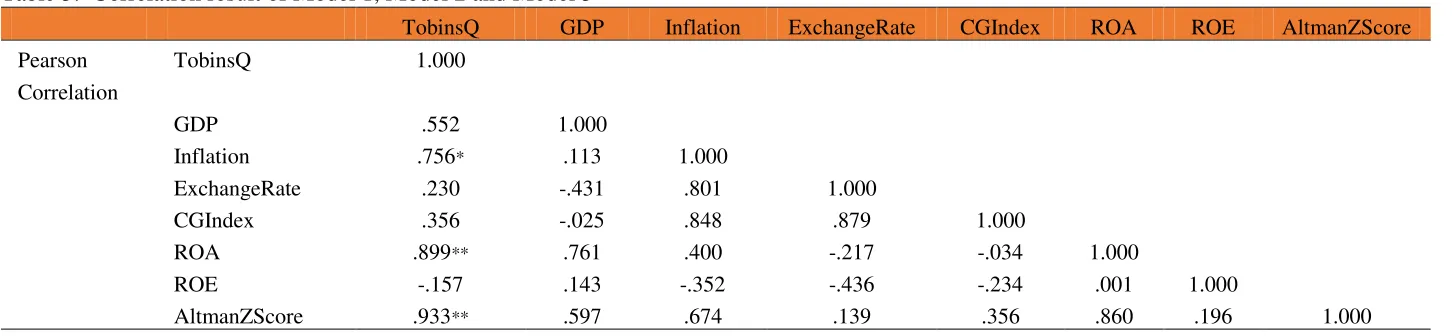
The table shows the result of the correlation for Model 1, Model 2 and Model 3. According to
the result above, most of the variables have a positive correlation to Tobin’s Q. The variables in which positively correlated to Tobin’s Q consists of GDP, inflation, exchange rate, corporate governance index, ROA, and Altman Z score. Meanwhile, ROE is negatively correlated to
Tobin’s Q.
There are two significant correlated variables to Tobin’s Q. The result shows that inflation is positively significant to Tobin’s Q with the P < 0.1 and followed by ROA and Altman Z score
which has positive significant to Tobin’s Q with the P < 0.05. While the other variables have no significant to Tobin’s Q.
4.3 Model Summary
Table 4: Model Summary for Model 1, Model 2 & Model 3
Model
R R Square
Adjusted
R Square Durbin-Watson 1 .995b .990 .981 1.728
2 - - - -
3 .995b .990 .981 1.728
The table shows the result of the model summary for Model 1, Model 2 and Model 3. When internal factors were tested in Model 1, the adjusted R² shows 0.981 which indicates that 98.1%
of the internal factors able to explain Tobin’s Q. Meanwhile there is no result shown in Model
2 when external factors being tested. 98.1% of external factors in Model 3 has the ability to predict the observations. The percentage explained that the Altman Z score and ROE are highly
4.4 ANOVA
Table 5: ANOVA of Model 1, Model 2 & Model 3
Model 1 Model 2 Model3
F Sig. F Sig. F Sig.
Regression 102.193 0.10* - - 102.193 0.10*
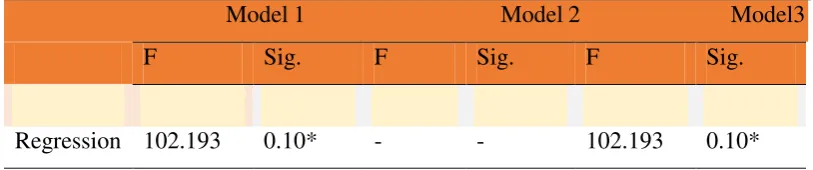
Based on the ANOVA result shown, Model 1 has a statistically significant to Tobin’s Q with
P < 0.1 when the internal factors are examined. There was no significant result in Model 2 when the external factors being tested. While for Model 3 indicates that internal factors and external factors have a statistically significant with P < 0.1.
[image:9.595.70.477.124.209.2]4.5 Coefficient
Table 6: Coefficient result of Model 1, Model 2 & Model 3
Model 1
Model 2
Model 3
Variables Beta t value Sig. Beta t value Sig. Beta t value Sig. Constant 9.584 .011 - - - 9.584 .011
Altman Z 1.002 14.116 .005** - - - 1.002 14.116 .005**
ROE -.354 -4.985 .038** - - - -.354 -4.985 .038**
The coefficient result shows that there are two significant variables in Model 1 which consists
of Altman Z score and ROE. Altman Z score has a positive significant influenced to the Tobin’s
Q with the P < 0.05. It can be said that when Altman Z score increases, Tobin’s Q will be increased. It implies that when the bankruptcy of the firm increase, the firm’s market valuation will increase as well. Meanwhile, ROE is statistically significant and negatively influenced to
Tobin’s Q with the P < 0.05. It resulted that the increasing of ROE will lead to a decreasing of Tobin’s Q. This can be seen that the increase in profitability resulting in a decrease of firm
Model 2 has no significant variable to the market valuation when external factors were tested. Model 3 shows the same result of significant variables in Model 1 which are Altman Z score and ROE. Altman Z score is statistically significant and positively influenced Tobin’s Q which implies that when Altman Z increase, definitely market valuation will increase. It implies that when the company is more tendency to default, the market valuation will increase which implies that share price increases dramatically in the bullish market. While ROE has a significant negative influenced to Tobin’s Q which resulted if ROE increase, Tobin’s Q will be decreased. The profitability of the company increase when market valuation decrease. It shows that when the share price of the company decrease, the investor will buy the stocks to gain the profit of the investment. The investor tends to buy the stocks at a lower current share price. The profitability of the company will increase since the investor buys the stocks at the lower current share price.
5. CONCLUSIONS
This study empirically examines the relationship between the internal factors and external factors with the market valuation of MISC Berhad from 2012 to 2016. The key focus of this study is to test the determinants of market valuation in which internal factors and external factors that would be affected the market valuation. There are two significant variables of internal factors that answered the research objective 1 which are Altman Z score and ROE. Meanwhile, in research objective 3 also explained that when internal factors and external factors are combined together it resulted also two significant variables which are Altman Z score and ROE. Whereas when Model 2 being tested, there is no significant variable that explained to Tobin’s Q.
In overall, Model 1 has in which internal factors have a significant impact on the market valuation which consists of two significant variables. Meanwhile, for Model 2 that consists of external factors variable resulted in no significant variable that can explain market valuation. Model 3 stated that there are also two significant variables similar to Model 1 when the internal factors and external factors were examined together.
REFERENCES
Agrawal, A., & Chadha, S. (2005). Corporate governance and accounting scandals. The
Journal of Law and Economics, 48(2), 371-406.
Agrawal, A., & Cooper, T. (2017). Corporate governance consequences of accounting
scandals: Evidence from top management, CFO and auditor turnover. Quarterly
Journal of Finance, 7(01), 1650014.
Bai, C. E., Liu, Q., Lu, J., Song, F. M., & Zhang, J. (2004). Corporate governance and market
valuation in China. Journal of comparative economics, 32(4), 599-616.
Bhagat, S., & Bolton, B. (2008). Corporate governance and firm performance. Journal of
corporate finance, 14(3), 257-273.
Black, B. S., Jang, H., & Kim, W. (2006). Does corporate governance predict firms' market
values? Evidence from Korea. The Journal of Law, Economics, and
Organization, 22(2), 366-413.
Black, B. S., Love, I., & Rachinsky, A. (2006). Corporate governance indices and firms' market
values: Time series evidence from Russia. Emerging Markets Review, 7(4), 361-379.
Brown, L. D., & Caylor, M. L. (2004). Corporate governance and firm performance. Available
at SSRN 586423.
Daily, C. M., & Dalton, D. R. (1994). Corporate governance and the bankrupt firm: An
empirical assessment. Strategic Management Journal, 15(8), 643-654.
Dignam, A., & Galanis, M. (2008). Corporate governance and the importance of
macroeconomic context. Oxford Journal of Legal Studies, 28(2), 201-243.
Darrat, A. F., Gray, S., Park, J. C., & Wu, Y. (2016). Corporate governance and bankruptcy
risk. Journal of Accounting, Auditing & Finance, 31(2), 163-202.
Haniffa, R., & Hudaib, M. (2006). Corporate governance structure and performance of
Malaysian listed companies. Journal of Business Finance & Accounting, 33(7‐8),
1034-1062.
Kirkpatrick, G. (2009). The corporate governance lessons from the financial crisis. OECD
Lang, W. W., & Jagtiani, J. A. (2010). The mortgage and financial crises: The role of credit
risk management and corporate governance. Atlantic Economic Journal, 38(2),
123-144.
Pongsatat, S., Ramage, J., & Lawrence, H. (2004). Bankruptcy prediction for large and small
firms in Asia: a comparison of Ohlson and Altman. Journal of Accounting and