RESEARCH ARTICLE
HIGHLIGHT ON THE EFFECT OF DAILY CONSUMPTION OF GRAPEFRUIT
1,*
Rasha A. Eldeeb,
2Shifan Khanday, G. and
3Rawoof Khan
1
Department of Physiology, Dubai Medical College, Dubai, UAE
2Department of Anatomy, Dubai Medical College, Dubai, UAE
3Central Bio Medical Laboratory, Dubai Medical College, Dubai, UAE
ARTICLE INFO ABSTRACT
Introduction and objectives: Grapefruit juice is recommended daily for normal individual and patients with obesity, dyslipidemia, insulin resistant, cancer with a promising hope of its beneficial effect. This study investigates the effect of daily intake of grapefruit on body weight, lipid profile and cerebellar function.
Material and Methods: 40 Albino rats divided into four groups and followed up for 14 days. Control group (Cgp) took pure water; Experimental group (E. gp1, 2, 3) took 10 ml, 20 ml and 30 ml of grapefruit juice daily respectively. Body weight, lipid profile and motor coordination of the groups were assessed as well as the histological study of the cerebellum.
Results: daily consumption of grapefruit /14 days in rat showed a non- statistical reduction in body weight, cholesterol, triglyceride, LDL levels and an increase in HDL level; accompanied by atrophy in the granular layer of the cerebellum and a decrease in the number of Purkinje cells.
Conclusion and recommendations: daily consumption of grapefruit juice reduced body weight, improved lipid profile in rats yet affected their motor coordination. We recommend further research at the cellular and molecular level with large sample size before we can generalize the findings.
Copyright © 2015 Rasha A. Eldeeb et al. This is an open access article distributed under the Creative Commons Attribution License, which permits unrestricted use, distribution, and reproduction in any medium, provided the original work is properly cited.
INTRODUCTION
Grapefruit “the forbidden fruit of Barbados” that was discovered in 1750 is an excellent source of many nutrients and phytochemicals. It is a good source of Vitamin C, Pectin fiber and antioxidant lycopene. Studies suggest that grapefruit had a beneficial effect on the lipid profile of dyslipidemic patients, the glycemic state of diabetic and insulin resistant patients. Also grapefruit is useful in removing and dissolving inorganic calcium that has been formed in the cartilage of the joint as in arthritis (George, 2007, Armando et al., 1997, Fellers et al., 2007, Cerda, 2007, Platt, 2000 and WMUR, 2003). A study in 2007 found a correlation between eating quarter grapefruit daily and a 30% increase in risk for breast cancer in post- menopausal women. The study pointed that grapefruits inhibits CYP3A4 enzyme which metabolize estrogen (Monroe et al., 2007). Others found significant decrease in the risk of breast cancer with greater intake of grapefruit in women who never used hormone therapy (Kim
et al., 2008)
*Corresponding author: Rasha A. Eldeeb
Department of Physiology, Dubai Medical College, Dubai, UAE
Studies had shown that grapefruit may have different drug interaction that may affect the potency of drugs. It contains narinigin, bergamottin and dihydroxybergamottin which inhibit the protein isoform CYP3A4 predominantly in the small intestine rather than liver. By the inhibition of this enzyme, grapefruit increases the effects of a variety of drugs by increasing their bioavailability. This effect became a concern after being responsible for a number of deaths due to overdosing of medication (Backely et al., 1988). With the fact that nowadays the consumption of grapefruit and grapefruit juice daily by normal individual as well as by patients is an upward trend. This study aims to investigate the effect of the daily consumption of grapefruit juice on the body weight, lipid profile and motor coordination, in an attempt to weigh the pros and cons of the daily consumption of grapefruit juice.
MATERIAL AND METHODS
The Experimental Research Committee and the Scientific and Ethics committees of Dubai Medical College approved all procedures. Male rats were supplied by Animal Care facility of Dubai Medical College. The study was conducted in accordance with World Helsinki Declaration. 40 male Albino
ISSN: 0975-833X
International Journal of Current Research
Vol. 7, Issue, 12, pp.24428-24432, December, 2015
INTERNATIONAL JOURNAL OF CURRENT RESEARCH
Article History:
Received 02nd September, 2015
Received in revised form
25th October, 2015
Accepted 07th November, 2015
Published online 30th December,2015
Key words:
Body weight, Cerebellum, Coordination, Grapefruit, Lipid profile.
rats of average body weight 125-169 g were randomly divided equally into four groups; control group (C gp) and three Experimental group (E gp 1,2,3); were fed commercial rat chow; C gp was given water while x.gps were given grapefruit juice as 10 ml/day , 20 ml/day, 30 ml/day respectively. Groups were maintained in a room at 23οC with light on from 7:00 till 18:00. After 14 days the body weight (BW) and lipid profile were measured, behavioral and neural assessments (coat hanger test" or horizontal bar and static rod test) were done to assess behavior, motor activity, coordination and forelimb strength. Rats were sacrificed twenty four hours after the administration of the last dose. The skulls were opened up using a bone crusher and the cerebellum was dissected out and fixed in 10% of formalin for routine histological study using H/E stain.
Serum triglycerides were measured by lipoprotein lipase technique (Colorimetric triglyceride kits DIALAB Co.). Total serum cholesterol (esterified and free forms) and HDL-C were measured by Colorimetric method. LDL-C serum level was calculated by using the following equation:
L D L - C = T C - (H D L - C + TG /5)
Extract preparation
Grapefruit was purchased from local commercial source, the juice was extracted and sieved to obtain a clear sample of the juice then evaporated to reduce the water content and obtain the desired concentration. The pH of the extract before evaporation was 3.48 at 30.1°C and was 2.9 at 30.1°C after evaporation.
Statistics
Data obtained from the study was subjected to appropriate statistics using SPSS Package. Values are expressed as mean ±SD. The independent t- test was used to compare the two groups. Analysis of variance ANOVA was done. P<0.05 was considered statistically significant.
RESULTS
In this study the daily consumption of grapefruit for 14 days (E.gp1, 2, 3) – Table (1)- showed non-statistical significant decrease in body weight, triglyceride, cholesterol and LDL levels associated with non-statistical significant increase in HDL level compared to the C gp and these changes were dose dependent.
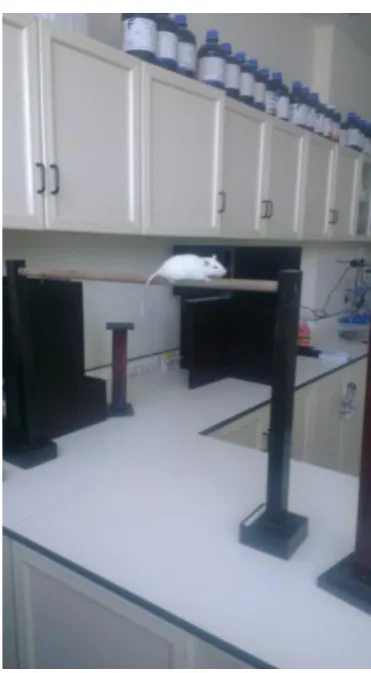
Assessing the motor coordination of the pre trained rats using the static rod test Fig.(1) showed increase in the number of falls and the duration taken to traverse the rod in the E gp compared to the C gp, this increase was associated with the increase in the dose of grapefruit taken. The increase in the number of falls was statistically significant. String test Fig. (2) was used to assess grip strength where the rat is allowed to hold a steel wire (2 mm in diameter and 60 cm in length) with its forepaws. The length of the time the rat was able to hold the wire till it fell was recorded. String test results showed decrease in the grip time of the E.gp compared to the C gp., this decrease was associated with the increase in the dose of grapefruit taken. The histological study of the cerebellum in the E gp Fig. (4-7) showed atrophy in the granular layer and decrease in the number of Purkinje cells compared with the C gp., which was dose dependent.
[image:2.595.339.525.266.603.2]Neurological Examination
Fig. 1. Rat crossing the static rod
Table 1. Effect of grapefruit Extract on Rats
Parameters Control group E.gp.1 E.gp.2 E.gp.3 P
Mean ± SD Mean ± SD Mean ± SD Mean ± SD
Body weight (BW) (g) 139.4 ± 11.41 137.5 ±14.30 136.3 ± 14.97 135.5 ± 15.20 >0.05
TG (mg/dl) 66.56 ± 13.64 62.05 ±14.35 60.42 ± 13.86 59.48 ± 13.22 >0.05
cholesterol (mg/dl) 82.48 ± 8.65 81.4 ± 9.36 81.15 ± 7.82 80.83 ± 8.022 >0.05
HDL(mg/dl) 36.52 ± 3.05 37.21± 2.88 37.71 ± 2.79 38.92 ± 3.15 >0.05
LDL(mg/dl) 45.84 ± 7.83 45.65 ± 7.84 45.27 ± 7.77 42.92 ± 8.33 >0.05
String test- Duration of maintain grip (Sec.) 239 ± 4.19 222 ± 6.76 217 ± 6.35 115 ± 4.32 >0.05
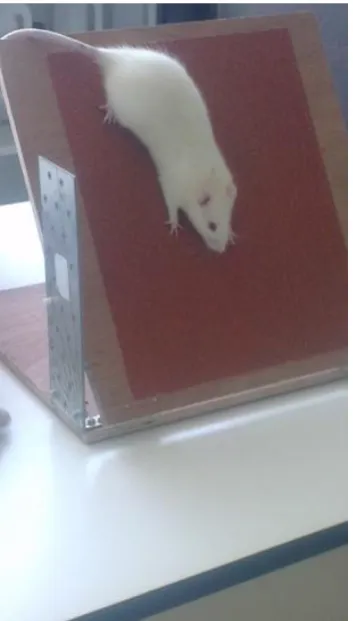
Duration of balance on a tilted surface at 60O( min) 13± 0.77 12± 0.89 11± 0.73 9± 0.81 >0.05
Static rod test
1. Duration of traverse static the rod (Sec.) 93 ± 2.27 109 ± 5.48 113 ± 1.57 121 ± 4.57 >0.05
2. No. of falls ( Expressed as Mode) 0 1 2 3 <0.05*
[image:2.595.81.516.656.774.2]Fig. 2. String test assessing grip strength in rats
Fig. 3. Balancing on a tilted surface 60O
Histological Findings
[image:3.595.318.548.323.492.2]Fig. 4. Cgp showed normal cerebellum in all the layers. The cellular architecture was preserved. A well- defined molecular, granular and Purkinje layers were observed along with numerous closely packed small cells in the granular layer and large typical flask shaped Purkinje cells
Fig. 5. E gp -1 showed a well preserved cerebellar architecture in all the layers
[image:3.595.75.252.427.738.2] [image:3.595.320.545.534.707.2]Fig. 7. E gp -3 showed marked atrophy of granular layer and Purkinje cells reducing in number. A few atypical axonal
torpedoes like cells were observed
DISCUSSION
This study spots the light on the effect of drinking grapefruit juice daily for 14 days in rats which was accompanied by non-significant reduction in the body weight and improvement lipid profile, these findings run in coherence with other studies who reported significant reduction in body weight and modest improvement in the lipid profile after the consumption of grapefruit (Bachey et al., 1988; Cerda, 1988; Kurowska 2000, Heidi, 2011; Martinez de Pardo, 1981). Studies showed that grapefruit by itself may not have a direct effect on the body weight yet it may help people on diet by delaying gastric emptying, expanding satiety and reducing the feeling of empty stomach (Heidi, 2011; Martinez de Pardo, 1981).
Grapefruit improves the lipid profile by the effect of its components: high amount of polyphenols, pectin fibers, Vitamin C and trace elements. Several studies showed the ability of Pectin to increase the excretion of lipids, cholesterol, bile acids and reduce serum cholesterol levels. It binds with the bile acids, thus decreases the cholesterol and fat absorption. Other studies found that dietary Pectin increase the excretion of fecal neutral steroids hence contributes indirectly to the reduction of the blood cholesterol levels Heidi J 2011, Martinez 1981 and Kurowska (2000). Consumption of Grapefruit juice daily for 14 days affected the motor coordination of the rats; that was manifested by the reduction in the time they were able to maintain their balance and grip on the tilted surface 60O and on the string test respectively.
This was accompanied by increased number of falls during the static rod test. Histological study of the cerebellum using H/E stain was done to try to find a possible explanation and justification for the change in the coordination level of the rats after consuming grapefruit daily /14 days and this study found a dose dependent atrophy in the cerebellar granular layer accompanied by decrease in the number of Purkinje cells. The histological findings of this study runs in agreement with Dare
et al. 2012 who found a dose dependent cellular degeneration
of the granular and Purkinje cells of the rats after the consumption of grapefruit juice daily/14 days.
In this study the mechanism by which grapefruit extracts induced cellular atrophy and degeneration in the cerebellum needs further investigation. We postulate that grapefruit juice acted as a toxin to the cerebellar cells and that induced cellular necrosis which involved disruption of the structural and functional integrity of the cerebellar cells and manifested by disturbance in the coordination level of the rats which was a landmark in this study. Studies have reported that degenerative changes results in cell death of two types either apoptotic or necrotic cell death which may be caused by extrinsic insults such as osmotic, toxic and traumatic effect.
The rate of progression of the cellular necrosis depends on the severity of the environmental insults. The greater the severity of insult, the more rapid the progression of cellular injury.(Dare BJ et al 2012, Wyllie AH 1980 and Ito U et al., 1975).This is in accordance with the findings of this study as it showed dose dependent atrophy in the cerebellar granular layer and Purkinje cells with affection of the coordination level of the rats after consuming grapefruit juice daily / 14 days. The limitations of this study is the small sample size and that is more thorough investigation at the cellular and molecular levels is needed to explain the mechanism by which grapefruit juice alter the structural and functional integrity of the cerebellar granular layer and Purkinje cells.
Conclusion
This study found that consumption of grapefruit juice daily/ 14 days showed non- statistical significant reduction in body weight, modest improvement in lipid profile accompanied by atrophy in the granular layer of the cerebellum and a decrease in the number of Purkinje cells. This cerebellar insult had affected the motor coordination thus we recommend further research at the cellular and molecular level with large sample size to clarify the mechanisms by which grapefruit induced this effect before we can generalize the findings.
Conflict of Interest: None. The authors declare that they have no competing interests.
Funding agents: None
REFERENCES
Armando, C., S. Maythe, and N. P. Beatriz. 1997. Antioxidant activity of grapefruit seed extract on vegetable oils. Journal
of the Science of Food and Agriculture, 77(4): 463-467.
Retrieved October 9, 2007
Backey, P.A., Cerda, J.J., Burgin, C.W. et al. 1988. Grapefruit pectin inhibits hypercholesterolemia and atherosclerosis in miniature swine. ClinCardiol., 11: 595–600
Bressler, R. 2006. Grapefruit juice and drug interactions. Exploring mechanisms of this interaction and potential toxicity for certain drugs. Geriatrics, 61:12-18
Cerda, J.J., Burgin, C.W., Robbins, F.L. et al. 1988. The effects of grapefruit pectin on patients at risk for coronary heart disease without altering diet or lifestyle. ClinCardiol., 11: 589–94
patients at risk for coronary heart disease without altering diet or lifestyle. Clin Cardiol., 11(9): 589-594. Retrieved October 9, 2007.
Dare, B.J., Oyewopo, A.O., Saalu, L.C., Kadir, R.E., Osinubi, A.A.A., et al. 2012. Histological Alteration of the Cerebellum of Adult Male Wistar Rat Treated with the Grapefruit Extract (Citrus paradisi). AnatPhysiol., 2:107. doi: 10.4172/2161-0940.1000107
Fellers, P. J., S. Nikdel, and H. S. Lee. 1990. Nutrient content and nutrition labeling of several processed Florida citrus juice products. J Am Diet Assoc., 90(8): 1079-1084. Retrieved October 9, 2007.
George Mateljan Foundation (GMF). 2007. The world's healthiest foods: Grapefruit. The George Mateljan
Foundation. Retrieved October 9, 2007.
Heidi J Silver, Mary S Dietrich, Kevin D Niswender. 2011. Effects of grapefruit, grapefruit juice and water preloads on energy balance, weight loss, body composition, and cardiometabolic risk in free-living obese adults. Nutrition & Metabolism. 2011 8:8. doi:10.1186/1743-7075-8-8 Ito, U., Spartz, M., Warzo, J.T., Klatzo, I. 1975. Experimantal
ischemia in Mongolian gerbils .I. Light microscope observations. ActaNeuropathol., 32: 209-223.
Kim, E.H., Hankinson, S.E., Eliassen, A.H., Willett, W.C. 2008. “ A prospective study of grapefruit and grapefruit juice intake and breast cancer risk “ . Br J Cancer, 98: 240-241.
Kurowska, E.M., Borradaile, N.M., Spence, J.D., Carroll, K.K. 2000. Hypocholesterolemic effects of dietary citrus juices in rabbits. Nutr Res., 2000; 20: 121–29
Kurowska, E.M., Spence, J.D., Jordan, J. et al. 2000. HDL-cholesterol-raising effect of orange juice in subjects with hypercholesterolemia. ClinNutr., 2000; 72: 1095–100 Martinez de Prado, M.T., Sanchez-Muniz, F.J., Katan, M.B.,
Hermus, R.J. 1981. The effectof different fi bre sources on the neutral steroid excretions of hypercholesterolemic casein fed rabbits. Rev EspFisiol., 1981; 37: 407–12 Monroe, K. R., S. P. Murphy, L. N. Kolonel, and M. C. Pike.
2007. Prospective study of grapefruit intake and risk of breast cancer in postmenopausal women: The multiethnic cohort study. PMID 17622247. Br J Cancer, 97(3): 440-445. Retrieved October 9, 2007.
Platt, R. 2000. Current concepts in optimum nutrition for cardiovascular disease. PrevCardiol., 3(2): 83-87.
WMUR, Channel 9. 2003. Researchers put grapefruit diet to test: Grapefruit compound lowers cholesterol, helps regulate insulin. WMUR June 11, 2003. Retrieved October, 9, 2007.
Wyllie, A.H. 1980. Glucocorticoid-induced thymocyte apoptosis is associated with endogenous endonuclease activation. Nature, 284:555-556.