ISSN Print: 2163-0429
DOI: 10.4236/ojf.2018.84033 Oct. 23, 2018 532 Open Journal of Forestry
Applying Sustainability and Ethics in Forest
Management and Community Livelihoods: A
Case Study from Arabuko Sokoke Forest, Kenya
Musingo T. E. Mbuvi
1*, Leila Ndalilo
1, Aden Hussein
21Kenya Forestry Research Institute, Coast Eco Region Research Programme, Malindi, Kenya 2Manager Kipepeo Project, National Museums of Kenya, Gede, Kenya
Abstract
Efforts to manage forests continue to be enhanced equally as emergence of investments in community livelihoods whose benefits are inequitable. Litera-ture review, focus group discussion and key informant interviews showed that Arabuko Sokoke Forest has been managed under different management regimes; stakeholders have increased from singular to multiple with each stakeholder’s interests hinged on different conservation theories and ethical principles, despite that well-meaning facilitation, laws and policies, unsus-tainable and un-ethical scenarios abound. Extreme scenarios of a poor mother being denied firewood for lighting, warming and cooking food in or-der to conserve biodiversity. These are both right and wrong, a fluidity re-quiring situation specific sustainability and ethical justification. A discourse guided by the sustainable development goals provides a mechanism for mod-erating the diverse interests and helps bring harmony and synergies among all stakeholders for the common good without compromising the ecological functions of the forests thus ensuring sustainability.
Keywords
Forest, Equitable, Livelihoods, Sustainability and Ethics
1. Introduction
Forestry management in Kenya formally started in late 1890s’ with the first leg-islation being enacted in 1891 and the first Chief Conservator of Forest being posted in 1902 (Logie & Jones, 1968). It was after a century, in 1997, that the country initiated a process to change the century old singular command and
How to cite this paper: Mbuvi, M. T. E., Ndalilo, L., & Hussein, A. (2018). Applying Sustainability and Ethics in Forest Man-agement and Community Livelihoods: A Case Study from Arabuko Sokoke Forest, Kenya. Open Journal of Forestry, 8, 532-552. https://doi.org/10.4236/ojf.2018.84033
Received: April 10, 2018 Accepted: October 20, 2018 Published: October 23, 2018
Copyright © 2018 by authors and Scientific Research Publishing Inc. This work is licensed under the Creative Commons Attribution International License (CC BY 4.0).
DOI: 10.4236/ojf.2018.84033 533 Open Journal of Forestry control system in forest management, through piloting of Participatory Forest Management (PFM). It has been subsequently institutionalized as an alternative national forest management approach. Participatory Forest Management has been defined as a forest management approach, which deliberately involves the Forest Adjacent Communities (FAC) and other stakeholders in sustainable management of forests within a framework that contributes to community’s livelihoods(Kenya Forest Service—KFS, 2015a).
The PFM pilot was done in Arabuko Sokoke Forest Reserve (ASFR) which is an indigenous coastal forest (Mbuvi & Ayiemba, 2005). The changes in forest management approach were done to align forest management in Kenya with the requirement for protected areas to be equitably governed and managed as per the Convention on Biological Diversity’s(CBD, 2010) goal 2.1 that calls for the pro-motion of “equity and benefit sharing” and goal 2.2 on enhancing “involvement of indigenous and local communities and relevant stakeholders”, an initiative also in line with Aichi Biodiversity Target 11, which required that protected areas should be “effectively and equitably managed” (Schreckernberg et al., 2016: p. 1).
The forestry sector in Kenya faced a national outcry over unprecedented deg-radation in 1980s’ (Wass, 1995; Republic of Kenya RoK, 2009a). A scenario similar to observations byManning et al. (1999) that the current development paradigm of individual maximizing their material is leading to conversion of forest to other land uses and may lead to catastrophic consequences to human wellbeing. This thinking calls for sustainable forest management for the in-herent value of life therein.
This school of thought requires that ethical considerations be internalized in the management of forests. The forest ethics would operate at all levels from the community to the global citizen where a farmer collecting firewood for cooking for his family has to do it well aware of the effect it has on the habitat for the ASFR endemic birds which attract national and international research-ers, citizens and development partners to learn and have immense biodiversity value.
DOI: 10.4236/ojf.2018.84033 534 Open Journal of Forestry
2. The Scenario in Arabuko Sokoke Forest Reserve
The review is premised on analysis of scenarios that are operating in several for-ests in Kenya where communities have been participating in forest management with defined benefits by law, though the law may not be providing adequate op-portunities. The challenge is more on the process (implementation). Arabuko Sokoke forest reserve was chosen for review but also quotes scenarios from other select forest in Kenya. ASFR was given special attention because it draws local, national and global interest. It is the forest that had the first forest management plan approved by the Chief Conservator of Forests(Forest Department, 2002). The forest has also gone through all the phases of governance; community man-aged, government managed and PFM. The forest has been receiving adequate funding (Appendix I) from government, national and global development part-ners supported by very enthusiastic community. This has ensured that the forest is exposed to best global practices and experiences through interaction with re-known conservationists and development experts. After PFM pilot (Mbuvi & Ayiemba, 2005;Matiku et al., 2013), ASFR is now focusing on governance, live-lihoods, maximizing on returns from Income generating Activity (IGA) and lev-eraging on the partnerships to support organizational stability at the forest level. This calls for collective ethics as different partners seek to maximise on both conservation and livelihood gains (Manning et al., 1999).
2.1. Description and Management of Arabuko Sokoke Forest
Reserve
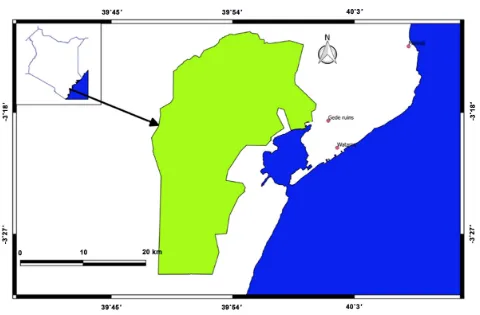
The Arabuko-Sokoke Forest Reserve (ASFR) is a lowland dry forest in the Coastal region of Kenya, starting at sea level with the mangroves at the Mida Creek. It is located in Kilifi County about 110 km North of Mombasa (Figure 1) at a latitude of 3˚20'S and a longitude of 39˚50'E (Forest Department, 2002). The forest experiences bi-modal rainfall pattern with short rain season occurring between November and December and the long rains falling between April and June. The average annual rainfall fluctuates from the East part to the West part of the forest ranging from 900 mm in the Northwest to 1100 mm in the East. The forest is located in a humid and hot climate zone and its temperature aver-ages about 29˚C(Muriithi & Kenyon, 2002).
DOI: 10.4236/ojf.2018.84033 535 Open Journal of Forestry
Figure 1. Arabuko Sokoke forest.
managed by three forest stations: Gede; Sokoke and Jilore each manned by For-est Manager assisted by armed forFor-est rangers actively supported by communities organized through station based Community Forest Associations (CFAs).
The Arabuko-Sokoke Forest Reserve is an indigenous forest whose direct use for products like timber and poles is hardly possible. This is because the draft forest policy 2015, states that indigenous forests will be put under efficient and sustainable multipurpose management, which combines biodiversity conserva-tion and water-catchment funcconserva-tions together with the producconserva-tion of tangible benefits for forest adjacent communities (Ministry of Environment, Water and Natural Resources MEWNR, 2015). This scenario poses a challenge to the adja-cent communities especially the poor who view the forest as a means to escape from poverty and perceive the introduction of PFM as the start of that process.
DOI: 10.4236/ojf.2018.84033 536 Open Journal of Forestry laws and policies provide the rules and regulate the actions and power sharing mechanisms for the different stakeholders.
Therefore, the conservation of ASFR has been complex as noted by Gore et al., (2011)that the conservation policy choices can be complicated by stakeholder debate over the value of an individual animal’s life, humans’ role in nature, or the effectiveness of conservation actions. This is complicated by the different ethical principles which each stakeholders use to guide their actions and claims. This forms the basis of our discussion for this paper.
3. Theoretical Framework
Man and forests have coexisted over centuries and there have been several movements all over the world for inclusivity of human being in the management of forests for supply of goods and services (Guha, 1989;FAO, 1999;Gibson et al., 2000). Normative ethical theory guided in the understanding of different con-cepts on ethics and sustainable forest management. Normative theory defines what is right or wrong in the society and also helps the society to come up with sanctions for wrong doing so that those who deviate from the norm can be cor-rected. By defining what is right or wrong the society makes adjustments and the behaviour of different persons are regulated for the common good of all. Ac-cording to(Kant, 1968), human behaviour is controlled by what they consider as rational and this rationality helps them act rationally and expect the same from others. In the context of forest management this therefore means that humans interact with the forest through actions that are rationally defined to ensure that their actions and those of others are such that they don’t affect the forests nega-tively and that as they benefit from forest goods and services, they don’t affect each other and also the forest hence sustainability of the forests. The different actors in forests management also operate within the confines of culturally de-fined norms and the existing laws to remain relevant and acceptable to the soci-ety through the development of management agreements (KFS, 2015a) and management plans which are negotiated between the community forest associa-tions and the Kenya Forest Service(RoK, 2009a;KFS, 2015b).
4. Methodology
The study adopted a case study approach in which Arabuko Sokoke forest was comprehensively analysed as case study. Detailed literature review was ducted, 32 key informant interviews conducted, 8 focus group discussion con-ducted and expert opinions documented through key informant interviews. Through the different methods we gathered information on the history of the forests and forest management practices. The different themes were synthesized and formed the basis for the full discussion of the paper.
DOI: 10.4236/ojf.2018.84033 537 Open Journal of Forestry Ayiemba, 2005;Mbuvi et al., 2007;RoK, 2009a; RoK, 2009b;RoK, 2009c; RoK, 2010;RoK 2016a;Mbuvi et al., 2015;Ndalilo et al., 2017), to form the basis and draw parallels for the discussion on development and ethical issues affecting the forest. Experiences were also drawn from other parts of the world on how ethical issues have evolved and how they affect the management of forest in different parts of the world.
A total of 8 focus group discussion were conducted for in-depth analysis of the different issues that emerged during the individual interviews. Purposive sampling was used to select the respondents; two focus group discussions were held in each of the three forest blocks-Gede, Jilore and Sokoke, one with mem-bers of the CFA Management committees and the other with representatives of forest user groups. Each FGD comprised 10 people who were engaged in the discussions to explore the relevant issues in more details. The main issues probed included community involvement in decision making, resource utiliza-tion trends, access, benefit sharing and equity mechanisms, and compliance to legal and policy framework.
Key Informant interviews were conducted with persons who were privy to in-formation relevant to the study. Staff from Kenya Forest Service (KFS), Kenya Forestry Research Institute (KEFRI), Kenya Wildlife Service (KWS), Nature Kenya, Arocha Kenya, and National Museums of Kenya (NMK) were inter-viewed using interview schedules to capture their opinions and experiences on historical changes in forest management, resource use, access and utilization trends, policy and legal issues governing forest resource use and management and ethical issues affecting sustainable management of forests. Retired staff of these organizations were also interviewed to get the historical perspectives on ethical issues as they evolved. Leaders of community groups and forest product licensees were also interviewed with retired officials acting as key informants. A total of 32 key informants were interviewed.
5. Results and Discussion
5.1. Environmental Concerns in Arabuko Sokoke Forest Reserve
Arabuko Sokoke forest reserve is ranked second in Africa and fifty globally in biodiversity richness (Forest Department, 2002). It is the largest remnant of what was originally an extensive strip of dry coastal forest that extended from Southern Somalia in the horn of Africa to the Eastern Cape in the south(Forest Department, 2002;Oyugi et al., 2007). The forest is however threatened by habi-tat degradation resulting from economic development, poor forest governance and high levels of poverty among forest adjacent communities(Ndalilo et al., 2017).communi-DOI: 10.4236/ojf.2018.84033 538 Open Journal of Forestry ties. Although the local community perceive the forest as a source of fuelwood and other subsistence uses(Matiku et al., 2013; Mbuvi et al., 2007). Conserva-tionists on the other hand see livelihoods as a threat to the forest further mar-ginalizing the poor and vulnerable members of the community whose liveli-hoods are almost entirely dependent on the forest. The high levels of poverty that encourage poaching of forest products(Mbuvi et al., 2007), coupled with lack of alternative livelihood activities poses a major challenge to the conserva-tion and management of ASFR.
The other major potential threat to ASFR remains mining in the forest and adjacent areas recognizing that prospecting has been done with promising re-sults for Titanium, oil and gas, while compensation for CFAs may not be guar-anteed. The high interest generated by the anticipated high returns and the need for industrialization by the government and economic growth may weigh nega-tively on continued conservation of the forest, hence impacting neganega-tively on the role of ASFR in biodiversity conservation and socio-economic development. The forest provides fresh water re-charge that is necessary for continued growth of the Mida creek mangrove ecosystem which supports fisheries for food security and economic development. Mida Creek also has the oldest mangrove board walk in Kenya with a very active eco-tourism project which contributes signifi-cantly to local livelihoods and conservation of mangrove ecosystem as guided by a Participatory Forest Management Plan (PFMP). The conservation of ASF thus contributes to SDG 14 on conservation and sustainable use of oceans, seas and marine resources for sustainable development. It also contributes directly to SDG 15: Protect, restore and promote sustainable use of terrestrial Ecosystems, sustainably manage Forests, combat desertification, and halt and reverse land degradation and biodiversity loss.
5.2. Ethical Issues in the Management of Arabuko Sokoke Forest
from a Historical Development Perspective
Forest ethics operate at many levels—local, national or international, and ethical conflicts in forestry are common place because multiple different aspirations re-garding different forest products and services exist over extensive geographical areas and timeframes (Macqueen, 2004). For example, both local farmers and international climatologist have legitimate grounds for wanting or opposing for-est clearance, but their conflict arises because forfor-ests generate aspirations at dif-ferent levels (Manning et al., 1999). The local farmers control over his future depends firmly on clearing a particular local patch of forest. The international climatologist is concerned about long term changes at the global level(Manning et al., 1999). Both might share the same forest ethic, but the level at which their aspiration is based differs as noted byManning et al. (1999). Ethics as was noted byHorn (2013) refers to habits of thought and behaviour that emphatically take others interests into account in order to achieve greater good.
DOI: 10.4236/ojf.2018.84033 539 Open Journal of Forestry benefits disproportionately accrue to the well off in society (Mbuvi & Ayiemba, 2005;Mbuvi et al., 2015). Such forests simply cannot compete in terms of reve-nue generated per unit area, with land use alternatives yet contireve-nued conversion of natural forests to other land uses may have catastrophic consequences for human well-being. Currently, the main ethical issues affecting forest manage-ment include; the mismatch between the ethical driving forces affecting forests such as maximising individual wealth and proposed solutions which appeal to broader notions of human well-being; adequate and balanced representation from those suffering the consequences of forest loss rarely matches the power of those perpetrating it; individual or sovereign self-interests impede any attempt to develop a higher collective vision to the benefit of all; and short term restric-tions of behaviour are preferred to long term changes in behaviour (Manning et al., 1999).
ASFR was gazetted as a forest reserve in 1943 during which commercial and subsistence utilization of the forest was allowed for timber, poles, firewood, carving wood and sand harvesting for glass making. Local communities were also allowed free access to defined products legally through special rules for ASFR. This was fair then as the resource was adequate, the community demands were low, population was very low and demand for forest products was negligi-ble as to cause forest degradation.
With the ever increasing population and high demand for forest products and agricultural land adjacent to the forest, the main ethical concerns in ASFR are; 1) was it right to reduce the community forest products provisions when the forest products were declining? 2) Is there an equitable benefit sharing mechanism with regard to local communities access to forest resources; and 3) Is it right to protect elephants while denying local communities the opportunity to protect their crops and exploit a valuable natural resource? These kind of ethical dilem-mas are not easily resolvable.
DOI: 10.4236/ojf.2018.84033 540 Open Journal of Forestry of ethical obligations beyond that of the: conservation of biodiversity; the reduc-tion of poverty; imperative of social justice and cultural integrity and the im-provement in human livelihoods. This should ensure that people access to re-source is fair, there are no privileged groups of people over others, and some species are not conserved at a cost to others.
Previous studies conducted in ASFR (Mbuvi et al., 2007;Ndalilo et al., 2017)
established that informal access to forest products particularly timber and poles give the FAC the highest benefit; although the newly initiated donor funded IGAs are substantially benefiting households(Mbuvi, & Ayiemba, 2005;Matiku et al., 2013). The communities adjacent to ASFR have been alienated from access to forest resources and decision making, compensation and damage to crops. These bring the ethical questions of: What is the highest benefit the communities are accessing from the forest, how does the law support it and how sustainable is the benefit? Who bear the highest responsibility? Who should be the first benefi-ciary? Who takes care of the global good?
5.3. Economic Development and Implication on Ethics and
Sustainability
The forest is witnessing increased urbanization in Kilifi, Watamu and Malindi and the small adjacent Gede shopping centre whose residents shall continuously require forests for recreation in the midst of a poor forest adjacent community viewing the forest as a means to escape from poverty and perceive their participation in forest management as the beginning of that shift (Mbuvi & Ayiemba, 2005).
The ASFR is a tourist destination, and tourism among other products and services generates revenue to the government from payment of fees by both local and international forest users as outlined in Table 1.
Over the years, there has been a great push by local communities and civil so-ciety organizations to share the accruing revenues equitably but the local com-munities have always ended up holding the short end of the stick. This scenario is changing as the Forest Conservation and Management Act 2016 has explicitly provided for opportunities for accessing of both subsistence and commercial products under various forest management scenarios from joint management, leases and concessions and increasing of tree cover as incentives and benefits. Communities are increasingly feeling alienated from the forest benefits despite; the Kenya Constitution 2010 requirements (RoK, 2010) and community active role in conserving the forest. This has resulting to an ethical conflict, with the net effect being the illegal harvesting of forest products as FAC lack incentives to effectively engage in forest conservation.
DOI: 10.4236/ojf.2018.84033 541 Open Journal of Forestry
Table 1. Revenue* trend for ASFR.
Year/station 2005 2006 2007 2008 2009 2010 2011 2012 2013 2014 2015 2016
Gede and
Jilore 19,396 428,773 310,541 266,351 479,416 2,438,666 2,299,557 1,954,801 1,475,320 1,870,745 2,323,456 2,134,897 Sokoke
stations 0 0 0 78,000 76,700 101,100 30,800 215,700 228,900 301,500 211,700 295,600
Total 19,396 428,773 310,541 344,351 556,116 2,539,766 2,430,357 2,170,501 1,704,220 2,172,245 2,535,156 2,430,497 Source: KFS Records; * in Kenya shillings: 1 USD = 100 Kenya shillings.
and poverty. This conforms to Brundtland report, which stated that: “Those who are poor and hungry will often destroy their immediate environment in order to survive….”(Schreckernberg et al., 2016).
Community access to resources has been regulated in ASFR(Forest Depart-ment, 2002) which is an indigenous forest where direct exploitation is not al-lowed(RoK, 2016a). Access to resources by communities and other stakeholders has been mitigated through compensation, substitution and creation of alterna-tives. The alternative IGAs include butterfly farming, beekeeping, commercial tree nurseries, tour guiding and ecotourism which have contributed positively to community livelihoods.
Studies in ASFR(Matiku et al., 2013;Ndaliloet al., 2017) have reported that the community groups have recorded an increase in income generated from these activities over the past years following numerous capacity building initia-tives spearheaded by various stakeholders supported by donors. For instance Jamii villas, a forest adjacent community ecotourism project located adjacent to ASFR recorded revenue of USD 31,689.50 in the year 2016 up from USD 1630.00 in 2014. Msitu Women Tree nursery group recorded USD 25,348.70 in 2016 up from USD 8905.00 in 2013, while Kipepeo project which deal with sale of butter-fly pupae and honey generates an annual earning of USD 130,000.00.
Moreover the Arabuko Sokoke Ecotourism Scheme (ASSETS) project which offers education scholarships to forest adjacent students whose parents are ac-tively involved in forest conservation has witnessed 583 students trained in sec-ondary level of education and 12 students trained up to university level. This has provided opportunities for attachment of youth who acquire skills that ensure inclusive and equitable quality education that promote lifelong learning oppor-tunity for all in line with SDG 4. The above enterprises have immensely contrib-uted to SDG 1 which seeks to end poverty in all its forms everywhere. The ethi-cal question however is whether these projects have replaced the benefits derived from the forest, and could this result to more time being spent by members in these activities at the expense of forest conservation or would the benefits which are not necessary forest based alienate the benefiting households from the forest.
5.4. Ethical Issues in Forest Governance
environ-DOI: 10.4236/ojf.2018.84033 542 Open Journal of Forestry ment and appreciates that the environment is our heritage and the need to sus-tain it for the benefit of the future generations(RoK, 2010). The Forest Conser-vation and Management Act 2016, provides for improved governance and has been well expounded by creating and reforming organizations like KFS, Forest Conservation Committee (FCC) and CFAs(KFS, 2009;RoK, 2009b). The lower organizations have been provided clear formation and working guidelines(RoK, 2009a;RoK, 2009b; RoK, 2009c;KFS, 2015a; KFS, 2015b). This has ensured in-clusivity in forest management including community, government (national and county), CBOs and development partners. Further in ASFR, the community have formed the Arabuko Sokoke Forest Adjacent Dwellers Association which is an umbrella of the three CFAs through which communities have partnered with KFS to manage ASFR so as to ease community mode of engaging with KFS and development partners, ensure conflict management and over-sighting.
The forest governance system in ASFR thus contributes to SDG 16 which promotes peaceful and inclusive societies for sustainable development, provide access to justice for all and build effective, accountable and inclusive institutions at all levels. The concept of sustainable development(UNDP, 2000) requires that development be done in a manner that meets the needs of the present without compromising the ability of future generations to meet their own needs(Horn, 2013). This definition brings up ethical issues as to what are these needs and what is the threshold of satisfaction? In the case of PFM in ASFR, the primary concern has been the exclusion of non-PFM households in accessing forest benefits where(Mbuvi & Ayiemba, 2005) indicated that Non-PFM households earned less income as compared to PFM households. This scenario leaves out the majority of the community members from accessing these benefits. But should those not participating (therefore not spending their time in PFM activities like forest protection) be allowed to benefit equally like those participating?
Moreover, the community organizations representation may not be fair as the constitution of CFA committees and their representation has been hijacked by government or any other facilitating organization. The CFA get an introductory letter from KFS before they can be registered, KFS in most instances coordinates and supervises their elections. Further, key appointments to community-KFS committees have been legally prescribed where the chair and the secretary to the conservancy forest management level FCC is defined with the chair being di-rectly remunerated by KFS. These entire scenarios bring forth serious ethical considerations. Additionally, the over-reliance by CFAs on external support to hold elections has further created room for hijacking of CFAs by the supporting organizations and facilitating selection of officials and not electing as expected of good governance practices.
DOI: 10.4236/ojf.2018.84033 543 Open Journal of Forestry effective control of their resources and livelihoods as noted by Minteer & Miller (2010). Studies conducted by Mbuvi & Ayiemba (2005) and Schreckenberg & Luttrel (2009)in ASFR, the PFM pilot area showed that the poor would only be in the committees through deliberate project intervention and it has to be sus-tained through constant monitoring without which the poorest households would be excluded from CFA committees. The situation in ASFR is a pointer to inefficient systems of community involvement in forest management leading to questions about who makes which decision and how are the communities in-volved in the management of the resources, what rights do they have and how do they exercise them, and what opportunities exist for communities to engage the managers, policy makers and donors. At the local scale, inadequate repre-sentation of women in the CFA committees is yet another challenge. In the case of ASFADA, nearly 80% of the committee is represented by men (KFS Records). Women in ASFR are the majority in butterfly farming as well as fuelwood col-lection, the latter being the main product whose extraction is legally permitted in the forest. Even though, women lack the voice to give their input and attend awareness meetings on the regulations on fuelwood collection, which are often organized through CFAs.
5.5. Legal Concerns and Implication on Sustainability
Arabuko Sokoke forest reserve has a 25 year strategic plan, station based PFMP and has signed Forest Management Agreements (FMAs) with KFS hence pro-viding an avenue for sustainable forest utilization through user groups that have formed a CFA (KFS, 2009) in each station. Forest user rights are accessed through PFMPs and formalised through FMAs. Moreover, the PFM guidelines provide for participation of youth, women and all stakeholders living in the for-est area where PFM is being implemented, essentially contributing to SDG 5 on achieving gender equality and empowering all women and girls. The PFMPs
(KFS, 2015b)are used as means for promoting restraint in the harvest and con-sumption of natural resources by prescribing what can be harvested and the quantities of each as noted by Robinson (2011). This ensures sustainable con-sumption and production patterns as elucidated in SDG 12. It also brings in ne-gotiated positions which shift the ethical perceptions of different stakeholders. If this new positions are respected by all, an ethically acceptable balance is achieved. The issues of concern here would be how participatory and involving were the negotiations aimed at drafting PFMPs? Do they provide an opportunity for communities to have their prioritized demands and make compromises to satisfy those of others as Mutually Agreed Terms (MATS) as noted bySchroeder & Pisupati (2010).
DOI: 10.4236/ojf.2018.84033 544 Open Journal of Forestry means for continuous improvement based on evidence, while the community nurseries are able to produce over one million seedlings supplementing the gov-ernment supported ones with capacity to produce around 100,000 seedlings per year. This has ensured sustainable production of seedlings which also provides a source of income and means for livelihood capitals building avenue. The nursery groups are also accessing funds from other government funding streams to di-versify their income sources. Additional ethical concerns have also arose with regard to FMA which formalizes what has been agreed in the PFMP. This leads to questions as to whether it is negotiated or imposed recognizing that it is a na-tional template(KFS, 2015b) which each CFA is supposed to use, and whether its development process is robust enough to reflect the ethical spirit of The For-est Act and the Constitution of Kenya 2010 (RoK, 2010; RoK, 2016c) which pro-vides for meaningful community participation of communities in forest man-agement and equitable access and sharing of forest benefits (RoK, 2009a).
Further as indicated byManning et al. (1999), there is an increasingly obvious deficit in representation between those suffering the consequences of forest loss and those perpetrating it, there is also a concern that the perpetrators are the us-ers of the products and not necessarily the real poachus-ers. The poacher is not guided by the feeling that “we do whatever we please to other animals” (Bekoff, 2002) but in most cases it is for their daily survival. This brings the question as to who should be punished by the law; the users or the perpetrators? With the question being who is the poacher? The hotelier using timber and poles poached from the forest or the person who cuts (poaches) to sell or both?
5.6. Partnerships and Networks
Arabuko Sokoke Forest is ranked second in Africa and fifty globally in biodiver-sity richness. The forest is estimated to hold about 50 species of globally rare plant species, three internationally endangered mammal species, six globally threatened bird species, many species of reptiles and invertebrates, and four en-demic butterfly species (Collar & Stuart, 1998;Forest Department, 2002;Lange, 2003;Oyugi et al., 2007). Its international significance in biodiversity conserva-tion has enabled the forest to get support from several global, multilateral and national funding partners (Appendix I). The forest receives researchers and students from all over the globe for studies. With the increasing habitat destruc-tion, the local communities are likely to be alienated and focus is likely to turn to the few intact forests in a bid to strengthen their protection. This would lead to the poor losing right of access to subsistence products like firewood for cooking, and funding opportunities to initiate alternative IGAs. Funding opportunities from both government and development partners for ASFR has been stable for the last 30 years (Appendix I). This contributes to SDG 17 which aims to strengthen the means of implementation and revitalize the global partnership for sustainable development.
DOI: 10.4236/ojf.2018.84033 545 Open Journal of Forestry multi-stakeholder involvement in forest management coordinated by ASFMT has been weakened by lack of transparency and accountability resulting to poor forest management and minimal contribution to both forest conservation and local community livelihoods improvement despite sustained donor funding to-talling to over US$ 536 million. These findings have elicited ethical concerns as to whether the existing forest management approach is indeed effective, and who benefits from donor support in ASFR, and how do we invest the benefit?
5.7. Building Fairness as a Basis for Enhancing Ethical Conduct in
Forestry Management
Many Foresters handle forest matters as technical matters and have very mini-mal engagement with the society and have been accused to care more about the forest than the community. The foresters seem to be guided by law and not fair-ness and ethically this is not right as it denies the communities the chance to benefit fairly with concerns more on future generations (intra-generational) rather than fair and equitable sharing of benefits (inter-generational)(Schroeder & Pisupati, 2010). It will be important to ensure fairness to all including the for-est so as to ensure no one level jeopardizes the opportunity of the other and the resource recognizing that sustainability is supreme.
In Kenya despite the rights of communities to a clean and healthy environ-ment (RoK, 2016c) and clear provisions in the Forest Conservation and Man-agement Act, 2016 to involve forest adjacent communities in forest manage-ment, most FAC do not see themselves as forest managers (RoK, 2016b). There is need for the forest managers to see the social contract and appreciate the ethi-cal aspects by the officers considering themselves as “the loethi-cal state” (Funder & Marani, 2015) as was noted for environmental officer in Taita Tavetta County Kenya, when facilitating project with the communities living next to a river. They are required to appreciate their pivotal role in policy formulation, review and implementation, and facilitation of projects applied through a fair blend of formal and informal rules and governance arrangement produced through in-terplay of various stakeholders.
Fairness will start arousing ethical principles and make communities and other stakeholders ensure that justice prevails through continuous engagement with the agencies mandated to manage forest resources. Fairness does not mean equal (Schreckernberg et al., 2016) but situations like the poor or the rich getting more than the other is fair as long as it is agreed upon by society and done openly and through a negotiated process where all are involved and agree and abide by the regulations. In Loita Forest, the society donates and grazes livestock for the children of the poor who do not participate in forest management
(Mbuvi & Musyoki, 2013). Though practically wrong, from a social and ethical perspective it is right as they are investing in the future of that household, and it is socially agreed.
DOI: 10.4236/ojf.2018.84033 546 Open Journal of Forestry suitable for the local conditions and that there is no serious harm to all the par-ties and that ultimately the resource is managed for public good before signing.
6. Conclusion and Recommendation
Arabuko Sokoke forest reserve and other forests being managed through part-nerships have witnessed tremendous improvement in conservation efforts, or-ganizational transformation exhibited by multi-stakeholder partnerships, diver-sified household income sources, improved governance exemplified by commu-nity and other stakeholder participation in forest management through several forest based committees and partnerships. The forest has very strong oversight-ing by the local, national and global citizenry who have also sustainably sup-ported its conservation, governance and community livelihood improvement ac-tivities. This has facilitated the management to adapt to the changing socio-economic scenarios which has brought in ethical consideration by de-manding fairness and equity targeting inclusion of all especially the poor and other disadvantaged members of the society so that it can ensure sustained par-ticipation of the communities. This also obligated the global citizen to provide alternatives to direct forest utilization for the common large societal good. The best approach could be adaptive as it allows plurality of goals and the incorpora-tion of a range of different values in forest management.
Acknowledgements
The authors are very grateful to the individuals who participated in the survey especially the focus group discussion participants and the Key informants for the valuable contributions. We acknowledge the founders of the different research projects that provided the information that was used in the review to develop this journal paper and lastly the anonymous reviewers.
Author Contributions
The key contributions of the authors were: Mũsingo T. E. Mbuvi: conceived the paper and developed the first draft, developing the checklist to guide focus group discussion and key informant interviews, revising the drafts and ensuring the fi-nal paper quality as the corresponding author. Leila A. Ndalilo: paper writing, literature review and coordinating and undertaking focus group discussion, Key informant interview and paper editing. Aden Hussein: literature review and undertaking key informant interviews, review of livelihood activities and writing up the paper.
Conflicts of Interest
DOI: 10.4236/ojf.2018.84033 547 Open Journal of Forestry decision to publish the results.
References
Bekoff, M. (2002). The Importance of Ethics in Conservation Biology: Let’s Be Ethicists Not Ostriches. Endangered Species Update, 19, 23-26.
Collar, N. J., & Stuart, S. N. (1998). Key Forests for Threatened Birds in Africa. Mono-graph 3. Cambridge: International Council for Bird Preservation.
Convention on Biological Diversity (CBD) (2010). United Nations Environment Pro-gramme.
FAO (1999). State of the World’s Forests (154 p). Rome: FAO.
Forest Department (2002). Arabuko Sokoke Strategic Forest Management Plan 2002-2027
(66 p.). UK: Birdlife International.
Funder, M., & Marani, M. (2015). Local Bureaucrats as Bricoleurs. The Everyday Imple-mentation Practices of County Environment Officers in Rural Kenya. International Journal of the Commons, 9, 87-106.
Gibson, C., McKean, M. A., & Ostrom, E. (2000). People and Forests: Communities, In-stitutions, and Governance. Cambridge: MIT Press.
Gore, M. L., Nelson, M. P., Vucetich, J. A., Smith, A. M., & Clark, M. A. (2011). Exploring The Ethical Basis for Conservation Policy: The Case of Inbred Wolves on Isle Royale,
USA Conservation Letters, 4, 394-401.
Guha, R. (1989). Unquiet Woods: Ecological Change and Peasant Resistance in the Hi-malaya. Delhi: Oxford University Press.
Horn, V. (2013). Ethical & Sustainability. Texas: Centre for Human & Nature. Kant, I. (1968). Critique Is the Critique of Judgement. New York: Harper.
Kenya Forest Service (2015a). Participatory Forest Management Guidelines. Nairobi: KFS.
Kenya Forest Service (2015b). Manual on Preparation of a Participatory Forest Manage-ment Plan (PFMP). Nairobi: KFS.
Kenya Forest Service KFS (2009). Manual on Forming and Registering Community For-est Associations (CFAs). Nairobi: Kenya Forest Service and Kenya Forest Working Group.
Lange, C. N. (2003). Environmental Factors Influencing Land Snail Diversity Patterns in Arabuko-Sokoke Forest, Kenya. African Journal of Ecology, 41, 352-355.
https://doi.org/10.1111/j.1365-2028.2003.00482.x
Logie, J. P. W., & Jones, G. A. (1968). Land Use Planning for Forestry in Kenya. East Af-rican Agricultural and Forestry Journal, 1-4.
Macqueen, D. J. (2004). Forest Ethics: The Role of Ethical Dialogue in the Fate of the Forests. Comparing and Contrasting the International Forest Policy Dialogue with the Earth Charter Initiative. In International Conference on Global Ethics, Development, Environment and the Earth Charter (p. 20). Aberdeen: University of Aberdeen. Manning, R., Valliere, W., & Minteer, B. (1999). Values, Ethics and Attitudes toward
Na-tional Forest Management. An Empirical Study. Burlington, VT: University of Ver-mont.
DOI: 10.4236/ojf.2018.84033 548 Open Journal of Forestry Mbuvi, M. T. E., & Ayiemba, W. O. (2005). Sustained Natural Resources Management
and Community Livelihoods Improvement through Partnerships: The Case of Arabuko Sokoke Forest Kenya. In 1st International Congress on Successful Cases in Sustainable Development in the Tropics (p. 548). Veracruzana: Universidad.
Mbuvi, M. T. E., & Musyoki, J. K. (2013). Impacts of Participatory Forest Management on Community Livelihoods: A Case Study of Dida Community Adjacent to Arabuko-Sokoke Forest in Kilifi County, Kenya. World Journal of Agricultural Sci-ences, 1, 44-55.
Mbuvi, M. T. E., Ayiemba, W. O., & Wambua, S. (2007). Costs and Benefits of the Arabuko-Sokoke Forest Reserve: Local, National and Global Level Perspectives. Mbuvi, M. T. E., Musyoki, J. K., & Ongugo, P. O. (2015). Equity Mechanisms in
Tradi-tional Forest Management Systems: A Case Study of Loita Forest in Kenya. Journal of Sustainable Forestry, 34, 380-405.https://doi.org/10.1080/10549811.2015.1010092 Ministry of Environment, Water and Natural Resources (2015). Draft National Forest
Policy 2015. Nairobi: Government Printers.
Minteer, B. A., & Miller, T. R. (2010). The New Conservation Debate: Ethical Founda-tions, Strategic Trade-Offs and Policy Opportunities. Biological Conservation, 114,
945-947.
Muriithi, S., & Kenyon, W. (2002). Conservation and Biodiversity in Arabuko-Sokoke Forest, Kenya. Biodiversity Conservation, 11, 1437-1450.
https://doi.org/10.1023/A:1016234224819
Ndalilo, L., Mbuvi, M. T. E., & Luvanda, A. (2017). Utilization and Governance of Arabuko Sokoke Forest. In Biodiversity Status of Arabuko Sokoke Forest (pp. 47-59). Nairobi: Kenya Forestry Research Institute.
Oyugi, J. O., Brown, J. S., & Whelan, C. J. (2007). Effects of Human Disturbance on Composition and Structure of Brachystegia Woodland in Arabuko-Sokoke Forest, Kenya. African Journal of Ecology, 46, 374-383.
https://doi.org/10.1111/j.1365-2028.2007.00850.x
Republic of Kenya RoK (2009a). Forests (Harvesting) Rules 2009. Nairobi: Government Printer.
Republic of Kenya RoK (2009b). Forest (Charcoal) Rules 2009. Nairobi: Government Printer.
Republic of Kenya RoK (2009c). Forests (Participation in Sustainable Forest Manage-ment) Rules 2009. Nairobi: Government Printer.
Republic of Kenya RoK (2010). The Constitution of Kenya 2010. Nairobi: Government Printer.
Republic of Kenya RoK (2016a). The Forest Conservation and Management Act (2016). Republic of Kenya RoK (2016b). National Forest Programme (2016-2030), Ministry of
Environment and Natural Resources. Nairobi: Government Printer.
Republic of Kenya RoK (2016c). The Forests (Fees and Charges) Regulations 2016, Spe-cial Issue 1469. Kenya Gazette Supplement No. 16 of 26th February, 2016. Legislative Supplement No. 12. Legal Notice No. 21. Nairobi: Government Printer.
Robinson, J. G. (2011). Ethical Pluralism, Pragmatism, and Sustainability in Conservation Practice: Biological Conservation (pp. 1-8).
https://doi.org/10.1016/j.biocon.2010.04.017
Schreckenberg, K., & Luttrell, C. (2009). Participatory Forest Management: A Route to Poverty Reduction? The International Forestry Review, 11, 221-238.
DOI: 10.4236/ojf.2018.84033 549 Open Journal of Forestry Schreckernberg, K., Franks, P., Martin, A., & Lang, B. (2016). Unpacking Equity for
Pro-tected Area Conservation. Parks, 22, 12-26.
Schroeder, D., & Pisupati, B. (2010). Ethics, Justice and the Convention of Biological Di-versity.
UNDP (2000). Sustainable Development Goals.
DOI: 10.4236/ojf.2018.84033 550 Open Journal of Forestry
Appendix I: Trend Analysis of Jointly Implemented Projects
in ASFR (1990-2017)
Kenya Indigenous Forest Conservation Project (KIFCON) 1 (1990-1993) • It demonstrated that there are formal and informal benefits of the forest to
the community
• It demonstrated that informal (illegal) benefits from ASFR were higher than the legalized benefits
• Started the initial attempts for community participation in forest manage-ment
• It facilitated the initiation of the process of KWS participation in joint man-agement of ASFR through a Memorandum of Understanding (MOU) • The biggest challenge was how to legalize, diversify and spread the benefits
Kipepeo Project (1993 to date)
• It demonstrated that communities could get higher returns from non-timber forest products such as butterflies
• It demonstrated that the attitude of the community towards forest conserva-tion is directly related to the benefits they draw from it
• This project started (“opened eyes”) the first forest based direct non-consumptive benefits
• By 2000 it started facilitating sale of honey produced by ASFR FAC with an equipped marketing centre where honey is processed and packaged
• The project has not received funding since 2006
Promotion of Sustainable Forest Management (PSFM) 3 (1993-1998) • Emphasized on sustainable management of natural forests
• It initiated on-farm forestry
• Conducted Participatory Rural Appraisal (PRAs) focused to initiating com-munity involvement in forestry management
Arabuko-Sokoke Forest Management and Conservation Project (ASFMCP) 4 (1997-2001)
• Build capacity of Government officers and community to support forest management paradigm shift
• Initiated Participatory Forest Management (PFM) and integrated rural de-velopment
• Expanded existing forestry related Income Generating Activities (IGAs) and initiated new ones like beekeeping, community patrolling
• Further developed the ASFMT and community partnerships and structures • Government increased funding towards multiple stakeholder management in
ASFR
Arabuko Sokoke Forest Community Conservation Initiatives 5 (2003-2005) • Project developed and implemented equally by Government and Community • Initiated joint human-wildlife conflict deterrent through construction of
electric fence in ASF and did the initial 20 km solar fence
DOI: 10.4236/ojf.2018.84033 551 Open Journal of Forestry • Consolidated existing IGAs like Eco-Tourism, Butterfly farming and Bee
keeping
• Initiated new IGAs like Mushroom farming
• Enhanced equity in partnership between ASFMT and FAC
Enhanced sustainability of Arabuko-Sokoke forest through Improved Natural Resources Management by and for Stakeholders 6 (2003-2006) • Consolidating existing IGAs like Eco-Tourism, Butterfly farming and Bee
keeping
• Facilitating the completion of the PFM piloting, scaling up and starting a monitoring system
• Building CBOs capacity in organization and advocacy • Initiated Aloe vera farming as a new IGA
• Expanded PFM to cover two more sites in ASF
Developing Incentives for Community Participation in Forest Conserva-tion through the use of Commercial Insects in Kenya 7 (2004-2008)
• Awareness on Participatory Forest Management.
• Beekeeping and sericulture as Income Generating Activities • Expanded PFM to cover two more sites in ASFR
• Capacity building of communities
People and Sustainable Development: Investing in Education, and Social and Economic Empowerment to conserve globally threatened biodiversity in Arabuko-Sokoke Forest, Kenya 8 (2004-2008)
• Improving household livelihood so that children live a better life through better farming methods and use of NTFPs
• Provision of water • Beekeeping
• Initiated Farm Forestry Field School for improving farming Kenya Coastal Development Project 9 (2010-2017) • Biodiversity assessment in ASF
• Support to community nursery groups • Establishment of commercial woodlots • Rehabilitation of degraded forest ecosystems • Establishment and maintenance of seed sources
Smallholder Innovation for Resilience Project 10 (2012-2017)
• Improving the adaptive capacity of Coastal communities against the impacts of climate change
• Sustainable utilization of forest products for Nature based Enterprises devel-opment
• Capacity building of community groups in Nature based enterprises • Preservation of cultural heritage and conservation of agrobiodiversity
Arabuko Sokoke Landscape Project 11 (2012-2015) • Improving household livelihood
• Awareness on PFM
DOI: 10.4236/ojf.2018.84033 552 Open Journal of Forestry Strengthening Community Capacity to adapt to Climate Change 12 (2014-2015)
• Planting of drought resilient crops • Establishment of tree nurseries • Poultry keeping
• Capacity building of Farm Forestry Field School (FFFS)
Capacity building of Forest Adjacent Communities, Kenya 13 (2015-2017) • Capacity building of local communities