Lognormal Process Software Reliability Modeling with
Testing-Effort
Shinji Inoue, Shigeru Yamada
Department of Social Management Engineering, Graduate School of Engineering, Tottori University, Tottori, Japan. Email: [email protected], [email protected]
Received December 26th,2012; revised January 29th, 2013; accepted February 6th, 2013
Copyright © 2013 Shinji Inoue, Shigeru Yamada. This is an open access article distributed under the Creative Commons Attribution License, which permits unrestricted use, distribution, and reproduction in any medium, provided the original work is properly cited.
ABSTRACT
We propose a software reliability growth model with testing-effort based on a continuous-state space stochastic process, such as a lognormal process, and conduct its goodness-of-fit evaluation. We also discuss a parameter estimation method of our model. Then, we derive several software reliability assessment measures by the probability distribution of its solution process, and compare our model with existing continuous-state space software reliability growth models in terms of the mean square error and the Akaike’s information criterion by using actual fault count data.
Keywords: Software Reliability Growth Model; Lognormal Process; Testing-Effort Function; Software Reliability Assessment Measures; Goodness-of-Fit
1. Introduction
Quantitative software reliability assessment is one of the important activities to produce reliable software systems. A software reliability growth model (abbreviated as SRGM) [1,2] is known as a useful mathematical tool for assess- ing software reliability quantitatively. The SRGM can describe the software fault-detection phenomenon or the software failure-occurrence phenomenon in the testing or operational phase by applying stochastic and statistical theories. Especially, a nonhomogeneous Poisson process (abbreviated as NHPP) [3,4], which describes the fault- detection phenomenon as a discrete-state space, is often applied in software reliability growth modeling by sup- posing an appropriate mean value function of the NHPP. Accordingly, the NHPP model is utilized for quantitative software reliability assessment in many software houses and computer manufacturers from the view point of the high applicability and simplicity of the model structure of an NHPP.
In contrast with discrete-state space SRGMs, such as well-known NHPP models [5], there are continuous- state space SRGMs to assess software reliability for large scale software systems. Specifically, Yamada et al. [6] discussed a framework for the continuous-state space software reliability growth modeling based on a stochas- tic differential equation of Itô type, and compared the
continuous-state space SRGM with the NHPP models. Recently, Yamada et al. [7] and Lee et al. [8] proposed several type of the continuous-state space SRGMs based on stochastic differential equations of Itô type, such as exponential, delayed S-shaped, inflection S-shaped sto- chastic differential equation models, by characterizing the fault-detection rate per unit time per one fault, re- spectively.
However, these continuous-state space SRGMs have not taken the effect of testing-effort into consideration in software reliability assessment. The testing-effort, such as the number of executed test-cases, testing-coverage, and CPU hours expended in the testing phase, is well known as one of the most important factors being related to the software reliability growth process [9]. Under the above background, there is necessity to discuss a testing- effort dependent SRGM on a continuous-state space for the purpose of developing a more plausible continu-ous-state space SRGM.
ential equation of Itô type by considering with the test-ing-effort factor, and derive its solution process which represents the fault-detection process. Then, we discuss estimation methods for unknown parameters in our model. And we then compare our model with existing continu-ous-state space SRGMs in terms of the mean square error (MSE) [5] and Akaike’s information criterion (AIC) [10]. Finally, we derive several software reliability assessment measures by the probability distribution of the solution process, and show numerical examples for software re- liability assessment measures derived from our model by using actual fault counting data.
2. Basic Modeling Framework
We discuss a framework of continuous-state space soft-ware reliability growth modeling [6]. Letting N t
be a random variable which represents the number of faults detected up to time t. From the common assumptions for software reliability growth modeling, that is, the instan-taneous number of detected faults at time t depends on the residual number of undetected faults at time t [1,2,5], we have the following linear differential equation:
d
0, 0 ,
d N t
b t a N t a b t
t (1)
where b(t) indicates the fault-detection rate at test-ing-time t and is assumed to be a non-negative function, and a the initial fault content in the software system. Equation (1) describes the behavior of the decrement of the fault content in the software system.
Especially, in the large-scale software development, a fault-detection process in an actual testing phase is in-fluenced by several uncertain testing-factors, such as test- ing-skill, debugging-environment. Accordingly, we should take these factors into consideration in software reliabi- lity growth modeling. Therefore, we extend Equation (1) to the following equation:
d d N t
b t t a N t
t
, (2) where
t is a noise that exhibits an irregular fluctua-tion. For the purpose of making its solution a Markov process, we assume that
t in Equation (2) has
t
t 0
, (3) where indicates a positive constant representing ma- gnitude of the irregular fluctuation and a standard-ized Gaussian white noise.
We transform Equation (2) into the following stochas-tic differential equation of Itô type:
2 1 d
2
d ,
N b t a N t
a N t W t
where W(t) is a one-dimensional Wiener process which is formally defined as an integration of the white noise
t with respect to time t. The Wiener process W(t) is called a Gaussian process, and has the following proper-ties:
PrW 0 01 (a)
EW t 0 (b)
EW t W t min ,t t (c)
where Pr[A] and E[·] represent the probability of the event A and the expectation, respectively. Next, we de-rive a solution process N(t) by using the Itô’s formula. The solution process N(t) can be derived as
1 exp
0t
d
.N t a b W t
(5)Equation (5) implies that the solution process N(t) obeys a geometric Brownian motion or a lognormal process [11]. And the transition probability distribution of the solution process N(t) is derived as
log 0
dPr | 0 0 ,
t
a b a n
N t n N
t
(6)
consequently, by the properties (a)-(c) and the assump-tion that W(t) is a Gaussian process. in Equation (6) indicates a standard normal distribution defined as
1 exp 2 d . 2 2πx y
x y
(7)By giving an appropriate function b(t) in Equation (5), we can derive several SRGM’s. Yamada et al. [7] and Lee et al. [8] proposed several lognormal process models, in which the fault-detection rates b(t) follow the basic modeling assumptions of the well-known NHPP model, such as the delayed S-shaped [12] and inflection S- shaped [13] SRGMs, based on the modeling framework [6] mentioned in this section
3. Lognormal Process SRGM with
Testing-Effort
dt
(4)
3.1. Modeling
For developing a continuous-state space SRGM with the effect of the testing-effort factor, we characterize b(t) in Equation (5) as follows:
T
0
b t b t r s t r 1
t
, (8)
where r represents the fault-detection rate per expended testing-effort at testing time t and s(t)(
dS(t)/dt) is the amount of the testing-effort expended at arbitrary testing time t. In Equation (8), we assume that the fault-detection rate at testing-time t depends on the instantaneous test-ing-effort expenditures [9]. That means, the testing-team can detect or remove more software faults when the software development manager decides to expend more testing-effort to detect or remove software fault. Based on the framework of continuous-state space software reliability growth modeling [6], we can obtain the fol-lowing solution process:
0
1 exp d
1 exp ,
T
t
N t N t
a r s W
a rS t W t
(9)The transition probability distribution function of the solution process in Equation (9) can be derived as
log
Pr T | T 0 0 .
a
rS t a n
N t n N
t
(10)
We should specify the testing-effort function s(t) in Equation (8) to utilize the solution process N tT
inEquation (9) as an SRGM.
3.2. Testing-Effort Function
We need to specify a suitable function for the s(t) in Equation (8). In this paper we describe the time-depen- dent behavior of testing-effort expenditures in the test- ing-phase by using a Weibull curve function, that is,
m1exp
m
0, 0, 0 .
s t mt t m
,
(11) Then, we have
0t
d 1 exp
m
S t
s t (12)where is the total amount of testing-effort expendi-tures, the scale parameter, and m the shape parame-ter characparame-terizing the shape of the testing-effort function. The Weibull curve function has a useful property to de-scribe the time-dependent behavior of the expended test-ing-effort expenditures in the testing-phase approxi-mately because of its flexibility. For examples, we can obtain the exponential curves when m = 1 in Equations
(11) and (12). And when m = 2, we can derive Rayleigh curves. That is, the Weibull curve function is a general type model, which includes the exponential and Rayleigh curve functions.
4. Parameter Estimation
We discuss estimation methods of unknown parameters of the testing-effort function in Equation (11) and the solution process in Equation (9), respectively. Now we suppose that K data pairs
t y nj, ,j j
j0,1, 2, ,K
,
with respect to the total number of faults, nj detected
during the time-interval
0,tj, and the amount oftesting-effort expenditures, yj , expended at tj are
observed.
4.1. For the Testing-Effort Function
Regarding a parameter estimation method for the test-ing-effort function in Equation (11), we use a method of least squares. First we can obtain the following equation by taking the natural logarithm of Equation (11):
logs t logloglogm m1 logttm.(13)
Then, the sum of the squares of vertical distances from the data points to the estimated values is derived as
21
, , K log j log j ,
j
S m y s t
(14)by using Equation (13). The estimations ˆ, ,ˆ and for the parameters
ˆ m , ,
and minimizing m
, ,
S m in Equation (14) can be obtained by solving the following simultaneous equations:
0.
S S S
m
(15)
4.2. For the Solution Process
Next we discuss a parameter estimation method for the solution process in Equation (9) by using the method of maximum-likelihood. Let us denote the joint probability distribution function of the process N tT
as
1 1 2 2
1 1
2 2
, ; , ; ; , ,
Pr , , ,
| 0 0
K K
T
T
T K K T
P t n t n t n
N t n
N t n
N t n N
(16)
and also denote its density as
1 1 2 2 1 1 2 2
1 2 , ; , ; ; ,
, ; , ; ; , .
K K
K
K K
K
P t n t n t n
P t n t n t n
n n n
(17)
observed data pairs
t nj, j
j0,1, 2, , K
as follows:
1, ; , ;1 2 2 ; ,K K
.l p t n t n t n (18)
For convenience in the mathematical manipulations, we use the following logarithmic likelihood function:
log .
L l
,
(19) The likelihood function l in Equation (18) can be writ-ten as the following equation by using the Bayes’ for-mula and a Markov property:
1 11
, | ,
K
j j j j
j
l p t n t n
(20)where is the conditional probability density under the condition of T 0. The transition
den-sity 1 j1 in Equation (20) can be obtained by partially differentiating the following transition prob-ability of under the condition
| ,0 0p t n
j, j| jp t n t
T
N t
0N t n
,n
1 1,T j j
N t n
1 1 1 1 1 Pr | log ,T j j T j j
j
j j
j
j j
N t n N t n
a n
r S t S t a n t t (21)
with respect to nj. Consequently, the likelihood
func-tion l in Equafunc-tion (20) can be rewritten as
1 1 2 1 1 2 1 1 2π log exp , 2 K jj j j
j
j j
j
j j
l
a n t t
a n
r S t S t a n t t
(22)and the logarithmic likelihood function is derived as
1 1 2 1 1 2 1 1log log log 2π
2 1 log 2 log 1 2 K j j j j j j j K j
j j j
L
K
a n K
t t
a n
r S t S t a n t t
(23)Then, we can obtain the maximum likelihood estima-tions a rˆ ˆ, , and ˆ for the parameters a r, , and in Equation (9) by solving the following simultaneous like-lihood equations numerically:
0.
L L L
a r
(24)
5. Software Reliability Assessment Measures
We derive several software reliability assessment meas-ures, which are useful for quantitative assessment of software reliability. Especially, we derive instantaneous and cumulative MTBF’s in this paper.
5.1. Instantaneous MTBF
We discuss an instantaneous MTBF (mean time between software failures or fault-detections) which has been used as one of the substitution for the usual MTBF. An in-stantaneous MTBF is approximately derived by
d
MTBF . d I T t t N t
(25)
We need to derive dN tT
, which represents the expected number of faults detected up to arbitrary testing time t, to obtain dN tT
in Equation (25). By the Wiener process W(t) ~ N(0,t), the expected number of faults detected up to arbitrary testing time t is obtained as
1 exp
1 2 .2
T
N t a rS t t
(26)
Since the Wiener process has the independent incre-ment property W(t) and dW(t) are statistically independ-ent with each other, and E[dW(t)] = 0, dN tT
inEquation (25) is finally derived as
1 2
1 2d exp
2 2
T d
N t a rs t rS t t
t
(27)
The instantaneous MTBF in Equation (25) can be cal-culated by substituting Equation (27) into Equation (25).
5.2. Cumulative MTBF
A cumulative MTBF is also the substitution for the usual MTBF. The cumulative MTBF is approximately derived as
MTBFC .
T
t t
N t
(28)
If the instantaneous MTBF in Equation (25) and the cumulative MTBF in Equation (28) take on a large value, respectively, then it enables us to decide that the software system becomes more reliable.
6. Model Comparisons
S-shaped stochastic differential equations, in terms of the mean square errors (MSE) [5] and Akaike’s Information Criterion (AIC) [10]. Regarding the goodness-of-fit com- parisons, we use two actual data sets [14] named as DS1 and DS2, respectively. DS1 and DS2 indicate an S- shaped and exponential reliability growth curves, respec- tively.
The MSE [5] is obtained by dividing the sum of squared errors between the observed and estimated cu-mulative numbers of detected faults, yk and y tˆ
kduring
0,tk
, respectively, by the sample number ofobserved data. Assuming that K data pairs
t yk, k
are observed, we can formulate the MSE as
2, , K
1,
k
2 11 ˆ
MSE K k k ,
k
y y t K
(29)where k denotes the estimated value of the expected cumulative number of faults by arbitrary testing time
k . Accordingly, the model which
indi-cates the smallest MSE fits best to the observed data set than other models.
) ( ˆt y
k 1, 2,t K
,
The AIC [10] is known as a goodness-of-fit evaluation criterion considering the number of model parameter. The AIC is given by
AIC 2 the logarithmic maximum-likelihood 2 the number of free model-parameters
, (30)
[image:5.595.314.534.566.720.2]We should note that the AIC values themselves are not significant. The absolute value of difference among their values is significant. We can judge that the model indi-cating the smallest AIC fits best to the actual data set if their differences are greater than or equal to 1. If the dif-ferences are less than 1, there are no significant.
[image:5.595.61.285.612.725.2]Table 1 shows the results of model comparisons based on the MSE and the AIC, respectively. The model com-parisons based on the AIC is not significant only for DS2, however, we can see that our model improves a per- formance of the MSE and the AIC respectively, com- pared with other continuous-state space SRGMs dis- cussed in this paper.
Table 1. Results of model comparisons.
MSE AIC
DS1 DS2 DS1 DS2
Proposed model 1367.63 1370.8 306.15 125.51 Exponential SDE
model 22528 1332.34 325.32 125.18 Delayed S-shaped
SDE model 6018.65 36549 315.98 131.65 Inflection S-shaped
SDE model 6550.37 1986.8 318.57 126.47
(SDE: stochastic differential equation).
7. Numerical Examples
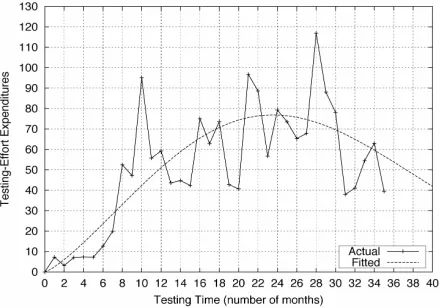
We show numerical examples by using testing-effort data recorded along with detected fault counting data col- lected from the actual testing. In this testing, 1301 fault are totally detected and 1846.92 (testing hours) are to- tally expended as the testing-effort within 35 months [14].
Figure 1 shows the estimated testing-effort function
ˆ
s t
ˆ in Equation (11), in which the parameter estimates
as 2253.2, , and . As
we can see, the actual time-dependent behaviour of the
4
ˆ 4.5343 10
mˆ 2.2580
instantaneous testing-effort expenditures is observed on the discrete-time, and is quite oscillatory. Although it is very difficult to describe completely such behaviour by a mathematical model, the Weibull curve function in Equation (11) enables us to describe the time-dependent behaviour approximately and smoothly on the continu- ous-time function. Figure 2 shows the estimated ex- pected number of detected faults in Equation (26), where the parameter estimates in ˆ N tT
are obtained asˆ 1435.3
a , rˆ 1.4122 10 3, and ˆ 3.4524 10 2.
Furthermore, Figure 3 shows the time-dependent behav- ior of the estimated two types of the substitutions of the MTBF, such as instantaneous and cumulative MTBFs in Equations (25) and (28), respectively. We should note that getting larger instantaneous or cumulative MTBF indicates growing the software reliability. From Figure 3, we can see that the software reliability decreases in the early testing period because the estimated software fault-detection rate is getting larger in the early testing period due to the model structure. And then, the software reliability grows as the testing procedures go on because the fault-detection rate is getting decrease and the resid- ual fault content is also getting decrease. We note that the time-dependent behaviour of the instantaneous and cu- mulative MTBFs are different each other due to ap- proximation methods. The instantaneous MTBF responds sensitively to the number of software faults detected at testing-time t because the instantaneous MTBF does not
Figure 2. Estimated expected number of detected faults.
Figure 3. Estimated instantaneous and cumulative MTBFs.
incorporate information of the past software reliability growth process as shown in Equation (25). We can esti-mate the instantaneous MTBF at the termination time of the testing, , to be about 0.1297 (about 4.5 months), and also, the cumulative MTBF, MTBF 35I
MTBF 35C
,to be about 0.0269 (about 0.9 months).
8. Concluding Remarks
We have discussed a continuous-state space SRGM with the effect of testing-effort by using a mathematical tech- nique of stochastic differential equations and its parame- ters estimation methods. Then, we have compared per- formance in software reliability measurement of our model with existing continuous-state space SRGMs in terms of the MSE and the AIC by using actual data, respectively. Finally, we have also shown numerical illustrations for the software reliability assessment measures, such as the instantaneous and cumulative MTBFs.
We believe that software developing managers can get information on a relationship between the attained soft- ware reliability and the testing-effort expenditures by us- ing our software reliability growth model. And our model
also enables software development managers to decide how much testing-effort are expended to attain a reliabi- lity objective. Further studies are needed to examine the validity of our model for practical applications by using many observed data.
9. Acknowledgements
The second author is supported in part by the Grant-in- Aid for Scientific Research (C), Grant No. 22510150, from the Ministry of Education, Culture, Sports, Science and Technology of Japan.
REFERENCES
[1] J. D. Musa, D. Iannio and K. Okumoto, “Software Reli- ability: Measurement, Prediction, Application,”McGraw- Hill, New York, 1987.
[2] H. Pham, “Software Reliability,”Springer-Verlag, Singa- pore City, 2000.
[3] S. Osaki, “Applied Stochastic System Modeling,”Springer- Verlag, Berlin-Heidelberg, 1992.
doi:10.1007/978-3-642-84681-6
[4] K. S. Trivedi, “Probability and Statistics with Reliability, Queueing and Computer Science Applications,” John Wiley & Sons, New York, 2002.
[5] S. Yamada, “Software Reliability Models,” In: S. Osaki, Ed., Stochastic Models in Reliability and Maintenance, Springer-Verlag, Berlin-Heidelberg, 2002, pp. 253-280. doi:10.1007/978-3-540-24808-8_10
[6] S. Yamada, M. Kimura, H. Tanaka and S. Osaki, “Soft- ware Reliability Measurement and Assessment with Sto- chastic Differential Equations,” IEICE Transactions on Fundamentals of Electronics, and Computer Sciences, Vol. E77-A, No. 1, 1994, pp. 109-116.
[7] S. Yamada, A. Nishigaki and M. Kimura, “A Stochastic Differential Equation Model for Software Reliability As- sessment and Its Goodness-of-Fit,” International Journal of Reliability and Applications, Vol. 4, No. 1, 2003, pp. 1- 11.
[8] C. H. Lee, Y. T. Kim and D. H. Park, “S-shaped Software Reliability Growth Models Derived from Stochastic Dif- ferential Equations,” IIE Transactions, Vol. 36, No. 12, 2004, pp. 1193-1199. doi:10.1080/07408170490507792 [9] S. Yamada, H. Ohtera and H. Narihisa, “Software Reli-
ability Growth Models with Testing-Effort,” IEEE Trans- actions on Reliability, Vol. R-35, No. 1, 1986, pp. 19-23. doi:10.1109/TR.1986.4335332
[10] H. Akaike, “A New Look at the Statistical Model Identi- fication,” IEEE Transactions on Automatic Control, Vol. AC-19, No. 6, 1974, pp. 716-723.
doi:10.1109/TAC.1974.1100705
[11] B. Øksendal, “Stochastic Differential Equations: An In- troduction with Applications,” Springer-Verlag, Berlin- Heidelberg, 1985.
[image:6.595.60.284.274.437.2]Transactions on Reliability, Vol. R-33, No. 4, 1984, pp. 289-292. doi:10.1109/TR.1984.5221826
[13] M. Ohba, “Inflection S-Shaped Software Reliability Growth Model,” In: S. Osaki and Y. Hatoyama, Eds., Stochastic Models in Reliability Theory, Springer-Verlag, Berlin, 1984, pp. 144-165.
doi:10.1007/978-3-642-45587-2_10