High Temperature Sintering and Oxidation Behavior in
Plasma Sprayed TBCs [Single Splat Studies] Paper
1—Role of Heat Treatment Variations
Swarnima Deshpande
Center for Thermal Spray Research, Department of Materials Science and Engineering, State University of New York at Stony Brook, New York, USA.
Email: [email protected]
Received December 1st,2012; revised December 31st, 2012; accepted January 7th, 2013
ABSTRACT
The TBC system is examined with regards to its response to thermal exposure at high temperature. It has been estab- lished before that the thermally grown oxide (TGO) layer that forms upon bond coat oxidation is the key factor deter- mining the performance of the TBC system and/or its failure. However, characteristics of TGO growth, bond coat rum- pling, principles governing failure of TBC systems and the various failure mechanisms have been studied extensively in case of just super alloy with bond coat or with thick top coating. In this study super alloy/bond coat system with single splats of YSZ instead of thick topcoat is analyzed in order to scrutinize the effect on the first layer of splats during thermal exposure. The splats with microcracks are the building blocks of the top coat. The most important aspect of this layer is the inherent inter-splat and intra-splat porosity which undergoes sintering during thermal exposure. The interac- tions between the YSZ splats and the evolving TGO is directly linked to the presence or absence of bond coat oxidation. Therefore the high temperature behavior of this system is analyzed with variations in heat treatment involving, tem- perature, duration and environment of thermal exposure.
Keywords: TBC; Bond Coat; Top Coat; Thermal Exposure; Vacuum Environment; Oxidation; TGO Imperfections; Sintering
1. Introduction
Thermal barrier coatings (TBCs) are employed in the aerospace and power systems because they permit the usage of higher operating temperatures and reduced cool- ing air requirements and yet achieve higher efficiencies and longer engine life thus providing high ripple effects on energy conservation. High service temperatures, ex- treme and cyclic stresses and harsh environmental condi- tions are some of the concerns [1]. They experience di- verse thermal histories which could be just isothermal exposure or multiple thermal cycles depending on the application [2].
The TBCs are a system consisting of a superalloy sub- strate, an MCrAlY bond coat (BC)and a YSZ top coat I(TC) applied on these.A thermally grown oxide (TGO), typically α-alumina, is formed during heat treatment and/or in service between the bond coat and the topcoat [3]. The bond-coat alloy is an Al reservoir, enabling α-alumina to form in preference to other oxides.
The failure mechanisms involve the TGO, the TGO/BC interface and the TBC. It has been surmised that these
mechanisms are activated primarily by the stress state caused by the residual compression in the TGO even when the failure occurs in the TBC layer itself.
Table 1. Deposition parameters for APS sprayed NiCrAlY bond coat.
presence of a TBC layer, referred to as “ratcheting”. TGO growth and TGO instabilities influence TBC be- havior and failure. Effect of rumpling on TBC layer, if present, is observed to be a delamination between TGO and topcoat leading to subsequent failure [9].
However, characteristics of TGO growth, bond coat rumpling, principles governing failure of TBC systems and the various failure mechanisms have been studied extensively in case of just superalloy with bond coat or with thick top coating [7,8].
In this study superalloy/bond coat system with single splats of YSZ instead of thick topcoat is analyzed. The objectives are:
Understanding the influence of present YSZ layer on the chemistry of bond coat oxidation.
Studying the interactions between the YSZ splats and the evolving TGO.
Inspection of effects of bond coat oxidation on first splat layer of topcoat. Single splats as opposed to freestanding coatings include the splat/substrate in- terfacial interaction. The morphological changes and sintering of intrasplat cracks in the YSZ is directly linked to the presence or absence of bond coat oxida- tion.
2. Experimental Approach
NiCrAlY coatings were air plasma sprayed onto Inconel 718 superalloy substrates. The surfaces of these sub- strates were then polished to a 0.05 micron finish using a Buehler semi-automatic polisher. Single splats of YSZ were collected on these bond coat surfaces in order to conduct thermal exposure studies on the same. Splats were collected on polished bond coat surface so as to eliminate ratcheting instabilities that could arise due to initial undulations on BC/TBC interface.
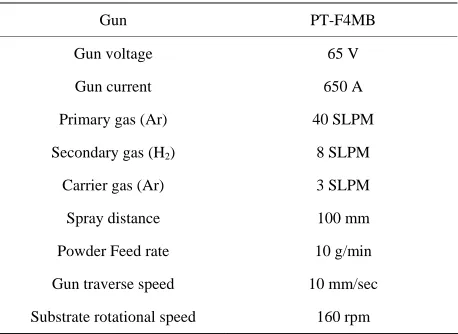
Processing conditions used for the NiCrAlY bond coats and the YSZ splats are given below in Tables 1 and
2 respectively.
Thermal exposure behavior of these splats in air was studied using a Thermolyne 1400 box furnace, to see effect of temperature and duration. Temperatures used were in the range of 1100˚C to 1300˚C and durations were 2 to 24 hrs. Only isothermal heat treatments were employed to eliminate cyclic TGO elongation effects. Long-term exposure to high temperature is thought to reduce mismatch stress in the bond coat by relaxation and creep [Ref. from 9] thus resulting in a very long rum- pling wavelength and making it impossible to observe the rumpling process. As such for this single splat study, shorter exposure times were considered for isothermal heat treatments to avoid complete spallation or failure.
Gun Sulzer F4MB
Gun voltage 68 V
Gun current 500 A
Primary gas (Ar) 50 SLPM
Secondary gas (H2) 10 SLPM
Carrier gas(Ar) 3 SLPM
Spray distance 120 mm
Powder Feed rate 40 g/min
Table 2. Deposition parameters for APS sprayed YSZ splats [Metco 204NS].
Gun PT-F4MB
Gun voltage 65 V
Gun current 650 A
Primary gas (Ar) 40 SLPM
Secondary gas (H2) 8 SLPM
Carrier gas (Ar) 3 SLPM
Spray distance 100 mm
Powder Feed rate 10 g/min
Gun traverse speed 10 mm/sec
Substrate rotational speed 160 rpm
see changes in crack network, surface roughness, and splat lifting/spalling. A comparison of splat cross-sec- tions was made using SEM (Leo 1550, FEG) to observe splat dimensions, microcrack sintering and effect of TGO growth after HT. Back-scattered imaging was employed and Energy Dispersive Spectrometry (EDS) gave ele- mental composition. Atomic Force Microscopy (AFM) was employed to quantify surface roughness of splats.
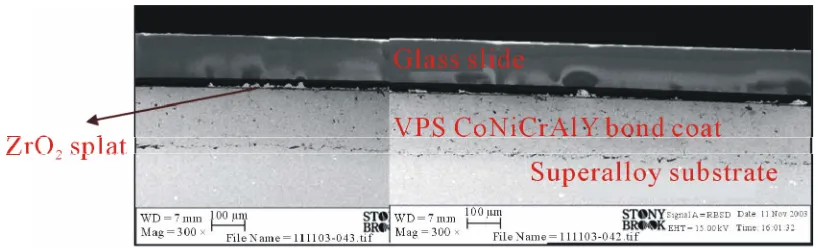
Cross-section (CS) samples were prepared by covering the single splats with glass slide, Figure 1, and then pol- ishing using the SEM T-tool of the tripod polisher.
3. Results and Discussion
The sintering study of single splats on bond-coat is im- portant because in case of single splats the factors intro- duced by TBC coating are minimal and failure can be more related to the bond-coat chemistry and microstruc- ture which upon thermal exposure changes by interdiffu- sion with the substrate and upon thickening of the ther- mally grown oxide (TGO). The appearance of failure and sites of failure can be determined more stochastically [11]. Particular splats were identified and the top surface
[image:2.595.309.538.290.457.2]Figure 1. Cross-section sample preparation of single splats on bond coat surface.
MCrAlY bond coats were subjected to various heat treat- ments. Their top surface microstructures and cross-sec- tions were analyzed before and after Heat Treatment (HT) as described in the previous section.
In order to understand the influence of TGO growth and thickening on the first layer of splats, this system of splat—bond coat—substrate was thermally exposed to different temperatures and for different durations.
3.1. TGO Growth—Effect of Heat Treatment Temperature
YSZ splats on bond coated substrate were subjected to a 2 hr heat treatment in air (isochronal) at different tem- peratures: 1100˚C, 1200˚C and 1300˚C. Particular splats were identified and their top surface microstructures, at exact locations, in the as-sprayed and heat treated condi- tion are shown in Figures 2(a)-(c) for the three tempera- tures respectively.
In Figure 2(a), it is seen that after HT at 1100˚C, the overall crack network between the as-sprayed and the heat treated splat seems unchanged. The grain size does not seem to have altered either.
According to Figure 2(b), after HT at 1200˚C, the as- sprayed and heat-treated splats still show same overall crack network. However, some outward oxide growth from the bond coat is now visible at the larger micro- cracks as shown by the circle marks. Finer microcracks have also started sintering as indicated by the arrows.
These effects are even more pronounced after the 1300˚C HT, Figure 2(c).
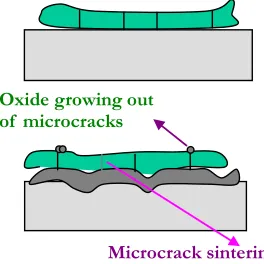
More of the fine microcracks are seen to have sintered and the entire microcrack network is now lined with the oxide growth from below. These grains growing outward through the microcracks were analyzed using EDS and indicated Ni and O peaks. These phenomena are sche- matically illustrated in Figure 3.
3.1.1. NiO Outgrowth Outlining Crack Network on Splat Surface
APS NiCrAlY bond coat microstructure (Figure 4) con- tains internal oxide chunks of alumina. These regions
may be locally depleted of aluminum. Microcracks in splats are seen to coincide with oxide points in the bond- coat, Figure 4.
Several studies have shown that oxygen diffusion through TGO along grain boundaries causes more TGO growth at these boundaries [4,5,8]. Similarly at these micro- crack positions, there is a path for oxygen to reach a BC area that is locally depleted of free aluminum. As such, other oxides could form at these microcrack positions.
Supporting Observation
In some circumstances, as activity of Oxygen at the interface increases, the solubilities of Ni and Cr (and Fe when present) in the Al2O3 also increase. This condition can result in outward diffusion of cations through the TGO. Upon encountering higher oxygen activities, these cations can form new oxide phases. For e.g. in regions between the TGO and the TBC, the thermodynamics and kinetics are such that spinel formation is allowed [8].
3.1.2. Sintering of Fine Microcracks
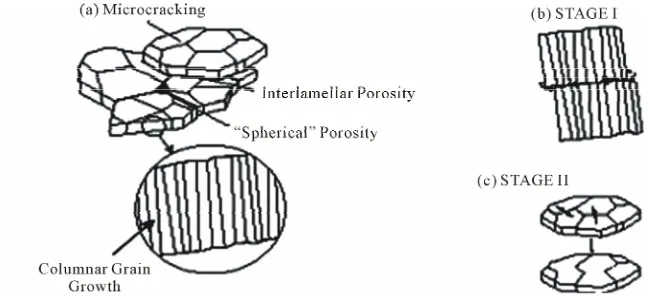
A study by Thompson et al. speculates regarding sub- processes occurring at a splat level during sintering, as shown in Figure 5. The as-sprayed microstructure (a) incorporates three types of pores. Stage I (b) involves healing of interlamellar porosity, where the separation in the material is very small. While at longer times and at higher temperatures, Stage II (c) occurs by micro-crack healing [3].
Since we are dealing with single splats, we cannot ob-serve the stage I sintering. But incidences of sintering of finer microcracks are seen to increase as HT temperature increases. This is in agreement with the observation of the above study.
3.2. TGO Thickening—Effect of Heat Treatment Duration
As-sprayed splat
After 2hr HT in Air
(a)
As-sprayed splat After 2hr HT in Air
Ni
Ni O Ni
Ni O
As-sprayed splat After 2hr HT in Air
(c)
Figure 2. (a) Splat exposed to 1100˚C; (b) Splat exposed to 1200˚C; (c) Splat exposed to 1300˚C.
Microcrack sintering
[image:5.595.166.429.96.406.2]Oxide growing out of microcracks
Figure 3. Isochronal HT in air—effect of temp (schematic).
O K Al K
Ni L O K
Al K
Ni L
[image:5.595.229.361.437.569.2] [image:5.595.88.509.598.721.2]Figure 5. Schematic representation of the proposed sintering mechanism occurring at high temperature [Ref 3: J. A.Thompson, W. Ji, T. Klocker and T. W.Clyne].
As-sprayed ZrO2 splat on bond coat surface
[image:6.595.145.452.281.457.2]TGO formed at bond coat/splat interface after 24 h @ 1100˚C
Figure 6. Interface between bond coat and ZrO2 splats (shown as composite images).
layer formed at the interface between bond coat and top coat after 24 hr HT in air.
Splats are imaged at particular locations and their top surface microstructures in the as-sprayed and heat-treated condition are compared in Figures 7(a)-(c) for the three HT times respectively.
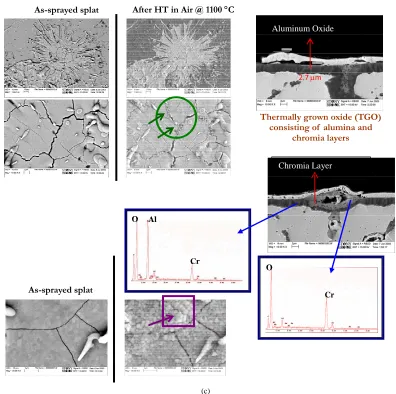
Figure 7(a) shows that after a 2hr HT at 1100˚C the overall crack network has not changed significantly. The columnar grains in the splat appear to have been pushed slightly upwards in some areas. Such regions are marked by square marks.
As seen in Figure 7(b) below, after an 8 hr HT, the microcrack network still remains unchanged between the as-sprayed and the heat-treated splats. Most of the fine microcracks are also still present. However the top sur- face of the heat-treated splat appears much rougher com- pared to the top surface of the as-sprayed splat. Square marks denote this roughening. This has been quantified using Atomic Force Microscopy (AFM). Wave patterns depicting the roughness are obtained using section analy- sis. Mean Roughness analysis over a given area measures
the value of roughness as Ra = 12 nm for the as-sprayed splat surface and Ra = 153 nm for the heat-treated splat surface. Apart from this, top surface as well as cross- section images show a few instances of oxide growth through microcracks (circle marks) as described in the previous section.
From Figure 7(c) below, it is seen that even a 24 hr HT at 1100˚C does not cause the overall microcrack net- work to change or fine microcracks to sinter. More in- stances of outward oxide growth as marked by circle marks are now visible even at 1100˚C because of longer HT duration. Thus this outward oxide growth is en- hanced by an increase in HT temperature as well as an increase in duration of HT.
Once again splat surface after HT becomes rougher because of lifting of columnar grains in some regions. An examination of cross-section samples revealed that this is probably due to oxide growth over the bond coat (TGO) and its thickness imperfections.
After HT @ 1100˚C As-sprayed splat
Interface between NiCrAlY coating and YSZ splats before HT
(a)
As-sprayed splat After HT @ 1100 C
Outward oxide growth from bond coat oxide as seen on top surface (green arrow)
1.3 m 1.1 m Alumina
Chromia
AFM (Section Analysis and Mean Roughness Analysis)
After HT @ 1100 C As-sprayed splat
Ra = 153.08 nm Ra = 11.852 nm
After HT in Air @ 1100 C As-sprayed splat
Thermally grown oxide (TGO) consisting of alumina and
chromia layers
Aluminum Oxide
2.7 m
As-sprayed splat Cr
O
Cr O
Cr O Al
Cr O Al
Chromia Layer
(c)
Figure 7. (a) Splat exposed for 2 hr; (b) Splat exposed for 8 hr; (c) Splat exposed for 24 hr.
TGO layer is mainly constituted by Alumina since Al in the bond coat is preferably oxidized but at some places Chromia is also formed as disclosed by EDS. Previous studies also show that other oxides occur in isolated do- mains within the TBC next to the TGO and have a lighter gray contrast. These are typically spinels comprising oxi- des of Cr/Ni/Co often with associated internal porosity [11]. Studies have shown that spinels when formed also act as preferential sites for failure [11]. Reason might be that the interfacial fracture resistances of the TBC/
α-chromia and the TBC/spinel interfaces are lower than that of the TBC/α-alumina interface originally present [12].
Thickness imperfections in TGO enlarge in regions where O2-diffusivity through TGO is exceptionally large i.e. at locations where TGO contains oxides other than alumina [8]. These TGO undulations must then push the grains in the splats upward and cause splat lifting or may
be spalling. This explains the increase of surface rough- ness.
3.3. Elimination of Bond Coat Oxidation—Effect of Heat Treatment Environment
In order to isolate the effect of bond coat oxidation, heat treatment was conducted in vacuum thus eliminating it. Thermal cycling studies of TBC systems have shown how bond coat oxidation leads to phenomena such as ratcheting and influences TBC behavior and failure [5-9]. The role of the TGO layer that grows between bond coat and TBC during thermal cycling is of significance. In order to assess this, heat treatments were also conducted in vacuum so as to eliminate oxidation and see how the behavior differs with changes in HT environment.
[image:8.595.92.488.92.486.2]As-sprayed splat
0.17 m
0.52 m 0.48 m
0.45 m
After 2 hr HT in Vacuum After 24 hr HT in Air
[image:9.595.130.465.96.364.2]As-sprayed Vacuum 2hr at 1100 Air 24 hr at 1100
Figure 8. As-sprayed splat exposed for 2 hr in Vac exposed for 24 hr @ 1100 C in air.
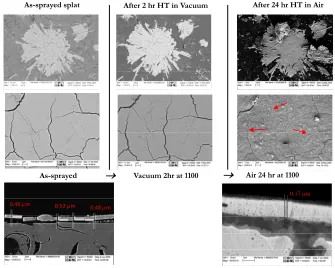
the intermediate vacuum HT of 2 hr at 1100˚C, the over- all microcrack network appears unaltered as seen in the top surface microstructures. The oxide grain growth through microcracks or the splat surface roughening are however, not visible.
A comparison is made between this and the as-sprayed splat that directly underwent the 24 hr air HT, as shown in Figure 7(c). As discussed earlier in section 3.2, the splats directly exposed to the 24 hr Air HT at 1100˚C showed instances of outward oxide growth through mi- crocracks (circle marks) and surface roughening due to splat lifting (square marks).
However, the splats with intermediate vacuum HT as shown in Figure 8 when thermally treated in air for 24 hr showed no signs of grain growth through microcracks or of upward lifting of grains. Additionally, most fine mi- crocracks are seen to have sintered as marked by arrows. The cross-section images show that microcrack widths are much reduced compared to the as-sprayed splat. TGO growth does occur in the subsequent air HT but the out- ward oxide growth is curtailed probably because the in- termediate vacuum treatment started the sintering or sealing of most microcracks from their bottom end. This may be related to the increase in lattice spacing that was observed by Thornton et al. [13] when a TBC coating was heat treated in vacuum. In vacuum, there is no oxy- gen to replace that lost from zirconia in the formation of bond coat oxide and less oxygen appears to cause larger
lattice spacing [13].
Thus the overall sintering behavior is notably altered by a change in heat treatment environment.
4. Summary and Conclusions
The high temperature behavior of a TBC system is in- vestigated using single splats of YSZ on MCrAlY bond coat surface instead of freestanding thick YSZ coatings, in order to integrate the effects of splat-substrate interfa- cial interaction and bond coat oxidation at a fundamental level. In case of single splats sprayed on polished bond- coat surface, there are no preexisting undulations (inter- facial imperfections), and also no influence of thick top coating. Phenomena such as ratcheting and rumpling which have been analyzed in other studies with thick topcoats are not observed here. These would have drastic spallation effects in case of single splats and hence have been excluded by the usage of polished bond coat surface and short thermal exposures. Effects of thermal treat- ment are attributable to the thickening of the thermally grown oxide (TGO) layer and the initial bond coat mi- crostructure.
The TGO layer grows and thickens with increasing temperature and duration of thermal exposure. Ther- mal treatment temperature is seen to have a more sig- nificant influence on microcracks sintering than the duration of thermal exposure.
markable impact. Even a short intermediate vacuum treatment changes the high temperature behavior ob- served otherwise during long air treatment and causes sintering of most fine microcracks. Thus sintering of microcracks is directly influenced by bond coat oxi- dation.
Microcracks in as-sprayed splats coincide with inter- nal oxide positions within bond coat. A path is thus provided for oxygen to reach a bond coat area that is locally depleted of aluminum. As such, other oxides such as NiO form locally at these microcracks. Che- mical changes occur in the bond coat oxidation due to presence of the YSZ splats on top.
Outward oxide growth into microcracks increases with heat treatment temperature as well as time. Longer thermal treatment durations cause further Al
depletion within bond coat leading to formation of oxides other than α-alumina in the TGO, thereby cre- ating thickness imperfections in the TGO at some lo- cations. These TGO undulations are observed to push grains in the splats upward and induce splat lift- ing/spalling. Interaction between evolving TGO and YSZ top coat is thus apparent in the form of splat surface roughening.
The distinctions of TGO formation and interactions with YSZ as a function of initial YSZ splat layer (mor- phology, purity) and initial bond coat microstructure (processing conditions) will be addressed in a subsequent paper.
5. Acknowledgements
We would like to thank Glenn Bancke, AnirudhaVaidya and Li Li (CTSR) for preparation of the specimens and spraying diagnostics.
REFERENCES
[1] P. S. Mohanty, “Challenges in Thermal Spraying of Re- fractory Materials,” Surface Engineering, Vol. 21, No. 1, 2005, pp. 1-4. doi:10.1179/174329405X36691
[2] A. G. Evans, “Thermal Barrier Coatings: Workshop Sum- mary,” TBC Workshop, Irsee, 17-22 August 2003, pp. 17- 22.
[3] A. N. Khan and J. Lu, “Behavior of Air Plasma Sprayed Thermal Barrier Coatings, Subject to Intense Thermal Cycling,” Surface and Coatings Technology, Vol. 166, No. 1, 2003, pp. 37-43.
doi:10.1016/S0257-8972(02)00740-5
[4] T. Xu, M. Y. He and A. G. Evans, “A Numerical As- sessment of the durability of Thermal Barrier Systems That Fail by Ratcheting of the Thermally Grown Oxide,” Acta Materialia, Vol. 51, No. 13, 2003, pp. 3807-3820. doi:10.1016/S1359-6454(03)00194-0
[5] A. M. Karlsson, J. W. Hutchinson and A. G. Evans, “The Displacement of the Thermally Grown Oxide in Thermal Barrier Systems upon Thermal Cycling,” Materials Sci- ence and Engineering, Vol. 351, No. 1-2, 2003, pp. 244- 257. doi:10.1016/S0921-5093(02)00843-2
[6] M. Y. He, A. G. Evans and J. W. Hutchinson, “The Rat-cheting of Compressed Thermally Grown Thin Films on Ductile Substrates,” Acta Materialia, Vol. 48, No. 10, 2000, pp. 2593-2601.
doi:10.1016/S1359-6454(00)00053-7
[7] D. R. Mumm, A. G. Evans and I. T. Spitsberg, “Charac- terization of a Cyclic Displacement Instability for a Thermally Grown Oxide in a Thermal Barrier System,” Acta Materialia, Vol. 49, No. 12, 2001, pp. 2329-2340. doi:10.1016/S1359-6454(01)00071-4
[8] A. G. Evans, D. R. Mumm, J. W. Hutchinson, G. H. Mei-er and F. S. Pettit, “Mechanisms Controlling the Du- ra-bility of Thermal Barrier Coatings,” Progress in Mate- rials Science, Vol. 46, No. 5, 2001, pp. 505-553. doi:10.1016/S0079-6425(00)00020-7
[9] R. Panat, S. Zhang and K. J. Hsia, “Bond Coat Surface Rumpling in Thermal Barrier Coatings,” Acta Materialia, Vol. 51, No. 1, 2003, pp. 239-249.
doi:10.1016/S1359-6454(02)00395-6
[10] A. M. Karlsson and A. G. Evans, “A Numerical Model for the Cyclic Instability of Thermally Grown Oxides in Thermal Barrier Systems,” Acta Materialia, Vol. 49, No. 10, 2001, pp. 1793-1804.
doi:10.1016/S1359-6454(01)00073-8
[11] A. Rabiei and A. G. Evans, “Failure Mechanisms Associ- ated with the Thermally Grown Oxide in Plasma Sprayed Thermal Barrier Coatings,” Acta Materialia, Vol. 48, No. 15, 2000, pp. 3963-3976.
doi:10.1016/S1359-6454(00)00171-3
[12] E. A. G. Shillington and D. R. Clarke, “Spalling Failure of a Thermal Barrier Coating Associated with Aluminum Depletion in the Bond-Coat,” Acta Materialia, Vol. 47, No. 4, 1999, pp. 1297-1305.
doi:10.1016/S1359-6454(98)00407-8