Association Between Timed Up-and-Go and Memory, Executive
Function, and Processing Speed
Orna A. Donoghue, PhD,* N. Frances Horgan, PhD,
†George M. Savva, PhD,* Hilary Cronin, MB,*
Claire O’Regan, MSc,* and Rose Anne Kenny, MD*
‡OBJECTIVES: To determine which cognitive tests are independently associated with performance on the Timed Up-and-Go Test (TUG).
DESIGN: Data were obtained from Wave 1 of The Irish Longitudinal Study on Ageing (TILDA), a population-based study assessing health, economic, and social aspects of aging.
SETTING: Community-dwelling adults completed a home based interview and a health center–based assessment.
PARTICIPANTS: TILDA participants aged 50 and older with a Mini-Mental State Examination (MMSE) score of 10 or greater (N=4,998).
MEASUREMENTS: Participants completed a battery of cognitive assessments including the Montreal Cognitive Assessment (MoCA), Color Trails Test, word and letter fluency, choice reaction time, sustained attention, prospec-tive memory, word recall, and picture memory. Linear regression was used to determine univariate and multivari-ate associations between TUG and each cognitive test.
RESULTS: Slower TUG time was associated with poorer performance on all cognitive tests in univariate analysis (P< .05). In multivariate analysis, poorer performance on the MoCA, letter fluency, Color Trail 1, cognitive reaction time, mean sustained attention response time, and prospec-tive memory were independently associated with slower TUG time (P<.05).
CONCLUSION: Slower TUG time is independently asso-ciated with poorer performance on global cognition, exec-utive function, and memory tests and slower processing speed. This highlights that TUG is more than just a simple
mobility task and suggests that a comprehensive cognitive assessment is important for individuals with mobility difficulties.J Am Geriatr Soc 60:1681–1686, 2012. Key words: physical mobility; cognitive function; older adults
T
he Timed Up-and-Go (TUG) test is a simple, well-established test of lower extremity function and mobility. It requires an individual to stand up from a seated position, walk 3 m at a comfortable pace, turn around, walk back to the chair and sit down.1Poor TUG performance is correlated with slow gait speed1 and poor balance and functional indexes,1 and it predicts global health decline,2 disability in activities of daily living,2–4falls,4recurrent falls,2and nursing home placement.5
Walking relies on cognitive processes such as attention and executive function.6Executive function includes “a set of cognitive skills that are responsible for the planning, ini-tiation, sequencing, and monitoring of complex goal-direc-ted behaviour.”7 Because TUG involves additional
components such as turning and transfers from sitting to standing, it is not surprising that recent research has reported cross-sectional associations between TUG and cognition and has highlighted that it is a much more com-plex task than originally thought. Most studies have exam-ined associations between TUG and executive function, although this domain is involved to some extent in most other cognitive tasks as well.8
Timed Up-and-Go performance is slower in commu-nity-dwelling adults with poorer performance on verbal fluency (executive function) and backward attention span (working memory) tests9 and in those with Alzheimer’s disease.10,11 TUG has also been weakly correlated with Mini-Mental State Examination (MMSE) score, digit span, verbal fluency,9 and memory.12 Poorer global cognition has been shown to be an independent predictor of slower TUG in community-dwelling older adults,13,14and poorer
From *The Irish Longitudinal Study on Ageing, Trinity College Dublin,
†School of Physiotherapy, Royal College of Surgeons in Ireland, and ‡Trinity College Institute of Neuroscience, Trinity College Dublin, Dublin,
Ireland.
Paper was submitted to Joint World Congress of International Society of Posture and Gait Research and Gait and Mental Function conference, Trondheim, Norway, June 24–28, 2012 and British Geriatric Society conference, Harrowgate, UK, November 28–30, 2012 (partial data). Address correspondence to Orna A. Donoghue, The Irish Longitudinal Study on Ageing, Lincoln Gate, Trinity College, Dublin 2, Ireland. E-mail: [email protected]
DOI: 10.1111/j.1532-5415.2012.04120.x
JAGS 60:1681–1686, 2012
©2012, Copyright the Authors
executive function was an independent predictor of slower TUG (at fast pace) in adults with amnesic mild cognitive impairment.15 These links between TUG and executive function are not surprising because longitudinal research has found that poorer executive function predicts mobility impairment in community-dwelling older adults,16but the potential of other cognitive domains (processing speed, attention, and memory) to affect functional mobility is not fully understood and has been largely neglected in the research. Therefore, the aim of this study was to examine the cross-sectional associations between TUG and a range of tests of multiple cognitive domains in community-dwelling older adults. Specifically, the goal was to identify which cognitive domains contribute independently to TUG performance.
METHODS
Study Design
The Irish Longitudinal Study on Ageing (TILDA) is a large prospective cohort study of the social, economic, and health circumstances of community-dwelling older people in Ire-land. This study is based on the first wave of data, which was collected between October 2009 and July 2011. The sam-pling frame is the Irish Geodirectory, a listing of all residen-tial addresses in the Republic of Ireland. A clustered sample of addresses was chosen, and household residents aged 50 and older and their spouses/partners (of any age) were eligi-ble to participate. Ethical approval was obtained from the Trinity College Dublin research ethics committee, and all participants provided written informed consent.
The study design has previously been described in detail.17Briefly, there were three parts to data collection: a
computer-assisted personal interview that included detailed questions on sociodemographic characteristics, wealth, health, lifestyle, social support and participation, use of health and social care, and attitudes toward aging; a self-completion questionnaire; and a health assessment that research nurses performed. Eight thousand one hundred seventy-five individuals aged 50 and older were inter-viewed, of whom 5,037 (61.6%) agreed to attend the health center assessment. Inclusion criteria for the present analysis was a MMSE score of 10 or greater to ensure understanding of the test procedure and valid TUG data, making 4,998 participants eligible for the study.
Data Collection
Education was dichotomized into primary/secondary and tertiary levels. Height and weight were measured, allowing body mass index (BMI) to be calculated. The number of doctor-diagnosed chronic conditions was obtained from the following: heart attack, heart failure, or angina pecto-ris; cataracts; stroke; diabetes mellitus; lung disease; asthma; arthritis; osteoporosis; cancer; Parkinson’s disease; peptic ulcer; hip fracture; hypertension; and high choles-terol. Number of regular medications was also recorded. Depression was assessed using the 20-item Center for Epidemiologic Studies Depression Scale (CES-D), on which scores of 16 or greater represent clinically relevant depres-sive symptoms.18
Mobility was assessed with the TUG using a chair with armrests and a seat of height of 46 cm. Participants were asked to rise from the chair, walk 3 m at normal pace to a line clearly marked on the floor, turn around, walk back to the chair, and sit down again. Walking aids were allowed if required, and no instructions were given about the use of participants’ arms. The time taken from the command “Go” to when the participant was sitting with their back resting against the back of the chair was recorded using a stopwatch. In addition to TUG, gait was assessed using a 4.88-m electronic walkway with embed-ded pressure sensors (GAITRite; CIR Systems, Inc., Haver-town, PA). Participants started and finished 2.5 m before and after the walkway to allow for acceleration and decel-eration. Average gait speed was calculated from two walks performed at normal pace.
Participants underwent a comprehensive cognitive assessment including two tests of global cognition—the MMSE19 and the Montreal Cognitive Assessment (MoCA).20A number of cognitive tests were used to assess
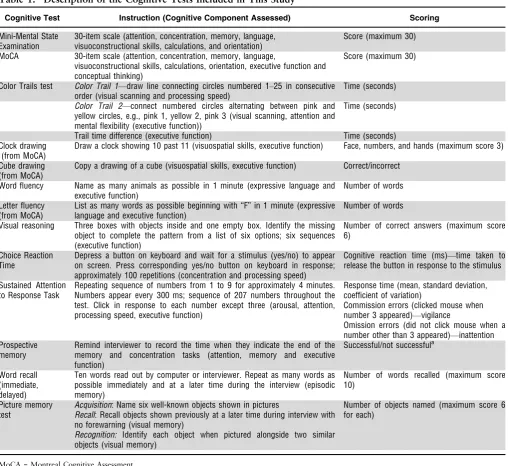
function in four cognitive domains (executive function, processing speed, attention and memory); see Table 1 for full details of these tests. Most cognitive tasks assess more than one domain, but for the purposes of this study, each test was classified according to the main cognitive compo-nent (Table 2).
The Color Trails Test was used as an alternative to the Trail-Making Task because it removes any cultural or language bias.21Color Trail 1 mainly reflects visual scan-ning and processing speed, and Color Trail 2 requires visual scanning, attention, and mental flexibility, making it an executive function task. The clock and cube drawing tasks were extracted from the MoCA as additional mea-sures of executive function and visuospatial skills. Partici-pants also completed two verbal fluency tasks, which measure expressive language and executive function. These tests assess the ability to devise a strategy to search for and list words (e.g., categories of objects, verbs, words with similar letters), switch between these categories, and use short-term memory to keep track of the words that have already been recited.22
Sustained attention is also an executive function requiring arousal and the ability to focus attention on and process specific stimuli over a prolonged period of time. It is required to focus on an activity for long enough to complete a cognitively planned activity, any sequenced action, or any thought. It is assessed using the Sustained Attention to Response Task (SART).23 The choice reaction time test used a computer based program to assess concentration and processing speed. Cognitive reaction time was the time taken to release a button in response to a stimulus.
Statistical Analysis
Statistical analyses were performed using STATA version 12 (StataCorp LP, College Station, TX). All analyses were weighted with respect to age, sex, and education to the Quarterly National Household Survey (2010) to ensure that data were nationally representative. Data were further weighted according to health status and sociodemographic factors to account for those who did not attend a health assessment.26 Because the TUG was positively skewed, it was inverse transformed. Four linear regression models were used to examine the relationship between inverse TUG (dependent variable) and cognition. In Model 1, the univari-ate associations between TUG and each cognitive test were obtained. Model 2 adjusted for age, sex, education, height, BMI, number of chronic conditions, number of medications, and depressive symptoms. Next, all confounders and all
cognitive variables were added to the model simultaneously (Model 3). Color Trail time difference and SART standard deviation (SD) were not entered into this model because they are functions of other parameters that were entered into the model. Gait speed was added as an explanatory var-iable in Model 4, which allowed the associations between the cognitive tests and the nonwalking components of TUG to be identified. Complete covariate data were available for 4,544 (91.1%) participants. Complete case analysis was used for multivariate analyses (i.e., all missing data were treated as missing at random). Standardized beta coeffi-cients are presented.
RESULTS
The median age of the sample was 62 (interquartile range (IQR) 56–70), 54% were female, and 36% had attained
Table 1. Description of the Cognitive Tests Included in This Study
Cognitive Test Instruction (Cognitive Component Assessed) Scoring
Mini-Mental State Examination
30-item scale (attention, concentration, memory, language, visuoconstructional skills, calculations, and orientation)
Score (maximum 30)
MoCA 30-item scale (attention, concentration, memory, language,
visuoconstructional skills, calculations, orientation, executive function and conceptual thinking)
Score (maximum 30)
Color Trails test Color Trail 1—draw line connecting circles numbered 1–25 in consecutive order (visual scanning and processing speed)
Time (seconds)
Color Trail 2—connect numbered circles alternating between pink and yellow circles, e.g., pink 1, yellow 2, pink 3 (visual scanning, attention and mental flexibility (executive function))
Time (seconds)
Trail time difference (executive function) Time (seconds) Clock drawing
(from MoCA)
Draw a clock showing 10 past 11 (visuospatial skills, executive function) Face, numbers, and hands (maximum score 3)
Cube drawing (from MoCA)
Copy a drawing of a cube (visuospatial skills, executive function) Correct/incorrect
Word fluency Name as many animals as possible in 1 minute (expressive language and executive function)
Number of words
Letter fluency (from MoCA)
List as many words as possible beginning with “F” in 1 minute (expressive language and executive function)
Number of words
Visual reasoning Three boxes with objects inside and one empty box. Identify the missing object to complete the pattern from a list of six options; six sequences (executive function)
Number of correct answers (maximum score 6)
Choice Reaction Time
Depress a button on keyboard and wait for a stimulus (yes/no) to appear on screen. Press corresponding yes/no button on keyboard in response; approximately 100 repetitions (concentration and processing speed)
Cognitive reaction time (ms)—time taken to release the button in response to the stimulus
Sustained Attention to Response Task
Repeating sequence of numbers from 1 to 9 for approximately 4 minutes. Numbers appear every 300 ms; sequence of 207 numbers throughout the test. Click in response to each number except three (arousal, attention, processing speed, executive function)
Response time (mean, standard deviation, coefficient of variation)
Commission errors (clicked mouse when number 3 appeared)—vigilance
Omission errors (did not click mouse when a number other than 3 appeared)—inattention Prospective
memory
Remind interviewer to record the time when they indicate the end of the memory and concentration tasks (attention, memory and executive function)
Successful/not successfula
Word recall (immediate, delayed)
Ten words read out by computer or interviewer. Repeat as many words as possible immediately and at a later time during the interview (episodic memory)
Number of words recalled (maximum score 10)
Picture memory test
Acquisition: Name six well-known objects shown in pictures
Recall: Recall objects shown previously at a later time during interview with no forewarning (visual memory)
Recognition: Identify each object when pictured alongside two similar objects (visual memory)
Number of objects named (maximum score 6 for each)
MoCA = Montreal Cognitive Assessment.
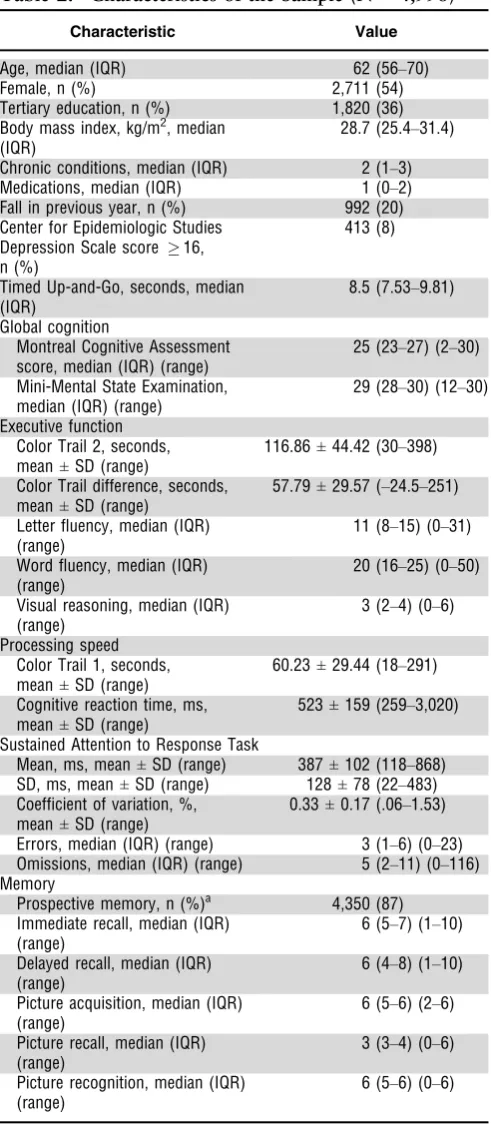
[image:3.595.48.557.61.527.2]tertiary level education (Table 2). They had a median of two chronic conditions, 8% had clinically relevant depres-sive symptoms, and 20% reported a fall in the previous year. Median TUG time for the sample was 8.5 seconds (IQR 7.53–9.81 seconds). Information on baseline perfor-mance on all cognitive tests is also provided in Table 2.
In univariate analysis, better performance on all cog-nitive tests was associated with faster TUG time (P<.001, Table 3). These associations were substantially less but remained statistically significant after adjusting for age, sex, height, BMI, education, comorbidity, number of medi-cations, and depressive symptoms (P< .05) for most cog-nitive tests except picture memory task and cube drawing (P> .10) (Model 2). When all cognitive tests were entered into Model 3 simultaneously, MoCA and at least one test from each cognitive domain (letter fluency, Color Trail 1, cognitive reaction time, mean SART, and prospective memory) remained significantly associated with TUG time.
Table 2. Characteristics of the Sample (N= 4,998)
Characteristic Value
Age, median (IQR) 62 (56–70) Female, n (%) 2,711 (54) Tertiary education, n (%) 1,820 (36) Body mass index, kg/m2, median
(IQR)
28.7 (25.4–31.4)
Chronic conditions, median (IQR) 2 (1–3) Medications, median (IQR) 1 (0–2) Fall in previous year, n (%) 992 (20) Center for Epidemiologic Studies
Depression Scale score 16, n (%)
413 (8)
Timed Up-and-Go, seconds, median (IQR)
8.5 (7.53–9.81)
Global cognition
Montreal Cognitive Assessment score, median (IQR) (range)
25 (23–27) (2–30)
Mini-Mental State Examination, median (IQR) (range)
29 (28–30) (12–30)
Executive function Color Trail 2, seconds, mean±SD (range)
116.86±44.42 (30–398) Color Trail difference, seconds,
mean±SD (range)
57.79±29.57 (–24.5–251) Letter fluency, median (IQR)
(range)
11 (8–15) (0–31)
Word fluency, median (IQR) (range)
20 (16–25) (0–50)
Visual reasoning, median (IQR) (range)
3 (2–4) (0–6)
Processing speed Color Trail 1, seconds, mean±SD (range)
60.23±29.44 (18–291) Cognitive reaction time, ms,
mean±SD (range)
523±159 (259–3,020) Sustained Attention to Response Task
Mean, ms, mean±SD (range) 387±102 (118–868) SD, ms, mean±SD (range) 128±78 (22–483) Coefficient of variation, %,
mean±SD (range)
0.33±0.17 (.06–1.53) Errors, median (IQR) (range) 3 (1–6) (0–23) Omissions, median (IQR) (range) 5 (2–11) (0–116) Memory
Prospective memory, n (%)a 4,350 (87)
Immediate recall, median (IQR) (range)
6 (5–7) (1–10)
Delayed recall, median (IQR) (range)
6 (4–8) (1–10)
Picture acquisition, median (IQR) (range)
6 (5–6) (2–6)
Picture recall, median (IQR) (range)
3 (3–4) (0–6)
Picture recognition, median (IQR) (range)
6 (5–6) (0–6)
SD = standard deviation; IQR = interquartile range.
[image:4.595.41.287.63.627.2]aSuccessful performance, participant remembered to performed the task.
Table 3. Standardized Beta Coefficients Outlining the Cross-Sectional Associations Between Inverse Time Up-and-Go Test (TUG) and Each Cognitive Test in Univari-ate (Model 1) and MultivariUnivari-ate Analysis (Models 2–4)
Test
Standard Beta Coefficient
Model 1
Model 2
Model 3
Model 4
Global cognition Montreal Cognitive
Assessment
.232c .075c .046a .005
Mini-Mental State Examination
.221c .086c .008 .003
Executive function
Color Trail 2 .335c .146c .023 .006 Trail time difference .185c .055c – –
Letter fluency .174c .084c .031a .019
Word fluency .171c .059c .012 .024a
Cube drawing .146c .016 .009 .019
Clock drawing .140c .053c .010 .008
Visual reasoning .182c .044b .005 .006
Processing speed
Color Trail 1 .371c .184c .100c .051c
Cognitive reaction time
.222c .113c .051c .019
Sustained Attention to Response Task
Mean, ms .238c .140c .096c .058c SD, ms .280c .117c – – Coefficient of
variation
.192c .049c .011 .010
Errors .225c .065c .003 0 Omissions .261c .106c .015 .005 Memory
Prospective memory
.189c .082c .054c .026b
Immediate recall .240c .085c .031 .014
Delayed recall .222c .061c .001 .001
Picture acquisition .072c .028 .007 .002
Picture recall .136c .021 .014 .011
Picture recognition .118c .023 .012 .007
The number of participants included in each regression analysis varied slightly depending on data available for each cognitive test and confound-ers. Model 1: Effect of each cognitive test on TUG performance in univari-ate analysis. Standardized b coefficients show how many standard deviation (SDs) that a dependent variable will change for a 1 SD increase in the predictor variable. Model 2: Effect of each cognitive test on TUG performance after adjusting for age, sex, height, body mass index, educa-tion, comorbidity, number of medications, and depressive symptoms. Model 3: Model 2 with all cognitive tests included in a single model. Model 4: Model 3 additionally adjusting for gait speed.
[image:4.595.303.549.253.628.2]Although statistically significant, the independent effects of cognitive tests were small. Under this multivari-ate model, for every standard deviation (SD) increase in letter fluency and for successful completion of the prospec-tive memory task, inverse TUG increased by 0.031 and 0.054 SD, respectively, indicating faster TUG performance. For every SD increase in cognitive reaction time, Color Trail 1 time, and mean SART, inverse TUG decreased by 0.051, 0.100 and 0.096 SD, respectively.
Gait speed completely explained the contributions of MoCA, letter fluency, and cognitive reaction time in Model 4, whereas the standardized coefficients reduced but remained statistically significant for the other cognitive tests, with significant effects in Model 3. Therefore, the nonwalking components of TUG (standing, sitting, turn-ing) were associated with the same cognitive factors as the entire TUG task.
Covariates other than cognitive tests explained 27.8% of variation in TUG, and considering all covariates includ-ing cognitive tests in Model 3 explained 29.7%. In Model 4, gait speed explained a large proportion of additional variance (total coefficient of determination=64.0%).
DISCUSSION
The current study has shown that functional mobility as measured using the TUG is independently associated with several domains of cognitive function. These results extend previous findings in two ways. First, they show that the relationship between TUG and cognition exists for the majority of cognitive tests at the univariate level, and sec-ond, poorer performance in global cognition (MoCA), executive function (letter fluency), and memory (prospec-tive memory) tests and slower processing speed (Color Trail 1, cognitive reaction time, mean SART) are indepen-dently associated with slower TUG in multivariate analysis (Models 2 and 3). Previous studies reported poorer mobil-ity in groups with poor cognitive function10,11and associa-tions between slower TUG and poorer executive function and memory.9,12 Other studies reported associations
between slower TUG and global cognitive impairment,14 poorer global cognition,13and poorer executive function15 after adjusting for covariates. Because these models included only one cognitive test in their regression models, this makes them comparable with Model 2 in the current study.
Given the complexity of the TUG (involving transfers, turning, walking), the involvement of multiple cognitive domains is not surprising. Any task that involves planning and executing a goal-directed action requires executive function,7 which explains the significant associations between TUG and verbal fluency tests. Prospective mem-ory tasks require an individual to form and activate an intention to perform the future task after receiving a set of instructions. This requires executive function and episodic memory.
Distractions from competing stimuli rather than an individual forgetting which step comes next in the task often affect functional performance,27 therefore focus and concentration are important for TUG performance. Sus-tained attention reflects this ability to maintain attention on the task and avoid distraction. Although errors of
commission and omission would reflect deficits in vigilance and attention, respectively, greater mean SART, as found in this study, may reflect slower processing speed. This slower processing is also reflected in slower cognitive reac-tion time and the need for more time for Color Trail 1. Prolonged time to plan a move is particularly relevant for TUG, where fluid transitions between consecutive phases of the task are required.
These results suggest that slower processing speed is an important contributor to slower TUG and provide some support for the processing speed theory that age-associated declines in processing speed reflect a general constraint on all cognitive processing.28 This theory suggests that many higher-level cognitive functions such as perception, encod-ing and retrieval, decision-makencod-ing, and transformencod-ing infor-mation held in active memory depend on processing speed.29
Adjusting for gait speed in Model 4 allowed the non-walking components of TUG to be distinguished from the task as a whole. Again, word fluency, Color Trail 1, mean SART, and prospective memory were significantly associ-ated with TUG, although the sizes of the standardized coefficients were less than in Model 3. This suggests that the entire TUG task and the nonwalking components are both associated with cognitive performance across all domains, although it is possible that another unmeasured variable could influence this association. In addition, the associations between mobility and other health variables (e.g., age, BMI, comorbidity, medications, and depression) are much stronger than the associations with cognition, which play a comparatively small albeit significant role.
The main strengths of this study are the large, nation-ally representative data set and the detailed cognitive assessment, making it the most comprehensive analysis of the associations between TUG and cognition to date. Nev-ertheless, the results are directly applicable only to com-munity-dwelling adults, and only those who attended a health assessment center were included.
These findings have several clinical implications. Previ-ous research has shown that slower gait speed and gait impairment predict declines in executive function, atten-tion,30,31 and memory tasks.31 Poorer executive function
in cognitively intact older adults also predicts future mem-ory decline,27 accelerated decline in executive function, mobility impairment, and mortality.16 TUG may be a use-ful tool to detect mobility impairment and possible cogni-tive impairment, but longitudinal data are required to determine whether slow TUG can identify individuals at risk of future cognitive decline.
Clinicians assessing TUG performance should consider the role of cognition, particularly when individuals have difficulty or take longer to complete the task than would be expected for their age and health profile. If factors such as injury, degenerative joint conditions, or walking aids cannot completely explain this mobility impairment, impaired cognitive function and a comprehensive cognitive assessment should be considered.
be considered. In a meta-analysis, it was concluded that combined aerobic, strength, and flexibility training improved performance on all cognitive tasks (speed, visuo-spatial, controlled, and executive based), although the effects were greatest for executive tasks.32 Furthermore, it
was found that aerobic training (walking) increased activ-ity in the frontal and parietal regions of the brain, whereas stretching did not.33 Because these areas are involved in executive control and integration of sensory information, respectively, this further emphasizes the potential benefits of aerobic exercise for mobility and fall prevention.
ACKNOWLEDGMENT
The authors would like to acknowledge the contribution of the participants in the study, members of the TILDA research team, study nurses, and administrators. Funding was gratefully received from the Atlantic Philanthropies, the Irish Government, and Irish Life plc.
Conflict of Interest: The editor in chief has reviewed the conflict of interest checklist provided by the authors and has determined that the authors have no financial or any other kind of personal conflicts with this paper.
Author Contributions: Orna A. Donoghue: Analysis and interpretation of data, drafting and critical revision of the article, and final approval for publication. N. Frances Horgan, George Savva: Analysis and interpretation of data, critical revision of the article, and final approval for publication. Hilary Cronin: Conception and design, acqui-sition of data, critical revision of article, and final approval for publication. Claire O’Regan: Conception and design, acquisition of data, and final approval for publication. Rose Anne Kenny: Conception and design, acquisition and interpretation of data, critical revision of article, and final approval for publication.
Sponsor’s Role: The sponsors played no part in the design, methods, subject recruitment, data collection, anal-ysis, or preparation of this paper.
REFERENCES
1. Podsiadlo D, Richardson S. The timed “Up & Go”: A test of basic func-tional mobility for frail elderly persons. J Am Geriatr Soc 1991;39:142– 148.
2. Viccaro LJ, Perera S, Studenski SA. Is Timed Up and Go better than gait speed in predicting health, function, and falls in older adults? J Am Geriatr Soc 2011;59:887–892.
3. Wennie Huang W-N, Perera S, Van Swearingen J et al. Performance mea-sures predict onset of activity of daily living difficulty in community-dwell-ing older adults. J Am Geriatr Soc 2010;58:844–852.
4. Lin M-R, Hwang H-F, Hu M-H et al. Psychometric comparisons of the timed up and go, one-leg stand, functional reach, and Tinetti balance mea-sures in community-dwelling older people. J Am Geriatr Soc 2004;52: 1343–1348.
5. Nikolaus T, Bach M, Oster P et al. Prospective value of self-report and per-formance-based tests of functional status for 18-month outcomes in elderly patients. Aging (Milano) 1996;8:271–276.
6. Yogev-Seligmann G, Hausdorff JM, Giladi N. The role of executive func-tion and attenfunc-tion in gait. Mov Disord 2008;23:329–342.
7. Royall DR, Lauterbach EC, Cummings JL et al. Executive control function: A review of its promise and challenges for clinical research. A report from the Committee on Research of the American Neuropsychiatric Association. J Neuropsychiatry Clin Neurosci 2002;14:377–405.
8. Glisky EL Changes in cognitive function in human aging. In: Riddle DR, editor. Brain Aging: Models, Methods, and Mechanisms. Boca Raton, FL: CRC Press, 2007: pp. 3–20.
9. Herman T, Giladi N, Hausdorff JM. Properties of the “Timed Up and Go” test: More than meets the eye. Gerontology 2011;57:203–210.
10. Eggermont LH, Gavett BE, Volkers KM et al. Lower-extremity function in cognitively healthy aging, mild cognitive impairment, and Alzheimer’s dis-ease. Arch Phys Med Rehabil 2010;91:584–588.
11. Pettersson A, Olsson E, Wahlund LO. Motor function in subjects with mild cognitive impairment and early Alzheimer’s disease. Dement Geriatr Cogn Disord 2005;19:299–304.
12. Kimura N, Kazui H, Kubo Y et al. Memory and physical mobility in physi-cally and cognitively-independent elderly people. Geriatr Gerontol Int 2007;7:258–265.
13. Kwan MM-S, Lin S-I, Chen C-H et al. Sensorimotor function, balance abil-ities and pain influence Timed Up and Go performance in older commu-nity-living people. Aging Clin Exp Res 2011;23:196–201.
14. Pondal M, del Ser T. Normative data and determinants for the Timed “Up and Go” test in a population-based sample of elderly individuals without gait disturbances. J Geriatr Phys Ther 2008;31:57–63.
15. McGough EL, Kelly VE, Logsdon RG et al. Associations between physical performance and executive function in older adults with mild cognitive impairment: Gait speed and the Timed “Up & Go” test. Phys Ther 2011;91:1198–1207.
16. Vazzana R, Bandinelli S, Lauretani F et al. Trail Making Test predicts physical impairment and mortality in older persons. J Am Geriatr Soc 2010;58:719–723.
17. Kearney PM, Cronin H, O’Regan C et al. Cohort profile: The Irish Longi-tudinal Study on Ageing. Int J Epidemiol 2011;40:877–884.
18. Beekman ATF, Deeg DJH, van Limbeek J, Braam AW, de Vries MZ, van Tilburg W. Criterion validity of the Center for Epidemiologic Studies Depression Scale (CES-D): Results from a community-based sample of older subjects in the Netherlands. Psychol Med 1997;27:231–235. 19. Folstein MF, Folstein SE, McHugh PR. ‘Mini-mental state’. A practical
method for grading the cognitive state of patients for the clinician. J Psy-chiatr Res 1975;12:189–198.
20. Nasreddine ZS, Phillips NA, Be´dirian V et al. The Montreal Cognitive Assessment, MoCA: A brief screening tool for mild cognitive impairment. J Am Geriatr Soc 2005;53:695–699.
21. D’Elia LF, Satz P, Uchiyama CL et al. Color Trails Test. Professional Man-ual. Odessa, FL: Psychological Assessment Resources, 1996.
22. Lezak MD, Howieson DB, Loring DW. Neuropsychological Assessment, 4th Ed. New York: Oxford University Press, 2004.
23. Robertson IH, Manly T, Andrade J et al. ‘Oops!’: Performance correlates of everyday attentional failures in traumatic brain injured and normal sub-jects. Neuropsychologia 1997;35:747–758.
24. Kvavilashvili L, Ellis J. Varieties of intentions: Some distinctions and classi-fication. In: Kliegel M, McDaniel MA, Einstein GO, eds. Prospective Mem-ory: Theory and Applications. Hillsdale, NJ: Erlbaum. 1996, pp 23–51. 25. Roth M, Huppert FA, Mountjoy CQ et al. CAMDEX-R: The Revised
Cambridge Examination for Mental Disorders of the Elderly, 2nd Ed. Cambridge, UK: Cambridge University Press, 1999.
26. Savva G. Chapter 11 Methodology. In: Barrett A, Savva G, Timonen V et al., editors. Fifty Plus in Ireland 2011: First Results from the Irish Longi-tudinal Study on Ageing. Dublin, Ireland: TILDA, 2011: pp 293–303. 27. Carlson MC, Xue Q-L, Zhou J et al. Executive decline and dysfunction
precedes declines in memory: The Women’s Health and Aging Study II. J Gerontol A Biol Sci Med Sci 2009;64A:110–117.
28. Salthouse TA. The processing-speed theory of adult age differences in cog-nition. Psychol Rev 1996;103:403–428.
29. Dickinson D, Ramsey ME, Gold JM. Overlooking the obvious: A meta-analytic comparison of digit symbol coding tasks and other cognitive mea-sures in schizophrenia. Arch Gen Psychiatry 2007;64:532–542.
30. Inzitari M, Newman AB, Yaffe K et al. Gait speed predicts decline in atten-tion and psychomotor speed in older adults: The Health Aging and Body Composition Study. Neuroepidemiology 2007;29:156–162.
31. Verghese J, Wang C, Lipton RB et al. Quantitative gait dysfunction and risk of cognitive decline and dementia. J Neurol Neurosurg Psychiatry 2007;78:929–935.
32. Colcombe S, Kramer AF. Fitness effects on the cognitive function of older adults: A meta-analytic study. Psychol Sci 2003;14:125–130.