1
Faculty of Electrical Engineering,
Mathematics & Computer Science
Gray-box Network Fuzzing using
Genetic Algorithms and Code Coverage
Fokke Heikamp M.Sc. Thesis October 2017
Supervisors:
Summary
There are many recent news articles on the topic of cyber-security. This includes articles about companies being hacked, theft of digital information and the spread of ransomware. A big component in all these incidents is software. Defects or vulnerabilities in software might allow malicious entities to gain access to computer systems. These vulnerabilities are usually easy to remove if they are known. Finding them is however difficult since software is large, complex and connected.
Fuzzing is a method to automatically find vulnerabilities for a given target. The basic idea of fuzzing is to generate lots of data, send it to the target and see if the application handled it correctly. Random fuzzing has shown to be effective however it suffers from a serious drawback. It generally has a poor code coverage because of its random nature, which in turn means that a relatively large part of the target remains untested.
To solve this problem a new fuzzer, called MyFuzzer, was developed. MyFuzzer contains a genetic algorithm which tries to maximize code coverage. Each input gets scored on eleven metrics. Most of these metrics quantify how much new code has been executed. The two main metrics used in MyFuzzer are the number of new basic blocks found by an input and the number of new transitions between basic blocks found by an input. A basic block is a list of instructions without jumps. The genetic algorithm calculates a score for an input based on its metric values. Inputs which find a lot of new code get a higher score and have more probability of being reused. MyFuzzer has two main design restrictions. First of all the set of targets is limited to network applications and secondly the target source-code cannot be used. This means that code coverage has to determined on instruction level.
After the development of MyFuzzer research is done by executing several in-stances of MyFuzzer on a set of targets. The first goal of the research was to show that a genetic algorithm improved fuzzing both in terms of finding vulnerabilities and code coverage. The second goal of the research was to determine which metric or combination of metrics best describe the fitness of an input.
The results for this project suggest that a genetic algorithm does improve fuzzing because MyFuzzer found vulnerabilities more frequently and obtained a better code coverage than fuzzers without a genetic algorithm. The results also indicate that the
Contents
Summary iii
1 Introduction 1
1.1 Motivation . . . 2
1.2 Research Questions . . . 3
1.3 Rationale . . . 3
1.4 Related Work . . . 4
1.5 Report organization . . . 5
2 Background 7 2.1 Software Security . . . 7
2.1.1 Vulnerabilities . . . 8
2.1.2 Trends against Software Security . . . 9
2.1.3 Common Vulnerabilities . . . 10
2.2 Software Testing . . . 11
2.2.1 Limitations . . . 13
2.2.2 Software Security Testing . . . 13
2.2.3 Test Automation . . . 14
2.3 Coverage Criteria . . . 14
2.3.1 Importance to Software Testing . . . 16
2.4 Genetic Algorithms . . . 17
2.4.1 Operators . . . 18
2.4.2 Test-case generation . . . 19
2.5 Fuzzing . . . 19
2.5.1 Generation and Mutation Fuzzing . . . 20
2.5.2 White-box versus Black-box Fuzzing . . . 21
2.5.3 Fuzz Vectors . . . 21
2.5.4 Guided Fuzzing . . . 21
2.6 Putting Things Together . . . 21
2.6.1 Example . . . 22
3 Solution 25
3.1 Requirements . . . 25
3.1.1 Functional Requirements . . . 25
3.1.2 Non-functional Requirements . . . 26
3.2 Overview . . . 27
3.3 Design . . . 29
3.3.1 Architecture . . . 29
3.3.2 Dynamic Analysis . . . 35
3.4 Implementation . . . 37
3.4.1 Sulley . . . 37
3.4.2 DynamoRIO . . . 38
3.4.3 Genetic Algorithm . . . 39
3.4.4 Fuzzer . . . 41
3.4.5 Monitors . . . 42
3.4.6 Strategies . . . 43
3.5 Argumentation . . . 44
4 Experiments 47 4.1 Experimental Setup . . . 48
4.1.1 System Configuration . . . 48
4.1.2 Targets . . . 48
4.1.3 Fuzzers . . . 52
4.1.4 Data Collection . . . 53
4.1.5 Measurements . . . 54
4.2 Experiments . . . 54
4.2.1 Experiment 1 . . . 54
4.2.2 Experiment 2 . . . 56
4.2.3 Experiment 3 . . . 57
4.3 Results . . . 59
4.3.1 Results for Experiment 1 . . . 59
4.3.2 Results for Experiment 2 . . . 69
4.3.3 Results for Experiment 3 . . . 76
4.4 Analysis . . . 83
4.4.1 Experiment 1 . . . 83
4.4.2 Experiment 2 . . . 87
4.4.3 Experiment 3 . . . 91
CONTENTS VII
6 Future Work 99
6.1 Practical . . . 99
6.1.1 GUI . . . 99
6.1.2 Central Point of Configuration . . . 99
6.1.3 Attack Libraries . . . 100
6.2 Research . . . 100
6.2.1 Mutation Rates . . . 100
6.2.2 Code Coverage using Source-code . . . 100
6.2.3 Other Metrics . . . 101
6.2.4 Multiple Populations . . . 101
6.2.5 Multiple Targets and Different Configurations . . . 101
7 Conclusion 103
Chapter 1
Introduction
Software is everywhere these days. It is used for email, playing games, writing reports, bookkeeping, controlling hardware, storing files and more. It is used in consumer products as well as in embedded systems. Governments, companies and consumers are all heavily reliant on software. Because of this reliance it is im-portant that the software does what it is supposed to do and is protected against malicious use. This is easier said than done. An inspection of the national vul-nerability database [24] or the exploit database [30] shows that software is rarely secure. Software testing can be used to identify software failures, however finding all software failures is generally an undecidable problem [26]. Another limitation of software testing is that it can only show the existence of a software failure, it cannot show the absence of software failures [26]. Because of these theoretical limitations the main goal of software testing is to minimize software failures by identifying as much failures as possible.
The focus for this project is on automatically finding security failures for a given target. Security failures are defects in a piece of software which can be misused by a malicious entity. There are several automated security testing techniques available, the main methods being symbolic execution, taint analysis, model based security testing and fuzzing. The last method was chosen for this project. The most basic form of fuzzing works by sending random inputs to the target. More complex fuzzers use additional knowledge about the target to generate better test-cases. For this project a new fuzzer called MyFuzzer was created. MyFuzzer extends the basic fuzzing functionality with support for genetic algorithms which try to optimize runtime code coverage. Each test-case gets a score which indicates the importance of that test-case. The scores are based on runtime code coverage metrics. The code coverage metrics quantify how much new code a test-case has found in the target. A test-case which finds a lot of new code is more likely to be used again, whilst a test-case which does find little new code is likely to be removed. Some important restrictions were placed on the fuzzer. First of all the source-code of the target is not
available. This means that the code coverage has to be obtained on assembly level. The reason for this is that source-code is not available in closed-source products. Secondly the set of targets for MyFuzzer is restricted to network applications.
The project was carried out for Thales Hengelo. Thales Hengelo is known for de-veloping products like the SMART-L, APAR and the GOALKEEPER. Thales Nether-lands is also known for their work in public transport and cyber-security. MyFuzzer was developed to be tested on the software they develop in order to increase the confidence that their software is secure. Software security is important for the prod-ucts Thales develops because their software is used for critical applications.
1.1 Motivation
Software testing is expensive, difficult and time consuming [26]. The main reason for this is that the input space for a given SUT is very large. A tester has to take a representative sample of inputs/test-cases from all possible inputs. MyFuzzer solves this problem by using a genetic algorithm. Test-cases which find a lot of new code in the target have more chance of being used again in a mutated form. Test-cases which do not find a lot of new code have less chance of being selected and are likely removed. The benefit of selection is that less promising inputs don’t have to be evaluated anymore, which saves resources. The aim of this approach is to guide MyFuzzer into the right direction whilst keeping its power of random mutation.
This project has two goals:
1. To investigate the practicality of gray-box network fuzzing using a genetic al-gorithm optimized for maximizing runtime code coverage.
2. To do research about optimal parameter settings for the genetic algorithm.
The first goal is about creating a practical fuzzer. This means that MyFuzzer should not be reliant on hard to obtain information. It should also not require time consum-ing pre-execution steps in order to work. MyFuzzer should be able to run after a small setup and generate results which are easy to understand. The practicality of MyFuzzer can be measured by comparing it to Sulley. Sulley is perfect as a baseline because MyFuzzer is based on Sulley.
1.2. RESEARCHQUESTIONS 3
1.2 Research Questions
The goals mentioned in 1.1 can be used to construct the following research ques-tions:
• Can the accuracy of a gray-box fuzzer be increased by using a genetic
algo-rithm optimizing for runtime code coverage.
1. How does MyFuzzer compare to existing fuzzers in terms of finding vul-nerabilities and code coverage.
2. How does the choice of metrics for the fitness function influence the ac-curacy of MyFuzzer.
3. How does the choice of fuzzing strategy influence MyFuzzer in terms of finding vulnerabilities and code coverage.
Research question 1 can be tied to the first goal explained in 1.1. The other two research questions, 2 and 3, are related to the second goal explained in 1.1.
Terms like fitness function, gray-box fuzzing and fuzzing strategies will be ex-plained in more detail in chapters 2 and 3.
1.3 Rationale
The rationale behind the solution presented in this report is based on several as-sumptions. The first assumption is given in assumption 1. It is easy to see that this assumption holds for most instances. For example take a piece of code which hasn
possible test-cases, then each unique test-case which does not find a vulnerability decreases the probability that the piece of code contains a vulnerability. It is still an assumption because it does not state that each test-case is unique.
Assumption 1 The more times a piece of code has been tested the less likely it is that it contains vulnerabilities.
The second assumption 2 states that the focus should also be on the least tested component. This assumption is based on the first assumption. Intuitively assump-tion 2 makes sense. If partahas been tested extensively whilst partbhas only been
tested once it makes sense to test partb more often.
Of-course following these assumptions does not give guarantees about the test qual-ity. First of all a vulnerability is only observed when the target receives data which triggers the vulnerability. Consider a buffer overflow vulnerability where there is room for100bytes. The vulnerability will only be triggered if it receives an input larger than 100bytes. Secondly the location or state of the target where the vulnerability can be
triggered has to be found. If the correct values are sent to the wrong place nothing will happen. These two concepts can be called generation and exploration. A good automated security testing tool tries to explore the target as much as possible whilst generating data which will trigger vulnerabilities.
MyFuzzer tries to solve both problems. Generation is done through the use of templates, which give structure to the data, and random mutations. The exploration part is solved by using a genetic algorithm aimed for increasing runtime code cover-age. Note that the genetic algorithm is blind. It does not know the inner workings of the target, but using random mutation it will continue to find new areas of code. So both the exploration and the generation problems are taken care of in MyFuzzer.
1.4 Related Work
The idea of guiding a fuzzer using other techniques is not new. In [5] a concept for a fuzzer using a genetic algorithm is presented. Several other sources indicate the possible benefits of extending fuzzing with genetic algorithms [17, 21, 18]. Below are summaries of a selection of articles which tried to improve fuzzing one way or another.
In [8] it is proposed to extend fuzzing with dynamic taint analysis. The main idea behind their solution is to perform taint analysis on network packets and observe which sensitive functions the packets influence in the SUT. The main disadvantage of this method is that the fuzzer has to be told which sensitive functions to look for.
In [7] a solution which combines fuzzing, symbolic execution and taint analysis is proposed. Symbolic execution is used to find paths and valid variable assignments in the target. Taint analysis is executed on these paths to find taint information. The fuzzer uses the path information and path related taint information to generate test-cases. This solution is very complete but has some practical problems. One of the problems is how to implement a test-case generator which preserves path constraints.
In [5] another fuzzing solution is presented which uses taint analysis, con-colic execution, genetic algorithms and code coverage. The main steps of their method are:
1.5. REPORT ORGANIZATION 5
2. Perform taint analysis on the binary taking the found vulnerability patterns into account.
3. Test-case generation using concolic execution and search algorithms.
4. Use coverage information and genetic algorithms to generate next generation.
There are also some post-fuzzing steps but they are not relevant for this project. The disadvantage of this solution is that it is still very abstract. It raises questions about how the genetic algorithm is implemented and how code coverage is obtained.
In [18] static analysis and genetic algorithms are used to create a fuzzer called GAFuzzing. The static analysis is done using IDA pro. The output of the static anal-ysis step is a set of vulnerability points or predicates, the control flow graph and an instrumented target. After the static analysis comes dynamic analysis. In the dy-namic analysis step test-cases are generated and scored. The score of a test-case depends on the number of predicates it reaches. In [18] a tool called PIN is used. This tool is similar to the DynamoRIO tool used in this project. The disadvantage of this approach is that it still requires a static analysis step. MyFuzzer does not require this. On the other side the static analysis step might lead to better results. Another disadvantage is that this approach is dependent on the x86 processor architecture.
Some existing fuzzers need to be mentioned. First of all Sulley [27] is an open-source network fuzzer which uses attack libraries and a target specification to gen-erate test-cases. Sulley evaluates the fuzzer results by using monitors on the target system. AFL [16] is an efficient and practical file fuzzer. It has found a lot of vul-nerabilities in well known software. AFL uses a modified genetic algorithm to find good test-cases. The main difference between AFL and the fuzzer presented in this report is that AFL works on files whilst the fuzzer for this project works using network packets.
The main advantages of the solution presented in this report are that it requires minimal setup and that it does not require static analysis or pre-execution steps.
1.5 Report organization
Chapter 2
Background
Some essential background needs to be provided before going further. The top-ics in this chapter are software security, software testing, coverage criteria, genetic algorithms and fuzzing.
Software security is included because the project is about making software more secure by finding vulnerabilities. The section about software security will explain why software security is generally so poor and what can be done about it. It also de-scribes some common vulnerabilities. Knowledge about these vulnerabilities helps with developing a tool which can find them.
The section about software testing discusses two main topics about software testing: software security testing and test automation. Both topics are important because the focus of this project is on finding security defects automatically.
The topics of coverage criteria, genetic algorithms and fuzzing are included be-cause MyFuzzer uses all three extensively. The last section contains some informa-tion on how these topics are combined in MyFuzzer.
2.1 Software Security
One of the most important components of cyber security and computer security is software security [20, chapter, p. 215]. This is because software is ubiquitous on computer systems and is used in every aspect of society. Software security is part of software engineering and has to do with developing secure software [20, chapter 1, p. 27]. These defects are important because they might be exploitable by attackers [20, chapter 1, p. 28]. Research has shown that the level of security in software has not increased over the years and there are reasons to believe that this will not happen in the near future. This has to do with three trends in software development. These trends are explained in more detail in section 2.1.2.
Software security aims to solve these problems by integrating security into the
software development cycle. The definition for software security given in [20] can be seen in definition 1. Software security is not to be confused with application security or security software because those terms usually refer to tools which are applied after development.
Definition 1 Software security is about understanding software-induced security risks and how to manage them. Good software security practice leverages good software engineering practice and involves thinking about security early in the soft-ware life-cycle, knowing and understanding common problems (including language-based flaws and pitfalls), designing for security, and subjecting all software artifacts to thorough objective risk analyses and testing. As you can imagine, software secu-rity is a knowledge-intensive field. [20]
For this project software security is important. First of all fuzzing can be seen as a part of software security since it is used to identify software defects. Secondly soft-ware security is a knowledge intensive field. Some of this knowledge, especially the common vulnerabilities, are useful for this project since it helps to identify what we are looking for. Thirdly this section gives some basic insights about the importance of software security and why it is not getting better. The last part is not directly useful for this project but it does indicate that it is important to develop new techniques for software security.
2.1.1 Vulnerabilities
In [20] they talk about two types of vulnerabilities, implementation and design vul-nerabilities. A definition of the term vulnerability as defined by [20] can be seen in definition 2, this definition matches with the definition given by the national institute of standards and technology [15]. The difference between the two types of vulner-abilities is that implementation vulnervulner-abilities are simple mistakes like forgetting to check buffer sizes whilst design vulnerabilities are more fundamental mistakes. Vul-nerabilities are important for this project since it tells us what to look for. Lots of known vulnerabilities are described in the literature. These common vulnerabilities are responsible for most software breaches [32, 24].
2.1. SOFTWARESECURITY 9
2.1.1.1 Defects
In [20, chapter 1, p. 37] definitions for the terms defect, flaw and bug are given. These can be seen in definitions 3, 4 and 5 respectively. The main difference be-tween the terms are that a defect refers both to implementation and design vulner-abilities whilst a bug refers only to implementation vulnervulner-abilities and a flaw only refers to design vulnerabilities.
Definition 3 Defect: Both implementation vulnerabilities and design vulnerabilities are defects. A defect is a problem that may lie dormant in software for years only to surface in a fielded system with major consequence.
Definition 4 Flaw:A flaw is a problem at a deeper level. Flaws are often much more subtle than simply an off- by-one error in an array reference or use of an incorrect system call. A flaw is certainly instantiated in software code, but it is also present (or absent!) at the design level. For example, a number of classic flaws exist in error-handling and recovery systems that fail in an insecure or inefficient fashion. Definition 5 Bug: A bug is an implementation-level software problem. Bugs may exist in code but never be executed. Though the term bug is applied quite generally by many software practitioners, I reserve use of the term to encompass fairly simple implementation errors. Bugs are implementation-level problems that can be easily discovered and remedied.
Throughout this report the terms defect and vulnerability are used interchangeably. The defects MyFuzzer finds are most probably bugs since flaws are more difficult to find automatically.
2.1.2 Trends against Software Security
There are some trends which make software more vulnerable against misuse [20, chapter 1, p. 29]. These trends are connectivity, extensibility and complexity. These trends show why it is unlikely that software defect will be eradicated from software. In general the increase of vulnerabilities in software has to do with the fact that software becomes larger, more complex and more connected.
2.1.2.1 Connectivity
2.1.2.2 Extensibility
With extensibility is meant that after the development of software new features can be added without rewriting the code. Examples of this are mods for games, ex-tensions for the chrome browser and plugins for photoshop. Extensibility is useful because not all functionality needs to be available at release. A new feature can be introduced and installed with ease after a period of time. However one malicious extension might be enough to infect the whole system.
2.1.2.3 Complexity
The complexity of software is increasing with time. Software becomes larger and is dependent on the operating system, libraries and other dependencies. It has been stated by Bruce Schneier that complexity is the enemy of security [29]. There are some publications indicating the correlation between complexity and the number of software flaws. For example [12] published an article clearly indicating that an increase of lines of code leads to more security flaws.
2.1.3 Common Vulnerabilities
There are a lot of software vulnerabilities. However a few of them occur very often. Five of the most common vulnerabilities [32, 24] will be explained here.
Cross Site Scripting Cross site scripting, sometimes called CSS or XSS, is a vul-nerability where input is interpreted as code by an application. In normal cases a user sends normal data to the application and it will work fine. However an attacker could send code to the application and the application would execute it. This vulnerability is very common in web-applications.
Buffer Overflow A buffer overflow happens when an attacker puts m bytes into
a buffer which can only allocate n bytes, m > n. Usually these buffers are
allocated on the stack. If there is a buffer overflow vulnerability then other parts of the stack can be overwritten. Usually this will result in a crash because the program will become corrupted. However carefully created input can make the program do what attacker wants to. A basic setup is this.
• Attacker finds a buffer overflow.
• The attacker determines the location of the return address and the buffer. • The attacker puts malicious code in the buffer and overwrites the return
address to point to the buffer.
2.2. SOFTWARETESTING 11
This is a simplified example. There are techniques to prevent this like address randomization, non-executable stack and stack-protection, but there are also more complex attacks which take care of these protections.
SQL injection Like cross site scripting an SQL injection happens when data is exe-cuted as code. An SQL can occur when user input is used for creating an SQL query. If an input field contains this vulnerability a hacker can insert a malicious piece of SQL code which for example removes the underlying database.
Insecure Remote File Include Remote file include is an attack where the attacker supplies the server with a malicious formed file. For example if the server asks the client to choose a string ’a’ or ’b’ and consequently displays ’a.txt’ or ’b.txt’ then an attacker can try to send the string ’http://malicious.website/virus’ as an option. If the remote file include is insecure than it will show ’virus.txt’, given that the file exists on the web-server. More dangerous would be that the attacker sends the string ’/etc/passwd’ so that the server shows the users of the server and the password hashes.
Directory Traversal Directory traversal is best explained with an example. If a web-page can show the contents of files then it might be susceptible to directory traversal. If the URL for retrieving file content is “example.com/file=test.txt”, then you can try to access important files stored on the server by doing some-thing like this: “example.com/file=../../../../../../../../../../../../etc/passwd”. If the server is susceptible it will show the contents of the password file.
Eliminating these common vulnerabilities from all software would increase software security enormously. An automated security testing tool should definitely try to find common vulnerabilities.
2.2 Software Testing
requirements are used to verify the test results. Lack of documentation has a nega-tive influence on software testing because without documentation it is hard to verify that the software meets the requirements of the client [19].
Testing has two main aspects, validation and verification [19, 25, 26]. Verification has to do with making sure that the implementation matches with the requirements or specification [19, 26]. On the other hand, validation of a software system is mak-ing sure that the user expectation matches with the implementation [19, 26]. The difficulty of software testing is that the requirements are not always fixed or open to multiple interpretations. For example the requirement ”the software should be fast” is not very specific and therefore difficult to test. The requirement should be made more clear by quantifying what fast is. Some common terminology in software testing [26]:
Test Case A test case consists of test case values, which are the values needed to form an execution in the system under testing. In addition to the test case values a test case consist information about expected results.
Test Suite Also called a test set. Is a set of test cases. It is a good habit to keep test suites structured.
Testing can be done on several levels, from system wide to individual code units. Each level has its own testing techniques and needs a different approach. In [26] five levels are presented, from low to high:
Unit Testing Unit testing tests individual elements of the system. It has to do with verifying if the implementation matches the expected functionality. A unit is a coherent set of code, like a function or class.
Module Testing Modules can be seen as a bundle of units. Module testing takes a module and checks if the implementation matches its requirements. The only difference with unit testing is the scope.
Integration Testing Integration testing works on the subsystem level. It checks if the modules of a subsystem work together in a consistent way. In integration testing it is assumed that the modules are correct.
System Testing In system testing it is verified that the system meets its require-ments. It assumes the lower level components to work, which can be verified with the previous mentioned testing levels. System testing does not test the implementation, it tests the analysis and design of the system.
2.2. SOFTWARETESTING 13
Software does rarely stay the same. New updates, patches and configuration changes might break some parts of the system. Regression testing aims to solve this by retesting the system after each update to make sure it still functions properly. If the system is large it can be more efficient to perform regression testing on a subset of the system instead of retesting the whole system. Note that these testing techniques are usually executed at different times and test different aspects of the system. Mod-ule and unit testing test the implementation whilst system testing tests the analysis and design of the system [26]. Testing can also focus on different aspects of the system like usability, robustness, security and functionality [25].
2.2.1 Limitations
Software testing has some limitations. The most important limitations are:
Undecidable In general it is undecidable if all failures of the SUT have been found [26]. Usually this limitation is accepted and the tester tries to find test-cases which fail. There are also methods which uses over- and under-estimation in order to give guarantees about the vulnerabilities in the SUT. For example a sound static analysis tool gives the guarantee that the set of all failures in the SUT is a subset of the vulnerabilities it found, although there might be false positives.
Complexity Software becomes increasingly more complex and thus it becomes harder to find software defects using testing methods [25].
Because of these limitations some alternatives to testing have been proposed like code reviews and formal methods. These methods have limitations as well.
2.2.2 Software Security Testing
fuzz testing, vulnerability scanning testing, risk based security testing and white box security testing [22]. MyFuzzer is an instance of security vulnerability testing.
2.2.3 Test Automation
A lot of research is done on test automation [26, 28]. The benefits of test automation is that parts of the testing process are automated and thus take less time. Some other benefits of automated testing are that it reduces human errors in the testing process and regression testing becomes easier.
A specific part of test automation is test-case generation. Test-case generation is the process of generating a set of test-cases given a set of test requirements [26]. Writing test-cases manually is already difficult for a tester because he has to write meaningful test-cases. A tester writes test-cases based on the source-code, if it is available, past knowledge and test requirements. In short the tester uses his intellect to construct test-cases. If the test-cases are generated the algorithm needs to come up with meaningful test-cases as well. This is difficult but there are solutions to this. In [28] five techniques are explained:
• Symbolic Execution.
• Model-based Test-case Generation
• Combinatorial Testing
• Adaptive Random Testing
• Search-based Testing
Fuzzing is another technique for test-case generation. Fuzzing is explained in 2.5. As stated in [26] it is important to note that these techniques can be combined to form different automated testing solutions.
2.3 Coverage Criteria
The set of possible inputsIfor a given SUTSis usually very large. For example take
a program which takes as input a stringsand an integeri, where#s <20, then there
are already232∗25620= 232∗2160 = 2192inputs. It is already unfeasible to test every
input for SUT S, and a program has usually way more than two inputs. Coverage
2.3. COVERAGECRITERIA 15
Definition 6 A test requirements is a specific element of a software artifact that a test-case must satisfy or cover. [26]
Test requirements can be given on different levels. For example a requirement might be ”every line of code needs to be tested at least two times”, whilst another require-ment might be ”every node in the class diagram must have at most three connections to other nodes”. The first is on the implementation level whilst the other is on a de-sign level. A coverage criterion is a recipe for generating test-cases [26]. So from a coverage criterionC a set of test requirementsT R can be generated. A test-set T
is measured in terms of coverage. Coverage is achieved ifT satisfies every test
re-quirement for a coverage criterionC. Usually testers make use of a coverage level.
Coverage level is defined as the ration between the test-requirements satisfied byT
and the size of the set of test requirements. So if there are five test requirements for coverage criterion C and a test-setT only satisfies three test requirements the
coverage level is 3/5. Usually the term coverage level is omitted and it is simply
stated as a coverage of3/5.
The main difficulty with coverage is to construct a complete and relevant set of test requirements.
On implementation level there is code coverage, which counts as a subset of the general test coverage [26]. Code coverage has to do with keeping track of which parts of the code or system have been tested and which parts have not [19]. This is useful in locating regions which might need additional testing. A good testing method should cover all the relevant parts it wants to test, no relevant region should be left untested in the optimal case. Code coverage is said to be white-box in that it takes the program code into account [9]. Black-box or gray-box code coverage is however also possible by doing code coverage on assembly code. To do this some reverse engineering techniques, runtime executable manipulation software and memory scanners [2, 13] might be useful. Code coverage has multiple metrics but the general idea is to indicate how much of the source code has been tested. In [9] they talk about code coverage analysis, this is a testing method which uses code coverage as instrument. There are several code coverage metrics, defined on multiple levels [9]:
Statement Coverage Statement coverage counts every executable statement which was executed. This excludes control statements. The advantage of this metric that it is easy to calculate. On the negative side, it does not take into account control flows and logical statements.
behind this is that with decision coverage you can check if every distinct path has been tested.
Condition Coverage Condition coverage is like decision coverage the only differ-ence is that it is verified if every condition is evaluated to both true and false. In decision coverage only the outcome of the whole expression is evaluated. Full condition coverage does not mean full decision coverage, for example the statement “if a and not a: statement” cannot have full decision coverage but can have full condition coverage. Control coverage has better sensitivity to the control flow than decision coverage.
Multiple Condition Coverage Multiple condition coverage is an extension of con-dition coverage. Where concon-dition coverage only looks at atomic Boolean state-ments individually, multiple condition coverage checks if for each expression all possibilities have been evaluated. So if you have the expressiona∧b∧(c∨d)
you have full multiple condition coverage if all possibilities ofa, b, c, dhave been
evaluated. Note that if the programming language uses short circuit logical op-erators that the number of possibilities can be decreased. In that case the possibilities would bea ↦→ F, a ↦→ T ∧b ↦→ F, a ↦→ T ∧b ↦→ T ∧c↦→ F ∧d ↦→ F, a ↦→ T ∧b ↦→ T ∧c ↦→ T ∧d ↦→ F, a ↦→ T ∧b ↦→ T ∧c ↦→ F ∧d ↦→ T, a ↦→ T ∧b ↦→T∧c↦→T ∧d↦→T. Multiple condition coverage can be very thorough.
Path Coverage Path coverage considers if every path through the code has been executed. With a path is an unique sequence of commands from start to end. Path coverage has some difficulty with loops because they increase the num-ber of paths which can even lead to an infinite numnum-ber of paths. This can be solved by using a boundary-interior path coverage which reduces loops to bi-nary variables, zero runs or more then zero runs. Some other disadvantages are that path coverage increases exponentially with the number of decisions or branches, also some paths are impossible due to data restrictions.
This list is not conclusive, [26, 9] identify a lot more code coverage metrics. More about coverage criteria can be found in [19, 26, 9].
2.3.1 Importance to Software Testing
Code coverage is important for software testing because code coverage gives mea-surements about how much of the SUT has been tested. These measurement can be used to say something about the quality of the tests. For example if there are two test-sets for the same SUT called test-set a and test-set b, where test-set a has a
2.4. GENETIC ALGORITHMS 17
can conclude that test-set b is better. This conclusion is not necessary correct but
the statement coverage metric is an indication. If several code coverage metrics are used in combination with other test requirements like each branch, line of code or function needs to be tested at least n times then we can argue about the quality of
the test-set. Therefore code coverage is important to software testing.
2.4 Genetic Algorithms
A genetic algorithm is a searching method which can be used to find near-optimal solutions in a large solution-space [31]. It is a method based on natural selection where selection, mutation and crossover are important concepts [4]. Genetic algo-rithms work by creating a random population consisting of several individuals which is called generation0. The individuals in the population receive a score based on a
fitness function. Based on the fitness scores a subset of the population is selected for the next generation. The higher the individual’s fitness the higher the probability it gets selected [4]. The selected individuals get recombined and mutated to form the next generation [4]. This process continues until the stop criterion is met. Some common stop criteria are [4]:
1. A maximum number generations.
2. A certain amount of time.
3. The solution has been found
More formally a genetic algorithm starts with a randomly selected population P0 ⊂
X, where X is the set of all possible individuals. Each p ∈ X consists ofn genes p0, p1, ..., pn. A gene is a small part of information which encodes a property of the
individual. Eachp∈ P0 is evaluated according to a fitness functionf(p) =s, where
the higher the score the higher the fitness. If f is applied to all p ∈ p0 then we
have a set S0 = {s0, s1, ..., s#P0}. Based on the scores a selection C ⊂ P0 is taken
where the highest scores have the highest chance of being selected and the lowest scoring individuals have almost no chance being selected. Scoring can be time consuming, to take care of this sometimes only a random sample is scored [33]. The next step is apply genetic operators on the selectionC. Usually the set op genetic
operators consists of a mutation operatorM which transforms a individualitoi′ and
a cross-over operatorCO which given two(or more) individualsi1, i2, i1 ∈ C, i2 ∈ C
generates a new individualic. Other operators are possible but these are the most
For this assignment the individuals of the population are cases each test-case consists of a set of genes where a gene can be identified as a piece of data like a string, delimiter or integer
2.4.1 Operators
Like explained earlier, genetic algorithms consist of three main operators: selection, cross-over and mutation. It is important to explain every operator in more detail because they are used for MyFuzzer quite extensively.
2.4.1.1 Selection
Selection is the process of selecting a sample from a population. There are sev-eral selection mechanisms. Each mechanism works differently, but usually the in-dividuals with the highest fitness score have the highest chance of being selected. Selection needs to be tuned together with crossover and mutation in order to get a well functioning GA [23]. Too much selection leads to early convergence(no more variance) and to slow selection leads to a slow evolutionary process [33, 23].
2.4.1.2 Crossover
Crossover is the process wherenor more individuals are used to create a new
indi-viduali. The simplest form of cross-over is single-point cross-over where, given two
parentsi1 andi2, a pointp,0≤p≤l is randomly selected. Leti(k),0≤k < lbe the
k′th bit ofi, then the new individualiis constructed as followsi(k) =i1(k), if k≤p
and otherwise i(k) = i2(k). So all bits below p are selected from i1 and the rest
is selected from i2. Single-point crossover has several shortcomings: it cannot
combine all individuals and suffers from positional bias [23]. There is also double-points cross-over which extends single-point cross-over by selecting two double-points p1
and p2. An individual is than constructed as follows i(k) = i1(k), if k ≤ p1,
i(k) = i2(k), if p1 < k ≤ p2 and i(k) = i1(k). Another crossover scheme is
50-50 crossover where each bit has 50-50 percent change of being selected from i1 and
50 percent change of being selected fromi2. It is noted in [23] that it is unclear what
cross-over method is the best.
2.4.1.3 Mutation
Mutation is the third main part of a genetic algorithm. Mutation takes an individual
i and flips bits at random locations. Mutations can be more complex than bit-flips.
2.5. FUZZING 19
which is slightly different fromi. There is some debate about whether cross-over and
mutation are both necessary since they seem to do the same thing, which is adding variance within the population. Research shows that cross-over is more robust than mutation but also that mutation helps in the process [23]. The key is to find balance between mutation and crossover.
2.4.2 Test-case generation
The relevancy of genetic algorithms to automated test-case generation is that a genetic algorithm could be useful in searching the input space. If a proper fitness function can be defined the GA can select the best test-cases and throw away the others. Using mutations and cross-over the search space could be explored in a structured way.
In [1] it is indicated that fuzzing could be improved by using genetic algorithms. A genetic algorithm has also been used in the fuzzer AFL [16].
Genetic algorithms are relevant to the subject because they help with searching. As described before, there are almost infinite possibilities for test-cases and not all can be evaluated. A genetic algorithm would help finding good test-cases while neglecting the bad test-cases. The basic concept of combining test-case generation with a genetic algorithm would look like this:
1. Generate a first generation of test-cases.
2. Send test-cases to the SUT and measure the results.
3. Based on the results, calculate the fitness per test-case.
4. Use the fitness scores to make a selection.
5. Perform crossover and mutation in order to create the next generation.
6. Repeat.
A difficulty is how to define the fitness of a test-case. In AFL a test-case gets a higher fitness score if it tests new parts of the SUT. An other idea is to make the fitness dependent on the number of variables changed or accessed.
2.5 Fuzzing
based on injecting invalid or random inputs into a program in order to obtain an unexpected behavior and identify errors and potential vulnerabilities“ [5]. What can be learned from these definitions is that fuzzing aims to test a system by sending lots of (semi)random inputs [31]. The advantage of fuzzing is the ability to generate lots of test-cases in a short time. On the other hand fuzzing does not guarantee that the generated test-cases will find all vulnerabilities. It also does not give any guarantees about the quality of the generated test-set. Fuzzing has been used to find a lot of security flaws in software and network protocols [31, 16].
2.5.1 Generation and Mutation Fuzzing
Fuzzers can be distinguished into two types, mutation and generation fuzzers [11]. Mutation fuzzers take existing input for a system and randomly mutate parts of the data each cycle. If X is the set of possible inputs for the SUT, then a random fuzzer
will generate an input x, x ∈ X and send it to the SUT. The generation process
starts with given inputs I, where each input i, i ∈ I can either be valid or invalid
input. Let T(n) be a function which returns the n’th test-case then T(0) = i, i ∈ I
and T(n) = M(T(n−1)), M ∈ M U, where M U is a set of transformation functions
which perform a transformation on test-case n− 1. M can be multiple functions.
This processes is repeated until a stop criteria c ∈ C is met, where C is the set of
stop criteria. Stop criteria could be a maximum number of test-cases m, a
time-span t or if the SUT crashes [31]. Some tools which make use of mutation fuzzing
are zzuf and AFL[6, 16]. Generation fuzzers on the other hand have knowledge about the protocol or file structure and use this to generate (semi)valid messages. A generation fuzzer does the same as a mutation fuzzer with the constraint that the set of all inputs I match with the given structure. An example of a generation fuzzer
is peach [3], although it also has mutation capabilities. In real scenarios generation fuzzers are to be preferred because they generate valid inputs, whereas a mutation fuzzer might not always generate valid input [11]. Another example of a generation fuzzer is Sulley [27]. Note that the two types are not mutually exclusive, but that a generation fuzzer can use mutation fuzzing. Also note that not all fuzzers are the same. Some fuzzers use non-random methods for fuzzing as well.
Both types of fuzzers still suffer from the same problem that it is not guaranteed that it finds all paths through the target.
2.6. PUTTINGTHINGSTOGETHER 21
2.5.2 White-box versus Black-box Fuzzing
Like normal testing, there is black, white and gray box fuzzing [5]. Black box fuzzing does not have any knowledge about the system. White box fuzzing does have a complete knowledge about the system and gray box fuzzing has limited knowledge about the system.
2.5.3 Fuzz Vectors
Fuzz vectors are used to make fuzzing more directed and less random. A fuzz vec-tor is a string which contains a common dangerous value, for example a cross-site scripting value. These fuzz vectors are then mutated and inserted into the system. Fuzz vectors can help with finding vulnerabilities a lot if the vectors are representa-tive of common vulnerabilities. Fuzz vectors are used in the solution presented in this report.
2.5.4 Guided Fuzzing
The random element of fuzzing is not always an advantage. That is why it is a good idea to guide the fuzzing process into a certain direction. By guiding the fuzzing process the tester can increase the quality of the tests. Data is collected for ev-ery test-case sent from the fuzzer to the SUT and based on the data the test-case is assigned a fitness score. In [16] the number of new transitions between basic blocks are used in order to score a test-case. Code coverage in general seems a good metric for guided fuzzing. However other metrics, like the number of changed variables and memory scanning might also be possible. One difficulty is that in or-der to collect these metrics usually re-compilation of the SUT is required. There are methods for which this is not necessary however these tools decrease the perfor-mance. On the upside these tools do not need source-code so it can be applied for all binaries. For re-compilation there are tools like gcov to collect coverage data. Without re-compilation there are several run time code manipulation systems like QEMU, DynamoRIO and PIN which can be used for data extraction.
2.6 Putting Things Together
Fuzzing is undirected, there are no quality guarantees about code coverage and finding vulnerabilities. A genetic algorithm can be used to guide the fuzzing process to a goal. A reasonable goal is to have a high code coverage. Although good code coverage does not necessarily mean that the test quality is high, it is used as test quality metric in the testing community [26]. Code coverage can be maximized to give test-cases which find new code a higher score thus giving it more chance to stay in the population. So the basic idea is to generate random test-cases in the beginning, evaluate the impact of the test-cases on the target in terms of code coverage and then use a genetic algorithm to construct a new set of test-cases which consists of mutated versions of the highest scoring test-cases.
More formally it can be written like this. Given a targetT there is a setI which
denotes all possible inputs or test-cases for T. Consider the functionV(i) = x, x∈ {0,1}to be a boolean function which indicates if test-case i triggers a vulnerability
or not. The main goal of the fuzzer is to find inputs i, i ∈ I where V(i) = 1. It is
assumed that code which has not been tested has more probability of containing a vulnerability, so the genetic algorithm tries to guide the fuzzer towards untested pieces of code. For the first set of test-cases a random sampleSofIis taken. Each s, s ∈ S gets a score after being sent to the target T. The score is based on code
coverage metrics, which are based on how much new code a test-case has found. The genetic algorithm selects a set of test-cases S′ from S based on the scores.
Then the genetic algorithm uses cross-over to fill S′ to its original size. After the
cross-over stepS′ is mutated and the process is repeated. This keeps on repeating
until an appropriate stop criterion is met.
2.6.1 Example
A demonstration of how this approach works can be seen in the following example. Consider the following piece of pseudo-code.
run ( char ∗data , i n t seed ) {
char ∗b u f f e r = malloc ( s i z e o f ( char ) ∗ 2 0 ) ;
Random rand ( seed ) ;
i n t x = rand . random ( 6 ) ; i n t y = rand . random ( 6 ) ; i n t z = rand . random ( 6 ) ; i n t sum = x + y + z ; i f (sum == 18)
{
2.6. PUTTINGTHINGSTOGETHER 23
}
else
{
/ / nothing happens
} }
The if statement is expected to be executed once every63 = 216times. In normal
Chapter 3
Solution
This chapter describes the design and implementation of MyFuzzer. It consists of several sections. The first section gives the requirements for MyFuzzer. The second section provides an overview of the solution and gives some reasons why this solu-tion is an improvement over other solusolu-tions. The design secsolu-tion explains the static and dynamic design of MyFuzzer. The static design explains the architecture of My-Fuzzer whilst the dynamic design shows the interactions between components. The implementation section contains some low-level information about how MyFuzzer was implemented.
The solution presented in this report is a proof of concept. Before using it in practice it should receive some revisions. These revisions are needed to make the tool more usable in practice are described in the discussion and future work chapters 5 and 6.
3.1 Requirements
The assignment was flexible, so at the start of this project there where not a lot of hard requirements. The initial assignment was the development of an automated security testing framework which could be configured and extended with new mod-ules later on. Eventually it was decided to use fuzzing as a solution. Through interviews and meetings with employees from Thales and the University of Twente additional requirements were obtained. The requirements are split up into functional and non-functional requirements. The requirements should give an overview of what MyFuzzer is supposed to do.
3.1.1 Functional Requirements
MyFuzzer should at least contain the following functionality:
1. MyFuzzer has to be able to understand how to communicate with the target. This can be split up into two sub-requirements.
(a) MyFuzzer should have the means to communicate with the target over IP using UDP and/or TCP.
(b) Given the target communication specification, which is a complete de-scription of how the fuzzer can communicate with the target, MyFuzzer should be able to construct valid messages.
2. MyFuzzer needs functionality for genetic algorithms. This requirement can be split up in several sub-requirements.
(a) MyFuzzer should be able to generate a set of inputs according to an input specification. The set of inputs should match the input specification but also be sufficiently different from each other.
(b) MyFuzzer should have capabilities for mutating data
(c) MyFuzzer should be able to recombine two or more inputs into one new input (cross-over).
(d) MyFuzzer should have a fitness function which can score a piece of data.
3. MyFuzzer should be able to monitor targets to detect crashes and obtain debug information.
3.1.2 Non-functional Requirements
The following non-functional requirements where identified. Stability/robustness is by far the most important requirement. A fuzzer can trigger strange behavior in the target, target monitor and even the fuzzer itself. So MyFuzzer should be able to recover itself in those cases.
Stability MyFuzzer has to generate and execute a lot of test-cases. This has to be done automatically, so it is important that MyFuzzer keeps running. A fuzzer is a complex system so achieving stability might be a challenge. To make the system stable it should have proper exception handling and should contain handles for restarting parts of the system.
3.2. OVERVIEW 27
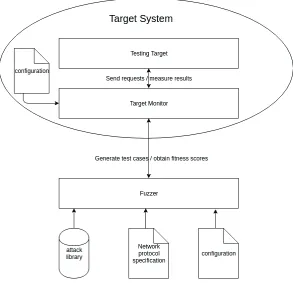
Figure 3.1:An overview of MyFuzzer
Automation This requirement is trivial because the whole idea of a fuzzer is to automate testing. However it is good to state again that the solution presented should be able to do its work automatically for 99 percent of the time.
Practical MyFuzzer should work on most network applications without much setup or other difficult steps. It also should work without needing a lot of information like source-code and flow diagrams.
3.2
Overview
MyFuzzer is a gray-box network fuzzer which uses a genetic algorithm to search for good test-cases. This is different than more traditional random fuzzing, which sends random test-cases without evaluating the results, or deterministic fuzzing which gen-erates test-cases by trying all possibilities.
MyFuzzer has several modules, which can be seen in figure 3.1. As can be seen MyFuzzer consists of three modules, the fuzzer, the target and the target monitor. Each module will be explained in more detail.
consists of multiple applications but they are all running on the same system. Adding distributed systems is however a simple extension so it could be added in future releases of MyFuzzer. The target is a network application, which has an ip address and port number. Clients can communicate with the target by sending requests to this ip address. The fuzzer is a client so it communicates with the target using ip. The target monitor runs on the same system as the target and identifies the target by its process id.
Target Monitor The target monitor monitors the target. It checks the target for crashes and malicious behavior like memory corruptions. The monitor also measures the impact of a test-case on the target. These measurements are sent to the fuzzer which in turn gives it to the genetic algorithm to score the test-case. The target monitor is tied to the fuzzer. Without the target moni-tor the fuzzer would not be able to detect crashes and evaluate the quality of test-cases.
Fuzzer The fuzzer generates the test-cases which are sent to the target. The initial set of test-cases is generated randomly by the fuzzer. After that the genetic algorithm is used to generate new sets of test-cases. This is done by select-ing the best test-cases from the set based on code coverage metrics, and letting the best test-cases create offspring. The set is than mutated to create the new set of test-cases. The genetic algorithm is an important component of the fuzzer and will be explained in the next section 3.3. The fuzzer also communicates with the target monitor to obtain the measurements for the sent test-cases.
The target monitor and the fuzzer together constitute MyFuzzer. The interactions can be divided in to three main steps: initialization, execution and evaluation. The initialization step reads the configuration files and makes everything ready. The execution step starts with the generation of a set of test-cases according to the configuration and uses the genetic algorithm to generate new sets of test-cases. The genetic algorithm uses the results obtained from the target monitor. The evaluation step is about the evaluation of the results. This step should answer questions like:
• How many errors have been found.
• How long did it take.
• What is the code coverage.
3.3. DESIGN 29
3.3 Design
This section explains how MyFuzzer is designed. After reading the information in this section the following things should be clear:
• How the genetic algorithm is combined with the fuzzer.
• How the fitness of a test-case is calculated.
• Which code coverage metrics are collected.
• How test-cases are generated and mutated.
• How the target communication specification is given and used by the fuzzer.
• Why there are multiple fuzzing strategies and how they differ from each other.
• How and when components interact with each other.
It has to be said that the implementation does not always match the design. This is due to the fact that the implementation of MyFuzzer is based on Sulley. The consequence of this is that the implementation of Sulley does not always match the design presented in this section.
3.3.1 Architecture
Figure 3.2: The architecture of MyFuzzer
As can be seen in figure 3.2 MyFuzzer consists of multiple components and sub-components. Every component will be explained in more detail in the following sections.
3.3.1.1 Fuzzer
3.3.1.1.1 Configuration Configuration is the label applied to all functionality which is used by the fuzzer to be able to start fuzzing. So the configuration component has the information to let the Fuzz Manager know where the target is located and how the requests are structured. It also tells the GA the importance of each coverage metric, which has influence on the fitness function, and which mutation rates the GA has to use. The concepts of fitness function, mutation rates and coverage metrics will be explained in sections 3.3.1.1.3 and 3.3.1.2. The configuration consists of several important sub-components.
3.3. DESIGN 31
the same e.g. after doing command x the application went from state1 to state 1.
For example consider an imaginary authenticated FTP server application. In that case there are two states, AUTH and PRE-AUTH, where the latter is the default
state. To use all FTP commands you have to be authenticated, so, assuming there is a transition betweenAUTH andPRE-AUTH, you would have to issue a command
which goes from PRE-AUTH to AUTH. For our fuzzer the commands are issued
by sending messages to the target over the network. For example the state transi-tion mentransi-tioned earlier could be triggered by theAUTHENTICATE command, so the
message sent to the target could be something like AUTHENTICATE USERNAME PASSWORD.
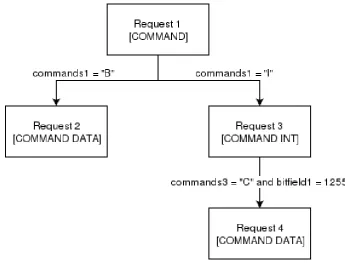
So the target communication specification has two components. First of all it con-tains a list of templates, one for each distinct message. These templates describe how a message has to be constructed. The second part of the target communication specification is to describe the states and transitions between states.
For MyFuzzer the list of all possible messages are given in a block structure. A message can consist of several blocks and each blocks in term can have several other blocks. Eventually a block is reduced to a primitive or a set of primitives. Prim-itives are simple pieces of data like strings, integers, set of commands, delimiters or random data. Using this block structure almost every possible message can be con-structed. For example the message ”AUTHENTICATE USERNAME PASSWORD” can be represented as the template[COMMAND][DELIM][STRING][DELIM][STRING].
In this template there is only one block and this block consists of five primitives.
3.3.1.1.1.2 Attack Libraries Attack libraries are collections of vulnerable in-puts. Each primitive can have an individual attack library. For example the string attack library contains several potentially dangerous strings, like SQL injections and string format attacks. Attack libraries are used when an input is mutated, with a certain probability the current value is replaced by an input from the attack library.
3.3.1.1.1.3 Execution Parameters The execution parameters instruct the fuzzer and genetic algorithm how to do the fuzzing. There are several parameters which can be specified, the most important being:
Strategy Specifies the fuzzing strategy which MyFuzzer has use. There are four strategies which are explained in more detail in section 3.4.6.
Coverage Metrics Weigths Coverage metrics weights, also called coverage weights, specify the importance of a coverage metric. A higher weight indicates that the metric is more important and thus it will have more impact on the fitness func-tion.
3.3.1.1.2 Fuzz Manager The fuzz manager is responsible for storing and execut-ing the test-cases. It also keeps track of all aspects of the fuzzexecut-ing process and relies on the configuration and genetic algorithm components. The fuzz manager is also responsible for test-case generation.
3.3.1.1.2.1 Test-case generation Although generation has a lot to do with the genetic algorithm, test-case generation is seen as a sub-component of the fuzz manager. Test-case generation takes the Target Communication Specification as input and constructs a set of test-cases which match the specification whilst ran-domizing the data itself. So the output is a set of test-cases which have the same structure but contain different data.
3.3.1.1.3 Genetic Algorithm The genetic algorithm is the component which does contain the functionality for mutating data. It also contains the functionality for scor-ing test-cases, selectscor-ing test-cases based on score and creatscor-ing new test-cases from a set of test-cases. Like explained in the literature section these are the basic functions of a genetic algorithm. In the case of fuzzing the individuals are test-cases. There are two types of genetic algorithm implemented in my fuzzers. The firsts GA implementation follows the literature strictly, so it generates a population of test-cases, scores all test-cases, takes a selection of test-cases and uses them to create new test-cases. After that the test-cases are mutated. This is different from the second implementation which relaxes the requirements from the literature a bit. In the second implementation a queue with test-cases is generated. After sending a test-case from the queue the results are compared to thresholds. If the scores are higher then the thresholds the test-case will be mutated and added to the queue again. At some times a cross-over step is done to create new test-cases. In MyFuzzer this is done when there have beenn consequent test-cases which did
not meet the thresholds. So in the second implementation there is no such thing as populations. It was implemented because some fuzzers use an implementation like this and had quite a lot of success with it [16]. Another reason is that it makes the process easier, since there is no need to evaluate groups of test-cases anymore.
3.3. DESIGN 33
forms for both implementations.
3.3.1.1.3.1 Fitness Function The fitness function scores test-cases based on eleven metrics, which will be explained in a later section. The higher the score the more chance of being selected in the selection step. Each test-case gets a score for each of the eleven metrics after it has been executed. These scores are normalized with each-other to make each metric equally important. Each metric also has a weight associated with it. The metric weight determines the importance of the metric. For example a metric with metric weight0.8determines for80percent
the resulting fitness score. The fitness function can be defined formally as follows : f(x) = w1 ∗m1(x) +...+w11∗m11(x), wherex is a test-case,wi is the weight for
metriciandmi(x)is the value for metricifor test-casex. Also note that
∑11
i=1wi = 1
and that∀w∈{w1,...,w11}0≤w≤1.
3.3.1.1.3.2 Selection The selection step does the following. From a popula-tion of size n, where each test-case in the population has been scored, n/2
test-cases are selected. This is done using a random weighted select. What that means is that test-cases with higher weights(which are the scores they received from the fitness function) have more probability of being selected. The selection is important because it roots out bad test-cases and keeps the best ones.
3.3.1.1.3.3 Crossover Crossover is explained in the background chapter 2.4. Cross-over happens after the selection step. The selection step reduced the number of cases by a half. The goal of the crossover is to increase the number of test-cases to the original value. This is done by taking two random test-test-cases from the available test-cases and use them to create a new test-case. This happens until the number of test-cases is the same as before.
MyFuzzer uses simple 50-50 cross-over which means that a new test-case re-ceives a piece of data with 50 percent from parent 1 or with 50 percent from parent 2. There are two things which make crossover a bit more complicated. First of all there are exceptions where parent 1 and parent 2 do not share the same tem-plate. This is solved by determining which pieces of data the parents do not have in common. The child inherits a piece of datad which is only available in one parent
with 50 percent change, otherwise it is omitted. The second complication is how
deep the crossover has to be done. In the section about the target communication section 3.3.1.1.1.1 it is explained that blocks can be nested. Currently MyFuzzer performs crossover only on the top level. So if the template for both parents is
parent 2. Alternatively crossover could be performed on BLOCK itself because it
consists of primitives and other blocks as well.
In the implementation section 3.4 cross-over is explained in more detail.
3.3.1.1.3.4 Mutation Mutation happens after the crossover step. The goal is to create variance within the population. Without the mutation step the inputs would look too much like each other. The mutation step is executed on the highest level, usually a request, which propagates to lower levels and eventually the primitives. The primitives contain concrete implementations for mutation. The mutations per primitive are given in the implementation section 3.4.
3.3.1.2 Target Monitor
The target monitor has several important functions:
1. Monitor the impact of a test-case on the target.
2. Measure coverage results for a test-case.
3. Restart the target if the target is in a corrupt state.
3.3.1.2.1 Coverage Data Collection Code coverage is usually obtained on source-code level. However for MyFuzzer there is no target source-source-code available. The solution to this is to go one level deeper and use the concept of code coverage on assembly level. To do this a virtualization layer between the operating system and the target is added. This layer can be instructed to analyze or manipulate the ex-ecution of the target. For the purposes of this project it suffices to identify which basic blocks a test-case has executed. A basic block is a sequence of instructions without jumps. So once the first instruction of a basic block is executed all the other instructions will also be executed in order without interruptions. For each test-case it is determined which basic blocks it executed by using pre- and post- signals.
3.3. DESIGN 35
Using the raw coverage data for test-case t and a hash-table which contains
the context it can be deduced how many new basic blocks and how many new transitions where found by test-case t. These two values are the most important
coverage metrics. In addition to those two metrics there are several other metrics.
New Basic Blocks Indicate how many new basic blocks have been tested by test-caset.
New Edges Indicates how many new edges between basic blocks have been tested by test-caset.
Test-case Impact Indicates how many basic blocks test-case thas tested. It does
not matter how many times each basic block has been tested.
Basic Blocks Executed Less Then x Times Indicates how many basic blocks tested byt where tested less than x times.
Edges Executed Less Then x Times Same as with basic blocks only now for edges. The last two metrics are divided into four concrete metrics. Less then 10, 100, 1000 and 10000. Note that a basic block is at max only in one of these four.
3.3.2 Dynamic Analysis
To understand the workings of MyFuzzer it is important to understand the interaction between components. MyFuzzer has four important interactions: initialization, exe-cution, evaluation and error recovery. These interactions, together with prerequisites are explained in the following sections.
3.3.2.1 Prerequisites
Before MyFuzzer can be executed the following things have to be in place.
1. The target must be reachable. This means that the fuzzer has to be able to send messages to the target using an ip address and port number.
2. The target monitor must be installed on the target system.
3. The fuzzer needs to know the target communication specification of the target.