7517
A STUDY ON PROGRAMMING EDUCATION TO DEVELOP
SUSTAINABLE INTEREST
1SEONGKYUN JEON, 2EUNKYOUNG LEE, 3YOUNGJUN LEE
1Chungbuk, Korea Institute for Curriculum and Evaluation, Department of Educational Evaluation, Korea
2Chungbuk, Korea Institute for Curriculum and Evaluation, Department of Educational Evaluation, Korea
3Chungbuk, Korea National University of Education, Department of Computer Education, Korea
E-mail: 1[email protected], 2[email protected], 3[email protected]
ABSTRACT
Programming education is considered a primary area aiding the development of computational thinking, an
essential 21st century competency. To verify the effects of computer education, we must create
well-designed learning environments along with strategies to develop learner’s interests and computational thinking. This study developed a programming education program based on design principles to promote and maintain students’ interest in learning; the program’s effects were then verified. The results of our study show that our programming education program positively effects students’ interest in learning.
Keywords: Programming Education, Interest, Computational Thinking
1. INTRODUCTION
Students use analytical and logical thinking to approach and interpret problems in programming education. In the process of developing a program, students engage the creative thinking process to develop ideas, critical and convergent thinking to compare these ideas and choose the best option, and logical thinking to properly express computer languages. Additionally, students receive immediate feedback on their problem-solving through the resulting program. If there is an error, they ruminate on their thought process to logically analyze, and solve the error. Alternately, students can think creatively to consider the problem from new perspectives, breaking away from fixed ideas to resolve the error [1].
Programming education consists of a series of thought processes including problem identification, devising a solution, determining optimal alternatives, coding in logical expressions, and problem solving when errors occur. In this context, programming education has recently been acknowledged as a core educational area capable of fostering computational thinking [1], [2].
Programming education was incorporated into Korean elementary school curriculum for the first time in the mid-1990s; however, the expected effects of this program were not achieved [3] since
programming education did not attract student interest or attention [4].
Student interest, as many past examples attest, is very important to learning. Learners interested in a specific task or subject spontaneously increase the amount of time they devote to learning and participate in learning activities and problem solving more actively, yielding meaningful learning outcomes[5], [6].
Therefore, promoting educational
environments that allow students to actively participate in learning with interest is of the utmost importance.
Recently, various efforts have been made to promote educational environments where learners can enjoy learning computers. The representative ones are the development and
dissemination of Educational Programming
7518 would in existing computer language education. In addition to visual and auditory stimuli, attention has recently been paid to physical computing, utilizing robots or Arduino, by which users can individually create products and use computers to control them. Programming education that incorporates the control of physical objects allows students to participate in learning with greater interest.
There are, however, critical opinions about educational methods that arouse interest through sensory stimuli. As learners watch bright screens and robots moving animatedly in front of them, they are stimulated and become interested. As time goes by, however, they gradually become familiar with this sensory stimulation, and it no longer arouses their interest; interest that depends upon sensory stimulation rarely lasts. Numerous studies indicate that programming education was not as successful as expected due to this problem [7]. “Persistence” and “induction” of interest are both important. It is more important to draw growth by education through a dynamic interaction as such an interest continues, instead of the momentary condition in which the learners are interested. Therefore, creating learning environments that stimulate students’ intellectual interests is integral to developing students’ sustained interest in computer learning.
In light of this, we must conduct a study on interest itself to understand it, and utilize it in education
Since the term “interest” is used in everyday speech, interest in learning is often understood and studied on a common sense level instead of conducting in-depth studies expertly and academically. As such, it is necessary to analyze the change and development of interest thoroughly as it may otherwise elicit misunderstanding and prejudice.
This study bases its understanding of interest on previous studies in hopes of creating educational environments that promote learner interest. Based on this discussion, we developed a programming education program capable of developing sustained interest in learning among students, and its effects were later verified.
2. BACKGROUND
2.1 Interest as an emotion
Interest is recognized as a part of the many
emotions humans feel. Emotions happen
instantaneously, appearing and disappearing in a
short space of time. If stimulation causes emotion, physiological reactions instantly occur. Emotions must occur immediately to aid basic survival. If it takes a lot of time to feel and respond to fear, for instance, this delay threatens survival. Additionally, if emotions remain for a considerable amount of time, irrespective of ever-changing situations, survival is also threatened [8].
Interest is like other emotions, but there are also clear differences. In daily life, interest and enjoyment are often used interchangeably; however, many studies suggest that there are important differences between them [9]. People tend to feel interested when they are investigating complicated matters. In contrast, enjoyment is often felt when people engage in simple things [10], [11]. Interest motivates people to explore new and complex subjects, which eventually leads to gaining knowledge and competence. In contrast, enjoyment provides a compensation function. For instance, people who pursue interest will order different food in a restaurant while those who pursue enjoyment will order food they liked in the past [12].
2.2 Appraisal model of interest
The appraisal model of interest explains interest as an individual’s cognitive process regarding an event. The core argument of the appraisal model is that cognitive appraisal of an experience causes and composes emotional experience [13].
The difference in individuals’ appraisal ability leads to different interpretations of experiences. For example, studies show that experts in music and art prefer complex images and melodies while novices favor relatively simple images and melodies [14], [15].
The appraisal model of interest came to the fore as a solution to resolve problems that could not be explained by emotion psychology [13]. Why do people have differing emotional responses to the same event? Why does the same person have different emotional experiences during similar events?
7519 why it may vary even to similar events can be
explained [16].
2.3 Situational-personal interest model
On the other hand, interest may be explained situationally and personally [17].
The situational-personal interest model
distinguishes between temperamental and
instantaneous aspects of interest. Situational interest is a form of instantaneous interest. Since
situational interest occurs instantly by
environmental or stimulatory characteristics, it lasts for a relatively short time, and disappears immediately. Situational interest does not substantially affect a person’s knowledge or values; its main feature is that it does not affect individuals differently, rather, it is experienced identically by many individuals.
Personal interest may be regarded as one’s relatively persistent preferences towards specific subjects or activities. Personal interest may vary depending on an individual's character or inclinations. It develops relatively slowly and is maintained persistently, directly affecting an individual’s behavior. Hence, personal interest substantially affects one’s learning choices and persistence as well as his/her knowledge and values. A person who feels interested in a subject or activity requires less intentional effort and self-control to maintain concentration [18].
3. THE PROGRAMMING EDUCATION
PROGRAM
3.1 Trends of programming education in Korea
The development and introduction of various Educational Programming Languages has reduced students’ excessive cognitive burdens in studying and learning grammar. Students are able to concentrate more on cultivating highly complex thinking skills through programming education. Scratch, especially, provides a visual programming environment with enhanced multimedia elements [19]. Scratch emphasizes logical thinking as students write programs to resolve problems. Additionally, by utilizing multimedia elements, Scratch adds visual and auditory meaning and emphasizes the importance of engaging a learning process to produce creative drafts. Educational Programming Languages with enhanced visual and multimedia elements allow students to freely create programs such as animation and media art. With
previous text-based programming languages, this was difficult to express.
Students’ methods of learning
programming have been greatly affected by the
dissemination of easy-to-use Educational
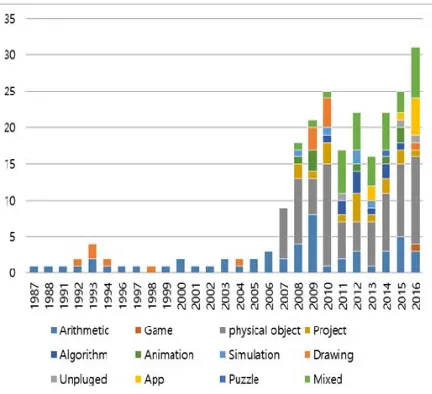
Programming Languages. Our study analyzed South Korean articles published between 1987 and 2016 to analyze changes in the learners’ programming learning. A total of 234 articles were collected from the Research Information Sharing Service (RISS) by searching “programming education.” By analyzing these articles, the topics of students’ learning activities were classified into 12 categories including game, physical object
utilization, project, algorithm, animation,
[image:3.612.315.531.495.692.2]simulation, drawing, unplugged, app development, puzzles, and combinations of many other activities; these articles were then analyzed by period. Because of the analysis, it is noted that the topics of programming learning changed as time passed as shown in Figure 1. Until the mid-2000s, programming learning activities mainly consisted of mathematical activities. Even if students wanted to participate in learning activities with more interesting topics, it was difficult for them to develop them since most learning environments at the time were text-based languages. However, since block-based programming languages have been disseminated since the mid-2000s, diverse and interesting learning activities such as games, physical object utilization, projects, animation, and simulation have been conducted. Additionally, the amount of studies regarding programming education has also greatly increased since the mid-2000s.
7520 Through this analysis, we must recognize that multimedia can be utilized in programming learning. Many types of learning such as animation, games, and media art are possible, and can be further expanded to robots and physical computing. Learners can express their thoughts and intentions in addition to cognitive learning activities through programming learning. They can make programs focusing on topics in which they are interested and
express their artistic sensibility through
programming.
As we can see in Figure 2 [20], changes in programming education have expanded to include content in which learners find interesting. Learning opportunities in programming should be provided for students to cultivate their talents utilizing computing since future society will surely advance computing. It is necessary for design programming learning to make students of various personalities
and development potentials interested in
[image:4.612.91.305.406.554.2]programming through various topics and activities; as such, student interest will become sustainable. It is also necessary to design teaching and learning so students can learn with continued interest in addition to cultivating existing cognitive abilities through programming learning.
Figure 2: Expansion of programming education concept
3.2 Design principles
To provide students with interesting learning experiences, the following strategies, based on conceptual understanding and working interest mechanisms, should be applied.
First, the emotional attribute of interest should be utilized. A strategy that stimulates student interest by motivating them as they begin learning is an example of recognizing interest as an emotion. This emotional attribute is a strategic element that can be effectively used to cause instant
interest for individual learners. Therefore, it is necessary to design learning environments in consideration of the emotional aspects of interest when learning begins.
Second, interest should be perceived not only as an emotional factor but also a cognitive one; as such, intellectual interests should be stimulated. Studies on interest in the early 1960s mainly defined interest as an emotion [21]. A view of interest as an emotion recognized interest as a universal phenomenon that could happen to anyone but could not explain why individual interests develop differently. The appraisal model of interest was presented as an alternative to explain individuality and individual differences of interest. The appraisal model of interest suggests that interest is felt through cognitive processes and interpretations of an event. By introducing a cognitive aspect to interest, it further suggests that individual differences of interest arise since events are judged and interpreted according to one’s existing knowledge and knowledge schema. This means that to develop sustainable interest, it is necessary not only to develop simple sensory interests but also a learners’ knowledge schema through assimilation and accommodation.
Third, concepts between subjects should be linked to enable real-life learning. Students are generally interested in activities in which relevant concepts and principles are realized and applied to the real world [22]. It is important for learners to experience the process of how related knowledge can be interpreted and integrated into real-life problem solving.
7521
3.3 Development of a programming education
program
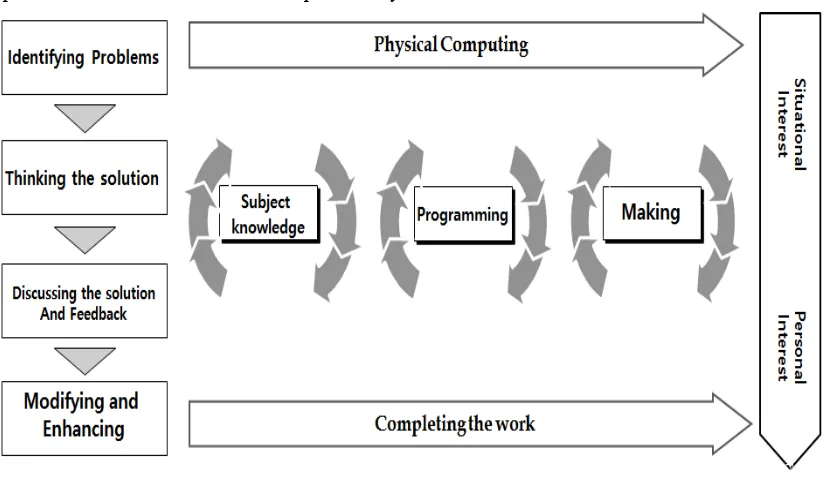
We developed a programming education program based on design principles. The outline of this education program is shown in Figure 3, and consists of four phases.
In the problem identification phase, learners take the lead in recognizing problems. Teachers must present concrete tasks such as “produce a blimp.”
In the phase of thinking a solution, students collect necessary information and knowledge to solve a problem and discuss potential solutions. Using our blimp example, students should determine the airframe’s density, and discuss principles of buoyancy and the computer program required to make the blimp fly.
Next, in the phase of discussing solutions and receiving feedback, learners present prototype. Also, learners present the problem-solving process used to make a draft and teachers provide feedback. Students also conduct a comparative analysis of the problem-solving method and strategies they utilized while collaboratively producing a prototype. Through this, they examine an improved strategy to produce a more developed draft.
The phases of “Thinking a solution” and “Discussing the solution and feedback” are carried out repetitively. Learners draw reasonable solutions to the problem, and repeat this process. Through this, the work produced by students should improve. Thus, the process of exchanging feedback is important. Learners should have an experience by
which they come closer to problem-solving; they repeat this process and construct knowledge. This learning experience arouses positive interpretations of problem-solving possibilities. In other words, this is an important point at which learners’ interest transitions from situational interest to personal interest.
Last is the phase of Modifying and Enhancing. In this phase, students evaluate and revise existing solutions or drafts, reflecting on feedback from previous phases, and presenting the results before receiving their evaluation.
This education program was designed so learners could take a lead in the overall process of devising and producing concrete products. Physical computing was utilized as a key learning tool since given that it utilizes several sensors and tools, it can help students to enjoy learning. Additionally, since physical computing is implemented in the real world, it requires knowledge about subjects outside of computers.
During the problem-solving process, students complete works and utilize physical computing. Students perform self-directed activities including programming learning, exploration of various subjects’ principles, and producing work throughout the problem-solving process.
It is expected that through this study, student interest in programming will continue and that deeper, more meaningful self-directed learning will be accomplished in the process.
[image:5.612.99.511.483.722.2]4. METHOD
7522 To analyze the effect the programming education program we developed for this study has on the development of learners interest, 25 grade six students in class A at Y elementary school in Y city were selected as an experimental group and 23 students in class B served as a control group.
The experimental group received 20 programming education classes developed by our program. These classes were based on learning principles that stimulate interest. The control group also received 20 classes but with the regular programming education program. Over the period of these 20 classes, two assignments were given to both groups and later collected.
[image:6.612.93.309.395.510.2]To analyze the persistence of learning interest, after 20 classes were completed, the experimental and control groups both had a one-month rest period over which programming education was not conducted. After this rest period, a third learning assignment was presented to students in both groups and the two groups’ assignment return rates were compared and analyzed. Figure 4 shows the procedure of presenting assignments.
Figure 4: Procedure of presenting assignments
This study analyzed the return rate of assignments to determine the persistence of learning interest. One month after the experiment, assignments were simultaneously presented to both experimental and control groups, and the rates of the fulfillment and submission were analyzed.
Koulouri (2014) investigated students’ initiative in programming learning by analyzing
assignments. Non-compulsory programming
assignments were presented to students, and as a result of the analysis of the collected assignments, the students who received formative feedback submitted assignments below expectations. This is due to the attitudes of externally motivated students’ which include a fear of receiving negative feedback and evaluation scores. In other words,
unless assignment submission is compulsory or connected to test scores, it can serve as an index of learning that reveals students’ voluntary will to learn [23].
Students’ continuous selection of
interesting topics and their assignment of more time have positive effects on learning [24]. In this sense, students whose interests become sustainable have the will to learn continuously even when their academic program ends. This study verified the development of students’ interests by presenting assignments related to programming after a one month period and conducting a comparative analysis of how actively they participated in resolving the assignment. For this purpose, assignments were presented three times as shown in
Figure 4. Thefirst and second assignments were
presented during the experimental period, while the final assignment was presented one month after the completion of the experiment. The presentation and assignment collection were performed with both experimental and control groups under strict controls so researcher bias could not impact the results.
Students who develop personal interest from situational interests through programming education will be willing to continue learning even if the classes are discontinued. After a certain period, the learners’ persistence of interest was verified by providing them with a relevant assignment, and comparatively analyzing how actively they participated in completing it.
5. RESULTS
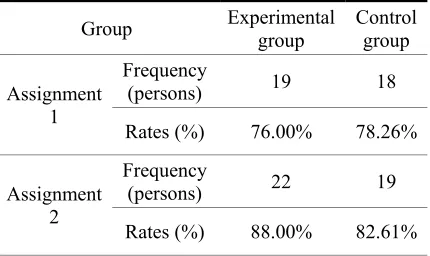
[image:6.612.310.525.588.716.2]To analyze the effects this study’s education program had on the persistence of learners’ interest, three assignments were presented and their return rates were analyzed. The results of the assignment return rates are shown in Table 1.
Table 1: Assignment return rates
Group Experimental group Control group
Assignment 1
Frequency
(persons) 19 18
Rates (%) 76.00% 78.26%
Assignment 2
Frequency
(persons) 22 19
7523 Assignment
3
Frequency
(persons) 21 18
Rates (%) 84.00% 78.26%
Number of participants 25 23
Figure 5 shows the assignments and the changes in their return rates over the course of three tasks. The first assignment’s return rate was lower in the experimental group (76%) than the control group (78.26%).
The first assignment was assigned early in the experimental period. The experimental and control groups were randomly selected, and the return rates of the assignment varied according to learning attitudes and atmosphere as well as their teacher’s philosophy. Therefore, a comparative analysis of the first assignment’s return rate with those of the second and third is necessary to objectively analyze the return rates from the perspective of persistence of interest in learning. In this respect, the first assignment’s return rate was used as the baseline for the second and third assignments.
The second assignment, which was presented at the end of the experiment, showed that the return rate of the experimental group (88%) was higher than that of control group (82.61%).
Students who had approximately one month of rest at the end of the experiment showed distinct differences in the third assignment. Although the experimental group's return rate of the third assignment was lower than that of the second, it was higher than that of the first. This shows that the experimental group’s interest was more persistent than that of the control group.
Figure 5: Changes in the return rates of assignments
6. CONCLUSIONS
Programming’ positive educational effects have long been recognized. While there have been efforts to spread programming education in the past, these efforts were not as successful as expected. Programming education failed since it did not engage students’ attention and interests. Interest is an important factor in learning. Learners who feel interested in a subject or assignment spontaneously increase their time studying and have better learning outcomes.
However, “interest” is often used generally. Thus, most existing studies apply interest to educational programs in a commonsense understanding rather than investigating it professionally or academically. Accordingly, misunderstandings and prejudice about interest skew and weaken the meaning of
interest in learning. Therefore, a clear
understanding of the concept of interest and its developmental mechanisms is needed. For this purpose, our study investigated the theories of emotional interest, the model of interest as an appraisal, and personal-situational interest.
[image:7.612.128.529.56.300.2]7524 Interest as an emotion emphasizes emotions commonly felt by people according to variables of human nature such as newness, uncertainty, conflict, and complexity; however, it does not explain why interest is felt differently by individuals or why an individual’s interest changes over time. The appraisal model of interest explains interest as an individual’s cognitive process concerning experience. In other words, individuals make different evaluations and interpretations of
interesting experiences by different prior
knowledge. Cognitive evaluations and
interpretations of interest explain why interest changes over time in various ways according to individuals, even in similar cases.
Situational-personal interest explains the change in an individual’s interest as it develops from emotional interest to cognitive interest. Situational interest appears in many people and is instantly induced by short-term environmental factors or stimulation. On the other hand, personal interest is a relatively persistent characteristic felt in specific topics or activities. Therefore, difference among individuals may appear according to personality or prior knowledge, as personal interest is characterized by slow development and persistency. Content is the key to developing situational interests into personal interests; it must be valuable and resolve cognitive conflict. In other words, to create and sustain learner’s interest, cognitive elements must be considered in addition to sensory stimulation and interesting elements. We must discuss and analyze interest and cognitive factors separately. However, it is more important to prepare an integrated design of interest and cognitive factors in the context of learning. To develop an interest into a sustainable interest so students continue to learn independently, it is desirable to build learning environment by organically integrating interest with cognitive factors instead of separating them.
This study developed a programming education program to enhance sustainable interest; its educational effects were then verified.
A programming education program was developed, following design principles to develop sustained interest.
First, interest’s emotional attributes should be utilized. Second, interest should be perceived not only as an emotional factor but a cognitive one; based on this, intellectual interest should be stimulated. Third, concepts between subjects should be linked to enable learning relating to real life. Fourth, programming activities should be used in problem solving processes.
To analyze educational effects, three assignments were presented and their return rates analyzed. The first and second assignments were presented during the experimental period, and the third assignment was presented one month after. Subsequently, persistence of interest was estimated by comparing the assignment’s return rates.
The results show that the experimental group's assignment return rate was higher in the second assignment than the first. Although the return rate of the third assignment was slightly lower than the second, it was still higher than the first.
Based on these findings we can say that the programming education program we designed for this study had a positive effect on learners' persistent interest.
REFERENCES:
[1].S. K. Jeon and Y. J. Lee, “A meta analysis of
programming education effects according to
learning activity themes”, Journal of Korean
association of computer education, Vol. 19, No. 2, 2016, pp. 21-29.
[2]. S. Y. Lye and J. H. L. Koh, “Review on teaching and learning of computational thinking through programming: What is next for K-12?”,
Computers in Human Behavior, Vol. 41, 2014,
pp. 51-61.
[3]. D. S. Park and S. H. Bae, “A Study on the New
Curriculum of Computer Education in
Elementary Schools”, The Journal of
Soonchunhyang University, Vol. 15, 1992, pp. 945-951.
[4]. M. Resnick, J. Maloney, A. Monroy Hernández, N. Rusk, E. Eastmond, K. Brennan, and Y. B. Kafai, “Scratch: programming for all”,
Communications of the ACM, Vol. 52, No. 11,
2009, pp. 60-67.
[5]. O. Köller, J. Baumert, and K. Schnabel, “Does interest matter? The relationship between
academic interest and achievement in
mathematics”, Journal for Research in
Mathematics Education, Vol. 32, No. 5, 2001, pp. 448.
[6]. M. Ainley, S. Hidi, and D. Berndorff, “Interest, learning, and the psychological processes that
mediate their relationship”, Journal of
educational psychology, Vol. 94, No. 3, 2002, pp. 545-561.
7525 [8]. P. Ekman, “An argument for basic emotions,
Cognition and Emotion”, in Oliver, R. L. (Ed.), Satisfaction: A Behavioral Perspective on the Consumer, McGraw-Hill International, New York, NY, 1992, pp. 169-200
[9]. J. D. Mayer and Y. N. Gaschke, “The experience
and meta-experience of mood”, Journal of
personality and social psychology, Vol. 55, No. 1, 1988, pp. 102-111.
[10]. P. P. Aitken, “Judgments of pleasingness and
interestingness as functions of visual
complexity”, Journal of Experimental
Psychology, Vol. 103, No. 2, 1974, pp. 240-244. [11]. R. Eisenman, “Pleasing and interesting visual
complexity: Support for Berlyne”, Perceptual
and motor skills, Vol. 23, No. 3, 1966, pp. 1167-1170.
[12]. S. S. Tomkins, “Affect Imagery Consciousness: Volume 1 The positive Affects, Springer, New York, 1962.
[13]. I. J. Roseman and C. A. Smith, “Appraisal theory”, In Appraisal processes in emotion: Theory, methods, research, Edited by K. R. Scherer, A. Scherer, and T. Johnstone, Oxford University Press, New York, 2001, Chapter 1, pp. 3-19.
[14]. R. Frances, “Comparative effects of six collative variables on interest and preference in adults of
different educational levels”, Journal of
Personality and Social Psychology, Vol. 33,
No. 1, 1976, pp. 62-79.
[15]. P. Hekkert and van P. C. Wieringen, “The impact of level of expertise on the evaluation of original and altered versions of
post-impressionistic paintings”, Acta psychologica,
Vol. 94, No. 2, 1966, pp. 117-131.
[16]. K. R. Scherer, “Appraisal considered as a process of multilevel sequential checking”, In Appraisal processes in emotion: Theory, methods, research, Edited by K. R. Scherer, A. Schorr, and T. Johnstone, Oxford University Press, New York, 2001, Chapter 21, pp. 369-391.
[17]. S. Hidi, “Interest and its contribution as a mental resource for learning”, Review of Educational research, Vol. 60, No. 4, 1990, pp. 549-571.
[18]. A. Krapp, S. Hidi, and K. A. Renninger, “Interest, learning and development”, In The role of interest in learning and development, Edited by K. A. Renninger, S. Hidi, and A. Krapp, Psychology Press, NJ, 1992, Chapter 1, pp. 3-25.
[19] Resnick, M., Maloney, J., Monroy-Hernandez, A., Rusk, N., Eastmond, E., Brennan, K., et al,
“Scratch: Programming for all”,
Communications of the ACM, Vol. 52, No. 11, 2009, pp. 60-67
[20] S. K. Jeon and Y. J. Lee, “Direction for
Learner-centered Programming Education”, In
Proceedings of E-Learn: World Conference on
E-Learning in Corporate, Government,
Healthcare, and Higher Education, Association for the Advancement of Computing in Education (AACE), 2015, pp. 1796-1801. [21]. K. Oatley and J. M. Jenkins, “Understanding
emotions”, Blackwell publishing, Oxford, 1996. [22]. H. G. Schmidt, J. I. Rotgans, and E. H. Yew,
“The process of problem-based learning: what
works and why”, Medical education, Vol. 45, No. 8, 2011, pp. 792-806.
[23] Koulouri, T., Lauria, S., & Macredie, R. D.,
“Teaching introductory programming: a
quantitative evaluation of different approaches”, ACM Transactions on Computing Education (TOCE), Vol. 14, No. 4, 2014, pp. 1-28.