http://wrap.warwick.ac.uk/
Original citation:Hugh-Jones, David and Leroch, Martin A. (2011) Reciprocity towards groups. Working Paper. Coventry, UK: Department of Economics, University of Warwick. (CAGE Online Working Paper Series).
Permanent WRAP url:
http://wrap.warwick.ac.uk/57660
Copyright and reuse:
The Warwick Research Archive Portal (WRAP) makes this work of researchers of the University of Warwick available open access under the following conditions. Copyright © and all moral rights to the version of the paper presented here belong to the individual author(s) and/or other copyright owners. To the extent reasonable and practicable the material made available in WRAP has been checked for eligibility before being made available.
Copies of full items can be used for personal research or study, educational, or not-for-profit purposes without prior permission or charge. Provided that the authors, title and full bibliographic details are credited, a hyperlink and/or URL is given for the original metadata page and the content is not changed in any way.
A note on versions:
The version presented here is a working paper or pre-print that may be later published elsewhere. If a published version is known of, the above WRAP url will contain details on finding it.
WORKING PAPER SERIES
Centre for Competitive Advantage in the Global Economy
Department of Economics
September 2011 No.52
Reciprocity towards Groups
Reciprocity towards Groups
David Hugh-Jones and Martin A. Leroch*
30 August 2011
People exhibitgroup reciprocity when they retaliate, not against a person who harmed them, but against another person in that person's group. We tested for group reciprocity in laboratory experiments. Subjects played a Prisoner's Dilemma with partners from different groups. They then allocated money between themselves and other participants. In punishment games, subjects whose partner had defected punished participants from the partner's group more, compared to their punishment of participants from a third group. In dictator-style games, subjects did not exhibit group reciprocity. We examine possible correlates of group reciprocity, including group identification and cooperativeness.
Keywords: reciprocity, groups, conflict, experiment
JEL classification: D74, C92
* David Hugh-Jones: Warwick University, [email protected]. Martin Leroch: University of Hamburg, [email protected]. This work was supported in part by British Academy Small Research Grant SG101553. We thank Vittoria Levatti, Werner Gueth, Eva Steiger, Johannes Weisser, Ro'i Zultan, David Reinstein, Ryan McKay, Eva van den Broek, Shaun Hargreaves Heap and seminar participants at the Max Planck Institute of Economics, University of Hamburg, University of Warwick and King's College London; and the Max Planck Institute ESI group hiwis and administrative staff: Martin Beck, Nadine Erdmann, Adrian Liebtrau, Christian Williges, Christian Streubel, Claudia Zellmann and especially Christoph Goering.
Introduction
In the summer of 1906, Atlanta, a city previously known for relatively
peaceful race relations, saw a spate of newspaper coverage of black attacks on
whites, in particular white women. (“Bold Negro Kisses White Girl's Hand,”
screamed one headline.) On September 22nd, four assaults upon white women
were reported. Armed with guns, a group of whites went downtown to a black
neighbourhood and attacked black men, killing 25.1 None of the original
alleged assaults were later substantiated.
Laboratory experiments have persuaded many economists that humans are
reciprocators, who will pay so as to punish actions they perceive as unfair
towards them or others (Rabin 1993; Fehr and Gaechter 2000; Bolton and
Ockenfels 2000). Examples like the above suggest that people sometimes
strike back, not against the individual who caused the perceived harm, but
against other people in that individual's group. In these cases, those punished
may have nothing to do with the initial offence, and the offender himself may
be completely unaffected by the retaliation. We call this kind of retaliation
group reciprocity.
Group reciprocity appears widespread in human conflict, including riots,
pogroms and ethnic civil wars. Many such episodes involve calls for revenge
against an opposing group for previous harms, whether real or imaginary,
recent or ancient.2 Indeed, grievances over previous conflicts may provide the
cause or pretext for further outbreaks, leading to cycles of violence.3 These
cycles hinder development in many of the world's poorest states (World
Development Report 2011).
Group reciprocity can also be seen in ordinary economic behaviour.
Consumers may boycott the produce of countries whose policies they
disapprove of, or products offered by specific ethnic groups. In 2010, during
the European financial crisis, a German news magazine headline described
Greeks as “Crooks in the European Family”. This led to a boycott of German
products in Greece. Later, when Greek protesters used Nazi symbols to protest
bailout conditions, the tabloid Das Bild commented “We pay – and still get
insulted!” Such cycles of recrimination may affect voters' support for
Eurozone bailouts (Daily Telegraph 2010; Reuters 2011). Companies, too,
may be targets for group reciprocity. In 1995, after the Shell Corporation's
2 For numerous examples, see Horowitz (1985; 2001).
3 For the role of grievance in civil wars, see Collier and Hoeffler (2004), Fearon and Laitin
(2003), as well as the literature review in Blattman and Miguel (2010). For its role in
terrorism see Krueger and Maleckova (2003).
decision to sink the oil drilling platform “Brent Spar” in the North Sea, several
Shell petrol stations in Germany received bomb threats, and at least one
actually received a letter bomb (Die Welt 1995). Lastly, group reciprocity may
be positive as well as negative: football fan communities sometimes maintain
bonds of friendship, established by acts of generosity such as refraining from
physical assault on specific occasions (Koester 2008).
Although group reciprocal behaviour has been attested beyond reasonable
doubt, we know little about the motivations behind it. Acts of group
reciprocity could be undertaken by materially self-interested, rational actors.
For example, boycotting a country's exports may be seen as an effective way
to change its policies. Striking back against groups may help someone to build
a reputation for toughness. Or, not doing so might expose one to punishment
from others in one's own group: one eyewitness of the Rwandan genocide
stated “ten percent helped; 30 percent were forced to kill; 20 percent killed
reluctantly; 40 percent killed enthusiastically” (Mamdani 2001). However, as
this quote suggests, it is also possible that some people may group-reciprocate
even when there is no strategic incentive to do so. These people will act as if
group fairness is a primitive in their utility function: they simply prefer to
harm (or help) members of groups who have harmed (helped) them.4
4 We do not propose a particular functional form for group-reciprocal utility in this paper.
To investigate whether this is the case, we ran laboratory experiments in
which there was no strategic incentive to group-reciprocate. Subjects in the
experiments were divided into groups. Each group jointly completed a
cooperative task. Then, each subject played a Prisoner's Dilemma (PD) against
a partner who was a member of a different group. After play in the PD was
revealed, subjects made decisions allocating money between themselves and
members of other groups. We compare each subject's allocations to the fellow
group members of their partner in the PD, with their allocations to members of
a different group with which they had not previously interacted. Using this
other group as a control, we can test whether subjects' PD partners'
cooperation or defection affected their allocations specifically to the partner's
group.
Our main findings are as follows. While the majority of our subjects do not
group-reciprocate, and indeed do not discriminate at all between groups, a
minority of subjects do group-reciprocate. In particular, we find significant
evidence of group reciprocity in punishment decisions, where subjects must
pay to harm others. However, we do not observe group reciprocity in dictator
games where harming others benefits the subject. Lastly, we examine some
possible correlates of group reciprocity. Although group reciprocity is only
induced when subjects cooperated and their partner defected, subjects who are
more cooperative in general are no more likely to group-reciprocate than
others. Group reciprocity is also not predicted by a psychological measure of
group identification.
In the next section we review the relevant literature, and explain our
contribution. We then describe our experiments and results.
Related Literature
Economists have long been interested in the economic consequences of groups
and ethnicity (Becker 1957; Arrow 1972; Akerlof 1976). More recently,
economic experimentalists have focused on how group membership affects
behaviour, a topic that has long fascinated social psychologists (Sumner 1906;
Sherif et al. 1961; Tajfel et al. 1971). Hargreaves Heap and Zizzo (2009)
show experimentally that people will put a monetary value on group
membership. Further, people discriminate between in- and outgroups. They
cooperate more with in-group members (de Cremer and van Vugt 1999;
Goette and Huffman 2006, Guala et al. 2009; but cf. Bouckaert and Dhaene
2004); give in-group members more, reward them more for good behaviour,
and punish them less (Chen and Li 2009); they also punish offenders more
when the victim is an in-group member (Goette and Huffman op. cit.,
Bernhard et al. 2006). Debate continues over whether this different behaviour
is driven by expectations of future reciprocity (Yamagishi and Kiyonari 2000;
As psychologists have noted (Brewer 1999), ingroup bias per se does not
imply that people will behave unkindly towards members of an outgroup, only
that they will behave more kindly towards members of their ingroup. For
example, when asked to allocate a “bad” (exposure to aversive noise) among
ingroup and outgroup members, members of a minimal groups did not favour
the ingroup (Mummendey et al. 1992). Therefore, ingroup bias alone may not
explain the empirical regularity that many real-world conflicts involve
appalling intergroup violence (Brewer op. cit.). Dispositions to group
reciprocity may be a missing part of the story. Individual biases towards one's
own group, which are (relatively) innocuous in ordinary circumstances, can
become more dangerous after a perceived threat or insult from another group.
Psychologists have investigated indirect group reciprocity (i.e. reciprocity
towards groups in retaliation for harms done to other members of one's own
group) under the term “vicarious retribution” (Lickel et al. 2006). Stenstrom et
al. (2008) show that subjects will verbally express a demand for sanctions in
retaliation for a presumed intergroup insult. In Gaertner et al. (2008), subjects
allocated unpleasant noise to a group one of whose members had rejected the
subject.
Group reciprocity may also help to explain the harmful intergroup behaviour
observed in some lab experiments. Abbink and Herrmann (2009) created a
ten-round vendetta game between two groups: in each round, subjects could
deduct money from the other group, at a cost to themselves. The low observed
rates of this inefficient behaviour (13%) were tripled (40%) by the addition of
a symbolic reward. Suggestively, rates of harmful actions were increased by
the other group's harmful actions in the previous round, although since the
group included the person who chose the previous harmful action, group
reciprocity cannot be clearly distinguished here from individual reciprocity.
By contrast, Halevy et al. (2008) observe very low rates of intergroup harm
when an option to benefit one's own group without harming the other group
was available; this was a one-shot game, with less scope for group reciprocity
to operate.
Similarly, some results from field data are compatible with group reciprocity.
Shayo and Zussman (2010) show that Israeli judges were more likely to find
in favour of Israeli plaintiffs against Arab defendants shortly after terrorist
incidents. This could be explained by increased solidarity with the ingroup, or
by bias against an outgroup perceived as responsible for an attack; a point
favouring the former interpretation is that Arab judges were also more likely
to find in favour of Arabs against Israelis after an attack. In a military context,
Kocher et al. (2008) show that indiscriminate US bombing in Vietnam
increased Vietcong control, suggesting that it drove Vietnamese civilians “into
We see our contribution as follows. We test experimentally, using real money
payoffs, whether people will reciprocate the actions of one group member
when they make choices affecting other members of that group. Our design
rules out strategic motivations, including expectations about others' behaviour
towards oneself and reputational considerations. We clearly distinguish group
from individual reciprocity, by ensuring that subjects knew they were not
harming (helping) the person who had harmed (helped) them, but rather others
from that person's group. By having subjects make allocations to multiple
out-groups, we also differentiate reciprocity towards a specific group from
generalized reciprocity towards third parties (Dufwenberg et al. 2001, Nowak
and Roch 2007). Thus, the laboratory setting allows us to identify group
reciprocal behaviour more cleanly than would be possible with field data.
Experiments have been run both with lab-created groups (Tajfel et al. 1971;
Hargreaves Heap and Zizzo 2009; Guala et al. 2009; Chen and Li 2009;
Yamagishi and Kiyonari 2000; Yamagishi and Mifune 2008, 2009; de Cremer
and van Vugt 1999) and with naturally occurring groups (Sherif et al. 1961;
Fershtman and Gneezy 2001; Bouckaert and Dhaene 2004; Goette and
Huffman 2006; Bernhard et al. 2006; Habyarimana et al. 2009). We chose to
use lab-created groups in our experiment, for two reasons. First, lab-created
groups reduce the likelihood that subjects will bring into the lab set patterns of
intergroup behaviour, which might have a strategic or group-reputational
component. Second, lab groups are relatively easy to create without access to a
specific subject pool, and this contributes to our goal of developing a simply
reusable experimental paradigm. We also note that the use of lab-created
groups arguably provides a stronger test of group reciprocal motivations than
using powerful existing identities such as ethnicity. Nevertheless, we believe
that future tests of group reciprocity with naturally occurring groups will also
be interesting and important.
Experimental Design
We ran two experiments. Both experiments shared the following sequence of
events. First, subjects were separated into colour-coded groups. Second, to
increase group identification, subjects performed a collective task. Third,
subjects were paired with members of other groups, and played a Prisoner's
Dilemma (PD). Following Fehr and Fischbacher (2004), we think defection in
a PD would be considered a norm violation by many of our subjects.5 Fourth,
after the PD, subjects completed allocation tasks involving themselves,
members of their PD partner's group (but not the PD partners themselves), and
members of a third group with whom they had not previously interacted.
Defection by a subject's PD partner might affect the subject's behaviour to
5 Note, however, that we chose a simultaneous PD game, whereas Fehr and Fischbacher
members of all other groups, not just to members of the partner's group; we
use the allocations to the third group to control for this.
Our basic empirical model is
(1) givingi,g = f(αi + κ Self Di + λ Partner Di + μ (Partner Di × Self Di)
+ Xiβ + γ Pgrpg + δ (Pgrpg × Self Di) + ζ (Pgrpg × Partner Di) + η
(Pgrpg × Partner Di × Self Di) + Pgrpg × Ziθ + εi,g)
Here, givingi,g is the amount given by individual i to a member of group g ∈
{Partner,Other}. Pgrpg is 1 if g is the group of the subject's PD partner, and 0
otherwise. Self Di is 1 if subject i defected in the PD and 0 otherwise. Partner
Di is 1 if the subject's PD partner defected and 0 otherwise. We interact
Partner Di with Self Di because it is plausible that subjects will react
differently if they cooperated, but their partner defected, than if both they and
their partner defected. Parameters κ, λ and μ capture the effect of these
covariates upon total amounts given. Our parameters of interest, however, are
ζ and η. These are the effect of the PD partner's defection specifically on
giving to the Partner group, above any effect on giving to the Other group. ζ
gives the effect for subjects who are themselves PD cooperators and (ζ+η)
gives the total effect for subjects who are defectors. Lastly, αi is a subject
specific intercept, Xi is a vector of known covariates which may affect
subjects' giving to all groups, and Zi is a vector of known covariates which
may influence subjects' giving to the Partner group alone. Subjects' individual
propensities to give, αi, are highly likely to be correlated with their behaviour
in the PD, and therefore with values of Self D and Self D× Partner D. For this
reason, we treat αi as a fixed effect. If our specification were linear (f(x)=x),
then we could use first-differencing to eliminate both the fixed effects and all
the terms affecting amounts given in general, leaving:
(2) givingi,partner – givingi,other = γ + δ Self Di + ζ Partner Di + η
(Partner Di × Self Di) + Ziθ + εi,partner – εi,other
Our data is not suitable for a linear model in either experiment, so that naïve
first-differencing will not work, but we use estimation strategies based upon
the same idea.
For clarity and ease of comparison, the sequence of treatments and choices in
both experiments is illustrated in Table 1 below. The complete description of
Subjects Pre-Group Stage Group Formation Post-Group PD Allocation Task Post-experiment E xp er im en t 1
180 subject in 6 sessions.
3 groups per session.
10 members per group.
1 ECU = 1 EURO.
None. Random assignment into colour-coded groups.
Task: group pelmanism game. 5 ECU for winners.
Players endowed with 2 ECU and choose actions A or B. Payoffs in ECU:
A B A +2,+2 -2,+5 B +5,-2 -1,-1
10 randomly ordered binary choices allocating money. Players choose A or B. Payoffs shown in Table 2.
Questionnaire. Pelmanism winners revealed.
Payment: 2.50 EURO show up fee plus pelmanism + PD + results of 1 randomly chosen allocation per subject. E xp er im en t 2
172 subjects in 10 sessions.
6 groups per session.6
3 members per group.
100 ECU = £1.
Anonymous Prisoner's Dilemma with random other participant. Results revealed at end.
Random assignment into colour-coded groups.
Task: quiz on animal collective names, with group chat. 1000 ECU for winners. 100 ECU for losers.
Players endowed with 200 ECU and choose actions A or B. Payoffs in ECU:
A B A +200,+200 -200,+500 B +500,-200 -100,-100
6 randomly ordered continuous choices allocating money.
3 dictator games with taking frame: other participant has 1000 ECU and subject can take 0-1000 ECU.
3 punishment games: subject has 400 ECU, other participant has 900 ECU. Subject can spend up to 300 ECU to punish. Each ECU spent reduces other's payoff by 3 ECU.
Each game played: once with random member of Own group, once with random member of Partner group (not PD partner him/herself), once with random member of (an) Other group. Other participant identified by group and number.
Questionnaire. Initial PD results and quiz winners revealed.
Payment: £5 showup fee
plus:
Sessions 1-5: 1 chosen at random from: initial PD, quiz, second PD or allocation results (from one randomly chosen allocation per subject).
Sessions 6-10: at random,
either initial PD + quiz or
second PD + allocation results.
TABLE 1: EXPERIMENT DESIGN SUMMARY
Experiment 1
Experiment 1 was run at the Jena laboratory of the Max Planck Institute for
Economics, using the computer software zTree (Fischbacher 2007).7 180
subjects, recruited via ORSEE (Greiner 2004), took part during 6 sessions.
Each session lasted about 1 hour. Subjects were paid in Experimental
Currency Units (ECU), with 1 ECU = 1 Euro.
In each session, 30 subjects were randomly allocated into three groups named
red, green and blue. Each subject was given a player number, running from
1-10 within each group. These numbers, together with the group names, were
used to identify subjects to each other throughout the remainder of the
experiment. In order to increase group identification and entitativity (the sense
that each group forms a single entity), each group played a team game. This
was an adapted version of the card game Pelmanism, in which players have to
find pairs of identical cards from a face-down deck. In our computer version,
the whole group anonymously voted for which card to turnover, and one
selected member then observed the votes and chose a card. The group which
found the most pairs was awarded 5 ECU. The winning group was not
revealed until the end of the experiment.
After the Pelmanism game, subjects were allocated into pairs, each pair
containing subjects from two different groups. They were informed of their
partner's group and player number. They then played a one-shot PD.
Afterwards, subjects were shown their partner's choices and the resulting
payoffs for both players. We call each subject's PD partner's group the Partner
group; the remaining group is the Other group. For instance, if a red group
member played the PD against a green group member, then for her the green
group is the Partner group, and the blue group is the Other group.
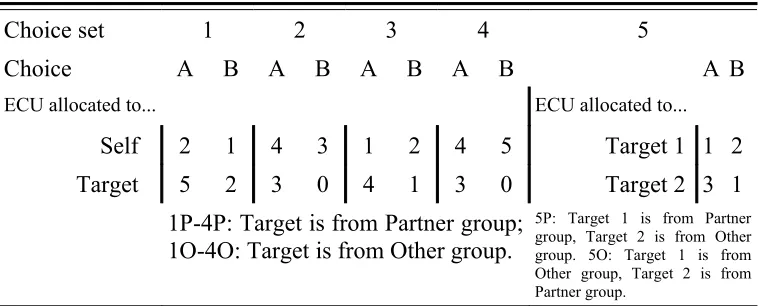
Choice set 1 2 3 4 5
Choice A B A B A B A B A B
ECU allocated to... ECU allocated to...
Self 2 1 4 3 1 2 4 5 Target 1 1 2
Target 5 2 3 0 4 1 3 0 Target 2 3 1
1P-4P: Target is from Partner group; 1O-4O: Target is from Other group.
[image:17.595.109.488.336.489.2]5P: Target 1 is from Partner group, Target 2 is from Other group. 5O: Target 1 is from Other group, Target 2 is from Partner group.
TABLE 2: ALLOCATIONS IN EXPERIMENT 1
Lastly, each subject made a set of ten binary choices, allocating money
between him- or herself and one or more other subjects (the “target(s)”),
always identified by their player number and group. The choices are shown in
Table 2. Subjects chose between allocation A and allocation B. There are five
pairs of similar choices; we refer to each pair as a “choice set”. In each choice
set, subjects faced tradeoffs between maximizing their own income, helping
the target, and increasing or decreasing inequality. Choice sets 1-4 allocate
money to the subject him- or herself and to one other target. Choice B always
gives less to the target. Choice sets 1 and 2 involve “punishment choices”: the
subject can either maximize his own and the other's income, or pay to reduce
the other's income. They also have distributional consequences: the
income-maximizing choice in set 1 is unequal in the other's favour, compared to the
alternative. In set 2, the income-maximizing choice is less unequal than the
alternative. Choice sets 3 and 4 are “dictator” choices: the subject can either
maximize his own income, or reduce his income but give more to the other. In
set 3 the selfish allocation also reduces other-favouring inequality; in set 4 it
increases self-favouring inequality. Each of choice sets 1-4 is made once
where the target is a member of the Partner group (1P-4P) and once when the
target is a member of the Other group (1O-4O). Two allocations, 5P and 5O,
were between a Partner group member and an Other group member, with the
subject herself not being involved. The choice here was which of the two
groups to favour; A is the efficient choice. By comparing subjects' decisions
within each pair of choices in a choice set, we can observe the effect of the
target's group membership.
Subjects never made allocations involving their previous PD partner – only
involving other members of the same group. They could easily observe this,
the PD, was shown onscreen (in a “history box”) throughout the 10
allocations. The order of the allocations was randomized. At the end of the
experiment a single allocation was randomly selected, and the relevant payoffs
were implemented.
After the experiment, subjects were given a questionnaire including
demographics, measures of group identity, and debriefing questions. The
winning group of the Pelmanism game was then revealed. Finally, subjects
were called up and paid privately for their winnings from the Pelmanism
game, the Prisoner's Dilemma, and the randomly selected allocations (their
own and others'). Each subject also received a 2.50 Euro showup fee.
Two points about this design deserve attention. First, allocation into groups
and of PD partners within groups was random, and prior to the PD, subjects
had no interaction with groups other than their own. Hence, in what follows,
we can treat subjects' PD partners' cooperation or defection as an exogenous
variable. Second, subjects knew that the allocations were the last part of the
experiment. Therefore, in making allocation decisions, they had no strategic
reasons to play a particular way (e.g. reputation-building). These comments
also apply to Experiment 2. Descriptive statistics for our subjects are shown in
Table 3.
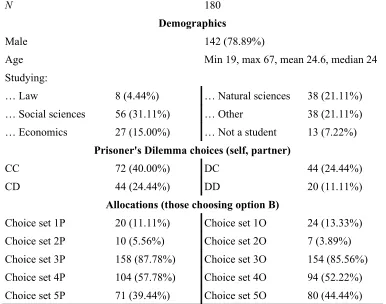
N 180 Demographics
Male 142 (78.89%)
Age Min 19, max 67, mean 24.6, median 24
Studying:
… Law 8 (4.44%) … Natural sciences 38 (21.11%)
… Social sciences 56 (31.11%) … Other 38 (21.11%)
… Economics 27 (15.00%) … Not a student 13 (7.22%)
Prisoner's Dilemma choices (self, partner)
CC 72 (40.00%) DC 44 (24.44%)
CD 44 (24.44%) DD 20 (11.11%)
Allocations (those choosing option B)
Choice set 1P 20 (11.11%) Choice set 1O 24 (13.33%)
Choice set 2P 10 (5.56%) Choice set 2O 7 (3.89%)
Choice set 3P 158 (87.78%) Choice set 3O 154 (85.56%)
Choice set 4P 104 (57.78%) Choice set 4O 94 (52.22%)
[image:20.595.106.492.116.420.2]Choice set 5P 71 (39.44%) Choice set 5O 80 (44.44%)
TABLE 3: DESCRIPTIVE STATISTICS, EXPERIMENT 1
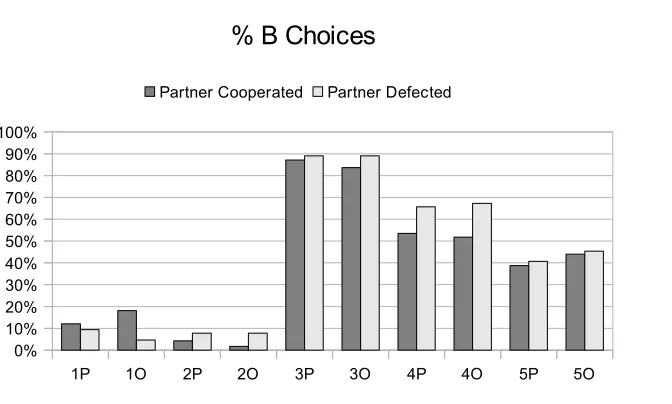
Figure 1 shows the percentage of B choices made in each of the 10 allocations,
split by whether the PD partner cooperated or defected. In choice sets 1-4, B is
the decision that gives least to the target. In general, PD partner defection
increases the proportion of B choices. In choice set 1, partner defection
decreases unkind choices (which also reduce the subject's own payoff), but
more so towards the Other group than towards the Partner group. Patterns for
Table 4 tabulates the pairs of choices made by our subjects in each choice set,
split up by whether the PD partner cooperated or defected. In order to
investigate whether PD partner's defection affected discriminatory behaviour,
we examine only those subjects who discriminated either for or against the
Partner group. If PD partner behaviour does not affect the level of
discrimination, i.e. if ζ=η=0 in equation (1), then there should be no
association between partner behaviour and the proportion, among those who
discriminate in either direction, of those who discriminate against the Partner
group. The final row of Table 4 shows the results of the corresponding Fisher
[image:21.595.148.484.114.316.2]19 FIGURE 1: ALLOCATION DECISIONS BY PD PARTNER BEHAVIOUR, EXPERIMENT
1
1P 1O 2P 2O 3P 3O 4P 4O 5P 5O
0% 10% 20% 30% 40% 50% 60% 70% 80% 90% 100%
% B Choices
test.8 Only the first choice set shows a significant effect: PD partner defection
was associated with more discrimination against the Other group. Apparently,
subjects who had been defected against were more willing to harm the target
when the target was from the Partner group.
Choice set 1 2 3 4 5
PD Partner C D C D C D C D C D
Choice P/Choice O
A/A 94 56 111 56 9 5 47 19 53 28
A/B 8 2 0 3 6 2 7 3 18 10
B/A 1 5 3 3 10 2 9 11 12 7
B/B 13 1 2 2 91 55 53 31 33 19
Fisher test, A/B or B/A vs Partner C or D
0.0350* 0.464 1 0.260 1
C = PD partner cooperated. D = PD partner defected. + p < 0.10; * p < 0.05; ** p < 0.01; *** p < 0.001.
TABLE 4: PARTNER AND OTHER GROUP ALLOCATIONS BY PD PARTNER BEHAVIOUR, EXPERIMENT 1
To separate out the effect of partner defection on defectors and cooperators,
we run logit regressions. Thus, in equation (1), we take
f(x)=G
Aif x>0; G
Botherwise
in each of the five choice sets, where GJ is the amount given to the target by
choice J in {A,B}, and we assume that εi,g has a logistic distribution. Fixed
8 We use a Fisher test rather than a chi-squared test because the Fisher test is exact when
effects logits failed to converge in 2 out of 5 regressions, probably because
this approach ignores subjects who made the same choice against both Partner
and Other group members, leaving insufficient cases for estimation. As a
second best, we estimate random effects logits. Table 5 reports selected
coefficients. For each choice set, the first column comes from a regression
without controls (i.e. with X and Z empty). Controls are not necessary, since
the main variable Partner D is guaranteed to be exogenous by the
experimental design, but appropriate controls will increase the accuracy of our
estimates in the nonlinear logit model. The second column adds a vector of
controls to both X and Z: dummies for gender, for subjects studying
economics, and for group colour. The third column adds the controls and also
a vector of session dummies.9 The coefficients of interest are quite stable
across these specifications. Partner D significantly predicts less generosity to
the partner group in choice set 1 only, although this variable approaches weak
significance in choice set 4. The Partner D × Self D interaction is significant
in choice set 5, but this is not easy to interpret, since the coefficient on Partner
D is small and insignificant. Thus, group reciprocity was only evident in one
out of the five choice sets.
9 Regressions for choice set 2 failed to converge and are omitted. It is clear from Table 4
that partner defection would not be significant in choice set 2, under any specification.
(1) (2) (3) (4) (5) (6) (7) (8) (9) (10) (11) (12)
Choice set 1 1 1 3 3 3 4 4 4 5 5 5
Pgrp 2.47 -0.67 -2.12 -0.97 -0.98 -0.93 -0.29 -0.78 -0.77 -0.4 -0.49 -0.5
(1.64) (9.2) (11.48) (0.8) (2.55) (2.53) (0.53) (1.12) (1.21) (0.41) (0.84) (0.85) Pgrp × ...
Partner D -9.37 -8.02 -7.81 0.67 1.99 1.89 -1.35 -1.4 -1.63 -0.77 -0.92 -0.96
(4.2)* (4.05)* (3.88)* (1.68) (3.04) (3) (0.88) (0.93) (1.04) (0.68) (0.72) (0.73)
Self D 6.87 8.12 8.67 0.19 1.78 1.54 0.29 0.41 0.41 0.07 0.11 0.13
(7.73) (9.38) (10.17) (1.41) (2.55) (2.51) (0.84) (0.9) (0.97) (0.67) (0.68) (0.7)
Partner D × Self D 0.02 -2.31 -1.87 0.06 1.08 1.32 0.85 0.76 0.92 2.59 2.79 2.86
(8.86) (10.65) (10.28) (2.74) (5.33) (5.32) (1.47) (1.54) (1.66) (1.2)* (1.26)* (1.27)*
Log Likelihood -75.99
(9 df) -73.32 (19 df) -72.99 (24 df) -106.37 (9 df) -96.7 (19 df) -96.31 (24 df) -208.46 (9 df) -204.23 (19 df) -196.94 (24 df) -225.67 (9 df) -217.99 (19 df) -210.94 (24 df)
Controls No Yes Yes No Yes Yes No Yes Yes No Yes Yes
Session dummies No No Yes No No Yes No No Yes No No Yes
Experiment 2
Experiment 1 produced evidence for group reciprocity in 1 out of 2
punishment choices, with little evidence for group reciprocity in the dictator
choices (sets 3 and 4). To confirm these results, we ran a second experiment.
In this design, subjects made continuous rather than binary choices at the final
stage. By allowing subjects finer-grained control over their allocations, we
hoped to get more accurate estimates of the distribution of group reciprocal
preferences in the population. We also changed our group identity
manipulation to increase levels of group identification. The new manipulation
was a quiz on collective animal names, allowing for computer-based chat
among participants of the same group.10
Experiment 2 was run at the University of Warwick experimental laboratory,
again using zTree. 172 subjects, recruited from the subject pool via ORSEE,
participated in 10 sessions. Subjects were paid in ECU, this time with 100
ECU = £1. At the start of the experiment, subjects were informed that the
experiment had 4 stages, and that instructions for each stage would be
revealed prior to the stage itself. In stage 1, subjects were randomly paired to
play an initial PD, the results of which were not revealed until the end of the
10 Pretests showed that this manipulation was successful in increasing subjects' levels of
group identification.
experiment. The aim of this pre-group PD was to observe subjects' propensity
to cooperate, before any group assignment took place.
In stage 2, subjects were separated into 6 groups, red, green, blue, purple,
orange and cyan.11 For the remainder of the experiment, all subjects were
identified to others by their group name, combined with an individual,
within-group number. (In this experiment, subjects were not informed of their own
number.) After being assigned to their group, subjects took a collective quiz
on animal group names. Subjects could communicate with other group
members via computer chat.12 The members of the group with the highest
average number of correct answers won 1000 ECU each. Other groups
received 100 ECU each. Announcement of the winning group took place after
a final questionnaire was answered.
After the quiz, in stage 3, subjects were paired with subjects from other
groups, identified by group name and player number, and played a one-shot
11 Most sessions consisted of 18 subjects in 6 groups of 3. However, due to no-shows, some
sessions had fewer subjects and one session had only 5 groups. Subjects were not
explicitly informed of the groups' sizes.
12 We required subjects not to reveal personal information during the chat. All subjects
obeyed this instruction. Chat messages were almost exclusively focused on the quiz
PD, just as in Experiment 1. Afterwards, as before, subjects were shown their
partner's choices and the resulting payoffs.
Finally, in stage 4, subjects made 6 allocation decisions allocating money
between themselves and another participant (the “target”). 3 of these decisions
were dictator games, with a “taking” frame: the target was endowed with 1000
ECU, and subjects could take up to 1000 ECU from the target for themselves.
This dictator game was played once against a member of the PD partner's
group (but not the PD partner himself: subjects knew this because a history of
play, including player numbers, was visible on screen), once against a member
of a third group subjects had not previously any interacted with, and once
against a member of the subject's own group. Again, we refer to these groups
as the Partner, Other and Own groups. We do not analyse choices against the
Own group further in this paper.13 The remaining 3 decisions were costly
punishment games in which subjects chose the number of ECU to deduct from
the other subject's payoff. Subjects chose x between 0 and 300; they received
400-x and the target received 900-3x. Again this game was played once
against members of the Partner, Other, and Own groups. The order of
allocation tasks was randomized.
After the experiment, subjects answered a questionnaire. Then the winning
group of the quiz, the result of the stage 1 PD, and the stage(s) chosen for
13 We intend to examine these decisions in separate work on in-group favoritism.
payment were revealed. Finally, subjects were called up and paid privately,
receiving in addition a GBP 5 showup fee. For 5 of the 10 sessions one of the
four different stages was selected for payment; in the other 5 sessions, either
stages 1 and 2, or stages 3 and 4 were paid. Under the first payment method
(selection of one stage only), if the stage 3 PD is paid, then the subject's stage
4 allocations are not paid. This allows us to examine whether others' intentions
alone suffice to induce group reciprocity, or whether those intentions must
also have material results. We found few consistent differences between
behaviour under the two payment methods, so we pool them in the subsequent
analysis.14 Table 6 shows descriptive statistics for Experiment 2.
N 172
Demographics
Male 78 (45.35%)
Age Min 17, max 42, mean 20.8, median 20
Studying:
… Law 9 (5.23%) … Natural sciences 29 (16.86%)
… Social sciences 23 (13.37%) … Other 79 (45.93%)
… Economics 32 (18.60%) … Not a student 0 (0.00%)
Prisoner's Dilemma choices (self, partner)
CC 80 (46.51%) DC 36 (20.93%)
CD 36 (20.93%) DD 20 (11.63%)
Allocations (ECU allocated to target, min / median / mean / max)
Dictator, vs Partner 0 / 10 / 241 / 1000 Dictator, vs Other 0 / 6 / 235 / 1000
Punishment,vs Partner 0 / 900 / 762 / 900 Punishment, vs Other 0 / 900 / 763 / 900
TABLE 6: DESCRIPTIVE STATISTICS, EXPERIMENT 2
Figure 2 shows empirical Cumulative Distribution Functions of the amounts
given to the other subject, in the “dictator” or “taking” choice, and in the
“punishment” choice, split up by PD partner behaviour. The first row shows
amounts given by all subjects. The second row shows amounts given by
subjects who themselves cooperated in the PD. Three facts stand out. First,
most subjects gave either 500 or nothing in the taking choice, quite typically
for dictator games (Engel 2010; see Bardsley 2008 for a dictator game with a
taking frame), and most subjects did not punish (i.e. gave 900) in the
punishment choice. Second, subjects became more selfish in the dictator
choices if their PD partners defected. Third, in punishment choices,
cooperators appear to have punished the Partner group more, but the Other
group less, if their PD partners defected.
The data is highly non-normal. In the punishment decisions, more than half of
our subjects chose to give the maximum amount of 900 ECU. We therefore
analyse the data using a Tobit model: f(x) = min{x, 900} in equation (1). We
use the semi-parametric estimator defined by Honore (1992), which removes
the subject-specific fixed effects by a process analogous to first-differencing,
and which does not rely on assumptions about the functional form of the errors
εi,g. The dictator decisions are more complex: many subjects gave 0 ECU, and
many gave 500 ECU, with some donations between 0 and 500 and a few
above 500. We analysed these using a fixed effects Tobit with f(x)=max{x,0}
in (1)15.
15 We also tried a fixed effects ordered logit estimator using the approach of Baetschmann et
al. (2011), categorizing the amount given as 0, 1-499, 500, or above 500. The results are
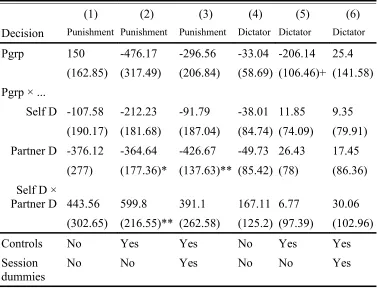
(1) (2) (3) (4) (5) (6) Decision Punishment Punishment Punishment Dictator Dictator Dictator
Pgrp 150 -476.17 -296.56 -33.04 -206.14 25.4 (162.85) (317.49) (206.84) (58.69) (106.46)+ (141.58) Pgrp × ...
Self D -107.58 -212.23 -91.79 -38.01 11.85 9.35 (190.17) (181.68) (187.04) (84.74) (74.09) (79.91) Partner D -376.12 -364.64 -426.67 -49.73 26.43 17.45
(277) (177.36)* (137.63)** (85.42) (78) (86.36) Self D ×
Partner D 443.56 599.8 391.1 167.11 6.77 30.06 (302.65) (216.55)** (262.58) (125.2) (97.39) (102.96)
Controls No Yes Yes No Yes Yes
Session dummies
No No Yes No No Yes
[image:32.595.111.488.180.469.2]Controls: Z=(gender, group colour, economics student, session % male, Partner group decision taken before Other group decision). Session % male omitted when session dummies included. Standard errors in parentheses. + p < 0.10; * p < 0.05; ** p < 0.01; *** p < 0.001.
TABLE 7: FE TOBIT REGRESSIONS, EXPERIMENT 2
Table 7 shows the results. Columns 1-3 are regressions on the amount given in
the punishment decisions. The first column is a simple regression on Self D,
Partner D and their interaction, without controls. The second column adds a
vector of controls to Z in equation (1). As before, appropriate controls should
increase the efficiency of our estimates. (The Honore estimator does not
group, so we cannot include controls in X in (1).) Controls include dummies
for gender, for subjects who studied economics, and for subjects' colour group;
in addition we include a measure of the proportion of male subjects in the
whole session, since this varied quite widely and we considered that it might
affect levels of group reciprocity, and a dummy for the order of the Partner
group and Other group decisions. Column 3 adds session fixed effects. The
coefficient on PD partner defection is consistently large and negative, and is
more precisely estimated when controls are included. The coefficient on the
interaction of partner defection and own defection is large and positive; the
sum of these two coefficients (i.e. ζ+η in equation (1)) is never significantly
different from 0. Columns 4-6 are regressions on the amount given in dictator
decisions. The coefficients on both Partner D and Self D × Partner D are
small and not statistically significant. Thus, subjects who cooperated in the PD
responded to PD partner defection by giving less to members of the Partner
group, but only in punishment decisions, where harming the other participant
was costly to the subject.
These results conformed to the basic pattern of Experiment 1: group
reciprocity was observed in punishment decisions but not in dictator decisions.
In addition, group reciprocity was observed only among those who themselves
cooperated in the PD. This finding could be interpreted in two ways. Subjects
may react strongly to betrayal in the PD, but not to mutual defection.
Alternatively, subjects who are in general more cooperative may react more to
others' defection, whether or not they themselves cooperated in a particular
instance (but these subjects are also more likely to cooperate in the PD). To
distinguish between these two explanations, Experiment 2 included an initial,
anonymous Prisoner's Dilemma without feedback, before subjects were placed
into groups. We use subjects' behaviour in this first PD to categorize them as
cooperative or non-cooperative “types”. Decisions in the first and second PD
were correlated: about 50% of cooperators in the first PD defected in the
second PD, while about 75% of defectors in the first PD defected again in the
(1) (2) (3)
Decision Punishment Punishment Punishment
Pgrp 161 -521.99 -441.22
(186.83) (271.53) + (371.62) Pgrp × ...
Self D -78 -44.88 -32.31 (236.31) (183.21) (241.76) Partner D -248 -291.5 -195.76
(257.7) (208.29) (188.54) Self D × Partner D 303.85 408.83 162.7
(308.61) (255.08) (318.56)
Self D1 -86 132.05 78.63
(194.64) (219.16) (194.49) Self D1 × Self D -33.76 -237.23 -242.24
(258.73) (303.34) (437.06) Self D1 × Partner D -427.01 -275.75 -444.21
(321.15) (364.69) (366.1) Self D1 × Self D × Partner D 437.41 324.72 747.73
(384.82) (472.07) (592.28) Summed coefficients:
Self D + (Self D1 × Self D) -111.75 -355.36 -284.26 (105.34) (207.64) + (229.61) Partner D + (Self D1 × Partner D) -675 -603.62 -641.13
(191.65) *** (272.32) * (271.71) * Self D × Partner D + (Self D1 × Self D ×
Partner D) 741.25 804.35 902.42 (229.88) ** (344.13) * (352.8) *
Controls No Yes Yes
Session dummies No No Yes
Controls: Z=(gender, group colour, economics student, session % male, Partner group decision taken before Other group decision). Session % male omitted when session dummies included. Standard errors in parentheses. + p < 0.10; * p < 0.05; ** p < 0.01; ***
p < 0.001.
TABLE 8: FE TOBIT REGRESSIONS, INTERACTIONS WITH INITIAL PD
Table 8 adds Self D1,a dummy taking the value 1 if subjects defected in the
initial anonymous PD, to the first 3 regressions of Table 7, and interacts it with
Partner D and Self D. If the size of the Partner D × Self D interaction in Table
7 is genuinely caused by betrayal in the main PD, then the Self D1 coefficient
should not be significant. On the other hand, if the interaction arises because
people with cooperative personalities react more strongly to partner defection,
then the interactions with Self D should lose significance, and interactions with
Self D1 should be significant instead. In fact, Self D1 and its interactions are
never significant, and, as the “summed coefficient” rows show, the effect of
partner defection is consistently larger for subjects who defected in stage 1.
Thus, behaviour in the initial PD does not help to explain why “betrayal”
causes more group reciprocal behaviour than mutual defection. We conclude
that only betrayal induces group reciprocity, and that it does so among both
more and less cooperative subjects.
Social identity theorists argue that intergroup discrimination is caused by the
level of people's identification with their own group – the extent to which they
perceive themselves as part of the group and take on its interests as their own
(Tajfel et al. 1971; Tajfel 1982). We were interested in whether group
identification could help explain group-reciprocal behaviour. In both
experiments, the final questionnaire included questions measuring group
Group ID by summing answers to these questions.16 Table 9 reproduces the
first 3 columns of Table 7, interacting the other independent variables with
Group ID. We expected that subjects who showed higher identification with
their group would be more likely to group-reciprocate. In fact, while Group
ID itself predicts less giving to the partner group, its interaction terms are not
significant. Indeed, the effect of partner defection is stronger among those
with lower Group ID. Thus, group identification does not seem to be a useful
predictor of group reciprocal behaviour.
16 Results using an alternative Group ID variable, derived from the questionnaire scores by
factor analysis, were very similar to those shown here.
(1) (2) (3)
Decision Punishment Punishment Punishment
Pgrp -68.41 -804.2 -192.26
(102.13) (425.85) + (439.18)
Pgrp × ...
Self D 148.64 171.15 120.69
(173.06) (178.72) (250.75)
Partner D -331.28 -238.14 -257
(248.02) (329.72) (240.09)
Self D × Partner D 361.42 288.59 217.99
(293.75) (344.95) (369.31)
Group ID -50.74 -45.52 -38.91
(17.61) ** (19.36) * (28.34)
Group ID × Self D 30.03 26.56 23.83
(23.97) (21.83) (34.51)
Group ID × Partner D 5.27 21.47 12.71
(41.33) (49.08) (28.01)
Group ID × Self D × Partner D 14.84 -1.58 1.92
(44.85) (49.61) (39.63)
Effect of Partner D at...
first quartile Group ID -362.87 -426.54 -297.19
(155.12) * (161.31) ** (205.57)
third quartile Group ID -304.95 -178.86 -125.08
(432.06) (574.97) (327.21)
Controls No Yes Yes
Session dummies No No Yes
Controls: Z=(gender, group colour, economics student, session % male, Partner group decision taken before Other group decision). Session % male omitted when session dummies included. Group ID was centered at its median. Standard errors in parentheses. +
p < 0.10; * p < 0.05; ** p < 0.01; *** p < 0.001.
Experiments involving lab-created groups can run the risk of demand effects,
in which subjects follow norms implicitly suggested by the experimental
design. We took steps to minimize this risk. For example, we randomized the
order of allocation decisions, so as to avoid obvious pairings of similar choices
made vis-à-vis Partner and Other group members. We also asked subjects
about the experiment's purpose in the final questionnaire. Many subjects
answered that the experiment was about teamwork; only a few (7 in
Experiment 1; 3 in Experiment 2) mentioned e.g. “revenge” or related
concepts. Rerunning our analyses without these subjects does not affect our
results.
Interpretation
The results above, coming from a new experimental design, need to be
interpreted with care. Nevertheless, we here draw some initial conclusions.
Firstly and most importantly: taken together, our experiments provide
evidence for group reciprocity. Some subjects responded to their PD partner's
defection by reducing their allocations specifically to other members of the
partner's group, even at a cost to themselves. Group reciprocity was observed
in the absence of strategic incentives, supporting a preferences-based
explanation.
Second, group reciprocity did not affect all decisions equally. We saw
significant evidence for it only in choices where the Pareto-dominant
allocation would give subjects less than the other participant, but subjects
could pay to lower the discrepancy. This is surprising, since we did not
observe group reciprocation in the dictator games, where subjects could have
punished costlessly (indeed at a profit). One possibility is that group
punishment does not obey the law of demand (cf. Anderson and Putterman
2006).
Lastly, not all subjects group-reciprocated. Indeed, the majority of subjects did
not discriminate between groups. More cooperative subjects, as measured by
an initial anonymous PD, were not more likely to group-reciprocate than less
cooperative ones, conditional on their choice to cooperate in the main PD.
Also, group reciprocal behaviour was not predicted by psychological measures
of group identification, which suggests that a different psychological
mechanism is at work than that posited by Social Identity Theory. Other
psychological theories not tested here, such as social dominance theory
(Sidanius and Pratto 1999), might have more explanatory power.
Conclusion
In recent years, evidence from laboratory and field experiments has challenged
such as fairness and reciprocity. One so far under-emphasized factor, we
believe, is that humans, who often act in groups, often also treat other groups
as actors. They may therefore assign blame and praise to groups as well as
individuals – with important consequences for human society and politics. At
times in history, entire groups have been blamed and scapegoated for their
members' real or imagined behaviour. Laboratory experiments could help in
understanding the processes behind this phenomenon. In our experiments,
subjects responded to one group member's behaviour by treating other
members of that group differently.
Discriminatory behaviour may be driven by beliefs rather than by preferences.
For example, ethnic discrimination in hiring may come from statistical or
screening discrimination (Arrow 1972) rather than from a “taste for
discrimination” (Becker 1957). In our experiments, strategic incentives were
ruled out: group reciprocity appears to be a matter of pure preference.
However, we caution against too narrow an interpretation of this. Group
reciprocity may be due to the activation of context-specific norms, rather than
to “preferences” thought of as unchanging characteristics of individuals.
The majority of our subjects did not exhibit group reciprocity, and it was not
visible in all decisions. To investigate the causes and correlates of group
reciprocity, our experimental paradigm needs further refinement.
Complementary experiments could be done using homegrown identities such
as ethnicity. Lastly, we have still to investigate third-party group reciprocity,
in which people retaliate against a group for harm done not to themselves, but
to a fellow group member of theirs.
Demonstrating group reciprocity in a reproducible laboratory experiment
could open the door to deeper exploration of how it works. We draw an
analogy with the minimal group paradigm in psychology. After Sherif's initial
research in the 1950s on in-group prejudice, the famous Robber's Cave
experiment (Sherif 1961), researchers developed a canonical experimental
paradigm to analyse in-group prejudice (Tajfel et al. 1971). By making the
behaviour of interest reproducible, the minimal group paradigm catalysed a
productive tradition of research on prejudice. We hope that our experiment
will similarly encourage further study of this phenomenon under controlled
conditions. This could be a valuable complement to field study of the often
Bibliography
Abbink, Klaus and Benedikt Herrmann (2009), “Pointless Vendettas”, Manuscript.
Akerlof, George (1976), “The Economics of Caste and of the Rat Race and Other Woeful Tales.” The Quarterly Journal of Economics 90 (4): 599-617.
Anderson, C. M, and L. Putterman. 2006. “Do non-strategic sanctions obey the law of demand? The demand for punishment in the voluntary contribution mechanism.” Games and Economic Behavior 54 (1): 1-24.
Arrow, Kenneth J. (1972), “Some mathematical models of race discrimination in the labor market”, in: Pascal, Anthony H. (ed.), Racial discrimination in economic life, Lexington: Lexington Books: 187-203.
Bardsley, Nicholas (2008), “Dictator Game Giving: Altruism or Artefact?”, Experimental Economics 11(2): 122-133.
Bauerlein, Mark (2001), Negrophobia: A race riot in Atlanta, 1906, Encounter Books.
Becker, Gary S. (1957), The economics of discrimination, University of Chicago Press.
Baetschmann, Gregori, Kevin E Staub, and Rainer Winkelmann (2011) “Consistent Estimation of the Fixed Effects Ordered Logit Model.” IZA discussion paper.
Bernhard, H., Urs Fischbacher, and Ernst Fehr (2006), “Parochial altruism in humans.” Nature 442 (7105): 912-5.Bornstein, Gary (1992), “The Free Rider Problem in Intergroup Conflicts over Step-Level and Continuous Public Goods”, Journal of Personality and Social Psychology 62: 597-606.
Blattman, Christopher., and Edward Miguel (2010), “Civil War.” Journal of Economic Literature 48 (1): 3-57.
Bolton, Gary E., and Axel Ockenfels (2000) “ERC: A Theory of Equity, Reciprocity, and Competition.” The American Economic Review 90 (1): 166-193.
Bornstein, Gary (1992), “The free-rider problem in intergroup conflicts over step-level and continuous public goods.” Journal of Personality and Social Psychology 62 (4): 597.
Bornstein, Gary (2003), “Intergroup Conflict: Individual, Group, and Collective Interests”, Personality and Social Psychology Review 7(2): 129-145.
Bouckaert, Jan, and Geert Dhaene (2004), “Inter-ethnic trust and reciprocity: results of an experiment with small businessmen.” European Journal of Political Economy 20 (4): 869-886.
Brewer, Marilynn B. (1979), “Ingroup Bias in the Minimal Intergroup Situation: A Cognitive-Motivational Analysis”, Psychological Bulletin 86, 307-324.
Brewer, Marilynn B. (1999), “The Psychology of Prejudice: Ingroup Love or Outgroup Hate?” Journal of Social Issues 55(3): 429-444.
Chen, Yan and Sherry Xin Li (2009), “Group Identity and Social Preferences”, American Economic Review 99(1): 431-457.
Collier, Paul, and Anke Hoeffler (2004), “Greed and grievance in civil war.” Oxford Economic Papers 56 (4) (October 1): 563 -595.
Daily Telegraph (2010). “Germany divided again as Europe grapples with
http://www.telegraph.co.uk/news/worldnews/europe/eu/8656892/Germany-divided-again-as-Europe-grapples-with-euro-bailout-plan.html. Downloaded 1 August 2011.
De Cremer, David and Mark van Vugt (1999), “Social Identification Effects in Social Dilemmas: A Transformation of Motives”, European Journal of Social Psychology 29: 871-893.
Dufwenberg, Martin, Uri Gneezy, Werner Güth, and Eric Van Damme (2001), “Direct vs indirect reciprocity: an experiment.” Homo Oeconomicus 18: 19-30.
Ellemers, Naomi, Russel Spears, and Bertjan Doosje (1997), “Sticking together of falling apart: In-group identification as a psychological determinant of group commitment versus individual mobility”, Journal of Personality and Social Psychology 72 (3): 617.
Ellemers, Naomi, Pauleen Kortekaas, and Jaap W. Ouwerkerk, (1999), “Self-categorisation, commitment to the group and group self-esteem as related but distinct aspects of social identity”, European Journal of Sococial Psychology 29: 371-389.
Engel, Christoph (2010), “Dictator games: A meta study”, Preprints of the Max Planck Institute for Research on Collective Goods Bonn 7: 2010.
Fearon, James D., and David D. Laitin (2003), “Ethnicity, Insurgency, and Civil War.” The American Political Science Review 97 (1) (February 1): 75-90.Fehr, Ernst and Urs Fischbacher (2004), “Third-Party Punishment and Social Norms”, Evolution and Human Behavior 25: 63-87.
Fehr, Ernst, and Simon Gächter (2000), “Fairness and Retaliation: The Economics of Reciprocity.” Journal of Economic Perspectives 14: 159-181.
Fershtman, Chaim, and Uri Gneezy (2001), “Discrimination in a segmented society: an experimental approach.” Quarterly Journal of Economics 115: 351- 377.
Fischbacher, Urs (2007), “z-Tree: Zurich toolbox for ready-made economic experiments”, Experimental Economics 10(2): 171-178.
Gaertner, Lowell, Jonathan Iuzzini, and Erin M. O’Mara (2008), “When rejection by one fosters aggression against many: Multiple-victim aggression as a consequence of social rejection and perceived groupness.” Journal of Experimental Social Psychology 44 (4) (July): 958-970.
Gaertner, Lowell and John Schopler (1998), “Perceived Ingroup Entitativity and Intergroup Bias: An Interconnection of Self and Others”, European Journal of Social Psychology 28: 963-980.
Goette, Lorenz, David Huffman, and Stephan Meier (2006), “The impact of group membership on cooperation and norm enforcement: Evidence using random assignment to real social groups”, American Economic Review 96 (2): 212-216.
Greiner, Ben (2004), “The online recruitment system ORSEE 2.0 – a guide for the organization of experiments in economics”, University of Cologne, Working Paper Series in Economics 10: 2004.
Guala, Francesco, Luigi Mittone and Matteo Ploner (2009), “Group Membership, Team Preferences, and Expectations”, University of Trento, CEEL Working Papers 0906.
Halevy, Nir, Gary Bornstein and Lilach Sagiv (2008), “`In-Group Love´ and `Out-Group Hate´ as Motives for Individual Participation in Intergroup Conflict”, Psychological Science 19(4): 405-411.
Hargreaves Heap, Shaun and Daniel J. Zizzo (2009), “The Value of Groups”, American Economic Review 99(1): 295-323
Honoré, Bo E. (1992), “Trimmed LAD and least squares estimation of truncated and censored regression models with fixed effects.” Econometrica: Journal of the Econometric Society: 533-565.
Horowitz, Donald L. (1985), Ethnic Groups in Conflict, Berkeley: University of California Press.
Horowitz, Donald L. (2001), The Deadly Ethnic Riot, University of California Press.
Kocher, Matthew A., Thomas B. Pepinsky, and Stathis N. Kalyvas (2008), “Into the Arms of the Rebels? Aerial Bombardment, Indiscriminate Violence, and Territorial Control in the Vietnam War”, Paper prepared for the ISA’s 49th annual convention, San Francisco.
Krueger, A. B, and J. MaLeckova (2003) “Education, Poverty and Terrorism: Is There a Causal Connection?” The Journal of Economic Perspectives 17 (4): 119-144.
Koester, Philipp (2008), “Fanfreundschaften: Die Liebe kommt, die Liebe geht”, http://www.spiegel.de/sport/fussball/0,1518,575641,00.html
Lickel, Brian, Norman Miller, Douglas M. Stenstrom, Thimas F. Denson, and Toni Schmader (2006), “Vicarious retribution: The role of collective blame in intergroup aggression”, Personality and Social Psychology Review 10, no. 4: 372.
Mamdani, Mahmood (2001), When victims become killers: colonialism, nativism, and the genocide in Rwanda, Princeton University Press Princeton.
Moreno, Alexandro T. (2008), “Group Fairness and Game Theory”, Universidad de Guanajuato, School of Economics Working Papers.
Mummendey, Amélie, and Sabine Otten (1998), “Positive–negative asymmetry in social discrimination”, European review of social psychology 9(1): 107-143.
Mummendey, Amélie, Bernd Simon, Carsten Dietze, Melanie Grünert, Gabi Haeger, Sabine Kessler, Stepahn Lettgen, and Stefanie Schäferhoff (1992), “Categorization is not enough: Intergroup discrimination in negative outcome allocation”, Journal of Experimental Social Psychology 28(2): 125-144.
Nowak, Martin A, and Sébastien Roch (2007), “Upstream reciprocity and the evolution of gratitude.” Proceedings of the Royal Society B: Biological Sciences 274 (1610).
Rabin, Matthew (1993), “Incorporating fairness into game theory and economics.” The American Economic Review 83 (5): 1281-1302.
Reuters (2011), “Bailout fatigue forces Germany to hear the skeptics.”
http://www.reuters.com/article/2011/07/13/us-germany-eurosceptics-idUSTRE76C1FS20110713. Downloaded 1 August 2011.
Shayo, Moses and Asaf Zussman (2011), “Judicial Ingroup Bias in the Shadow of Terrorism”, The Quarterly Journal of Economics (forthcoming).
cooperation, Wesleyan University Press Scranton, Pa.: Distributed by Harper & Row, Middletown, Conn.
Sidanius, Jim, and Felicia Pratto (1999), Social dominance: An intergroup theory of social hierarchy and oppression. Cambridge University Press.
Stenstrom, Douglas M., Brian Lickel, Thomas F. Denson and Norman Miller (2008), “The Roles of Ingroup Identification and Outgroup Entitativity in Intergroup Retribution”, Personality and Social Psychology Bulletin 34(11):1570-1582.
Sumner, William G. (1906), Folkways: A study of the sociological importance of usages, manners, customs, mores, and morals. Ginn.
Tajfel, Henri (1982), “Social psychology of intergroup relations”, Annual review of psychology 33 (1): 1-39.
Tajfel, Henri, M. G Billig, R. P Bundy, and Claude Flament (1971), “Social categorization and intergroup behavior”, European Journal of Social Psychology 1 (2): 149-178.
Yamagishi, Toshio and Toko Kiyonari (2000), “The Group as the Container of Generalized Reciprocity”, Social Psychology Quarterly 63(2): 116-132.
Yamagishi, Toshio and Nobuhiro Mifune (2008), “Does Shared Group Membership Promote Altruism?”, Rationality and Society 20(1): 5-30.
Yamagishi, Toshio and Nobuhiro Mifune (2009),”Social Exchange and Solidarity: In-Group Love or Out-Group Hate?”, Evolution and Human Behavior 30: 229-237.