University of Warwick institutional repository: http://go.warwick.ac.uk/wrap
A Thesis Submitted for the Degree of PhD at the University of Warwick
http://go.warwick.ac.uk/wrap/39305
This thesis is made available online and is protected by original copyright. Please scroll down to view the document itself.
W~IC]<
DECENTRALISATION AND LAND ADMINISTRATION IN
THE UPPER WEST REGION OF GHANA: A SPATIAL
EXPLORA TION OF LAW IN DEVELOPMENT
BENJAMIN BEWA-NYOG KUNBUOR
Thesis Submitted to the University of Warwick for fulfilment of the
Degree of Doctor of Philosophy in Law
School of Law University of Warwick
f
{
r
)
/
MAP OF THE ADMINISTRATIVE DISTRICTS OF THE
UPPER WEST REGION OF GHANA
.r
· - · - · 0 ... ~ . . --... _ _ . - . - . I(
Tumu
~
/", ro '3olgQtanga
T U H u
( ' UP PE R
\ EAST
l
REGION-,\,,"'1
"r·.
/ , ')
" / ' ' I
N
'-
'
..
-(' ..-...
/
/
( Nadowlr
'vi L I
o
\.
~
')
u- (
,
<t \
= )
g (
CD
_ .. )
",..
I
(
...
.
" _ •• J ...
-J.
'""
' 1 .-r..)·· ,-'/-~
(
'vi A
I
~
')
: .-..
-
.._
..
-.,.,~_··-·· ... _ .. i
---
.".-_.---NORTHERN REGION
KEY
_ e _ e _ e _ International Boundary
_"_"_"_ Regional Boundary
_ e e e_e e e_e e e _ District Boundary
_ _ _ _ _ Main Road
SYNOPSIS
Decentralisation for local community development has become the new paradigm of development discourse in Ghana in the present times. There is currently an elaborate legal framework in Ghana on decentralisation as a means for addressing local community development. The role of law in development is therefore implicated in the discourse. This study raises provocative, startling and challenging questions not only on the decentralisation programme, but the appropriate theoretical framework for reading the role of law in development. The study argues that decentralisation in Ghana is a spatial strategy of the state for addressing the crisis of its political economy and not one necessarily for local community development. Taking its starting point in land administration in the Upper West Region of Ghana (predominantly agrarian communities), the study explores how the objectives of decentralisation in Ghana address the subjectivity of development needs of local communities in Ghana. The study's contention is that the legal regime of the decentralisation programme and its praxis fail to address a pertinent development concern (land) of the Upper West communities. The study argues that if local community development were the object of the programme, it would perforce address the problematic of land administration that is an important concern for predominantly subsistence farming communities. The study also demonstrates how a spatial reading of social phenomenon provides critical insights to an understanding of the role of law in development.
ACKNOWLEDGEMENTS
It would be a difficult task to enumerate all the people and institutions who supported me in diverse ways in this study. I do appreciate their individual and collective invaluable assistance to me in the course of this study. I would however like to extend special thanks to:
Professor Upendra Baxi (my supervisor) who showed great patience and interests in the study, my detours in search of an appropriate analytical framework, and personal difficulties when they did come up. It would always be my pleasure to acknowledge my considerable intellectual and practical indebtedness to him;
Professor Gordon Woodman who took a keen interest in the study and made useful comments on the questionnaire for the field study as well as earlier drafts;
Professor Kasim Kasanga who readily made available to me his own Works on the subject of study;
Mr. Mohammed Ayariga (my landlord), who offered me a place to stay in 1998 when I was in Ghana for a field study. He was a lovely fellow in his stimulating discussions with me at a rather difficult point in this study; and
Bimi Larry, Ambrose Dery, Amadu Tanko and the Late Claudius Dery (my partners in the Law Firm), who carried on the load of work in my absence, and also provided me with relevant legal documents.
I would also like to extend my appreciation to the RTDF (Research and Teaching Development Fund) and the Legal Research Institute of the University of Warwick who funded my two trips to Ghana for the fieldwork.
I further extend my appreciation to members of my family both in the UK and in Ghana for their support in this study.
Victoria Kunbuor, Sylvera Kunbuor and Benjamin Kunbuor (Inr.) made my otherwise lonely existence in the UK enjoyable when they agreed to join me 1998. They had to brave a foreign culture, a sometimes-strange society together with a hostile weather. My mother Rose Mary Kunbuor, who needed my support most at the difficult period of the death of my father Mr. Edward Tuodekun Kunbuor getting to the last moments of this study.
Bagr Bagrbure Bekuone) Birifuole) Dikpielle) Kpielle) Kusielle) Gbaane) Naayiile) Botina Doglo Kyiru Kar Kakube Kobine Kuoro Maalu zie Naa Naalo Puo Saa sob GLOSSARY
- A secret cult of the Dagara - A diviner of the Dagara
- Names of patricIans of the Dagara
- Custodian of the earth shrine of the Sissala of Wellembelle - Blood descent group
- A taboo
- Land not suitable for farming around the settlement - Traditional festival of the Nandom traditional area - Traditional festival of the Lawra traditional area - A chief of the Sissala
- Place for sacrifices - A chief of the Dagara
- Institution of chieftancy among the Dagara -Farm
- Custodian of the raingod
Saakum bam - Activity of the ancestors
Siman - A farm around a compound house
Suo sob - The person who actually performs the physical acts during sacrifices
Tendamba - Custodian of the earthshrine of the Wala and South Dagara
Tengan - Jurisdictional area of the tengan sob or location of the earthshrine of
the Dagara
Tengan sob - Custodian of the earthshrine of the Dagara
Tendaalun - Institution over which the tengan sob presides
Tindana
(tendana) - General term used in the literature to refer to the custodian of the earthshrine in Northern Ghana
Totina - Custodian of the earthshrine of the Sissala of Tumu and Lambussie
Vene - Location of the earthshrine among the Sissala of Tumu
Waja - Uncultivated land of a settlement
Wie - A farm located away from the settlement
Wie sob
(gara dana) - The spiritual leader of hunting expeditions on land
Yielu - General designation of the patricIan
Yir - Depending on the context, could refer to a building, patricIan or family
Yikpen
DEDICATED TO:
My father the Late Edward Tuodekun Kunbuor,
Synopsis Glossary Abbreviations Table a/Legislation Table a/Cases CHAPTER 1
TABLE OF CONTENTS
Xlll
xvi
xviii
DECENTRALISATION AND LAND ADMINISTRATION IN THE UPPER 1
WEST REGION: INTRODUCTION AND BACKGROUND 1
1.1 Definition and explanations of key concepts 6
1.2 A Brief History of the Upper West Region 7
Part I 10
1.3 Decentralisation: A Historical Overview of Legislations on Northern
Ghana 10
1.3.1 The Precolonial Era 10
1.3.2 The Colonial Era 13
1.3.3 The Postcolonial Era 20
1.3.4 Ghana's Current Decentralisation Programme 23
~rr TI
1.4 Historicity of the Relationships between Decentralisation and
Land Administration in Northern Ghana 27
1.4.1 The Colonial Period 28
1.4.2 The Postcolonial Period 30
1.4.3 The Current Legal Regime of Decentralisation and Land Administration 32
1.5 Summary of Chapters 35
CHAPTER 2
THE LAW AND DEVELOPMENT PROBLEMATIC
2.0 Introduction
Part I
2.1 Law and Development Discourse: An Overview
2.2 The Genres of Law and Development Discourse on Ghana
2.2.1 The National Context
2.2.2 The Context of Northern Ghana
2.3 A Thematic critique of the Discourse on Law and Development 65
Part II 69
2.4 The Spatiality of Law in Social Processes 69
2.4.1 The Precursors to the Spatiality of Law 71
2.4.2 Critical Geographies of Law 73
2.5 Conclusion 76
CHAPTER 3 78
DEFINING THE SCOPE AND METHODOLOGY OF THE STUDY 78
3.0 Introduction 78
3.1 Critical Methodological Approaches 78
3.2 Research Strategy 83
3.3 The Gap in Legal Discourse on Development of the Upper West Region 84
3.4 Personal Location in the Study 87
3.5 Limitations and Strengths of the Study 88
3.6 Purpose of Study 89
3.7 Data Collection 90
3.7.1 Interviews 93
3.7.2 Documents 94
3.8 Observations and Comments on the Institutional Categories 94
3.9 Data Analysis 97
3.10 The Question of Research Ethics 98
CHAPTER 4 100
DECENTRALISED DEVELOPMENT AND LAND ADMINISTRATION IN
THE UPPER WEST REGION: OUR FINDINGS 100
4.0 Introduction
4.1 The Objectives of Decentralisation and Land Administration 4.1.1 Devolution and Land Machinery
4.1.2 Democratisation of State Power and land administration 4.1.2.1 Chiefs and Tengan dem
4.1.2.2 Traditional Family Farming Units 4.1.2.3 Migrant Farmers
4.1.2.4 Youth and Development Associations
4.1.2.5 Women Fanning Associations
4.1.3 The Bottom-up Approach to Development Planning 4.2 Conclusion
CHAPTER 5
DEVOLUTION AND LAND ADMINISTRATION
5.0 Introduction
5.1 The Discourse on Devolution: An Overview
5.2 The Legal Regime of Devolution in Ghana
5.3 Central State Land Machinery
5.4 Local level Land Machinery
5.4.1 Traditional Land Administration Machinery
5.4.1.1 Tendaalun
5.4.1.2 The Traditional Family
5.4.1.3 Lesser Interests in Land
5.4.1.4 Traditional Land Uses
5.4.2 Decentralised State Institutions and Land Administration
5.5 The Spatial Politics of Devolution
5.5.1 Under the Colonial State
5.5.2 Under the Postcolonial State
5.6 Conclusion
CHAPTER 6
DEMOCRATIZATION AND LAND ADMINISTRATION
6.0 Introduction
6.1 Notions on Democratization
6.2 The Legal Regime of Democratic Decentralisation
6.3 Democratization of Power and Land Relations: An Overview
6.4 State Power and Land Administration
6.4.1 The Colonial Period
6.4.2 The Postcolonial Period
6.5 Local level Power Structure and Land Administration
6.5.1 Traditional Power Structure
6.5.2 Decentralized State Power Structure
6.6 The Spatial Politics of State Power and Land Administration 6.7 The Role of Local Civil Society Organisations and the Politics of
Land Administration 6.8 Conclusion
CHAPTER 7
DEVELOPMENT PLANNING AND LAND ADMINISTRATION
187 192 192 199 200 200
7.0 Introduction 200
7.1 Development Planning as Discourse of Representation 201 7.2 Policy Objectives and Legal Framework of Development Planning 201 7.3 Forms of Representation in the Development Planning Process 204 7.4 Representation as a Form of Exclusion in Development Planning 212 7.5 The Spatiality of Development Planning and Regional Underdevelopment 217
7.5.1 Development Planning in Ghana: 1920-1970 220
7.5.2 Development Planning Under the Decentralisation Programme 224 7.5.3 Development Priorities of Local Communities in the D-Plans
7.5.4 The Spatial Politics of Development Planning 7.6 Conclusion
CHAPTER 8
THE GEOGRAPHIES OF DECENTRALISED DEVELOPMENT IN THE UPPER WEST REGION
8.0 Introduction Part I
8.1 Nature of the Ghanaian Social Problematic 8.2 The Political Economy
8.2.1 The National Context 8.2.2 The Upper West Specifica 8.3 Why the Law?
8.4 Legal Ideology as mode for the Reproduction of a Social Order
Part II
8.5 The Trialectic of Spatiality and Social Processes
8.5.1 The Spatial Implications of the Legal Regime of Decentralization
and Land Administration for Development in the Upper West Region 261
8.5.2 The Spatiality of Development: The Subjectivity of Local Communities 262
8.5.2.1 Concepts of Community 263
8.5.2.2 Traditional Political Structures 267
8.5.2.3 The Politics of District Assembly Boundary Demarcation and
Local Communities 272
8.5.2.4 Civil Society and the Politics of Space 274
8.5.2.5 Land, Local Communities and the Spatial Politics of Decentralisation 276
8.6 Conclusion 278
CHAPTER 9 279
CONCLUSIONS AND AREAS FOR FUTURE RESEARCH 279
9.0 Introduction 279
9.1
9.2
9.3
9.4
9.5
On Understanding Silence
On Implications of Land in Decentralisation
On Decentralised Governance
On Civil Society and Decentralisation
Areas of Future Research
BIBLIOGRAPHY APPENDICES
280
283
286
291
ABBREVIATIONS
AFRC- Armed Forces Revolutionary Council. ARPS- Aborigines Rights Protection Society. CEPS- Customs, Excise and Preventive Service. CO- Colonial Office
CPP- Convention Peoples Party. DA- District Assembly.
DISEC- District Security Committee.
DPCU- District Planning and Co-ordinating Unit. 31 DWM- 31 December Women's Movement. DFID- Department for International Development. DCE- District Chief Executive.
DPA- District Planning Authority. ERP- Economic Recovery Programme. EPA- Environmental Protection Agency. GLQJ- Ghana Law Quarterly Journal GLRD- Ghana Law Report Digest. GLR- Ghana Law Report
GTZ- German Institute for Technical Co-operation. IMF - International Monetary Fund.
IF AD- International Fund for Agricultural Development. ISSER- Insitute for Statistical, Social and Economic Research. IWDU- Issaw West Development Union.
JA YDA- Jirapa Youth and Development Association. KAF - Konrad Adenauer Foundation
LAPY A - Lawra Paramountcy Area Youth and Development Association. L VB- Land Valuation Board.
LACOSREP- Land Conservation and Smallholder Rehabilitation Project. MOFA- Ministry for Food and Agriculture.
ML&F- Ministry for Lands and Forestry.
MLG&RD- Ministry for Local Government and Rural Development. NDPC- National Development and Planning COmmission.
NTs- Northern Territories.
NYDA- Nandom Youth and Development Association. NTC- Northern Territorial Council.
NYA- Northern Youth Association. NLM- National Liberation Movement. NLC- National Liberation Council NPP- Northern Peoples Party.
NRC- National Redemption Council.
PAMSCAD- Programme of Action to Mitigate the Social Costs of Adjustment. PIP- Public Investment Programme.
PNDC- Provisional National Defence Council. PM- Presiding Member.
PACIPE- Programme for Infonnation and Awareness Creation for the Protection of the Environment.
RCC- Regional Co-ordinating Council. RGL- Review of Ghana Law.
RPCU- Regional Planning and Co-ordinating Unit. RLC- Regional Lands Commission.
OASL- Office of the Administrator of Stool Lands. SSC- Site Selection Committee.
SD- Survey Department.
Sar. F. C. L. - Sarbah Fanti Customary Law. SAP- Structural Adjustment Programme.
SSNIT- Social Security and National Insurance Trust.
SNRD- Work Group on Decentralisation and Rural Development. SDLYA- South Dagaaba Langburi Youth Association.
SMC- Supreme Military Council. T &CP- Town and Country Planning. UER- Upper East Region.
UGCC- United Gold Coast Convention. UGLJ· University of Ghana Law Journal. UWR- Upper West Region.
UWRHCs- Upper West Regional House of Chiefs.
VISION 2020- Co-ordinated Programme of Social and Economic Development Policies: 1996-2020.
WACA· West African Court of Appeal. WAYA- Wala Youth Association.
TABLE OF LEGISLATION
Administration of Lands Act 1962, (Act 123).
Administration (Northern Territories) Ordinance 1902, (Cap. 111). Administration of Estates (Amendment) Law 1985, (PNDCL 113). Constitution of the Republic of Ghana 1969.
Constitution of the Republic of Ghana 1979. Constitution of the Republic of Ghana 1992. Courts Act 1993, (Act 459).
Civil Service Law 1993, (pNDCL 327).
District Assemblies Common Fund Administrator Act 1993, (Act 455). Executive Instrument No. 87, 1963.
Executive Instrument No. 109, 1963.
Head of Family Accountability Law 1985, (PNDCL 114). Intestate Succession Law 1985, (PNDCL 111).
Lands and Natives Rights (Northern Territories) Ordinance, (Cap. 147). Lands Commission Act 1994, (Act 483).
Lands and Natives Rights Ordinance 1931, (Cap. 147). Land Title Registration Law 1986, (PNDCL 152). Laws of the Gold Coast 1951, Vol. 3.
Local Government Ordinance 1951, No. 29. Local Government Act 1993, (Act 462). Local Government Law 1988, (PNDCL 207). Local Government Act 1961, (Act. .. ).
Local Government Ordinance 1951, (Cap. 64).
Local Administration (Amendment) Decree 1972, (NRCD 138). Local Administration (Amendment) Decree 1974, (NRCD 258).
Local Government (Urban, Zonal, Town Councils and Unit Committees Establishment) Instrument 1994 (L. I. 1589).
Local Government (Wa District Assembly) (Establishment) Instrument 1988, (L. I. 1433).
Local Government (Sissala District Assembly) (Establishment) Instrument 1988, (L.I. 1435).
Local Government (Jirapa/Lambussie District Assembly) (Establishment) Instrument 1988, (L. I. 1436).
Local Government (Nadowli District Assembly) (Establishment) Instrument 1988, (L. I. 1437).
Marriage and Divorce Registration Law 1985, (PNDCL 112). National Commission for Democracy Law 1988, (PNDCL 208).
Provisional National Defence Council Establishment Proclamation (Supplementary and Consequential Provisions) Law 1982, (PNDCL 42).
Public Elections (Unit Committees) Regulations 1997, (C. I. 18). State Lands Act 1962, (Act 125).
State Property and Contracts Act 1957, (C. A. 6).
Town and Country Planning Ordinance 1945, (Cap. 84). Environmental Protection Agency Act 1994, (Act 490). Mineral Rights Ordinance of 1904.
National Development and Planning Commission Act 1994, (Act 479). National Development Planning (System) Act 1994, (Act 480).
TABLE OF CASES
Abaye v. Akotia [1982-83] GLRD, 109 R. C.
Abrefa and 6 Others v. Ghana Water and Sewerage Corporation, Regional Co-ordinating Council and Kumasi Metropolitan Assembly. High Court, Kumasi (pending).
Alhaii Adamu Iddrisu (on behalf of the Banja Clan of Wa) v. Daanaa Yakubu (on behalf of the Danaayiiri Clan of Wa). L. S. No. 1/93, High Court, Wa (unreported).
Ashirifi v. Golightly [1961] 1 GLR, 28. Attah v. Esson [1976] GLR, 128 C.A. Biei v. Akomea [1956] WALR, 174.
Golightly v. Ashirifi (1955) 14 W. A. C. A. 676.
Kpenbaar Sorbobr v. Dabuo Pagr and Another L. S. No. 5/97, High Court, Wa (pending).
Lokko v. Konklofi (1907) Renn. 450 (D.C. and F.C.).
Mumuni Jatoe and Another v. Nakori-Na Yakubu and Others L. S. No. 3/96, High Court, Wa (unreported).
New Patriotic Party v. The Electoral Commission and Another [1992-93] Ghana Bar Report.
Oppon v. Ackinnie (1877) Sarb. F. C. L., 79.
Re- Agyankote Acquisition: Klu v. Agyemang II [1982-83] GLR 852.
Republic v. Regional Lands Commission, Ex parte Professor A. K. P. Kludze Suit No. Misc. 3/94, High Court, Rohoe, (unreported).
CHAPTER 1
DECENTRALISATION AND LAND ADMINISTRATION IN THE UPPER WEST
REGION: INTRODUCTION AND BACKGROUND
An important dimension in evolving structures for local level governance in Ghana for
decades has been the development of local communities. Yet these communities remain
underdeveloped notwithstanding these policies. In the case of communities of Northern
Ghana and for that matter the Upper West Region, this issue becomes all the more
problematic due to current attempts by the government at decentralisation for local
community development.
The question we ask is: why is decentralisation policy normally expressed in legal form?
Such a question strikes local government practitioners as well as law persons as odd. It is
taken for granted what has always been the case and therefore remains so. In the case of
Ghana, it has witnessed eighteen principal legislations and numerous subsidiary legislations
on decentralisation between independence in 1957 and 1993 (see Appendix "A"). It therefore
becomes important to explore how the law has become an important mechanism for
addressing local community development by the Ghanaian State.
The role of law in development is implicated in the central themes of our study:
(decentralisation, land administration and development). A deeper appreciation of the role of
law in development requires focus on a legal regime in the development context of a
community. Narratives on the role of law in general on development, and on society at large
law in development. As it happens, such narratives make a number of assumptions that are held to be applicable to all communities. We will consider some of these assumptions in detail in chapter 2.
The issue of decentralisation for local community development in Ghana has also assumed conceptual significance. Local government in Ghana has witnessed a shift in its legal representation; as it is no longer limited to local government, previously understood as one of
administrati ve deconcentration but is characterised as decentralization as welll.
Decentralization as a concept raises issues of devolution of power and local level autonomy. The import of the shift from deconcentration to devolution according to official discourse is to ensure that local communities participate in decisions that affect them (MLG&RD, 1996).
There is also now an explicit link between local level governance and development that had been implicit in previous legislations. The current legal regime of decentralisation in Ghana suggests that its architects have got it right this time round as it is entrenched in the 1992
Constitution. An elaborate procedure is required for its amendment; extending to a national referendum in which 40 per cent of registered voters must vote with 75 per cent voting in support (Article 290, 1992 Constitution). As stated by the then Minister for Local Government and Rural Development;
This is the first time in Ghana's history that decentralisation has been included in the constitutional agenda of this country. It is now part of the fundamental and supreme law of the land. Foot-<iragging civil servants who in the past employed pussy footing strategies to derail the decentralisation agenda must now be aware that if they continue in this manner,
I Decentralization is an umbrella term used .to de~ote d~v~luti~n, deconcentration, delegation and privatisation of central government institutions and functIons, in adrrumstratlve, political and fiscal contexts. Administrative
they will be undermining the Constitution and likely be breaching the provisions, for which
they may be liable to high crime under Article 2 of the Constitution (Ahwoi, 1995: 28).
Notwithstanding these unique features of the current programme, there are visible
continuities with previous local government legislations. These continuities can be tracked
from the political and economic contexts from which they issued. Dating back to the colonial
era, local government legislations in Ghana have been implicated in its political economy.
Given the intensely political character of such legislation they tend to exclude some interests
and perspectives on development as well as segments of local communities. Similar features
abound in the current legal regime of the decentralisation programme.
The bane of decentralisation as a development approach by the Ghanaian State is often
attributed to the fact that previous decentralisation policies failed to learn from historical
experience. Ayee (1994) observes that the "complexity of joint action and implementation as
evolution" explains the under-achievement of decentralisation in Ghana (also see Massing,
1994; Saaka, 1978). Policy documents on decentralisation in Ghana also justify the need to
restructure local government on the basis of the poor performance of previous local
government initiatives (see NeD Report, 1991 and MLG&RD, 1996). These scholarly
narratives and policy positions do not consider the issue whether the dismal performance of
decentralisation in Ghana might be attributable to its spatial diversity as well. The people of
the present-day Ghana belonged to independent and diverse political formations in
pre-colonial times, with different notions of governance and socio-political institutions. They
therefore respond differently to the modem state decentralised institutions and its
Though historical accounts on decentralisation in Ghana provide useful lessons for the
present, a historical geography, to borrow Blomley's (1994) term, of decentralisation offer
deeper insights to an understanding of its problems and fortunes. Our study therefore seeks to
explore both the historicity and spatiality of decentralisation in Ghana. The very notions of
decentering governmental power, its institutions, and development initiatives evoke the
spatially contingent nature of decentralisation programmes over time.
However, as argued by Harvey (1996: 266), academic disciplines constitute their distinctive
objects of enquiry through a particular "spatio-temporal framing of the world, which accepts
a conventional spatio-temporal frame and amounts to an acceptance of existing patterns of
social relations, without necessarily knowing it". Harvey's view is particularly characteristic
of legal discourse, which as legal ideology and science define space and time in their own
terms and negate other forms of spatio-temporality (von Benda-Beckmann, 1999: 131). We
are wary of this pitfall in our study and as such we do not seek to conflate social and physical
spaces that could result in ambiguity or exclude the interrelationships between them. In this
context, we adopt a three-dimensional approach, which refers to the cognitive and normative
boundaries of social relations, physical boundaries in which these relations are actually
located, and their interrelationships (von Benda-Beckmann, 1999: 132).
A further issue that narratives on decentralisation in Ghana fail to engage relates to their
material implications. The fact that these programmes have material consequences in terms of
social production and reproduction processes is hardly explored. According to
Benda-Beckmann (1999), legal notions of space and place are produced and reproduced in different
contexts. Discourses on decentralisation in Ghana focus on only administrative and
operate to affect social relations of local communities. In exploring these issues in our study,
we use land administration in the Upper West Region as a relevant example of the material
question decentralisation programmes over the years have failed to address. We see the
Upper West Region as a historically and socially produced space through local government
legislation. It is also a space within which state law structures particular land relations that are
reproduced through the current legal regime of decentralisation. The land question in the
Upper West Region is critical to the material existence of its communities that are
predominantly agrarian.
In this chapter we trace the legal development of decentralisation in Ghana over the years
with a focus on the Upper West Region. We take particular note of the political economy
framework from which local government legislations issued. There are, however,
undeveloped narratives on the issue concerning whether there were pre-colonial forms of
decentralisation within traditional political structures. We make a brief observation on these
forms of decentralisation and how they relate to Ghana's attempts at modern forms of local
governance. It is our view that differences between traditional forms of governance and the
modern attempts have implications not only for political negotiations between local
communities and the state, but also the former's material existence.
Though the land question is implicated in Ghana's decentralisation, its presence in official
discourse is one of absence. Decentralised institutions regulate land relations of local
communities to a considerable extent and yet the decentralisation development discourse fails
to articulate the land question. By this silence, the land question remains outside the political
negotiation processes that decentralisation engenders. We will trace the links between
in perspective. Before exploring the decentralisationlland administration relationship we offer tentative definitions and explanations on key concepts of our study. In addition, we provide general information on the Upper West region in terms of its location, population, size, people, and social structure. In other words, its spatiality vis-a.-vis the rest of the country.
1.1 Definitions and explanations of key concepts
Land Administration is given a broad meaning in our study to include both statutory regulations of the state and traditional normative mechanisms governing land use, its control and access, its management, and interests in land.
Law in our study refers to state law as stipulated in either legislations, constitutional provisions or enunciated by the courts of law except where it is expressly stated to have a
contrary meaning.
Decentralization is understood in both conceptual and statutory terms. Conceptually it includes devolution, deconcentration and delegation (the three DS)2 in its political, administrative and fiscal forms. Where it is used with particular reference to Ghana's programme, it refers also to local government.
Development is understood in our study as the struggles of local communities for autonomy
to improve their life chances in social, economic and political relationships. It is also used interchangeably with social change.
The term tendana is rendered differently by the various ethnic groups of Northern Ghana, as tengan sob, tendamba, totina or botina. Consistency would require the use of one term throughout the study. However, it remains a highly contested concept as to its character. We would maintain the use of tendana where it relates to the literature on Northern Ghana in
general and use tengan sob, tendamba and totina in the specific contexts of the Dagara, Wala
and Sissala ethnic groups of the Upper West Region respectively.
Local Communities: For the purposes of our study we consider local communities tentatively
to mean the people ordinarily resident in a district assembly area. We will revisit this issue in
chapter 8.
1.2 A Brief History of the Upper West Region
As a distinct administrative and political region in Ghana, the Upper West Region is of recent
creation. In the colonial era it fonned part of the Northern Territories3; in 1960 it became part
of the then Upper Region and remained so up to 1983 when it was created as a separate
administrative and political region (see Ordinance No.1 (Northern Territories) 1902; C. A.
11 of 1960; and PNDCL 41 respectively). Therefore, reference to the Northern Territories
and the Upper Region before 1983 also apply to the Upper West Region.
The Upper West and Upper East Regions are the youngest of the ten regions of Ghana. The
Upper West Region is further divided into five administrative and political districts made up
of the: Wa, Nadowli, JirapalLambussie, Lawra, and Sissala district assembly areas. The
regional capital is located in Wa in the southern most part of the region4• It is made up of the
Wala, the Sissala, and the Dagara ethnic groups; each of which has its language. Some
historical accounts suggest that all these ethnic groups can be subsumed under one broad
linguistic group of mole-speaking; having all migrated from Tinkorogo or Tenkor in Mossi
(Moshie) land in the present day Republic of Burkina Faso (Tuurey, 1982). Rattray (1932) sees most of these communities as having been resident in or near their present localities as autochthonous segmentary groups; and upon them descended small bands of strangers within comparatively recent historical times. The invaders were mostly from the traditional kingdoms of Mamprugu, Dagbon, and Gonja.
More specifically, the Wala and Dagara (gUT speaking) trace their origin to the Mossi through the early political mass formations of Mamprugu or Dagbon. The Sissala (guan speaking; except the Lambussie group) indicate that their ancestors were of the Vagala and Tampolense ethnic group who were overrun by the Gonja; an offshoot of Mende Chiefdoms that emerged around the confluence of the Niger River (see Wilks, 1976 and Levtzion, 1968). The origin of the Dagara ethnic group is however contested. Apart from the Dagbon/Mamprugu theory, another theory indicates that some Dagara migrated northwards from the present vicinity of Accra and Cape Coast in southern Ghana (Lentz, 1994; 1997). There are as many stories on the Dagara origins as storytellers. These stories as observed by Lentz range from those of "the hunter and his neighbours, "a dispute between brothers", conquest and inter-marriages", "a Dagara rebellion against Dagbon" to the "Mossi and Accra/Cape Coast" theories. The DagombalMamprugu theory, however, is dominant in the discourse on Dagara ontology.
As the name suggests, the Upper West Region lies in the North-western comer of Ghana. It
borders the Republic of Burkina Faso to the North and West; the Upper East Region to the East; and the Northern region to the South. It covers a total land area of 18 476 square kilometres and with a 1995 population estimate of 580 000 people. It is 89 per cent rural with subsistence food crop farming as the predominant occupation of its inhabitants (UWRCC,
1996). Together with the Upper East and Northern Regions, it lies within the Guinea
Savannah belt. Its rainfall patterns are characterised not only by seasonality but variability
and unreliability as well. These uncertain climatic conditions for farming get worse towards
the extreme northern frontier with the Sahelian Republic of Burkina Faso (Dickson, 1970).
The main economic activity of the region being agriculture, land is of importance to its
communities. A common view held is that land is abundant in the Upper West Region and as
such it is not the subject of much social conflict (see Kasanga, 1988; 1993; Benneh, et al
1995). However, such abundance of land is not uniformly distributed across the region in
terms of its population. While the eastern parts of the Wa, Nadowli, Jirapa, and Sissala
districts have large expanses of uninhabited lands, the Western half with relatively higher
population density experience pressure on the land (see Bourret, 1963: 84). Population
pressure on land is particularly acute around the north-western corridor along the HamilelWa
axis (Songsore and Denkabe, 1995: 34).
In legal terms, the local communities are said to have absolute titles to their lands (see article
257 of the 1992 Constitution). However, administrative and institutional practices of state
land administration agencies render such titles only symbolic; as the state continues to
exercise a monopoly over important land administration functions. As rightly noted, it is
necessary to make a distinction between "simple legal title to land" such as is held by peasant
producers in the region and the "ultimate control over the land and its resources which may
Part I
1.3 Decentralisation: A historical overview of legislations on Northern Ghana
1.3.1 The Precolonial Era
It may appear odd to be exploring a pre-colonial legislative framework on decentralisation in
a society that historically did not have writing. We are, however, exploring normative
regulatory mechanisms and structures of traditional pre-colonial political formations that
relate to decentralised forms of governance. They might not have been reduced into a legal
code but nonetheless provide useful insights into the social matrix upon which modern state
legislation on local government is scripted. The earlier forms of modern local government in
Northern Ghana claim to have tried to approximate pre-colonial forms of decentralised
political administration (see Rattray, 1932; Eyre-Smith, 1933). Therefore, an understanding
of the pre-colonial forms of decentralised governance assists a better reading of the modern
attempts.
An assertion one comes across in the literature on decentralization in Ghana is that local
government or forms of devolved political authority are not an entirely British creation. The
view is that communities of the present day Ghana have practised decentralization in one
form or another under their pre-colonial political formations. Ayee (1994) sees in Ghana
surviving traditional political structures of ethnic groups such as the Asante, Ewe, Ga and
Fanti, which suggest that pre-political indigenous administration was bureaucratic in the
Weberian sense. An important element he sees in such bureacratization is the relatively high
degree of decentralization in which village administration enjoyed considerable autonomy
within the chief's hierarchical administration. Example in the case of the Ashanti include; the
main body of the troops of Ashanti), nifahene (commander of the left wing of the army, and
the benkumhene who led the left wing of its Army. In addition, there are also the okyeame
(speaker of the chief), and the asafo (a designation for youngmen and other social groupings
used in contradistinction to the chiefs and elders; Ayee, 1994: 7-12).
However, beyond these centralized traditional pre-colonial political formations in today's
Ghana, there were non-centralized or decentralized political formations often referred to by
anthropologists as acephalous systems. Examples in Northern Ghana include the Dagara or
Lobi, Tallensi, Konkomba, Frafra and Sissala (see Fortes, 1949; Rattray, 1932; Hawkins,
1996). Iroko (1997) observes that by the extreme simplicity of these traditional decentralised
polities, their structure and functioning had democratic forms of expression far more
advanced than those of the centralised polities did. The traditional political formations of the
communities of our study area (Upper West Region) being predominantly typical examples
of acephalousness, we explore lineaments of its characteristic features briefly.
Literature on these acephalous or so-called stateless communities is confusing. We can
therefore only indicate broad features of their socio-political organisation. While there are
many typologies in the literature on these communities, three broad features are discernible.
These are the: segmented lineage systems, dispersed territorially defined communities, and
large compact villages (see Horton, 1976: 78-91). Though some of these communities are
pastoralists, our focus is on the sedentary agricultural communities. Land being important for
their livelihood, ecological and demographic factors influence their social organisation. As
subsistence economies, labour recruitment through reciprocal aid and land inheritance
becomes important for social reproduction. The members of these communities therefore tend
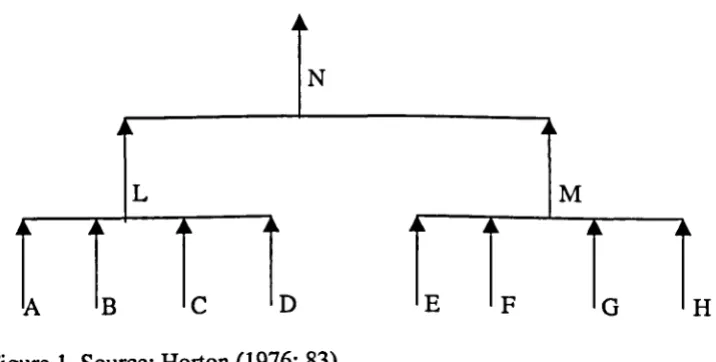
As observed by Horton, their socio-political organisation exhibits features of the relativity of
political grouping, equivalence of segments, and predominance of leadership over authority
(1976: 83-85). The individual lineage units come together in bigger units to act in concert to
ward off external intrusions but revert to their smaller units when the threat is over. To that
extent no form of enduring central authority is sustained; as the units consider themselves to
have equivalent status. An important feature of this socio-political arrangement is that spatial
distance becomes one of the most important determinants of social distance (Horton, 1976:
80). We will revisit this issue in detail in Chapter 5.
Among the communities of the Upper West Region, only the Malala and Wala are known
historically to have practised a form of centralised political organisation during the
pre-colonial era. The Wala ethnic group being the last offshoot of the Dagbon empire, brought
with them such a political arrangement now understood as chieftancy (see Wilks, 1976; 1989
and Songsore, 1975). However, the evidence shows that the princely (Nabihi) clans of Wa
were not the first settlers. The tendamba of Suuriyiri were first to arrive and settle in the area
though they met the Dagara (£Obis); who were driven further westwards along the Black
Volta River (see Levtzion, 1968 and Dougah, 1966). The tendamba of the Wala community
like those of the Dagara and SissaIa did not have a centralised form of political
administration.
The Sissala and the Dagara on the other hand, were organised into small autonomous political
units mostly made up of lineage groups. Unlike the typical segmentary lineages (referred to
earlier) the shortage of land often occasions migration, which leads to a division of the
Therefore a form of authority developed around the custodian of the earthshrine (tengan sob) as head of the landowning lineage (see Goody, 1954 and Tengan, 1991). They however had no chiefs or a centralised political organisation as in centralised communities. The tengan sob or totina as the case might be was the leader in both a spiritual and a secular sense. The bonds that united these autonomous groups were either a common earthshrine or totemic avoidance. Many anthropological narratives exist on these pre-colonial traditional structures and we do not intend to go into the details (see Rattray, 1932; Goody, 1956; Hawkins, 1996). Significant however, is the fact that the tengan institution exercised and still today exercises its authority with particular reference to land. The tengan sob or totina is often the most senior male descendant of the first settlers on the land.
1.3.2 The Colonial Era
The present Upper West Region in the early 19th century was a site of struggle between French and British colonial interests. Each struggled for influence over the communities that culminated in treaties; initially with communities who had a form of chieftancy and later with colonial chiefs (see Bourret, 1963; Arhin, 1974 and Thomas, 1972). British interest won out after the Berlin Conference of 1888 and settled the respective extent and spheres of influence of Britain and France in the areas.
The enactment of an Order-in-Council in 1901 (which came into force in 1902) made the Upper West area a Protectorate of the British Empire6• This marked the beginning of the legal
dominion of Britain over the area and of local government as well (Saaka, 1978). The head of the protectorate was the Chief Commissioner who was assisted at the district level by District
S See Laws of the Gold Coast. (1951 Rev.) Vol. 3; Foreign Jurisdiction Acts 1878,41 & 42 Vict. C 67; 189053
Commissioners. Unlike other parts of the Gold Coast colony (the previous name of Ghana),
there were two phases of modern local government in Northern Ghana during colonial rule.
There was the period of Direct Rule from 1899 to 1931 and the period of Indirect Rule from
1932 to 1951 (see Ayee, 1994; Saaka, 1978; Massing, 1994).
Under direct rule, three administrative districts (Southern, north-eastern and north-western)
were created in 19087• The Upper West area belonged to the north-west district. In the initial
period of colonial rule all administrators were military officers who undertook periodic armed
patrols round the districts to check what the Commissioners tenned truculence and
independence among the natives (Saaka, 1978). However, the purpose of these visits was to
demonstrate to the people the new political presence. In the later part of direct rule, civilian
administrators replaced military officers (Bourret, 1963: 83).
The direct fonn of colonial rule proved more difficult than anticipated by the colonial
administrators. They subsequently realised that traditional institutions had viability and
significance in governing the communities. This was the case with the Dagara and the Sissala
who unaccustomed to central rule, resisted the colonial administrators. In response, the
colonial administration universalised the institution of chieftancy practised by Southern and
some Northern communities of Ghana to the Upper West communities (NAGT,
ADMl5611/50). This was a case of correcting one political mistake with another, as
chieftancy was not known among most communities of the Upper West area.
By the early 1930s local government had made a transition from direct rule to indirect rule
with the promulgation of a Native Administration Ordinance (Cap.121). In the new local
government structure under the Ordinance the Northern Territories was divided into two
Provinces (Southern and Northern). The Upper West area fonned part of the Northern
Province. Within the provinces were districts further divided into Native Authority areas as
basic administrative units. Section 2 of the Ordinance defined a native authority to include: "a
chief, other native or group of natives appointed to be a native authority". In practice, chiefs
were the only category considered competent to constitute or lead native authorities (Saaka,
1978).
In 1935 two legislations (Native Treasuries Ordinance and Native Jurisdiction Ordinance)
were passed to complete the indirect rule systems. By the Native Treasuries Ordinance the
Chief Commissioner was given authority to establish Native Authority Treasuries and to
define their sources of revenue. In 1936 the people of the Upper West area were directly
taxed for the first time. Customary tribute previously paid to the tengan dem (plural of tengan
sob) by the communities became an important revenue source for native authorities under
local government (see Ferguson and Wilks, 1970: 335-338). As a result, chiefs of previously
non-chiefly communities were given added economic power to enhance their new political
power, status, and dominance within the communities.
The Native Jurisdiction Ordinance, on the other hand, created a hierarchy of chiefs
(Paramount Chiefs, Divisional Chiefs, Sub-divisional Chiefs, and Village Headmen).
However, this was only a fonnaIity, as the pacification of Northern Ghana went along with
the institutionalisation of chieftancy (see Lentz, 1998: 1-17). The first two categories of
chiefs were given jurisdiction to adjudicate on disputes within their areas. The Ordinance
made it a criminal offence to undennine the authority or position of a chief. They were given
the additional function to declare from time to time and when necessary, whatever they might
consider to be the prevailing customary law on a given subject within their jurisdictional
areas; only subject to the Governor's approval (Elias, 1962: 91). Judicial precedent
strengthened the chiefs new jurisdiction in Oppon v. Ackinnie (1887 2G & G 4), which held
that the establishment of the Supreme Court Ordinance No.4 of 1876 had not taken away the
traditional jurisdiction of the Chiefs to hold their Courts according to immemorial custom.
Though chiefs in the Upper West area in some communities could lay no claim to such
immemorial customs; as chiefs, their jurisdictional basis has never been challenged.
In essence, both Direct and Indirect rule were neither aimed at improving local governance in
any participatory way nor were traditional institutions assisted in evolving customary rules of
governance. As noted, they were "nothing but pragmatic ways of cheaply maintaining
colonial rule" (Saaka, 1978: 26). Of interest to the colonial administration was revenue
accruing from direct taxation (see Bourret, 1968: 95-96). The jurisdiction of chiefs on
customary law, as in most parts of colonial Africa, was subject to a proviso that it should not
be "contrary to natural justice, equity and good conscience nor incompatible either directly or
by necessary implication with any Ordinance for the time being in force" (Cap. 4, 1951
Rev.). Therefore, the customary law of the local communities had to meet the standards of
law as understood in western jurisprudence regardless of the differences in social settings.
There were no significant changes in local government up to the 1940s.
By the mid-1940s nationalist agitation and civil unrest had become rampant in the country
(see Austin, 1964: 49-102 and Apter, 1963: 159-174). In the face of these political upheavals
the colonial government appointed an All-African Committee (the Coussey Committee) to
draft a new Constitution that would address the limitations of the 1946 Bums Constitution9•
An issue the Committee gave serious consideration was local government; the need for a sound and democratic local government that would serve as a foundation for a central democratic structure. The Committee's Report formed the basis of the beginning of a uniform modem local government system for Ghana (Nsarkoh, 1964). For the first time, local government functions were separated from the traditional councils that operated under the Native Authorities in rural areas. Paragraph 182 of the Coussey Committee Report (1949) recommended that traditional councils should have the power to make declarations having only the force of law on all customary constitutional matters and on subjects affecting the social and the cultural life of the people. In the Committee's opinion;
The complexity and stress of modem life, the desire for change and the progressive outlook which are now pervading even the remotest villages call for more efficient organs of local administration. We therefore recommend entirely new councils democratic in composition which should prove more efficient and effective in discharge of greater responsibilities for the society's welfare and well-being of their local communeslO
•
By 1951 the political situation in Ghana had changed considerably. Ghana was now self-governing though not yet independent under Kwame Nkrumah and the CPP government. One of the first legislations the government passed was the Local Government Ordinance No.29 of 1951 (Cap. 64). Except in matters of detail, the Ordinance followed closely the recommendations of the Coussey Committee. In introducing the Bill to the National Assembly, the Minister for Local Government argued that the objective of the government was to provide a system which would enable the people (operating through popularly elected
(Northern Ghana) Ordinance, 1935 (Ordinance No. 31)
9 The Bums Constitution of 1946 did not contain a provision for an elected African majority in the Legislative Council; as demanded by the nationalists' movements. It was described by one of the nationalist leaders (J. B. Danquah), as "still born at birth".
councils) to decide for themselves what their needs were and how to provide for them (Wood,
1971).
Saaka (1978) is of the view that such a preface by the Minister was a reiteration of the CPP
government's commitment to a sound local government that was participatory. Such a
commitment, he asserts, arose from a feeling that the masses of the people had been deprived
for a long time of the right to speak for themselves and they could best be introduced to
government through local authorities accessible to them. As he sees it, the efficacy of local
government is dependent on mass participation and effective administration. The former, he
contends, was provided through the process of electing candidates to the councils; and the
latter by the element of a permanent body of officials employed to run their day-to-day
business (Saaka, 1978: 32).
However, the colonial government had also used the interests of the masses of the people as
an ideology in legitimising its local government policies and the CPP Government was not
different. It is not clear from a reading of the 1951 Local Ordinance what the masses were,
nor in what and how, they were to participate? Subsequent developments in local government
in Ghana show that the CPP Government's interest was how councils (under the local
government system) could provide municipal works cheaply and not one for democratic
participation (Massing, 1994).
By 1956 when it was realised that service delivery by these councils were as poor as well as
costly to the state, the Greenwood Commission was set up to consider a number of issues on
local government. The issues for consideration were:
(ii ) methods of local revenue collection and expenditure control; and
(iii) prospects of raising the level of rates by imposing other forms of taxation.
By an extension of the Greenwood Commission's terms of reference in 1957, it was required
to further consider the functions of local authorities and the division of responsibilities
between central, regional, and local government. This additional term de-emphasises the
importance of mass participation and self-rule at the local level. The CPP Government was of
the view that the only local authorities worth having were those with the financial strength to
support themselves (Saaka, 1978). The importance government was to attach to local
government authorities was therefore dependent on their viability, measured by their level of
economic efficiency.
The Greenwood Commission proposed two models of local government structures that came
to be known as Plan A and Plan B. Plan "A" model was to produce large local government
units based on district councils where they existed and smaller units of local authorities where
they did not exist. Existing urban and municipal councils with adequate resources were
however to be retained. In Plan "B" model, the principal unit for provision of local
government services was to be the Regional Authority while lesser services were to be
provided by urban and local councils. Though these seemed alternative plans, a reading of the
Report suggests that both plans could be used but for different regions of the country or there
could be a combination of features from both for the entire country. The CPP Government
which had over the years been opposing in Ashanti the agitation for federalism, saw regional
autonomy in Plan "B" as lending itself to such demands and therefore opted for Plan "A" (see
Saaka, 1978; Massing, 1994). This plan was, however, not implemented before Ghana
1.3.3 The Postcolonial Era
A substantive legislation was passed in 1961 to implement the new local government system
proposed in the Greenwood Report Plan "A" (Act 54, 1961). The importance of this
legislation lies in the fact that it finally removed the direct influence of traditional authorities
(chiefs) on local government in Ghana; as local authorities were to be composed of elected
members through electoral colleges. There was a distinction in the legislation between
traditional councils that dealt with customary affairs and local authorities that dealt with
secular local political affairs. The Greenwood Report Proposals, even now, continue to
influence the structure of local government in Ghana; as either Plan "A" or "B" is adopted as
governments change. It is rightly considered the magna carta of Ghana local government.
This will be evident when we consider Ghana's current decentralisation programme.
Some amendments worthy of note were made in 1962 to the 1961 local government
legislation. The idea of having large and viable local units was disregarded as the number of
district councils was increased from 70 to 150. At the same time, district councils were
constituted as parliamentary constituencies for purposes of electing representatives to the
national legislature. While arguments are raised to indicate that these amendments were to
enhance local community participation (see Saaka, 1978), it was the case for only CPP
members (see MLG&RD, 1996).
By 1962 Ghana had become a de/acto one party state. District councils were multiplied daily
and packed with CPP faithfuls to complete its dominance in all local communities in the
country. There was no fundamental change in this structure of local government up to the
Council (NLC) in 1966. The NLC regime disbanded all district councils and all local
government affairs were administered by the most senior civil servants in the districts.
Between 1967 and 1968, Ghana witnessed yet two further Commissions of Inquiry
(Mills-Odoi and Siriboe Commissions) to look into the problems of local government. The
recommendations of these Commissions formed the substance of chapter 16 of the 1969
Constitution and the then Local Government Act as subsequently amendedll. The object of
these constitutional and legislative provisions was to make local government units in essence
local agencies of central government. There was no attempt this time to even pay lip-service
to local autonomy or participation. Local government was a four-tier structure of regional
councils, district councils, municipallurban/local councils, and town/area councils. In
addition, there were town and village development committees that were not part of the local
government structure but established by the CPP government to operate alongside local
government institutions in rural areas (MLG, 1975). Regional councils were composed of two
representatives from each district council in the region and the regional heads of state
departments. Regional Commissioners appointed by the government chaired them. The
Councils acted as agents of central government in respect of national programmes and
development projects.
District Councils were the basic units of administration at the local level. Government
nominated two-thirds of the district councils from the locality and local authorities nominated
one-third of the membership. There was no provision for either direct or indirect election of
members as in the previous situations. This marked retrogression in democratic local
introduced at this point. Real power in the district resided in the DCE as he was head of the
Civil Service in the district; and by the integration of local government agencies into central
government, he controlled all employees who were by then all civil servants. No significant
development occurred in local government from 1974 up to the PNDC decentralisation
programme in the mid-1980s.
From the preceding account of the emergence and development of modern local government
in both the colonial and post-colonial periods in Ghana, the political and economic factors
that gave rise to legal changes in local government are obvious. Legal changes became
necessary as a response to manifold factors: rivalry between colonial powers, the demand for
additional sources of government revenue, the need to curtail general civil unrest, or political
advantage in a multi-party system. All these local government reforms also used the
"welfare" of the people, "participation", "democracy" and "development" arguments as
ideological forms in legitimising their policies contrary to these very notions.
Northern Ghana and for that matter the Upper West area, in the twists and turns of local
government, were continually marginalized in development terms. We explore this issue later
in the chapter, when we come to trace the emergence and development of state control of
Northern Ghana lands. For now, it would suffice to say that the excess baggage (to borrow
Mamdani's phrase) of isolation and neglect of Northern Ghana by the colonial state was
carried into the postcolonial era. We will also indicate shortly that the legal regime of
colonial forms of local government gave rise to the systematic underdevelopment of Northern
Ghana. The current attempts at local level governance are held to be a fundamental departure
from previous local government arrangements. We next sketch its main features to ascertain whether it is indeed a departure from the previous attempts.
1.3.4 Ghana's Current Decentralisation Programme
The current decentralisation programme was mooted in the early 1980s but was implemented between 1988 and 1989 (see Government of Ghana, 1984). Its discourse focuses on a number of related factors as the basis on which it was conceptualised. The first relates to the centralised development approach of the Ghanaian state over the years. This development approach, it is argued, privileged the state as the sole agent of development to the neglect of the local communities and civil society. It is a development approach that focuses on economic growth to the neglect of the social and the human dimensions of development. As such it adversely affected locaVcentral government relationship and gave rise to demands by local communities for participation in decisions affecting them (see Crook and Manor, 1998; GTZ, 1996 and Diaw, 1994).
A third view suggests that the erstwhile PNDC government was committed to a philosophy of
empowering local communities. Therefore the current decentralisation programme is seen as
that government's commitment to addressing the issue of rural development through local
community participation (see NCD Report, 1991 and MLG&RD, 1996), the origin of the
programme is therefore traceable to a number of converging factors:
(i) Macro-economic policies pursued under ERP.
(ii) Urging by international donor community to establish democratic structures for
greater participation in development as a SAP conditionality.
(iii) Internal demands for devolution of power to the local level for resource
mobilisation and utilisation for sustainable development.
(iv) The shortcomings of the pre-and immediate post-independence local government
systems; and
(v) a favourable political environment by the PNDC government's genuine
commitment to decentralisation and grassroots participation in development.
The Local Government Law of 1988 (PNDCL 207) was enacted to regulate the
decentralisation programme.
The said legislation was the most comprehensive local government legislation Ghana ever
experienced. It is now superseded by the current Local Government Act of 1993 (Act 462).
There are however very minor differences between the two legislations. The differences are
in terms of new designations to conform to the 1992 Constitution (see Crook and Manor,
1998). However, the Supreme Court in New Patriotic Party v. The Electoral Commission and
Another (No.2)12 is of the view that the DAs as constituted under article 242 of the 1992
Constitution are legally different from those established under PNDCL 207. Abban JSC (as he then was) observes as follows:
[T]he present district assemblies as established by PNDCL 207 are completely different bodies or entities from the district assemblies to be established in the future under article 242 of the Constitution13•
The issue before the court was whether the district assemblies under PNDCL 207 in addition to their functions set out in section 6 thereto had also the authority to approve District Chief Executives. The position of the court, in our view, seems to be based on statistical differences in the composition of the DA. The 1992 Constitution provides that 30 per cent of the membership of the district assembly be appointed by the President; while PNDCL 207 provided for one-third of such membership to be appointed by the President. In substance however, the powers and functions of the assemblies in PNDCL 207 are retained in both the 1992 Constitution and the Local Act of 1993 pursuant to it (see section 6 of PNDCL 207, and chapter 21 of the 1992 Constitution and sections 10 and 41 of Act 462 respectively). We are therefore of the view that the current DAs are not different from those created by PNDCL 207 in 1988.
As a jurisprudential question, it may be argued that the 1988 DA system had its legal validity from the PNDC revolutionary order, while the current system is rooted in the 1992 Constitution. However, it has to be noted that the 1992 Constitution itself was promulgated as a schedule to a PNDC Law (PNDCL 28214; also see Ahwoi, 1985: 139-167)15. To that extent one can discern continuity between the two constitutional regimes, and for that matter the DA system.
13 Ibid. [po 11].
14 Constitution of the Fourth Republic of Ghana (promulgation) Law, 1992.