http://wrap.warwick.ac.uk
Original citation:Yau, Jane Yin-Kim and Joy, Mike (2007) A context-aware and adaptive learning schedule framework for supporting learners’ daily routines. In: Second International Workshop on Mobile Communications and Learning (MCL 2007), Sainte-luce,
Martinique, 22-28 Apr 2007. Published in: Second International Conference on Systems, 2007. ICONS '07.
Permanent WRAP url:
http://wrap.warwick.ac.uk/61647
Copyright and reuse:
The Warwick Research Archive Portal (WRAP) makes this work by researchers of the University of Warwick available open access under the following conditions. Copyright © and all moral rights to the version of the paper presented here belong to the individual author(s) and/or other copyright owners. To the extent reasonable and practicable the material made available in WRAP has been checked for eligibility before being made available.
Copies of full items can be used for personal research or study, educational, or not-for profit purposes without prior permission or charge. Provided that the authors, title and full bibliographic details are credited, a hyperlink and/or URL is given for the original metadata page and the content is not changed in any way.
Publisher’s statement:
“© 2007 IEEE. Personal use of this material is permitted. Permission from IEEE must be obtained for all other uses, in any current or future media, including reprinting
/republishing this material for advertising or promotional purposes, creating new collective works, for resale or redistribution to servers or lists, or reuse of any copyrighted component of this work in other works.”
A note on versions:
The version presented here may differ from the published version or, version of record, if you wish to cite this item you are advised to consult the publisher’s version. Please see the ‘permanent WRAP url’ above for details on accessing the published version and note that access may require a subscription.
A Context-aware and Adaptive Learning Schedule framework for
supporting learners’ daily routines
Jane Yau, Mike Joy
Department of Computer Science, University of Warwick, UK {j.y-k.yau, m.s.joy}@warwick.ac.uk
Abstract
A learning context describes the current situation of a learner related to a learning activity, and continually changes in a mobile learning environment. As a result, context-awareness in mobile learning has become an essential part when designing more adaptive mobile learning systems. In this paper, we introduce our novel Context-aware and Adaptive Learning Schedule framework which makes use of a learning schedule to support the students’ daily routines, and first, adapts the activities to the student’s learning styles and then, selects the appropriate activity for the learner based on their current learning context.
Keywords: Context-aware, Adaptive Learning, Learning Schedule, Learning Styles, Mobile Learning
1. Introduction
Mobile learning has become widespread and students nowadays are able to learn anywhere and at any time, enabled by mobile technologies and wireless internet connections. Goodyear [ 1 ] suggested that “there may be good reasons for allowing and perhaps encouraging learners to create their own ‘learn places’, configuring the physical resources available to them in ways they find most comfortable, efficient, supportive, congenial and convivial”. Sharples [2] noted that learners should be able to choose the times and locations of their learning, and Syvänen et al. [3] stated that learning activities should not be bound to only one specific environment (e.g. classroom), nor should the activities be pre-structured. Mobile learning can be distinguished “by rapid and continual
changes of context, as the learner moves between locations and encounters localised resources, services and co-learners” [ 4 ], and these different situations of a person related to a learning activity are described by different learning contexts [5].
Corlett et al. [ 6 ] noted that the built-in software in mobile computing devices are not designed particularly to support students’ learning activities such as attending lectures, reading course content, revising and meeting course deadlines. Subsequently, they developed a student learning organizer which included the standard pocket pc applications and they incorporated specific tools for students to access course material, view their timetables, communicate via email and instant messaging and organize ideas and notes; however this tool is not context-aware.
In this paper, we introduce our novel Context-aware and Adaptive Learning Schedule (CALS) framework, consisting of the following three main components –
• A Learning Schedule for supporting the learners’ daily routines (including both learning-related and learning-unrelated events).
• A Learning Styles adaptation module for adapting the learning activities according to the students’ learning styles.
• A Context adaptation module first identifies the learning context which the learner is currently situated in which is subsequently combined with the filtered activities based on the learners’ learning styles, and recommends appropriate learning activities for them.
The remainder of this paper is organized as follows. In Section 2, context-awareness and adaptation in mobile learning is examined and related research is introduced. In Section 3, our CALS framework is explored in detail. In Section 4, we discuss our design, implementation and evaluation plans. Finally, conclusions and future work is given in Section 5.
2. Related Work
There has been an increased variety of different locations of where students’ learning can take place other than in educational institutions and at home; this includes on public transport (i.e. buses and trains etc), in restaurants or pubs [12], as well as outdoor places such as parks. The conditions within these different locations could affect differently a learner’s choice of educational task or learning activity, and also his/her ability to accomplish a task successfully. It was noted by Bull et al. [13] that the learner’s interactions with their learning device should be structured appropriately in their current location, considering their concentration level and the
likelihood of interruption in that location, and the available time for study.
There are two types of context-aware retrieval applications, known as interactive and proactive. The interactive applications directly issue requests to the users to input contextual information; whereas, the proactive applications can automatically retrieve the contextual information via some sensors such as GPS location sensor [11]. Bull et al.’s [13] application is an example of an interactive application, such that their attributes (location, concentration level, likelihood of interruption and available time) are inputted by the users.
An example of a proactive application includes Martin et al.’s [ 14 ] whom developed a system which selects and proposes the most appropriate activities to be completed at each time to learners. They take into account the user’s personal features, preferences or previous actions, user’s context, including spare time and location. They also take into account that users may use different physical devices (PCs, laptops, mobile phones and PDAs) and the activities are adapted to the different devices. There is an option which, if appropriate, according to the learner’s context, will alert or interrupt the users about the availability of an activity. Their system also allows collaborative activities between users to be performed.
3. The CALS Framework
Our proposed system draws upon three theoretical foundations – the contexts of mobile learning and computing, the Dunn and Dunn and the Felder and Silverman learning styles models [16]. Our goal is to develop a learning application to be used on a mobile handheld device, which adapts the learning activities to the learners according to their learning styles and is also capable of detecting the users’ current learning context, and recommends appropriate activities for them based on these two criteria.
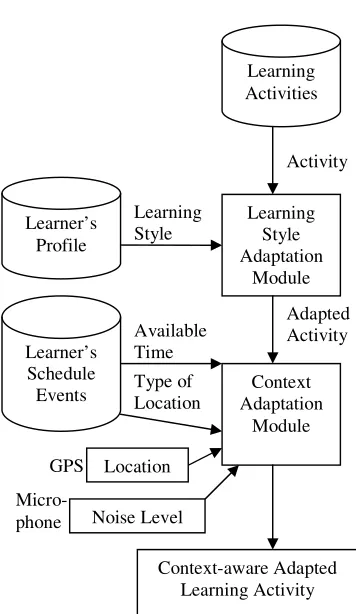
Figure 1 shows the pedagogical architecture of our framework, which includes three databases - the learner’s profile (including their learning styles), the learner’s scheduled events and the learning activities. There are two adaptation modules – learning styles adaptation and context adaptation.
Figure 1 – Pedagogical architecture of CALS
We have chosen to adopt the proactive approach because of the increased context-aware capability. We will retrieve the contextual information from the scheduled events database, (such as the time available for learning and the precise location), and two sensors, namely GPS for location detection and a microphone for noise detection.
We include the learners preferred learning styles because learners have different psychological properties which relate to their learning experiences and these considerations should be made [ 17 ]. We have identified the Felder and Silverman model as one which is appropriate for use within our system because this model describes the learner in more detail and is based on tendencies implying that learners can sometimes act differently if they have a high preference for certain behaviour [18]. Other authors such as Park [19] have also adopted the use of the Felder and Silverman model for the adaptation of learner’s learning styles in their learning systems.
The remainder of this section is organized as follows. First, we give a sample scenario to illustrate how our adaptation process functions. Then we explore each of the components of our architecture, namely, learner’s profile database, learner’s scheduled events database, learning activities database, learning styles adaptation module and context adaptation module.
3.1 Sample scenario
Four users are considered in our sample scenario to illustrate our adaptation process: John – an active learner, Peter – a reflective learner, Sarah – a visual learner and Amy – a verbal learner. The activities will be adapted to the different learning styles, where appropriate. Some of the activities defined in our system are as follows –
A. Formal assessments B. Un-assessed exercises
Learning Activities
Activity
Learning Style Adaptation
Module Learner’s
Profile
Learning Style
Context Adaptation
Module Adapted Activity Learner’s
Schedule Events
Available Time Type of Location
Location
Noise Level GPS
Micro-phone
[image:4.612.101.279.393.700.2]C. Pre-lecture notes
D. Learning from examples E. Review activity
F. Discussion about work
It is an hour prior to their lecture. John is commuting on a quiet train for an hour; Peter is commuting on a noisy bus also for an hour; Sarah is in the library whilst Amy is in the computer lab. They all would like to undertake some learning activities based on their current learning situation. B has been selected for John as it is considered quiet enough for John to concentrate on the quiet train; C has been selected for Peter; and A has been selected for Sarah and Amy. In addition, a visual version of A has been selected for Sarah whereas a verbal version has been selected for Amy.
After the lecture, John goes to study in a quiet restaurant whereas Peter goes to a noisy café – each has 30 minutes to study. As John is an active learner, D is selected for him; on the contrary, E is selected for Peter as he is a reflective learner.
3.2 Learner’s profile database
Personal information about the learner is recorded in this database, including a unique identifier for the learner, surname, forename, address, email address, gender, date of birth, degree and modules undertaking, and their preferred learning styles according to the Felder and Silverman model [20]. Therefore each of the learner’s preferences under the following categories will be recorded – (1) Active/Reflective, (2) Sensing/Intuitive, (3) Visual/Verbal, and (4) Sequential/Global.
The use of a learner profile is especially important in a mobile learning environment because different types of users may require the devices for different reasons and may require different capabilities of the devices [17]. For example, a music student may require audio capabilities whereas an art student will require drawing capabilities from the device. Jones and Brown [11] also
noted that certain user activities can be adapted to the learners which specifically affect some aspects of the learner profile.
3.3 Learner’s scheduled events database
The learner must supply to the system his/her scheduled events that he/she will be participating in at a specific time; these can either be learning related or unrelated. A unique identifier for the event is recorded, a name for quick reference, the event start and finish time, the category (whether learning related or unrelated), the event location, subject and type (whether seminar, lecture, tutorial and so on).
3.4 Learning activities database
All learning activities are stored in this database. Different types of learning activities are stored including compulsory activities (such as assessments), non-compulsory activities (such as exercises) and revision activities (such as review). Each activity has the following attribute – a unique identifier, title, subject, description, activity objective, priority of activity to be undertaken (high, medium and low), duration of time needed for completion, and Status of activity (unfinished or finished) - if the activity is not finished, then the remaining duration of the activity is recorded).
3.5 Learning styles adaptation module
Where possible, each of the learning activities will have a version which will cater for learners with the eight different learning preferences based on the Felder and Silverman model. This module takes the learner’s learning style from the learner’s profile database as input and outputs the appropriate learning activities for the learner, which is then inputted into the context adaptation module.
This module first identifies the current context that the learner is situated in, based on a number of variables which indicate the individual contextual factors as follows - the actual physical address of the location (for example, University of Warwick) retrieved from GPS; whereas type of location (computer lab, library, café, home etc.), category of location (public, private, in transport) and time available are retrieved from the learner’s scheduled events; finally the noise level will be detected from the built-in microphone on the learner’s device. Note that it is the precise type of location which is important, rather than the actual location because the importance arises from the way this kind of location affects the individual learner [13]. A check can also be performed to see if the information from the database corresponds with the location sensor (i.e. a check on whether the learner is really keeping his/her schedule) (or do we assume that the learner will keep to his schedule?). This information can be used to alert the user to download lecture notes if he/she missed a lecture, for example.
We will assign individual and exclusive (and exhaustive?) context patterns for each of the combination of the values of the variables, such that (we cannot make an exhaustive list of locations) -
Context pattern = {location, precise type of location, category of location, time available, noise level}
(Is a reference needed for context pattern? – I’ve seen one author use this approach)
For example, Context pattern number 1 is assigned for a situation where the learner is at the university’s computer lab, has 30 minutes, and is quiet.
When the context has been identified and a context pattern is inferred, this information is combined with the filtered learning activities according to the learner’s preferred learning styles, and context-aware learning activities are outputted.
Four categories of context-aware applications were described by Schilit et al. [21], namely proximate selection, automatic contextual reconfiguration, contextual information and commands, and context-triggered actions. Context-context-triggered actions specify how context-aware systems should adapt using IF-THEN rules, which are previously specified. Actions are then invoked automatically when a contextual element or a mixture of contextual elements are fulfilled. We have selected the context-triggered approach for use within our system. This approach has also been adopted by Martin et al. [14].
4. Future Work
Our future work is described in this section.
4.1 Systems Design and Development
A prototype Java-based web application will be developed from this model and we have chosen the Fujitsu-Siemens LOOX n560 pocket pc device in which to build/run/test our system because of the following main benefits:
• It uses the Microsoft Windows Mobile 5.0 premium edition.
• It uses the .NET compact framework 1.0 SP2 which allows .NET programs to be used and has a new generation of platform application programming interfaces (APIs) which allows rich multimedia support.
• GPS and microphone are built-in.
4.2 Systems Evaluation
the system and to provide us with qualitative results.
5. Conclusions
In this paper, we have introduced our novel Context-aware and Adaptive Learning Schedule framework and we are currently designing and developing the system prototype which will be implemented and evaluated.
6. References
[1] Goodyear, P.M. (2000) Environments for lifelong learning: ergonomics, architecture and educational design. In J.M. Spector, and T.M. Anderson (eds.), Integrated and holistic perspectives on learning, instruction and technology: understanding complexity. Kluwer Academic Publishers, Dordrecht, 1-18.
[ 2 ] Sharples, M. (2000) The design of personal mobile technologies for lifelong learning. Computers and Education 34, P. 177-193.
[3] Syvänen, A., Beale, R., Sharples, M., Ahonen, M. and Lonsdale, P. (2005) Supporting Pervasive Learning Environments: Adaptability and Context Awareness in Mobile Learning. International Workshop on Wireless and Mobile Technologies in Education, P. 251-253.
[4] Chan, T., Sharples, M., Vavoula, G. and Lonsdale, P. (2004) Educational Metadata for Mobile Learning. International Workshop on Wireless and Mobile Technologies in Education.
[5] Derntl, M. and Hummel, K. (2005) Modelling context-aware e-learning scenarios. Pervasive computing and communications workshop.
[6] Corlett, D., Sharples, M., Chan, T. and Bull, S. (2004) A Mobile Learning Organiser for University Students. International Workshop on Wireless and Mobile Technologies, P. 35-42.
[7]Malek, J., Laroussi, M. and Derycke, A. (2006) A Multi-Layer Ubiquitous Middleware for Bijective Adaptation between Context and Activity in a Mobile and Collaborative learning. ICSNC 2006.
[ 8 ]Lavoie, M. (2006) I, Mlearning: Identifying Design Recommendations for a context-aware mobile learning system. IADIS International Conference Mobile Learning.
[ 9 ]Krause, A., Smailagic, A., and Siewiorek, D. (2006) Context-aware mobile computing: learning context-dependent personal preferences from a wearable sensor array. Transactions on mobile computing, Vol. 5, No. 2, February 2006.
[10]Kaenampornpan, M. and O’Neill, E. (2004) An Integrated Context Model: Bringing Activity to
Context. Workshop on Advanced Context Modelling, Reasoning and Management”, UbiComp 2004. [11] Jones, G. and Brown, P. (2002) Challenges and Opportunities for Context-aware Retrieval on Mobile Devices, University of Exeter.
[12] Cui, Y. and Bull, S. (2005) Context and learner modeling for the mobile foreign language learner. Science Direct, System 33 (2005) P. 353-367. [13] Bull, S., Cui, Y., Röbig, H. and Sharples, M. (2005) Adapting to Different Needs in Different Locations: Handheld Computers in University Education. International Workshop on Wireless and Mobile Technologies in Education, P. 48-52. [ 14 ] Martin, E., Andueza, N., Carro, R. M. & Rodriguez, P. (2006) Recommending Activities in Collaborative M-Learning. Adaptive Hypermedia and Adaptive Web-based Systems.
[15] Cheverst, K., Davies, N., Mitchell, K. and Smith, P. (2000) Providing Tailored (Context-Aware) Information to City Visitors. Adaptive Hypermedia and Adaptive Web-based Systems.
[16] Yau, J. and Joy, M. (2006) Context-aware and Adaptive Learning Schedule for Mobile Learning. International Conference on Computers in Education. [17] Parsons, D., Ryu, H. and Cranshaw, M. (2006) A Study of Design Requirements for Mobile Learning Environment. International Conference on Advanced Learning Technologies.
[18] Graf, S. and Kinshuk (2006) An Approach for Detecting Learning Styles in Learning Management Systems. International Conference on Advanced Learning Technologies, P. 161- 163.
[19] Park, H. (2005) Design and development of a mobile learning management system adaptive to learning style of students. International Workshop on Wireless and Mobile Technologies.
[20] Felder , R. and Silverman, L. (1998) Learning Styles and Teaching Styles in Engineering Education. Engineering Education, Vol. 78, No. 7, 674-681. [ 21 ] Schilit, B., Adams, N. and Want, R. (1994) Context-aware computing applications. Workshop on Mobile Computing Systems and Applications, P. 88-90.