Exploiting Qualitative Information from Automatic Word Alignment
for Cross-lingual NLP Tasks
Jos´e G.C. de Souza
FBK-irst, University of Trento
Trento, Italy [email protected]
Miquel Espl`a-Gomis
Universitat d’Alacant Alacant, Spain [email protected]
Marco Turchi
FBK-irst Trento, Italy [email protected]
Matteo Negri
FBK-irst Trento, Italy [email protected]
Abstract
The use of automatic word alignment to capture sentence-level semantic relations is common to a number of cross-lingual NLP applications. Despite its proved usefulness, however, word alignment in-formation is typically considered from a quantitative point of view (e.g.the number of alignments), disregarding qualitative aspects (the importance of aligned terms). In this paper we demonstrate that integrat-ing qualitative information can brintegrat-ing sig-nificant performance improvements with negligible impact on system complexity. Focusing on the cross-lingual textual en-tailment task, we contribute with a novel method that: i) significantly outperforms the state of the art, andii)is portable, with limited loss in performance, to language pairs where training data are not available.
1 Introduction
Meaning representation, comparison and projec-tion across sentences are major challenges for a variety of cross-lingual applications. So far, de-spite the relevance of the problem, research on multilingual applications has either circumvented the issue, or proposed partial solutions.
When possible, the typical approach builds on the reduction to a monolingual task, burdening the process with dependencies from machine transla-tion (MT) components. For instance, in cross-lingual question answering and cross-cross-lingual tex-tual entailment (CLTE), intermediate MT steps are respectively performed to ease answer re-trieval/presentation (Parton, 2012; Tanev et al., 2006) and semantic inference (Mehdad et al., 2010). Direct solutions that avoid such pivot-ing strategies typically exploit similarity measures that rely on bag-of-words representations. As an
example, most supervised approaches to MT qual-ity estimation (Blatz et al., 2003; Callison-Burch et al., 2012) and CLTE (W¨aschle and Fendrich, 2012) include features that consider the amount of equivalent terms that are found in the input sen-tence pairs. Such simplification, however, disre-gards the fact that semantic equivalence is not only proportional to the number of equivalent terms, but also to their importance. In other words, in-stead of checkingwhatof a given sentence can be found in the other, current approaches limit the analysis to the amount of lexical elements they share, under the rough assumption that the more the better.
In this paper we argue that:
(1)Considering qualitative aspects of word align-ments to identify sentence-level semantic relations can bring significant performance improvements in cross-lingual NLP tasks.
(2) Shallow linguistic processing techniques (of-ten a constraint in real cross-lingual scenarios due to limited resources availability) can be leveraged to set up portable solutions that still outperform current bag-of-words methods.
To support our claims we experiment with the CLTE task, which allows us to perform exhaus-tive comparaexhaus-tive experiments due to the availabil-ity of comparable benchmarks for different lan-guage pairs. In the remainder of the paper, we:
(1) Prove the effectiveness of our method over datasets for four language combinations;
(2)Assess the portability of our models across lan-guages in different testing conditions.
2 Objectives and Method
We propose a supervised learning approach for identifying and classifying semantic relations be-tween two sentencesT1andT2written in different
languages. Beyond semantic equivalence, which is relevant to applications such as MT quality
(a) (b) (c)
Word alignment model for L1-L2
Parallel data for L1-L2
Unlabeled CLTE data for L1-L2
Word alignment algorithm
CLTE annotation
Learning algorithm
CLTE model for L1-L2
Labeled CLTE data
for L1-L2
Word alignment model for L3-L4
Parallel data for L3-L4
Unlabeled CLTE data for L3-L4
Word alignment algorithm
CLTE annotation CLTE model
for L1-L2
Word alignment model for L3-L4
Parallel data for L3-L4
Unlabeled CLTE data for L3-L4
Word alignment algorithm
CLTE annotation
CLTE model for L1-L2
CLTE model for L5-L6
CLTE model for L7-L8
[image:2.595.94.507.65.255.2]Combination
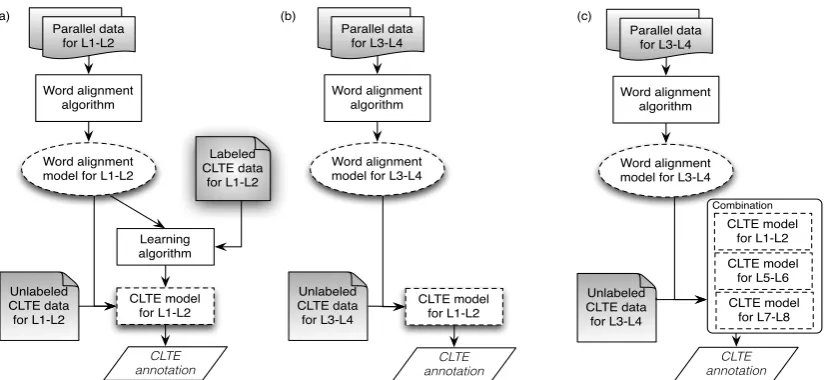
Figure 1: System architecture in different training/evaluation conditions. (a): parallel data and CLTE labeled data are available for language pair L1-L2. (b): the L1-L2 CLTE model is used to cope with the unavailability of labeled data for L3-L4. (c): the same problem is tackled by combining multiple models.
timation (Mehdad et al., 2012b),1 we aim to cap-ture a richer set of relations potentially relevant to other tasks. For instance, recognizing unrelated-ness, forward and backward entailment relations, represents a core problem in cross-lingual docu-ment summarization (Lenci et al., 2002) and con-tent synchronization (Monz et al., 2011; Mehdad et al., 2012a). CLTE, as proposed within the Se-mEval evaluation exercises (Negri et al., 2012; Negri et al., 2013), represents an ideal framework to evaluate such capabilities. Within this frame-work, our goal is to automatically identify the fol-lowing entailment relations between T1 and T2:
forward (T1 → T2), backward(T1 ← T2),
bidi-rectional(T1↔T2) andno entailment.
Our approach (see Figure 1) involves two core components:i)a word alignment model, andii)a CLTE classifier. The former is trained on a par-allel corpus, and associates equivalent terms inT1
andT2. The information about word alignments
is used to extract quantitative (amount and dis-tribution of the alignments) and qualitative fea-tures (importance of the aligned terms) to train the CLTE classifier. Although in principle both com-ponents need training data (respectively a paral-lel corpus and labeled CLTE data), our goal is to develop a method that is also portable across lan-guages. To this aim, while the parallel corpus is necessary to train the word aligner for any lan-guage pair we want to deal with, the CLTE
clas-1A translation has to be semantically equivalent to the
source sentence.
sifier can be designed to learn from features that capture language independent knowledge.2 This allows us to experiment in different testing con-ditions, namely: i)when CLTE training data are available for a given language pair (Figure 1a), andii)when CLTE training data are missing, and a model trained on other language pairs has to be reused (Figure 1b-c).
Features. Considering word alignment informa-tion, we extract three different groups of features:
AL,POS, andIDF.
The AL group provides quantitative informa-tion about the aligned/unaligned words in each sentenceT∗of the pair. These features are:
1. proportion of aligned words in T∗. We use
this indicator as our baseline (Bhenceforth); 2. number of sequences of unaligned words,
normalized by the length ofT∗;
3. length of the longesta) sequence of aligned words, andb) sequence of unaligned words, both normalized by the length ofT∗;
4. average length of a) the aligned word se-quences, and b) the unaligned word se-quences;
5. position of a) the first unaligned word, and b) the last unaligned word, both normalized by the lenght ofT∗;
6. proportion of word n-grams in T∗
contain-ing only aligned words (the feature was
com-2For instance, the fact that aligning all nouns and the most
relevant terms inT1 andT2 is a good indicator of semantic
puted separately for values ofn= 1. . .5).
The POS group considers the part of speech (PoS) of the words inT∗as a source ofqualitative
information about their importance. To compute these features we use the TreeTagger (Schmid, 1995), manually mapping the fine-grained set of assigned PoS labels into a more general set of tags (P) based on the universal PoS tag setby Petrov
et al. (2012). POS features differentiate between
aligned words(words inT1that are aligned to one
or more words inT2) and alignments(the edges
connecting words inT1 andT2). Features
consid-ering the aligned words inT∗ are:
7. for each PoS tagp∈P, proportion of aligned
words inT∗tagged withp;
8. proportion of words inT1aligned with words
with the same PoS tag inT2(and vice-versa);
9. for each PoS tagp∈P, proportion of words
inT1 tagged aspwhich are aligned to words
with the same tag inT2(and vice-versa).
Features considering the alignments are:
10. proportion of alignments connecting words with the same PoS tagp;
11. for each PoS tagp ∈P, proportion of
align-ments connecting two words tagged asp.
IDF, the last feature, uses the inverse docu-ment frequency (Salton and Buckley, 1988) as an-other source ofqualitative information under the assumption that rare words (and, therefore, with higher IDF) are more informative:
12. summation of all the IDF scores of the aligned words in T∗ over the summation of
the IDF scores of all words inT∗.
3 Experiments
Our experiments cover two different scenarios. First, the typical one, in which the CLTE model is trained on labeled data for the same pair of lan-guages L1–L2 of the test set. Then, simulating
the less favorable situation in which labeled train-ing data forL1–L2are missing, we investigate the
possibility to use existing CLTE models trained on labeled data for a different language pairL3–L4.
The SemEval 2012 CLTE datasets used in our experiments are available for four language pairs: Es–En, De–En, Fr–En, and It–En. Each dataset was created with the crowdsourcing-based method
described in Negri et al. (2011), and consists of 1000T1–T2pairs (500 for training, 500 for test).
To train the word alignment models we used the Europarl parallel corpus (Koehn, 2005), con-catenated with the News Commentary corpus3 for three language pairs: De–En (2,079,049 sentences), Es–En (2,123,036 sentences), Fr–En (2,144,820 sentences). For It–En we only used the parallel data available in Europarl (1,909,115 sentences) since this language pair is not covered by the News Commentary corpus. IDF values for the words in each language were calculated on the monolingual part of these corpora, using the aver-age IDF value of each languaver-age for unseen terms.
To build the word alignment models we used the MGIZA++ package (Gao and Vogel, 2008). Ex-periments have been carried out with the hidden Markov model (HMM) (Vogel et al., 1996) and IBM models3 and 4 (Brown et al., 1993).4We also explored three symmetrization techniques (Koehn et al., 2005): union,intersection, and grow-diag-final-and. A greedy feature selection process on training data, with different combinations of word alignment models and symmetrization methods, indicatedHMM/intersectionas the best perform-ing combination. For this reason, all our experi-ments use this setting.
The SVM implementation of Weka (Hall et al., 2009) was used to build the CLTE model.5 Two binary classifiers were trained to separately check T1 → T2 and T1 ← T2, merging
their output to obtain the 4-class judgments (e.g.
yes/yes=bidirectional,yes/no=forward).
3.1 Evaluation with CLTE training data
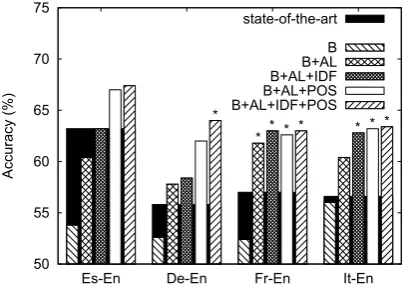
Figure 2 shows the accuracy obtained by the dif-ferent feature groups.6 For the sake of compari-son, state-of-the-art results achieved for each lan-guage combination at SemEval 2012 are also re-ported. As regards Es–En (63.2% accuracy) and De–En (55.8%), the top scores were obtained by the system described in (W¨aschle and Fendrich, 2012), where a combination of binary classifiers for each entailment direction is trained with a
mix-3http://www.statmt.org/wmt11/ translation-task.html#download
4Five iterations of HMM, and three iterations of IBM
models 3 and 4 have been performed on the training corpora.
5The polynomial kernel was used with parameters
empir-ically estimated on the training set (C= 2.0, andd= 1)
6In Figures 2 and 3, the “*” indicates statistically
ture of monolingual (i.e. with the input sentences translated in the same language using Google Translate7) and cross-lingual features. Although such system exploits word-alignment information to some extent, this is only done at quantitative level (e.g.number of unaligned words, percentage of aligned words, length of the longest unaligned subsequence). As regards It–En, the state of the art (56.6%) is represented by the system described in (Jimenez et al., 2012), which uses a pure pivot-ing method (uspivot-ing Google Translate) and adaptive similarity functions based on “soft” cardinality for flexible term comparisons. The two systems ob-tained the same result on Fr–En (57.0%).
50 55 60 65 70 75
Es-En De-En Fr-En It-En
Accuracy (%)
*
* * * * * * * state-of-the-art
B B+AL B+AL+IDF B+AL+POS B+AL+IDF+POS
Figure 2: Accuracy obtained by each feature group on four language combinations.
As can be seen in Figure 2, the combination of all our features outperforms the state of the art for each language pair. The accuracy improve-ment ranges from 6.6% for Es–En (from 63.2% to 67.4%) to 14.6% for De–En (from 55.8% to 64%). Except for Es–En, that has very competitive state-of-the-art results, the combination of AL with POS or IDF feature groups always outperforms the best systems. Furthermore, the performance increase with qualitative features (POS and IDF) shows co-herent trends across all language pairs. It is worth noting that, while we rely on a pure cross-lingual approach, both the state-of-the-art CLTE systems include features from the translation ofT1into the
language ofT2. For De–En, quantitative features
alone achieve lower results compared to the other languages. This can be motivated by the higher difficulty in aligning De–En pairs (this hypothesis is supported by the fact that the average number of alignments per sentence pair is 18 for De–En, and>22 for the other combinations).
Neverthe-less, qualitative features lead to results comparable
7http://translate.google.com/
with the other language pairs.
The selection of the best performing features for each language pair produces further improve-ments of varying degrees in Es–En (from 67.4% to 68%), De–En (64% – 64.8%) and It–En (63.4% – 66.8%), while performance remains stable for Fr–En (63%). All these configurations include the IDF feature (12) and the proportion of aligned words for each PoS category (7), proving the ef-fectiveness of qualitative word alignment features. The fact that HMM/intersection is the best com-bination of alignment model and symmetrization method is interesting, since it contradicts the gen-eral notion that IBM models 3 and 4 perform bet-ter than HMM (Och and Ney, 2003). A possible explanation is that, while word alignment models are usually trained on parallel corpora, the major-ity of CLTE sentence pairs are not parallel. In this setting, where producing reliable alignments is more difficult, IBM models are less effective for at least two reasons. First, including a word fertil-ity model, IBM 3 and 4 limit (typically to the half of the source sentence length) the number of tar-get words that can be aligned with thenullword. Therefore, when such limit is reached, these mod-els tend to force low probability, hence less reli-able, word alignments. Second, in IBM model 4, the larger distortion limit makes it possible to align distant words. In the case of non-parallel sen-tences, this often results in wrong or noisy align-ments that affect final results. For these reasons, CLTE data seem more suitable for the simpler and more conservative HMM model, and a precision-oriented symmetrization method like intersection.
3.2 Evaluation without CLTE training data
The goal of our second round of experiments is to investigate if, and to what extent, our approach can be considered as language-independent. Confirm-ing this would allow to reuse models trained for a given language pair in situations where CLTE training data is missing. This is a rather realistic situation since, while bitexts to train word aligners are easier to find, the availability of labeled CLTE data is far from being guaranteed.
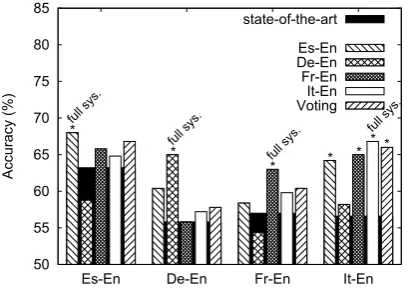
Our experiments have been carried out, over the same SemEval datasets, with two methods that do not use labeled data for the target language com-bination. The first one (method b in Figure 1) uses a CLTE model trained for a language pair
[image:4.595.75.281.268.412.2]avail-able, and applies this model to a language pair
L3–L4 for which only parallel corpora are
avail-able. The second method (cin Figure 1) addresses the same problem, but exploits a combination of CLTE models trained for different language pairs. For each test set, the models trained for the other three language pairs are used in a voting scheme, in order to check whether they can complement each other to increase final results.
All the experiments have been performed using the best CLTE model for each language pair, com-paring results with those presented in Section 3.1.
50 55 60 65 70 75 80 85
Es-En De-En Fr-En It-En
Accuracy (%)
full sys.
full sys.
full sys.
full sys.
*
* *
*
* * * state-of-the-art
[image:5.595.75.282.244.389.2]Es-En De-En Fr-En It-En Voting
Figure 3: Accuracy obtained by reusing CLTE models (alone and in a voting scheme).
As shown in Figure 3, reusing models for a new language pair leads to results that still outperform the state of the art.6 Remarkably, when used for other language combinations, the Es–En, It–En, and Fr–En models always lead to results above, or equal to the state of the art. For similar lan-guages such as Spanish, French, and Italian, the accuracy increase over the state of the art is up to 14.8% (from 56.6% to 65.0%) and 13.4% (from 56.6% to 64.2%) when the Fr–En and Es–En mod-els are respectively used to label the It–En dataset. Although not always statistically significant and below the performance obtained in the ideal sce-nario where CLTE training data are available (full sys.), such improvements suggest that our features can be re-used, at least to some extent, across dif-ferent language settings. As expected, the major incompatibilities arise between German and the other languages due to the linguistic differences between this language and the others. However, it is interesting to note that: i) at least in one case (i.e. when tested on It–En) the De–En model still achieves results above the state of the art, andii) on the De–En evaluation setting the worst model (Fr–En) still achieves state of the art results.
The results obtained with the voting scheme suggest that our models can complement each other when used on a new language pair. Although statistically significant only over It–En data, vot-ing results both outperform the state of the art and the results achieved by single models.
4 Conclusion
We investigated the usefulness of qualitative infor-mation from automatic word alignment to iden-tify semantic relations between sentences in dif-ferent languages. With coherent results in CLTE, we demonstrated that features considering the im-portance of aligned terms can successfully inte-grate the quantitative evidence (number and pro-portion of aligned terms) used by previous su-pervised learning approaches. A study on the portability across languages of the learned mod-els demonstrated that word alignment information can be exploited to train reusable models for new language combinations where bitexts are available but CLTE labeled data are not.
Acknowledgments
This work has been partially supported by the EC-funded projects CoSyne (FP7-ICT-4-248531) and MateCat (ICT-2011.4.2–287688), and by Span-ish Government through projects TIN2009-14009-C02-01 and TIN2012-32615.
References
John Blatz, Erin Fitzgerald, George Foster, Simona Gandrabur, Cyril Goutte, Alex Kulesza, Alberto Sanchis, and Nicola Ueffing. 2003. Confidence Es-timation for Machine Translation. Summer work-shop final report, JHU/CLSP.
Peter F. Brown, Stephen A. Della Pietra, Vincent J. Della Pietra, and Robert L. Mercer. 1993. The Mathematics of Statistical Machine Translation: Pa-rameter Estimation. Computational Linguistics, 19(2):263–311.
Chris Callison-Burch, Philipp Koehn, Christof Monz, Matt Post, Radu Soricut, and Lucia Specia. 2012. Findings of the 2012 workshop on statistical ma-chine translation. In Proceedings of the Sev-enth Workshop on Statistical Machine Translation (WMT’12), pages 10–51, Montr´eal, Canada.
Mark Hall, Eibe Frank, Geoffrey Holmes, Bernhard Pfahringer, Peter Reutemann, and Ian H. Witten. 2009. The WEKA Data Mining Software: an Up-date.SIGKDD Explorations, 11(1):10–18.
Sergio Jimenez, Claudia Becerra, and Alexander Gel-bukh. 2012. Soft Cardinality + ML: Learning Adap-tive Similarity Functions for Cross-lingual Textual Entailment. InProceedings of the 6th International Workshop on Semantic Evaluation (SemEval 2012), pages 684–688, Montr´eal, Canada.
Philipp Koehn, Amittai Axelrod, Alexandra Birch Mayne, Chris Callison-Burch, Miles Osborne, and David Talbot. 2005. Edinburgh System Descrip-tion for the 2005 IWSLT Speech TranslaDescrip-tion Evalu-ation. InProceedings of the International Workshop on Spoken Language Translation, Pittsburgh, Penn-sylvania, USA.
Philip Koehn. 2005. Europarl: a Parallel Corpus for Statistical Machine Translation. In Proceedings of MT Summit X, pages 79–86, Phuket, Thailand.
Alessandro Lenci, Roberto Bartolini, Nicoletta Cal-zolari, Ana Agua, Stephan Busemann, Emmanuel Cartier, Karine Chevreau, and Jos´e Coch. 2002. Multilingual summarization by integrating linguistic resources in the MLIS-MUSI Project. In Proceed-ings of the Third International Conference on Lan-guage Resources and Evaluation (LREC’02), pages 1464–1471, Las Palmas de Gran Canaria, Spain.
Yashar Mehdad, Matteo Negri, and Marcello Federico. 2010. Towards Cross-Lingual Textual Entailment. In Proceedings of the Eleventh Annual Conference of the North American Chapter of the Association for Computational Linguistics (NAACL HLT 2010), pages 321–324, Los Angeles, California, USA.
Yashar Mehdad, Matteo Negri, and Marcello Federico. 2012a. Detecting Semantic Equivalence and Infor-mation Disparity in Cross–lingual Documents. In
Proceedings of the 50th Annual Meeting of the As-sociation for Computational Linguistics (ACL’12), pages 120–124, Jeju Island, Korea.
Yashar Mehdad, Matteo Negri, and Marcello Fed-erico. 2012b. Match without a Referee: Evaluating MT Adequacy without Reference Translations. In
Proceedings of the Machine Translation Workshop (WMT2012), Montr´eal, Canada.
Christoph Monz, Vivi Nastase, Matteo Negri, Angela Fahrni, Yashar Mehdad, and Michael Strube. 2011. CoSyne: a Framework for Multilingual Content Synchronization of Wikis. In Proceedings of Wik-iSym 2011, the International Symposium on Wikis and Open Collaboration, pages 217–218, Mountain View, California, USA.
Matteo Negri, Luisa Bentivogli, Yashar Mehdad, Danilo Giampiccolo, and Alessandro Marchetti. 2011. Divide and Conquer: Crowdsourcing the Cre-ation of Cross-Lingual Textual Entailment Corpora.
InProceedings of the 2011 Conference on Empirical Methods in Natural Language Processing (EMNLP 2011), Edinburgh, Scotland.
Matteo Negri, Alessandro Marchetti, Yashar Mehdad, Luisa Bentivogli, and Danilo Giampiccolo. 2012. Semeval-2012 Task 8: Cross-Lingual Textual En-tailment for Content Synchronization. In Proceed-ings of the 6th International Workshop on Seman-tic Evaluation (SemEval 2012), pages 399–407, Montr´eal, Canada.
Matteo Negri, Alessandro Marchetti, Yashar Mehdad, Luisa Bentivogli, and Danilo Giampiccolo. 2013. Semeval-2013 Task 8: Cross-Lingual Textual En-tailment for Content Synchronization. In Proceed-ings of the 7th International Workshop on Semantic Evaluation (SemEval 2013), Atlanta, GA.
Franz J. Och and Hermann Ney. 2003. A Systematic Comparison of Various Statistical Alignment Mod-els. Computational Linguistics, 29(1):19–51.
Sebastian Pad´o, 2006. User’s guide tosigf: Signifi-cance testing by approximate randomisation.
Kristen Parton. 2012. Lost and Found in Transla-tion: Cross-Lingual Question Answering with Result Translation. Ph.D. thesis, Columbia University.
Slav Petrov, Dipanjan Das, and Ryan McDonald. 2012. A universal part-of-speech tagset. In Proceedings of the Eight International Conference on Language Resources and Evaluation (LREC’12), pages 2089– 2096, Istanbul, Turkey.
Gerard Salton and Christopher Buckley. 1988. Term-weighting Approaches in Automatic Text Re-trieval. Information Processing and Management, 24(5):513–523.
Helmut Schmid. 1995. Improvements in Part-of-Speech Tagging with an Application to German. In
Proceedings of the ACL SIGDAT-Workshop, pages 47–50, Dublin, Ireland.
Hristo Tanev, Milen Kouylekov, Bernardo Magnini, Matteo Negri, and Kiril Simov. 2006. Exploit-ing LExploit-inguistic Indices and Syntactic Structures for Multilingual Question Answering: ITC-irst at CLEF 2005.Accessing Multilingual Information Reposito-ries, pages 390–399.
Stephan Vogel, Hermann Ney, and Christoph Tillmann. 1996. HMM-based Word Alignment in Statisti-cal Translation. In Proceedings of the 16th Inter-national Conference on Computational Linguistics (ACL’96), pages 836–841, Copenhagen, Denmark.