Incremental Syntactic Language Models for Phrase-based Translation
Lane Schwartz
Air Force Research Laboratory Wright-Patterson AFB, OH USA
Chris Callison-Burch
Johns Hopkins University Baltimore, MD USA
William Schuler
Ohio State University Columbus, OH USA
Stephen Wu
Mayo Clinic Rochester, MN USA
Abstract
This paper describes a novel technique for in-corporating syntactic knowledge into phrase-based machine translation through incremen-tal syntactic parsing. Bottom-up and top-down parsers typically require a completed string as input. This requirement makes it dif-ficult to incorporate them into phrase-based translation, which generates partial hypothe-sized translations from left-to-right. Incre-mental syntactic language models score sen-tences in a similar left-to-right fashion, and are therefore a good mechanism for incorporat-ing syntax into phrase-based translation. We give a formal definition of one such linear-time syntactic language model, detail its re-lation to phrase-based decoding, and integrate the model with the Moses phrase-based trans-lation system. We present empirical results on a constrained Urdu-English translation task that demonstrate a significant BLEU score im-provement and a large decrease in perplexity.
1 Introduction
Early work in statistical machine translation viewed translation as a noisy channel process comprised of a translation model, which functioned to posit ad-equate translations of source language words, and a target language model, which guided the fluency of generated target language strings (Brown et al.,
This research was supported by NSF CAREER/PECASE award 0447685, NSF grant IIS-0713448, and the European Commission through the EuroMatrixPlus project. Opinions, in-terpretations, conclusions, and recommendations are those of the authors and are not necessarily endorsed by the sponsors or the United States Air Force. Cleared for public release (Case Number 88ABW-2010-6489) on 10 Dec 2010.
1990). Drawing on earlier successes in speech recognition, research in statistical machine trans-lation has effectively used n-gram word sequence models as language models.
Modern phrase-based translation using large scale n-gram language models generally performs well in terms of lexical choice, but still often produces ungrammatical output. Syntactic parsing may help produce more grammatical output by better model-ing structural relationships and long-distance depen-dencies. Bottom-up and top-down parsers typically require a completed string as input; this requirement makes it difficult to incorporate these parsers into phrase-based translation, which generates hypothe-sized translations incrementally, from left-to-right.1 As a workaround, parsers can rerank the translated output of translation systems (Och et al., 2004).
On the other hand, incremental parsers (Roark, 2001; Henderson, 2004; Schuler et al., 2010; Huang and Sagae, 2010) process input in a straightforward left-to-right manner. We observe that incremental parsers, used as structured language models, pro-vide an appropriate algorithmic match to incremen-tal phrase-based decoding. We directly integrate in-cremental syntactic parsing into phrase-based trans-lation. This approach re-exerts the role of the lan-guage model as a mechanism for encouraging syn-tactically fluent translations.
The contributions of this work are as follows:
• A novel method for integrating syntactic LMs into phrase-based translation (§3)
• A formal definition of an incremental parser for
1
While not all languages are written left-to-right, we will refer to incremental processing which proceeds from the begin-ning of a sentence as left-to-right.
statistical MT that can run in linear-time (§4)
• Integration with Moses (§5) along with empiri-cal results for perplexity and significant transla-tion score improvement on a constrained Urdu-English task (§6)
2 Related Work
Neither phrase-based (Koehn et al., 2003) nor hierar-chical phrase-based translation (Chiang, 2005) take explicit advantage of the syntactic structure of either source or target language. The translation models in these techniques definephrasesas contiguous word sequences (with gaps allowed in the case of hierar-chical phrases) which may or may not correspond to any linguistic constituent. Early work in statisti-cal phrase-based translation considered whether re-stricting translation models to use only syntactically well-formed constituents might improve translation quality (Koehn et al., 2003) but found such restric-tions failed to improve translation quality.
Significant research has examined the extent to which syntax can be usefully incorporated into sta-tistical tree-based translation models: string-to-tree (Yamada and Knight, 2001; Gildea, 2003; Imamura et al., 2004; Galley et al., 2004; Graehl and Knight, 2004; Melamed, 2004; Galley et al., 2006; Huang et al., 2006; Shen et al., 2008), tree-to-string (Liu et al., 2006; Liu et al., 2007; Mi et al., 2008; Mi and Huang, 2008; Huang and Mi, 2010), tree-to-tree (Abeill´e et al., 1990; Shieber and Schabes, 1990; Poutsma, 1998; Eisner, 2003; Shieber, 2004; Cowan et al., 2006; Nesson et al., 2006; Zhang et al., 2007; DeNeefe et al., 2007; DeNeefe and Knight, 2009; Liu et al., 2009; Chiang, 2010), and treelet (Ding and Palmer, 2005; Quirk et al., 2005) techniques use syntactic information to inform the translation model. Recent work has shown that parsing-based machine translation using syntax-augmented (Zoll-mann and Venugopal, 2006) hierarchical translation grammars with rich nonterminal sets can demon-strate substantial gains over hierarchical grammars for certain language pairs (Baker et al., 2009). In contrast to the above tree-based translation models, our approach maintains a standard (non-syntactic) phrase-based translation model. Instead, we incor-porate syntax into the language model.
Traditional approaches to language models in
speech recognition and statistical machine transla-tion focus on the use ofn-grams, which provide a simple finite-state model approximation of the tar-get language. Chelba and Jelinek (1998) proposed that syntactic structure could be used as an alterna-tive technique in language modeling. This insight has been explored in the context of speech recogni-tion (Chelba and Jelinek, 2000; Collins et al., 2005). Hassan et al. (2007) and Birch et al. (2007) use supertag n-gram LMs. Syntactic language models have also been explored with tree-based translation models. Charniak et al. (2003) use syntactic lan-guage models to rescore the output of a tree-based translation system. Post and Gildea (2008) investi-gate the integration of parsers as syntactic language models during binary bracketing transduction trans-lation (Wu, 1997); under these conditions, both syn-tactic phrase-structure and dependency parsing lan-guage models were found to improve oracle-best translations, but did not improve actual translation results. Post and Gildea (2009) use tree substitution grammar parsing for language modeling, but do not use this language model in a translation system. Our work, in contrast to the above approaches, explores the use of incremental syntactic language models in conjunction with phrase-based translation models.
Our syntactic language model fits into the fam-ily of linear-time dynamic programming parsers de-scribed in (Huang and Sagae, 2010). Like (Galley and Manning, 2009) our work implements an in-cremental syntactic language model; our approach differs by calculating syntactic LM scores over all available phrase-structure parses at each hypothesis instead of the 1-best dependency parse.
The syntax-driven reordering model of Ge (2010) uses syntax-driven features to influence word order within standard phrase-based translation. The syn-tactic cohesion features of Cherry (2008) encour-ages the use of syntactically well-formed translation phrases. These approaches are fully orthogonal to our proposed incremental syntactic language model, and could be applied in concert with our work.
3 Parser as Syntactic Language Model in Phrase-Based Translation
Parsing is the task of selecting the representationτˆ
ÀÁÂÃÄÅÆ hsi
˜
τ0
ÊÁÂÃÄÅÆ hsithe
˜
τ11
ÊÁÂÃÄÅÆ hsithat
˜
τ12
ÀËÂÃÄÅÆ hsipresident
˜
τ13
. . .
ÊËÂÃÄÅÆ the president
˜
τ21
ÊËÂÃÄÅÆ that president
˜
τ22
ÀËÂÍÄÅÆ president Friday
˜
τ23
. . .
ÊËÌÃÄÅÆ president meets
˜
τ31
ÊËÌÃÄÅÆ Obama met
˜
τ32
[image:3.612.148.465.71.263.2]. . .
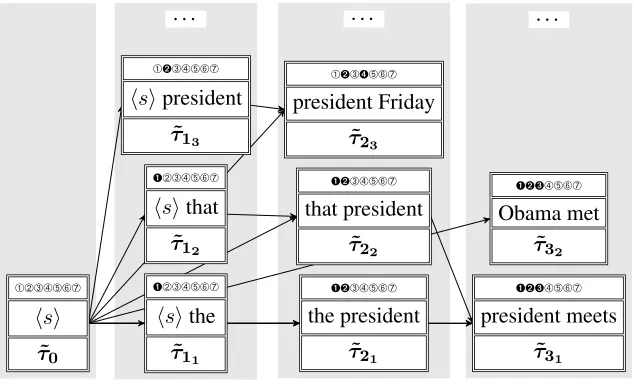
Figure 1: Partial decoding lattice for standard phrase-based decoding stack algorithm translating the German sentence Der Pr¨asident trifft am Freitag den Vorstand. Each node h in decoding stackt represents the application of a translation option, and includes the source sentence coverage vector, target language n-gram state, and syntactic language model state τ˜th. Hypothesis combination is also shown, indicating
where lattice paths with identicaln-gram histories converge. We use the English translationThe president meets the board on Fridayas a running example throughout all Figures.
sentence e, out of all such possible representations
τ. This set of representations may be all phrase structure trees or all dependency trees allowed by the parsing model. Typically, treeˆτ is taken to be:
ˆ
τ = argmax τ
P(τ|e) (1)
We define a syntactic language modelP(e)based on the total probability mass over all possible trees for stringe. This is shown in Equation 2 and decom-posed in Equation 3.
P(e) =X τ∈τ
P(τ,e) (2)
P(e) =X τ∈τ
P(e|τ)P(τ) (3)
3.1 Incremental syntactic language model
An incremental parser processes each token of in-put sequentially from the beginning of a sentence to the end, rather than processing input in a top-down (Earley, 1968) or bottom-up (Cocke and Schwartz, 1970; Kasami, 1965; Younger, 1967) fashion. After
processing the tth token in string e, an incremen-tal parser has some internal representation of possi-ble hypothesized (incomplete) trees,τt. The
syntac-tic language model probability of a partial sentence e1...etis defined:
P(e1...et) =
X
τ∈τt
P(e1...et|τ)P(τ) (4)
In practice, a parser may constrain the set of trees under consideration toτ˜t, that subset of analyses or
partial analyses that remains after any pruning is per-formed. An incremental syntactic language model can then be defined by a probability mass function (Equation 5) and a transition function δ (Equation 6). The role of δ is explained in §3.3 below. Any parser which implements these two functions can serve as a syntactic language model.
P(e1...et)≈P(τ˜t) =
X
τ∈τ˜t
P(e1...et|τ)P(τ) (5)
3.2 Decoding in phrase-based translation
Given a source language input sentencef, a trained source-to-target translation model, and a target lan-guage model, the task of translation is to find the maximally probable translation eˆ using a linear combination of j feature functions h weighted ac-cording to tuned parametersλ(Och and Ney, 2002).
ˆ
e= argmax e
exp(X
j
λjhj(e,f)) (7)
Phrase-based translation constructs a set of trans-lation options — hypothesized transtrans-lations for con-tiguous portions of the source sentence — from a trained phrase table, then incrementally constructs a lattice of partial target translations (Koehn, 2010). To prune the search space, lattice nodes are orga-nized into beam stacks (Jelinek, 1969) according to the number of source words translated. Ann-gram language model history is also maintained at each node in the translation lattice. The search space is further trimmed with hypothesis recombination, which collapses lattice nodes that share a common coverage vector andn-gram state.
3.3 Incorporating a Syntactic Language Model
Phrase-based translation produces target language words in an incremental left-to-right fashion, gen-erating words at the beginning of a translation first and words at the end of a translation last. Similarly, incremental parsers process sentences in an incre-mental fashion, analyzing words at the beginning of a sentence first and words at the end of a sentence last. As such, an incremental parser with transition functionδcan be incorporated into the phrase-based decoding process in a straightforward manner. Each node in the translation lattice is augmented with a syntactic language model stateτ˜t.
The hypothesis at the root of the translation lattice is initialized withτ˜0, representing the internal state
of the incremental parser before any input words are processed. The phrase-based translation decoding process adds nodes to the lattice; each new node contains one or more target language words. Each node contains a backpointer to its parent node, in whichτ˜t−1 is stored. Given a new target language
word et and τ˜t−1, the incremental parser’s
transi-tion functransi-tion δ calculates τ˜t. Figure 1 illustrates
S
NP
DT
The
NN
president
VP
VP
VB
meets
NP
DT
the NN
board PP
IN
on NP
[image:4.612.317.519.63.157.2]Friday
Figure 2: Sample binarized phrase structure tree.
S
S/NP
S/PP
S/VP
NP
NP/NN
DT
The
NN
president
VP
VP/NN
VP/NP
VB
meets DT
the NN
board IN
on NP
Friday
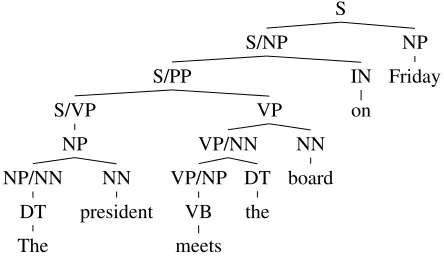
Figure 3: Sample binarized phrase structure tree af-ter application of right-corner transform.
a sample phrase-based decoding lattice where each translation lattice node is augmented with syntactic language model stateτ˜t.
In phrase-based translation, many translation lat-tice nodes represent multi-word target language phrases. For such translation lattice nodes, δ will be called once for each newly hypothesized target language word in the node. Only the final syntac-tic language model state in such sequences need be stored in the translation lattice node.
4 Incremental Bounded-Memory Parsing with a Time Series Model
Having defined the framework by which any in-cremental parser may be incorporated into phrase-based translation, we now formally define a specific incremental parser for use in our experiments.
[image:4.612.315.537.208.338.2]recur-r1t−1
r2t−1
r3t−1
s1t−1
s2t−1
s3t−1
r1t
r2t
r3 t
s1t
s2t
s3t
et−1 et
. . .
. . .
. . .
[image:5.612.81.296.58.187.2]. . .
Figure 4: Graphical representation of the depen-dency structure in a standard Hierarchic Hidden Markov Model with D = 3hidden levels that can be used to parse syntax. Circles denote random vari-ables, and edges denote conditional dependencies. Shaded circles denote variables with observed val-ues.
sive phrase structure trees using the tree transforms in Schuler et al. (2010). Constituent nontermi-nals in right-corner transformed trees take the form of incomplete constituents cη/cηι consisting of an
‘active’ constituent cη lacking an ‘awaited’
con-stituent cηι yet to come, similar to non-constituent
categories in a Combinatory Categorial Grammar (Ades and Steedman, 1982; Steedman, 2000). As an example, the parser might consider VP/NN as a possible category for input “meets the”.
A sample phrase structure tree is shown before and after the right-corner transform in Figures 2 and 3. Our parser operates over a right-corner trans-formed probabilistic context-free grammar (PCFG). Parsing runs in linear time on the length of the input. This model of incremental parsing is implemented as a Hierarchical Hidden Markov Model (HHMM) (Murphy and Paskin, 2001), and is equivalent to a probabilistic pushdown automaton with a bounded pushdown store. The parser runs in O(n) time, wherenis the number of words in the input. This model is shown graphically in Figure 4 and formally defined in§4.1 below.
The incremental parser assigns a probability (Eq. 5) for a partial target language hypothesis, using a bounded store of incomplete constituents cη/cηι.
The phrase-based decoder uses this probability value as the syntactic language model feature score.
4.1 Formal Parsing Model: Scoring Partial Translation Hypotheses
This model is essentially an extension of an HHMM, which obtains a most likely sequence of hidden store states, sˆ1..D
1..T, of some length T and some
maxi-mum depthD, given a sequence of observed tokens (e.g. generated target language words),e1..T, using
HHMM state transition model θA and observation
symbol modelθB(Rabiner, 1990):
ˆ
s1..D1..T def= argmax s1..D
1..T T
Y
t=1
PθA(s
1..D
t |s1..Dt−1 )·PθB(et|s
1..D
t )
(8) The HHMM parser is equivalent to a probabilis-tic pushdown automaton with a bounded push-down store. The model generates each successive store (using store modelθS) only after considering whether each nested sequence of incomplete con-stituents has completed and reduced (using reduc-tion modelθR):
PθA(s
1..D t |s1..Dt−1 )
def =
X
r1
t..rDt D
Y
d=1
PθR(r
d
t|rdt+1sdt−1sd
−1 t−1)
·PθS(s
d
t|rtd+1rtdsdt−1sd
−1
t ) (9)
Store elements are defined to contain only the active (cη) and awaited (cηι) constituent categories
necessary to compute an incomplete constituent probability:
sdtdef=hcη, cηιi (10)
Reduction states are defined to contain only the complete constituent categorycrd
t necessary to
com-pute an inside likelihood probability, as well as a flag frd
t indicating whether a reduction has taken
place (to end a sequence of incomplete constituents):
rdtdef=hcrd
t, frtdi (11)
The model probabilities for these store elements and reduction states can then be defined (from Mur-phy and Paskin 2001) to expand a new incomplete constituent after a reduction has taken place (frd
s11
s21
s3 1
e1
t=1
r12
r2 2
r32 s12
s22
s32
e2
t=2
r13
r2 3
r33 s13
s23
s33
e3
t=3
r41
r2 4
r43 s14
s24
s34
e4
t=4
r51
r2 5
r53 s15
s25
s35
e5
t=5
r16
r2 6
r36 s16
s26
s36
e6
t=6
r17
r2 7
r37 s17
s27
s37
e7
t=7
r18
r2 8
r38 =DT =NP/NN =NP =NN =S/VP =VB =S/VP =VP/NP =DT =VP/NN =S/VP =NN =VP =S/PP =IN =S/NP =S =NP
[image:6.612.74.537.56.212.2]=The =president =meets =the =board =on =Friday
Figure 5: Graphical representation of the Hierarchic Hidden Markov Model after parsing input sentenceThe president meets the board on Friday. The shaded path through the parse lattice illustrates the recognized right-corner tree structure of Figure 3.
if no reduction has taken place (frd
t = 0; using
depth-specific store state transition modelθS-T,d):2
PθS(s
d t|rdt+1r
d
t sdt−1sdt−1) def
=
iffrdt+1= 1, frd
t= 1 :PθS-E,d(s d t|sd
−1 t )
iffrdt+1= 1, frdt= 0 :PθS-T,d(s d
t|rtd+1rdtsdt−1s d−1 t )
iffrdt+1= 0, frd
t= 0 :Js
d t=sdt−1K
(12)
and possibly reduce a store element (terminate a sequence) if the store state below it has re-duced (frdt+1 = 1; using depth-specific reduction
modelθR,d):
PθR(r
d
t|rdt+1sdt−1sd
−1 t−1)
def =
iffrdt+1= 0 :Jr
d t=r⊥K
iffrdt+1= 1 :PθR,d(r d
t|rdt+1sdt−1s d−1 t−1)
(13)
wherer⊥is a null state resulting from the failure of an incomplete constituent to complete, and constants are defined for the edge conditions ofs0
t andrD+1t .
Figure 5 illustrates this model in action.
These pushdown automaton operations are then refined for right-corner parsing (Schuler, 2009), distinguishing active transitions (model θS-T-A,d, in
which an incomplete constituent is completed, but not reduced, and then immediately expanded to a
2An indicator function
J·Kis used to denote deterministic
probabilities:JφK= 1ifφis true,0otherwise.
new incomplete constituent in the same store el-ement) from awaited transitions (model θS-T-W,d,
which involve no completion):
PθS-T,d(s d
t|rtd+1rtdsdt−1sdt−1) def
=
ifrdt6=r⊥:PθS-T-A,d(s d t|sd
−1 t rtd)
ifrd
t=r⊥:PθS-T-W,d(s d
t|sdt−1rdt+1)
(14)
PθR,d(r d
t|rdt+1sdt−1sdt−−11) def
=
ifcrdt+16=xt:Jr
d t=r⊥K
ifcrdt+1=xt:PθR-R,d(r d
t|sdt−1sdt−−11)
(15)
These HHMM right-corner parsing operations are then defined in terms of branch- and depth-specific PCFG probabilitiesθG-R,dandθG-L,d:3
3Model probabilities are also defined in terms of
left-progeny probability distributionEθG-RL∗,dwhich is itself defined in terms of PCFG probabilities:
Eθ G-RL∗,d(cη
0
→cη0...) def
=X cη1
PθG-R,d(cη→cη0cη1) (16)
EθG-RL∗,d(cη k
→cη0k0...) def
=X cη0k
EθG-RL∗,d(cη k−1
→cη0k...)
·X
c η0k1
PθG-L,d(cη0k→cη0k0cη0k1) (17)
EθG-RL∗,d(cη ∗ →cηι...)
def
= ∞
X
k=0
EθG-RL∗,d(cη k
→cηι...) (18)
Eθ G-RL∗,d(cη
+
→cηι...)
def
=Eθ G-RL∗,d(cη
∗ →cηι...)
−EθG-RL∗,d(cη
0
ÊËÌÃÄÅÆ president meets
˜
τ31
. . .
ÊËÌÃÄÏÐ the board
˜
τ51
. . .
s13
s23
s33
e3
r14
r24
r34 s14
s2 4
s34
e4
r51
r52
r53
s15
s2 5
s35
e5
[image:7.612.173.442.70.302.2]=meets =the =board
Figure 6: A hypothesis in the phrase-based decoding lattice from Figure 1 is expanded using translation op-tionthe boardof source phraseden Vorstand. Syntactic language model stateτ˜31 contains random variables
s1..33 ; likewiseτ˜51 containss
1..3
5 . The intervening random variablesr41..3,s1..34 , andr1..35 are calculated by
transition functionδ(Eq. 6, as defined by§4.1), but are not stored. Observed random variables (e3..e5) are
shown for clarity, but are not explicitly stored in any syntactic language model state.
• for expansions:
PθS-E,d(hcηι, c
0
ηιi | h−, cηi) def
=
EθG-RL∗,d(cη
∗
→cηι ...)·Jxηι=c
0
ηι=cηιK (20)
• for awaited transitions:
PθS-T-W,d(hcη, cηι1i | hc
0
η, cηιicηι0) def
=
Jcη=c
0
ηK·
PθG-R,d(cηι →cηι0cηι1)
EθG-RL∗,d(cηι 0
→cηι0 ...)
(21)
• for active transitions:
PθS-T-A,d(hcηι, cηι1i | h−, cηicηι0) def
=
EθG-RL∗,d(cη
∗
→cηι...)·PθG-L,d(cηι →cηι0cηι1)
EθG-RL∗,d(cη +
→cηι0...)
(22)
• for cross-element reductions:
PθR-R,d(cηι,1| h−, cηi hc
0
ηι,−i) def
=
Jcηι=c
0
ηιK·
EθG-RL∗,d(cη 0
→cηι...)
EθG-RL∗,d(cη
∗
→cηι...)
(23)
• for in-element reductions:
PθR-R,d(cηι,0| h−, cηi hc
0
ηι,−i) def
=
Jcηι=c
0
ηιK·
EθG-RL∗,d(cη +
→cηι...)
EθG-RL∗,d(cη
∗
→cηι...)
(24)
We use the parser implementation of (Schuler, 2009; Schuler et al., 2010).
5 Phrase Based Translation with an Incremental Syntactic Language Model
de-coder’s hypothesis stacks. Figure 1 illustrates an ex-cerpt from a standard phrase-based translation lat-tice. Within each decoder stack t, each hypothe-sishis augmented with a syntactic language model state τ˜th. Each syntactic language model state is
a random variable store, containing a slice of ran-dom variables from the HHMM. Specifically, τ˜th
contains those random variabless1..Dt that maintain distributions over syntactic elements.
By maintaining these syntactic random variable stores, each hypothesis has access to the current language model probability for the partial transla-tion ending at that hypothesis, as calculated by an incremental syntactic language model defined by the HHMM. Specifically, the random variable store at hypothesis h provides P(τ˜th) = P(e
h
1..t, s1..D1..t ),
whereeh1..tis the sequence of words in a partial hy-pothesis ending athwhich contains ttarget words, and where there areDsyntactic random variables in each random variable store (Eq. 5).
During stack decoding, the phrase-based decoder progressively constructs new hypotheses by extend-ing existextend-ing hypotheses. New hypotheses are placed in appropriate hypothesis stacks. In the simplest case, a new hypothesis extends an existing sis by exactly one target word. As the new hypothe-sis is constructed by extending an existing stack ele-ment, the store and reduction state random variables are processed, along with the newly hypothesized word. This results in a new store of syntactic ran-dom variables (Eq. 6) that are associated with the new stack element.
When a new hypothesis extends an existing hy-pothesis by more than one word, this process is first carried out for the first new word in the hypothe-sis. It is then repeated for the remaining words in the hypothesis extension. Once the final word in the hypothesis has been processed, the resulting ran-dom variable store is associated with that hypoth-esis. The random variable stores created for the non-final words in the extending hypothesis are dis-carded, and need not be explicitly retained.
Figure 6 illustrates this process, showing how a syntactic language model stateτ˜51in a phrase-based
decoding lattice is obtained from a previous syn-tactic language model stateτ˜31 (from Figure 1) by
parsing the target language words from a phrase-based translation option.
In-domain Out-of-domain LM WSJ 23ppl ur-en devppl
WSJ 1-gram 1973.57 3581.72
WSJ 2-gram 349.18 1312.61
WSJ 3-gram 262.04 1264.47
WSJ 4-gram 244.12 1261.37
WSJ 5-gram 232.08 1261.90
WSJ HHMM 384.66 529.41
Interpolated WSJ
5-gram + HHMM 209.13 225.48
Giga 5-gram 258.35 312.28
Interp. Giga 5-gr
+ WSJ HHMM 222.39 123.10
Interp. Giga 5-gr
[image:8.612.313.548.58.278.2]+ WSJ 5-gram 174.88 321.05
Figure 7: Average per-word perplexity values. HHMM was run with beam size of 2000. Bold in-dicates best single-model results for LMs trained on WSJ sections 2-21. Best overall initalics.
Our syntactic language model is integrated into the current version of Moses (Koehn et al., 2007).
6 Results
As an initial measure to compare language models, average per-word perplexity, ppl, reports how sur-prised a model is by test data. Equation 25 calculates pplusing log basebfor a test set ofT tokens.
ppl=b
−logbP(e1...eT)
T (25)
We trained the syntactic language model from §4 (HHMM) and an interpolated n-gram language model with modified Kneser-Ney smoothing (Chen and Goodman, 1998); models were trained on sec-tions 2-21 of the Wall Street Journal (WSJ) tree-bank (Marcus et al., 1993). The HHMM outper-forms then-gram model in terms of out-of-domain test set perplexity when trained on the same WSJ data; the best perplexity results for in-domain and out-of-domain test sets4 are found by interpolating
4In-domain is WSJ Section 23. Out-of-domain are the
Sentence Moses +HHMM +HHMM
length beam=50 beam=2000
10 0.21 533 1143
20 0.53 1193 2562
30 0.85 1746 3749
40 1.13 2095 4588
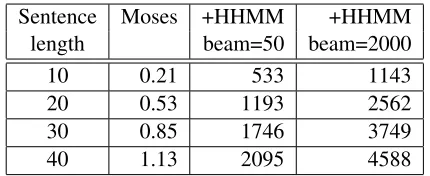
Figure 8: Mean per-sentence decoding time (in sec-onds) for dev set using Moses with and without syn-tactic language model. HHMM parser beam sizes are indicated for the syntactic LM.
HHMM andn-gram LMs (Figure 7). To show the effects of training an LM on more data, we also re-port perplexity results on the 5-gram LM trained for the GALE Arabic-English task using the English Gi-gaword corpus. In all cases, including the HHMM significantly reduces perplexity.
We trained a phrase-based translation model on the full NIST Open MT08 Urdu-English translation model using the full training data. We trained the HHMM andn-gram LMs on the WSJ data in order to make them as similar as possible. During tuning, Moses was first configured to use just the n-gram LM, then configured to use both then-gram LM and the syntactic HHMM LM. MERT consistently as-signed positive weight to the syntactic LM feature, typically slightly less than then-gram LM weight.
In our integration with Moses, incorporating a syntactic language model dramatically slows the de-coding process. Figure 8 illustrates a slowdown around three orders of magnitude. Although speed remains roughly linear to the size of the source sen-tence (ruling out exponential behavior), it is with an extremely large constant time factor. Due to this slowdown, we tuned the parameters using a con-strained dev set (only sentences with 1-20 words), and tested using a constrained devtest set (only sen-tences with 1-20 words). Figure 9 shows a statis-tically significant improvement to the BLEU score when using the HHMM and the n-gram LMs to-gether on this reduced test set.
7 Discussion
This paper argues that incremental syntactic lan-guages models are a straightforward and
[image:9.612.78.293.56.144.2]appro-Moses LM(s) BLEU n-gram only 18.78 HHMM +n-gram 19.78
Figure 9: Results for Ur-En devtest (only sentences with 1-20 words) with HHMM beam size of 2000 and Moses settings of distortion limit 10, stack size 200, and ttable limit 20.
priate algorithmic fit for incorporating syntax into phrase-based statistical machine translation, since both process sentences in an incremental left-to-right fashion. This means incremental syntactic LM scores can be calculated during the decoding pro-cess, rather than waiting until a complete sentence is posited, which is typically necessary in top-down or bottom-up parsing.
We provided a rigorous formal definition of in-cremental syntactic languages models, and detailed what steps are necessary to incorporate such LMs into phrase-based decoding. We integrated an incre-mental syntactic language model into Moses. The translation quality significantly improved on a con-strained task, and the perplexity improvements sug-gest that interpolating betweenn-gram and syntactic LMs may hold promise on larger data sets.
The use of very largen-gram language models is typically a key ingredient in the best-performing ma-chine translation systems (Brants et al., 2007). Our n-gram model trained only on WSJ is admittedly small. Our future work seeks to incorporate large-scalen-gram language models in conjunction with incremental syntactic language models.
The added decoding time cost of our syntactic language model is very high. By increasing the beam size and distortion limit of the baseline sys-tem, future work may examine whether a baseline system with comparable runtimes can achieve com-parable translation quality.
References
Anne Abeill´e, Yves Schabes, and Aravind K. Joshi. 1990. Using lexicalized tree adjoining grammars for machine translation. InProceedings of the 13th Inter-national Conference on Computational Linguistics. Anthony E. Ades and Mark Steedman. 1982. On the
order of words. Linguistics and Philosophy, 4:517– 558.
Kathy Baker, Steven Bethard, Michael Bloodgood, Ralf Brown, Chris Callison-Burch, Glen Coppersmith, Bonnie Dorr, Wes Filardo, Kendall Giles, Anni Irvine, Mike Kayser, Lori Levin, Justin Martineau, Jim May-field, Scott Miller, Aaron Phillips, Andrew Philpot, Christine Piatko, Lane Schwartz, and David Zajic. 2009. Semantically informed machine translation (SIMT). SCALE summer workshop final report, Hu-man Language Technology Center Of Excellence. Alexandra Birch, Miles Osborne, and Philipp Koehn.
2007. CCG supertags in factored statistical machine translation. In Proceedings of the Second Workshop on Statistical Machine Translation, pages 9–16. Thorsten Brants, Ashok C. Popat, Peng Xu, Franz J. Och,
and Jeffrey Dean. 2007. Large language models in machine translation. InProceedings of the 2007 Joint Conference on Empirical Methods in Natural guage Processing and Computational Natural Lan-guage Learning (EMNLP-CoNLL).
Peter Brown, John Cocke, Stephen Della Pietra, Vin-cent Della Pietra, Frederick Jelinek, John Lafferty, Robert Mercer, and Paul Roossin. 1990. A statisti-cal approach to machine translation. Computational Linguistics, 16(2):79–85.
Eugene Charniak, Kevin Knight, and Kenji Yamada. 2003. Syntax-based language models for statistical machine translation. InProceedings of the Ninth Ma-chine Translation Summit of the International Associ-ation for Machine TranslAssoci-ation.
Ciprian Chelba and Frederick Jelinek. 1998. Exploit-ing syntactic structure for language modelExploit-ing. In Pro-ceedings of the 36th Annual Meeting of the Association for Computational Linguistics and 17th International Conference on Computational Linguistics, pages 225– 231.
Ciprian Chelba and Frederick Jelinek. 2000. Structured language modeling. Computer Speech and Language, 14(4):283–332.
Stanley F. Chen and Joshua Goodman. 1998. An empir-ical study of smoothing techniques for language mod-eling. Technical report, Harvard University.
Colin Cherry. 2008. Cohesive phrase-based decoding for statistical machine translation. InProceedings of the 46th Annual Meeting of the Association for Compu-tational Linguistics: Human Language Technologies, pages 72–80.
David Chiang. 2005. A hierarchical phrase-based model for statistical machine translation. InProceedings of the 43rd Annual Meeting of the Association for Com-putational Linguistics, pages 263–270.
David Chiang. 2010. Learning to translate with source and target syntax. InProceedings of the 48th Annual Meeting of the Association for Computational Linguis-tics, pages 1443–1452.
John Cocke and Jacob Schwartz. 1970. Program-ming languages and their compilers. Technical report, Courant Institute of Mathematical Sciences, New York University.
Michael Collins, Brian Roark, and Murat Saraclar. 2005. Discriminative syntactic language modeling for speech recognition. InProceedings of the 43rd Annual Meeting of the Association for Computational Linguis-tics, pages 507–514.
Brooke Cowan, Ivona Ku˘cerov´a, and Michael Collins. 2006. A discriminative model for tree-to-tree trans-lation. In Proceedings of the 2006 Conference on Empirical Methods in Natural Language Processing, pages 232–241.
Steve DeNeefe and Kevin Knight. 2009. Synchronous tree adjoining machine translation. InProceedings of the 2009 Conference on Empirical Methods in Natural Language Processing, pages 727–736.
Steve DeNeefe, Kevin Knight, Wei Wang, and Daniel Marcu. 2007. What can syntax-based MT learn from phrase-based MT? InProceedings of the 2007 Joint Conference on Empirical Methods in Natural guage Processing and Computational Natural Lan-guage Learning (EMNLP-CoNLL), pages 755–763. Yuan Ding and Martha Palmer. 2005. Machine
trans-lation using probabilistic synchronous dependency in-sertion grammars. InProceedings of the 43rd Annual Meeting of the Association for Computational Linguis-tics, pages 541–548.
Jay Earley. 1968. An efficient context-free parsing algo-rithm. Ph.D. thesis, Department of Computer Science, Carnegie Mellon University.
Jason Eisner. 2003. Learning non-isomorphic tree map-pings for machine translation. InThe Companion Vol-ume to the Proceedings of 41st Annual Meeting of the Association for Computational Linguistics, pages 205–208.
Michel Galley and Christopher D. Manning. 2009. Quadratic-time dependency parsing for machine trans-lation. InProceedings of the Joint Conference of the 47th Annual Meeting of the ACL and the 4th Interna-tional Joint Conference on Natural Language Process-ing of the AFNLP, pages 773–781.
Daniel Marcu Susan Dumais and Salim Roukos, edi-tors,Proceedings of the Human Language Technology Conference of the North American Chapter of the As-sociation for Computational Linguistics, pages 273– 280.
Michel Galley, Jonathan Graehl, Kevin Knight, Daniel Marcu, Steve DeNeefe, Wei Wang, and Ignacio Thayer. 2006. Scalable inference and training of context-rich syntactic translation models. In Proceed-ings of the 21st International Conference on Computa-tional Linguistics and 44th Annual Meeting of the As-sociation for Computational Linguistics, pages 961– 968.
Niyu Ge. 2010. A direct syntax-driven reordering model for phrase-based machine translation. InHuman Lan-guage Technologies: The 2010 Annual Conference of the North American Chapter of the Association for Computational Linguistics, pages 849–857.
Daniel Gildea. 2003. Loosely tree-based alignment for machine translation. In Proceedings of the 41st An-nual Meeting of the Association for Computational Linguistics, pages 80–87.
Jonathan Graehl and Kevin Knight. 2004. Training tree transducers. InProceedings of the Human Language Technology Conference of the North American Chap-ter of the Association for Computational Linguistics, pages 105–112.
Hany Hassan, Khalil Sima’an, and Andy Way. 2007. Su-pertagged phrase-based statistical machine translation. InProceedings of the 45th Annual Meeting of the Asso-ciation of Computational Linguistics, pages 288–295. James Henderson. 2004. Lookahead in deterministic
left-corner parsing. In Proceedings of the Workshop on Incremental Parsing: Bringing Engineering and Cognition Together, pages 26–33.
Liang Huang and Haitao Mi. 2010. Efficient incremental decoding for tree-to-string translation. InProceedings of the 2010 Conference on Empirical Methods in Nat-ural Language Processing, pages 273–283.
Liang Huang and Kenji Sagae. 2010. Dynamic program-ming for linear-time incremental parsing. In Proceed-ings of the 48th Annual Meeting of the Association for Computational Linguistics, pages 1077–1086. Liang Huang, Kevin Knight, and Aravind Joshi. 2006.
Statistical syntax-directed translation with extended domain of locality. InProceedings of the 7th Biennial conference of the Association for Machine Translation in the Americas.
Kenji Imamura, Hideo Okuma, Taro Watanabe, and Ei-ichiro Sumita. 2004. Example-based machine transla-tion based on syntactic transfer with statistical models. In Proceedings of the 20th International Conference on Computational Linguistics, pages 99–105.
Frederick Jelinek. 1969. Fast sequential decoding al-gorithm using a stack. IBM Journal of Research and Development, pages 675–685.
T. Kasami. 1965. An efficient recognition and syntax analysis algorithm for context free languages. Techni-cal Report AFCRL-65-758, Air Force Cambridge Re-search Laboratory.
Philipp Koehn, Franz Joseph Och, and Daniel Marcu. 2003. Statistical phrase-based translation. In Proceed-ings of the 2003 Human Language Technology Confer-ence of the North American Chapter of the Association for Computational Linguistics, pages 127–133. Philipp Koehn, Hieu Hoang, Alexandra Birch, Chris
Callison-Burch, Marcello Federico, Nicola Bertoldi, Brooke Cowan, Wade Shen, Christine Moran, Richard Zens, Chris Dyer, Ondrej Bojar, Alexandra Con-stantin, and Evan Herbst. 2007. Moses: Open source toolkit for statistical machine translation. In Proceed-ings of the 45th Annual Meeting of the Association for Computational Linguistics, pages 177–180.
Philipp Koehn. 2010. Statistical Machine Translation. Cambridge University Press.
Yang Liu, Qun Liu, and Shouxun Lin. 2006. Tree-to-string alignment template for statistical machine trans-lation. InProceedings of the 21st International Con-ference on Computational Linguistics and 44th Annual Meeting of the Association for Computational Linguis-tics, pages 609–616.
Yang Liu, Yun Huang, Qun Liu, and Shouxun Lin. 2007. Forest-to-string statistical translation rules. In Pro-ceedings of the 45th Annual Meeting of the Association of Computational Linguistics, pages 704–711. Yang Liu, Yajuan L¨u, and Qun Liu. 2009. Improving
tree-to-tree translation with packed forests. In Pro-ceedings of the Joint Conference of the 47th Annual Meeting of the ACL and the 4th International Joint Conference on Natural Language Processing of the AFNLP, pages 558–566.
Mitchell P. Marcus, Beatrice Santorini, and Mary Ann Marcinkiewicz. 1993. Building a large annotated cor-pus of English: the Penn Treebank. Computational Linguistics, 19(2):313–330.
I. Dan Melamed. 2004. Statistical machine translation by parsing. In Proceedings of the 42nd Meeting of the Association for Computational Linguistics, pages 653–660.
Haitao Mi and Liang Huang. 2008. Forest-based transla-tion rule extractransla-tion. InProceedings of the 2008 Con-ference on Empirical Methods in Natural Language Processing, pages 206–214.
Kevin P. Murphy and Mark A. Paskin. 2001. Linear time inference in hierarchical HMMs. In Proceedings of Neural Information Processing Systems, pages 833– 840.
Rebecca Nesson, Stuart Shieber, and Alexander Rush. 2006. Induction of probabilistic synchronous tree-insertion grammars for machine translation. In Pro-ceedings of the 7th Biennial conference of the Associ-ation for Machine TranslAssoci-ation in the Americas, pages 128–137.
Franz Josef Och and Hermann Ney. 2002. Discrimi-native training and maximum entropy models for sta-tistical machine translation. In Proceedings of 40th Annual Meeting of the Association for Computational Linguistics, pages 295–302.
Franz Josef Och, Daniel Gildea, Sanjeev Khudanpur, Anoop Sarkar, Kenji Yamada, Alex Fraser, Shankar Kumar, Libin Shen, David Smith, Katherine Eng, Viren Jain, Zhen Jin, and Dragomir Radev. 2004. A smorgasbord of features for statistical machine trans-lation. InProceedings of the Human Language Tech-nology Conference of the North American Chapter of the Association for Computational Linguistics, pages 161–168.
Matt Post and Daniel Gildea. 2008. Parsers as language models for statistical machine translation. In Proceed-ings of the Eighth Conference of the Association for Machine Translation in the Americas, pages 172–181. Matt Post and Daniel Gildea. 2009. Language modeling with tree substitution grammars. InNIPS workshop on Grammar Induction, Representation of Language, and Language Learning.
Arjen Poutsma. 1998. Data-oriented translation. In
Ninth Conference of Computational Linguistics in the Netherlands.
Chris Quirk, Arul Menezes, and Colin Cherry. 2005. De-pendency treelet translation: Syntactically informed phrasal SMT. In Proceedings of the 43rd Annual Meeting of the Association for Computational Linguis-tics, pages 271–279.
Lawrence R. Rabiner. 1990. A tutorial on hid-den Markov models and selected applications in speech recognition. Readings in speech recognition, 53(3):267–296.
Brian Roark. 2001. Probabilistic top-down parsing and language modeling. Computational Linguistics, 27(2):249–276.
William Schuler, Samir AbdelRahman, Tim Miller, and Lane Schwartz. 2010. Broad-coverage incremental parsing using human-like memory constraints. Com-putational Linguistics, 36(1):1–30.
William Schuler. 2009. Positive results for parsing with a bounded stack using a model-based right-corner
trans-form. InProceedings of Human Language Technolo-gies: The 2009 Annual Conference of the North Ameri-can Chapter of the Association for Computational Lin-guistics, pages 344–352.
Libin Shen, Jinxi Xu, and Ralph Weischedel. 2008. A new string-to-dependency machine translation algo-rithm with a target dependency language model. In
Proceedings of the 46th Annual Meeting of the Asso-ciation for Computational Linguistics: Human Lan-guage Technologies, pages 577–585.
Stuart M. Shieber and Yves Schabes. 1990. Synchronous tree adjoining grammars. InProceedings of the 13th International Conference on Computational Linguis-tics.
Stuart M. Shieber. 2004. Synchronous grammars as tree transducers. In Proceedings of the Seventh Interna-tional Workshop on Tree Adjoining Grammar and Re-lated Formalisms.
Mark Steedman. 2000. The syntactic process. MIT Press/Bradford Books, Cambridge, MA.
Dekai Wu. 1997. Stochastic inversion transduction grammars and bilingual parsing of parallel corpora.
Computational Linguistics, 23(3):377–403.
Kenji Yamada and Kevin Knight. 2001. A syntax-based statistical translation model. In Proceedings of 39th Annual Meeting of the Association for Computational Linguistics, pages 523–530.
D.H. Younger. 1967. Recognition and parsing of context-free languages in time n cubed. Information and Control, 10(2):189–208.
Min Zhang, Hongfei Jiang, Ai Ti Aw, Jun Sun, Seng Li, and Chew Lim Tan. 2007. A tree-to-tree alignment-based model for statistical machine translation. In
Proceedings of the 11th Machine Translation Summit of the International Association for Machine Transla-tion, pages 535–542.
Andreas Zollmann and Ashish Venugopal. 2006. Syntax augmented machine translation via chart parsing. In